

Germany Flight Management Systems Market Summary
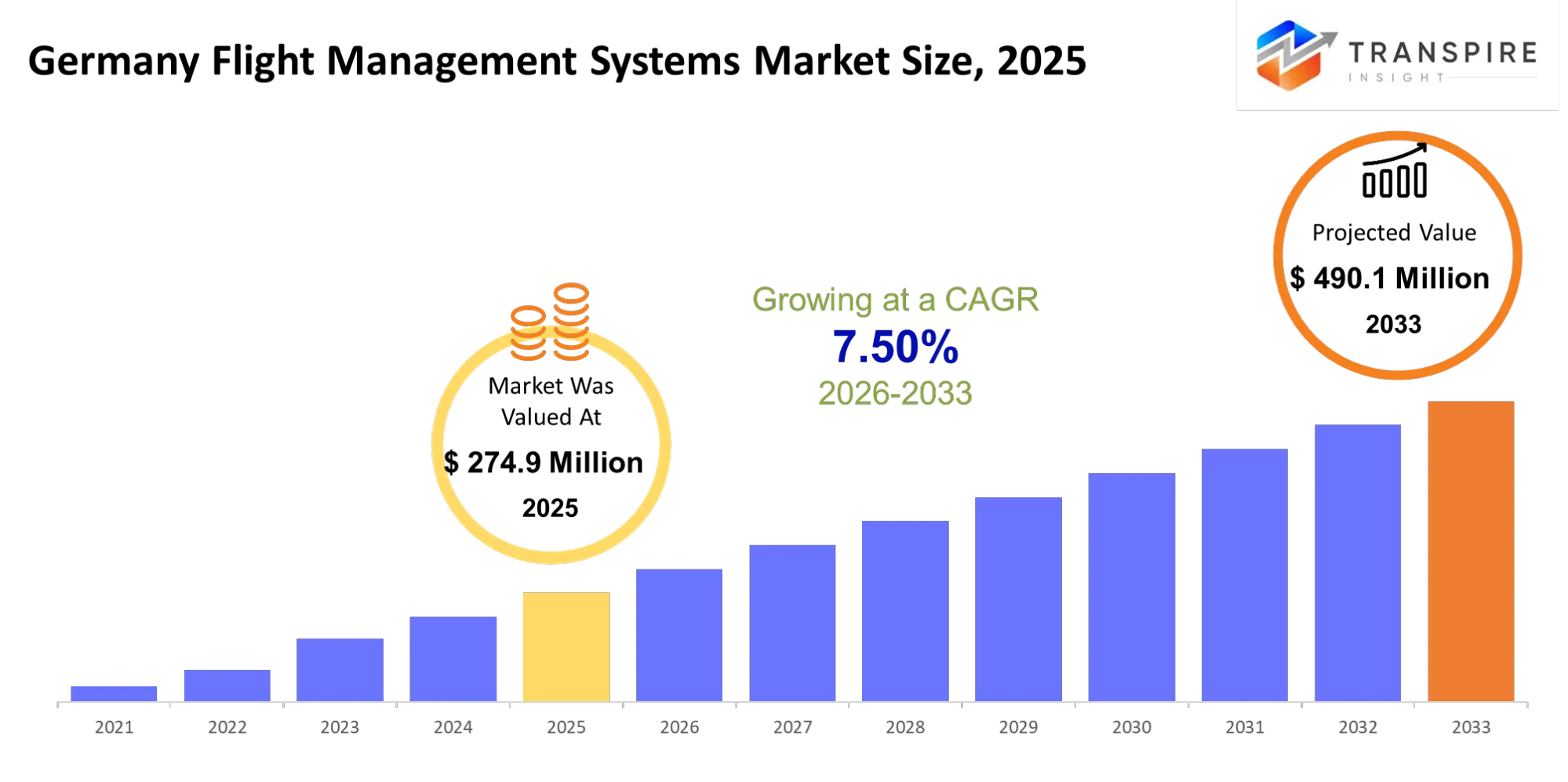
As per Transpire Insight Analysis the Germany Flight Management Systems Market size is estimated at USD 274.9 Million in 2025 and is anticipated to reach USD 490.1 Million by 2033, growing at a CAGR of 7.50% from 2026 to 2033.
The Germany Flight Management Systems Market helps keep aircraft operations safer, smoother, and more automated by pulling together navigation, flight planning, guidance, and performance oversight into one kind of unified cockpit experience. Airlines, corporate aviation operators, defense bodies, and aircraft makers depend on these systems to tune flight trajectories, lessen the pilot’s everyday task load, boost fuel economy, and stay aligned with changing airspace rules. In the past 5 years, it looks like the market moved away from separate, standalone avionics toward more tightly integrated digital flight management platforms. These platforms connect with upgraded navigation tools, richer communication links, and aircraft health monitoring, sort of as one continuous workflow. After COVID-19 disrupted commercial aviation, the rebound, plus Europe’s airspace modernization efforts, and also tougher sustainability targets, has pushed many operators to speed up fleet updates and retrofit cycles. As a result, aircraft operators are now funding next‑generation flight management tools to trim total operating costs, improve route effectiveness, and strengthen day to day operational reliability. That shift is not only widening retrofit opportunities, but also building steady revenue pathways for avionics manufacturers, software developers, and maintenance service providers.
Germany Flight Management Systems Market Size & Forecast:
- Germany Flight Management Systems Market Size 2025: USD 274.9 Million
- Expected Market Value 2033: USD 490.1 Million
- Forecast CAGR: 7.50%
- Leading region in 2025:Southern Germany
- Fastest Growing region:Northern Germany
- Key Profile: Honeywell Aerospace, Collins Aerospace, Thales, Garmin, Lufthansa Technik, Safran Electronics & Defense, GE Aerospace, BAE Systems, Leonardo, Airbus, Boeing, Universal Avionics, Elbit Systems, Indra Sistemas, Cobham Aerospace
Key Market Insights
- In a way, Southern Germany kinda dominates the Germany Flight Management Systems Market around 38% market share in 2025, and this is backed by Airbus facilities, aerospace suppliers , and those broader aviation technology clusters that keep feeding the ecosystem.
- Northern Germany, meanwhile, is projected to be the fastest-growing regional market through 2033, mostly because MRO capabilities are expanding, airports are getting modernized, and digital aviation investments keep ramping up.
- On the component side, Flight Management Computers account for close to 32% of component revenue in 2025, supported by steady avionics replacements and cockpit upgrades that seem to show up every few cycles.
- For the software side, solutions are still the fastest-growing component segment, since airlines roll out navigation updates , cybersecurity improvements, and predictive operational features that help them run things more smoothly.
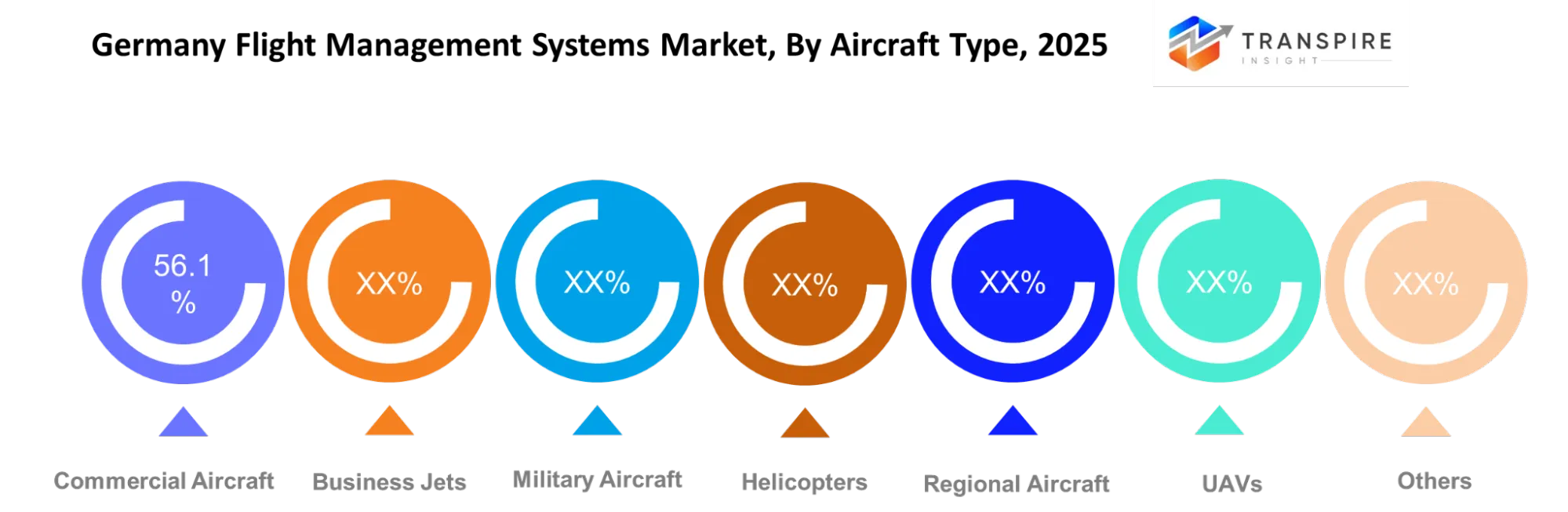
- When it comes to aircraft types, commercial aircraft contribute about 52% of total market revenue, which matches the ongoing fleet renewal and retrofit programs across European operators.
- Military aircraft stay as the second-largest aircraft segment, while UAV applications are expected to grow the quickest during the forecast period, kinda like an acceleration in the background.
- Looking at applications, navigation management represents nearly 34% of the application demand, whereas performance
- mance optimization records the highest growth, mainly due to fuel-saving initiatives. End users wise, airlines generate roughly 49% of revenue, and MRO providers keep pushing further retrofit and avionics upgrade services across older fleets.
- Key players, such as Honeywell Aerospace, Collins Aerospace, Thales, Garmin, Safran Electronics & Defense, and Lufthansa Technik, compete using certified avionics platforms, digital cockpit innovation, strategic partnerships with airlines , and software upgrade roadmaps.
What are the Key Drivers, Restraints, and Opportunities in the Germany Flight Management Systems Market?
Fleet modernization across Germany and wider Europe remains the strongest force supporting market expansion, kind of. European airspace modernization initiatives, performance based navigation requirements, and airline efforts to lower operating costs have pushed investment into advanced flight management platforms. Newer systems can optimize flight trajectories , reduce fuel burn , and lift operational efficiency, all while helping airlines meet more strict environmental objectives. And those measurable economic gains make it easier for customers to justify both fresh aircraft installations and retrofit programs, which then turns into recurring revenue for avionics suppliers as well as software providers.
Aircraft certification requirements and avionics integration complexity keep acting like a brake on quick adoption. Every flight management upgrade has to meet tight aviation safety standards , and it also needs to sit in smoothly with what is already in the cockpit. Certification timelines can stretch over several months or even years, especially for older fleets. High engineering costs plus long approval steps also delay deployment schedules, so manufacturers see fewer short term revenue opportunities, and modernization tends to slow down for smaller operators.
The biggest long term opportunity seems to be digital cockpit modernization, driven by artificial intelligence, satellite based navigation, and connected aircraft technologies. Airlines increasingly want integrated platforms, not just isolated upgrades, that can bundle flight planning, predictive maintenance, weather optimization, and real time operational analytics. Germany, with its solid aerospace manufacturing ecosystem and growing maintenance, repair, and overhaul capabilities, is positioned as a pretty attractive location for developing next generation avionics solutions.
What Has the Impact of Artificial Intelligence Been on the Germany Flight Management Systems Market?
Artificial intelligence is kind of reshaping flight management technologies, by boosting operational efficiency, upping navigation accuracy, and helping with aircraft performance optimization. In practice, modern flight management platforms tend to ingest and analyze weather details, aircraft performance data, airport congestion levels, plus air traffic conditions, then suggest an optimal route or flight path with only minimal pilot involvement , like it’s trying not to bother anyone.
Machine learning algorithms additionally assist predictive maintenance, in a way that spots component degradation before failures actually show up, so maintenance crews can plan repairs during routine service windows instead of dealing with unexpected equipment faults. As a result, aircraft availability improves , maintenance costs are reduced, and airline operations feel more dependable overall.
On top of that, advanced analytics make continuous fuel optimization more feasible, by working out efficient climb profiles, cruise altitudes, and descent paths using real time operational data. Airlines end up gaining lower fuel burn, reduced carbon emissions, better schedule reliability, and also stronger alignment with European environmental objectives. And there’s more, because digital connectivity between flight management systems and airline operational centers supports fleet wide decision making via automated route corrections and ongoing performance monitoring, which sounds simple, but it is actually pretty involved.
Still, AI deployment does not move freely everywhere, because integration costs can be high, certification requirements are complex, and there’s a need for extensive operational validation before safety critical algorithms get approved for commercial aviation. Plus, limited interoperability across older aircraft fleets slows wider adoption, especially for operators who still maintain older avionics architectures , even if their systems already work “fine” on paper.
Key Market Trends
- Since 2021 airlines have kind of shifted away from standalone navigation gear, toward integrated flight management platforms—so now there is real time route optimization and smoother cockpit operations, more or less.
- Performance based navigation has been picking up pace across European airspace, which pushes operators to refresh certified flight management software for better routing precision, and also for fuel savings.
- Retrofit programs are expanding pretty steadily too, as carriers stretch aircraft service life and keep the airframe, while adding modern avionics instead of swapping whole fleets out.
- Honeywell Aerospace, Collins Aerospace, Thales, and Garmin have ramped up investment in modular software architectures. These make upgrades simpler, and they cut down aircraft downtime, especially during maintenance windows.
- More and more aircraft operators are using cloud connected flight planning tools. The idea is to sync operational data between flight crews, dispatch centers, and maintenance teams, nearly in real time.
- Also artificial intelligence is showing up more often in predictive maintenance. So maintenance teams can often spot avionics issues before they become operational disruptions.
- Since 2022 cybersecurity expectations have gotten stronger, which means manufacturers now integrate secure software updates, plus enhanced data protection, into these flight management platforms.
- On the military side, aviation programs have accelerated procurement of advanced navigation and mission management capabilities. That creates new chances for multi role flight management technologies.
- Business aviation operators are also leaning more toward touchscreen enabled control display units and “intuitive cockpit” interfaces, because it lowers pilot workload during complicated flight operations.
Germany Flight Management Systems Market Segmentation
By Component
Flight Management Computers hold the biggest share since these units do the route calculating, aircraft capability handling, and navigation processing during basically every phase of flight, so yeah they matter a lot. Control Display Units still stay critical too because they give pilots an easy, almost natural way to enter flight plans and keep an eye on operational information as things progress. Navigation Databases help make routing more precise, through regularly refreshed airspace, aerodrome, and procedure details. Software keeps getting more attention as operators roll out advanced flight preparation functions, cybersecurity protections, and performance optimization features.
Sensors, Communication Interfaces, and some other parts support the whole arrangement by feeding aircraft location, altitude, speed, weather, and communications data into the flight management platform. Better sensor precision makes navigation work more smoothly, while modern communication interfaces allow a more seamless linking with air traffic management systems and connected aircraft solutions. Ongoing software updates, along with modular system designs, are raising the compatibility across both fresh aircraft and retrofit installs. Strong funding for integrated avionics will keep fueling innovation across each component category.
By Aircraft Type
Commercial Aircraft generate the largest revenue— mostly because airlines keep investing in fleet modernization, operational efficiency, and yes meeting European aviation standards, even when timelines slip a bit. Business Jets also add a lot, corporate operators are looking for advanced navigation capabilities and, somehow lower operating costs, which helps budgets feel less strained. Military Aircraft remain a major segment too, since defense modernization programs demand highly dependable mission navigation and flight control technologies that don’t waver. Helicopters support specialized duties like emergency medical services, search-and-rescue operations, and offshore transportation, which is kind of a broad mix but it all fits.
Regional Aircraft still move toward advanced flight management systems, to boost operational efficiency on shorter routes where every minute matters. UAVs are probably the fastest-growing aircraft category, because autonomous operations, surveillance missions and commercial drone applications are becoming more sophisticated over time. Other specialized aircraft contribute as well, through tailored avionics installations designed for unique operational needs, not just generic setups. With continued aircraft modernization across both civil and defense sectors, demand should stay steady across every aircraft category, regardless of which one you look at first.
By Application
Navigation Management kind of leads the whole application scene because accurate routing is really the main job in pretty much every flight management platform, even when people say otherwise. Flight Planning also counts a lot since it assists operators to streamline routes before takeoff, and that can cut down operational costs while raising schedule consistency, not just in theory but in daily use. Performance Optimization has been getting more attention lately as airlines push for lower fuel burn and better aircraft efficiency. Fuel Management keeps growing too, mostly with automated calculations that back up economical flight operations.
Route Optimization and Guidance & Control are gaining more momentum due to satellite based navigation and digital air traffic management technologies. These features help pilots adapt faster to weather shifts, airspace limitations, and operational disruptions, all while keeping the aircraft safe and performing within bounds. There are other niche applications as well like mission planning, military operations, and customized navigation functions for business aviation. On top of that, the ongoing integration between onboard avionics and ground operations systems will keep widening the mix of available applications, bit by bit.
By End User
Airlines account for the largest share, mostly because commercial fleet operators need continual flight management upgrades, to boost operational efficiency, cut fuel burn, and keep regulatory compliance in good standing. Aircraft OEMs are also a major customer group , since they embed advanced flight management systems inside freshly built aircraft. Defense Organizations still put money into mission-capable navigation technologies that back military modernization and day to day operational readiness. Business Aviation Operators are leaning more and more toward digital cockpit technologies, to strengthen safety and also operational flexibility.
MRO Providers have become pretty crucial as retrofit work keeps expanding across older commercial and business aircraft fleets. Maintenance organizations carry out software upgrades, install certified avionics packages, and swap replacement hardware, which extends aircraft service life while also lifting navigation performance. Other end users cover government agencies and specialized aviation service providers, and they often want tailored flight management solutions. As fleet modernization continues, long term opportunities should show up across every end user segment.
By Installation
Line Fit installations sort of dominate, because most aircraft manufacturers integrate certified flight management systems during production, so everything stays compatible with complete avionics architectures by the time delivery happens. And yes, OEM Installation also helps with advanced cockpit technologies that are built for new-generation aircraft, the ones entering both commercial and defense fleets. These factory-installed solutions make certification easier, while still offering operators the newest navigation and operational capabilities.
Retrofit installations keep expanding too, mainly as airlines stretch the aircraft service life by doing avionics modernization instead of swapping out full fleets. The Aftermarket backs that shift by delivering software upgrades, replacement hardware, certified maintenance services, plus system enhancements that support better aircraft performance over the whole operational life. Other installation approaches show up for specialized aircraft, where customized integration is needed based on mission requirements, or on legacy cockpit configurations. Overall, the growing retrofit investment should stay a key driver for long-term market expansion.
What are the Key Use Cases Driving the Germany Flight Management Systems Market?
Commercial airline operations are, well, probably the biggest use case, because flight management systems are constantly trying to optimize navigation, flight planning and fuel consumption during almost every part of the journey. Airlines depend on these platforms to figure out more efficient routes, enable performance based navigation and keep schedules more dependable while still staying in line with European airspace regulations. So basically that mix of operational efficiency ,and lower operating costs is what drives the most investment.
Then there is business aviation and military aviation, which are turning into serious secondary applications. Corporate aircraft operators are starting to use enhanced flight management capabilities to get more route flexibility, lessen pilot workload, and cut down the time needed before departure or even just preflight. On the other hand defense organizations are embedding these systems into mission aircraft, in order to support precision navigation, tactical flight planning, and secure operational execution across lots of different mission profiles.
Looking ahead, emerging applications are forming around unmanned aerial vehicles and connected aircraft ecosystems. More and more, advanced flight management platforms are supporting autonomous route determination, real time data exchange and even digital air traffic integration. As artificial intelligence develops further, and satellite based communication keeps maturing, these types of applications should open up new chances for avionics suppliers and software developers during the forecast period.
|
Report Metrics |
Details |
|
Market size value in 2025 |
USD 274.9 Million |
|
Market size value in 2026 |
USD 295.5 Million |
|
Revenue forecast in 2033 |
USD 490.1 Million |
|
Growth rate |
CAGR of 7.50% from 2026 to 2033 |
|
Base year |
2025 |
|
Historical data |
2021 - 2024 |
|
Forecast period |
2026 - 2033 |
|
Report coverage |
Revenue forecast, competitive landscape, growth factors, and trends |
|
Regional scope |
Germany |
|
Key company profiled |
Honeywell Aerospace, Collins Aerospace, Thales, Garmin, Lufthansa Technik, Safran Electronics & Defense, GE Aerospace, BAE Systems, Leonardo, Airbus, Boeing, Universal Avionics, Elbit Systems, Indra Sistemas, Cobham Aerospace |
|
Customization scope |
Free report customization (country, regional & segment scope). Avail customized purchase options to meet your exact research needs. |
|
Report Segmentation |
By Component (Flight Management Computers, Control Display Units, Navigation Databases, Software, Sensors, Communication Interfaces, Others); By Aircraft Type (Commercial Aircraft, Business Jets, Military Aircraft, Helicopters, Regional Aircraft, UAVs, Others); By Application (Navigation Management, Flight Planning, Performance Optimization, Fuel Management, Route Optimization, Guidance & Control, Others); By End User (Airlines, Aircraft OEMs, Defense Organizations, Business Aviation Operators, MRO Providers, Others); By Installation (Line Fit, Retrofit, Aftermarket, OEM Installation, Others) |
Which Regions are Driving the Germany Flight Management Systems Market Growth?
Southern Germany keeps being the leading regional market, because it has big aerospace manufacturing facilities, aircraft engineering centers, and this pretty dense web of avionics suppliers. There is also strong teamwork between aircraft manufacturers, research institutions, and aviation technology firms, which helps with constant innovation, and product certification too. On top of that, major airports plus maintenance facilities also pull more money into advanced cockpit modernization programs. So yeah, this already well-set aerospace ecosystem makes it easier for the region to stay on top, in both production, and tech development.
Western Germany shows up as the second-largest regional contributor mostly due to its solid industrial foundation, a wide range of airline operations, and older but very capable maintenance repair, and overhaul infrastructure. Here the pattern is a bit different than Southern Germany, with growth coming less from aircraft manufacturing, and more from fleet support services, retrofit activity, and day to day commercial aviation operations. Airlines keep putting resources into certified avionics upgrades, to raise operational efficiency , and also to keep meeting changing European aviation requirements. With steady economic conditions and longer-term aviation funding, the demand stays fairly consistent for both commercial aviation, and business aviation segments.
Northern Germany is expected to see the fastest growth during 2026–2033, since aerospace investment keeps expanding around Hamburg and the nearby aviation clusters. The region has been building momentum through new aircraft production efforts, digital aviation technologies, and improved maintenance capabilities, which basically boosts competitiveness. At the same time, airport modernization initiatives, and the wider use of connected aircraft technologies, are opening extra doors for avionics suppliers and software developers.
Who are the Key Players in the Germany Flight Management Systems Market and How Do They Compete?
In the Germany Flight Management Systems Market, competition feels moderately consolidated, but the big global avionics players still push hard, mainly via technology innovation, deep certification know-how, careful software integration, and really long-term customer support. In the day to day, product reliability stays huge , plus compliance with international aviation standards, and also fit with both newer airframes and older legacy aircraft. On top of that, companies often lean into digital cockpit capabilities, predictive maintenance features , and integrated navigation systems that basically help operators run with better efficiency.
Honeywell Aerospace keeps strengthening its position using integrated flight management platforms , where navigation and performance optimization are tied together, plus connected aircraft functions. They keep rolling out ongoing software improvements , and because the platform works across several aircraft types, they can serve commercial as well as defense customers without too much friction. Collins Aerospace goes another route by emphasizing modular avionics architectures, which makes upgrades less painful and also supports future digital cockpit expansion. That approach makes retrofit programs seem more attractive for airlines as well as business aviation operators, not just one side.
Thales stands out with more advanced navigation technologies, and also with cybersecurity integration, and they’re pretty active in European aviation modernization efforts. Garmin, meanwhile, competes by offering cockpit interfaces that are easy to read, plus very reliable flight management solutions aimed at business aviation and regional aircraft, with a clear focus on operational simplicity and cost-friendly deployment. Lufthansa Technik is also expanding its footprint through certified retrofit initiatives, avionics integration services, and long-term maintenance backing, so operators can modernize existing fleets without always needing to replace entire aircraft.
Company List
- Honeywell Aerospace
- Collins Aerospace
- Thales
- Garmin
- Lufthansa Technik
- Safran Electronics & Defense
- GE Aerospace
- BAE Systems
- Leonardo
- Airbus
- Boeing
- Universal Avionics
- Elbit Systems
- Indra Sistemas
- Cobham Aerospace
Recent Development News
In January 2025, Honeywell Aerospace and NXP Semiconductors expanded their strategic partnership to accelerate next-generation aviation technologies. The collaboration integrates Honeywell Anthem with NXP's high-performance processors to support AI-enabled flight management, cloud-connected cockpits, and autonomous flight capabilities, strengthening future avionics innovation.https://www.honeywell.com
In May 2025, Honeywell Aerospace and Vertical Aerospace signed an expanded long-term partnership to support certification of the VX4 eVTOL aircraft. The agreement covers Honeywell Anthem flight deck technology, aircraft management systems, and fly-by-wire controls, reinforcing Honeywell's position in advanced flight management solutions.https://www.honeywellaerospace.com
In June 2025, Honeywell announced that Southwest Airlines selected SmartRunway and SmartLanding software for fleetwide installation. The deployment enhances runway awareness and cockpit decision support while demonstrating continued investment in advanced flight management and operational safety technologies across commercial aviation.https://www.honeywell.com
What Strategic Insights Define the Future of the Germany Flight Management Systems Market?
Germany Flight Management Systems Market is drifting toward very tightly connected, software focused avionics platforms that blend artificial intelligence, cloud connectivity, satellite guided navigation and predictive analytics into one kind of unified flight management environment. The main reason behind this shift is that the aviation industry keeps trying to cut down operating costs while still having to satisfy more strict European airspace rules, safety expectations, and environmental targets. Also as airlines stretch the aircraft useful lifespan via retrofits, it is becoming pretty clear that software upgrades will bring more of the market value than plain hardware swapping, even if the hardware still matters of course.
There is another risk people often overlook, which is the increasing reliance on intricate semiconductor supply chains, plus certified software development timelines. If avionics certification gets delayed, or if critical electronic components get stuck in shortages, aircraft deliveries and retrofit plans could slide out, and that would then shrink near term revenue opportunities. On the opportunity side, something interesting is forming around integrated flight management platforms for advanced air mobility aircraft, unmanned aviation, and connected cockpit ecosystems. Players in the market should push for modular and easily upgradeable architectures, with built in cybersecurity as well as artificial intelligence functions, and they should keep strengthening partnerships with aircraft manufacturers, airlines and maintenance providers. That way they can lock in longer term contracts and more predictable recurring software revenue, instead of only one time system sales.
Germany Flight Management Systems Market Report Segmentation
By Component
• Flight Management Computers
• Control Display Units
• Navigation Databases
• Software
• Sensors
• Communication Interfaces
• Others
By Aircraft Type
• Commercial Aircraft
• Business Jets
• Military Aircraft
• Helicopters
• Regional Aircraft
• UAVs
• Others
By Application
• Navigation Management
• Flight Planning
• Performance Optimization
• Fuel Management
• Route Optimization
• Guidance & Control
• Others
By End User
• Airlines
• Aircraft OEMs
• Defense Organizations
• Business Aviation Operators
• MRO Providers
• Others
By Installation
• Line Fit
• Retrofit
• Aftermarket
• OEM Installation
• Others
Frequently Asked Questions
Find quick answers to common questions.
The expected Germany Flight Management Systems Market size for the market will be USD 490.1 Million in 2033.
Key segments for the Germany Flight Management Systems Market are By Component (Flight Management Computers, Control Display Units, Navigation Databases, Software, Sensors, Communication Interfaces, Others); By Aircraft Type (Commercial Aircraft, Business Jets, Military Aircraft, Helicopters, Regional Aircraft, UAVs, Others); By Application (Navigation Management, Flight Planning, Performance Optimization, Fuel Management, Route Optimization, Guidance & Control, Others); By End User (Airlines, Aircraft OEMs, Defense Organizations, Business Aviation Operators, MRO Providers, Others); By Installation (Line Fit, Retrofit, Aftermarket, OEM Installation, Others).
Major Germany Flight Management Systems Market players are Honeywell Aerospace, Collins Aerospace, Thales, Garmin, Lufthansa Technik, Safran Electronics & Defense, GE Aerospace, BAE Systems, Leonardo, Airbus, Boeing, Universal Avionics, Elbit Systems, Indra Sistemas, Cobham Aerospace.
The Germany Flight Management Systems Market size is USD 274.9 Million in 2025.
The Germany Flight Management Systems Market CAGR is 7.50% from 2026 to 2033.
- Honeywell Aerospace
- Collins Aerospace
- Thales
- Garmin
- Lufthansa Technik
- Safran Electronics & Defense
- GE Aerospace
- BAE Systems
- Leonardo
- Airbus
- Boeing
- Universal Avionics
- Elbit Systems
- Indra Sistemas
- Cobham Aerospace
About the Authors

Tejashri Dhatrak
I am Tejashri Dhatrak, a Senior Research Analyst at Transpire Insight, specializing in the Aerospace and Defence sector. My work focuses on analyzing industry trends, defence technologies, market developments, and emerging innovations that shape the global aerospace and security landscape. At Transpire Insight, I research complex topics, evaluate credible sources, and transform technical insights into accurate, well-structured, and easy-to-understand content for industry professionals and decision-makers. My goal is to provide reliable, research-backed information that helps readers stay informed about defence capabilities, aerospace advancements, strategic developments, and the evolving dynamics of the global defence ecosystem.

Chakradhar Khansole
Chakradhar serves as the Research Director at Transpire Insight, bringing over 8 years of experience in technology, innovation, and strategic market intelligence. He specializes in transforming complex market data into actionable business insights that enable organizations to make informed, growth-oriented decisions. Recognized for his strategic vision and analytical expertise, Chakradhar leads high-impact research initiatives, delivering comprehensive market assessments, competitive intelligence, and forward-looking industry analysis.
Recently Published Reports
-
Apr 2026
Aerospace Fluoropolymers Market
Aerospace Fluoropolymers Market Size, Share & Analysis Report By Type (PTFE, FEP, PFA, ETFE, and Others), By Application (Electrical Insulation, Seals & Gaskets, Coatings, and Others), By End User (Commercial Aviation, Military Aviation, General Aviation, and Others), and Geography (North America, Europe, Asia-Pacific, Middle East and Africa, South and Central America), 2021 - 2031
-
Apr 2026
Airborne SATCOM System Market
Airborne SATCOM System Market Size, Share & Analysis Report By Type (SATCOM Terminals, Transceivers, Airborne Radio, Modems and Routers, SATCOM Radomes, and Other), By Application (Government and Defense and Commercial), and Geography (North America, Europe, Asia-Pacific, Middle East and Africa, South and Central America), 2021 – 2031
-
Apr 2026
Ship Leasing Market
Ship Leasing Market Size, Share & Analysis Report By Vessel Type (Container Ships, Bulk Carriers, Tankers, and Specialized Vessels), By Lease Duration (Short-Term Lease (Less than 1 year), Medium-Term Lease (1-5 years), and Long-Term Lease (More than 5 years)), By Lease Type (Bareboat Charter, Time Charter, Financial Lease, and Others), By End-User Industry (Oil and Gas, Manufacturing and Industrial, Automotive, Agriculture and Food, Retail and Consumer Goods, and Others), and Geography (North America, Europe, Asia-Pacific, Middle East and Africa, South and Central America), 2021 – 2031
-
Apr 2026
Thread Rolling Dies Market
Thread Rolling Dies Market Size, Share & Analysis Report By Type (Flat Thread Rolling Dies, Circular (Cylindrical) Dies, Tangential Thread Rolling Dies, Planetary Thread Rolling Dies, and Other Types), By Material Type (High-Speed Steel (HSS), Carbide, Tool Steel, Alloy Steel, and Other Specialized Alloys), By Distribution Channel (Direct Sales, Distributors and Dealers, and Online Platforms), By Application (Automotive Industry, Aerospace and Defense, Construction and Infrastructure, Industrial Machinery, Electronics and Electrical Components, Medical Devices, and Fastener Production), and Geography (North America, Europe, Asia-Pacific, Middle East and Africa, South and Central America), 2021 – 2031
Our Clients





