
Germany Car GPS Navigation Systems Market Summary
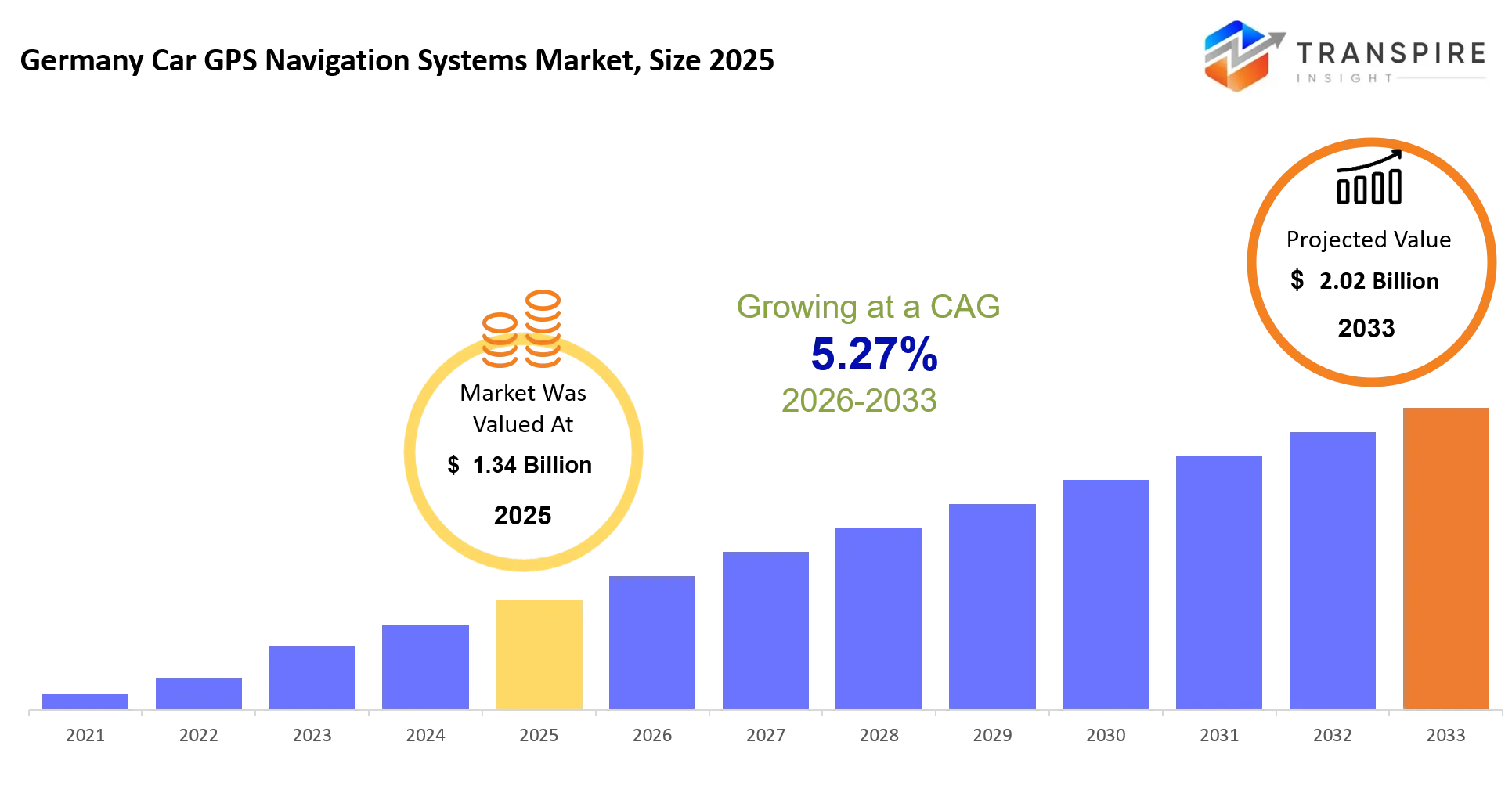
As per Transpire Insight Analysis, the Germany Car GPS Navigation Systems Market size is estimated at USD 1.34 Billion in 2025 and is anticipated to reach USD 2.02 Billion by 2033, growing at a CAGR of 5.27% from 2026 to 2033.
The Germany Car GPS Navigation Systems Market is a bit of a key deal for drivers, because it helps people get to their destinations more efficiently, not just by “maps” but also through route planning, traffic management, and driving safety, a lot of which happens in real time. Today’s navigation platforms typically include live traffic refreshes, lane guidance, connected vehicle features, and location-based functions that can cut down on delays and even help optimize fuel use for both private drivers and commercial fleets. In the last five years the market has kinda moved away from standalone navigation devices, and more toward cloud-connected and AI-enabled embedded systems that sit inside digital cockpit setups. At the same time, the global semiconductor shortage after COVID-19 did a temporary number on car production, so manufacturers had to rethink their supply chains and push faster toward software-first vehicle development. And as vehicle connectivity and advanced driver assistance features become normal on new models, automakers keep embedding intelligent navigation solutions, which then generate recurring software revenue, improve the overall customer experience, and help support steady long-term growth across Germany’s automotive scene.
Germany Car GPS Navigation Systems Market Size & Forecast:
- Germany Car GPS Navigation Systems Market Size 2025: USD 1.34 Billion
- Expected Market Value 2033: USD 2.02 Billion
- Forecast CAGR: 5.27%
- Key Profile: Garmin, TomTom, Bosch, Continental, HERE Technologies, Denso, Pioneer, Alpine, Harman International, Mitsubishi Electric, Panasonic Automotive, Qualcomm, Google, Apple, Visteon
Key Market Insights
- The Germany Car GPS Navigation Systems Market keeps expanding, kinda steadily, because connected vehicles are becoming the norm and AI- powered navigation plus software-defined automotive platforms are getting baked into both passenger models and commercial fleets.
- Market watchers project growth from USD 1.34 billion in 2025 up to about USD 2.02 billion by 2033, mainly pushed by more embedded navigation being installed, and by heavier digital mobility investments, across the ecosystem.
- Regional Outlook: In 2025, Southern Germany looks like the main hub, with an estimated 38% market share, supported by those automotive manufacturing clusters that keep getting stronger. Meanwhile Eastern Germany is expected to post the quickest growth pace through 2033, as adoption ripples outward.
- Product Trends: Built-in navigation systems still lead, holding roughly 42% of the market. Smartphone-based navigation lands in second place, and AI navigation systems are forecast to show the fastest expansion from 2026 to 2033, more or less as “smarter route guidance” becomes common.
- Application Trends: Personal navigation contributes around 48% of overall industry revenue. Fleet management applications are also expanding quickly, especially as logistics companies move toward digitized vehicle operations, and streamline everything from dispatch to tracking.
- End-User Trends: Individual consumers are almost 52% of all demand , and fleet operators seem to be the quickest-growing customer segment, mostly due to continuous connected fleet investments.
- Competitive Landscape: Garmin, HERE Technologies, Bosch, Continental, TomTom and Qualcomm keep improving their relative standing through AI-driven navigation, high definition mapping, cloud based connectivity, strategic collaborations and ongoing vehicle software innovation .
What are the Key Drivers, Restraints, and Opportunities in the Germany Car GPS Navigation Systems Market?
The strongest growth driver is this fast shift toward connected, and then software-defined vehicles. European vehicle safety regulations, the ongoing spread of advanced driver assistance systems, and the steady rise in electric vehicle production have pushed automotive makers to add intelligent navigation right into their infotainment platforms. Now embedded navigation kind of does predictive routing, flags charging station locations, and handles over-the-air software updates, so there is a recurring software revenue stream, beyond the first time the vehicle is sold. Automotive OEMs are starting to treat navigation more like a digital service, not just some separate hardware item, which in turn helps them protect long term market value.
The biggest structural hassle is still the competition from free smartphone navigation apps. Services like Google Maps and Apple Maps keep getting better at routing precision, traffic intelligence, and the whole user experience without any need for dedicated navigation hardware. A lot of consumers feel smartphone navigation is enough for daily driving, so demand for portable navigation devices tends to cool down. Meanwhile, putting embedded navigation into today’s vehicle architecture takes serious spending on software development, cybersecurity, and cloud infrastructure. That pushes adoption out, especially for cost-sensitive vehicle categories.
AI-powered navigation, when it’s integrated with connected mobility ecosystems, looks like the most solid long-term opportunity. High-definition mapping, vehicle-to-cloud communication, predictive traffic analytics, and electric vehicle route optimization are opening new monetization routes for software providers and automotive suppliers.
What Has the Impact of Artificial Intelligence Been on the Germany Car GPS Navigation Systems Market?
Artificial intelligence has, sort of, transformed automotive navigation from fixed route guidance into a more adaptive decision-support system, not that it was simple before. AI algorithms keep analyzing historical traffic patterns alongside live congestion information, weather conditions, road work updates, and also driver behavior, to suggest routes that are faster or somehow more efficient. Machine learning models get better at estimating arrival times by processing millions of location data points, then they dynamically rework the route whenever the traffic situation shifts. Cloud connected navigation platforms can even automate map updates, so maintenance costs go down while routing accuracy improves.
More advanced digital technologies also help with predictive stuff that supports electric vehicle charging routes, gently steering drivers toward more fuel efficient highways, and tying navigation together with advanced driver assistance systems. Fleet operators, especially, depend on AI powered navigation to follow vehicle utilization, reshape dispatch timing, cut down idle moments, and raise fuel efficiency during everyday commercial operations. In general, all these functions lift operational productivity while bringing transportation costs down, and yes, improving customer service too.
Still, even with all that, AI adoption runs into a few limits. When companies bring artificial intelligence into automotive software stacks it takes serious investment, like cloud infrastructure, cybersecurity, high definition mapping, and constant data validation. Also, navigation can get less accurate in areas with spotty connectivity, or if the mapping data is only partially complete, so organizations have to keep paying for updates until truly autonomous navigation rolls out more widely.
Key Market Trends
- From 2021 to 2025, embedded navigation adoption really started to speed up, as connected vehicle production rolled out more widely across Germany’s automotive manufacturing ecosystem. It felt like once the supply chain caught up, everything else followed, and yes, the growth was noticeable even in plants that used to move slower.
- AI driven routing then gradually pushed out static navigation, not by force but by layering multiple inputs together with live traffic feeds, weather data, and even driver behavior patterns, which helped keep trips more efficient than before, most of the time. In a lot of cases, the system just “learned the rhythm” a bit.
- After 2023, over-the-air software updates turned into a routine capability, and that meant fewer dealership visits. At the same time navigation databases stayed current through continuous updates , rather than waiting for manual refreshes.
- As electric vehicle adoption increased, navigation providers had to adapt. Charging station availability became part of the experience , plus battery optimization and predictive route planning were blended into connected platforms, so the route wasn’t only about distance but also energy management.
- Companies like Garmin, HERE Technologies, Bosch, Continental, and Qualcomm expanded partnerships with automotive manufacturers too. The goal was to strengthen digital cockpit functionality and improve HD mapping solutions, basically making the in car experience feel more consistent.
- Cloud based navigation services also gained traction because subscription models created ongoing software revenue beyond the initial vehicle purchase. So the revenue loop wasn’t just one time, it kept flowing.
- Logistics companies started investing more in intelligent fleet navigation after 2022, which improved route optimization, delivery scheduling, and fuel efficiency across commercial transport. That operational edge mattered , especially when margins tightened.
- Meanwhile smartphone integration evolved from simple connectivity into full ecosystem support. Android Automotive and Apple CarPlay, along with cloud based navigation platforms, made it easier for drivers to keep using familiar apps without friction.
- On the security side, automotive cybersecurity became a bigger priority once connected vehicle adoption accelerated. That focus helped protect navigation software and also the underlying vehicle data from emerging risks.
- And then AI assisted predictive routing showed up as a real differentiator. Instead of reacting when congestion already formed, platforms could recommend alternative routes ahead of time, sort of preemptively, before the slowdown fully developed.
Germany Car GPS Navigation Systems Market Segmentation
By Product Type
Built in navigation systems still take the biggest share, because car makers are more and more folding navigation right into their infotainment platforms while the vehicle is being produced. At the same time, smartphone based navigation is becoming a real alternative, mostly thanks to Android Auto and Apple CarPlay compatibility. Portable navigation devices keep a steady pull too, especially with owners of older vehicles, plus commercial drivers who prefer a dedicated navigation unit rather than depending on the phone. Head up display navigation is also getting more popular in higher end cars, since it puts route guidance straight in the drivers view, like in front of you rather than down on the dashboard.
For fleet navigation systems, logistics firms use them for route optimization, driver monitoring and vehicle tracking, which tends to lower operating costs. AI navigation systems are probably the fastest growing group, since machine learning keeps improving traffic prediction, route planning, and even personalized guidance suggestions. There are also other options, like motorcycle, recreational vehicle and specialty navigation products, built for particular transport needs, sort of niche requirements that standard units may not cover as well.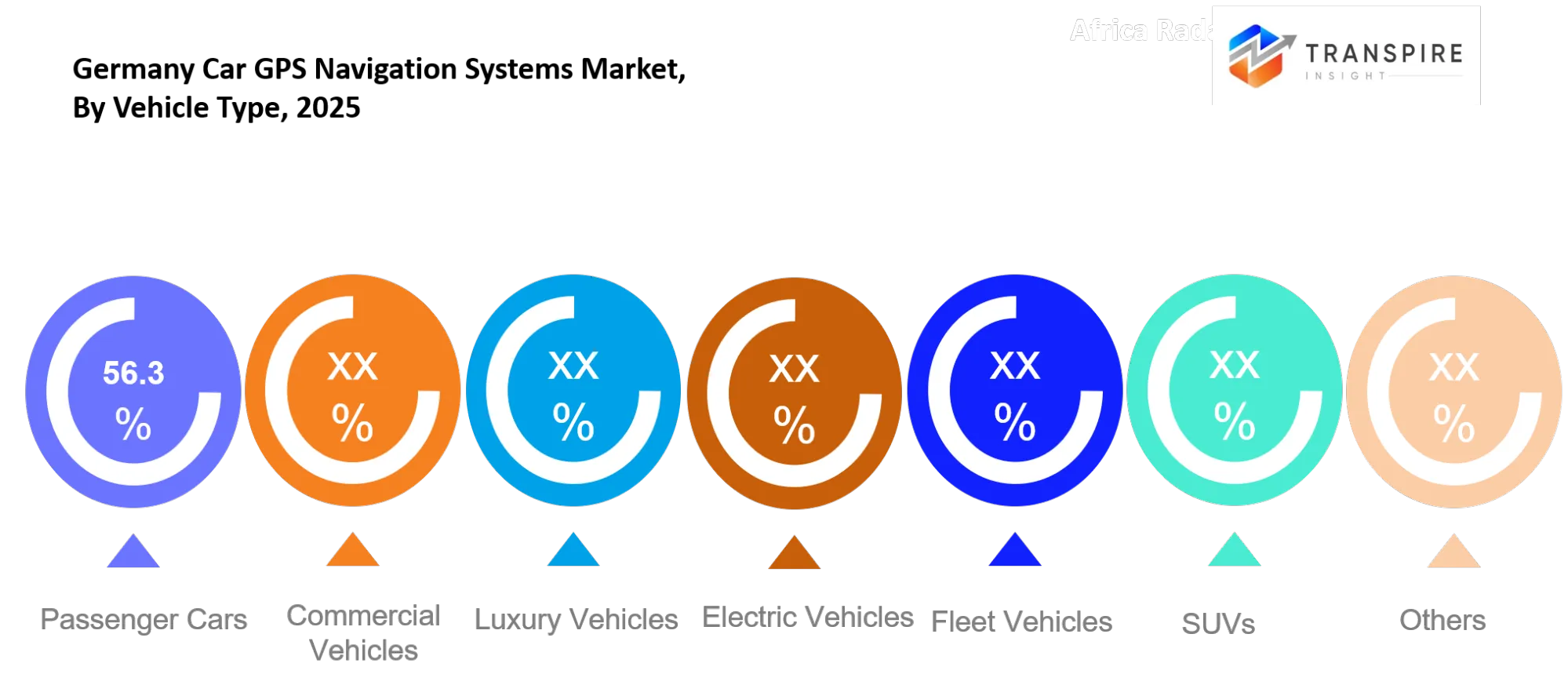
By Vehicle Type
Passenger Cars end up bringing in the highest revenue, mostly because factory installed navigation systems have been showing up more and more across mid-range plus premium models. SUVs stay in the second slot too, you know, as connected infotainment tools become normal for both family types and utility focused vehicles. Commercial Vehicles keep pushing forward as fleet digitalization and logistics optimization programs keep rolling , these efforts also lean on more advanced route handling.
Luxury Vehicles tend to use the nicer kind of navigation, think augmented reality wayfinding, high-definition cartography, and AI supported driving help. Electric Vehicles look especially promising ahead, since the navigation software can figure out charging stop patterns and battery saving routes. Fleet Vehicles count on connected navigation for dispatch optimization, while Others is basically a mix, like specialty machines, emergency fleets, and even recreational transportation use cases.
By Technology
GPS is still the main positioning tool because it has wide infrastructure support, and navigation accuracy stays reliable across Germany. GNSS boosts the precision by pulling in signals from multiple satellite systems, so overall guidance becomes more dependable, even in dense city areas. Real-Time Traffic Navigation has turned into a standard thing via ongoing traffic tracking and automatic route changes.
AI-Based Navigation helps with driving efficiency by picking up travel patterns and anticipating congestion early, before delays actually show up. Cloud Navigation offers frequent software refreshes , it syncs user preferences and keeps connected vehicle services running without you doing manual steps. Offline Navigation is also useful when network coverage is weak, and the Others category covers hybrid positioning approaches and sensor-assisted navigation platforms.
By Application
Personal Navigation ends up taking the biggest chunk, mostly because everyday commuting , plus business trips and even leisure movement all rely on right-time guidance that feels accurate enough. Fleet Management has been growing pretty steadily too, as transportation businesses roll in connected vehicle platforms that help them plan routes better, cut down fuel usage and boost driver productivity. Logistics companies are also bringing intelligent navigation right into supply chain operations, so delivery accuracy gets better and scheduling efficiency improves , kind of in tandem.
Ride-Hailing platforms rely on exact route finding and arrival estimates, that’s what lifts the passenger experience. Emergency Services on the other hand really need dependable navigation, since faster response time matters during medical calls , police incidents and disaster management. Tourism apps help travelers with destination direction and nearby local details , while Others cover things like agriculture, construction, and niche industrial transportation.
By End User
Individual Consumers show up as the biggest customer group, mainly because navigation now counts as a key, kind of essential feature in day to day personal transportation and in general connected vehicle ownership. Fleet Operators are still pouring money into intelligent navigation platforms , aiming for better delivery efficiency, lower day-to-day operating expenses, and more consistent vehicle performance monitoring across huge transportation networks. Automotive OEMs bring in advanced navigation software to help them stand out, and also to back software based business models.
Rental Companies are increasingly turning on connected navigation systems, so customers get more convenience, and so fleet management stays easier across many sites. Government Agencies use navigation technologies for public transit routing , emergency response coordination, and municipal fleet operations too. And then there are Others , such as educational institutions, research organizations, plus specialized commercial users, who adopt customized navigation solutions that match their needs.
What are the Key Use Cases Driving the Germany Car GPS Navigation Systems Market?
Personal navigation still seems to be the biggest use case , mainly because those integrated and connected navigation systems help drivers pick efficient routes, steer away from congestion, and get real time traffic updates. Passenger cars make up the largest share of deployments too, since automotive makers keep slipping in embedded navigation platforms with live map updates and digital cockpit type integration.
Fleet management and logistics are growing the fastest, or at least thats what most operators report. Commercial vehicle owners , ride-hailing providers, and logistics companies use intelligent navigation to squeeze delivery timing, keep an eye on vehicle movement, trim fuel consumption and generally boost fleet utilization. Even rental vehicle operators go for connected navigation , partly to make customer experience easier, and partly for better vehicle tracking.
Newer use cases are also popping up , like AI assisted route planning for electric vehicles, or navigation that sits alongside advanced driver assistance systems. Meanwhile smart city mobility platforms and autonomous vehicle testing programs are opening doors for high definition mapping, predictive traffic analytics, and vehicle to cloud communication. That kind of setup should support the next stage of navigation technology development across Germany .
|
Report Metrics |
Details |
|
Market size value in 2025 |
USD 1.34 Billion |
|
Market size value in 2026 |
USD 1.41 Billion |
|
Revenue forecast in 2033 |
USD 2.02 Billion |
|
Growth rate |
CAGR of 5.27% from 2026 to 2033 |
|
Base year |
2025 |
|
Historical data |
2021 - 2024 |
|
Forecast period |
2026 - 2033 |
|
Report coverage |
Revenue forecast, competitive landscape, growth factors, and trends |
|
Regional scope |
Germany |
|
Key company profiled |
Garmin, TomTom, Bosch, Continental, HERE Technologies, Denso, Pioneer, Alpine, Harman International, Mitsubishi Electric, Panasonic Automotive, Qualcomm, Google, Apple, Visteon |
|
Customization scope |
Free report customization (country, regional & segment scope). Avail customized purchase options to meet your exact research needs. |
|
Report Segmentation |
By Product Type (Built-in Navigation Systems, Portable Navigation Devices, Smartphone-Based Navigation, Head-Up Display Navigation, Fleet Navigation Systems, AI Navigation Systems, Others); By Vehicle Type (Passenger Cars, SUVs, Commercial Vehicles, Luxury Vehicles, Electric Vehicles, Fleet Vehicles, Others); By Technology (GPS, GNSS, Real-Time Traffic Navigation, AI-Based Navigation, Cloud Navigation, Offline Navigation, Others); By Application (Personal Navigation, Fleet Management, Logistics, Ride-Hailing, Emergency Services, Tourism, Others); By End User (Individual Consumers, Fleet Operators, Automotive OEMs, Rental Companies, Government Agencies, Others) |
Which Regions are Driving the Germany Car GPS Navigation Systems Market Growth?
Southern Germany is still leading the market , i mean kind of, because the area has big automotive manufacturing hubs, research facilities, and also a lot of technology suppliers. Bavaria and Baden-Württemberg keep demand strong , thanks to the premium vehicle manufacturers there plus automotive electronics companies that are always pushing newer solutions. Also the ongoing push for connected vehicle technologies helps embed navigation related features into new vehicle platforms, pretty broadly. With a mature supplier ecosystem, advanced testing sites, and solid engineering know how, the region just stays in front, more or less.
Western Germany comes in as the second-largest regional market, but the growth path looks a bit different. It’s more tied to steady industrial activity and commercial transportation routes. North Rhine-Westphalia backs consistent adoption because logistics operators, fleet owners, and corporate vehicle users need advanced navigation, and fleet optimization, not only navigation in general. With solid digital infrastructure and steady spending on intelligent transportation systems, the market keeps expanding in a dependable way. Plus, long standing automotive suppliers keep helping roll out these technologies across both passenger vehicles and commercial ones.
Eastern Germany is forecast to see the quickest growth from 2026 to 2033. The rise is linked to expansion in electric vehicle manufacturing, more money for smart mobility infrastructure, and modernization of regional transport networks that in turn boosts connected navigation uptake. Public and private investments into digital infrastructure are still making the conditions better for automotive software deployment.
Who are the Key Players in the Germany Car GPS Navigation Systems Market and How Do They Compete?
Competition still looks, moderately consolidated, with suppliers of long lived automotive technology and global navigation software firms going after each other mostly via innovation, not just price. These days, winning feels more like it comes down to software prowess, plus artificial intelligence, cloud connectivity, high resolution mapping, and that smooth-fit integration with the car’s infotainment, you know. Automotive OEM partnerships have basically turned into the main edge, since manufacturers want ongoing software ecosystems rather than standalone navigation products that sit there quietly.
Bosch and Continental push their positions forward by tying navigation software into advanced driver assistance systems, digital cockpit environments, and connected vehicle capabilities. HERE Technologies sets itself apart with high definition mapping, cloud hosted location services, and automotive grade navigation frameworks that show up across multiple vehicle makers. Garmin keeps expanding past portable devices, working on connected in vehicle navigation and fleet management solutions for commercial transport.
TomTom leans hard on real time traffic intelligence, cloud native mapping, and software defined vehicle platforms, mainly via partnerships with major automotive manufacturers worldwide. Qualcomm blends automotive processors with AI enabled navigation features, aiming for connected digital cockpits and next generation infotainment systems. Google and Apple keep tightening ecosystem integration through Android Automotive, Android Auto, Apple CarPlay, cloud services, and AI powered navigation, which nudges automakers to ship digital mobility experiences that get updated, basically continuously.
Company List
• Garmin
• TomTom
• Bosch
• Continental
• HERE Technologies
• Denso
• Pioneer
• Alpine
• Harman International
• Mitsubishi Electric
• Panasonic Automotive
• Qualcomm
• Google
• Apple
• Visteon
Recent Development News
In April 2026, HERE Technologies entered a strategic partnership with KOTEI to co-develop AI-native navigation solutions for software-defined vehicles. The collaboration combines HERE's mapping platform with KOTEI's automotive AI software to deliver predictive, intelligent in-vehicle navigation and accelerate next-generation connected mobility.https://www.here.com
In January 2026, Garmin expanded its collaboration with Qualcomm by introducing the Nexus automotive-grade High Performance Compute platform. The solution, powered by the Snapdragon Elite Platform for automotive, strengthens AI-enabled digital cockpits, navigation, ADAS, and software-defined vehicle capabilities for future production programs.https://www.garmin.com
In January 2026, TomTom and Visteon announced a strategic partnership to integrate TomTom's Automotive Navigation Application with Visteon's cognitoAI™ platform. The partnership enables privacy-first onboard conversational AI navigation that operates in both online and offline modes, improving driver experience and intelligent cockpit functionality.https://www.tomtom.com
What Strategic Insights Define the Future of the Germany Car GPS Navigation Systems Market?
The market is moving toward software-defined mobility, where navigation functions will end up inside integrated digital vehicle platforms rather than being treated like standalone hardware products. Artificial intelligence , cloud connectivity, over-the-air software updates, and electric vehicle ecosystem integration will start reshaping revenue models , mostly by turning things into recurring subscription income plus value-added digital services. Navigation providers that blend mapping, predictive analytics, and connected vehicle intelligence should end up with stronger competitive positioning over the next five to seven years.
There s also a less obvious risk, it comes from an increasing dependence on just a few global software ecosystem providers. Once cloud platforms and smartphone operating systems get more control over vehicle navigation, automotive suppliers might run into pricing pressure and, at the same time lose some control over customer relationships. On the other side, an emerging chance is AI-powered predictive routing that s tailored for electric vehicles, autonomous driving, and smart city infrastructure. Companies should really make partnerships with automotive OEMs a priority, while investing in high-definition mapping, cybersecurity , and cloud-native software architecture, to secure a longer-term competitive edge.
Germany Car GPS Navigation Systems Market Report Segmentation
By Product Type
• Built-in Navigation Systems
• Portable Navigation Devices
• Smartphone-Based Navigation
• Head-Up Display Navigation
• Fleet Navigation Systems
• AI Navigation Systems
• Others
By Vehicle Type
• Passenger Cars
• SUVs
• Commercial Vehicles
• Luxury Vehicles
• Electric Vehicles
• Fleet Vehicles
• Others
By Technology
• GPS
• GNSS
• Real-Time Traffic Navigation
• AI-Based Navigation
• Cloud Navigation
• Offline Navigation
• Others
By Application
• Personal Navigation
• Fleet Management
• Logistics
• Ride-Hailing
• Emergency Services
• Tourism
• Others
By End User
• Individual Consumers
• Fleet Operators
• Automotive OEMs
• Rental Companies
• Government Agencies
• Others
Frequently Asked Questions
Find quick answers to common questions.
The Expected Germany Car GPS Navigation Systems Market size for the Market will be USD 2.02 Billion in 2033.
Key segments for the Germany Car GPS Navigation Systems Market are By Product Type (Built-in Navigation Systems, Portable Navigation Devices, Smartphone-Based Navigation, Head-Up Display Navigation, Fleet Navigation Systems, AI Navigation Systems, Others); By Vehicle Type (Passenger Cars, SUVs, Commercial Vehicles, Luxury Vehicles, Electric Vehicles, Fleet Vehicles, Others); By Technology (GPS, GNSS, Real-Time Traffic Navigation, AI-Based Navigation, Cloud Navigation, Offline Navigation, Others); By Application (Personal Navigation, Fleet Management, Logistics, Ride-Hailing, Emergency Services, Tourism, Others); By End User (Individual Consumers, Fleet Operators, Automotive OEMs, Rental Companies, Government Agencies, Others).
Major Germany Car GPS Navigation Systems Market players are Garmin, TomTom, Bosch, Continental, HERE Technologies, Denso, Pioneer, Alpine, Harman International, Mitsubishi Electric, Panasonic Automotive, Qualcomm, Google, Apple, Visteon
The Current Germany Car GPS Navigation Systems Market size is USD 1.34 Billion in 2025.
The Germany Car GPS Navigation Systems Market CAGR is 5.27% from 2026 to 2033.
• Garmin
• TomTom
• Bosch
• Continental
• HERE Technologies
• Denso
• Pioneer
• Alpine
• Harman International
• Mitsubishi Electric
• Panasonic Automotive
• Qualcomm
• Google
• Apple
• Visteon
About the Authors

Mayur Shinde
I am Mayur Shinde, a Senior Research Analyst at Transpire Insight, specializing in the Automotive & Transportation and Information & Communication Technology (ICT) Industry. My work focuses on analyzing emerging market trends, technological advancements, competitive landscapes, and industry developments to deliver accurate, data-driven insights. I am passionate about transforming complex market information into clear, actionable content that helps businesses, professionals, and decision-makers stay informed and make confident strategic decisions.

Chakradhar Khansole
Chakradhar serves as the Research Director at Transpire Insight, bringing over 8 years of experience in technology, innovation, and strategic market intelligence. He specializes in transforming complex market data into actionable business insights that enable organizations to make informed, growth-oriented decisions. Recognized for his strategic vision and analytical expertise, Chakradhar leads high-impact research initiatives, delivering comprehensive market assessments, competitive intelligence, and forward-looking industry analysis.
Recently Published Reports
-
Apr 2026
ATV & UTV Market
ATV & UTV Market Size, Share & Analysis Report By Type (ATV, and UTV), By Variants (Less Than 400 CC, 400 CC To 800 CC, and More Than 800 CC), and Geography (North America, Europe, Asia-Pacific, Middle East and Africa, South and Central America), 2021 - 2031
-
Apr 2026
Automotive Central Gateway Module Market
Automotive Central Gateway Module Market Size, Share & Analysis Report By Type (Ethernet Central Gateway Module, CAN Central Gateway Module, LIN Central Gateway Module, and FlexRay), By Application (Powertrain Control, Body Control, Infotainment System, Advanced Driver Assistance Systems (ADAS), and Others), By End User (Passenger Vehicles, and Commercial Vehicles), and Geography (North America, Europe, Asia-Pacific, Middle East and Africa, South and Central America), 2021 - 2031
-
Apr 2026
Automotive Engine Oil Filter Market
Automotive Engine Oil Filter Market Size, Share & Analysis Report By Filter Type (Fuel Filter, Engine Oil Filter, Hydraulic Oil Filter, and Others), By Filter Media (Cellulose, Synthetic, and Micro), By Sales Channel (OEMs, and Aftermarket), By Vehicle Type (Passenger Cars, Light Commercial Vehicles, Heavy Duty Trucks, Buses and Coaches, and Off-road Vehicles), and Geography (North America, Europe, Asia-Pacific, Middle East and Africa, South and Central America), 2021 - 2031
-
Apr 2026
Automotive Parts Aluminium Die Casting Market
Automotive Parts Aluminium Die Casting Market Size, Share & Analysis Report By Production Process (Pressure Die Casting, Vacuum Die Casting, Squeeze Die Casting, Gravity Die Casting), By Application (Body Parts, Engine Parts, Transmission Parts, Battery And Related Components, Other Application Types), and Geography (North America, Europe, Asia-Pacific, Middle East and Africa, South and Central America), 2021 - 2031
Our Clients



