
South Korea Infotainment Navigation and Telematics Market Size & Forecast:
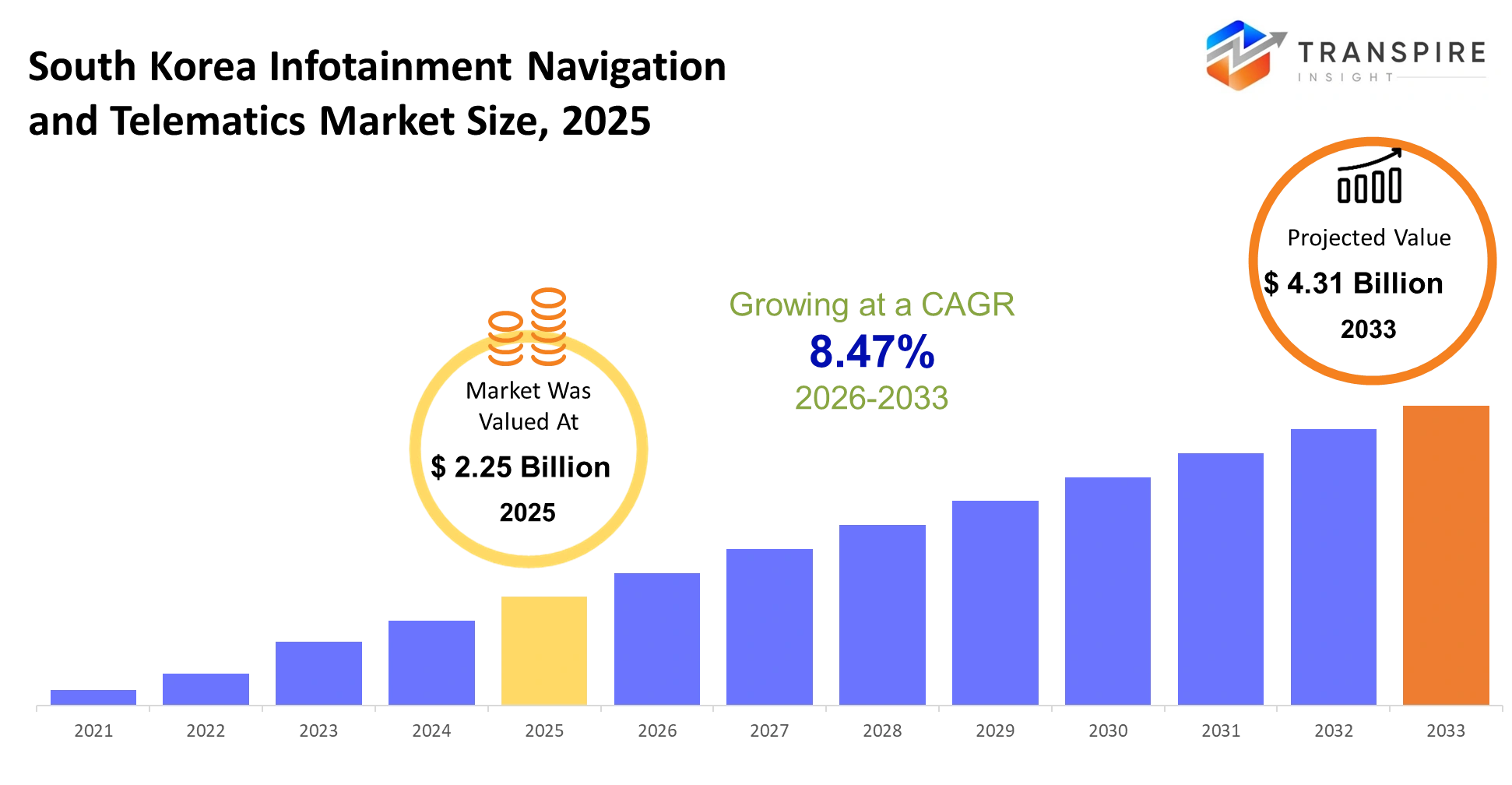
- South Korea Infotainment Navigation and Telematics Market Size 2025: USD 2.25 Billion
- South Korea Infotainment Navigation and Telematics Market Size 2033: USD 4.31 Billion
- South Korea Infotainment Navigation and Telematics Market CAGR: 8.47%
- South Korea Infotainment Navigation and Telematics Market Segments: By Component (Infotainment Systems, Navigation Systems, Telematics Control Units, Connectivity Modules, Others); By Vehicle Type (Passenger Cars, Commercial Vehicles, Electric Vehicles, Luxury Vehicles, Others); By Technology (Connected Car Technology, AI-based Navigation, 5G-enabled Telematics, Cloud-based Infotainment, Others); By Application (Fleet Management, Real-time Navigation, In-car Entertainment, Vehicle Diagnostics, Others); By End User (OEMs, Fleet Operators, Aftermarket Suppliers, Others)
To learn more about this report,  Download Free Sample Report
South Korea Infotainment Navigation and Telematics Market Summary
The South Korea Infotainment Navigation and Telematics Market was valued at USD 2.25 Billion in 2025. It is forecast to reach USD 4.31 Billion by 2033. That is a CAGR of 8.47% over the period.
In South Korea, infotainment navigation and telematics systems kind of act as the digital coordination layer inside vehicles, blending real-time navigation, driver assistance, diagnostics and connectivity services, for private rides and also commercial fleet operations. Over the last five years, the market has moved away from hardware-first head units, towards software-defined connected platforms, enabled by over the air updates, 5G connectivity, and cloud-based telematics ecosystems.
This change has made fixed in-vehicle systems a lot less central , and it also lets automakers and mobility providers earn money from steady feature upgrades, which helps lifecycle revenue, and gives users more tailored personalization. A big push, or maybe you could call it a trigger, was the post-pandemic semiconductor shortage , mixed with tighter South Korean safety and emissions regulations, and that combo forced manufacturers to rethink their supply chains and focus more on software-led vehicle intelligence. So now, demand is more and more concentrated among OEMs and fleet operators looking for an integrated telematics setup for efficiency, predictive maintenance, and data-driven mobility services, rather than just standalone navigation tools.
Key Market Insights
- Busan and Ulsan regions are showing what looks like the fastest growth, kinda pushed by logistics digitization and smart port mobility stuff across 2025–2030.
- Meanwhile the nationwide expansion of connected vehicle infrastructure is helping adoption go well beyond the metropolitan hubs in the South Korea Infotainment Navigation and Telematics Market.
- In-vehicle infotainment systems still take the lead in the market share because OEM integration is strong across passenger cars and commercial vehicles, not just one lane.
- Navigation solutions sit in the second-largest segment, mainly fueled by real-time traffic optimization and the rising pull for smart routing.
- And for the fastest-growing segment, telematics services are the one to watch as predictive maintenance and fleet analytics keep gaining traction, even when budgets are tight.
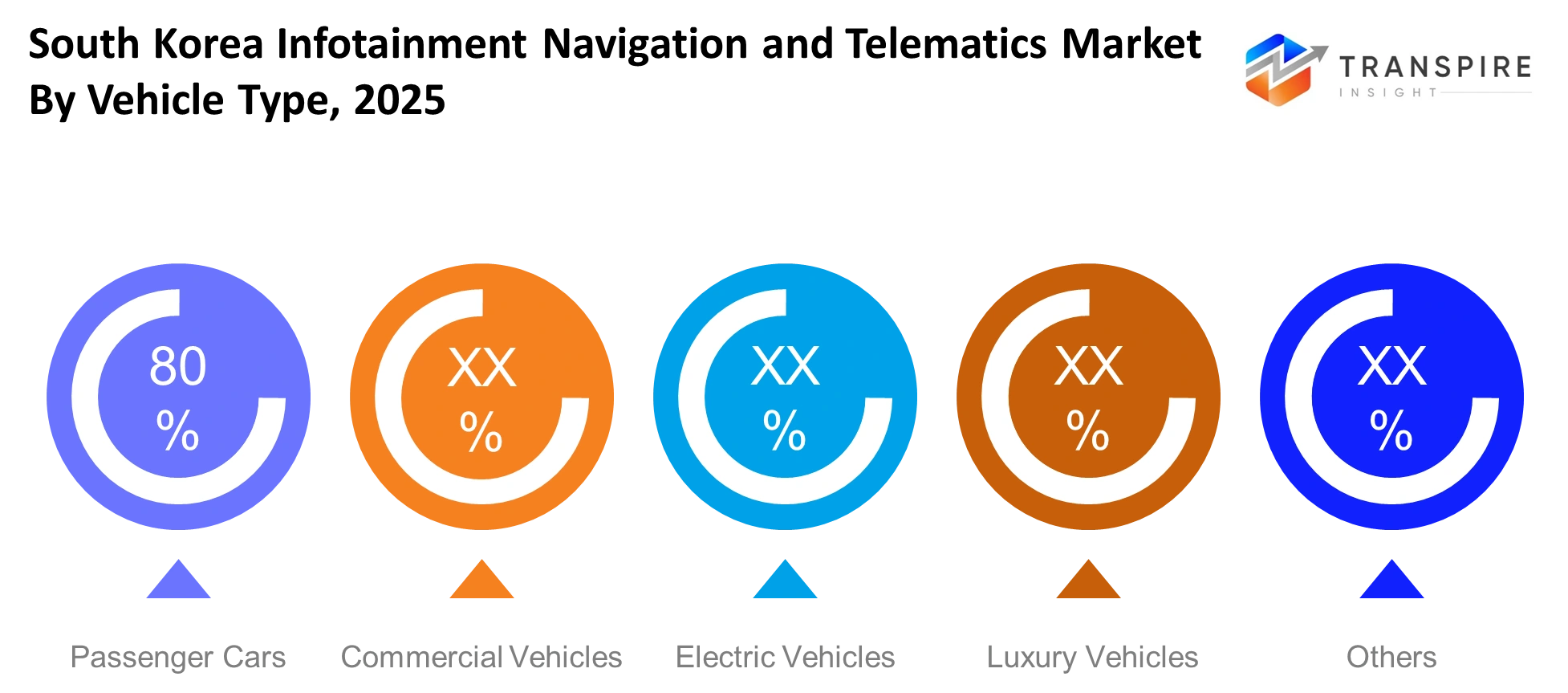
- Passenger vehicles kinda dominate the South Korea Infotainment Navigation and Telematics Market, taking up close to 60% share because OEM integration is widespread, and people also want that consumer connectivity thing.
- Fleet management applications show up as the fastest growing part, spurred by the growth of e-commerce logistics and the push for real time route optimization, not just “nice to have” navigation.
- Automotive OEMs lead the South Korea Infotainment Navigation and Telematics Market, backed by big deployments of embedded infotainment plus telematics systems in new vehicles, across lots of models.
- Commercial fleet operators are viewed as the fastest-growing end user group, mainly using data driven analytics for fuel efficiency , predictive maintenance and operational cost cutting.
- Ride hailing and shared mobility providers are also moving faster, adopting more advanced telematics platforms to support real time tracking, dynamic routing, and a smoother passenger experience in practice, not only in theory.
What are the Key Drivers, Restraints, and Opportunities in the South Korea Infotainment Navigation and Telematics Market?
The primary driver is this rapid shift toward software-defined, and connected vehicles that are basically pushed along by 5G infrastructure plus cloud-native automotive platforms. It kind of got triggered when automakers started treating connectivity as a baseline feature, not really as a premium add-on, and this happened particularly after regulators tightened things around road safety and vehicle diagnostics. So now, infotainment and telematics systems are generating recurring revenue via subscription-based services, over-the-air updates, and data-driven mobility apps, which in turn expands OEM revenue per vehicle by a lot.
The most significant restraint is the fragmented integration ecosystem between older automotive hardware and newer digital platforms. A lot of mid-tier suppliers still depend on proprietary systems that don’t interoperate cleanly with cloud and AI-based telematics architectures. That structural mismatch keeps raising integration costs, slows down deployment schedules, and reduces scalability, especially for smaller OEMs and for fleet operators in general. It also holds back short-term revenue realization because upgrades often force partial hardware replacement, instead of a smooth software migration, you know.
A key opportunity is starting to show up through AI-powered predictive mobility services, especially around logistics hubs like Busan’s smart port initiatives. Some companies that blend real-time traffic analytics with fleet telematics are already cutting delivery delays, and also lowering fuel consumption. This mix of AI, IoT sensors, and port digitization might unlock the next growth phase for the South Korea Infotainment Navigation and Telematics Market, overall.
What Has the Impact of Artificial Intelligence Been on the South Korea Infotainment Navigation and Telematics Market?
Artificial intelligence and newer digital systems are, kind of transforming the way navigation, in-car infotainment, and telematics platforms run across South Korea’s connected mobility plus maritime-connected ecosystems, particularly when it comes to fleet and vessel management.
From the automation side, AI is more and more being built right into scrubber performance units and exhaust gas cleaning technology, so it can keep track of emission levels, fuel sulfur content, and overall system efficiency continuously, you know without someone constantly stepping in. These intelligent control systems tweak operating parameters on the fly in real time, cutting down the human workload while also boosting how accurate they are for compliance as environmental rules tighten. At the same time, maritime and logistics fleets are using AI-enabled telematics dashboards to bring operational visibility into one place, plus make sure regulatory documents get done with only a small delay
Then there’s the predictive angle, it’s growing pretty fast too. Machine learning models look at past engine load, vibration behavior, and fuel usage records, and they forecast maintenance requirements while also catching early warnings of component wear and tear. That lets operators move away from reactive fixes toward planned interventions, which supports better vessel availability and reduces those unplanned downtime moments, by a noticeable margin. In logistics-heavy scenarios tied to the South Korea Infotainment Navigation and Telematics Market, these tools also help squeeze more out of route efficiency and fuel consumption.
Still, there’s an important catch that keeps coming up: offshore environments often don’t provide consistent access to high-quality real-time operational data. This gap limits how accurate the models can be, and it slows the broader rollout of AI-based optimization systems.
Key Market Trends
- South Korea's infotainment navigation and telematics market kinda shifted, from hardware-centric setups to cloud-connected infotainment platforms since 2021, and that’s been speeding up digital monetization, models.
- After 2022, over-the-air update uptake grew quite quickly, and it let OEMs, like Hyundai Motor Company , keep enhancing infotainment features even after the vehicle is sold, which feels pretty important.
- Then between 2020 and 2024, the 5G rollout changed telematics latency performance in a big way, so real-time navigation became more precise and fleet coordination got smoother along urban corridors.
- AI being plugged into navigation systems picked up pace after 2023, letting systems do dynamic rerouting, and that reportedly cut the usual urban travel delays across several major Korean cities.
- Commercial fleet operators also moved away from manual tracking towards AI-based telematics dashboards , and that helped with better fuel efficiency and less idling across logistics networks.
- In 2022 , regulatory tightening around vehicle safety diagnostics basically nudged OEMs to embed continuous monitoring systems directly inside infotainment-navigation architectures.
- Subscription-based in-vehicle services expanded a lot after 2023, because consumers are more okay now with pay-per-feature upgrades, across connected vehicles.
- Telematics adoption in logistics companies accelerated after the pandemic supply chain disruptions, so demand strengthened for predictive maintenance and asset tracking solutions, like it was really needed.
South Korea Infotainment Navigation and Telematics Market Segmentation
By Component:
Infotainment systems support in-vehicle media plus communication and app integration, but it kind of shifts toward platforms that are more software-based than hardware, and you know. Navigation systems enable real time route guidance with traffic changes using live data feeds, which is important because things happen. Telematics control units handle vehicle diagnostics and ongoing performance monitoring. Connectivity modules keep 4G and 5G data transfer stable, even when the signal is weird. Other components also help with broader integration, and with software upgrades across many vehicles.
These parts are getting grouped more and more into unified digital platforms. OEMs tend to favor modular design so updates, and service expansion, can roll out without major resets. The demand is slowly moving toward connected, upgradeable systems that lower hardware dependency and also boost lifecycle efficiency, overall.
By Vehicle Type:
Passenger cars are seeing strong adoption because people want connected driving features plus safety tools, and it feels like that keeps rising. Commercial vehicles lean on telematics for route tracking and operational control. Electric vehicles bring in more advanced infotainment for energy monitoring and charging assistance. Luxury vehicles concentrate on a premium digital experience. Other vehicle types generally take on simpler connectivity solutions rather than the full suite.
The market is shifting toward greater digital integration across nearly all categories. As electrification grows, there is more reliance on navigation together with telematics systems. Commercial fleets are moving toward data driven management so they can control costs, and improve efficiency faster.
To learn more about this report, Download Free Sample Report
By Technology:
Connected car tech lets vehicles stay in constant communication with outside networks, and yes it’s mostly continuous, all the time. AI-driven navigation helps with better route accuracy, pulling from real time traffic signals and driving patterns. With 5G-enabled telematics there is low-latency data sharing so live tracking stays smooth. Cloud-based infotainment makes remote updates easier and you can reach content without much friction. Then, there are the other supporting technologies that tie in sensors and help with system automation, sort of everything connected together.
The overall technology shift is going toward real-time processing, plus more reliance on the cloud. As AI gets adopted, decision making can happen faster and routing becomes more efficient too. Expanding 5G also boosts vehicle-to-network links and it supports mobility services that are more advanced.
By Application:
For fleet management, telematics gets used to keep track of assets, plan schedules, and manage fuel efficiency in everyday commercial work. Real-time navigation then supports dynamic routing based on traffic conditions and road data, instead of just static maps. In-car entertainment brings multimedia and app services so people stay engaged during drives. Vehicle diagnostics watch system health closely and can spot faults early, before they become a bigger issue. And there are still other use cases built around safety plus convenience.
In terms of how applications are used, the focus keeps moving toward operational efficiency and predictive control. Fleet operators increasingly lean on data analytics, because patterns show up if you look often enough. Navigation systems also keep changing into adaptive platforms that support continuous travel optimization, meaning the journey can adjust as conditions change.
By End User:
OEMs, kind of end up leading the whole adoption game via factory-installed infotainment plus telematics systems that are built into new vehicles. Meanwhile fleet operators tend to lean on tracking and analytics tools that are more advanced, so they can cut operational expenses while boosting efficiency too. Aftermarket suppliers then step in with upgrades, for older cars that don’t really have the connectivity features, or not enough of them. And there are also other users like mobility service providers, who start using digital vehicle platforms, to keep things coordinated.
Basically the end-user demand starts shifting toward connected mobility ecosystems. So OEMs typically bet on embedded systems , plus software upgrades that can be pushed and refreshed. For fleets, adoption keeps rising mostly because there’s efficiency pressure and because logistics optimization needs just never really go away.
What are the Key Use Cases Driving the South Korea Infotainment Navigation and Telematics Market?
Passenger vehicle connectivity is still, kinda the main use case in the South Korea Infotainment Navigation and Telematics Market, even if people also talk about other angles. Real time navigation demand keeps pushing it forward, along with safety alerts, and those integrated infotainment experiences that feel seamless. OEM installed systems seem to win, mostly because they bundle driver assistance, diagnostics and entertainment into one combined platform. That ends up being more convenient and it also gives better vehicle control, for the drivers.
At the same time fleet tracking and logistics optimization is growing fast, especially with commercial vehicle operators and e-commerce delivery networks. They depend on telematics for route efficiency, fuel monitoring, plus driver behavior analysis. Ride hailing platforms are also jumping in, mainly to improve trip allocation and to cut idle time, in busy dense urban transport zones where everything is moving at once.
Some newer use cases are showing up too, like AI driven predictive maintenance for connected vehicles. There is also talk about mobility to infrastructure communication getting more integrated. Ports and smart logistics hubs are starting to trial real time vehicle coordination, which helps improve turnaround time and reduce congestion. These efforts should pick up as 5G coverage spreads and cloud analytics maturity keeps climbing across South Korea.
|
Report Metrics |
Details |
|
Market size value in 2025 |
USD 2.25 Billion |
|
Market size value in 2026 |
USD 2.44 Billion |
|
Revenue forecast in 2033 |
USD 4.31 Billion |
|
Growth rate |
CAGR of 8.47% from 2026 to 2033 |
|
Base year |
2025 |
|
Historical data |
2021 - 2024 |
|
Forecast period |
2026 - 2033 |
|
Report coverage |
Revenue forecast, competitive landscape, growth factors, and trends |
|
Country scope |
South Korea |
|
Key company profiled |
Hyundai Mobis, LG Electronics, Harman International, Bosch, Continental AG, Denso, Panasonic Automotive, Visteon, Aptiv, Pioneer Corporation, Garmin, TomTom, HERE Technologies, Mitsubishi Electric, Samsung Electronics |
|
Customization scope |
Free report customization (country, regional & segment scope). Avail customized purchase options to meet your exact research needs. |
|
Report Segmentation |
By Component (Infotainment Systems, Navigation Systems, Telematics Control Units, Connectivity Modules, Others); By Vehicle Type (Passenger Cars, Commercial Vehicles, Electric Vehicles, Luxury Vehicles, Others); By Technology (Connected Car Technology, AI-based Navigation, 5G-enabled Telematics, Cloud-based Infotainment, Others); By Application (Fleet Management, Real-time Navigation, In-car Entertainment, Vehicle Diagnostics, Others); By End User (OEMs, Fleet Operators, Aftermarket Suppliers, Others) |
Which Regions are Driving the South Korea Infotainment Navigation and Telematics Market Growth?
Seoul Capital Region is basically leading the South Korea infotainment navigation and telematics market because it has this tight cluster of automotive OEMs, Tier-1 suppliers ,and also pretty advanced telecom infrastructure. Add to that the government seems to push connected mobility testing and those smart city programs, so the whole thing of deploying integrated in-car infotainment plus telematics moves faster ,and not just in a slow gradual way. People here also buy vehicles a lot, and they adopt digital services in the car early, so demand gets reinforced again. And then there’s that mature vibe in the ecosystem, with software developers, semiconductor firms, and cloud providers working together, which helps innovation keep coming and commercialization stay quick.
Meanwhile the Southeast industrial corridor, like Ulsan and Daegu, acts as the stable second region. It’s backed by a strong manufacturing base and export-focused vehicle production. It feels different from Seoul, because here the pull is more about long-term production agreements and steady OEM integration cycles rather than pure tech-led demand. Shipments coming from big assembly plants keep navigation and telematics installation fairly consistent, for both passenger vehicles and commercial ones. Even when regulations gradually align on vehicle safety and emissions, upgrades tend to be predictable ,more planned for the long run, instead of sudden disruption.
Then Busan comes in as the fastest-growing area, driven by aggressive port modernization and smart logistics programs that kicked off after 2023. As automated container handling expanded, and digital fleet coordination systems got rolled out, companies have leaned harder on telematics for real-time tracking and efficiency control. Recently, AI-based logistics platforms have also been integrated across port operations ,which boosts demand for connected navigation solutions even more. So for investors and new market entrants, Busan’s pace is like a clear signal of solid opportunity for logistics-linked telematics adoption through 2033.
Who are the Key Players in the South Korea Infotainment Navigation and Telematics Market and How Do They Compete?
Competition in the South Korea infotainment navigation and telematics market seems moderately consolidated, yet there’s this pretty clear advantage leaning toward domestic automotive and electronics conglomerates, not just by luck. Most incumbents show up strong because of deep OEM integration, long-term supply commitments, and they basically keep control over the in-vehicle software ecosystems, which makes switching harder. At the same time, the fight is shifting more toward technology leadership than pure pricing. Think AI-assisted navigation , 5G connectivity and those cloud-first vehicle platforms where the updates, data, and services are all tied together. For new entrants, the barriers feel real—strict automotive certification requirements , plus the need to integrate smoothly with the existing vehicle architectures without breaking anything.
Hyundai Motor Company plays with a vertical approach, by embedding its infotainment solutions directly into the lineup. This gives Hyundai a kind of tighter grip over both hardware and software experience, even if it sounds obvious. They differentiate via over-the-air update capability and internal mobility platforms, so the company is less dependent on third-party software vendors. Their expansion also rides on partnerships with global chipmakers and cloud service providers, in order to build stronger connected car ecosystems across export markets.
Samsung Electronics competes in a more underlying way, through semiconductor and display technologies that feed the next-generation infotainment units. The core advantage is tied to high-performance chipsets and automotive-grade connectivity modules, which multiple OEMs can actually reuse. That reuse factor matters more than people expect. LG Electronics, meanwhile, strengthens its position with premium in-vehicle display systems, plus AI-driven user interfaces that are tuned for global automakers, not only for one region or one brand. SK Telecom adds momentum by scaling 5G telematics platforms and real-time mobility data services. They partner with automakers to support low-latency, connected vehicle ecosystems that keep working even when conditions get messy.
Company List
- Hyundai Mobis
- LG Electronics
- Harman International
- Bosch
- Continental AG
- Denso
- Panasonic Automotive
- Visteon
- Aptiv
- Pioneer Corporation
- Garmin
- TomTom
- HERE Technologies
- Mitsubishi Electric
- Samsung Electronics.
Recent Development News
In April 2026, Hyundai Motor Group announced the launch of its next-generation infotainment platform “Pleos Connect” as part of its Software-Defined Vehicle (SDV) strategy. The system integrates AI-based navigation, an open app ecosystem, and OTA-upgradable software, and will debut on the new Grandeur in Korea before expanding to Hyundai, Kia, and Genesis models globally, significantly advancing in-vehicle telematics capabilities.
Source https://www.hyundaimotorgroup.com/
In April 2026, Hyundai Motor Group officially unveiled its AI-driven infotainment and navigation system “Pleos Connect,” featuring Gleo AI voice control, real-time data-driven route guidance, and seamless integration of online maps within a unified digital cockpit. The platform is designed to strengthen connected-car navigation services and expand subscription-based infotainment ecosystems across South Korea and global markets.
Source https://www.kiamedia.com/
What Strategic Insights Define the Future of the South Korea Infotainment Navigation and Telematics Market?
The South Korea Infotainment Navigation and Telematics Market is sorta shifting, in a structural way , toward fully software defined mobility platforms, where cars act like continuously updated digital endpoints, not some static hardware setup. You can see it happening because 5G keeps expanding, AI enabled navigation gets better, and OEMs get tighter control of the in vehicle operating environment. All of this is basically moving revenue away from one time installs, and more into ongoing digital service monetization, you know, that recurring vibe.
Still, there is a risk that is a bit less visible. It’s platform concentration, meaning only a few OEMs and telecom linked ecosystems end up steering most of the data paths and service access. When that happens, third party developers may find it harder to work across systems, plus you lose some of that innovation variety. There’s also the dependency angle, since suppliers that are tied to one ecosystem can get stuck there, even if the market changes.
On the brighter side, an emerging opening is combining vehicle telematics with urban mobility infrastructure inside smart city districts, like Seoul and Busan. In these zones, real time traffic data and logistics platforms are starting to blend, and then you get a chance for cross sector mobility tuning across public transit, cargo movements, and regular passenger driving. So market players should lean into open API architectures and cross industry collaborations , to avoid lock in, and keep scalability strong, especially as this ecosystem based operating model becomes the main way the whole thing runs.
South Korea Infotainment Navigation and Telematics Market Report Segmentation
By Component
- Infotainment Systems
- Navigation Systems
- Telematics Control Units
- Connectivity Modules
By Vehicle Type
- Passenger Cars
- Commercial Vehicles
- Electric Vehicles
- Luxury Vehicles
By Technology
- Connected Car Technology
- AI-based Navigation
- 5G-enabled Telematics
- Cloud-based Infotainment
By Application
- Fleet Management
- Real-time Navigation
- In-car Entertainment
- Vehicle Diagnostics
By End User
- OEMs
- Fleet Operators
- Aftermarket Suppliers
Frequently Asked Questions
Find quick answers to common questions.
The South Korea Infotainment Navigation and Telematics Market size is USD 4.31 Billion in 2033.
Key segments for the South Korea Infotainment Navigation and Telematics Market are By Component (Infotainment Systems, Navigation Systems, Telematics Control Units, Connectivity Modules, Others); By Vehicle Type (Passenger Cars, Commercial Vehicles, Electric Vehicles, Luxury Vehicles, Others); By Technology (Connected Car Technology, AI-based Navigation, 5G-enabled Telematics, Cloud-based Infotainment, Others); By Application (Fleet Management, Real-time Navigation, In-car Entertainment, Vehicle Diagnostics, Others); By End User (OEMs, Fleet Operators, Aftermarket Suppliers, Others).
Major South Korea Infotainment Navigation and Telematics Market players are Hyundai Mobis, LG Electronics, Harman International, Bosch, Continental AG, Denso, Panasonic Automotive, Visteon, Aptiv, Pioneer Corporation, Garmin, TomTom, HERE Technologies, Mitsubishi Electric, Samsung Electronics.
The South Korea Infotainment Navigation and Telematics Market size is USD 2.25 Billion in 2025.
The South Korea Infotainment Navigation and Telematics Market CAGR is 8.47% from 2026 to 2033.
- Hyundai Mobis
- LG Electronics
- Harman International
- Bosch
- Continental AG
- Denso
- Panasonic Automotive
- Visteon
- Aptiv
- Pioneer Corporation
- Garmin
- TomTom
- HERE Technologies
- Mitsubishi Electric
- Samsung Electronics.
Recently Published Reports
-
Apr 2026
3D Optical Profiler Market
3D Optical Profiler Market Size, Share & Analysis Report By Type (Desktop 3D Optical Profiler, and Portable 3D Optical Profiler), By Technology (Confocal Technology, and White Light Interference), By End-Use Industry (Manufacturing, Research Institutions, Automotive, Aerospace and Defense, Medical Devices, and Other), and Geography (North America, Europe, Asia-Pacific, Middle East and Africa, South and Central America), 2021 - 2031
-
Apr 2026
Depth Sensor Market
Depth Sensor Market Size, Share & Analysis Report By Type (Infrared Depth Sensors, Time-of-Flight (ToF) Sensors, Stereo Vision Sensors, Structured Light Sensors, Ultrasonic Depth Sensors), By Application (Automotive, Robotics, Gaming, Consumer Electronics, Industrial Automation, Healthcare, Security & Surveillance, Others), By End Users (Automotive Manufacturers, Consumer Electronics Companies, Healthcare Providers, Industrial Companies, Security Agencies, Gaming Companies, Robotics Companies, Others), and Geography (North America, Europe, Asia-Pacific, Middle East and Africa, South and Central America), 2021 – 2031
-
Apr 2026
Digital Manufacturing Market
Digital Manufacturing Market Size, Share & Analysis Report By Component (Hardware, Software, and Services), By Technology (Robotics, 3D Printing, Internet of Things (IoT), and Others), By Application (Automotive and Transportation, Aerospace and Defense, Consumer Electronics, Industrial Machinery, and Others), By Process Type (Computer-Based Designing, Computer-Based Simulation, Computer 3D Visualization, Analytics, and Others), and Geography (North America, Europe, Asia-Pacific, Middle East and Africa, South and Central America), 2021 – 2031
-
Apr 2026
Digital Visa Services Market
Digital Visa Services Market Size, Share & Analysis Report By Type (Individual Travelers, Group Travelers), By Application (Tourism, Business Travel, Others), and Geography (North America, Europe, Asia-Pacific, Middle East and Africa, South and Central America), 2021 – 2031