

Germany Alpha-Methylstyrene Market Summary
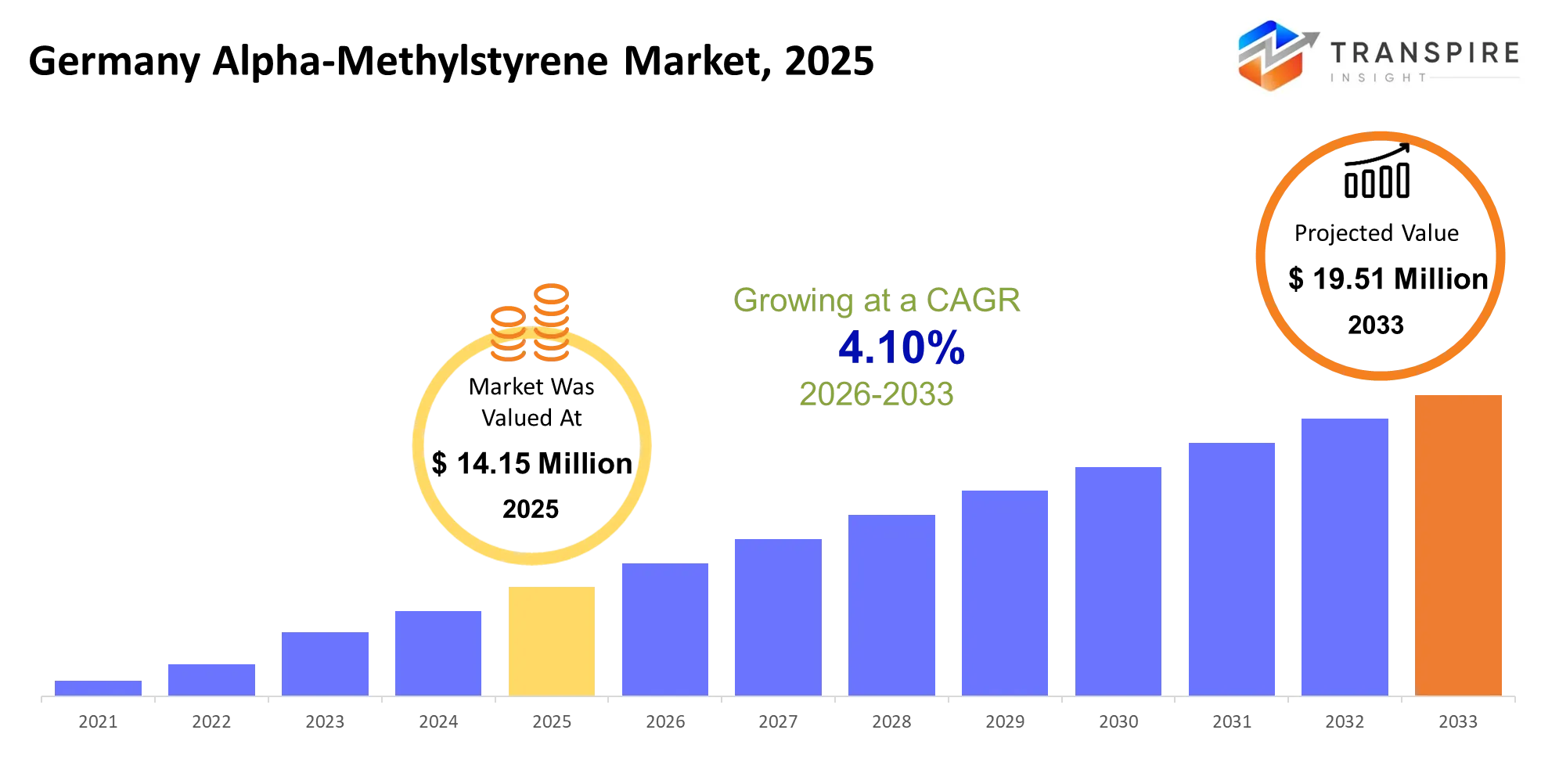
As per Transpire Insight Analysis theGermany Alpha-Methylstyrene Market size is estimated at USD 14.15 Million in 2025 and is anticipated to reach USD 19.51 Million by 2033, growing at a CAGR of 4.10%from 2026 to 2033.
The Germany Alpha-Methylstyrene Market kinda plays an essential role in feeding high-performance intermediates , for specialty polymers, ABS resins, adhesives, coatings, and chemical formulations used across automotive electronics, and industrial manufacturing too. By improving heat resistance durability, and processing efficiency, alpha-methylstyrene supports manufacturers in making lightweight but higher value engineered materials. They still have to meet demanding industrial specifications though, you know. Over the last five years the market has been moving more toward higher-purity and specialty-grade production. This is mainly because German producers increasingly prioritize advanced engineering plastics and some circular making practices too. Energy price volatility ,and raw material disruptions after the Russia-Ukraine conflict made companies diversify sourcing faster and push efficiency investments across the entire chemical value chain. At the same time, manufacturers are modernizing their production plants and expanding applications in electric vehicles, electronics, and specialty chemicals. So demand is trending toward premium grades with better performance attributes ,and that helps strengthen product value realization. It also encourages continued investment in domestic specialty chemical production, which in turn keeps the market expansion going, more or less.
Germany Alpha-Methylstyrene Market Size & Forecast:
- Germany Alpha-Methylstyrene Market Size 2025: USD 14.15 Million
- Expected Market Value 2033: USD 19.51 Million
- Forecast CAGR: 4.10%
- Leading region in 2025:Western Germany
- Fastest Growing region:Southern Germany
- Key Profile: INEOS Phenol, Altivia, DOMO Chemicals, Mitsubishi Chemical, AdvanSix, SI Group, Solvay, SABIC, Kumho P&B Chemicals, Mitsui Chemicals, Shell Chemicals, BASF SE, Dow Inc., LG Chem, Formosa Chemicals & Fibre
Key Market Insights
- Regional Assessment: Western Germany is basically leading the Germany Alpha-Methylstyrene Market, grabbing something like 46% share in 2025, and it kinda makes sense with the dense chemical manufacturing nodes in North Rhine-Westphalia behind it, right?
- Regional Growth: Southern Germany looks like the quickest mover for 2026–2033, mostly because of automotive innovation, electronics fabrication, plus those specialty polymer bet plans that keep showing up in investment roadmaps.
- Product Segment: The high-purity alpha-methylstyrene category seems to take the lead at about 61% in 2025, yet industrial-grade offerings stay as the second-largest slice. That said, ultra-high-purity grades are projected to grow more rapidly, through 2033.
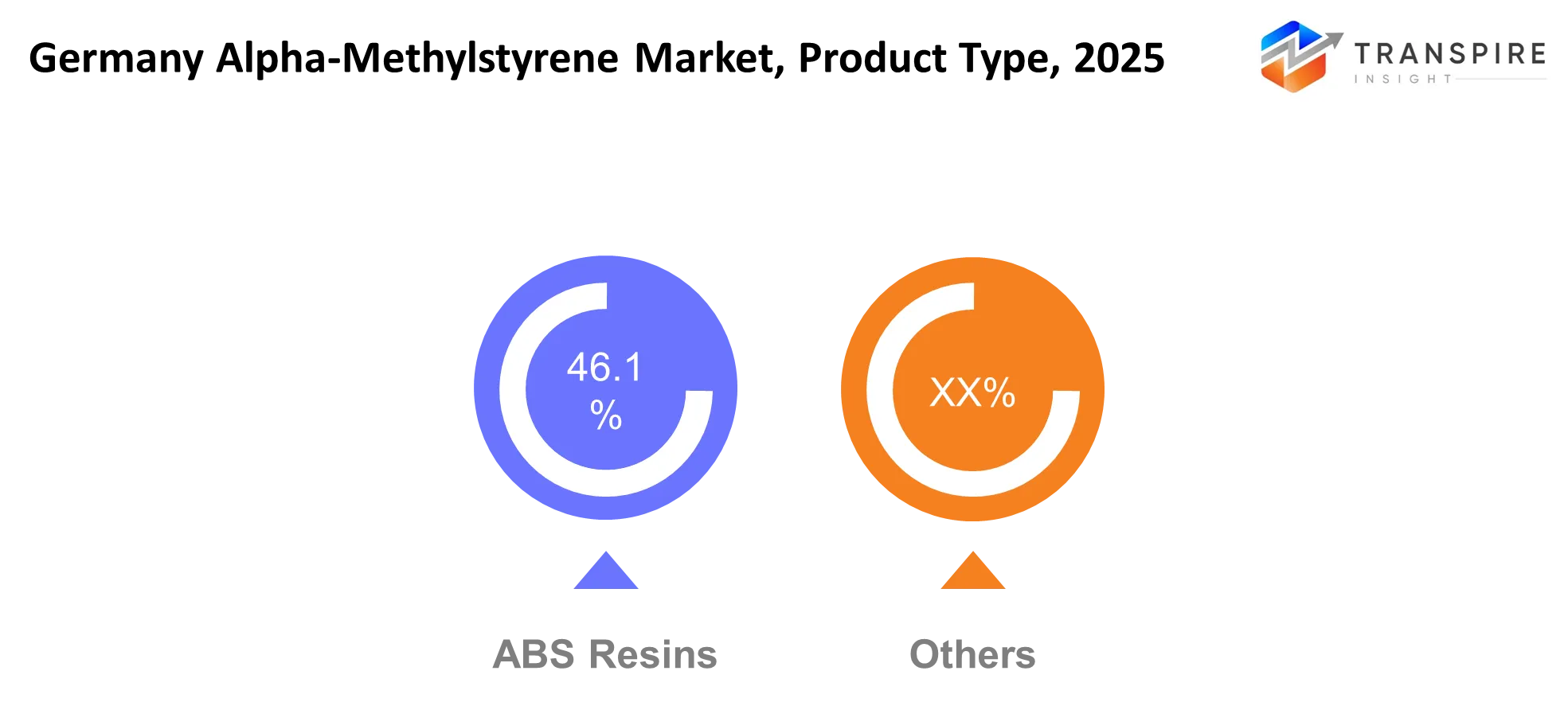
- Application Insights: ABS and specialty resin production dominate, roughly 48% share in 2025. Adhesive and coating formulations, on the other hand are seeing the strongest expansion during the forecast period, which is kind of a big deal.
- End-User Analysis: Chemical manufacturers account for over 52% of the total consumption. Meanwhile, advanced polymer compounders are expected to be the fastest-growing customer group through 2033.
- Operational / Tech Trends: Manufacturers are increasingly fine-tuning production with energy-efficient catalytic methods, boosting yield by 8–12%, and also lowering operating costs and emissions a bit at the same time.
- Supply chain diversification picked up pace after 2022, which reduces reliance on one single-source feedstock procurement, and supports smoother production continuity. Digital process monitoring, plus predictive maintenance has lifted plant availability by 10–15%, helping keep specialty chemical output more consistent.
- Key Players: INEOS Phenol, BASF SE, Mitsubishi Chemical, SABIC, Dow Inc., and LG Chem are continuing to invest in product innovation, strategic alliances, process optimization, and regional supply expansion, so they can keep their competitive position stronger than before.
What are the Key Drivers, Restraints, and Opportunities in theGermany Alpha-Methylstyrene Market?
Germany’s strongest growth driver is basically the continued expansion of high-performance engineering plastics being used in automotive, electronics, and industrial manufacturing. Vehicle lightweighting initiatives, tougher performance standards, and the growing take up of electric vehicles have pushed polymer producers to lean on specialty intermediates that can help improve thermal stability and mechanical performance. Meanwhile, investments in advanced chemical processing technologies have made production more efficient, and the product consistency a bit better, so manufacturers can actually serve premium applications with higher margins. So all this ends up meaning higher consumption of high-purity alpha-methylstyrene across specialty polymer production.
Still the market is sort of constrained, because it depends in a very structural way on petrochemical feedstocks, and their pricing tracks global crude oil and benzene markets very closely. Plus, production is energy intensive, so manufacturers keep getting hit by electricity and natural gas cost swings, especially in Europe. And if anyone wants to build new chemical production capacity, they need big capital spending , long environmental permitting, plus strict regulatory compliance, which makes rapid supply expansion basically not easy. In practice these structural factors raise production costs , limit pricing flexibility , and delay capacity additions, and as a result revenue growth gets held back.
A major opportunity is developing bio-based and recycled-feedstock specialty chemicals that match Germany’s circular economy goals. Chemical producers are increasingly putting money into advanced recycling technologies, mass-balance production approaches, and low-carbon manufacturing processes.
What Has the Impact of Artificial Intelligence Been on theGermany Alpha-Methylstyrene Market?
Artificial intelligence is steadily changing how alpha-methylstyrene is manufactured in practice, by nudging operational efficiency, process stability, and overall production quality forward across Germany ́s specialty chemical industry. Lately more chemical plants, deploy AI based control systems that kind of continuously watch reactor temperatures, how well the catalyst performs, pressure situation, and even the raw material composition. Instead of waiting for slow manual adjustments these automated setups steer reaction parameters in real time, cutting down on energy use, while also pushing product yield higher and improving purity. On top of that machine learning models provide predictive maintenance support, spotting equipment wear in advance, so failures don t just jump out unexpectedly. In turn it helps manufacturers reduce those unplanned shutdowns and lift plant availability, roughly by 10–15% or so.
There is also advanced analytics, which lets producers forecast raw material needs, tune inventory levels, and play out production scenarios when market conditions shift. AI helped quality inspection reduces batch to batch variability and supports compliance with tough industrial requirements, especially the kind automotive and electronics buyers demand. Meanwhile digital twins are being used more and more to test process modifications before they are actually applied, so operational risk drops and production optimization speeds up. Still widespread adoption of AI isn t universal because the integration costs can be high, and many sites rely on legacy production infrastructure. Plus the data side is heavy too, since high volumes of high-quality operational data are needed to train dependable machine learning models. Those obstacles keep implementation slower, mainly for medium sized specialty chemical manufacturers.
Key Market Trends
- Since 2021, specialty grade alpha-methylstyrene production has been expanding, though a lot of makers are looking at the higher value end uses—more engineering plastics, and also electronic materials, you know.
- After the 2022 energy market disruptions, producers started pushing harder on feedstock diversification, and they also changed up regional sourcing, sort of to keep the supply chain more resilient.
- Digital manufacturing platforms have helped production efficiency improve by 8–12% which also allows tighter quality control, and less process variability, overall.
- BASF SE, INEOS Phenol, Mitsubishi Chemical, SABIC, and Dow Inc. keep expanding their specialty chemical lineups, using process innovation plus strategic investments.
- German polymer manufacturers are increasingly leaning toward long term supply agreements, that improves procurement stability and helps reduce exposure to raw material price volatility .
- Meanwhile, adoption of advanced catalytic technologies has reduced energy use while lifting production yields across specialty chemical manufacturing sites.
- Chemical firms are also investing in circular manufacturing and mass balance production approaches, to better match the European sustainability goals that were laid out after 2021.
- On top of that, AI driven predictive maintenance cuts unexpected equipment downtime by 10–15% , so operational reliability is better at the newer production plants.
- And automotive electrification has shifted purchasing toward premium-performance polymers which in turn needs higher purity alpha-methylstyrene formulations.
- Export oriented specialty chemical manufacturers are also spending more on process automation and digital quality management, to stay competitive in European and global markets.
Germany Alpha-Methylstyrene Market Segmentation
By Product Type
High Purity AMS serves a bunch of applications that need strict quality standards and consistent chemical performance, you know. Electronics materials, specialty polymers, and advanced industrial formulations often use this grade because low impurity levels help keep production results stable. Standard AMS is also still widely used across general manufacturing tasks, where balanced performance and cost efficiency matter more.
Broad industrial consumption keeps steady demand going for standard grade material, more or less. Polymer Grade AMS helps support resin production and plastic making, it improves heat resistance and mechanical properties in final products. Chemical Grade AMS works like an important intermediate in several chemical synthesis processes, plus specialty formulations too. Other grades, cover sort of niche requirements in research, customized manufacturing, and specialized industrial uses. Choosing a product really depends on purity requirements, production objectives, and the performance targets for end use.
By Application
ABS Resins really sit in the biggest application area, because alpha-methylstyrene helps with strength, thermal stability, and overall durability in engineering plastics, not just in theory but in actual use. Automotive components, consumer electronics housings, and industrial equipment parts often rely on these materials. Adhesives and coatings also make use of alpha-methylstyrene to boost bonding performance, chemical resistance and longer product lifespan, which sounds simple, but it matters. With consistent material characteristics manufacturers get dependable results across many industries, even when the production lines are different.
Waxes and plastic additives tend to benefit too. They can get better processing efficiency, and the end-product performance tends to look better as well. Chemical intermediates, for their part, open up pathways for producing several follow-on products, that are then used throughout the chemical industry. In specialty chemicals, alpha-methylstyrene supports customized formulations, aimed at meeting specific industrial requirements. Other uses continue to show up as manufacturers explore new performance-enhancing material pairings, sometimes very quickly and without much fanfare.
By End User
Automotive manufacturers use alpha-methylstyrene based materials in lighter , stronger parts that help with vehicle performance and efficiency, sort of overall goals. Electronics companies also put these into housings, connector assemblies, and other structural pieces where thermal stability matters a lot, plus the strength part. In construction, crews tend to use related products in coatings and adhesives, and in certain building materials made for specialized use, not just generic ones. Meanwhile infrastructure projects keep going , which leads to steady, consistent material consumption over time.
Packaging firms apply these materials to boost durability and improve processing characteristics for particular packaging types, like selected products. Consumer goods manufacturers lean on advanced plastics and specialty formulations for household items and personal-use goods too. In industrial manufacturing plants, alpha-methylstyrene shows up across machine components, production materials, and chemical processing workflows, so it is not just one single step. Beyond that, other end-user groups add demand through specialized , niche industrial applications that are less visible but still important.
By Production Process
The Cumene Process sort of remains a major production route because the existing industrial infrastructure supports efficient large scale manufacturing, like it’s already built for this. There is also strong integration with phenol and acetone production facilities, helps optimize resource use and operational economics in a very practical way. You still get reliable feedstock availability and mature processing technologies that keep backing widespread adoption. So large chemical producers often end up relying on this method for steady output, and for cost control too.
Catalytic Dehydrogenation provides a different kind of production pathway, where the idea is converting suitable feedstocks into alpha-methylstyrene using controlled chemical reactions. Ongoing process improvements keep pushing efficiency forward, while also improving product quality, and day to day operational performance. Other production methods handle specialized manufacturing requirements or research-driven applications. Which technology to pick depends on production scale, how accessible the feedstock is, and what exact product specifications are desired.
By Distribution Channel
Direct Sales, still remain quite important for big volume transactions between producers and industrial buyers. Often, long-term supply agreements plus technical support services, together with tailored product specifications, can make the business bond feel a lot stronger. Chemical Distributors also matter, because they connect manufacturers to regional customers and to those smaller-volume purchasers who might need faster routing. In that way, distribution networks help make products more reachable across many industrial sectors.
Online B2B Platforms keep getting more attention, as digital procurement tools make sourcing, pricing comparisons, and order management activities feel simpler. These digital channels also help speed up communication, and they improve market clarity for both buyers and suppliers. Besides that, other distribution methods handle more specific customer needs, or even specialized procurement arrangements, depending on how the purchasing side works. The final choice of channel usually leans on purchase volume logistics requirements, and general supply chain preferences.
What are the Key Use Cases Driving theGermany Alpha-Methylstyrene Market?
ABS resin production kind of is the main use case, and it creates the biggest share of overall consumption. Automotive manufacturers, electronics producers too rely on ABS materials for parts that need durability, dimensional stability, and resistance to heat, without too much drama. Because strong demand for engineered plastics stays present, this application pretty much remains at the center of the market activity.
Meanwhile adhesives and coatings have been getting wider adoption across construction and industrial manufacturing. Formulations gain from enhanced performance traits that help extend service life and improve resistance against harsh operating conditions . Specialty chemical producers also use alpha-methylstyrene as an intermediate for downstream products with higher value, which kind of makes sense in practice.
Then there are emerging applications, like advanced polymer blends used in electric vehicle components and certain high-performance electronics. Research on lightweight materials and specialty formulations keeps turning up new commercial chances. And with more investment in advanced manufacturing technologies during the forecast period, further development of these applications should continue to grow, more or less.
|
Report Metrics |
Details |
|
Market size value in 2025 |
USD 14.15 Million |
|
Market size value in 2026 |
USD 14.74 Million |
|
Revenue forecast in 2033 |
USD 19.51 Million |
|
Growth rate |
CAGR of 4.10%from 2026 to 2033 |
|
Base year |
2025 |
|
Historical data |
2021 - 2024 |
|
Forecast period |
2026 - 2033 |
|
Report coverage |
Revenue forecast, competitive landscape, growth factors, and trends |
|
Regional scope |
Germany |
|
Key company profiled |
INEOS Phenol, Altivia, DOMO Chemicals, Mitsubishi Chemical, AdvanSix, SI Group, Solvay, SABIC, Kumho P&B Chemicals, Mitsui Chemicals, Shell Chemicals, BASF SE, Dow Inc., LG Chem, Formosa Chemicals & Fibre |
|
Customization scope |
Free report customization (country, regional & segment scope). Avail customized purchase options to meet your exact research needs. |
|
Report Segmentation |
By Product Type (High Purity AMS, Standard AMS, Polymer Grade AMS, Chemical Grade AMS, Others); By Application (ABS Resins, Adhesives, Coatings, Waxes, Plastic Additives, Chemical Intermediates, Specialty Chemicals, Others); By End User (Automotive, Electronics, Construction, Packaging, Consumer Goods, Industrial Manufacturing, Others); By Production Process (Cumene Process, Catalytic Dehydrogenation, Others); By Distribution Channel (Direct Sales, Chemical Distributors, Online B2B Platforms, Others) |
Which Regions are Driving theGermany Alpha-Methylstyrene Market Growth?
Western Germany holds the largest share of the market, mainly because the region is home to the country’s strongest petrochemical and specialty chemical making base, so producers sort of keep landing there. North Rhine-Westphalia specifically benefits from integrated production clusters, Rhine port logistics and feedstock infrastructure that help keep alpha-methylstyrene manufacturing efficient. On top of that, strict environmental rules have kind of pushed manufacturers to modernize their production assets and boost energy efficiency, rather than relocating capacity to somewhere else. Over time, a mature ecosystem—chemical suppliers, research institutes, polymer producers, and industrial customers—keeps reinforcing the region’s leadership, pretty consistently.
Northern Germany plays a different role, it tends to provide stable chemical processing and export capability, not really the same concentrated manufacturing clusters. Ports like Hamburg help strengthen raw material imports and also finished chemical exports, which reduces the supply chain risks for domestic producers. Industrial investment stays steady too, because regional manufacturers concentrate on long-term operational reliability, plus they maintain diversified customer portfolios. That sort of balanced industrial setup makes Northern Germany remain a dependable contributor even during periods when raw material prices wobble around.
Southern Germany is expected to grow the fastest through 2033, driven by expanding automotive, electronics and advanced manufacturing activity in Bavaria and Baden-Württemberg. Rapid investment in electric vehicle production along with high-performance engineering plastics has opened up new opportunities for specialty chemical suppliers. Also, recent expansions of advanced manufacturing facilities, and a greater focus on lightweight materials, have accelerated the consumption of high-purity alpha-methylstyrene.
Who are the Key Players in theGermany Alpha-Methylstyrene Market and How Do They Compete?
Competition stays kind of moderately consolidated since production depends on big scale petrochemical infrastructure, having integrated feedstock on hand, and also a lot of technical know-how. Most players end up competing via manufacturing efficiency, product purity, production scale, and dependable long term supply relationships, not just pricing. When a company is vertically integrated it can tap into the phenol, acetone, and cumene value chain directly, so they can manage production costs more closely and keep product quality more consistent, if that makes sense.
INEOS Phenol sets itself apart with vertically integrated production of phenol, acetone, and alpha-methylstyrene, it is backed by major European manufacturing assets. The firm keeps putting money into making operations more efficient, and also into lower-carbon activity, while at the same time tightening supply security for industrial customers. BASF SE, on the other hand leans into specialty chemical solutions that are supported by strong research capabilities, digital manufacturing, and sustainability programs which add more value for polymer manufacturers downstream. Mitsubishi Chemical highlights high purity specialty materials, aimed at tough industrial uses. They keep pushing product development and maintain strong ties with electronics, and engineering plastics customers too.
SABIC competes using global manufacturing scale, plus integrated petrochemical operations, which helps them keep supply steady across international markets. Dow Inc. leans on advanced process technology, a wide chemical portfolio, and close collaboration with industrial customers, so they can co-develop higher performance material solutions that fit practical needs.
Company List
- INEOS Phenol
- Altivia
- DOMO Chemicals
- Mitsubishi Chemical
- AdvanSix
- SI Group
- Solvay
- SABIC
- Kumho P&B Chemicals
- Mitsui Chemicals
- Shell Chemicals
- BASF SE
- Dow Inc.
- LG Chem
- Formosa Chemicals & Fibre
Recent Development News
In June 2025, INEOS Phenol announced that challenging European energy and carbon costs had led to operational changes affecting its European phenol business. The announcement highlighted cost pressures influencing the regional phenol and alpha-methylstyrene supply chain and future production planning.https://www.ineos.com
What Strategic Insights Define the Future of theGermany Alpha-Methylstyrene Market?
The market is kind of shifting toward higher- value specialty production instead of just going all in on large-volume commodity expansion. Growth will increasingly rely on advanced engineering plastics, digital manufacturing, and getting tighter with low-carbon chemical production, because industrial customers keep pushing for better performing materials, plus improved sustainability credentials . There is also a risk that is less seen , Europe’s long-term energy cost disadvantage versus other competing production regions, could slowly erode regional manufacturing competitiveness, even if downstream demand stays steady. Meanwhile, bio-attributed feedstocks, mass balance production approaches, and AI enabled process optimization are also real opportunities , like a chance to stand out in a more unique way. Firms that manage to commercialize sustainable alpha-methylstyrene grades, while also squeezing more efficiency out of production, should see stronger margins and better customer retention. Market participants might want to focus investments on integrated production, digital process control , and building partnerships with automotive plus specialty polymer manufacturers, so they can lock in long term positioning in Germany’s evolving specialty chemicals scene.
Germany Alpha-Methylstyrene Market Report Segmentation
By Product Type
• High Purity AMS
• Standard AMS
• Polymer Grade AMS
• Chemical Grade AMS
• Others
By Application
• ABS Resins
• Adhesives
• Coatings
• Waxes
• Plastic Additives
• Chemical Intermediates
• Specialty Chemicals
• Others
By End User
• Automotive
• Electronics
• Construction
• Packaging
• Consumer Goods
• Industrial Manufacturing
• Others
By Production Process
• Cumene Process
• Catalytic Dehydrogenation
• Others
By Distribution Channel
• Direct Sales
• Chemical Distributors
• Online B2B Platforms
• Others
Frequently Asked Questions
Find quick answers to common questions.
The expected Germany Alpha-Methylstyrene Market size for the market will be USD 19.51 Million in 2033.
Key segments for theGermany Alpha-Methylstyrene Market are By Product Type (High Purity AMS, Standard AMS, Polymer Grade AMS, Chemical Grade AMS, Others); By Application (ABS Resins, Adhesives, Coatings, Waxes, Plastic Additives, Chemical Intermediates, Specialty Chemicals, Others); By End User (Automotive, Electronics, Construction, Packaging, Consumer Goods, Industrial Manufacturing, Others); By Production Process (Cumene Process, Catalytic Dehydrogenation, Others); By Distribution Channel (Direct Sales, Chemical Distributors, Online B2B Platforms, Others)
Major Germany Alpha-Methylstyrene Market players are INEOS Phenol, Altivia, DOMO Chemicals, Mitsubishi Chemical, AdvanSix, SI Group, Solvay, SABIC, Kumho P&B Chemicals, Mitsui Chemicals, Shell Chemicals, BASF SE, Dow Inc., LG Chem, Formosa Chemicals & Fibre
The Germany Alpha-Methylstyrene Market size is USD 14.15 Million in 2025.
The Germany Alpha-Methylstyrene Market CAGR is 4.10% from 2026 to 2033
- INEOS Phenol
- Altivia
- DOMO Chemicals
- Mitsubishi Chemical
- AdvanSix
- SI Group
- Solvay
- SABIC
- Kumho P&B Chemicals
- Mitsui Chemicals
- Shell Chemicals
- BASF SE
- Dow Inc.
- LG Chem
- Formosa Chemicals & Fibre
About the Authors

Pankaj Ghogare Patil
I am Pankaj Ghogare Patil, a Senior Research Analyst at Transpire Insight, specializing in the Pharmaceutical, Chemicals & Materials, Healthcare IT, and Biotechnology industry. My expertise lies in conducting comprehensive market research, analyzing industry trends, evaluating competitive landscapes, and translating complex data into actionable insights. At Transpire Insight, I closely follow emerging technologies, regulatory developments, and market innovations to create accurate, well-researched, and informative content that helps businesses and professionals make informed decisions. I am committed to producing credible, evidence-based articles that reflect industry best practices while making technical topics accessible and valuable for a broad audience.

Chakradhar Khansole
Chakradhar serves as the Research Director at Transpire Insight, bringing over 8 years of experience in technology, innovation, and strategic market intelligence. He specializes in transforming complex market data into actionable business insights that enable organizations to make informed, growth-oriented decisions. Recognized for his strategic vision and analytical expertise, Chakradhar leads high-impact research initiatives, delivering comprehensive market assessments, competitive intelligence, and forward-looking industry analysis.
Recently Published Reports
-
May 2026
Healthcare Polymer Packaging Market
Healthcare Polymer Packaging Market Size, Share & Analysis Report By Packaging Type (Syringes, IV Bottles and Pouches, Clamshells, Blisters, Bottles & Jars, Containers, Tubes, IV Parental Packaging, Others), By Type (Regulated, Non-regulated), By Polymer Type (LDPE (Low-Density Polyethylene), HDPE (High-Density Polyethylene), Homo-polymer (Homo), Random Copolymer (Random), Block Copolymer (Block), PET, Polystyrene, Polyvinyl Chloride, Polyamide/EVOH, Others), and Geography (North America, Europe, Asia-Pacific, Middle East and Africa, South and Central America), 2021 - 2031
-
Apr 2026
Hydrophilic Tape (Waterstop) Market
Hydrophilic Tape (Waterstop) Market Size, Share & Analysis Report By Type (Bentonite-Based Hydrophilic Tape, Rubber-Based Hydrophilic Tape), By Application (Residential Buildings, Commercial Buildings, Infrastructure Projects), and Geography (North America, Europe, Asia-Pacific, Middle East and Africa, South and Central America), 2021 - 2031
-
Apr 2026
Metalens Market
Metalens Market Size, Share & Analysis Report By Type (Visible Light Metalens, and Infrared Metalens), By Application (Consumer Electronics, Automotive Electronics, Industrial, Medical, and Others), and Geography (North America, Europe, Asia-Pacific, Middle East and Africa, South and Central America), 2021 - 2031
-
Apr 2026
PBT Resin Market
PBT Resin Market Size, Share & Analysis Report By Type (Reinforced PBT Resin, Unreinforced PBT Resin), By Processing Method (Injection Molding, Extrusion, Blow Molding, Others), By End-User (Automotive, Electrical & Electronics, Consumer Appliances, Industrial Machinery, Medical Devices, Packaging, Others), and Geography (North America, Europe, Asia-Pacific, Middle East and Africa, South and Central America), 2021 - 2031