Germany Automotive DMS Market Summary
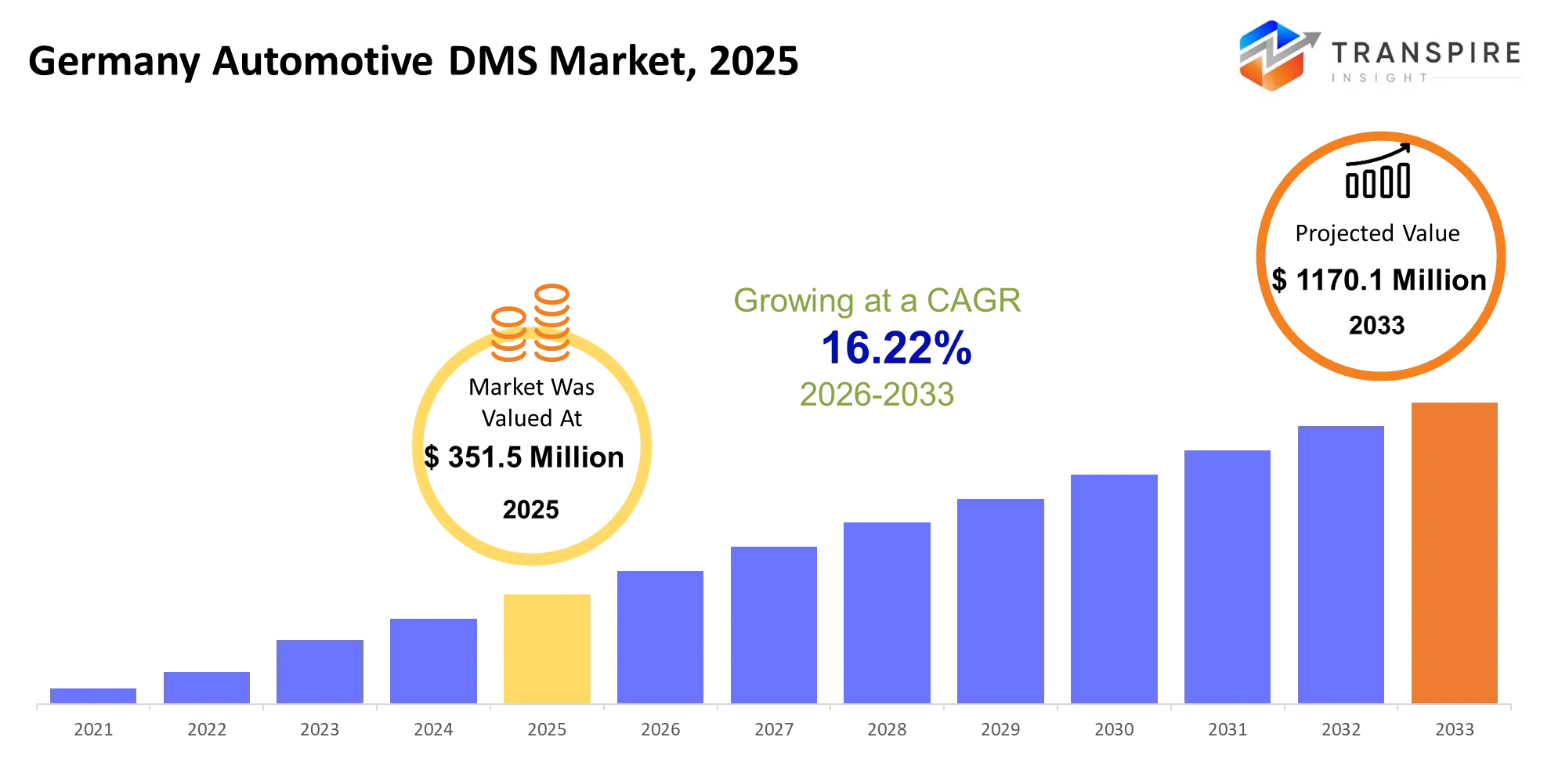
As per Transpire Insight, the Germany Automotive DMS Market size is estimated at USD 351.5 Million in 2025 and is anticipated to reach USD 1170.1 Million by 2033, growing at a CAGR of 16.22% from 2026 to 2033.
The Germany Automotive DMS Market helps organizations kinda peek into how their business processes really do run, by looking at digital event logs coming from ERP, CRM, and other enterprise systems. Companies in manufacturing, automotive, banking and insurance, plus logistics providers, lean on these platforms to spot process bottlenecks, strengthen compliance, and lower day to day operating costs, all while keeping the existing workflows more or less intact. Over the last five years, the whole focus has moved away from retrospective process review and toward real time process intelligence, with cloud deployment and AI enabled decision support showing up more and more.
Supply chain disruptions after the COVID-19 pandemic also made the hidden inefficiencies pretty visible across production lanes and procurement networks, so German enterprises started investing in process visibility and operational resilience instead of only doing occasional audits. On the other hand, tighter ESG reporting duties and ongoing digital transformation efforts pushed many firms to watch business performance in a continuous manner. And now, since enterprises want quicker decisions and sharper workflow optimization, software vendors keep expanding platform features, which leads to broader adoption across the enterprise and stronger recurring subscription revenue streams.
Germany Automotive DMS Market Size & Forecast:
- Germany Automotive DMS Market Size 2025: USD 351.5 Million
- Expected Market Value 2033: USD 1170.1 Million
- Forecast CAGR: 16.22%
- Leading region in 2025: Southern Germany
- Fastest Growing region: Eastern Germany
- Key Profile: Bosch, Continental, Valeo, Magna International, Smart Eye, Seeing Machines, Cipia, Denso, Aptiv, ZF Friedrichshafen, Hyundai Mobis, Visteon, Harman, Forvia, Mobileye
Key Market Insights
- Regional Leadership: Southern Germany pretty much leads the Germany Automotive DMS Market, sitting at about 38% share in 2025, and it’s backed by automotive demand, industrial manufacturing momentum, and also enterprise software adoption, in general.
- Fastest-Growing Region: Eastern Germany is expected to move faster, growing the most from 2026–2033, mainly because of digital manufacturing investment , and the push for Industry 4.0 rollout across plants and operations.
- Segment Leadership: In 2025, cloud based process mining solutions take roughly 62% market share while on-premise stays the second biggest deployment choice, especially for regulated industries and compliance-heavy environments.
- Fastest-Growing Segment: AI enabled process intelligence platforms are forecast to expand by more than 18% per year through 2033, helped along by predictive analytics plus workflow automation features that people actually use.
- Application Insights: Manufacturing makes up nearly 35% of total market revenue in 2025. Banking and financial services , by comparison, are showing up as the quickest growing use-case area.
- End-User Analysis: Large enterprises generate around 68% of market revenue, whereas mid-sized firms are adopting SaaS based process mining at the highest pace, sort of catching up quickly.
- Competitive Landscape: Prominent vendors such as Celonis, SAP, IBM, Microsoft, UiPath, and Software AG keep reinforcing their offerings via AI integration, cloud-native platforms, and selective acquisitions that broaden capabilities.
- Also, vendors are leaning into combining process mining, task mining, and robotic process automation , so organizations can automate entire business workflows, not just stand alone activities that happen in one corner.
- Enterprise customers even shifted away from department level rollouts to enterprise wide deployments between 2021 and 2025, which improved subscription revenue, and generally raised platform utilization, too.
What are the Key Drivers, Restraints, and Opportunities in the Germany Automotive DMS Market?
The most powerful push behind the Germany Automotive DMS Market is the fast modernization of enterprise operations, driven by Industry 4.0 and cloud based business platforms. In practice German manufacturers, automotive firms and financial institutions are leaning more and more on ERP systems like SAP S/4HANA, so they end up collecting broad operational records that process mining software can actually interpret. Companies use those findings, to speed up manufacturing loops, upgrade procurement handling, reinforce regulatory adherence, and also lower day to day operating spend. Moving away from periodic reporting toward continuous process watch has also boosted software subscription levels, consulting engagements, and longer platform agreements, which helps keep revenue rising over time.
That said, there’s a big structural hurdle involving how difficult it is to integrate process mining platforms with older enterprise infrastructures. A lot of German organizations run customized ERP setups that were shaped over decades, and that means data standardization becomes costly, plus technically demanding in the real world. Getting it to work frequently calls for major process redesign, experienced data engineers, and careful organizational change management. Because of those factors deployment can take longer, overall implementation expenses go up, and returns on investment get pushed back, especially for medium sized enterprises that just have less room in their digital transformation budgets.
At the same time, there’s a meaningful opening in pairing process mining with generative AI and predictive analytics aimed at more autonomous business improvement. Many organizations are already putting money into smarter platforms that can spot process drift, suggest corrective steps, and even start workflow automation automatically, often using robotic process automation.
What Has the Impact of Artificial Intelligence Been on the Germany Automotive DMS Market?
Artificial intelligence has, in practice, changed the Germany Automotive DMS Market in a pretty major way by letting organizations move past just looking at past process traces toward predictive and kind of autonomous day to day control. In today’s setup, AI methods can automatically sort process events, catch workflow oddities and also flag where operations seem inefficient across areas like manufacturing, finance, procurement and even customer service. The machine learning part studies old event logs and then it estimates when something will slow down, how long tasks might actually take, plus it suggests workflow tweaks well before delays start hitting business results.
On top of that, advanced analytics can back predictive maintenance, because they find the operational signals that usually show up before equipment failure. This can lower the amount of surprise downtime, and it supports better asset utilization across industrial plants. AI‑powered process intelligence in general helps firms steer resource allocation, strengthen regulatory adherence, and improve production planning, all while pressing down operational costs. A lot of enterprises say they see real gains such as shorter process cycle times, greater automation adoption, and stricter compliance monitoring after AI‑driven analytics are layered into enterprise platforms.
Generative AI then speeds up process discovery too, because it can turn complicated operational observations into natural language suggestions for managers and business analysts. Still, broad adoption is not fully frictionless, since connecting AI to heavily tailored legacy ERP environments takes substantial investment, lots of data preparation, and teams with strong implementation know how.
Key Market Trends
- From 2021 to 2025, cloud-native process mining platforms sort of ramped up their enterprise uptake past 60% , and yes they started swapping out the classic on-premise setup for more scalability which is kind of the whole point.
- After 2022, German manufacturers more and more mixed process mining with digital twins, this meant faster production tuning and a clearer operational picture, you know, stronger visibility overall.
- Since 2023, AI-driven process intelligence tools grew a lot, supporting enterprises to streamline the “why” behind issues, automating root-cause analysis and trimming workflow resolution times by about 20–30% .
- Celonis, SAP, IBM, Microsoft, and UiPath also pushed strategic collaborations from 2022 through 2025, so process mining got tied together with automation and enterprise AI platforms.
- In finance, institutions stretched process mining beyond compliance watching into customer onboarding and loan handling, they reduced operational delays, and they were also in a better spot for audit readiness.
- Meanwhile mid-sized German companies started leaning into SaaS subscription models after 2022, which lowered the entry hurdles for implementation and widened adoption beyond just big corporations.
- Organizations gradually moved away from disconnected departmental initiatives, toward full enterprise-wide process intelligence programs, improving cross-functional choices and giving a boost to digital transformation results.
- And sustainability reporting rules basically nudged firms to track operational efficiency continuously, connecting process intelligence with ESG reporting plus resource optimization efforts.
- After 2023, coupling robotic process automation with process mining became normal practice, helping organizations automate whole business workflows, rather than only those repetitive micro-tasks.
Germany Automotive DMS Market Segmentation
By Component:
Driver monitoring cameras actually hold a big role here, because continuous visual watching is sort of the basic thing behind how we analyze driver behavior inside today’s vehicles. Those high resolution cameras record facial movement, head placement and eye activity, while infrared cameras make night time vision more solid, especially in dim or low light conditions. Then the sensors plus control units gather and handle data coming from multiple vehicle subsystems, so the vehicle can react quicker when something like unusual driving behavior shows up.
After that, AI software together with analytics software turn the captured signals into actionable insights, which then back up safety functions and quick, near real time decision making. The AI side tries to spot fatigue, distraction, and how alert someone seems, and the analytics layer studies longer term driving patterns, for system tuning and gradual improvements. There are also supporting parts—like lighting modules, communication interfaces and processing hardware—which helps the whole system stay stable and work well across different vehicle types.
By Vehicle Type:
Passenger cars kind of stand out as the biggest vehicle group, because advanced safety technologies keep getting pushed into standard equipment across new models. Commercial vehicles also matter a lot, with transport companies trying to find workable solutions that boost road safety, lower the chance of mishaps, and satisfy fleet safety obligations, not just “nice to have” targets. Electric vehicles meanwhile are starting to blend intelligent monitoring systems more and more as digital vehicle platforms are becoming more common, and honestly they feel more normal every year.
Luxury vehicles are still moving toward premium monitoring technologies too, where advanced sensors pair up with AI safety features to make driving feel smoother and more secure. Autonomous vehicles depend on constant driver observation, so they can handle the awkward transitions between automated and manual driving functions without losing control, even slightly. Other groups, including specialty vehicles and utility vehicles, also use monitoring solutions as safety regulations keep widening across different transportation sectors.
By Technology:
Camera-based monitoring stays pretty much the front runner , since the visual data gives an accurate read on driver attention and facial movement during everyday driving conditions. The AI-driven side makes the whole system stronger, it can spot recurring behavioral patterns and then raise real-time warnings before an unsafe moment really takes shape. Infrared monitoring meanwhile helps a lot at night, and in those tricky lighting scenarios, it keeps performance solid, without messing with detection accuracy.
Facial recognition technology helps with identifying the driver, and it also lets the vehicle use personalized safety settings and more secure access. Eye tracking systems then go further by watching blink frequency, gaze direction, and how long the eyes stay closed, which can show signs of fatigue or distraction. Hybrid systems combine multiple methods for better reliability, and in the background other still-emerging approaches are also improving monitoring precision plus operational flexibility.
By Application:
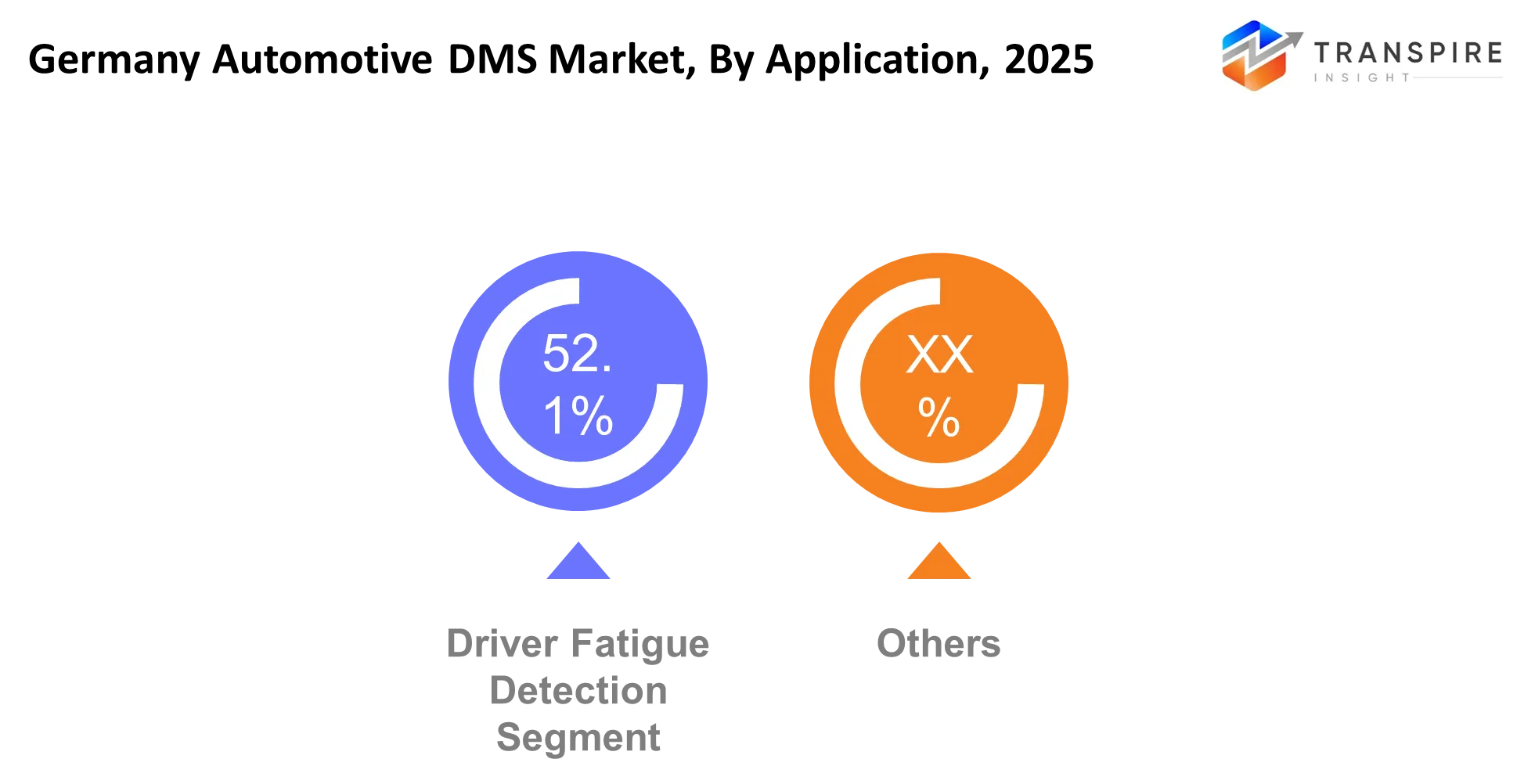
Driver fatigue detection ends up taking the biggest slice here, mostly because fatigue still sits among the chief causes of road accidents across the whole world. With continuous monitoring in place, it becomes easier to spot reduced alertness well before the risky driving situation really kicks in, so safety warnings can be sent in time. Driver distraction detection is also pretty key, since it spots what is diverting attention away from the roadway, like phone usage, or those long head movements that look abnormal.
Occupant monitoring keeps growing too as vehicle manufacturers work on passenger safety, for example through seat occupancy detection plus cabin observation. Safety assistance systems then weave these monitoring methods into vehicle warning features, aiming to lower accident exposure during everyday trips. Autonomous driving support and other emerging use cases add even more, they help coordinate human drivers with automated vehicle systems, and that tends to boost operational safety as the automation level keeps going up.
By End User:
Automotive OEMs show up as that main end-user slice, because vehicle makers bake in monitoring technologies while they are producing vehicles so they can satisfy the safety standards that keep changing and also the expectations from customers. At the same time, Tier-1 suppliers help out by building cameras, sensors, software platforms, and electronic control systems for those OEMs, basically to make sure it all works. This kind of back and forth, between OEMs and tech suppliers keeps going, it helps push fresh product ideas along, and it supports better system performance improvements too, even when requirements shift.
Fleet operators are also leaning into monitoring technologies more and more now. They do it to boost driver safety, cut down insurance costs, and raise day to day operational efficiency across commercial transport. Meanwhile the aftermarket part is still growing, mainly via retrofit installs, where older vehicle fleets get updated with more modern monitoring capabilities. Beyond that, other types of end users—like specialty vehicle manufacturers and mobility service providers—still put money into smart safety systems, with the aim to make operations more dependable.
What are the Key Use Cases Driving the Germany Automotive DMS Market?
Business process optimization is still the main use case i guess, because manufacturing companies use process mining to find production bottlenecks, make workflow run more smoothly, and lower operating costs. Big industrial groups tend to adopt it the most, often by integrating with ERP systems and manufacturing execution platforms , which makes the whole thing feel more seamless.
More recently, financial institutions and logistics providers are applying process intelligence to tighten compliance management, automate invoice handling, and improve supply chain coordination. Here too, large enterprises and cloud platform users get a real advantage, mainly faster process analysis, stronger audit readiness, and more careful resource allocation across different business activities.
Newer applications are showing up too, like AI driven process suggestions, ESG performance tracking, and linking digital twins with industrial facilities. Smart manufacturing setups and the whole Industry 4.0 push should add even more opportunities, because predictive process optimization and near autonomous workflow management will likely spread further across German industrial sectors, over time.
|
Report Metrics |
Details |
|
Market size value in 2025 |
USD 351.5 Million |
|
Market size value in 2026 |
USD 408.5 Million |
|
Revenue forecast in 2033 |
USD 1170.1 Million |
|
Growth rate |
CAGR of 16.22% from 2026 to 2033 |
|
Base year |
2025 |
|
Historical data |
2021 - 2024 |
|
Forecast period |
2026 - 2033 |
|
Report coverage |
Revenue forecast, competitive landscape, growth factors, and trends |
|
Regional scope |
Germany |
|
Key company profiled |
Bosch, Continental, Valeo, Magna International, Smart Eye, Seeing Machines, Cipia, Denso, Aptiv, ZF Friedrichshafen, Hyundai Mobis, Visteon, Harman, Forvia, Mobileye |
|
Customization scope |
Free report customization (country, regional & segment scope). Avail customized purchase options to meet your exact research needs. |
|
Report Segmentation |
By Component (Driver Monitoring Cameras, Sensors, Control Units, AI Software, IR Cameras, Analytics Software, Others); By Vehicle Type (Passenger Cars, Commercial Vehicles, Electric Vehicles, Luxury Vehicles, Autonomous Vehicles, Others); By Technology (Camera-Based Monitoring, AI-Based Monitoring, Infrared Monitoring, Facial Recognition, Eye Tracking, Hybrid Systems, Others); By Application (Driver Fatigue Detection, Driver Distraction Detection, Occupant Monitoring, Safety Assistance, Autonomous Driving Support, Others); By End User (Automotive OEMs, Tier-1 Suppliers, Fleet Operators, Aftermarket, Others) |
Which Regions are Driving the Germany Automotive DMS Market Growth?
Germany is still, honestly, the leading region in the automotive Driver Monitoring System DMS market, largely because the country has this really solid automotive manufacturing base , plus a habit of adopting advanced vehicle safety rules early. Premium vehicle brands, a lot of research facilities, and a dense set of Tier-1 suppliers have helped push camera-based monitoring , infrared sensing, and AI-enabled driver assistance into vehicles faster. The European General Safety Regulation has also made things stricter, so driver monitoring tech is basically required in new vehicle development. And it is not just one group, there’s close collaboration between OEMs, semiconductor suppliers, software developers, and engineering service providers that keeps feeding product innovation and real commercialization at scale.
Western Europe comes in next, as the second most important regional contributor, but the reasons are a bit different. The growth is more tied to steady vehicle production, dependable regulatory rollout, and ongoing spending on vehicle safety technologies, not manufacturing concentration alone. In places like France, Italy, and Spain, DMS deployment keeps expanding through established automotive supply chains, alongside deeper integration of Level 2 and Level 2+ driver assistance systems. Suppliers in the region often maintain long-term partnerships with global vehicle manufacturers, which leads to more predictable demand for monitoring solutions. That kind of steady industrial setup tends to support revenue that looks reliable even when vehicle production fluctuates.
Eastern Germany is expected to grow the quickest during 2026–2033, mostly because new investments in semiconductor manufacturing, automotive electronics, and smart mobility are upgrading regional capabilities.
Who are the Key Players in the Germany Automotive DMS Market and How Do They Compete?
Competition is kind of moderately consolidated since only a limited group of automotive technology suppliers actually hold the engineering know-how, the required automotive certifications, and the production capacity that you need for large-scale DMS rollout. In other words, competitive strength is leaning more and more toward AI algorithms, sensor integration, software reliability, and the capability to fuse driver monitoring with wider ADAS suites, not just chasing hardware cost. Suppliers also push harder with long-term development deals for vehicle manufacturers, plus the ability to supply full in-cabin sensing solutions end to end, including the whole stack.
Bosch stands out by meshing driver monitoring with braking, steering, and ADAS technologies, so vehicle makers can tidy up their system architecture a bit. Continental leans into a blend of interior sensing, cockpit electronics, and software-defined vehicle platforms, which gives OEMs more freedom while they’re developing the vehicle. Valeo, for its part, puts stress on tightly integrated hardware and software packages, combining cameras, electronic control units, and AI performance, so it can scale across high-volume vehicle platforms without too much friction.
Seeing Machines focuses on AI vision models, kind of tuned specifically for driver attention assessment, and that specificity makes the tech appealing for higher-tier safety programs. Mobileye combines driver monitoring with external road perception on one EyeQ platform, which cuts down on hardware overhead, while boosting contextual awareness for assisted driving scenarios.
Overall, these firms keep growing via strategic collaborations with major automakers, software integration arrangements, and development of next-gen in-cabin monitoring platforms that should support future automated driving features and workflows.
Company List
- Bosch
- Continental
- Valeo
- Magna International
- Smart Eye
- Seeing Machines
- Cipia
- Denso
- Aptiv
- ZF Friedrichshafen
- Hyundai Mobis
- Visteon
- Harman
- Forvia
- Mobileye
Recent Development News
- In March 2026, Mobileye secured a major Driver Monitoring System production program with a leading U.S. automaker. The agreement expands deployment of Mobileye DMS integrated with the EyeQ6L platform across millions of future vehicles, strengthening the company's position in AI-based in-cabin sensing.https://www.mobileye.com/news/mobileye-secures-major-dms-production-program-with-leading-us-automaker/ (Mobileye).
- In January 2026, Valeo and Seeing Machines showcased advanced in-cabin monitoring applications at CES 2026 through their strategic partnership. The integrated driver and occupant monitoring solution supports upcoming global vehicle safety regulations and expands commercial opportunities for intelligent cabin sensing.https://www.valeo.com/en/valeo-unveils-safety-enhancing-advanced-monitoring-applications-powered-by-seeing-machines-at-ces-2026/ (Valeo).
- In March 2025, Volkswagen Group entered a strategic partnership with Valeo and Mobileye to develop Level 2+ driver assistance systems for future MQB vehicles. The collaboration integrates cameras, sensors, mapping technologies, and driver monitoring into a centralized architecture that improves safety and reduces system complexity.https://www.mobileye.com/news/volkswagen-group-cooperates-with-valeo-and-mobileye-to-enhance-driver-assistance-in-future-mqb-vehicles/ (Mobileye).
What Strategic Insights Define the Future of the Germany Automotive DMS Market?
The Germany Automotive DMS Market will slowly but surely lean toward AI-based interior sensing platforms where driver monitoring and occupant monitoring sorta blend with advanced driver assistance, all inside one vehicle architecture that feels, I mean, unified. This shift is going to be pushed by tighter European safety rules , by software-defined vehicle platforms, and by higher levels of driving automation that kind of keep on climbing.
There’s also a quieter kind of risk, not as obvious at first, which comes from depending on a smaller set of semiconductor suppliers and AI software providers. That kind of reliance can lead to supply squeezes or just raise development costs if there are disruptions, even for short periods.
At the same time, a real opportunity is going to show up via context-aware monitoring systems that merge cabin sensing with external road perception. The idea is to support safer Level 2+ and even Level 3 automated driving functions, without relying on just one view of what’s happening.
Firms that want in should focus on software platforms that scale properly, plus durable partnerships with OEMs and Tier-1 suppliers. They should also bring compliance-ready AI technologies that can be updated over the air, because regulatory requirements keep changing and the systems need to adapt, fast enough to stay acceptable.
Germany Automotive DMS Market Report Segmentation
By Component
- Driver Monitoring Cameras
- Sensors
- Control Units
- AI Software
- IR Cameras
- Analytics Software
- Others
By Vehicle Type
- Passenger Cars
- Commercial Vehicles
- Electric Vehicles
- Luxury Vehicles
- Autonomous Vehicles
- Others
By Technology
- Camera-Based Monitoring
- AI-Based Monitoring
- Infrared Monitoring
- Facial Recognition
- Eye Tracking
- Hybrid Systems
- Others
By Application
- Driver Fatigue Detection
- Driver Distraction Detection
- Occupant Monitoring
- Safety Assistance
- Autonomous Driving Support
- Others
By End User
- Automotive OEMs
- Tier-1 Suppliers
- Fleet Operators
- Aftermarket
- Others
Frequently Asked Questions
Find quick answers to common questions.
The expected Germany Automotive DMS Market size for the market will be USD 1170.1 Million in 2033.
Key segments for theGermany Automotive DMS Market are By Component (Driver Monitoring Cameras, Sensors, Control Units, AI Software, IR Cameras, Analytics Software, Others); By Vehicle Type (Passenger Cars, Commercial Vehicles, Electric Vehicles, Luxury Vehicles, Autonomous Vehicles, Others); By Technology (Camera-Based Monitoring, AI-Based Monitoring, Infrared Monitoring, Facial Recognition, Eye Tracking, Hybrid Systems, Others); By Application (Driver Fatigue Detection, Driver Distraction Detection, Occupant Monitoring, Safety Assistance, Autonomous Driving Support, Others); By End User (Automotive OEMs, Tier-1 Suppliers, Fleet Operators, Aftermarket, Others).
Major Germany Automotive DMS Market players are Bosch, Continental, Valeo, Magna International, Smart Eye, Seeing Machines, Cipia, Denso, Aptiv, ZF Friedrichshafen, Hyundai Mobis, Visteon, Harman, Forvia, Mobileye.
The Germany Automotive DMS Market size is USD 351.5 Million in 2025.
The Germany Automotive DMS Market CAGR is 16.22% from 2026 to 2033.
- Bosch
- Continental
- Valeo
- Magna International
- Smart Eye
- Seeing Machines
- Cipia
- Denso
- Aptiv
- ZF Friedrichshafen
- Hyundai Mobis
- Visteon
- Harman
- Forvia
- Mobileye
About the Authors

Mayur Shinde
I am Mayur Shinde, a Senior Research Analyst at Transpire Insight, specializing in the Automotive & Transportation and Information & Communication Technology (ICT) Industry. My work focuses on analyzing emerging market trends, technological advancements, competitive landscapes, and industry developments to deliver accurate, data-driven insights. I am passionate about transforming complex market information into clear, actionable content that helps businesses, professionals, and decision-makers stay informed and make confident strategic decisions.

Chakradhar Khansole
Chakradhar serves as the Research Director at Transpire Insight, bringing over 8 years of experience in technology, innovation, and strategic market intelligence. He specializes in transforming complex market data into actionable business insights that enable organizations to make informed, growth-oriented decisions. Recognized for his strategic vision and analytical expertise, Chakradhar leads high-impact research initiatives, delivering comprehensive market assessments, competitive intelligence, and forward-looking industry analysis.
Recently Published Reports
-
Apr 2026
ATV & UTV Market
ATV & UTV Market Size, Share & Analysis Report By Type (ATV, and UTV), By Variants (Less Than 400 CC, 400 CC To 800 CC, and More Than 800 CC), and Geography (North America, Europe, Asia-Pacific, Middle East and Africa, South and Central America), 2021 - 2031
-
Apr 2026
Automotive Central Gateway Module Market
Automotive Central Gateway Module Market Size, Share & Analysis Report By Type (Ethernet Central Gateway Module, CAN Central Gateway Module, LIN Central Gateway Module, and FlexRay), By Application (Powertrain Control, Body Control, Infotainment System, Advanced Driver Assistance Systems (ADAS), and Others), By End User (Passenger Vehicles, and Commercial Vehicles), and Geography (North America, Europe, Asia-Pacific, Middle East and Africa, South and Central America), 2021 - 2031
-
Apr 2026
Automotive Engine Oil Filter Market
Automotive Engine Oil Filter Market Size, Share & Analysis Report By Filter Type (Fuel Filter, Engine Oil Filter, Hydraulic Oil Filter, and Others), By Filter Media (Cellulose, Synthetic, and Micro), By Sales Channel (OEMs, and Aftermarket), By Vehicle Type (Passenger Cars, Light Commercial Vehicles, Heavy Duty Trucks, Buses and Coaches, and Off-road Vehicles), and Geography (North America, Europe, Asia-Pacific, Middle East and Africa, South and Central America), 2021 - 2031
-
Apr 2026
Automotive Parts Aluminium Die Casting Market
Automotive Parts Aluminium Die Casting Market Size, Share & Analysis Report By Production Process (Pressure Die Casting, Vacuum Die Casting, Squeeze Die Casting, Gravity Die Casting), By Application (Body Parts, Engine Parts, Transmission Parts, Battery And Related Components, Other Application Types), and Geography (North America, Europe, Asia-Pacific, Middle East and Africa, South and Central America), 2021 - 2031
Our Clients