
Electric Double Layer Capacitor (EDLC) Market Summary:
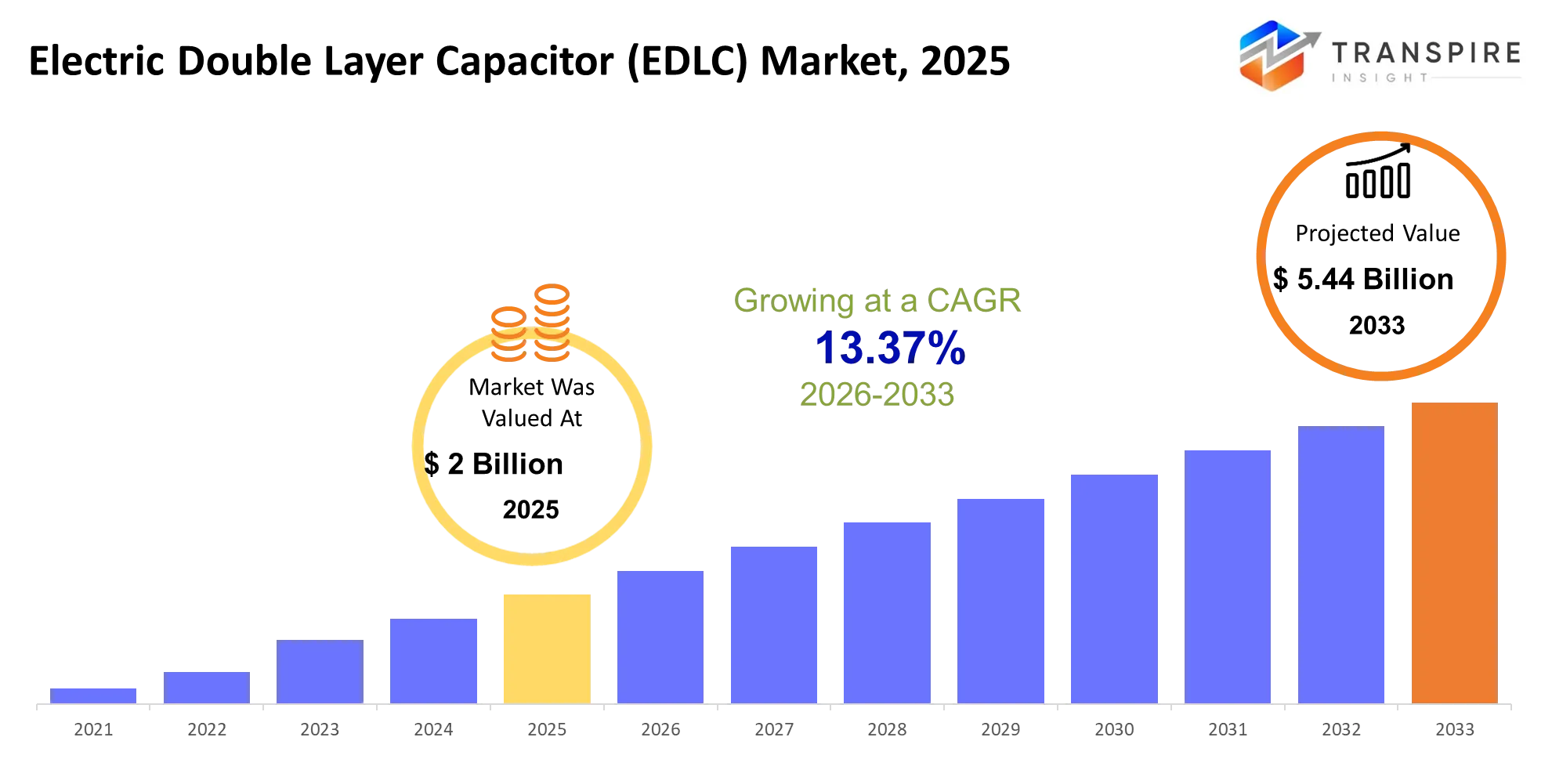
As per Transpire Insight, the Electric Double Layer Capacitor (EDLC) Market size is estimated at USD 2 billion in 2025 and is anticipated to reach USD 5.44 billion by 2033, growing at a CAGR of 13.37% from 2026 to 2033.
Electric Double Layer Capacitor (EDLC) Market supports equipment deliver power in bursts. They also recover energy. Keep systems running during brief power outages. This happens without relying on traditional batteries. These devices are used in controls, transport systems, smart meters, electronics and backup-power setups. In these areas, fast charging and the ability to go through charge-discharge cycles are important. Over the past three to five years, the market has changed. It has moved from selling EDLC components to offering engineered cells and modules. These can be built into power systems. A big change is the rise of new designs. Also, better carbon materials are being used. These help balance power output, energy storage and the physical size of the units. One reason for this growth is the spread of infrastructure. Things like meters, telecom gear and automated factory equipment need reliable backup for short power drops. As makers add monitoring electronics and get better at balancing the cells, designers can use EDLCs in voltage and power situations. This is making them more popular. Still, cost, how much energy they can store and how easy they are to fit into existing systems play a big part in whether someone buys them.
Electric Double Layer Capacitor (EDLC) Market Size & Forecast:
- Market Size 2025: USD 2 Billion
- Expected Market Value (2033): USD 5.44 Billion
- Forecast CAGR (2026–2033): 13.37%
- Leading Region in 2025: Asia Pacific
- Fastest Growing Region: Europe
- Key Company Profiles: Maxwell Technologies, Skeleton Technologies, Panasonic, Eaton, CAP-XX, Nippon Chemi-Con, LS Mtron, KEMET, Cornell Dubilier, Nesscap, Murata, Samwha Capacitor, Yunasko, Supreme Power Solutions, VINATech
Key Market Insights:
The market is shifting towards more traditional symmetric designs, but hybrid approaches and graphene studies hint at a slow move towards better performance.
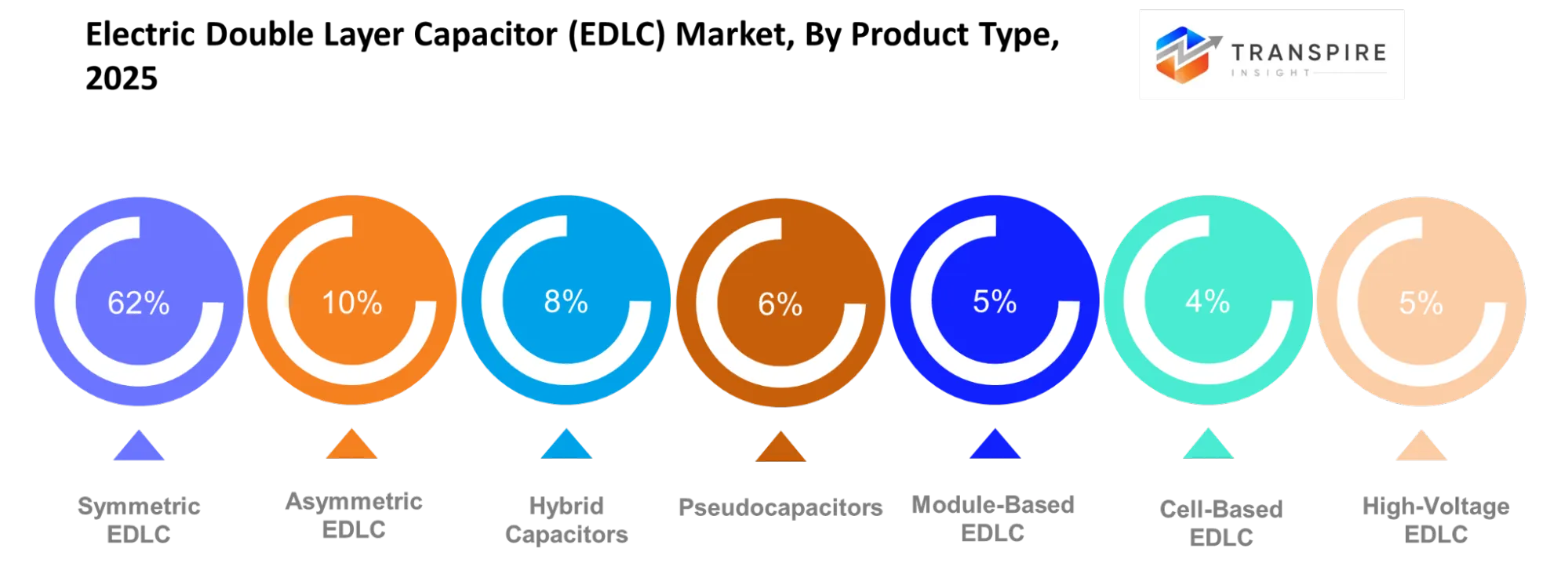
- Symmetric EDLCs constitute 62.40% of the supplied product-type mix, illustrating the established role of traditional designs in reliable, repeating power support.
- Asymmetric EDLCs With a 10.00% share of the supplied product mix, asymmetric EDLC designs give the makers a path to meeting application-related performance criteria as opposed to competing through standard cells.
- Hybrid Capacitors Comprising 8.00% of the supplied mix, hybrid capacitor products cater to needs for balancing high power supply and energy requirements.
- Pseudo-capacitors comprise 6.00% of the specified mix. Future development of this category will depend on electrode chemistry and cyclic stability.
- Module-based EDLCs holds 5.00% share implies, this category stresses the importance of packaging and voltage regulation in industrial and transport applications.
- Cell-based EDLCs account for a 4.00% share of the supplied mix, serving designers who prefer custom assembly of storage cells.
What are the Key Drivers, Restraints, and Opportunities in the Electric Double Layer Capacitor (EDLC) Market?
Drivers:
EDLC's growing use is facilitated by equipment with short-term power requirements, high charge/discharge rates, rapid recharge, and short backup durations. The use of connected infrastructure, autonomous manufacturing, energy meters, and transportation electrification are realistic triggers, as these systems often operate with short power interruptions or rapidly recover energy. As integrators bring storage closer to the load, EDLC cells and modules are specified as battery enhancers, alleviating peak stress and maintenance in appropriate applications. This provides earning opportunities for suppliers not only to sell cells but modules, balancing circuits, and engineering support.
Restraints:
Energy Density remains an inherent challenge. EDLCs are capable of high power delivery, but tend to offer a lower energy density than batteries on a per-weight basis, so may not be ideal for extended supply. Cost can also become an issue, requiring multiple cells, additional packaging, voltage-balancing circuits, protection and thermal management, which can all add to the overall system price. Consumers may hold off on adoption where the application can't support higher cost or existing battery solutions are more than sufficient.
Opportunities:
Growth may come from hybrid designs, graphene-based electrode research, and modular storage for industrial, telecom and grid-support applications. Local manufacturing programs and government backing of domestic energy-storage system providers could propel emerging entrants from prototypes to commercialisation. Suppliers should demonstrate lifetime, safety and system total cost of ownership with customers before scaling up their capacity.
|
Driver |
Relative Impact on Growth (%) |
Geographic Relevance |
Impact Timeline |
Demand Strength |
Growth Mechanism (5–10 words) |
Key Beneficiaries (5–10 words) |
Major Constraint (5–10 words) |
|
Renewable Energy Integration and Grid Stabilization |
26% |
Asia-Pacific, North America, Europe |
Medium-term (2–4 years) |
High |
Supports rapid power balancing and renewable energy fluctuations. |
EDLC manufacturers, grid operators, renewable energy equipment suppliers. |
High initial costs and limited energy storage capacity. |
|
Automotive Electrification and Regenerative Braking |
24% |
Asia-Pacific, Europe, North America |
Medium-term (2–4 years) |
High |
Captures braking energy and delivers rapid acceleration power. |
Automotive OEMs, capacitor manufacturers, electric vehicle component suppliers. |
Competition from lithium-ion batteries and alternative storage technologies. |
|
Industrial Automation and Uninterruptible Power Supply Systems |
20% |
North America, Asia-Pacific, Europe |
Short-term (≤2 years) |
High |
Provides instantaneous backup power and protects sensitive equipment. |
Industrial manufacturers, data centers, UPS suppliers, system integrators. |
Integration expenses and application-specific performance requirements. |
|
Consumer Electronics, Telecommunications and IoT Expansion |
16% |
Asia-Pacific, North America |
Short-term (≤2 years) |
Medium |
Enables rapid charging and reliable short-duration power delivery. |
Electronics manufacturers, telecom equipment suppliers, EDLC component vendors. |
Limited energy density and price-sensitive end-user demand. |
|
Technological Advancements and Sustainable Energy Storage Investments |
14% |
Asia-Pacific, Europe, North America |
Long-term (≥4 years) |
Medium |
Improves electrode performance, durability, and manufacturing efficiency. |
Advanced materials suppliers, research institutions, capacitor technology developers. |
Material costs, commercialization risks, and manufacturing scale-up challenges. |
|
Total |
100% |
Global |
— |
— |
— |
— |
— |
What Has the Impact of artificial intelligence on the Electric Double Layer Capacitor (EDLC) Market?
The application of AI will not replace EDLC chemistry, but will enhance the design and maintenance process of EDLC capacitor systems. In manufacturing, the use of machine vision inspection and process analytics can identify variations in electrodes, coatings, and assembly, thereby reducing defects and material waste. Modelling of the production process may also assist with operator tuning and batch-to-batch consistency. Once EDLC capacitors are integrated in modules, the monitoring software will be able to detect abnormal characteristics by analysing voltage, current, temperature and the charge-discharge behaviour. Predictive maintenance systems will be able to predict when module inspection is required, when there is a cell imbalance and prevent unexpected downtime. In power systems, energy management by the use of AI algorithms will allow coordination of EDLCs with batteries, renewable generation, or the grid, in order to use quick bursts of energy where it is more useful. This technology may improve uptime, quality control, and asset utilization.AI integration requires additional costs of sensors, software, and data management. The predictions are only as good as the amount of data that is obtained from the operation of the system.
Instance:
In September 2026, Infineon Technologies and Skeleton Technologies entered into a memorandum of agreement towards the creation of highly efficient power supplies for AI data centres. They have collaborated on the development of a new generation of power sources that integrate semiconductor technology from Infineon with supercapacitors by Skeleton to control the fast-changing demand for electricity. It is projected that this development will create fresh prospects for the EDLC industry through increased demand for fast energy storage.
https://www.infineon.com/technology-news/2026/inftn202609-134
Key Market Trends:
EDLC design and fabrication are now becoming governed more by the need for integration instead of capacitance only. End users want a dependable module, which can be made into a part of a larger electronic system thanks to support.
- The trend is from stand-alone cells toward packaged modules to facilitate installation and operation at higher voltages.
- EDLC vendors are incorporating capacitors with batteries, whereby the capacitors deliver short bursts of high power while the battery supplies long-term energy storage.
- The research focus has been expanded beyond activated carbon alone to include graphene and carbon nanotubes as well as composite electrodes, depending on materials and processes involved for each case.
- Smaller electronic products and devices that connect have encouraged more compact designs where smaller backup energy solutions can be housed inside smaller products.
- Buyers from industry sectors such as the telecommunications industry are becoming more interested in predictable lifecycle performance than component cost alone.
- Issues associated with balancing and monitoring of voltages are becoming more significant with multi-cell combinations forming higher voltages.
Electric Double Layer Capacitor (EDLC) Market Segmentation
By Product Type:
Symmetric EDLCs have the highest share of 62.40% due to the proven usage of symmetric EDLCs in applications where consistent performance is desired along with cycling capability. Asymmetric EDLCs hold 10.00% of the market, whereas hybrid capacitors make up 8.00%. These types of products are designed for applications where a different trade-off between power and energy is desired. Pseudocapacitors make up 6.00%, module-based EDLCs 5.00%, cell-based EDLCs 4.00%, and high-voltage EDLCs 4.60%. Hybrid and graphene-based EDLCs have been identified as the fastest-growing product type with a CAGR of 18.40%.
By Material:
Activated carbons are still an essential electrode choice given the familiarity of carbon production and their proven track record for double-layer storage. Carbon nanotubes and graphene are being considered for electrodes in conjunction with conductive networks, whilst carbon aerogels provide a porous structure for specialised geometries. Metal oxides and conducting polymers tend to be more associated with pseudocapacitive storage, but composites can be used to combine different properties from the constituent materials. The future for any of these materials will depend on ability to produce in a repeatable quality, at low cost, with stability.
By Application:
Automotive for peak-power support and short bursts of energy; consumer electronics as small backup power sources or energy harvesting. Industrial machinery for fast response in power dips, machine-cycle support, and backup of control systems. Renewable energy & grid for short-term power balancing & support applications-not a substitute for long-duration storage; transportation for high-cycle life and fast energy transfer, where braking energy or repeated acceleration produce short bursts of high power.
By Voltage:
The offered ranges from under 1V and 1-2V to 2-3V, 3-5V, 5-10V, above 10V and high-voltage modules. Lower-voltage versions are suitable for smaller electronic systems, while more powerful versions usually need cells in series with the proper balancing and protection. So the commercial potential is not solely a higher voltage level, but also the added ability to design a safe and monitored system.
By Power Rating:
Low- and medium-power products typically meet the demands of electronics and control systems. High-power, ultra-high-power and pulse-power product solutions are used in systems where rapid discharge is critical. Backup-power and energy-recovery product options can be matched to the power's duration and repetition rate, and application-specific sizing support can help ensure system cost is minimised by avoiding overdesign.
By End User:
Automotive OEMs want reliable parts that are platform qualified. Electronics device makers require components with reduced dimensions and enhanced integration to simplify assembly, minimise inventory and ensure continuous supply. Industrial companies care about uptime and service life, and energy companies assess system response and equipment reliability in the field. Transport operators demand fast power response and long service life; telecom customers need to be assured of backup performance. Aerospace and defence customers may need unique qualification or ruggedness, and may trace everything back to the original supplier.
What are the Key Use Cases Driving the Electric Double Layer Capacitor (EDLC) Market?
The use case of these EDLCs is fast power delivery and short-term backup, which fits into the powerful market presence of symmetric EDLCs in the provided segmentation. They can provide short bursts of current, assist in maintaining memory or control functions during interruption and ease the stress on the primary battery in the right designs. New applications include industrial automation, smart meters, telecommunication devices, transport systems, and automotive electronics. For these applications, modular design helps in matching the capacitance and voltage with the load, and also allows for balancing and monitoring if necessary. Potential new use cases include energy harvesting for connected sensors, renewable energy control systems and certain grid support functions. Hybrid storage systems might increase the number of applications, but EDLCs are useful when fast response and cycling are more important than energy storage.
|
Report Metrics |
Details |
|
Market size value in 2025 |
USD 2 Billion |
|
Market size value in 2026 |
USD 2.26 Billion |
|
Revenue forecast in 2033 |
USD 5.44 Billion |
|
Growth rate |
CAGR of 13.37% from 2026 to 2033 |
|
Base year |
2025 |
|
Historical data |
2021 - 2024 |
|
Forecast period |
2026 - 2033 |
|
Report coverage |
Revenue forecast, competitive landscape, growth factors, and trends |
|
Regional scope |
United States; Canada; Mexico; United Kingdom; Germany; France; Italy; Spain; Denmark; Sweden; Norway; China; Japan; India; Australia; South Korea; Thailand; Brazil; Argentina; South Africa; Saudi Arabia; United Arab Emirates |
|
Key company profiled |
Maxwell Technologies, Skeleton Technologies, Panasonic, Eaton, CAP-XX, Nippon Chemi-Con, LS Mtron, KEMET, Cornell Dubilier, Nesscap, Murata, Samwha Capacitor, Yunasko, Supreme Power Solutions, VINATech |
|
Customization scope |
Free report customization (country, regional & segment scope). Avail customized purchase options to meet your exact research needs. |
|
Report Segmentation |
Product Type (Symmetric EDLC, Asymmetric EDLC, Hybrid Capacitors, Pseudocapacitors, Module-Based EDLC, Cell-Based EDLC, High-Voltage EDLC); Material (Activated Carbon, Carbon Nanotubes, Graphene, Carbon Aerogel, Metal Oxides, Conducting Polymers, Composite Materials); Application (Automotive, Consumer Electronics, Industrial, Energy Storage, Renewable Energy, Grid Systems, Transportation); Voltage (Below 1V, 1–2V, 2–3V, 3–5V, 5–10V, Above 10V, High-Voltage Modules); Power Rating (Low Power, Medium Power, High Power, Ultra-High Power, Pulse Power, Backup Power, Energy Recovery); End User (Automotive OEMs, Electronics Manufacturers, Industrial Companies, Energy Companies, Transportation Operators, Telecom Companies, Aerospace & Defense) |
Which Regions are Driving the Electric Double Layer Capacitor (EDLC) Market Growth?
North America:
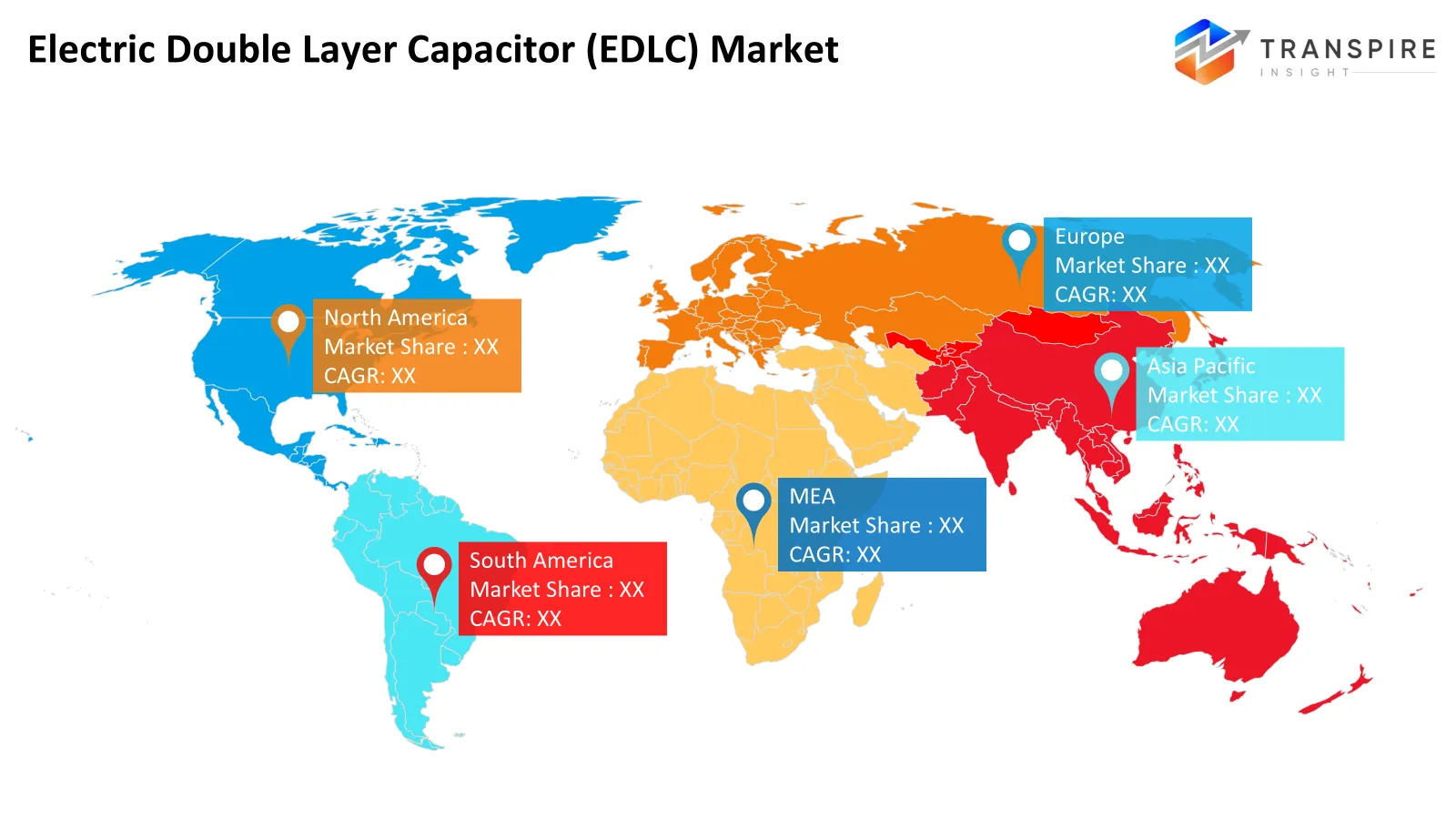
North America represents 17.00% of the regional split. Opportunities here relate to power systems in the industrial sector, increasing use of electricity in transport, the reliability needs of telecoms, and backup power needs for attached infrastructure. Ongoing engineering strength in the region, combined with technology suppliers, will help enable qualification and integration. The North America region has a smaller stated share compared to Asia-Pacific, so use case-specific high-value applications might matter more than volume-driven component manufacturing.
In October 2026, Siemens has made a strategic investment in Skeleton Technologies and an exclusive agreement for the incorporation of its supercapacitor technology with Siemens data centre infrastructure offerings. Siemens and Skeleton Technologies will also ramp up manufacturing in the United States to help meet North American demand for fast response energy storage for AI data centres and high-power electrical systems.
Europe:
Europe accounts for 25.00% of the supplied market and is listed as the fastest-growing, at 10.60% CAGR. Industrial modernisation, transport infrastructure and initiatives to increase energy efficiency will drive fast response storage opportunities. The need for clear documentation, safety validation and proven lifecycle performance will provide opportunities for application-specific engineering from suppliers. Whether projects can grow from evaluation and pilot use into repeat commercial orders will be key to growth.
In DECEMBER 2025, Skeleton Technologies officially launches the million Super Factory near Leipzig, Germany, which will deliver up to 12 million supercapacitor cells per year. The facility is already supplying some customers, including Siemens, General Electric and Hitachi Energy, for use in electricity-grid applications - helping to bolster manufacturing capacity in Europe and boosting the energy storage needed to power high-voltage systems.
Asia Pacific:
Asia Pacific accounts for 52.30% of the regional share supplied. Extensive electronics manufacturing ecosystems, industrial presence and automotive supply chains mean that Asia Pacific has a relatively wide customer base for EDLC cells and modules. Local component manufacturing and demand from connected devices can support volume manufacturing and provide a customer base for customers in multiple end markets. The challenge for Asia Pacific is to balance volume manufacturing with higher-value module design and quality, and advanced materials support.
In August 2026,Panasonic Industry. According to the company, mass production of these capacitors for external customers is planned to begin at the Chitose plant (Japan) in FY 2027. Panasonic is also exploring use in capacitor backup units for AI infrastructure, since supercapacitors can supply a significant amount of current all at once in order to compensate for power demand fluctuations. This could boost the inclusion of Asia Pacific in EDLC manufacturing and data centres 16.
https://news.panasonic.com/global/stories/18938
Who are the Key Players in the Electric Double Layer Capacitor (EDLC) Market and how do they compete?
Competition exists between specialist supercapacitor producers and diversified electronic component producers. Competition is based on power density, physical size, lifetime, temperature range, voltage offerings, application engineering capabilities and qualification of components for demanding applications. Some manufacturers concentrate on producing small-size components for electronics, while some produce large cells and modules for use in transportation, industrial power or backup systems. The ability to win customer design and reliable delivery could be as important as technical specifications since capacitor selection is often integrated into a product's design cycle. Maxwell Technologies concentrates on high-power cells and systems for mobility, industrial power and renewable energy applications, with experience and a wide cell offering as unique selling points. It produces flat supercapacitors for constrained electronics, IoT and selected automotive applications; its compact packaging is one of the differentiators. Vishay offers EDLC energy storage products for industrial and electronics designs, including ruggedised versions. Knowles extended its DSM module offering with a 60V version for high-voltage modular storage applications. Expansion in the competitive landscape will be achieved via design wins, distributor reach, engineering support and product variations for specific applications rather than via universal capacitor design.
Electric Double Layer Capacitor (EDLC) Market Companies
- Maxwell Technologies
- Skeleton Technologies
- Panasonic
- Eaton
- CAP-XX
- Nippon Chemi-Con
- LS Mtron
- KEMET
- Cornell Dubilier
- Nesscap
- Murata
- Samwha Capacitor
- Yunasko
- Supreme Power Solutions
- VINATech
|
Company |
Est. Revenue Share Range |
Key Offerings |
Strategic Positioning |
Geographic Strength |
Technology Focus |
|
Skeleton Technologies |
Estimated 8–14% |
SkelCap cells, SkelMod modules, SkelStart modules, SkelGrid systems |
High-power specialist with advanced materials differentiation |
Europe, North America |
Curved graphene, ultra-low ESR, high-power storage |
|
Maxwell Technologies |
Estimated 10–16% |
Standard Series cells, XP Series cells, DuraBlue cells, ultracapacitor modules |
Established supplier serving industrial and transportation applications |
North America, Asia Pacific, Europe |
High-capacitance cells, low ESR, rugged modules |
|
Eaton |
Estimated 7–12% |
XLR modules, XVM modules, XLM modules, XLHV modules |
Integrated power-management solutions for industrial customers |
North America, Europe |
Cell balancing, modular storage, power-system integration |
|
Nippon Chemi-Con |
Estimated 5–9% |
DLCAP DKA series, DKG series, DKJ series, supercapacitor modules |
Established component manufacturer emphasizing reliability and product breadth |
Asia Pacific, North America, Europe |
Low ESR, high capacitance, long-life EDLC cells |
|
VINATech |
Estimated 4–8% |
Hy-Cap cells, cylindrical cells, coin cells, customized modules |
Specialized manufacturer serving industrial and mobility applications |
Asia Pacific, Europe |
Advanced electrode materials, thermal management, long cycle life |
|
LS Mtron |
Estimated 3–6% |
Ultracapacitor cells, high-power energy-storage solutions |
Industrial technology challenger with energy-storage expertise |
Asia Pacific, North America |
High-power storage, electrode development, hybrid applications |
|
CAP-XX |
Estimated 2–5% |
Ultra-thin prismatic supercapacitors, coin-cell supercapacitors, cylindrical supercapacitors |
Niche specialist focused on compact electronic applications |
Asia Pacific, Europe, North America |
Thin-profile designs, high power density, compact packaging |
|
KEMET (YAGEO Group) |
Estimated 2–4% |
FC series, FCR series, FA series, FMD automotive series |
Component specialist competing through electronic-design integration |
North America, Europe, Asia Pacific |
Surface-mount EDLCs, high-temperature reliability, compact packaging |
|
Vishay Intertechnology |
Estimated 2–4% |
220 EDLC ENYCAP, 225 EDLC-R, 230 EDLC-HV, 235 EDLC-HVR |
Broadline component supplier targeting backup and industrial power applications |
North America, Europe, Asia Pacific |
Low-impedance EDLCs, ruggedized designs, backup-power integration |
|
KELTRON Component Complex Ltd. |
Estimated 1–3% |
EDLC supercapacitors, activated-carbon-based devices, aerogel-based technology |
Emerging regional manufacturer focused on India's supply base |
Asia Pacific, particularly India |
Automated production, advanced electrode materials, long cycle life |
Recent Development News
- In September 2026, EDLC technology was exhibited by Panasonic Industry along with other electronic components at Electronica India 2026, demonstrating its applicability to industries including industrial, automotive, rail, telecom, and data centres. The news indicates that suppliers continue to be focused on integrated component solutions for smart infrastructure. https://www.industrialautomationindia.in/news/panasonic-industry-next-gen-solutions-electronica-2026
- In October 2025, the Technology Development Board of India provided financial aid to Westech Power Management for the development of a mobile, high-power containerised supercapacitor energy storage system for industrial and defence applications. The initiative may help develop modular systems for fast charging, grid stabilisation, and field power supply applications in India. https://tdb.gov.in/tdb-dst-sanctions-support-indigenous-supercapacitor-energy-storage-system-ms-westech-power
What Strategic Insights Define the Future of the Electric Double Layer Capacitor (EDLC) Market?
The market is moving towards application-ready storage devices that combine cell performance, balancing electronics, monitoring and integration services in one package. Traditional symmetric EDLCs will continue to be relevant in existing applications, while hybrid EDLCs and new carbon materials will provide access to high-performance segments. One of the less visible risks is related to the investment in research-level materials without proving quality, price competitiveness and durability in large volumes. Another risk is the selection of batteries or other types of energy storage by customers in cases when energy duration is more critical than fast power delivery. The greatest opportunities exist in situations with intensive cycling, short power pulses and low maintenance costs, such as industrial controls, telecom backup and certain transport applications. Suppliers need to focus on pilot projects led by customers, publish life cycle and performance data, and develop modular products with clear balancing and monitoring options. Expansion should be based on validated design wins, not increased capacities based on forecasted demand.
Key Segmentations are:
Product Type
- Symmetric EDLC
- Asymmetric EDLC
- Hybrid Capacitors
- Pseudocapacitors
- Module-Based EDLC
- Cell-Based EDLC
- High-Voltage EDLC
Material
- Activated Carbon
- Carbon Nanotubes
- Graphene
- Carbon Aerogel
- Metal Oxides
- Conducting Polymers
- Composite Materials
Application
- Automotive
- Consumer Electronics
- Industrial
- Energy Storage
- Renewable Energy
- Grid Systems
- Transportation
Voltage
- Below 1V
- 1–2V
- 2–3V
- 3–5V
- 5–10V
- Above 10V
- High-Voltage Modules
Power Rating
- Low Power
- Medium Power
- High Power
- Ultra-High Power
- Pulse Power
- Backup Power
- Energy Recovery
End User
- Automotive OEMs
- Electronics Manufacturers
- Industrial Companies
- Energy Companies
- Transportation Operators
- Telecom Companies
- Aerospace & Defense
By Regional Analysis
North America
- US
- Canada
- Mexico
Europe
- Germany
- UK
- France
- Italy
- Spain
- Russia
- Rest of Europe
Asia Pacific
- China
- Japan
- India
- South Korea
- Australia
- Rest of Asia Pacific
South America
- Brazil
- Argentina
- Rest of South America
Middle East & Africa
- UAE
- Saudi Arabia
- Qatar
- South Africa
- Rest of the Middle East & Africa
Frequently Asked Questions
Find quick answers to common questions.
The electric double layer capacitor (EDLC) market size was valued at USD 2 Billion in 2025 and is poised to reach USD 5.44 Billion by 2033, expanding at a 13.37% CAGR.
Key segments for the electric double layer capacitor (EDLC) market are Product Type (Symmetric EDLC, Asymmetric EDLC, Hybrid Capacitors, Pseudocapacitors, Module-Based EDLC, Cell-Based EDLC, High-Voltage EDLC); Material (Activated Carbon, Carbon Nanotubes, Graphene, Carbon Aerogel, Metal Oxides, Conducting Polymers, Composite Materials); Application (Automotive, Consumer Electronics, Industrial, Energy Storage, Renewable Energy, Grid Systems, Transportation); Voltage (Below 1V, 1–2V, 2–3V, 3–5V, 5–10V, Above 10V, High-Voltage Modules); Power Rating (Low Power, Medium Power, High Power, Ultra-High Power, Pulse Power, Backup Power, Energy Recovery); End User (Automotive OEMs, Electronics Manufacturers, Industrial Companies, Energy Companies, Transportation Operators, Telecom Companies, Aerospace & Defense).
Growth is primarily driven by increasing demand for energy storage solutions, rising adoption of electric vehicles, expansion of renewable energy projects, and growing use of consumer electronics. The need for rapid charging, high power density, and longer-lasting energy storage systems further supports market growth.
The market is led by major manufacturers including Maxwell Technologies, Skeleton Technologies, Panasonic, Eaton, CAP-XX, Nippon Chemi-Con, LS Mtron, KEMET, Cornell Dubilier, Nesscap, Murata, Samwha Capacitor, Yunasko, Supreme Power Solutions, VINATech.
The Asia Pacific region leads the EDLC market share, accounting for 52.30%, due to high demand for consumer electronics, EVs, and renewable energy storage applications. Other favorable factors contributing to its growth include a robust base of electronics manufacturers in the region, increasing industrial automation, and government incentives for clean energy solutions.
The world EDLC market provides business prospects because of the increasing use of electric cars, renewable energy storage systems, and industrial automation. The rising need for rapid charging energy storage devices, energy-efficient electronics, and hybrid power sources can provide business prospects for manufacturers of EDLCs.
- Maxwell Technologies
- Skeleton Technologies
- Panasonic
- Eaton
- CAP-XX
- Nippon Chemi-Con
- LS Mtron
- KEMET
- Cornell Dubilier
- Nesscap
- Murata
- Samwha Capacitor
- Yunasko
- Supreme Power Solutions
- VINATech
About the Authors

Avinash Kumar
I’m Avinash Kumar, a Senior Research Analyst at Transpire Insight, with expertise in the Electronics and Semiconductor and Energy & Power industry. My work focuses on analyzing emerging technologies, market trends, industry developments, and innovation across these sectors. I specialize in transforming complex technical and market insights into clear, research-backed content that helps professionals, businesses, and decision-makers stay informed. Through continuous industry research and data-driven analysis, I strive to deliver accurate, reliable, and practical perspectives on the latest advancements shaping the semiconductor and energy landscape.

Chakradhar Khansole
Chakradhar serves as the Research Director at Transpire Insight, bringing over 8 years of experience in technology, innovation, and strategic market intelligence. He specializes in transforming complex market data into actionable business insights that enable organizations to make informed, growth-oriented decisions. Recognized for his strategic vision and analytical expertise, Chakradhar leads high-impact research initiatives, delivering comprehensive market assessments, competitive intelligence, and forward-looking industry analysis.
Recently Published Reports
-
Apr 2026
Fiber Optic Faceplates Market
Fiber Optic Faceplates Market Size, Share & Analysis Report By Type (< 300 mm2, 300-350 mm2, and > 350 mm2, By Application (Night Vision, Holographic Imaging, Medical, and Others), and Geography (North America, Europe, Asia-Pacific, Middle East and Africa, South and Central America), 2021 - 2031
-
Apr 2026
High Temperature Superconductors Market
High Temperature Superconductors Market Size, Share & Analysis Report By Type (1G HTS, and 2G HTS), By Application (Power Cable, Fault Current Limiter, and Transformer), and Geography (North America, Europe, Asia-Pacific, Middle East and Africa, South and Central America), 2021 - 2031
-
Apr 2026
Industrial Plugs and Socket Market
Industrial Plugs and Socket Market Size, Share & Analysis Report By Type (Industrial Plugs, Industrial Sockets), By Current (Up to 32 A, 32 to 125 A, Above 125 A), By Protection (Dustproof and Splash Proof, Waterproof, Explosion Proof), By End User (Heavy Industries, Oil and Gas, Chemicals and Pharmaceuticals, Power Generation, Others), and Geography (North America, Europe, Asia-Pacific, Middle East and Africa, South and Central America), 2021 - 2031
-
Apr 2026
InGaAs Avalanche Photodiodes Market
InGaAs Avalanche Photodiodes Market Size, Share & Analysis Report By Type (1100 - 1700 nm, and 1000 - 1600 nm), By Application (Missile Warning System, Muzzle Flash Detection, Wafer Defect Inspection, Laser Rangefinders, and Others), and Geography (North America, Europe, Asia-Pacific, Middle East and Africa, South and Central America), 2021 - 2031