

Fruit Concentrate Market Summary
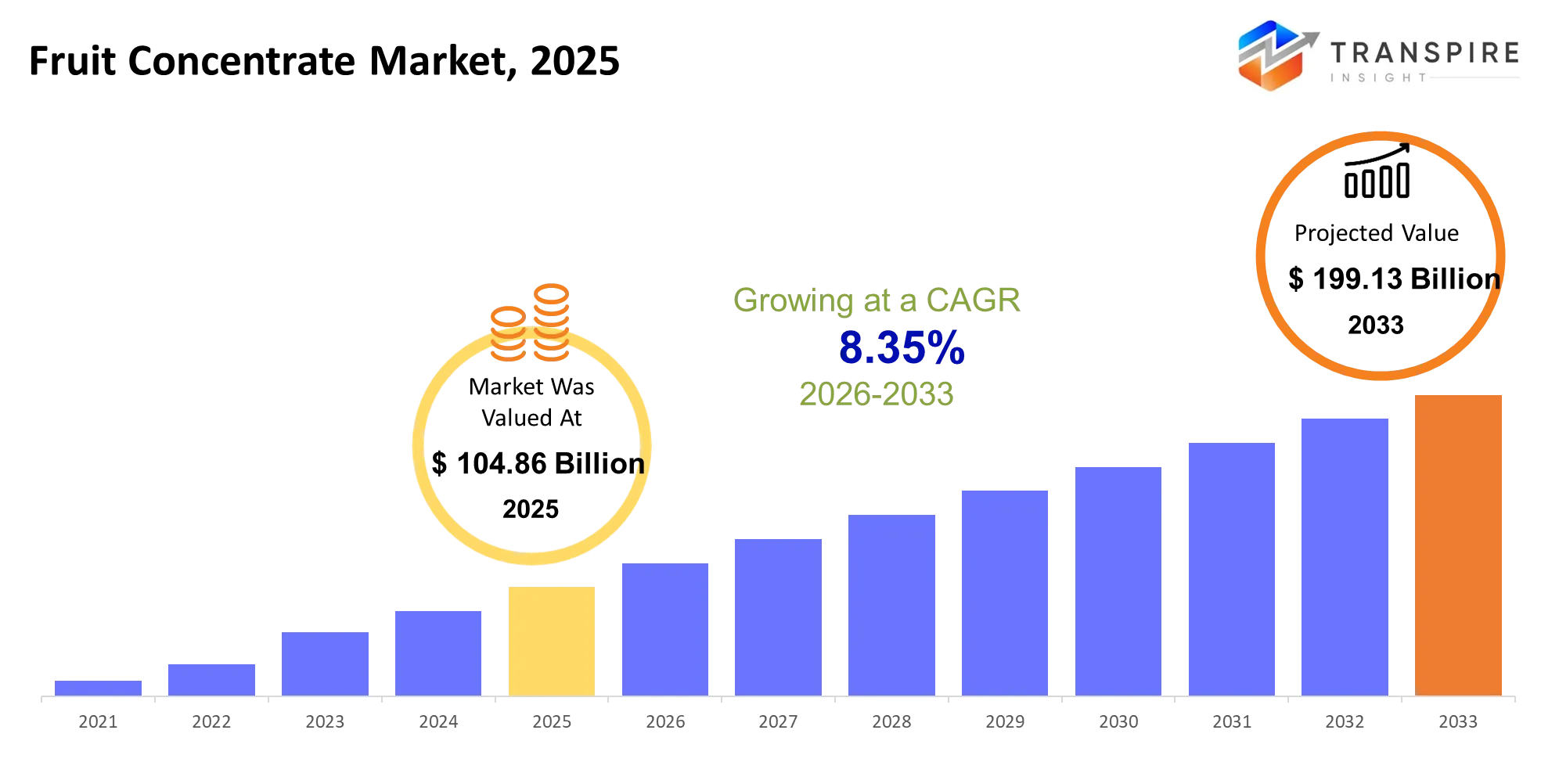
As per Transpire Insight Analysis, the Fruit Concentrate Market size is estimated at USD 104.86 billion in 2025 and is anticipated to reach USD 199.13 billion by 2033, growing at a CAGR of 8.35% from 2026 to 2033.
The fruit concentrates market supports food and beverage producers to give consumers fruit taste, bright colour and natural sweetness. At the same time, fruit concentrates cut down the amount of juice needed, saving storage space. Over the last three to five years in prices of fruits and their availability. There are demands for lists of ingredients as well as fruit-based sweetening alternatives. Poor weather conditions such as frosts and poor harvesting have contributed to the need for better planning in fruit procurement. The suppliers are developing fruit concentrates, beverage bases and natural fruit flavouring systems for ready-to-drink beverages, dairy products and other processed foods. More efficient evaporators and filtration systems, quality control and energy use can contribute to higher consistency. Reduce waste. The development of the market is not only about the production of the beverages but also because the manufacturers need fruit ingredients, formulas and fruit availability throughout the year. The companies that are able to guarantee fruit and application support are in a better position to cope with the price fluctuations.
Fruit Concentrate Market Size & Forecast:
- Market Size 2025: USD 104.86 Billion
- Expected Market Value (2033): USD 199.13 Billion
- Forecast CAGR (2026-2033): 8.35%
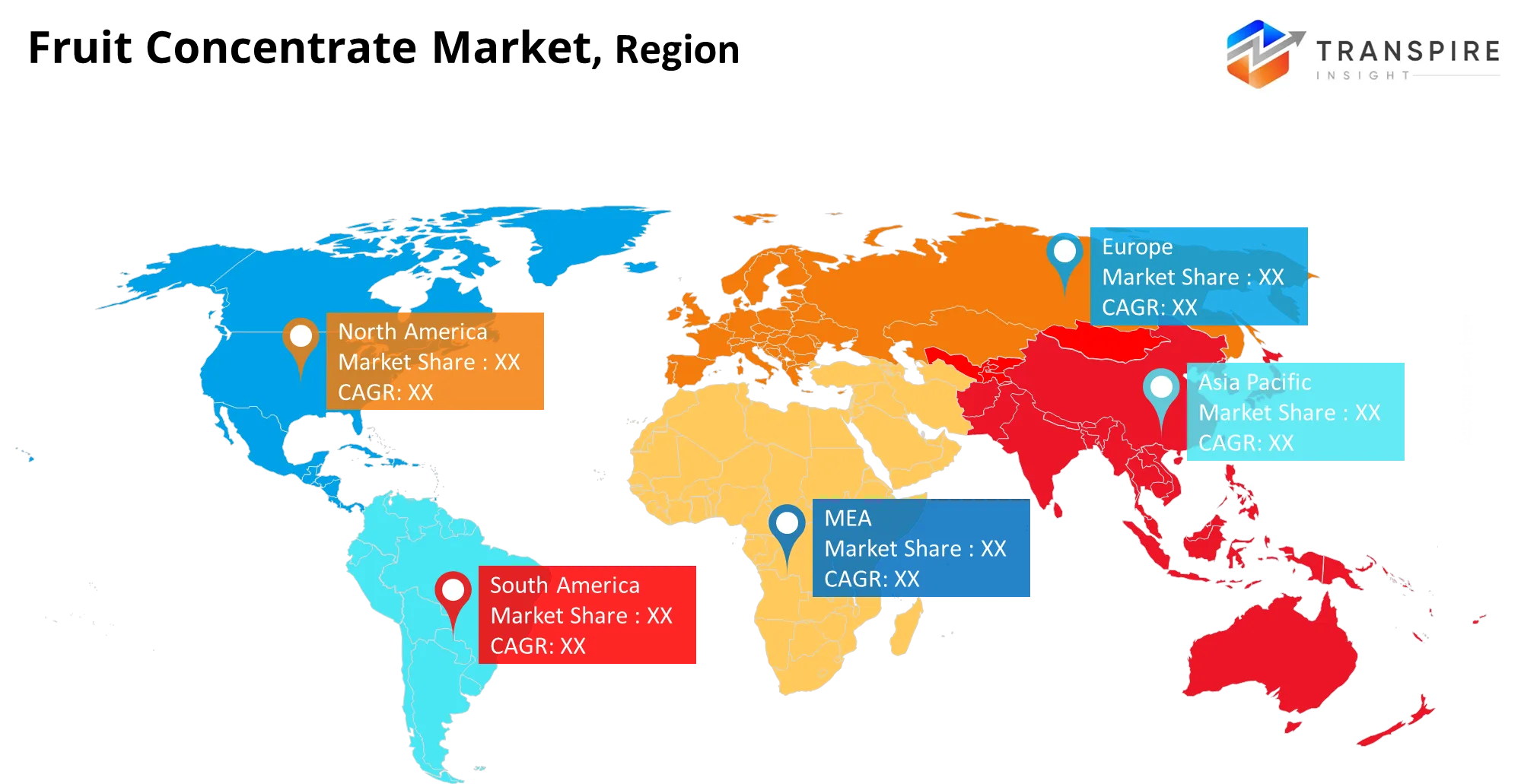
- Leading Region in 2025: Europe
- Fastest Growing Region: Asia Pacific
- Key Company Profiles: Döhler, Ingredion, Kerry Group, ADM, Tate & Lyle, Symrise, IFF, AGRANA, SVZ, Tree Top, Lemon Concentrate, Milne Fruit Products, Prodal, Citrofrut, Ciatti
Key Market Insights:
The market is moving towards a combination of traditional ingredients from apples and citrus fruits as well as growing tropical fruit options.
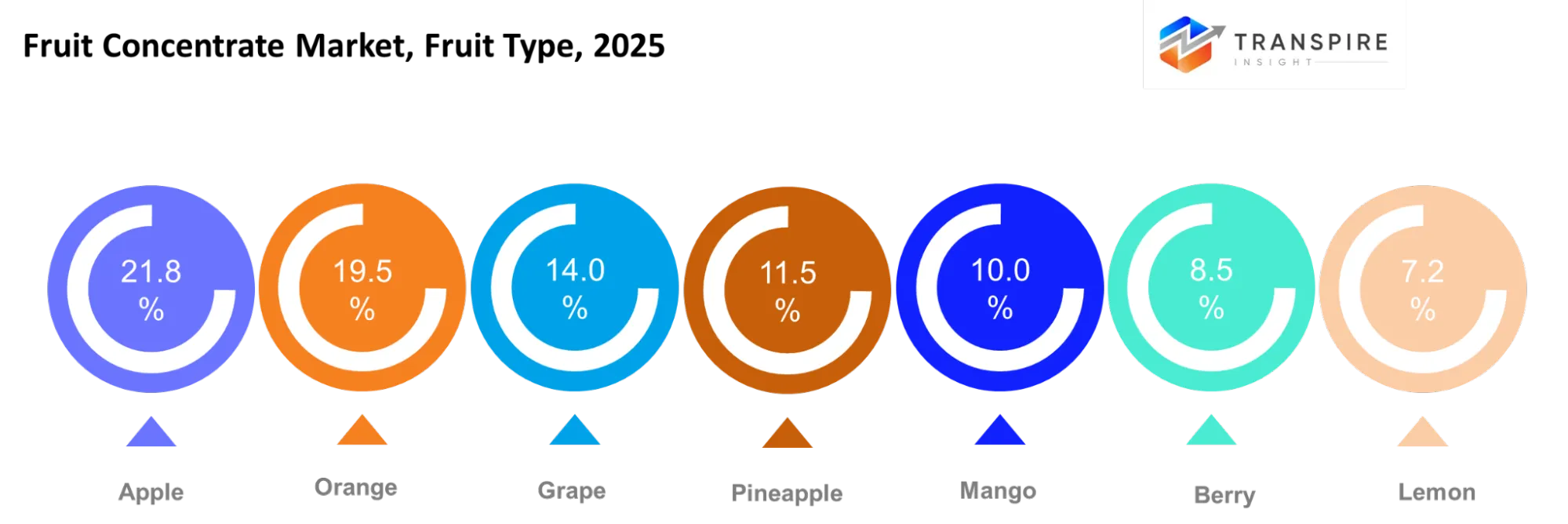
- Apple concentrate constitutes 21.8% of the fruit-type mix in the provided data set, thus emphasising the significance of existing orchard-fruit supply chains.
- Grape concentrate constitutes 14.0%, thus being suitable for juice mixes, sweetener systems, and food formulations where consistency of colour and taste is important.
- Pineapple accounts for 11.5%. Seasonal tropical fruit supply requires proper management of supplier relationships and procurement from various sources.
- Berry concentrate constitutes 8.5%, while its demand depends on flavour diversity and its application in beverages, dairy products and fruit mixes.
- Lemon concentrate constitutes 7.2%, providing opportunities for citrus flavours in drinks, sauces and other food products.
- Other fruits constitute 7.5%, allowing formulators to make their products distinctive by means of seasonality, regional and mixed-fruit recipes.
What are the Key Drivers, Restraints, and Opportunities in the Fruit Concentrate Market?
Drivers
One key driver is the requirement for food and beverage producers to make their product recipes uniform at a large commercial scale. Concentrates are an effective means of achieving batch-to-batch consistency in fruit taste and sugar content, while minimising the bulk that needs to be shipped and stored. The recent disturbance to harvests of apples, berries and tropical fruit has also led buyers to purchase sooner in the season, verify alternative sources and identify formulatory ingredients capable of delivering greater raw-material safety. This can aid the acceptance of suppliers with reliable quality and greater specification and technical flexibility.
Restraints
The limitations due to farm risks. Poor weather, plant diseases, changes in the amount of yield from the harvest, and the rise in the cost of energy and transportation can cause increases in the cost of inputs or reductions in supply. These are structural limitations since the supply of the fruit is seasonal and geographic in nature, and large producers may not always be able to pass these on to consumers. Small and medium-sized producers may find it hard to access financing to install modern technology and machinery.
Opportunities
There is an opportunity to build resiliency into the sourcing process, as well as to create more valuable ingredient portfolios. Optical sorting, process sensing, energy-efficient concentration, and crop monitoring will increase yield efficiency and reduce quality variability. The suppliers could also consider the cultivation of mango and berry ingredients that would satisfy requirements for Asian beverages and work on organic, clean label, and personalized formats that would help to differentiate the brand. Collaboration with growers and local processors will improve traceability, shorten the supply chain, and improve supply stability.
|
Driver |
Relative Impact on Growth (%) |
Geographic Relevance |
Impact Timeline |
Demand Strength |
Growth Mechanism (5-10 words) |
Key Beneficiaries (5-10 words) |
Major Constraint (5-10 words) |
|
Rising demand for fruit-based beverages and processed foods |
28% |
North America, Europe, Asia-Pacific |
Short-term (≤2 years) |
High |
Expands concentrate use in juices, beverages, dairy, and snacks |
Fruit concentrate producers, beverage brands, food processors |
Changing consumer preferences and intense beverage competition |
|
Growing preference for natural ingredients and clean-label products |
23% |
North America, Europe |
Medium-term (2-4 years) |
High |
Replaces artificial flavors with recognizable fruit-derived ingredients |
Natural ingredient suppliers, clean-label brands, food manufacturers |
Higher processing costs and inconsistent raw material quality |
|
Increasing demand for shelf-stable ingredients and efficient transportation |
19% |
Asia-Pacific, North America, Europe |
Short-term (≤2 years) |
High |
Reduces storage volumes, transportation costs, and spoilage risks |
Concentrate manufacturers, exporters, distributors, foodservice suppliers |
Energy-intensive processing and cold-chain infrastructure requirements |
|
Technological advancements in concentration and processing methods |
16% |
Europe, North America, Asia-Pacific |
Long-term (≥4 years) |
Medium |
Improves yield, flavor retention, and processing efficiency |
Processing equipment vendors, concentrate producers, ingredient technology providers |
High capital investment and technical implementation complexity |
|
Rising focus on food waste reduction and sustainable sourcing |
14% |
Europe, Asia-Pacific, Latin America |
Medium-term (2-4 years) |
Medium |
Converts surplus and imperfect fruits into commercially valuable ingredients |
Fruit processors, farmers, sustainability-focused food manufacturers |
Seasonal fruit availability and inconsistent sourcing standards |
|
Total |
100% |
— |
— |
— |
— |
— |
— |
|
Rising demand for fruit-based beverages and processed foods |
28% |
North America, Europe, Asia-Pacific |
Short-term (≤2 years) |
High |
Expands concentrate use in juices, beverages, dairy, and snacks |
Fruit concentrate producers, beverage brands, food processors |
Changing consumer preferences and intense beverage competition |
What is the Impact of artificial intelligence on the Fruit Concentrate Market?
AI is improving decision-making at the stages of sourcing, manufacturing, and quality control. In the orchards and sourcing network, machine vision and forecasts can be used to assess the condition of the crops and estimate the potential yield and weather risks. The forecasts will enable processors to make plans for purchasing and producing; the result will depend on the quality of the data. Predictive maintenance will be able to spot any equipment malfunctions and prevent any equipment failures that can stop the manufacturing process. Lastly, planning software can help match the availability of fruits, orders and the capacity of the production line. Consistent and timely reaction to changes in the supply without guarantee of reducing the costs. One of the main problems of utilising artificial intelligence technologies in fruit processing is the high price of using the technology, including the hardware, integration, and the learning by personnel. Furthermore, the forecasts provided by the model can be incorrect if the harvesting information is incomplete and the growing conditions change rapidly. The company needs to start with a defined use case and measure performance with plant data.
In September 2026, Fruit processing research through artificial intelligence pointed to the advantages that AI offers for fruit processing, such as quality inspections, optimal processing parameters, and waste reduction. These technologies could assist fruit concentrate manufacturers in keeping the same flavour, colour, and quality of their products.https://www.sciencedirect.com/science/article/pii/S0956713526001556
Key Market Trends:
The industry has shifted from conventional bulk mass commodities to more customised solutions that help companies achieve a balance between taste, price, and labelling.
- A shift towards clean labels has encouraged the use of solutions based on fruit-sourced sweetness and flavours, which meet the criteria of shorter lists of ingredients.
- Beverages like ready-to-drink, sports, and functional are leading the trend and encouraging manufacturers to develop concentrates which can be incorporated in complex formulations.
- Manufacturers are increasingly concerned about process control, filtration, and concentration processes, as they want to retain the flavour while keeping specifications constant.
- Traceability has become a concern among food processors because they need better documentation on the origin of ingredients, testing procedures, and batch handling processes.
- Not only juice manufacturers but now the use of fruit concentrates is also prevalent in dairy, baking fillings, sauces, confections, and fruit snacks industries.
Fruit Concentrate Market Segmentation
By Fruit Type
The apple concentrate segment holds the highest market share at 21.8% due to well-established processing facilities and the adaptability of the fruit in juice mixes and food products. The orange concentrate segment occupies 19.5%, followed by the grape segment with 14.0% and the pineapple segment with 11.5%. The mango segment has 10.0% and is noted to be the fastest-growing segment with a 7.8% CAGR, thus indicating the possibility of tropical beverages and fruit mixes. The berry concentrate segment holds 8.5%, while the lemon segment holds 7.2%.
By Form
Liquid concentrate is also a popular choice as it can be dosed into existing production lines for high output beverage and food applications. Powder concentrate has some advantages in dry mix handling and storage, and frozen concentrate helps to maintain product attributes during storage. Clarified and cloudy concentrate formats have different visual and textural effects, while NFC blends, puree concentrate and other formats offer more control over mouthfeel, appearance and processing properties. Investment in flexible processing equipment can help processors cater for customers' varied formulation needs.
By Nature
The traditional raw materials are valuable for low-cost, high-volume products because the distribution channels and specifications are all set up. Specialised solutions like organic, non-GMO, natural, clean label, fair trade and sustainability will be useful for addressing the specific requirements of sourcing and positioning. All of these can act as differentiation factors; there needs to be some evidence supporting the claims. Both standard and certified offerings will give an edge to the supplier in addressing varied customer requirements.
By Application
Juices and nectars are a primary application for concentrates, such as our spirulina extract. Whether it is a juice, a nectar, a children's juice beverage, a smoothie, or a ready-to-drink product, our concentrates are a foundation for nearly all beverage platforms. Our fruit ingredients are a key aspect of our dairy applications for yoghurts, drinkable dairy and desserts. Bakery and confectionery applications use fruit colour, fruit flavour and filling functionality and sauces and dressings apply our fruit ingredients as well.
By Distribution
Direct sales will provide large food and beverage companies the opportunity to negotiate specifications and the amount of supplies needed for processing. For example, distributors and wholesalers will enable smaller clients to be able to buy different types of fruit and packaging options, whereas supermarket retailers and speciality retailers will be important for consumer concentrates. Foodservice is an appropriate channel for beverages and ready-made foods. Online sales can benefit small brands that are seeking niche products. The right sales channel will depend on order size, storage possibilities and technical assistance.
By End User
Products used by beverage manufacturers are among the top purchasing categories because concentrates can keep flavours consistent over large production quantities. Food manufacturers, who use concentrates in sauces, confectionery, fillings and other processed foods, as well as dairy processors and bakeries which need ingredients for their particular processing conditions, also make considerable use of concentrates. Foodservice and retail customers want a consistent product, ease of preparation and quality service; ingredient suppliers may create 'value-added' concentrates for other upstream customers. Technical service and consistent supply may clinch qualification.
What are the Key Use Cases Driving the Fruit Concentrate Market?
The use case is beverage manufacturing, where the use of apple concentrate, being the biggest fruit type in the provided data set, enables suppliers to provide consistency in sweetness and fruity flavour in juices, nectars, and blends. The use of concentrates reduces the volume of water transportation when compared to single-strength juice, which makes for more efficient transport and handling. Use cases will include fruit-flavoured yoghurts, dairy beverages, bakery fillings, confections, dressings, and sauces. Different fruits such as orange, grape, pineapple, and berries will contribute their flavouring and colouring capabilities, making it possible to tailor products according to local requirements and preferences. Use cases can include fruit snacks, functional beverages, and customised blends that would be used in clean-label product lines. Mango is one of the fast-growing fruit categories mentioned in the provided market outlook. Growth will be driven by access to fruit supply, formula performance, and pricing.
|
Report Metrics |
Details |
|
Market size value in 2025 |
USD 104.86 Billion |
|
Market size value in 2026 |
USD 113.61 Billion |
|
Revenue forecast in 2033 |
USD 199.13 Billion |
|
Growth rate |
CAGR of 8.35% from 2026 to 2033 |
|
Base year |
2025 |
|
Historical data |
2021 - 2024 |
|
Forecast period |
2026 - 2033 |
|
Report coverage |
Revenue forecast, competitive landscape, growth factors, and trends |
|
Regional scope |
United States; Canada; Mexico; United Kingdom; Germany; France; Italy; Spain; Denmark; Sweden; Norway; China; Japan; India; Australia; South Korea; Thailand; Brazil; Argentina; South Africa; Saudi Arabia; United Arab Emirates |
|
Key company profiled |
Döhler, Ingredion, Kerry Group, ADM, Tate & Lyle, Symrise, IFF, AGRANA, SVZ, Tree Top, Lemon Concentrate, Milne Fruit Products, Prodal, Citrofrut, Ciatti |
|
Customization scope |
Free report customization (country, regional & segment scope). Avail customized purchase options to meet your exact research needs. |
|
Report Segmentation |
Fruit Type (Apple, Orange, Pineapple, Grape, Mango, Berry, Lemon, Others)Form (Liquid Concentrate, Powder Concentrate, Frozen Concentrate, Clarified Concentrate, Cloudy Concentrate, NFC Blends, Puree Concentrate, Others)Nature (Conventional, Organic, Non-GMO, Natural, Clean-Label, Fair-Trade, Sustainable, Others)Application (Beverages, Dairy Products, Bakery & Confectionery, Sauces & Dressings, Infant Food, Functional Foods, Alcoholic Beverages, Others)Distribution (Direct Sales, Supermarkets, Specialty Stores, Foodservice, Online, Distributors, Wholesalers, Others)End User (Food Manufacturers, Beverage Manufacturers, Dairy Producers, Bakeries, Foodservice Operators, Retailers, Ingredient Suppliers, Others) |
Which Regions are Driving the Fruit Concentrate Market Growth?
North America
North America accounts for 27.8% and has a mature packed foods and beverages industry, ingredient transportation channels and manufacturing capabilities on a large scale. The demand coming from companies that manufacture juices, dairy products, snacks and foodservice helps in using standard fruit ingredients. The logistics and quality management system is also in place to help the manufacturers in processing large orders and managing customer specifications. The competition in the region, nevertheless, makes reliable supplies and formulating expertise the key differentiators.
In October 2025, Lassonde Industries rolled out a production line for a fruit concentrate bag-in-box packaging system at their facility in Rougemont, Quebec, thus augmenting specialised packaging solutions for corporate and beverage clients.https://www.lassonde.com/en/communications/
Europe
The largest supplied regional market share is held by Europe, which accounts for 31.6%. This is because there exists well-developed processing expertise of fruits, food manufacturing industries and a developed customer base for the ingredient. Firms like AGRANA and AUSTRIA JUICE have concentrated on supplying apple and berry concentrates along with natural flavours in beverages. This region also serves customers who seek organic products and customised specifications.
In May 2025, AGRANA announced it would buy out the other 49.99% of AUSTRIA JUICE, enhancing its presence in the apple and berry concentrates, flavours, and ingredients markets.https://www.agrana.com/news/pr-2648-agrana-resolves-to-fully-acquire-austria-juice-gmbh
Asia Pacific
Asia Pacific represents 24.5% of the mix offered regionally and is seen as the highest growth region, which has a forecasted 7.4% CAGR. Urbanisation, growth of packaged beverages and food manufacturing provide opportunities for suppliers of liquid, powdered and tropical fruit concentrates. Mango and pineapple products will be helpful as they pertain to regional tastes; additionally, investments in local processing facilities will help access raw materials and shorten the distance of shipment. The suppliers that form partnerships regionally and provide formulations based on price could find an advantage.
In March 2026, Yantai North Andre Juice recorded higher operating profits in 2025 as a result of increased juice concentrates sales and functioning as a supplier to international market https://www.hkexnews.hk/listedco/listconews/sehk/2026/0408/2026040802508.pdf
Who are the Key Players in the Fruit Concentrate Market, and how do they Compete?
Competitors are diverse ingredient companies, speciality fruit processors and regional suppliers. Key differences arise in terms of fruit access, specification standards, portfolio range, technical service, production facilities and ability to manage fluctuations in costs during seasons. Companies increasingly compete with each other through providing full formulation solutions rather than just selling bulk concentrate.AGRANA leverages AUSTRIA JUICE for specialising in apple and berry concentrates, beverage bases and natural flavours. It helps the company grow internationally and build synergies. Döhler differentiates itself by integrating food and beverage ingredients, specialised formulas and application services. SunOpta is known to specialise in fruit and better-for-you food and beverages that include fruit ingredients for snacking applications, while Tree Top has a reputation for apple ingredients. SVZ and Kerry distinguish themselves with fruit ingredients experience and customised solutions for industrial customers. Growth can be achieved through acquisitions, building production facilities, customer partnerships and product portfolio expansion. Regarding buyers, supplier selection usually depends on fruit specification, quality documentation, cost stability, logistics performance and the supplier’s assistance in scaling recipes to production.
Fruit Concentrate Market companies
- Döhler
- Ingredion
- Kerry Group
- ADM
- Tate & Lyle
- Symrise
- IFF
- AGRANA
- SVZ
- Tree Top
- Lemon Concentrate
- Milne Fruit Products
- Prodal
- Citrofrut
- Ciatti
|
Company |
Est. Revenue Share Range |
Key Offerings |
Strategic Positioning |
Geographic Strength |
Technology Focus |
|
Döhler GmbH |
Estimated 4-7% |
Fruit juice concentrates; puree concentrates; special concentrates; fruit blends |
Integrated ingredient solutions with customized formulations |
Europe; North America; Asia Pacific |
Aroma recovery; gentle concentration; sensory stabilization |
|
AGRANA Beteiligungs-AG |
Estimated 5-8% |
Apple concentrates; berry concentrates; organic concentrates; fruit sweetness solutions |
Large-scale processing with integrated agricultural sourcing |
Europe; North America; Asia Pacific |
Concentration efficiency; quality analytics; process standardization |
|
Archer Daniels Midland (ADM) |
Estimated 3-6% |
Fruit-based ingredients; juice concentrates; beverage ingredient systems; customized blends |
ingredient sourcing and multinational customer partnerships |
North America; Europe; Asia Pacific |
Ingredient processing; formulation optimization; quality control |
|
Ingredion Incorporated |
Estimated 2-4% |
Fruit-based ingredients; specialty food ingredients; beverage formulation solutions; fruit-derived sweetening ingredients |
Specialty ingredient integration and application-led differentiation |
North America; Latin America; Asia Pacific |
Formulation science; texture optimization; ingredient functionality |
|
SunOpta Inc. |
Estimated 2-4% |
Fruit juice ingredients; fruit purees; organic fruit ingredients; beverage inputs |
Focus on plant-based and better-for-you food applications |
North America; Asia Pacific |
Aseptic processing; ingredient preservation; food safety systems |
|
SVZ International B.V. |
Estimated 1-3% |
Fruit juice concentrates; puree concentrates; NFC juices; frozen fruit ingredients |
Fruit-specialist supplier emphasizing tailored industrial ingredients |
Europe; North America; Asia Pacific |
Gentle processing; color retention; customized ingredient specifications |
|
Kerry Group plc |
Estimated 1-3% |
Fruit-based beverage ingredients; fruit preparations; flavor systems; customized beverage solutions |
Application-driven differentiation through taste and formulation expertise |
Europe; North America; Asia Pacific |
Flavor optimization; sensory science; formulation development |
|
China Haisheng Juice Holdings Co., Ltd. |
Estimated 2-5% |
Apple juice concentrates; apple-derived ingredients; fruit juice products; fruit processing solutions |
Scale-oriented fruit processing with strong apple supply-chain exposure |
Asia Pacific; Europe; North America |
Industrial extraction; concentration; integrated fruit processing |
|
Tree Top Inc. |
Estimated 1-3% |
Apple juice concentrates; fruit purees; apple ingredients; custom fruit ingredients |
Cooperative-backed sourcing and apple ingredient specialization |
North America; Asia Pacific |
Apple processing; concentrate standardization; quality testing |
|
Lemonconcentrate S.L.U. |
Estimated 1-3% |
Lemon juice concentrates; citrus concentrates; lemon juice; customized citrus ingredients |
Citrus-focused specialization with export-oriented supply |
Europe; North America; Asia Pacific |
Citrus extraction; concentration; acidity and flavor standardization |
Recent Development News
In February 2026, Refresco announced an agreement to buy out SunOpta at a share in cash. This acquisition was expected to build upon the strength of Refresco’s North American operations in manufacturing beverages and foods. https://www.refresco.com/en/press-releases/
In May 2025, AGRANA made its announcement regarding its plan to fully own the remaining 49.99% of the shares held in AUSTRIA JUICE, a company that produces juices, concentrated juices, drink bases, and natural flavours. https://www.agrana.com/news/pr-2648-agrana-resolves-to-fully-acquire-austria-juice-gmbh
What Strategic Insights Define the Future of the Fruit Concentrate Market?
The market is shifting towards suppliers who are able to integrate core concentrate volume with customised beverage bases, natural flavours, and application-specific ingredients. While apple continues to be an important anchor within the supplied segmentation, the much faster growth rate of mango implies that tropical fruits capabilities may help suppliers to capture new beverage and snack formulas. The silent threat in this market could be the adverse impact of poor harvests, extreme weather conditions or unexpected changes in fruit prices, which could adversely affect margins despite stable customer demand. Sourcing concentration in certain regions, as well as certification and traceability needs, increases costs. The emerging opportunity consists in integrating regional sourcing with flexible processing and production planning driven by data. Suppliers are able to utilise crop forecasts, process monitoring, and better relationships with growers in order to make more informed purchasing decisions, control quality and eliminate unnecessary waste. Investments should be focused on improvements in yield, energy efficiency, quality consistency and delivery reliability and not on technology for technology's sake. Companies need to have a balanced portfolio between traditional fruits and more rapidly growing tropical ones, and clear sourcing and pricing policies with customers.
Fruit Type
- Apple
- Orange
- Pineapple
- Grape
- Mango
- Berry
- Lemon
- Others
Form
- Liquid Concentrate
- Powder Concentrate
- Frozen Concentrate
- Clarified Concentrate
- Cloudy Concentrate
- NFC Blends
- Puree Concentrate
- Others
Nature
- Conventional
- Organic
- Non-GMO
- Natural
- Clean-Label
- Fair-Trade
- Sustainable
- Others
Application
- Beverages
- Dairy Products
- Bakery & Confectionery
- Sauces & Dressings
- Infant Food
- Functional Foods
- Alcoholic Beverages
- Others
Distribution
- Direct Sales
- Supermarkets
- Specialty Stores
- Foodservice
- Online
- Distributors
- Wholesalers
- Others
End User
- Food Manufacturers
- Beverage Manufacturers
- Dairy Producers
- Bakeries
- Foodservice Operators
- Retailers
- Ingredient Suppliers
- Others
By Regional Analysis
North America
- US
- Canada
- Mexico
Europe
- Germany
- UK
- France
- Italy
- Spain
- Russia
- Rest of Europe
Asia Pacific
- China
- Japan
- India
- South Korea
- Australia
- Rest of Asia Pacific
South America
- Brazil
- Argentina
- Rest of South America
Middle East & Africa
- UAE
- Saudi Arabia
- Qatar
- South Africa
- Rest of the Middle East & Africa
Frequently Asked Questions
Find quick answers to common questions.
The fruit concentrate market size was valued at USD 104.86 Billion in 2025 and is poised to reach USD 199.13 Billion by 2033, expanding at a 8.35% CAGR.
Key segments for the fruit concentrate market are Fruit Type (Apple, Orange, Pineapple, Grape, Mango, Berry, Lemon, Others)Form (Liquid Concentrate, Powder Concentrate, Frozen Concentrate, Clarified Concentrate, Cloudy Concentrate, NFC Blends, Puree Concentrate, Others)Nature (Conventional, Organic, Non-GMO, Natural, Clean-Label, Fair-Trade, Sustainable, Others)Application (Beverages, Dairy Products, Bakery & Confectionery, Sauces & Dressings, Infant Food, Functional Foods, Alcoholic Beverages, Others)Distribution (Direct Sales, Supermarkets, Specialty Stores, Foodservice, Online, Distributors, Wholesalers, Others)End User (Food Manufacturers, Beverage Manufacturers, Dairy Producers, Bakeries, Foodservice Operators, Retailers, Ingredient Suppliers, Others)
Growth is primarily driven by an increase in packaged beverages and processed food requirements, preference for natural ingredients, increased use of fruit concentrates in dairy and confectionery products, and improvements in technology used to process and preserve fruits.
The market is led by major manufacturers including Döhler, Ingredion, Kerry Group, ADM, Tate & Lyle, Symrise, IFF, AGRANA, SVZ, Tree Top, Lemon Concentrate, Milne Fruit Products, Prodal, Citrofrut, Ciatti
Europe holds 31.6% of the world market of fruit concentrates because of high consumption of processed foods and drinks, developed fruit processing industry, modern technology of manufacture, high quality standards in food industry, and preference of consumers to use natural products.
Opportunities in the fruit concentrate market arise due to increasing consumer preference for natural ingredients, increasing application in functional beverages and dairy drinks, growing demand for tropical fruit concentrates, and increasing opportunities in emerging markets
- Döhler
- Ingredion
- Kerry Group
- ADM
- Tate & Lyle
- Symrise
- IFF
- AGRANA
- SVZ
- Tree Top
- Lemon Concentrate
- Milne Fruit Products
- Prodal
- Citrofrut
- Ciatti
About the Authors

Chetan Dhatrak
I’m Chetan Dhatrak, a Senior Research Analyst at Transpire Insight, specializing in the Consumer Goods, Foods and Beverages industry. I focus on analyzing market trends, consumer behavior, competitive landscapes, and industry developments to deliver accurate, data-driven insights. My research at Transpire Insight is built on credible sources and in-depth analysis, helping businesses and readers better understand market dynamics, emerging opportunities, and evolving consumer preferences. I’m committed to creating reliable, well-researched content that supports informed decision-making and reflects the latest developments in the consumer goods and food & beverage sectors.

Chakradhar Khansole
Chakradhar serves as the Research Director at Transpire Insight, bringing over 8 years of experience in technology, innovation, and strategic market intelligence. He specializes in transforming complex market data into actionable business insights that enable organizations to make informed, growth-oriented decisions. Recognized for his strategic vision and analytical expertise, Chakradhar leads high-impact research initiatives, delivering comprehensive market assessments, competitive intelligence, and forward-looking industry analysis.
Recently Published Reports
-
Apr 2026
Baby Infant Formula Market
Baby Infant Formula Market Size, Share & Analysis Report By ype (Infant Milk, Follow On Milk, Specialty Baby Milk, Growing-Up Milk), By Ingredient (Carbohydrate, Fat, Protein, Minerals, Vitamins, and Others), By Product Form (Powder, Liquid, and Ready-to-feed), By Distribution Channels (Supermarket/Hypermarket, Specialty Store, Pharmacies, Online Retail, and Others), and Geography (North America, Europe, Asia-Pacific, Middle East and Africa, South and Central America), 2021 - 2031
-
Apr 2026
Edible Insects for Animal Feed Market
Edible Insects for Animal Feed Market Size, Share & Analysis Report By Type (Insect Powder, Insect Meal, Insect Bar, Insect Paste, Insect Oil, and Others), By Insect Type (Beetles, Cricket, Caterpillar, Hymenoptera, Orthoptera, Tree Bugs, and Others), By Application (Livestock, Pet Food, and Aquaculture), By Livestock Type (Poultry, Swine, and Others), and Geography (North America, Europe, Asia-Pacific, Middle East and Africa, South and Central America), 2021 - 2031
-
Apr 2026
Food Industry Disinfection and Bacterial Control Market
Food Industry Disinfection and Bacterial Control Market Size, Share & Analysis Report By Type (Chemical Disinfectants, Physical Disinfectants, and Biocides and Antimicrobials), By Application (Food Processing Equipment Surface Disinfection, Food Preparation Areas Surface Disinfection, Storage Areas Surface Disinfection, Anti-microbial Coatings Food Preservation, and Preservative Solutions Food Preservation), By End User (Meat and Poultry Processing, Dairy Processing, Seafood Processing, Bakery and Confectionery, Restaurants and Commercial Kitchens, and Food Service Providers), By Sales Channel (Online, Offline), and Geography (North America, Europe, Asia-Pacific, Middle East and Africa, South and Central America), 2021 - 2031
-
May 2026
Freeze Dried Food Market
Freeze Dried Food Market Size, Share & Analysis Report By Product Type (Fruits, Vegetables, Freeze-Dried Dairy Products, Freeze-Dried Meat and Seafood, Freeze-Dried Pet Food, and Prepared Meal), By Nature (Organic, and Conventional), By Form (Powdered, Granules, and Diced), By End Use (Breakfast Cereals, Dairy Products, Bakery & Confectionery, Nutritional Bars & Supplements, Powdered Beverages, Snacks, and Retail (Household)), and Geography (North America, Europe, Asia-Pacific, Middle East and Africa, South and Central America), 2021 - 2031