

Japan Lemon Juice Concentrate Market Summary:
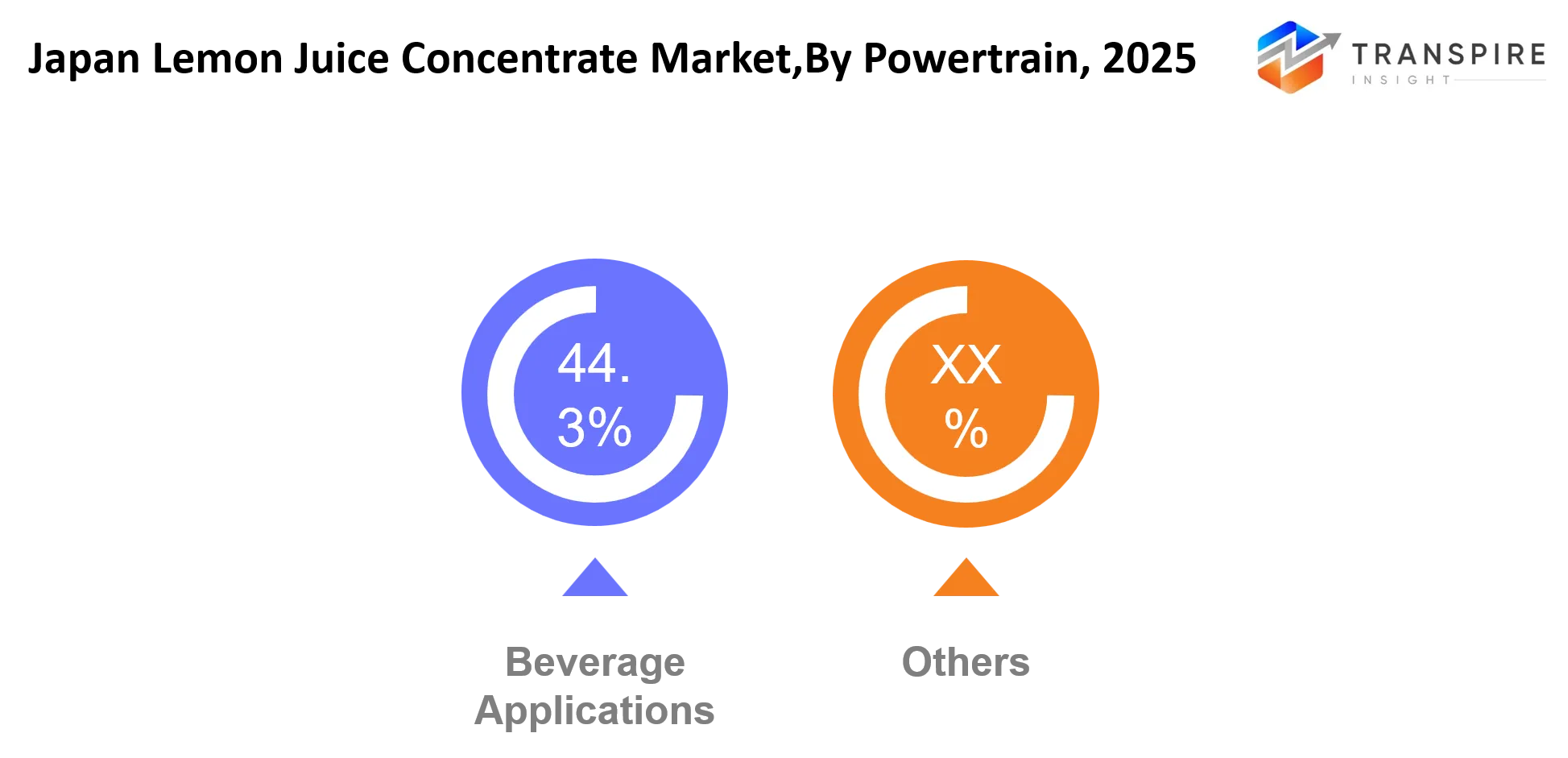
According to Transpire Insights, a detailed research report on the market reflects that the Beverages application segment dominates the Japan Lemon Juice Concentrate Market, accounting for approximately 34% of the total share in 2025. Major lemon juice concentrate and citrus ingredient suppliers contribute to the market through advanced processing technologies, consistent product quality, functional beverage applications, expanding manufacturing capabilities, and innovation, making them important contributors to Japan market development, product diversification, and growth dynamics.
Market Snapshot
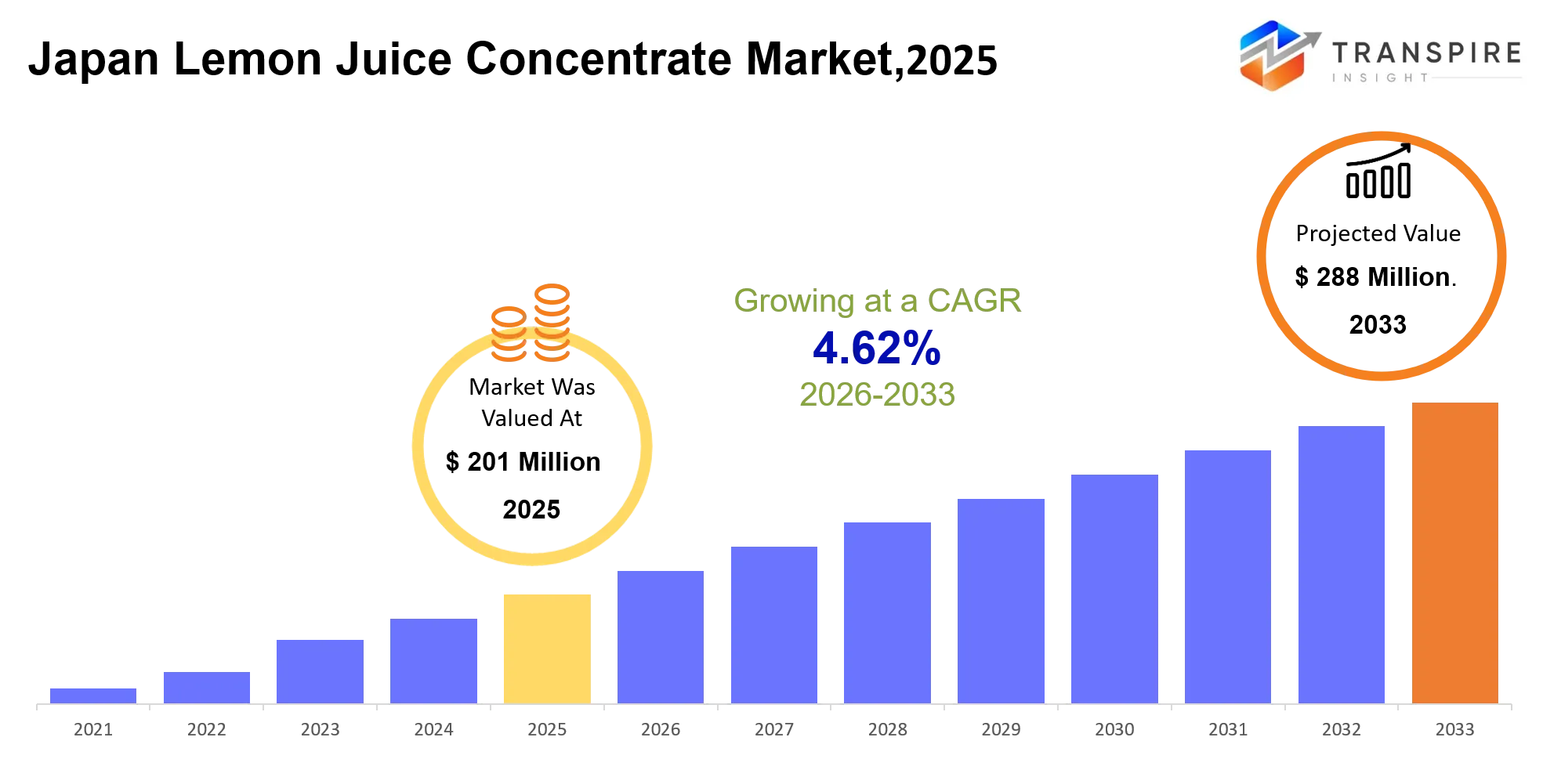
- Market Value (2025): USD 201 Million.
- Expected Market Value (2026): USD 210 Million.
- Estimated Market Value (2033): USD 288 Million.
- Forecast CAGR (2026–2033): 4.62%
Introduction
The lemon juice concentrate industry refers to the business of lemon juice, which has undergone the process of removing a significant amount of its water content. The removal results in the formation of a stable liquid or powdered concentrate, which is subsequently reconstructed for use in beverages, cooking recipes, foods, and cleansing products. In Japan, the lemon juice concentrate industry depends highly on the imports of concentrate raw materials from countries such as the US, Mexico, and Argentina because of limitations in its climate. Lemon Juice Concentrate: Regular lemon juice that undergoes the process of removal of a significant amount of water content either through heating or evaporation. The lemon juice concentrate is much more viscous than the regular lemon juice. The advantages of lemon juice concentrate include cost-effectiveness and space efficiency in storage due to the low presence of water, making it lighter to transport and reducing the need for cooling and space for refrigeration in comparison to fresh lemons. Taste consistency is an additional benefit due to the controlled tartness and acidity in industrial production. Extended shelf life makes it easy to utilize as a result of the concentrated nature and lower water activity in limiting microbial growth when stored properly. Lemon juice concentrate is highly versatile since it can be used in various food and beverage formulations such as sports drinks, sauces, and even in cooking.
Key Market Highlights: -
- By product type, the Conventional Concentrate segment dominated the market and holds nearly 65% share in 2025 and is projected to grow at a substantial CAGR during the forecast period.
- By application, the Beverages segment dominated the market and holds nearly 34% share in 2025 and is projected to grow at a substantial CAGR during the forecast period.
- By end user, the Food Manufacturers segment dominated the market and holds nearly 60% share in 2025 and is projected to grow at a substantial CAGR during the forecast period.
- Supporting Policies: Initiatives from the Japanese Government encourage innovation of food, research on food technology, development of functional ingredients, sustainable food systems, and sustainability in agriculture. This helps the Japan Lemon Juice Concentrate Market indirectly through food processing, sustainable sourcing, product innovations, and value addition in food & beverages sector in Japan.
How is Technology Driving Growth in the Japan Lemon Juice Concentrate Market?
Innovation in the Japan Lemon Juice Concentrate Market is driven by smart factories, automation, advanced processes, digital traceability, and functional-ingredient development. The use of robotics and automation helps to optimize production processes in terms of efficiency, consistency, and effective cost management. Advanced processes such as high-pressure processing and minimal thermal processing contribute to the optimization of shelf-life, flavor preservation, and nutrition preservation. IoT-driven traceability and digital supply chain technologies provide additional opportunities for quality control and resource management in production networks. Additionally, innovations in functional ingredients development allow manufacturers to create functional ingredients from lemon juices. This will drive further development of the Japan lemon juice concentrate market.
Market Drivers
The demand for lemon juice concentrate is being propelled due to increased consciousness among consumers regarding health and wellness, who are now aware of the antioxidant and vitamin C properties of citrus products. Increased efficiency and consistency have also contributed to the rising demand as industrialists are using lemon juice concentrate for standardized acidity, prolonged shelf-life, and effective transportation and storage. Increased preference for a clean label is pushing food and beverages industries to incorporate natural ingredients rather than artificial preservatives and acidulants. Functional beverages are presenting new avenues for lemon juice concentrate as an increasing demand exists for low sugar and wellness beverages. There are many economic benefits of using lemon juice concentrate owing to the reduced amount of liquid and weight, which help to reduce the costs associated with transporting, handling and storing the juice compared to single-strength juice. Another important benefit of using lemon juice concentrate is that the product has increased shelf life due to improved processing techniques. It also has a constant flavor and acidity level that helps food and beverage producers to maintain consistent tartness and acid content. Lemon juice concentrate is versatile and can be used as a flavor enhancer, which will help to eliminate the use of artificial additives.
Restrain
Production and storage costs are high due to energy costs related to processing and refrigeration. The possibility of oxidation and spoilage is there while storing the product. The price and availability risks related to raw materials arise due to climatic conditions affecting crops. Moreover, compliance with laws and regulations is difficult in the Japanese market.
Analysis of Prices and Consumer Behaviour
Conventional/Clarified Lemon Juice Concentrate (about 70% of total market) takes the largest share of the Japan Lemon Juice Concentrate Market (mainly driven by beverage manufacturing and food processing industries). The prices for organic and cloudy concentrate will be 25-40% higher compared to conventional clarified concentrate, because those concentrates are considered to be premium products with special processing and certificates. Around 55% of total consumption of lemon juice concentrate is connected with beverage manufacturing, because of the wide range of use in ready-to-drink teas, carbonated beverages, functional beverages etc. Food processing and preservation industries take around 20% of total consumption, and lemon juice concentrate is applied in such categories like sauces, dressings, marinades and condiments. The buyers in Japan have high demands for standardized Brix, food safety certification, supply stability and consistent quality. It is expected that 70-75% of total purchases will be done according to contracts because of the need of production safety from possible raw material price fluctuations.
Top Companies in the Japan Lemon Juice Concentrate Market
- Döhler
- Citromax
- Lemon Concentrate
- Louis Dreyfus Company
- Archer Daniels Midland
- Ingredion
- Kerry Group
- IFF
- Symrise
- Givaudan
- T. Hasegawa
- Mizkan
- Kagome
- Sunkist Growers
- Yakult Honsha
Japan Lemon Juice Concentrate Market Segmentation
The Japan Lemon Juice Concentrate Market share is divided into six categories: By product type, form, application, packaging, end user, distributed channel.
The Conventional Concentrate dominated the market, accounting for nearly 65% in 2025 and is expected to rise at a significant CAGR during the forecast period.
The Japan Lemon Juice Concentrate Market is segmented by product type into Lemon Juice Concentrate, Clarified Concentrate, Cloudy Concentrate, Organic Concentrate, Conventional Concentrate, NFC Lemon Juice, Lemon Juice Powder, Lemon Extract. Among these, the Conventional Concentrate segment dominated the market, accounting for nearly 65% in 2025 and expected to increase at a significant CAGR during the forecast period. The Conventional Concentrate segment leads owing to the already existing manufacturing process, economic feasibility, consistent quality, and wide application across various applications. Its longer shelf life, better transportability, standardized flavor, and ability to manufacture on a large scale boost demand. Increasing consumption among beverage manufacturers and processed food makers will contribute to the growth of the segment going forward.
The Beverages dominated the market, accounting for nearly 34% in 2025, and is expected to rise at a significant CAGR during the forecast period.
The Japan Lemon Juice Concentrate Market is segmented by application into Beverages, Soft Drinks, Juices, Food Processing, Sauces, Dressings, Confectionery, Bakery. Among these, the Beverages segment dominated the market, accounting for nearly 34% in 2025 and expected to increase at a significant CAGR during the forecast period. The Beverages Segment leads as a result of increasing consumer demand for convenience, naturalness, and functionality of citric beverages. The use of lemon juice concentrate gives the product consistent taste, tanginess, longer shelf life, and a better formulation process for juice drinks, flavored water, and functional drinks.
The Food Manufacturers dominated the market, accounting for nearly 60% in 2025 and is expected to rise at a significant CAGR during the forecast period.
The Japan Lemon Juice Concentrate Market is segmented by end user into Beverage Manufacturers, Food Manufacturers, Restaurants, Hotels, Bakeries, Confectionery Companies, Catering Companies, Ingredient Blenders. Among these, the Food Manufacturers segment dominated the market, accounting for nearly 60% in 2025 and expected to increase at a significant CAGR during the forecast period. Food Manufacturers is the dominant segment owing to the widespread use of lemon juice concentrate in processed foods, sauces, dressings, candies, and beverages. The stable acidity, flavor, longer shelf life, and easy processing capability of lemon juice concentrate aid mass production. Moreover, increasing demand for natural citrus products drives segment growth during the forecast period.
Future Market Trends for the Japan Lemon Juice Concentrate Market: -
- Functional Health Beverages: Health-conscious consumers are driving demand for vitamins-C rich citrus fruits in functional drinks.
- Industrial Consistency: Processors are leaning towards concentrates for consistency in pH levels, enhanced shelf life, and improved logistics.
- Adoption of Clean-Labeling: Food and beverage companies have switched from synthetic flavoring and preservatives to natural concentrates of lemon juice.
- Supply Chain Issues: Manufacturers have begun concentrating on reliable supplies and cold-chain solutions to overcome harvest seasonality and climate-related difficulties.
Recent Development
- In March 2026: Pokka Sapporo added lemon-based beverages with citric acid to its line of functional drinks named Kire-to Lemon, owing to increased consumer preference for convenient functional citrus drinks in Japan. Thereby, there are prospects for lemons and concentrated citrus fruit in Japan's functional drinks industry.
- In April 2026: WHOLE BERRY, a Korean natural brand focusing on inner care, entered the Japanese market through its 100 percent straight-pressed lemon juice, which was fueled by increasing popularity of lemon juice products that are natural, convenient, and health-oriented. The expansion is indicative of future prospects for premium lemon juice products and formulations in Japan.
Market Segment
This study forecasts revenue at Japan, regional and country levels from 2020 to 2033. Transpire Insights has segmented the Japan Lemon Juice Concentrate Market based on the below-mentioned segments:
Japan Lemon Juice Concentrate Market, By Product Type
- Lemon Juice Concentrate
- Clarified Concentrate
- Cloudy Concentrate
- Organic Concentrate
- Conventional Concentrate
- NFC Lemon Juice
- Lemon Juice Powder
- Lemon Extract
Japan Lemon Juice Concentrate Market, By Form
- Liquid Concentrate
- Frozen Concentrate
- Aseptic Concentrate
- Powder
- Paste
- Syrup
- Blended Concentrate
- Ready-to-Dilute Concentrate
Japan Lemon Juice Concentrate Market, By Application
- Beverages
- Soft Drinks
- Juices
- Food Processing
- Sauces
- Dressings
- Confectionery
- Bakery
Japan Lemon Juice Concentrate Market, By Packaging
- Drums
- Aseptic Bags
- IBC Containers
- Bottles
- Pouches
- Cans
- Totes
- Bulk Tankers
Japan Lemon Juice Concentrate Market, By End User
- Beverage Manufacturers
- Food Manufacturers
- Restaurants
- Hotels
- Bakeries
- Confectionery Companies
- Catering Companies
- Ingredient Blenders
Japan Lemon Juice Concentrate Market, By Distribution channel
- Direct Sales
- Food Ingredient Distributors
- Beverage Distributors
- Wholesale
- Importers
- Online B2B
- Specialty Suppliers
- Foodservice Distributors
Frequently Asked Questions
Find quick answers to common questions.
The market is projected to reach USD 288 million by 2033, growing from USD 201 million in 2025 at 4.62% CAGR
Conventional Concentrate dominates with nearly 65% share in 2025, supported by cost efficiency, consistent quality, and widespread industrial applications
Beverages account for nearly 34% share, driven by rising demand for convenient, natural, functional, and lemon-based beverage products
Food Manufacturers dominate with nearly 60% share in 2025, supported by extensive concentrate usage across processed foods, sauces, confectionery, and beverages
Key trends include clean-label products, functional beverages, industrial consistency, advanced processing, and reliable supply chains addressing seasonal and climate-related challenges
- Döhler
- Citromax
- Lemon Concentrate
- Louis Dreyfus Company
- Archer Daniels Midland
- Ingredion
- Kerry Group
- IFF
- Symrise
- Givaudan
- T. Hasegawa
- Mizkan
- Kagome
- Sunkist Growers
- Yakult Honsha
About the Authors

Chetan Dhatrak
I’m Chetan Dhatrak, a Senior Research Analyst at Transpire Insight, specializing in the Consumer Goods, Foods and Beverages industry. I focus on analyzing market trends, consumer behavior, competitive landscapes, and industry developments to deliver accurate, data-driven insights. My research at Transpire Insight is built on credible sources and in-depth analysis, helping businesses and readers better understand market dynamics, emerging opportunities, and evolving consumer preferences. I’m committed to creating reliable, well-researched content that supports informed decision-making and reflects the latest developments in the consumer goods and food & beverage sectors.

Chakradhar Khansole
Chakradhar serves as the Research Director at Transpire Insight, bringing over 8 years of experience in technology, innovation, and strategic market intelligence. He specializes in transforming complex market data into actionable business insights that enable organizations to make informed, growth-oriented decisions. Recognized for his strategic vision and analytical expertise, Chakradhar leads high-impact research initiatives, delivering comprehensive market assessments, competitive intelligence, and forward-looking industry analysis.
Recently Published Reports
-
Apr 2026
Baby Infant Formula Market
Baby Infant Formula Market Size, Share & Analysis Report By ype (Infant Milk, Follow On Milk, Specialty Baby Milk, Growing-Up Milk), By Ingredient (Carbohydrate, Fat, Protein, Minerals, Vitamins, and Others), By Product Form (Powder, Liquid, and Ready-to-feed), By Distribution Channels (Supermarket/Hypermarket, Specialty Store, Pharmacies, Online Retail, and Others), and Geography (North America, Europe, Asia-Pacific, Middle East and Africa, South and Central America), 2021 - 2031
-
Apr 2026
Edible Insects for Animal Feed Market
Edible Insects for Animal Feed Market Size, Share & Analysis Report By Type (Insect Powder, Insect Meal, Insect Bar, Insect Paste, Insect Oil, and Others), By Insect Type (Beetles, Cricket, Caterpillar, Hymenoptera, Orthoptera, Tree Bugs, and Others), By Application (Livestock, Pet Food, and Aquaculture), By Livestock Type (Poultry, Swine, and Others), and Geography (North America, Europe, Asia-Pacific, Middle East and Africa, South and Central America), 2021 - 2031
-
Apr 2026
Food Industry Disinfection and Bacterial Control Market
Food Industry Disinfection and Bacterial Control Market Size, Share & Analysis Report By Type (Chemical Disinfectants, Physical Disinfectants, and Biocides and Antimicrobials), By Application (Food Processing Equipment Surface Disinfection, Food Preparation Areas Surface Disinfection, Storage Areas Surface Disinfection, Anti-microbial Coatings Food Preservation, and Preservative Solutions Food Preservation), By End User (Meat and Poultry Processing, Dairy Processing, Seafood Processing, Bakery and Confectionery, Restaurants and Commercial Kitchens, and Food Service Providers), By Sales Channel (Online, Offline), and Geography (North America, Europe, Asia-Pacific, Middle East and Africa, South and Central America), 2021 - 2031
-
May 2026
Freeze Dried Food Market
Freeze Dried Food Market Size, Share & Analysis Report By Product Type (Fruits, Vegetables, Freeze-Dried Dairy Products, Freeze-Dried Meat and Seafood, Freeze-Dried Pet Food, and Prepared Meal), By Nature (Organic, and Conventional), By Form (Powdered, Granules, and Diced), By End Use (Breakfast Cereals, Dairy Products, Bakery & Confectionery, Nutritional Bars & Supplements, Powdered Beverages, Snacks, and Retail (Household)), and Geography (North America, Europe, Asia-Pacific, Middle East and Africa, South and Central America), 2021 - 2031