
Food Sweetener Market Summary:
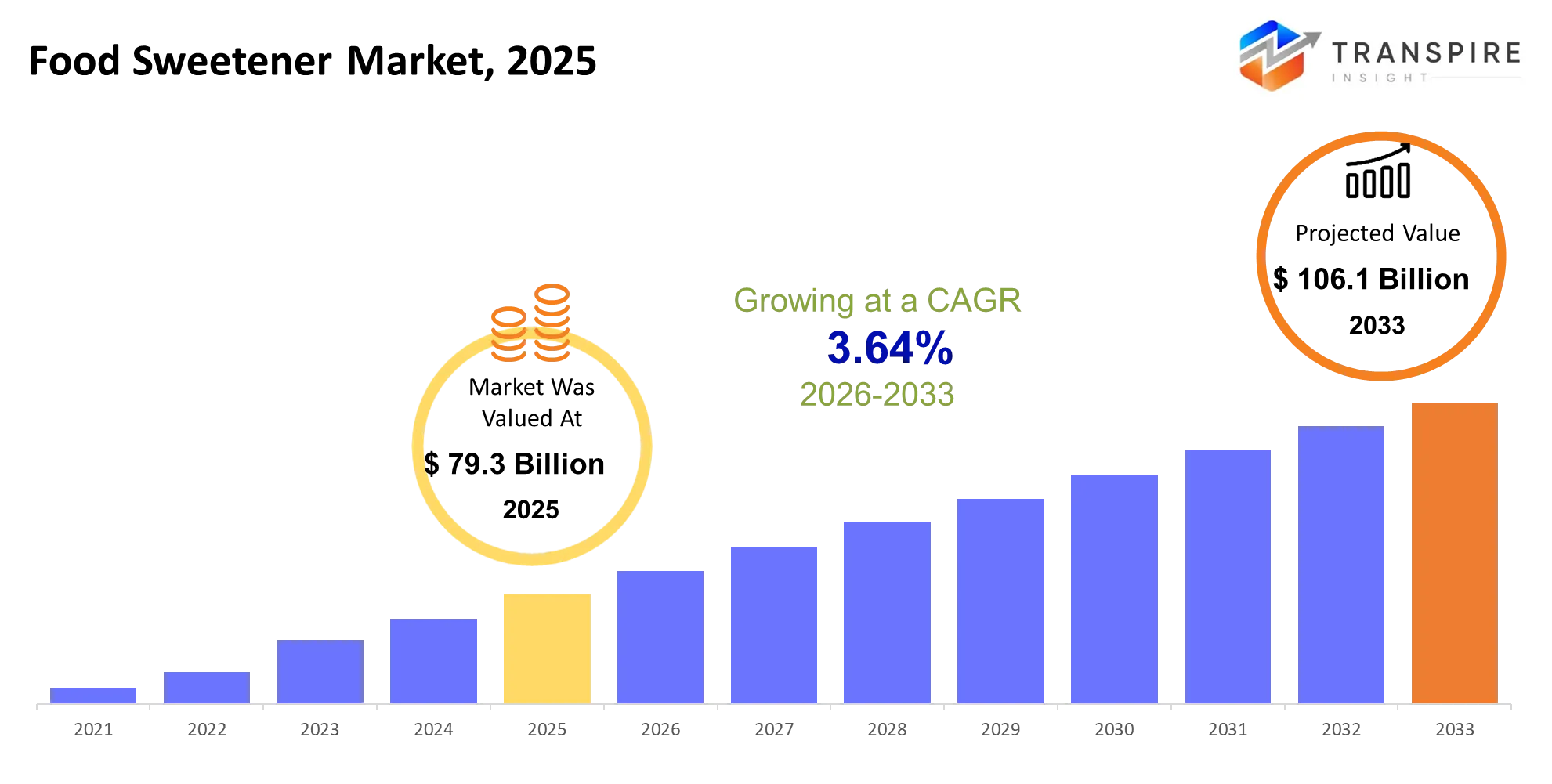
As per the Transpire Insight, The Food Sweetener Market size is estimated at USD 79.3 billion in 2025 and is anticipated to reach USD 106.1 billion by 2033, growing at a CAGR of 3.64% from 2026 to 2033.
The Food Sweetener Market helps food and beverage manufacturers control sweetness, texture, stability, and cost of production in packaged foods, drinks, dairy products, and confectionery. Over the past three to five years, sweetener manufacturers have moved away from the use of more conventional sugar-based ingredients to product formulations that balance taste with calorie reduction and clean label. The biggest structural shift in the market has been the creation of plant-based and fermentation-produced sweeteners alongside traditional synthetic products. A real-life driver for this has been the regulatory environment in certain markets, where front-of-pack nutrition labeling and sugar-reduction policies are spurring brands to reformulate rather than just reducing pack sizes. This has opened the door for ingredient suppliers that develop sweetening systems that can deliver the fine taste and process performance consumers have come to expect. Growth is coming from reformulation projects, lower-sugar beverages and a need to preserve quality alongside health benefits; however, cost, taste variations and gaining regulatory approval will still challenge wider commercial adoption.
Key Food Sweetener Market Insights:
The market is moving from single-ingredient sugar substitutes to integrated sweetening systems that help preserve taste, texture, and label appeal. It is no longer only about the intensity of sweetness, but also about the application expertise, biotechnology, and speed of reformulation.
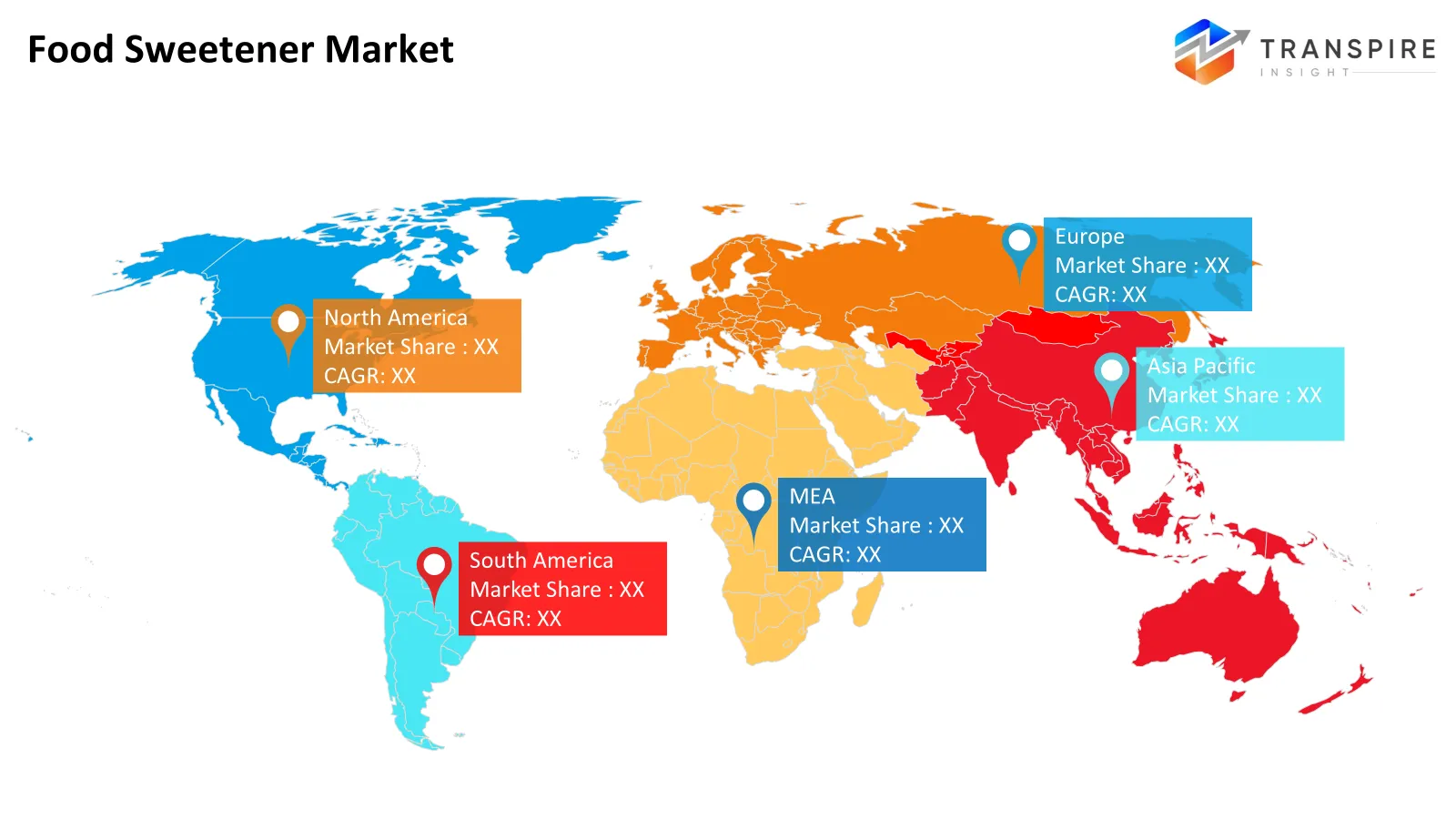
- Asia Pacific is the largest market, accounting for a 41.50% share of the market, and the market is expected to grow due to the increasing demand for processed food and growing awareness of health in the region.
- Europe represents 25.00%, and labelling regulations and strict clean-label requirements are driving faster uptake of natural sweeteners.
- North America accounts for 23.00% of the market, with beverage reformulation and demand for low/zero calories products contributing to this market.
- Latin America accounts for 6.00%, and growth is associated with urban diets and sugar-reduction efforts.
- The Middle East & Africa market accounts for 4.50% and is expected to see the highest growth rate at 7.10% CAGR.
- In 2026, Tate & Lyle introduced Yume M Stevia Sweetener, a bioconverted Reb M with a sugar-like taste.
- Ingredion is expanding its Dulcent and PureCircle stevia platforms to enhance taste and allow for more sugar reduction.
- Tate & Lyle's blend of Reb M, along with soluble fibre and allulose, restores sugar's functional properties.
- There has been a shift towards more complex sweetener blends than individual high-intensity sweeteners as consumers become more reluctant to accept the taste of a single sweetener.
- AI formulation models are cutting reformulation times by forecasting taste, texture, and label results.
What are the Key Drivers, Restraints, and Opportunities in the Food Sweetener Market?
Driver:
Sugar-reduction regulation and health-focused reformulation are the primary growth drivers. Front-of-pack labelling, sugar taxes, and public-health targets have converted consumer preference into a compliance requirement for food and beverage producers. This has increased adoption of stevia, sucralose, sugar alcohols, and hybrid sweetening systems, particularly in beverages, dairy, and bakery. Revenue impact comes from higher-value speciality ingredients and repeated reformulation projects rather than volume growth alone. The effect is strongest in carbonated drinks, flavoured dairy, and confectionery, where sugar provides both sweetness and functional performance.
Restraint:
Taste and formulation complexity remain the main restraint. High-intensity sweeteners can create bitterness, metallic aftertaste, or reduced bulk, while sugar contributes browning, viscosity, freezing-point control, and mouthfeel. This persists because replacing sugar is not a one-to-one ingredient substitution; manufacturers often need blends, fibres, bulking agents, and flavour-modifying systems. As a result, reformulation costs rise, and smaller producers may delay product changes.
Opportunity:
Fermentation-derived sweeteners, improved plant extraction, and precision blending create opportunities to deliver more consistent sweetness with fewer sensory compromises. Machine-learning-assisted formulation can help identify effective combinations before extensive factory trials. In parallel, India's evolving food-ingredient approval and labelling environment creates opportunities for suppliers that can demonstrate regulatory compliance and reliable local sourcing. Investment in regional production and application laboratories could shorten development cycles and improve access to beverage, dairy, and confectionery manufacturers.
Driver Impact Analysis – Food Sweetener Market
|
Driver |
Relative Impact on Growth (%) |
Geographic Relevance |
Impact Timeline |
Demand Strength |
Growth Mechanism |
Key Beneficiaries |
Major Constraint |
|
Rising demand for low-calorie and sugar-free food products |
26% |
North America, Europe, Asia-Pacific |
Short-term (≤2 years) |
High |
Reformulation of beverages and snacks increases sweetener adoption |
Stevia producers, sucralose manufacturers, beverage companies, food processors |
Aftertaste concerns and consumer preference for natural ingredients |
|
Growing health awareness and sugar-reduction initiatives |
23% |
North America, Europe, Asia-Pacific |
Medium-term (2–4 years) |
High |
Public health campaigns encourage reduced-sugar product reformulation |
Natural sweetener suppliers, ingredient manufacturers, packaged food companies |
Taste expectations and reformulation costs limit adoption |
|
Expansion of functional beverages and processed foods |
20% |
Asia-Pacific, North America, Europe |
Short-term (≤2 years) |
High |
Product innovation expands demand for specialised sweetening ingredients |
Beverage manufacturers, confectionery companies, ingredient suppliers |
Volatile input costs and intense product competition |
|
Advancements in natural sweetener extraction and fermentation technologies |
17% |
North America, Europe, Asia-Pacific |
Long-term (≥4 years) |
High |
Improved production efficiency enables scalable, consistent sweetener supply |
Biotechnology firms, stevia producers, fermentation technology providers |
High capital expenditure and regulatory approval requirements |
|
Increasing preference for sustainable, plant-based ingredients |
14% |
Europe, North America, Asia-Pacific |
Medium-term (2–4 years) |
Medium |
Clean-label formulations increase demand for plant-derived sweeteners |
Plant-based ingredient suppliers, sustainable agriculture firms, food brands |
Agricultural supply variability and higher sourcing costs |
|
Total |
100% |
— |
— |
— |
— |
— |
— |
What Has the Impact of Artificial Intelligence Been on the Food Sweetener Market?
AI changes sweetener development from an overly trial-dependent formulation process to one that uses data-driven optimisation. Machine-learning platforms are applied to screen combinations of ingredients, forecast sweetness level, bitterness, aftertaste, and mouthfeel interactions, and pre-test the most optimal reformulation routes. This reduces development cycle times and helps manufacturers balance sugar reduction with preserving product quality. In automation and optimisation, AI can be applied to dosing and blending, to control for fermentation, and to improve processing efficiency. In sweetener production, predictive models can enable real-time monitoring of fermentation and improve yield consistency of biologically produced steviol glycosides; in foods, AI simulations can optimise food systems for reducing sugar while also reducing energy consumption, with estimates around 30% energy savings when optimising fermented ingredients used to reduce sugar and sodium.
AI can improve predictive power in demand planning, sourcing of raw materials, and sensory prediction, enabling manufacturing teams to forecast formulation performance for applications such as beverage, bakery, dairy, and confectionery, reducing failed launches and ingredient waste. Having high-quality sensory, ingredient, and production data is crucial for training AI models and can be lacking in mid-sized food companies. It can be harder to accurately model complex matrices like bakery or chocolate, where sugar impacts texture and flavour.
In October 2026, Symrise expanded its Symvision AI™ platform by rolling out connected concept-to-design workflows featuring AI-assisted formula prediction tools. This product launch enables food and beverage manufacturers to precisely forecast sensory performance, accelerate go-to-market speed, and seamlessly balance taste profiles for low-sugar and low-sodium reformulations.
Key Food Sweetener Market Trends:
The market is moving from sweetness to application-specific ingredient systems that balance lower cost, taste, and nutritional positioning. Scalable innovation, regional supply resilience, and reformulation without a loss in product quality are becoming key drivers of competitive advantage.
- The sugar reduction has gone beyond the optional positioning to a reformulation mandate stemming from labelling and public-health policy.
- Stevia innovation has moved from extracts to high-purity Reb M and Reb D systems, which are less bitter.
- Precision fermentation is transforming sourcing of sweeteners by industrialising the production of speciality glycosides.
- In more sophisticated blends for sugar reduction, sweet-protein and fermentation-derived ingredients are beginning to serve as alternatives to stevia.
- Multi-sweetener combinations are becoming more common in products and are not just made up of one high-intensity sweetener.
- AI-driven formulation has reduced development times and predicted sensory trade-offs before pilot production.
- Beverage companies are spearheading the uptake as liquid formats offer quicker reformulation and better sugar reduction claims.
- Plant-based and fermentation-based sweeteners are shifting the focus of brands away from some synthetic sweeteners due to clean-label expectations.
- Sugar alcohols are becoming more significant as bulking agents for texture along with high-intensity sweeteners.
- Next-generation steviol glycosides are getting regulatory clearance in mainstream food and beverage applications.
Food Sweetener Market Segmentation
Sweetener Type:
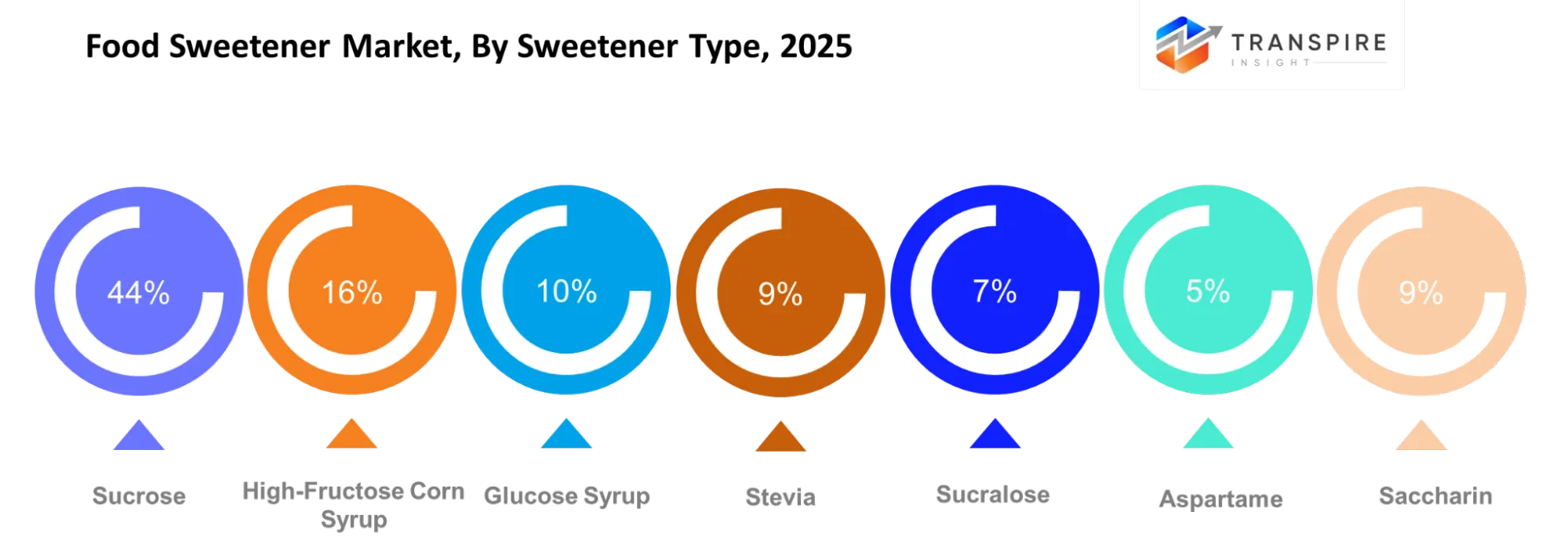
Sucrose holds the largest position at 43.80% because it remains the most cost-effective and functionally versatile sweetener for bakery, confectionery, beverages, and dairy. Its growth logic is based on reliability, browning, texture, and supply-chain familiarity, but its future depends on portion control and reformulated sugar-based products. High-fructose corn syrup accounts for 16.00%, supported by beverage and processed-food applications where liquid sweetness and low cost matter. Glucose syrup represents 10.00%, mainly serving confectionery, bakery, and sauces where viscosity and anti-crystallisation are important. Stevia holds 9.00% and is the fastest-moving natural segment, with an 8.60% CAGR for stevia and natural sweeteners, driven by clean-label demand and improved fermentation-derived glycosides. Sucralose accounts for 7.00%, aspartame 5.00%, and saccharin 3.00%, with adoption shaped by cost, stability, and regulatory acceptance. Sugar alcohols represent 6.20%, gaining relevance in sugar-free confectionery, dental-friendly products, and low-glycemic formulations.
Source:
Plant-based, synthetic, fermentation-derived, corn-based, sugarcane-based, and fruit-based sweeteners serve different formulation and sourcing needs. Plant-derived ingredients appeal to manufacturers responding to clean-label preferences, while synthetic options offer consistent sweetness and cost control. Fermentation-derived ingredients provide opportunities to improve production consistency and diversify supply beyond conventional crops. Future growth will depend on manufacturing efficiency, ingredient traceability, regulatory acceptance, and the ability to deliver reliable sensory performance across food and beverage applications.
Application:
Bakery, beverages, dairy, confectionery, processed foods, sauces and dressings, and pharmaceuticals require different sweetness levels and functional properties. Beverage manufacturers prioritise solubility, flavour stability, and reduced-sugar formulations, while bakery producers need ingredients that preserve moisture, browning, and texture. Dairy applications require sweetness compatibility with proteins and acidity, whereas confectionery depends on crystallisation and mouthfeel. These differences encourage suppliers to develop application-specific blends that maintain product quality while meeting nutritional targets and manufacturing requirements.
Form:
Sweeteners are supplied as powders, granules, liquids, syrups, crystals, tablets, and concentrates to accommodate different production processes. Powders and granules support dry blending, while liquids and syrups simplify dosing and integration into beverages and industrial formulations. Crystals suit applications requiring controlled dissolution, whereas tablets and concentrates serve specialised dispensing and formulation needs. Manufacturers select formats according to storage stability, transportation costs, solubility, dosing accuracy, and equipment compatibility. Improved packaging and moisture-control technologies can further reduce waste and preserve ingredient quality.
End User:
Food and beverage manufacturers represent important buyers because sweeteners directly influence product taste, texture, nutritional positioning, and production economics. Dairy producers, bakeries, confectionery companies, and foodservice operators have distinct requirements for sweetness consistency, shelf life, and processing performance. Household consumers purchase sweeteners for everyday cooking and specialised dietary preferences. As sugar-reduction initiatives influence product development, suppliers that provide technical guidance, dependable quality, and scalable ingredient solutions can strengthen customer relationships and increase adoption across industrial and consumer applications.
Distribution Channel:
Direct sales, distributors, retail stores, supermarkets, online retail, foodservice suppliers, and wholesalers connect sweetener producers with industrial and household customers. Direct sales support technical collaboration and bulk contracts, while distributors help manufacturers reach regional customers and manage inventory. Supermarkets and online platforms improve consumer access to packaged and speciality sweeteners, including plant-derived alternatives. Foodservice suppliers and wholesalers serve restaurants, bakeries, and institutional kitchens. Future competitiveness will depend on efficient logistics, reliable availability, transparent product information, and compliance with regional food-safety and labelling requirements.
What are the Key Use Cases Driving the Food Sweetener Market?
Sucrose, accounting for 43.80% of the market, remains central to bakery, confectionery, and traditional beverage production because it provides sweetness alongside bulk, browning, and texture. High-fructose corn syrup and glucose syrup support processed-food manufacturing where solubility, moisture retention, and product consistency influence production efficiency.
Expanding applications include reduced-sugar beverages, dairy products, sauces, and packaged snacks. Stevia and other natural sweeteners help manufacturers reformulate products, while sucralose and sugar alcohols support selected low-sugar formulations.
Emerging use cases include fermentation-derived sweeteners, precision-designed blends, and AI-assisted formulation for products requiring improved taste and reduced sugar content. These applications create opportunities for suppliers to offer specialised ingredients that meet nutritional objectives without compromising product performance.
|
Report Metrics |
Details |
|
Market size value in 2025 |
USD 79.3 Billion |
|
Market size value in 2026 |
USD 82.6 Billion |
|
Revenue forecast in 2033 |
USD 106.1 Billion |
|
Growth rate |
CAGR of 3.64% from 2026 to 2033 |
|
Base year |
2025 |
|
Historical data |
2021 - 2024 |
|
Forecast period |
2026 - 2033 |
|
Report coverage |
Revenue forecast, competitive landscape, growth factors, and trends |
|
Regional scope |
United States; Canada; Mexico; United Kingdom; Germany; France; Italy; Spain; Denmark; Sweden; Norway; China; Japan; India; Australia; South Korea; Thailand; Brazil; Argentina; South Africa; Saudi Arabia; United Arab Emirates |
|
Key companies profiled |
Cargill, Archer Daniels Midland, Tate & Lyle, Ingredion, Roquette, Kerry Group, Südzucker, Tereos, Cosun, Ajinomoto, DuPont, DSM-Firmenich, PureCircle, GLG Life Tech, Matsutani Chemical Industry. |
|
Customization scope |
Free report customization (country, regional & segment scope). Avail customized purchase options to meet your exact research needs. |
|
Report Segmentation |
Sweetener Type (Sucrose, High-Fructose Corn Syrup, Glucose Syrup, Stevia, Sucralose, Aspartame, Saccharin, Sugar Alcohols); Source (Natural, Plant-Based, Synthetic, Fermentation-Derived, Corn-Based, Sugarcane-Based, Fruit-Based); Application (Bakery, Beverages, Dairy, Confectionery, Processed Foods, Sauces & Dressings, Pharmaceuticals); Form (Powder, Granules, Liquid, Syrup, Crystals, Tablets, Concentrates); End User (Food Manufacturers, Beverage Manufacturers, Dairy Producers, Bakeries, Confectionery Companies, Foodservice, Household Consumers); Distribution Channel (Direct Sales, Distributors, Retail Stores, Supermarkets, Online Retail, Foodservice Suppliers, Wholesalers) |
Which Regions are Driving the Food Sweetener Market Growth?
Asia Pacific is the fastest-growing regional market, accounting for 41.50% of the market share. The strong presence of food manufacturing bases, rising disposable income, and rapid growth in beverages, convenience foods, and bakery categories contribute to the growth. Consumers in urban areas are more health-conscious, and thus manufacturers tend to cut down sugar content levels and preserve flavour in traditional recipe formats. Moreover, the availability of markets for sugarcane, corn, and other plant-based sweetener inputs is favourable in the region.
In October 2026, PepsiCo India transitioned over 70% of its beverage portfolio to zero-sugar or mid-calorie formulations. This rapid product reformulation and expanded distribution of flagships like Pepsi Black, 7UP Zero Sugar, and Gatorade Zero directly support regional health objectives by drastically reducing the brand's dependency on traditional high-calorie sugar content.
https://www.adgully.com/post/22171/pepsico-india-expands-low-sugar-beverages-to-70-of-portfolio
Europe 25.00% and North America 23.00% overall form a mature but innovation-driven demand profile. Sugar-reduction policies and strong demand for natural ingredients drive the EU market, with an emphasis on labelling. North America is driven by reformulation of beverage products and a demand for functional ingredients. Both regions have stable growth and can implement long-term reformulation projects thanks to major food companies, strong technical research capacity, and a clear regulatory framework. They focus more on higher-value, lower-volume markets with premium stevia, allulose, blends with fibres, and clean-label systems.
In June 2026, Truvia launched the Truvia® Allulose Plus Stevia Sweetener & Monk Fruit Sweetener. This tri-blend formulation directly addresses the value-led, innovation-driven demand for clean-label sugar alternatives by providing a zero-calorie, one-for-one sugar replacement that smooths out the flavour profile.
Middle East and Africa is currently the fastest-growing region for sweeteners, with a CAGR of 7.10%, accounting for 4.50% of the market share despite the fact that it is now one of the smallest regions. This recent growth has been supported by rising urbanisation, increased penetration of modern retail channels, and increased exposure to international food & beverage brands. Gulf countries are also directing their emphasis on food security and supporting local infrastructure for processing ingredients, which can also provide opportunities for sweetener manufacturing. The region can also witness a shift from importing as health awareness rises, and multinational brands are also localising reduced-sugar products.
In October 2026, Almarai Company announced an investment plan of over $4 billion through 2031 to expand its domestic production capacity and enter promising new food categories. This strategic funding will accelerate supply chain localisation, reduce the region's import dependency, and dramatically scale industrial processing capabilities across priority Gulf markets.
https://www.gdnonline.com/Details/1409077
Who are the Key Players in the Food Sweetener Market, and how do they compete?
Market participants are engaging in competition based on ingredient cost, sensory performance, production volume, and formulation support. Cargill, Archer Daniels Midland, Ingredion, Tate & Lyle and Südzucker play on their agricultural sourcing and industrial processing technologies; speciality suppliers use plant-based ingredients for niche applications; and food manufacturers want to work with partners who minimise sugar while safeguarding quality and controlling costs. Cargill is active as a large-scale, commodity-based agricultural supplier and in plant-derived ingredients and applications, exemplified by Ever Sweet®'s commercialisation in India in 2026.
Archer Daniels Midland and Tereos utilize their agricultural processing expertise, while Südzucker and Cosun utilise their sugar processing know-how. Ingredion's standalone acquisition of Tate & Lyle was approved by shareholders in July 2026 and is scheduled to close later that year; it intends to combine sweetening, texturising and formulation technologies. Roquette and Matsutani focus on speciality carbohydrate ingredients; Ajinomoto advances sweetening science; Kerry Group and dsm-firmenich combine taste innovations with food systems; Pure Circle and GLG Life Tech differentiate with stevia-based ingredients; and DuPont applies ingredient technologies to selected food applications. Throughout these strategies, partnerships, regional manufacturing, and technical customer support provide growth pathways and formulation wins.
Key Players are:
- Cargill
- Archer Daniels Midland
- Tate & Lyle
- Ingredion
- Roquette
- Kerry Group
- Südzucker
- Tereos
- Cosun
- Ajinomoto
- DuPont
- DSM-Firmenich
- PureCircle
- GLG Life Tech
- Matsutani Chemical Industry
Food Sweetener Market — Enhanced Competitive Benchmarking
Company |
Est. Revenue Share Range |
Key Offerings |
Strategic Positioning |
Geographic Strength |
Technology Focus |
Cargill |
Estimated 3–7% |
Corn syrups, HFCS, stevia, erythritol |
Broad portfolio leadership with integrated agricultural sourcing |
North America, Asia Pacific, Europe |
Enzymatic starch conversion and stevia sweetening |
Archer Daniels Midland (ADM) |
Estimated 3–6% |
Glucose, dextrose, fructose, stevia, polyols |
Scale-driven ingredient supply with customized sugar-reduction solutions |
North America, Europe, Asia Pacific |
Sweetness optimization and carbohydrate processing |
Ingredion Incorporated |
Estimated 2–5% |
Glucose syrups, dextrose, polyols, stevia |
Application-led differentiation through functional ingredient systems |
North America, Latin America, Asia Pacific |
Starch hydrolysis and multifunctional sweetener formulation |
Tate & Lyle |
Estimated 1–4% |
TASTEVA stevia, SPLENDA sucralose, DOLCIA PRIMA allulose, fructose |
Specialty sweetener innovation targeting sugar reduction |
North America, Europe, Asia Pacific |
High-purity stevia and sweetness profile optimization |
Südzucker Group |
Estimated 2–5% |
Beet sugar, liquid sugar, speciality sugars, isomalt |
Scale-based sugar production with established European distribution |
Europe, Asia Pacific |
Sugar crystallisation and beet-processing efficiency |
Tereos |
Estimated 2–5% |
Cane sugar, beet sugar, glucose, fructose, dextrose |
Agricultural integration and high-volume sweetener supply |
Europe, Latin America, Africa |
Integrated sugar extraction and starch conversion |
Roquette |
Estimated 1–3% |
Sorbitol, maltitol, mannitol, xylitol |
Speciality polyol leadership for sugar-free food applications |
Europe, Asia Pacific, North America |
Polyol hydrogenation and crystallisation processes |
Ajinomoto |
Estimated 1–3% |
Aspartame, advantame, other high-intensity sweetening solutions |
High-intensity sweetener specialisation and technical differentiation |
Asia Pacific, North America, Europe |
Amino-acid fermentation and high-intensity sweetener chemistry |
Kerry Group |
Estimated 0.5–2% |
Tastesense Sweet, Tastesense Advanced, sweetness-modulation systems |
Formulation-led sugar reduction with superior sensory performance |
Europe, North America, Asia Pacific |
Flavour modulation, sweetness balancing and off-note masking |
Cosun |
Estimated 0.5–2% |
Beet sugar, liquid sugar, speciality sugar ingredients |
Regional sugar expertise with value-added ingredient development |
Europe, selected international markets |
Beet processing, sugar purification and ingredient valorisation |
Recent Development News
- In July 2026, Icon Foods launched TagaLite, a ready-to-formulate tagatose sweetener designed to provide sugar-like functionality. The launch expands ingredient options for manufacturers developing reduced-sugar food and beverage products while addressing formulation requirements related to sweetness and product performance. http://m.careersinfood.com/career-planning/exploring-food-beverage/industry-news/united-states/icon-foods-unveils-innovative-tagalite-sweetener-solution
- In June 2026, Tate & Lyle expanded its strategic collaboration with BioHarvest Sciences to develop multiple non-GMO, plant-derived sweetener molecules. By combining Tate & Lyle's ingredient formulation expertise with BioHarvest's proprietary Botanical Synthesis platform, the partnership enables the sustainable, cell-based synthesis of rare sweetening molecules without relying on traditional, resource-intensive agricultural cultivation or botanical extraction methods. https://www.tateandlyle.com/news/tate-lyle-expands-collaboration-bioharvest-accelerate-next-generation-sweetener-innovation
- In March 2026, The Sweet Change secured ₹1.7 crore in pre-seed funding led by venture accelerator Rebalance following the commercial launch of its natural liquid sweetener drops. This capital injection provides the necessary funding to expand manufacturing operations, bolster B2B food service distributions, and accelerate the brand's growth as a major health-focused sugar substitute across household, café, and packaged food segments. https://www.vccircle.com/truefanaiphab-korinmi-the-sweet-change-raise-early-stage-funding
What Strategic Insights Define the Future of the Food Sweetener Market?
The market is moving towards multi-ingredient sweetening systems that combine high-intensity sweeteners, rare sugars, fibres, and flavour modifiers to meet the full spectrum of sensory and functional needs of sugar. Those most likely to succeed will be suppliers with tested reformulation platforms, not single ingredients. A hidden risk is regulatory and scientific innovation (or lack of it) for next-generation sweeteners. Approval may lag in some markets, changes in human health literature may impact perceptions and demand, and differing attitudes to sweetener categories can be a barrier to product launches and reformulation projects. An emerging opportunity is for fermentation-derived and plant-cell-cultured sweeteners, namely Reb M of high purity and rare sugars, as a means to reduce reliance on agriculture, improve consistency of taste, and gain labelling advantages. On the commercial strategy front, focus on beverage, dairy, and bakery application-specific sweetener systems, AI-enabled reformulation tools, and regional teams in Asia Pacific and the Middle East & Africa.
Key Segmentations are:
Sweetener Type
- Sucrose
- High-Fructose Corn Syrup
- Glucose Syrup
- Stevia
- Sucralose
- Aspartame
- Saccharin
- Sugar Alcohols
Source
- Natural, Plant-Based
- Synthetic
- Fermentation-Derived
- Corn-Based
- Sugarcane-Based
- Fruit-Based
Application
- Bakery
- Beverages
- Dairy
- Confectionery
- Processed Foods
- Sauces & Dressings
- Pharmaceuticals
Form
- Powder
- Granules
- Liquid
- Syrup
- Crystals
- Tablets
- Concentrates
End User
- Food Manufacturers
- Beverage Manufacturers
- Dairy Producers
- Bakeries
- Confectionery Companies
- Foodservice
- Household Consumers
Distribution Channel
- Direct Sales
- Distributors
- Retail Stores
- Supermarkets
- Online Retail
- Foodservice Suppliers
- Wholesalers
By Regional Analysis
North America
- US
- Canada
- Mexico
Europe
- Germany
- UK
- France
- Italy
- Spain
- Russia
- Rest of Europe
Asia Pacific
- China
- Japan
- India
- South Korea
- Australia
- Rest of Asia Pacific
South America
- Brazil
- Argentina
- Rest of South America
Middle East & Africa
- UAE
- Saudi Arabia
- Qatar
- South Africa
- Rest of the Middle East & Africa
Frequently Asked Questions
Find quick answers to common questions.
The food sweetener market was valued at USD 79.3 billion in 2025 and is expected to reach USD 106.1 billion by 2033, growing at a 3.64% CAGR.
Key segments for the food sweetener market are Sweetener Type (Sucrose, High-Fructose Corn Syrup, Glucose Syrup, Stevia, Sucralose, Aspartame, Saccharin, Sugar Alcohols); Source (Natural, Plant-Based, Synthetic, Fermentation-Derived, Corn-Based, Sugarcane-Based, Fruit-Based); Application (Bakery, Beverages, Dairy, Confectionery, Processed Foods, Sauces & Dressings, Pharmaceuticals); Form (Powder, Granules, Liquid, Syrup, Crystals, Tablets, Concentrates); End User (Food Manufacturers, Beverage Manufacturers, Dairy Producers, Bakeries, Confectionery Companies, Foodservice, Household Consumers); Distribution Channel (Direct Sales, Distributors, Retail Stores, Supermarkets, Online Retail, Foodservice Suppliers, Wholesalers).
Growth is primarily driven by sugar-reduction initiatives, demand for low-calorie products, clean-label preferences, and innovations in plant-based and fermentation-derived sweeteners.
The food sweetener market is led by major manufacturers, including Cargill, Archer Daniels Midland, Tate & Lyle, Ingredion, Roquette, Kerry Group, Südzucker, Tereos, Cosun, Ajinomoto, DuPont, DSM-Firmenich, PureCircle, GLG Life Tech, and Matsutani Chemical Industry.
Asia Pacific dominates with a 41.50% market share, supported by large-scale food processing, established sugarcane and corn supply chains, expanding packaged-food production, and growing demand for reduced-sugar products.
Key opportunities include fermentation-derived sweeteners, improved stevia formulations, AI-assisted sweetener blending, regional manufacturing investments, and customised sugar-reduction solutions for beverages, dairy, and confectionery.
- Cargill
- Archer Daniels Midland
- Tate & Lyle
- Ingredion
- Roquette
- Kerry Group
- Südzucker
- Tereos
- Cosun
- Ajinomoto
- DuPont
- DSM-Firmenich
- PureCircle
- GLG Life Tech
- Matsutani Chemical Industry
About the Authors

Chetan Dhatrak
I’m Chetan Dhatrak, a Senior Research Analyst at Transpire Insight, specializing in the Consumer Goods, Foods and Beverages industry. I focus on analyzing market trends, consumer behavior, competitive landscapes, and industry developments to deliver accurate, data-driven insights. My research at Transpire Insight is built on credible sources and in-depth analysis, helping businesses and readers better understand market dynamics, emerging opportunities, and evolving consumer preferences. I’m committed to creating reliable, well-researched content that supports informed decision-making and reflects the latest developments in the consumer goods and food & beverage sectors.

Chakradhar Khansole
Chakradhar serves as the Research Director at Transpire Insight, bringing over 8 years of experience in technology, innovation, and strategic market intelligence. He specializes in transforming complex market data into actionable business insights that enable organizations to make informed, growth-oriented decisions. Recognized for his strategic vision and analytical expertise, Chakradhar leads high-impact research initiatives, delivering comprehensive market assessments, competitive intelligence, and forward-looking industry analysis.
Recently Published Reports
-
Apr 2026
Baby Infant Formula Market
Baby Infant Formula Market Size, Share & Analysis Report By ype (Infant Milk, Follow On Milk, Specialty Baby Milk, Growing-Up Milk), By Ingredient (Carbohydrate, Fat, Protein, Minerals, Vitamins, and Others), By Product Form (Powder, Liquid, and Ready-to-feed), By Distribution Channels (Supermarket/Hypermarket, Specialty Store, Pharmacies, Online Retail, and Others), and Geography (North America, Europe, Asia-Pacific, Middle East and Africa, South and Central America), 2021 - 2031
-
Apr 2026
Edible Insects for Animal Feed Market
Edible Insects for Animal Feed Market Size, Share & Analysis Report By Type (Insect Powder, Insect Meal, Insect Bar, Insect Paste, Insect Oil, and Others), By Insect Type (Beetles, Cricket, Caterpillar, Hymenoptera, Orthoptera, Tree Bugs, and Others), By Application (Livestock, Pet Food, and Aquaculture), By Livestock Type (Poultry, Swine, and Others), and Geography (North America, Europe, Asia-Pacific, Middle East and Africa, South and Central America), 2021 - 2031
-
Apr 2026
Food Industry Disinfection and Bacterial Control Market
Food Industry Disinfection and Bacterial Control Market Size, Share & Analysis Report By Type (Chemical Disinfectants, Physical Disinfectants, and Biocides and Antimicrobials), By Application (Food Processing Equipment Surface Disinfection, Food Preparation Areas Surface Disinfection, Storage Areas Surface Disinfection, Anti-microbial Coatings Food Preservation, and Preservative Solutions Food Preservation), By End User (Meat and Poultry Processing, Dairy Processing, Seafood Processing, Bakery and Confectionery, Restaurants and Commercial Kitchens, and Food Service Providers), By Sales Channel (Online, Offline), and Geography (North America, Europe, Asia-Pacific, Middle East and Africa, South and Central America), 2021 - 2031
-
May 2026
Freeze Dried Food Market
Freeze Dried Food Market Size, Share & Analysis Report By Product Type (Fruits, Vegetables, Freeze-Dried Dairy Products, Freeze-Dried Meat and Seafood, Freeze-Dried Pet Food, and Prepared Meal), By Nature (Organic, and Conventional), By Form (Powdered, Granules, and Diced), By End Use (Breakfast Cereals, Dairy Products, Bakery & Confectionery, Nutritional Bars & Supplements, Powdered Beverages, Snacks, and Retail (Household)), and Geography (North America, Europe, Asia-Pacific, Middle East and Africa, South and Central America), 2021 - 2031