

Fruit Vinegar Market Summary:
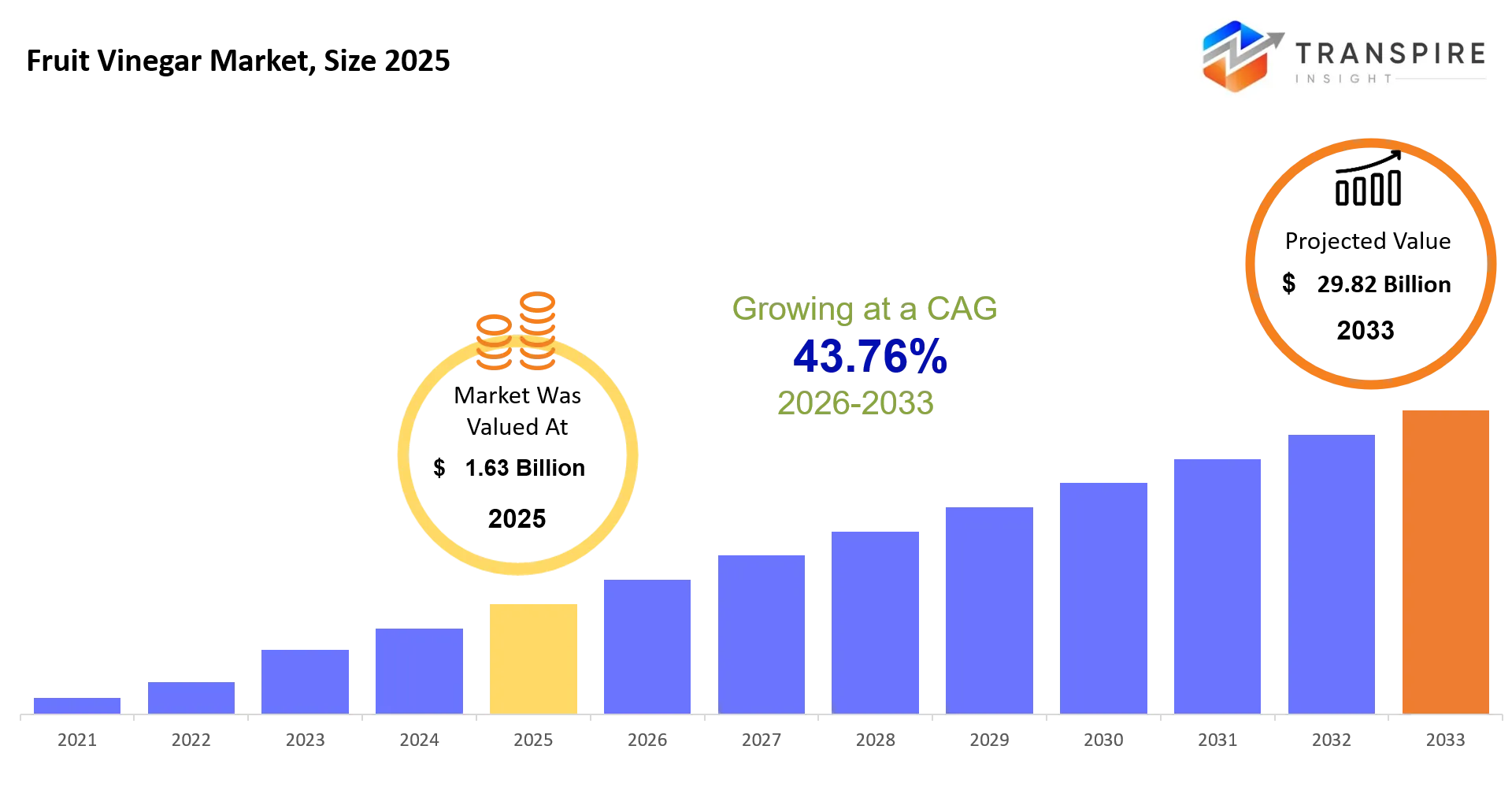
As per the Transpire Insight Analysis, The Fruit Vinegar Market size is estimated at USD 1.63 billion in 2025 and is anticipated to reach USD 29.82 billion by 2033, growing at a CAGR of 43.76% from 2026 to 2033.
The fruit vinegar category supplies natural acidity, layered flavour and functional ingredients to food, beverage, personal care and nutraceutical formulators, replacing synthetic acidulants, preservatives and colourants. In the last 3-5 years, this was a niche category for artisanal condiments and medicinal crops to a professional industrial functional-ingredient platform, driven by clean-label reformulation and the new health-claim positioning for gut-health ready-to-drink beverages. New precision fermentation, bioengineering and stabilisation techniques now diversify consistent acetic acid profiles; new blends and formats include concentrates, powders and gummies. Regulatory and retailer pressure to remove artificial colours and preservatives has fast-tracked clean-label reformulation and channelled well-established fermented ingredients toward broader recognition. Health-hungry consumers and manufacturers eliminate artificial additives with fruit vinegar, citing health-promoting metabolic and caloric value; reformulating, increasing procurement, expanding capacity for foodservice and CPG.
Fruit Vinegar Market Size & Forecast:
- Global Market Size 2025: USD 1.63 Billion
- Expected Market Value (2033): USD 29.82 Billion
- Forecast CAGR (2026–2033): 43.76%
- Leading Region in 2025: North America(36%)
- Fastest Growing Region: Asia Pacific( 27% & CAGR 16.7%)
- Key Company Profiles: Mizkan Holdings, Bragg Live Food Products, Eden Foods, Burg Groep, Fleischmann's Vinegar, Aspall Cyder, Vitacost, Vitane Pharmaceuticals, Dynamic Health Laboratories, Pompeian, De Nigris, Heinz, Marukan Vinegar, Acetum, Carl Kühne.
Key Fruit Vinegar Market Insights:
The fruit vinegar market is shifting from a pantry product to a platform for functional ingredients as a result of clean-label reformulation, gut health positioning and precision fermentation. The focus is on growth areas where sensory consistency, bottling capability and multi-occasion use cases intersect: culinary, wellness and personal care.
- Apple cider vinegar accounts for 44% of the market, while Mizkan and Bragg's raw, unfiltered SKUs grow as part of wellness-focused home routines.
- Blended fruit vinegar is the fastest-growing segment at 9% CAGR, with companies such as De Nigris and Acetum introducing multi-fruit, flavour-rich dressings.
- The premium positioning of Burg Groep and Aspall Cyder is helping to drive sales of grape vinegar at 18% and berry vinegar at 14%.
- The major application is still food and beverages, with Heinz and Marukan Vinegar using fruit vinegar in clean-label sauces and condiments.
- Growing, with Vitane Pharmaceuticals and Dynamic Health Laboratories releasing capsules and gummies for metabolic support.
- The growth of online retail and specialty stores allows Pompeian and Vitacost to experiment with new flavours and wellness packages.
- Liquid is the overwhelmingly dominant format, while powder, concentrate and gummies are on the uprise, and Eden Foods and Carl Kühne are betting on convenience and dosage accuracy.
- The North America region represents 36% of demand, and it is the fastest-growing region at a CAGR of 16.7%, owing to urbanisation and functional-beverage consumption.
What are the Key Drivers, Restraints, and Opportunities in the Fruit Vinegar Market?
Driver:
Constituted by clean-label reformulation and functional-food expansion, growth is spurred by function-demand for natural digestive and metabolic aid as gut-health claims go mainstream-rebalancing revenues from synthetic acidulants to fruit vinegar in dressings, drinks, and supplement formats, bolstering uptake in foodservice and CPG, where brands substitute artificial preservatives with fermented real foods; thereby increasing input volumes, commanding premium prices for raw and organic products, and hastening capacity investments in precision fermentation to deliver uniform taste and acidity levels required by mass-market ClFs.
Restraint:
Seasonal fluctuation of fruit supply and fluctuation of raw-material prices by commodity are hard to scale due to a structural problem of cyclicity in farming and climate. When orchids cannot fully be hedged by short-run contracts due to lead time and regional crop risk, the differences between supply and demand squeeze out margins in seasonal shortages, and manufacturers put up with lower-priced markets or increased margins.
Opportunity:
Precision fermentation and AI-guided strain selection can enable reproducible, customized flavour-and-acidity compositions for high-end blends and industrial-grade quality control for all food, beverage, and personal care products. Funding for cloud-connected bioreactors and machine-learning-enabled analyses of microbial data sets can decrease batch-to-batch composition volatility, dynamically regulate pH and temperature, and fast-track new product innovations for North America and Asia-Pacific. These innovations accelerate design-build-test-learn iterations, maximize output predictability, and allow for scalable, clean-label product reformulation.
What Has the Impact of Artificial Intelligence Been on the Fruit Vinegar Market?
AI is being adopted in fruit vinegar making through sensorized bioreactors and machine-learning decision models that track real-time dynamic changes in pH, temperature, dissolved oxygen, and microbes, allowing tighter acetic acid concentration and flavour profile control. This accelerates, simplifies, and automates the fermentation cycle, lowering energy cost and risk of off-flavours, while delivering batch-to-batch consistency demanded by scale-refining beverage and condiment manufacturers. It unlocks predictive functions through AI models that use past data to time optimal harvest windows for acid concentration and flavour, predict when contamination events may arise, and enable proactive interventions before flavour and quality deviations occur. Tactically, this enables shorter cycles, less waste, and more predictable supply to accelerate formulating for clean-label products. It will address the pain of infrastructure investment and data tagging challenges that inhibit many small to medium-sized vinegar producers from exploiting this technology, putting the potential of high-accuracy models and return on investment out of reach until large-scale factories.
In April 2026, Sennos raised $20 million in funding to scale its AI-powered intelligent fermentation systems. This financing expands automated bioprocess control and real-time monitoring across industrial installations.
Key Fruit Vinegar Market Trends:
The fruit vinegar market is changing from an artisanal condiment to a functional-ingredient platform, driven by clean-label reformulation and innovation in the wellness-beverage sector. Consumer purchasing increasingly favors authenticity, functional nutrition, and transparent sourcing, encouraging manufacturers to innovate beyond conventional vinegar applications.
- Fermentation control and stabilization technologies have developed to a level that allows for consistent acidity and new formats like concentrates and powders.
- Fruit vinegar functional beverages have gone from niche to mainstream, particularly in gut health and low-sugar positioning.
- Fruit vinegar has taken the place of synthetic acidulants and preservatives in dressings and sauces due to clean label pressure.
- Premiumisation has increased, and raw, unfiltered and organic options have been pushed to the shelves in North America and Europe.
- Exotic and blended fruit profiles are increasing, with a move from single-fruit to multi-fruit, flavour-forward offerings.
- E-commerce and direct-to-consumer channels have grown, enabling rapid trial of new flavours and wellness bundles.
- Sustainability initiatives are rising, including use of fruit waste streams in fermentation to cut raw-material costs and environmental impact.
- Asia-Pacific's share is increasing due to urbanisation, modern retail growth and an increasing consumption of functional beverages.
Fruit Vinegar Market Segmentation
By Product Type:
Apple cider vinegar leads with approximately 44% share, reflecting its entrenched role in culinary, wellness, and supplement formulations where its flavour and perceived health benefits are most recognized. Grape vinegar accounts for about 18%, followed by berry vinegar at 14% and citrus vinegar at 10%, while blended fruit vinegar represents around 9% but is the fastest-growing segment, with a CAGR of 15.8%, as manufacturers develop multi-fruit, flavour-forward blends for beverages and dressings. Pomegranate, tropical fruit, and other variants make up the remainder, with tropical fruit vinegar at roughly 3% and others at 2%, serving niche regional and premium applications.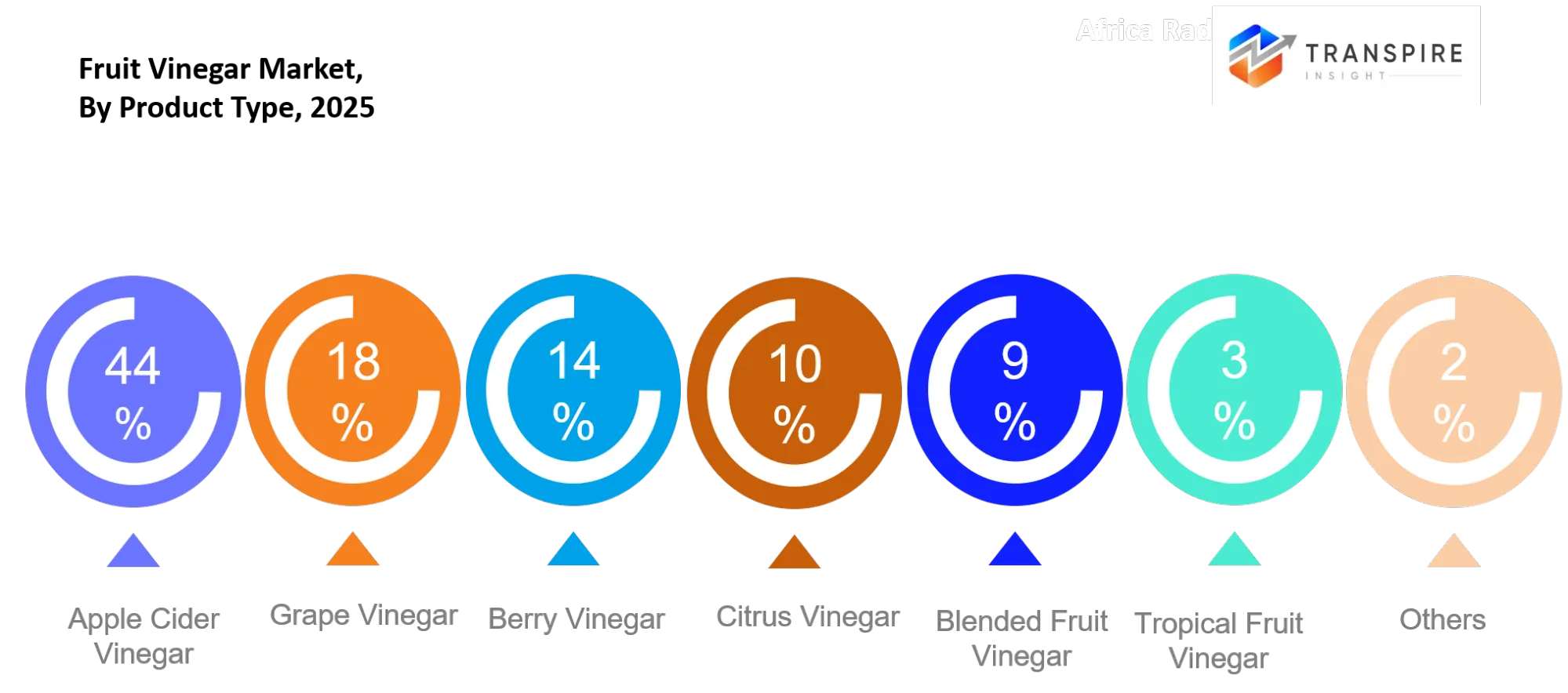
By Application:
Food and beverages still have the greatest share, as a variety of fruit vinegars are used widely in dressings, marinades, beverages, and processed food and beverages. Dietary supplements and functional food products are growing in digestive system health formulas; meanwhile, cosmetics and pharmaceutical products are adopting naturally fermented ingredients for product differentiation. Household usage is stable for traditional consumption patterns.
By End User:
Households continue to be the dominant consumers, driven by everyday use within cooking and health & beauty applications. Food manufacturers and catering companies boost trade demand with new product development, whilst more innovative beverage brands, nutraceutical companies and cosmetics producers are using fruit vinegar more and more in high-end formulas, with added-value positioning.
By Distribution Channel:
Supermarkets and hypermarkets generally lead in sales due to their wide variety of product availability. However, specialty retail outlets enhance the presence of high-end brands, online retail boosts direct sales, and wholesalers, convenience stores, and direct sales activities boost coverage of market segments.
By Form:
Liquid fruit vinegar still holds the strongest position in the traditional consumption sector. Concentrates and powders were launched to cater to the industrial application sector, whereas capsules and gummies gained speed fast by providing consumers with a more acceptable functional nutrition format.
What are the Key Use Cases Driving the Fruit Vinegar Market?
The primary use case is culinary acidulation and preservation, with fruit vinegar led by apple cider vinegar at 44% as a clean-label alternative to synthetic acidulants in dressings, marinades, sauces, and pickling, directly fuelling the food-and-beverages vertical's leading market share.
Developing applications include functional beverages and dietary supplements, with fruit vinegar used by manufacturers in order to highlight gut-health, low-sugar, and antioxidant positioning; driving enthusiasm within the dietary supplements, functional foods, and nutraceutical end-user markets.
Other use cases include cosmetics and personal care, in which mild acidity and antioxidant activity are used in tonics and hair rinses, and household cleaning, where natural, low-toxicity formulations cater to health- and sustainability-motivated consumers.
|
Report Metrics |
Details |
|
Market size value in 2025 |
USD 1.63 Billion |
|
Market size value in 2026 |
USD 2.35 Billion |
|
Revenue forecast in 2033 |
USD 29.82 Billion |
|
Growth rate |
CAGR of 43.76% from 2026 to 2033 |
|
Base year |
2025 |
|
Historical data |
2021 - 2024 |
|
Forecast period |
2026 - 2033 |
|
Report coverage |
Revenue forecast, competitive landscape, growth factors, and trends |
|
Regional scope |
United States; Canada; Mexico; United Kingdom; Germany; France; Italy; Spain; Denmark; Sweden; Norway; China; Japan; India; Australia; South Korea; Thailand; Brazil; Argentina; South Africa; Saudi Arabia; United Arab Emirates |
|
Key companies profiled |
Mizkan Holdings, Bragg Live Food Products, Eden Foods, Burg Groep, Fleischmann's Vinegar, Aspall Cyder, Vitacost, Vitane Pharmaceuticals, Dynamic Health Laboratories, Pompeian, De Nigris, Heinz, Marukan Vinegar, Acetum, Carl Kühne |
|
Customization scope |
Free report customisation (country, regional & segment scope). Avail customised purchase options to meet your exact research needs. |
|
Report Segmentation |
By Product Type (Apple Cider Vinegar, Grape Vinegar, Pomegranate Vinegar, Berry Vinegar, Citrus Vinegar, Tropical Fruit Vinegar, Blended Fruit Vinegar, Others); By Application (Food & Beverages, Dietary Supplements, Household Use, Cosmetics, Pharmaceuticals, Functional Foods, Others); By End User (Households, Food Manufacturers, Restaurants, Beverage Companies, Nutraceutical Companies, Cosmetic Manufacturers, Others); By Distribution Channel (Supermarkets & Hypermarkets, Convenience Stores, Specialty Stores, Online Retail, Direct Sales, Wholesalers, Others); By Form (Liquid, Powder, Concentrate, Capsules, Gummies, Others) |
Which Regions are Driving the Fruit Vinegar Market Growth?
North America currently dominates 36% of global demand for fruit vinegar, driven by established clean-label processes, robust bottling resources, and a strong wellness-beverage culture. The region's strength stems from FDA-backed health claims for ACV, comprehensive supermarket and e-commerce channels, and high household expenditure on functional foods. These factors allow rapid scaling of premium, organic and raw offerings, with brands like Bragg and Pompeian establishing benchmarks on sensory and label statements. Demand-sustainability is also supported by entrenched routines and healthy-use trends in eating out/foodservice reformulation.
Europe holds a 30% share, is more cautious with the fact that more stringent EFSA health-claim substantiation, and prefers culinary premiumization rather than wellness positioning. North American growth is more aggressive but less stable, as markets prefer more eclectic offerings (gourmet dressings, balsamic-style blends) and more artisanal producers, such as Aspall Cyder and Burg Groep. Regulatory caution to aggressive functional claims ultimately maintains consistent, steady adoption and widespread market acceptance, making Europe a reliable platform for high-margin, flavour-forward SKUs. In January 2026, Burg Groep updated its operations and officially secured a silver medal from EcoVadis for its sustainable procurement and ethical production standards across its core European vinegar markets.
Asia-Pacific holds a 27% share and is the most rapidly expanding region-CAGR 16.7% driven by urbanization, higher functional-beverage consumption, and burgeoning modern retail. Recent developments involve boosting local fermentation infrastructure, launching ready-to-drink (RTD) vinegar drinks, and developing e-commerce channels that will fast-track innovation and trial of new product flavours. Going forward, Asia-Pacific will provide new avenues for increasing volumes of precise bio-fermentation and bio-engineering to cover demand in food, beverages, and personal care with steady and persistently consistent acid profiles.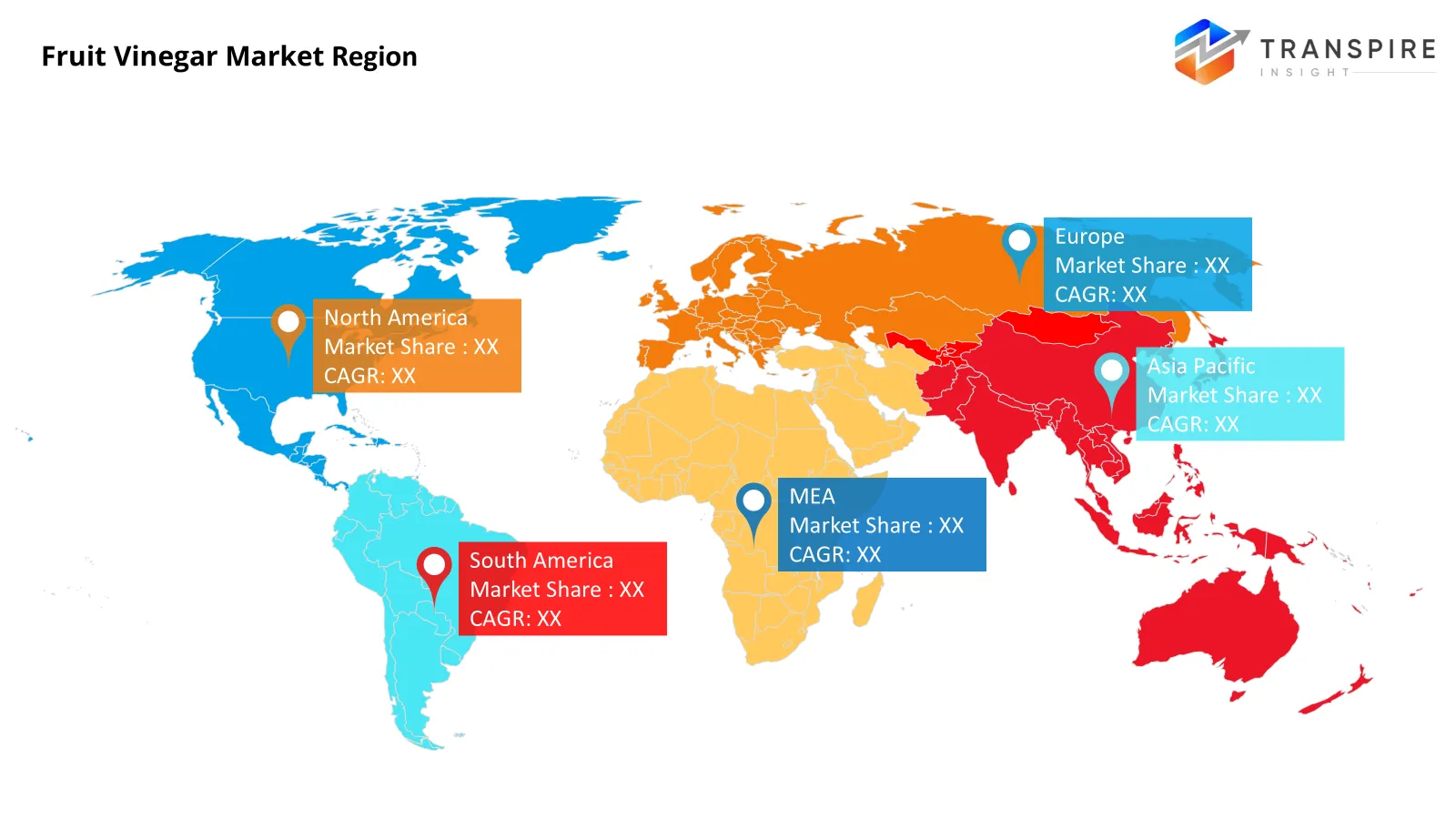
Who are the Key Players in the Fruit Vinegar Market and how do they Compete?
The worldwide fruit vinegar market is ‘moderately fragmented' with the competition characterised by the competition between clean-label positioning, sensory consistency, and multichannel distribution. The major brands are using brand equity and economies of scale, while small-scale producers are using artisanal production, organic certification, and functional claims to position their products.
Mizkan Holdings and Bragg Live Food Products utilise innovation and health & wellness positioning to differentiate their raw unfiltered apple cider vinegar on the shelves, supported by their probiotic and digestion-health ‘story’. Eden Foods and Burg Groep are best positioned for premium grocery and food service from evolving traditions and origin labelling. Fleischmann's Vinegar and Heinz employ cost leadership advantage and deca-trade, popular mainstream distribution to capitalize on the general shift to fruit vinegar in sauces and condiments for clean-label reformulation. Aspall Cyder and De Nigris select niche differentiation by single-fruit and artisanal blends, positioning their products at specialty retail and niche/strategy restaurants. Vitacost and Vitane Pharmaceuticals diversify by diversifying into dietary supplements through capsules and gummies tailored to address metabolic concerns, while Dynamic Health Laboratories and Pompeian expand by investing online and D2C to test new flavours and health boosts. Marukan Vinegar, Acetum, and Carl Khne focus on operational efficiencies and extending regional growth by sourcing raw materials and building product portfolios.
Key Players are:
- Mizkan Holdings
- Bragg Live Food Products
- Eden Foods
- Burg Groep
- Fleischmann's Vinegar
- Aspall Cyder
- Vitacost
- Vitane Pharmaceuticals
- Dynamic Health Laboratories
- Pompeian
- De Nigris
- Heinz
- Marukan Vinegar
- Acetum
- Carl Kühne
Recent Development News
- In May 2026, Lv Jie launched a new ready-to-drink (RTD) apple cider vinegar line featuring blended apple juice and functional prebiotics under the "Vinegar Fairy" concept. This product launch directly captures emerging consumer demographics by mitigating the sharp acidity of ancestral vinegars, facilitating mainstream retail expansion into the wellness-oriented millennial and female beverage categories.
- In July 2026, Tiger Brands invested R200 million to upgrade its Paarl condiments megasite, featuring the completion of a dedicated new industrial vinegar production facility. This infrastructural expansion transitions the company from outsourced vinegar procurement to an internalized capacity of three million litres annually, maximizing regional supply chain resilience and cost efficiency.
https://www.engineeringnews.co.za
What Strategic Insights Define the Future of the Fruit Vinegar Market?
The fruit vinegar market is heading toward industrial-appliance standardization-precision fermentation and bioengineering have allowed consistent acidity and new formats such as concentrates, powders, and gummies to emerge that deliver specifications for food and beverage brands at scale. A risk is regulation tightening on health claims-especially in Europe, where EFSA substantiation could restrict functional positioning and tighten margins on wellness SKUs, compelling brands to focus on culinary use and sensory differentiation. Meanwhile, a nascent opportunity is Asia-Pacific's urbanization, and adoption of functional-beverage habits- ready-to-drink vinegar beverages and e-commerce are encouraging trial, repeat purchase, and regional space for consumers to adopt at scale. Invest in IoT-enabled bioreactors and machine-learning models for microbial datasets to lower batch variability, speed time-to-market on new launches, and ensure supply for clean-label reformulation in food, beverage and personal care, while preparing regulatory-ready evidence dossiers to defend premium claims.
Key Segmentations are:
By Product Type
- Apple Cider Vinegar
- Grape Vinegar
- Pomegranate Vinegar
- Berry Vinegar
- Citrus Vinegar
- Tropical Fruit Vinegar
- Blended Fruit Vinegar
- Others
By Application
- Food & Beverages
- Dietary Supplements
- Household Use
- Cosmetics
- Pharmaceuticals
- Functional Foods
- Others
By End User
- Households
- Food Manufacturers
- Restaurants
- Beverage Companies
- Nutraceutical Companies
- Cosmetic Manufacturers
- Others
By Distribution Channel
- Supermarkets & Hypermarkets
- Convenience Stores
- Specialty Stores
- Online Retail
- Direct Sales
- Wholesalers
- Others
By Form
- Liquid
- Powder
- Concentrate
- Capsules
- Gummies
- Others
Regional Outlook
North America
- US
- Canada
- Mexico
- US
- Canada
Europe
- Germany
- UK
- France
- Italy
- Spain
- Rest of Europe
Asia Pacific
- China
- Japan
- India
- South Korea
- Australia
- Rest of Asia Pacific
South America
- Brazil
- Argentina
- Rest of South America
Middle East & Africa
- UAE
- Saudi Arabia
- Qatar
- South Africa
- Rest of the Middle East & Africa
Frequently Asked Questions
Find quick answers to common questions.
The Fruit Vinegar Market size was valued at USD 1.63 billion in 2025 and is poised to reach USD 29.82 billion by 2033, expanding at a 43.76% CAGR.
Key segments for the Fruit Vinegar Market are Type By Product Type (Apple Cider Vinegar, Grape Vinegar, Pomegranate Vinegar, Berry Vinegar, Citrus Vinegar, Tropical Fruit Vinegar, Blended Fruit Vinegar, Others); By Application (Food & Beverages, Dietary Supplements, Household Use, Cosmetics, Pharmaceuticals, Functional Foods, Others); By End User (Households, Food Manufacturers, Restaurants, Beverage Companies, Nutraceutical Companies, Cosmetic Manufacturers, Others); By Distribution Channel (Supermarkets & Hypermarkets, Convenience Stores, Specialty Stores, Online Retail, Direct Sales, Wholesalers, Others); By Form (Liquid, Powder, Concentrate, Capsules, Gummies, Others).
Growth is primarily driven by clean-label reformulation pressure, rising consumer demand for functional beverages with gut-health positioning, advances in precision fermentation enabling consistent acidity profiles, expansion of ready-to-drink wellness formats, and increasing foodservice adoption of natural acidulants.
The global market is led by major manufacturers including Mizkan Holdings, Bragg Live Food Products, Eden Foods, Burg Groep, Fleischmann's Vinegar, Aspall Cyder, Vitacost, Vitane Pharmaceuticals, Dynamic Health Laboratories, Pompeian, De Nigris, Heinz, Marukan Vinegar, Acetum, and Carl Kühne.
North America, holding a 36% share, influences dynamics through mature clean-label regulation, advanced bottling infrastructure, high per-capita functional-food spending, and entrenched household and foodservice reformulation routines that set global sensory and labelling benchmarks.
Commercial opportunities include precision fermentation and AI-guided strain selection for tailored acidity, RTD functional beverage expansion in Asia-Pacific, e-commerce-driven flavour trials, and clean-label acidulant replacement in sauces, dressings, and personal-care formulations.
- Mizkan Holdings
- Bragg Live Food Products
- Eden Foods
- Burg Groep
- Fleischmann's Vinegar
- Aspall Cyder
- Vitacost
- Vitane Pharmaceuticals
- Dynamic Health Laboratories
- Pompeian
- De Nigris
- Heinz
- Marukan Vinegar
- Acetum
- Carl Kühne
About the Authors

Chetan Dhatrak
I’m Chetan Dhatrak, a Senior Research Analyst at Transpire Insight, specializing in the Consumer Goods, Foods and Beverages industry. I focus on analyzing market trends, consumer behavior, competitive landscapes, and industry developments to deliver accurate, data-driven insights. My research at Transpire Insight is built on credible sources and in-depth analysis, helping businesses and readers better understand market dynamics, emerging opportunities, and evolving consumer preferences. I’m committed to creating reliable, well-researched content that supports informed decision-making and reflects the latest developments in the consumer goods and food & beverage sectors.

Chakradhar Khansole
Chakradhar serves as the Research Director at Transpire Insight, bringing over 8 years of experience in technology, innovation, and strategic market intelligence. He specializes in transforming complex market data into actionable business insights that enable organizations to make informed, growth-oriented decisions. Recognized for his strategic vision and analytical expertise, Chakradhar leads high-impact research initiatives, delivering comprehensive market assessments, competitive intelligence, and forward-looking industry analysis.
Recently Published Reports
-
Apr 2026
Baby Infant Formula Market
Baby Infant Formula Market Size, Share & Analysis Report By ype (Infant Milk, Follow On Milk, Specialty Baby Milk, Growing-Up Milk), By Ingredient (Carbohydrate, Fat, Protein, Minerals, Vitamins, and Others), By Product Form (Powder, Liquid, and Ready-to-feed), By Distribution Channels (Supermarket/Hypermarket, Specialty Store, Pharmacies, Online Retail, and Others), and Geography (North America, Europe, Asia-Pacific, Middle East and Africa, South and Central America), 2021 - 2031
-
Apr 2026
Edible Insects for Animal Feed Market
Edible Insects for Animal Feed Market Size, Share & Analysis Report By Type (Insect Powder, Insect Meal, Insect Bar, Insect Paste, Insect Oil, and Others), By Insect Type (Beetles, Cricket, Caterpillar, Hymenoptera, Orthoptera, Tree Bugs, and Others), By Application (Livestock, Pet Food, and Aquaculture), By Livestock Type (Poultry, Swine, and Others), and Geography (North America, Europe, Asia-Pacific, Middle East and Africa, South and Central America), 2021 - 2031
-
Apr 2026
Food Industry Disinfection and Bacterial Control Market
Food Industry Disinfection and Bacterial Control Market Size, Share & Analysis Report By Type (Chemical Disinfectants, Physical Disinfectants, and Biocides and Antimicrobials), By Application (Food Processing Equipment Surface Disinfection, Food Preparation Areas Surface Disinfection, Storage Areas Surface Disinfection, Anti-microbial Coatings Food Preservation, and Preservative Solutions Food Preservation), By End User (Meat and Poultry Processing, Dairy Processing, Seafood Processing, Bakery and Confectionery, Restaurants and Commercial Kitchens, and Food Service Providers), By Sales Channel (Online, Offline), and Geography (North America, Europe, Asia-Pacific, Middle East and Africa, South and Central America), 2021 - 2031
-
May 2026
Freeze Dried Food Market
Freeze Dried Food Market Size, Share & Analysis Report By Product Type (Fruits, Vegetables, Freeze-Dried Dairy Products, Freeze-Dried Meat and Seafood, Freeze-Dried Pet Food, and Prepared Meal), By Nature (Organic, and Conventional), By Form (Powdered, Granules, and Diced), By End Use (Breakfast Cereals, Dairy Products, Bakery & Confectionery, Nutritional Bars & Supplements, Powdered Beverages, Snacks, and Retail (Household)), and Geography (North America, Europe, Asia-Pacific, Middle East and Africa, South and Central America), 2021 - 2031