

Global Vinegar Market Size & Forecast:
- Global Vinegar Market Size 2025: USD 7.1 Billion
- Global Vinegar Market Size 2033: USD 8.5 Billion
- Global Vinegar Market CAGR: 2.20%
- Global Vinegar Market: By Type (Apple Cider Vinegar, White Vinegar, Balsamic Vinegar, Rice Vinegar, Malt Vinegar, Wine Vinegar, Flavored Vinegar, Others); By Application (Food & Beverage, Pharmaceuticals, Household Cleaning, Personal Care, Agriculture, Others); By Distribution Channel (Supermarkets, Convenience Stores, Online Retail, Specialty Stores, Others); By End-User (Residential, Commercial Food Service, Food Processing Industry, Others).
Global Vinegar Market Summary:
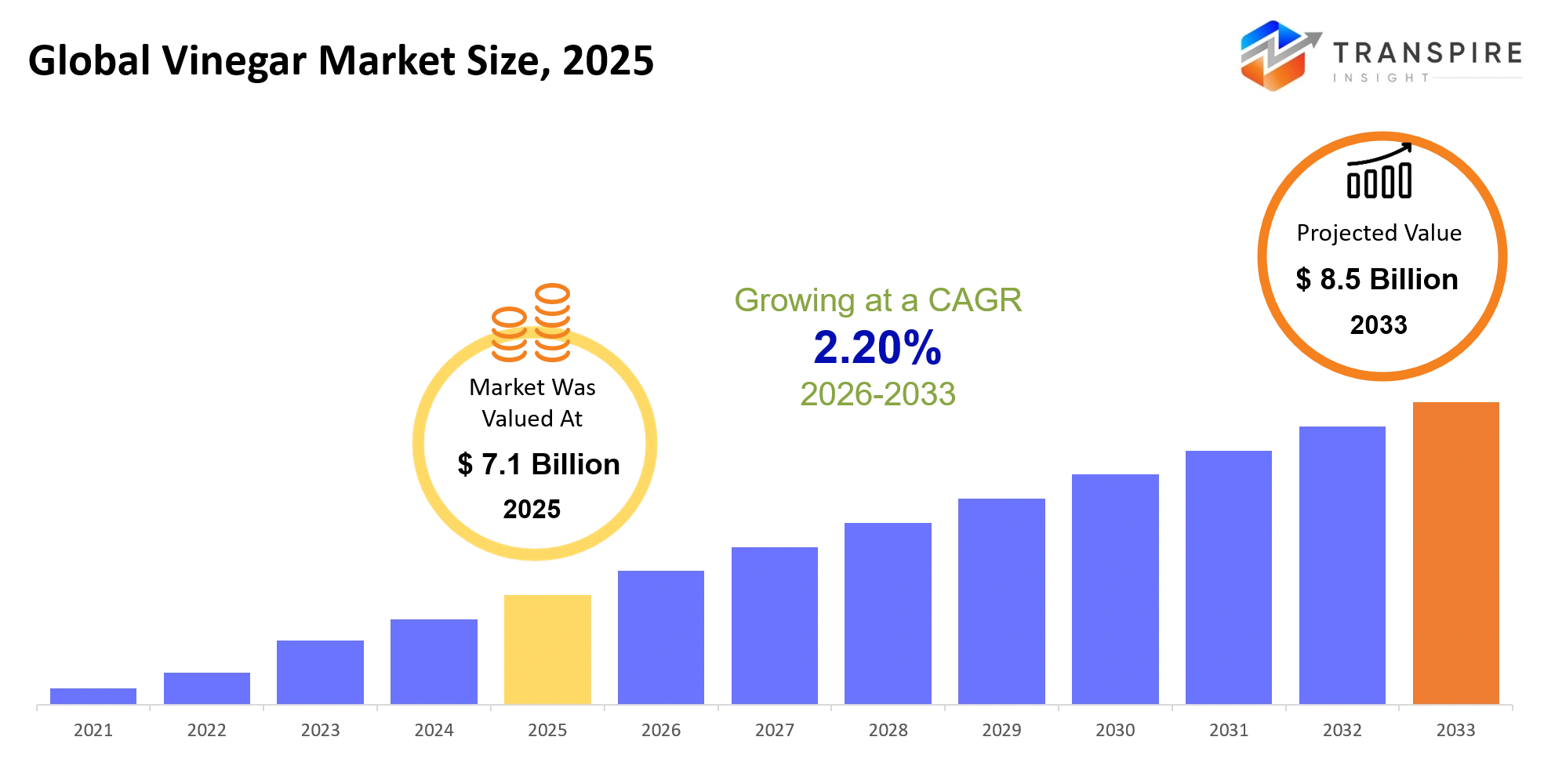
As per Transpire Insight Analysis, the Global Vinegar Market size is estimated at USD 7.1 Billion in 2025 and is anticipated to reach USD 8.5 Billion by 2033, growing at a CAGR of 2.20% from 2026 to 2033.
The global vinegar market has become highly diversified, serving various segments within the food & beverage, health & nutrition and home care industries. Previously, vinegar was consumed for its taste and preservation attributes. However, it is now considered a functional ingredient, applied within gourmet condiments, functional drinks, clean-label food products and natural household cleaning agents. In the last five years, a structural trend towards high-value-added and health-focused products has spurred manufacturers to shift away from the simple commodity production of vinegar. An observable real-world trend that triggered this was increased consumer awareness about using natural ingredients, minimum processing, etc., thus accelerating the trend towards organic, raw and niche vinegars, hence encouraging greater investment into sophisticated fermentation technologies, product development and high-end brand positioning. The market is thus witnessing the cause and effect trend that, due to an increase in consumer demand for natural, functional and sustainable products, applications for vinegar are widening in the numerous end-use segments and thereby the long-term positioning is being strengthened.
Key Global Vinegar Market Insights:
The global vinegar market is gradually evolving into a premium market with health assurance innovation and digitalisation leading the way, rather than the traditional volume market. The competitive edge is now moving to companies able to bring together fermentation experience, functionality development and technology- based manufacturing.
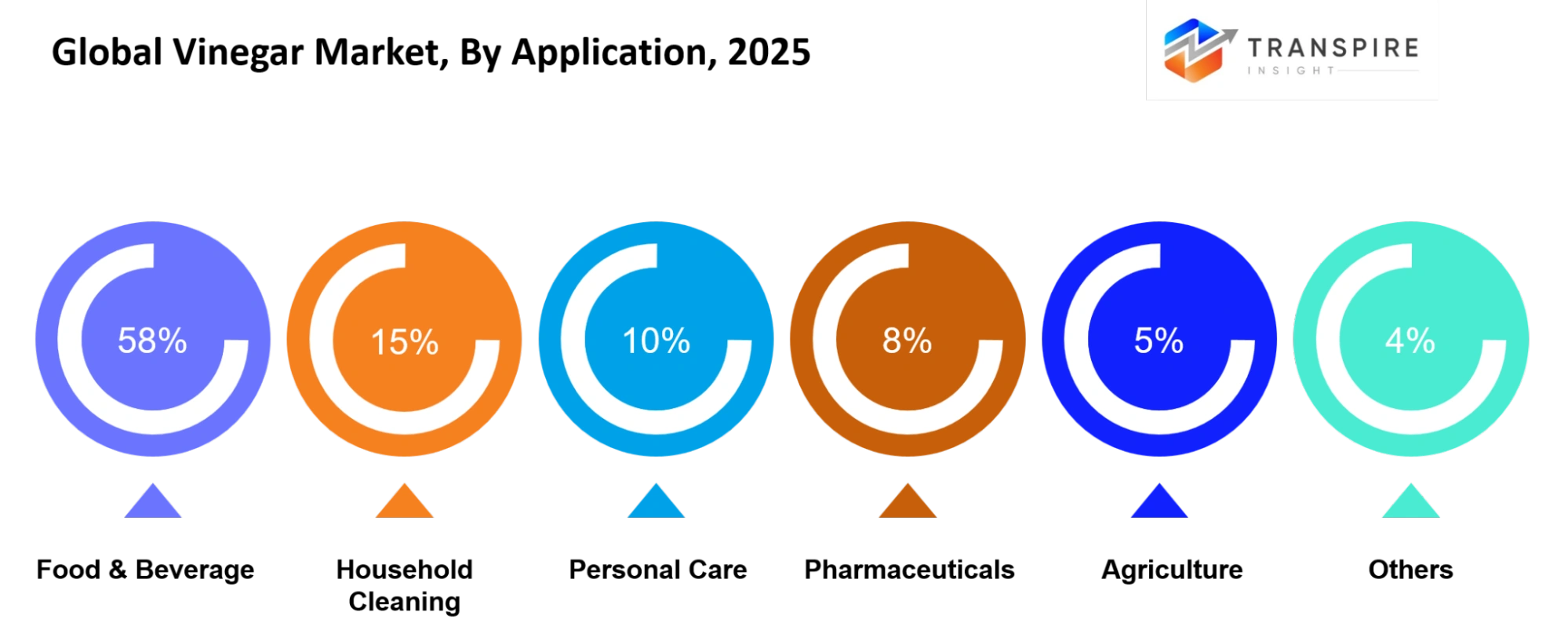
- Food & Beverage accounts for 58% of market demand, and functional and premium vinegar offerings are growing among companies like Mizkan and Kraft Heinz as consumer preferences change.
- North America makes up 36% of the market, bolstered by high levels of clean-label food products, wellness drinks, and value-added condiment innovations.
- In Europe, which accounts for 30% of the world market, companies such as Acetum, Ponti and De Nigris are investing in premium and organic certified vinegars.
- Asia Pacific accounts for 25% market share and is expected to grow at 11.7% CAGR due to the growing health awareness, urbanisation, and investment in modern fermentation facilities.
- Demand for Apple Cider Vinegar is the fastest-growing product category, growing at 10.8%, as consumers shift towards functional nutrition and preventive wellness products.
- Household Cleaning accounts for 15% of the market, and manufacturers are tapping into the rising demand for natural and chemical-free cleaning options.
- AI-driven fermentation technologies are emerging, with Sennos' intelligent fermentation platform for enhanced consistency, yield optimisation, and waste reduction standing out.
- Digital commerce is changing how consumers buy, and vinegar labels are leveraging online retail channels to sell speciality, organic, and premium products to consumers.
What are the Key Drivers, Restraints, and Opportunities in the Global Vinegar Market?
Driver:
The most compelling driver of growth comes from an increasing willingness from consumers and manufacturers to see vinegar move beyond being just an ingredient to a versatile, multi-purpose product with applications across food, wellness, and natural household use. Driven by a need for transparency in ingredients, consumers are searching for natural alternatives to manufactured components, so new organic, premium and functional vinegar lines that are in higher margin areas are being developed alongside those used in traditional recipes, enabling new revenue generation. Consumer demand is stimulating the development of a broader range of innovative products for beverage, condiments and wellness applications.
Restraints:
Dependency on the supply of agricultural inputs like apples, grapes, rice and grains is a major restriction of the market, which is susceptible to climate conditions, supply disturbances and price fluctuations. This is a structural drawback that still exists, as vinegar production is still dependent on the availability of the crops and on fermentation. Rising raw material prices affect the profitability, especially in the luxury and speciality markets, where consistent product quality is of paramount importance.
Opportunities:
The greatest opportunity lies in the synergy created through modern fermentation technology, AI-powered process optimisation, and smart manufacturing. Capital investments in smart fermentation technology and smart production tracking will contribute to an improved yield ratio, minimise losses, and facilitate the production of higher-end products. Another huge market to capitalise on is the developing countries in the Asia-Pacific, Latin America, and the Middle East regions, which are embracing high-value vinegar products. In April 2026, Planetary raised $28 million in funding led by Team for the Planet and the European Innovation Council Fund. The capital scales its automated bioprocess platform with real-time monitoring and smart fermentation control for optimised industrial-scale microbial processing.
What Has the Impact of Artificial Intelligence Been on the Global Vinegar Market?
AI is steadily changing the game when it comes to vinegar production - to make things more streamlined, quality assured, and to provide a more responsive supply chain. AI-driven solutions have been adopted by vinegar manufacturers to keep track of the fermentation process and its parameters like temperature, pH, and bacterial growth to achieve better performance, thereby cutting down costs and minimising waste. The application of AI predictive analysis is not restricted to just manufacturing. AI helps organisations in predicting what will be needed in the future, from the number of materials required to the quantity needed. This makes it easier for organisations to plan their supply management. The AI technology is also applied in the supply of materials used in agriculture, like grapes, cereals, and apples. AI is being applied increasingly to product development. Companies are studying consumer purchase behaviour and taste preferences to uncover new market opportunities and drive the creation of new products. The main problem that currently confronts this field is the cost and difficulty associated with its implementation. The problem here arises with small and medium firms as they lack both the necessary structure and the requisite expertise to make full use of advanced AI technologies.
Key Global Vinegar Market Trends:
The vinegar industry worldwide is moving away from being just a preservative to becoming an ecosystem of value-added products based on wellness, sustainability, and innovation. The growth of the market will continue to be driven not only by consumer needs but also by premium tastes and functionality offered by new technologies.
- Consumers no longer purchase conventional table vinegar and instead opt for high-quality, flavoured, and craft vinegar options.
- There is a change from preservation-related goals to functionality with respect to wellness. Wellness is generated as a result of the digestive functions linked to eating vinegar.
- It is because of transparency from consumers that companies have started increasing investments in fermented products.
- The industry is moving towards premiumization through the use of origin-based labelling and speciality production techniques instead of mass market offerings.
- Artificial intelligence and smart fermentation are replacing manual observation methods for improved consistency, efficiency, and output.
- E-commerce is emerging as a key distribution channel for speciality and wellness-oriented vinegar products.
- The use of sustainable packaging has accelerated as consumers have an increased environmental consciousness and retailers have sustainability expectations.
- Speciality vinegars are being added to upscale menus at foodservice establishments with the increase of consumer interest in international tastes and culinary innovation.
Global Vinegar Market Segmentation
By Type:
The vinegar industry has been divided on the basis of types like Apple Cider Vinegar, White Vinegar, Balsamic Vinegar, Rice Vinegar, Malt Vinegar, Wine Vinegar, Flavoured Vinegar, and Other types. White Vinegar has a prominent market share due to low prices and extensive usage in multiple sectors. In comparison to others, Apple Cider Vinegar is the most robust category; it has demonstrated a 10.8% CAGR in the market as consumer preferences are shifting towards this vinegar based on health, functional nutrition and natural lifestyle perceptions. The demand for flavoured and premium /speciality vinegars is anticipated to increase their business share due to a growing emphasis by brands on value-added services.
By Applications:
Food & Beverage held 58% market share and was the largest growing application segment. Vinegars are used more and more in sauces, dressings, nutritional drinks, preserved foods, and clean-label applications. Household Cleaning occupied 15%, with increasing awareness of eco-friendly cleaning agents, while Personal Care was 10% by vinegar-derived ingredients used in cosmetics and cosmetics. Others, namely Pharmaceutical and Agriculture, held 8% and 5% of market share respectively. While new applications will come from many more diverse functional products than just consumption.
By Distribution channel:
Supermarkets have the highest sales of vinegar due to the wide variety of products available. Convenience stores facilitate day-to-day buying habits. The growing demand for gourmet, organic, and specialty vinegar online is driving massive growth in online retail, while speciality stores continue to create awareness for premium products and provide platforms for niche brands.
By End-User:
Residential consumers will continue to hold the largest share in demand, due to the daily usage for household needs. Commercial food service providers'menu diversification and utilisation in new applications is propelling premium vinegar adoption, while the food processing industry is continually adopting vinegar for preservation and formulation processes. Industrial innovation will be critical in defining the future growth of the market.
What are the Key Use Cases Driving the Global Vinegar Market?
The major driver of demand for vinegar is the food and beverage segment, where it is widely used in sauces, dressings, marinades, pickles, and food processing. Moreover, its ability to add flavour and be an element of clean-label product formulations makes vinegar the ideal choice.
In addition to its conventional use in food products, vinegar is used in household and industrial cleaning products for its natural antibacterial properties and growing preference for chemical-free products. Also, vinegar is becoming increasingly popular as an ingredient in personal care products and health beverages.
The new opportunities associated with vinegar relate to the health & wellness trend. The arrival of apple cider vinegar shots, probiotic drinks, and specific types of vinegar creates additional consumption scenarios. Hence, in response to consumer demand for healthier foods, vinegars may transform from a food item into an ingredient across different sectors.
|
Report Metrics |
Details |
|
Market size value in 2025 |
USD 7.1 Billion |
|
Market size value in 2026 |
USD 7.3 Billion |
|
Revenue forecast in 2033 |
USD 8.5 Billion |
|
Growth rate |
CAGR of 2.20% from 2026 to 2033 |
|
Base year |
2025 |
|
Historical data |
2021 - 2024 |
|
Forecast period |
2026 - 2033 |
|
Report coverage |
Revenue forecast, competitive landscape, growth factors, and trends |
|
Regional scope |
United States; Canada; Mexico; United Kingdom; Germany; France; Italy; Spain; Denmark; Sweden; Norway; China; Japan; India; Australia; South Korea; Thailand; Brazil; Argentina; South Africa; Saudi Arabia; United Arab Emirates |
|
Key company profiled |
Mizkan Holdings, Kraft Heinz, Borges International Group, Australian Vinegar, Fleischmann’s Vinegar, Acetum, Marukan Vinegar, Shanxi Shuita Vinegar, Aspall Cyder, De Nigris, Ponti, Eden Foods, Nakano Vinegar, Burg Group, Carl Kühne. |
|
Customization scope |
Free report customisation (country, regional & segment scope). Avail customised purchase options to meet your exact research needs. |
|
Report Segmentation |
By Type (Apple Cider Vinegar, White Vinegar, Balsamic Vinegar, Rice Vinegar, Malt Vinegar, Wine Vinegar, Flavored Vinegar, Others); By Application (Food & Beverage, Pharmaceuticals, Household Cleaning, Personal Care, Agriculture, Others); By Distribution Channel (Supermarkets, Convenience Stores, Online Retail, Specialty Stores, Others); By End-User (Residential, Commercial Food Service, Food Processing Industry, Others). |
Which Regions are Driving the Global Vinegar Market Growth?
North America is in first place and accounted for nearly 36% of the world market share of vinegar. With high penetration rates of organic and premium foods, functional beverages, and natural domestic products, consumers in this region can readily accept premium products. The advanced food industry structure and wide distribution channels help accelerate the commercialisation of value-added vinegar products. Besides, the increase in demand for natural-label ingredients and health consciousness further drive market growth in the US and Canada.
In March 2026, Bragg Live Food Products launched a new metabolic support supplement in the United States using raw apple cider vinegar and botanical extracts. The impact of this development is to naturally increase GLP-1 release for consumers without relying on pharmacological drugs, addressing the growing wellness and clean-label trends in North America.
https://www.nutritioninsight.com/news/glp1-medication-weight-loss-supplements-bragg-metabolism.html
Europe accounts for roughly 30% of total market share and remains the second-largest contributor at the regional level. As opposed to North America, where there is greater emphasis on the industrial application of vinegars, the strength of Europe is more in its strong culinary background, heritage of high-quality vinegars, and penchant for authentic products. Stable consumer demand is ensured through high product quality standards and the protection of origin products. In May 2026, Voets Specialiteiten and Triple Invest jointly acquired and relaunched Oil & Vinegar out of bankruptcy. The Dutch-Belgian partnership preserves physical distribution footprints for heritage, high-quality European gourmet vinegars.
In July 2026, Gourmet Classic launched a new food service line featuring 9 mainstream vinegars in 2-litre PET bottles and 5-litre jerry cans, enhancing culinary distribution with an automated packing system.
https://gourmetclassic.com/cooking-wines-vinegars-july-2026/
The Asia-Pacific accounts for nearly 25% of the market and is the fastest-growing region with a CAGR of 11.7%. Urbanisation, disposable income, and the increasing trend of consumption of processed foods and speciality sauces have led to increased demand. Factors like increasing awareness regarding health and the trend towards consuming functional food products in China, Japan, India and Southeast Asia have been driving growth over recent periods. Investments in innovative and modern fermentation techniques, premium product differentiation and expansion of the digital sales channels are likely to trigger future growth opportunities.
In March 2026, dsm-firmenich strengthened its portfolio in Asia with new regulatory approvals for Human Milk Oligosaccharides (HMOs) to be used in countries including China and Malaysia.
Who are the Key Players in the Global Vinegar Market and how do they Compete?
Global vinegar markets are becoming competitive based on specialisation, premiumization, and control over the supply chain, rather than size. These manufacturers are developing heritage and functional offerings, organic certification, and regional flavours to compete. While efficiency is key to remaining competitive, manufacturers of products that appeal to the naturally inclined health-conscious consumer are also emphasizing added value to enhance brand loyalty and growth. Mizkan Holdings and Marukan Vinegar are competing through innovation of new products and their focus on fermentation products. The company Kraft Heinz is making use of its branding and marketing strategy to capture more market share, while Borges International Group and Acetum are making use of premium products from their region. Aspall Cyder, De Nigris and Ponti are seeking differentiation based on authenticity and brand positioning. Australian Vinegar, Fleischmann's Vinegar, Burg Group, Carl Kühne, Shanxi Shuita Vinegar, Nakano Vinegar, and Eden Foods aim to increase sales via their growing range of distribution outlets, increasing exports and introducing specialty products. Some have opted for a dual-market strategy, including organic options, artisanal production methods, and industrial uses, as well as working with retailers to create private-label brands in both mass and premium segments internationally.
Key Players are:
- Mizkan Holdings
- Kraft Heinz
- Borges International Group
- Australian Vinegar
- Fleischmann's Vinegar
- Acetum
- Marukan Vinegar
- Shanxi Shuita Vinegar
- Aspall Cyder
- De Nigris
- Ponti
- Eden Foods
- Nakano Vinegar
- Burg Group
- Carl Kühne
Recent Development News
In June 2026, Filippo Berio expanded its global product line by launching its raw, unfiltered Organic Apple Cider Vinegar featuring "with the mother" bacterial cultures alongside a new premium label design overhaul. This strategic deployment targets the surging consumer transition toward functional wellness-focused condiments.
Source: https://www.specialtyfood.com
In May 2026, Oil & Vinegar was relaunched under new joint leadership following a bankruptcy, while Shandong Lv Jie launched a "Vinegar Fairy" ready-to-drink apple cider vinegar line aimed at Southeast Asian markets. Additionally, Galactic introduced clean-label Galimax Flavor V-100 Pearls for improved manufacturing efficiency.
Source: https://www.retaildetail.eu/news/food/oil-vinegar-relaunches-under-belgian-dutch-leadership/
What Strategic Insights Define the Future of the Global Vinegar Market?
The global vinegar market is no longer just another seasoning; it's morphing into a key player in the healthy, clean, and "natural" food space. Consumers are more and more on the hunt for naturally-sourced, healthy foods, as well as fancy vinegars that will spice up their diet and deliver a kick of "health benefits." But the industry also faces a secret threat: the proliferation of cheaper, store-brand options. As more of these enter the market, prices will undoubtedly be driven down, impacting branded product profits. But there might be a chance to get into the value-added category. Health-aware customers might get hooked on organic, fortified or flavoured vinegars, particularly if businesses begin focusing more on innovation rather than sales volumes and on their ingredients, tracing them to the sources and building up the image of a high-value brand. Investing in branding, e-commerce, and niche markets such as specialised retail outlets would open up the market to them.
Key Segmentations are:
By Type
- Apple Cider Vinegar
- White Vinegar
- Balsamic Vinegar
- Rice Vinegar
- Malt Vinegar
- Wine Vinegar
- Flavoured Vinegar
- Others
By Application
- Food & Beverage
- Pharmaceuticals
- Household Cleaning
- Personal Care
- Agriculture
- Others
By Distribution Channel
- Supermarkets
- Convenience Stores
- Online Retail
- Speciality Stores
- Others
By End-User
- Residential
- Commercial Food Service
- Food Processing Industry
- Others
Regional Outlook
North America
- United States
- Canada
- Mexico
Europe
- Germany
- United Kingdom
- France
- Spain
- Italy
- Rest of Europe
Asia Pacific
- Japan
- China
- Australia & New Zealand
- South Korea
- India
- Rest of Asia Pacific
South America
- Brazil
- Argentina
- Rest of South America
Middle East & Africa
- Saudi Arabia
- United Arab Emirates
- South Africa
- Rest of the Middle East & Africa
Frequently Asked Questions
Find quick answers to common questions.
The global vinegar market size was valued at USD 7.1 Billion in 2025 and is projected to reach USD 8.5 Billion by 2033, growing at 2.20% CAGR.
Key segments for the global vinegar market are By Type (Apple Cider Vinegar, White Vinegar, Balsamic Vinegar, Rice Vinegar, Malt Vinegar, Wine Vinegar, Flavored Vinegar, Others); By Application (Food & Beverage, Pharmaceuticals, Household Cleaning, Personal Care, Agriculture, Others); By Distribution Channel (Supermarkets, Convenience Stores, Online Retail, Specialty Stores, Others); By End-User (Residential, Commercial Food Service, Food Processing Industry, Others).
Growth is primarily driven by being fueled by the rising adoption of vinegar in premium food, wellness, and natural lifestyle products, supported by consumer preference for clean-label and naturally sourced ingredients.
The global vinegar market is led by major manufacturers, including Mizkan Holdings, Kraft Heinz, Borges International Group, Australian Vinegar, Fleischmann’s Vinegar, Acetum, Marukan Vinegar, Shanxi Shuita Vinegar, Aspall Cyder, De Nigris, Ponti, Eden Foods, Nakano Vinegar, Burg Group, and Carl Kühne.
North America accounts for approximately 36% of the global vinegar market, driven by strong demand from the food and beverage industry, growing health-conscious consumer preferences, advanced distribution networks, and continuous product innovation.
Commercial opportunities are emerging from AI-enabled fermentation technologies, smart manufacturing investments, and expanding demand for high-value vinegar products across rapidly developing markets in Asia-Pacific, Latin America, and the Middle East.
- Mizkan Holdings
- Kraft Heinz
- Borges International Group
- Australian Vinegar
- Fleischmann's Vinegar
- Acetum
- Marukan Vinegar
- Shanxi Shuita Vinegar
- Aspall Cyder
- De Nigris
- Ponti
- Eden Foods
- Nakano Vinegar
- Burg Group
- Carl Kühne
About the Authors

Chetan Dhatrak
I’m Chetan Dhatrak, a Senior Research Analyst at Transpire Insight, specializing in the Consumer Goods, Foods and Beverages industry. I focus on analyzing market trends, consumer behavior, competitive landscapes, and industry developments to deliver accurate, data-driven insights. My research at Transpire Insight is built on credible sources and in-depth analysis, helping businesses and readers better understand market dynamics, emerging opportunities, and evolving consumer preferences. I’m committed to creating reliable, well-researched content that supports informed decision-making and reflects the latest developments in the consumer goods and food & beverage sectors.

Chakradhar Khansole
Chakradhar serves as the Research Director at Transpire Insight, bringing over 8 years of experience in technology, innovation, and strategic market intelligence. He specializes in transforming complex market data into actionable business insights that enable organizations to make informed, growth-oriented decisions. Recognized for his strategic vision and analytical expertise, Chakradhar leads high-impact research initiatives, delivering comprehensive market assessments, competitive intelligence, and forward-looking industry analysis.
Recently Published Reports
-
Apr 2026
Baby Infant Formula Market
Baby Infant Formula Market Size, Share & Analysis Report By ype (Infant Milk, Follow On Milk, Specialty Baby Milk, Growing-Up Milk), By Ingredient (Carbohydrate, Fat, Protein, Minerals, Vitamins, and Others), By Product Form (Powder, Liquid, and Ready-to-feed), By Distribution Channels (Supermarket/Hypermarket, Specialty Store, Pharmacies, Online Retail, and Others), and Geography (North America, Europe, Asia-Pacific, Middle East and Africa, South and Central America), 2021 - 2031
-
Apr 2026
Edible Insects for Animal Feed Market
Edible Insects for Animal Feed Market Size, Share & Analysis Report By Type (Insect Powder, Insect Meal, Insect Bar, Insect Paste, Insect Oil, and Others), By Insect Type (Beetles, Cricket, Caterpillar, Hymenoptera, Orthoptera, Tree Bugs, and Others), By Application (Livestock, Pet Food, and Aquaculture), By Livestock Type (Poultry, Swine, and Others), and Geography (North America, Europe, Asia-Pacific, Middle East and Africa, South and Central America), 2021 - 2031
-
Apr 2026
Food Industry Disinfection and Bacterial Control Market
Food Industry Disinfection and Bacterial Control Market Size, Share & Analysis Report By Type (Chemical Disinfectants, Physical Disinfectants, and Biocides and Antimicrobials), By Application (Food Processing Equipment Surface Disinfection, Food Preparation Areas Surface Disinfection, Storage Areas Surface Disinfection, Anti-microbial Coatings Food Preservation, and Preservative Solutions Food Preservation), By End User (Meat and Poultry Processing, Dairy Processing, Seafood Processing, Bakery and Confectionery, Restaurants and Commercial Kitchens, and Food Service Providers), By Sales Channel (Online, Offline), and Geography (North America, Europe, Asia-Pacific, Middle East and Africa, South and Central America), 2021 - 2031
-
May 2026
Freeze Dried Food Market
Freeze Dried Food Market Size, Share & Analysis Report By Product Type (Fruits, Vegetables, Freeze-Dried Dairy Products, Freeze-Dried Meat and Seafood, Freeze-Dried Pet Food, and Prepared Meal), By Nature (Organic, and Conventional), By Form (Powdered, Granules, and Diced), By End Use (Breakfast Cereals, Dairy Products, Bakery & Confectionery, Nutritional Bars & Supplements, Powdered Beverages, Snacks, and Retail (Household)), and Geography (North America, Europe, Asia-Pacific, Middle East and Africa, South and Central America), 2021 - 2031