
France Veterinary Artificial Insemination Market Size & Forecast:
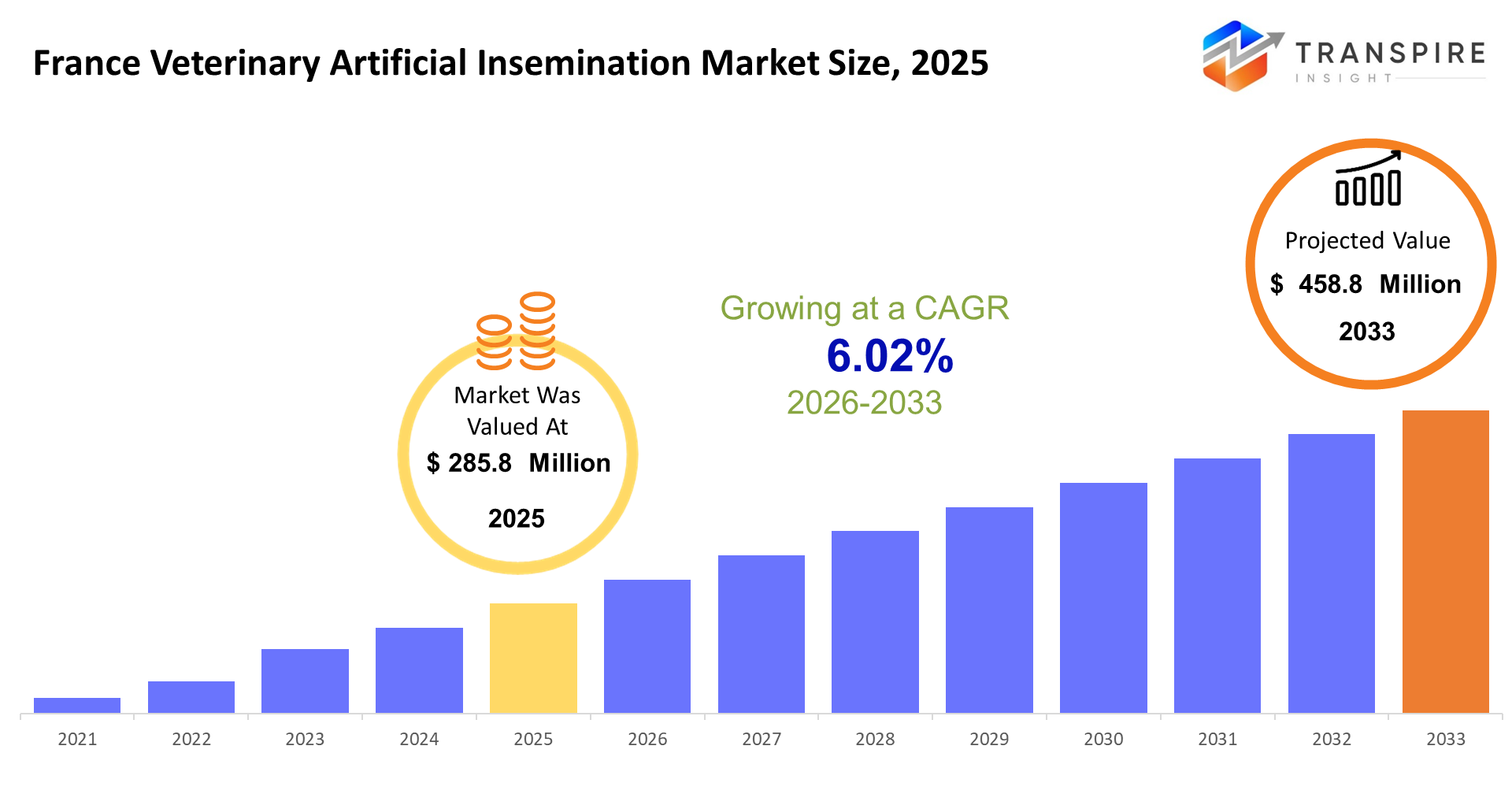
- France Veterinary Artificial Insemination Market Size 2025: USD 285.8 Million
- France Veterinary Artificial Insemination Market Size 2033: USD 458.8 Million
- France Veterinary Artificial Insemination Market CAGR: 6.02%
- France Veterinary Artificial Insemination Market Segments: By Type (Bovine AI, Swine AI, Canine AI, Equine AI, Others); By Application (Dairy Farming, Livestock Breeding, Genetic Improvement, Research, Others); By End-User (Farmers, Veterinary Clinics, Breeding Centers, Research Institutes, Livestock Companies, Others); By Technology (Conventional AI, Sexed Semen, Cryopreservation, Others)
To learn more about this report,  Download Free Sample Report
France Veterinary Artificial Insemination Market Summary
The France Veterinary Artificial Insemination Market was valued at USD 285.8 Million in 2025. It is forecast to reach USD 458.8 Million by 2033. That is a CAGR of 6.02%over the period.
The France Veterinary Artificial Insemination Market assists livestock producers through its capacity to provide controlled breeding methods which allow farmers to improve genetic traits and achieve better fertility and higher milk and meat production from their cattle and swine and other farm animals. The system helps farmers to achieve consistent herd results through its reduction of natural breeding methods while providing biosecurity protection for extensive dairy and meat facilities throughout France.
The market has moved towards precision breeding during the last five years which uses genomics and sexed semen and digital tracking systems to make selection choices and achieve better conception results. The traditional breeding supply chains experienced major disruptions through both livestock disease outbreaks and pandemic-related logistics challenges which caused farms and cooperatives to choose centralized technology-based insemination methods. The industry now demands standardized genetic material which meets high-quality standards and service-based insemination solutions that boost productivity and enhance operational efficiency throughout all business operations.
Key Market Insights
- The France Veterinary Artificial Insemination Market exists because northern and western France has both developed dairy farming operations and established sophisticated animal breeding systems.
- Central France is showing growth as a new adoption area because mechanized farming systems become more common and cooperative breeding programs expand their activities.
- Mobile insemination services together with veterinary outreach programs are delivering medical treatment to more rural livestock communities.
- The France Veterinary Artificial Insemination Market gets its primary market share from the semen doses segment because dairy cattle genetic improvement programs use this product extensively.
- Artificial insemination services hold strong demand as farms increasingly outsource reproductive management to specialized technicians.
- The France Veterinary Artificial Insemination Market shows its primary market share through dairy cattle applications which benefit from France's extensive dairy production network.
- The industrial pig farming sector is experiencing rapid expansion of its swine breeding applications,which focus on enhancing productivity. Artificial insemination remains the artificial insemination technique which dairy farms use most frequently,creating a major market channel for the procedure throughout France.
- The fastest-growing end-user category in livestock breeding centers operates through centralized genetic selection and controlled breeding systems. Veterinary clinics increasingly support outsourced insemination services and herd fertility management programs.
- Companies are investing in genomic selection tools and AI-assisted breeding analytics to improve conception success rates. Product innovation in sex-sorted semen and cryopreservation technologies is strengthening competitive positioning.
- The remote livestock regions of the world now have better access to veterinary services because of geographic expansion and the establishment of mobile veterinary insemination units.
What are the Key Drivers, Restraints, and Opportunities in the France Veterinary Artificial Insemination Market?
The France Veterinary Artificial Insemination Market experience sustainable growth because farmers need to breed cattle with better genetic traits. Dairy cooperatives and large-scale farms are increasingly adopting sexed semen, genomic selection, and controlled breeding programs to achieve better results in milk production and breeding success andof uniformity among their herds. French dairy farms need to implement these changes because they must reduce their production expenses while delivering their products with constant quality standards. Artificial insemination has transformed from an extra method into an essential process which boosts productivity because it now generates more service requests and increases repeat purchases of semen products.
The market faces limitations because it requires specialized veterinary personnel and temperature-controlled systems to transport and store semen samples. Rural farming areas experience restricted access to services because this structural limitation causes service delivery problems which lead to conception failures through extended wait times. The shortage of trained insemination professionals also slows adoption among small and medium farms because it operates as a market barrier which limits full product deployment throughout the industry.
Digital reproductive management platforms create a principal opportunity when they combine with AI-based breeding analytics systems. French precision livestock startups use sensor technologies for heat detection and cloud-based systems which enable better herd monitoring to achieve better timing for their insemination process. The introduction of this solution to cooperative networks in western and central France can enhance conception rates while increasing operational efficiency throughout the France Veterinary Artificial Insemination Market.
What Has the Impact of Artificial Intelligence Been on the France Veterinary Artificial Insemination Market?
The France Veterinary Artificial Insemination Market operates through two main forces which include the rising demand for optimized livestock genetic traits. Dairy cooperatives and large-scale farms are increasingly adopting sexed semen, genomic selection, and controlled breeding programs to improve milk yield, fertility rates, and herd uniformity. The requirement to decrease production expenses throughout extended periods while sustaining product excellence drives this development forward particularly in France's structured dairy industry. Artificial insemination has evolved into a fundamental productivity method which drives both service needs and ongoing purchases of semen products.
The market faces limitations because it needs highly skilled veterinary technicians and cold-chain systems which protect and move semen samples between facilities. The existing system prevents equal service access to rural agricultural areas which experience service interruptions that lead to decreased success rates in conception. The lack of qualified insemination experts hampers small and medium farm adoption which slows down market growth even though the technology is ready for use.
The main business opportunity exists through digital reproductive management platforms which combine with AI-powered breeding analytics solutions. French precision livestock startups now use sensor-based heat detection systems together with cloud-connected herd monitoring systems to achieve better results in determining the best time for insemination. The implementation of this system across cooperative networks which operate in western and central France will lead to major improvements in conception rates. This system enables veterinary artificial insemination services throughout France to achieve greater operational efficiency.
Key Market Trends
- After 2022, French dairy farms adopted sexed semen for female calf yield optimization.
- Cooperatives expanded their genomic testing operations, which enabled them to shift their breeding methods from visual selection toward data-based genetic scoring systems.
- Artificial insemination services increasingly replaced natural mating, with over 70% penetration in commercial dairy herds by 2025.
- Digital estrus detection systems using IoT sensors gained traction after 2023, which enabled better timing accuracy while decreasing missed conception cycles.
- Veterinary service providers shifted toward subscription-based herd fertility management models instead of one-time insemination services.
- Automated cryogenic storage upgrades improved cold-chain semen logistics by decreasing viability loss during rural distribution operations.
- Cooperative farming networks developed centralized breeding programs, which allowed them to obtain large quantities of semen while using standardized genetic improvement methods.
- Artificial intelligence tools introduced predictive fertility scoring, which enabled veterinarians to improve their timing for insemination based on historical herd patterns.
- The French farms established after 2021 required digital breeding record systems because of new livestock traceability regulations.
- IMV Technologies and Genus plc established new partnerships with dairy cooperatives to expand precision breeding technologies throughout the nation.
France Veterinary Artificial Insemination Market Segmentation
By Type
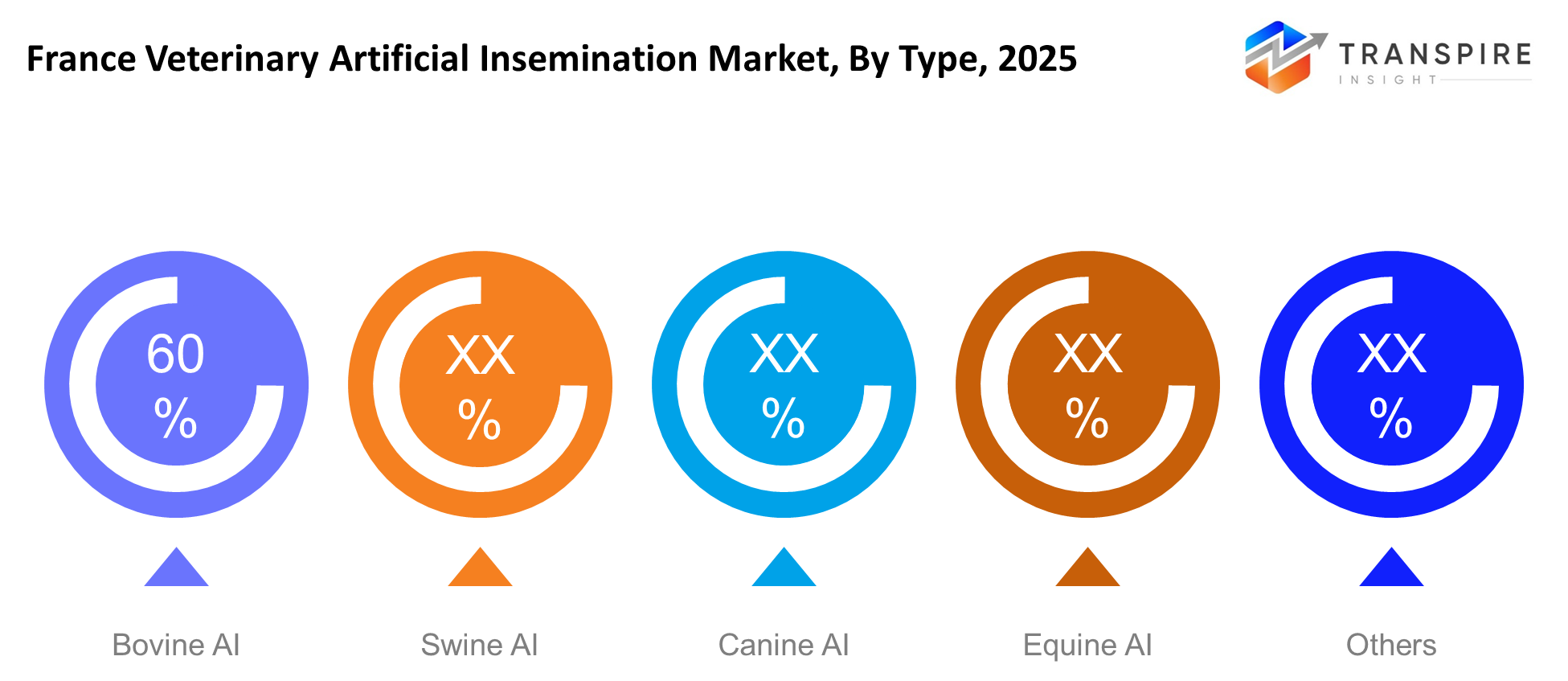
- The French dairy industry establishes Bovine AI as the leading technology because cattle breeders in France use genetic improvement programs for their herds. Bovine insemination serves as the primary method used by dairy cooperatives to enhance their milk production efficiency and breeding outcomes because it represents the most developed business segment of their operations.
- The expansion of industrial pig farming operations together with the establishment of controlled breeding protocols has led to the structured implementation of Swine AI technologies across the industry. The use of AI in dogs and horses remains limited to specific breeding activities and high-level pedigree evaluation processes.
- As precision breeding technologies and sexed semen become more widely adopted future expansion will focus on bovine and swine markets. The canine and equine segments will maintain their specialized status while experiencing benefits from advances in veterinary technology and higher success rates of reproduction.
To learn more about this report, Download Free Sample Report
By Application
- The established milk production system of France and its reliance on regulated breeding methods cause dairy farming to maintain control of application usage in the country. The commercial farms use insemination more effectively because genetic improvement programs focus on boosting productivity and maintaining consistent herd performance.
- Farmers who implement organized breeding systems observe consistent growth in their livestock breeding applications because they choose structured reproduction methods instead of natural mating. The research applications produce smaller results, yet their role in genomic studies and fertility optimization trials continues to grow.
- The development of the future will be driven by genetic improvement applications which use AI-based breeding analytics for their support. The dairy industry will sustain its importance, yet research applications will grow as investments in livestock biotechnology and predictive reproduction modeling increase.
By End-User
- Farmers represent the largest end-user group due to widespread adoption of artificial insemination in commercial dairy and mixed livestock farms. Veterinary clinics provide essential technical insemination services together with fertility monitoring services which they provide as their main responsibility.
- Breeding centers serve as centralized genetic selection centers which also distribute semen to their designated locations. Livestock companies increasingly invest in structured breeding programs to optimize productivity across large-scale operations.
- Future demand will shift toward breeding centers and livestock companies as consolidation increases in the sector. Farmers will continue to adopt new practices but they will depend on outsourcing veterinary services and genetic testing services to improve their efficiency while managing costs.
By Technology
- Rural farming systems currently depend on traditional artificial intelligence because it costs less and veterinarians already understand its functions. The adoption process is currently experiencing a slowdown because farms need better efficiency solutions.
- Dairy farms require female calf production which creates a growing need for sexed semen technology and enables better herd planning efficiency. Cryopreservation systems remain essential for both semen storage and transportation needs across extensive distances.
- The upcoming growth period will depend on sexed semen technology and advanced cryopreservation methods which work together with digital breeding platforms. Conventional methods will continue to operate in cost-sensitive markets but they will lose market share to technologies that use precise reproductive methods.
What are the Key Use Cases Driving the France Veterinary Artificial Insemination Market?
The primary application of artificial insemination in France Veterinary artificial insemination market exists because commercial farms use this method to achieve better milk production and higher fertility rates and consistent herd performance. The dairy cooperatives use their artificial insemination systems to create stable production schedules which help them decrease their dependence on mating through natural methods.
The genetic progress of livestock in the beef and swine industries through artificial breeding has become increasingly important to livestock businesses and breeding facilities which seek better production results. The veterinary clinics provide herd fertility solutions through their scheduled insemination services and reproductive health assessments which they perform for businesses that operate medium to large agricultural operations.
The agricultural industry is developing new applications that involve AI-based estrus detection systems and genomic selection tools which farmers can use to manage their operations. The research institutes study fertility improvement techniques which use advanced cryopreservation and embryo transfer methods to develop applications beyond their traditional focus on dairy production.
|
Report Metrics |
Details |
|
Market size value in 2025 |
USD 285.8 Million |
|
Market size value in 2026 |
USD 304.5 Million |
|
Revenue forecast in 2033 |
USD 458.8 Million |
|
Growth rate |
CAGR of 6.02% from 2026 to 2033 |
|
Base year |
2025 |
|
Historical data |
2021 - 2024 |
|
Forecast period |
2026 - 2033 |
|
Report coverage |
Revenue forecast, competitive landscape, growth factors, and trends |
|
Regional scope |
United States; Canada; Mexico; United Kingdom; Germany; France; Italy; Spain; Denmark; Sweden; Norway; China; Japan; India; Australia; South Korea; Thailand; Brazil; Argentina; South Africa; Saudi Arabia; United Arab Emirates |
|
Key company profiled |
Zoetis, Genus PLC, CRV, ABS Global, Select Sires, IMV Technologies, Semex, Alta Genetics, STgenetics, Neogen, Hipra, IDEXX, Virbac, Elanco, Ceva |
|
Customization scope |
Free report customization (country, regional & segment scope). Avail customized purchase options to meet your exact research needs. |
|
Report Segmentation |
By Type (Bovine AI, Swine AI, Canine AI, Equine AI, Others); By Application (Dairy Farming, Livestock Breeding, Genetic Improvement, Research, Others); By End-User (Farmers, Veterinary Clinics, Breeding Centers, Research Institutes, Livestock Companies, Others); By Technology (Conventional AI, Sexed Semen, Cryopreservation, Others) |
Which Regions are Driving the France Veterinary Artificial Insemination Market Growth?
The France Veterinary Artificial Insemination Market sees its highest demand from western France because of its dairy farming systems which operate through its well-structured cooperative networks in Brittany and Normandy. These regions maintain some of the highest cattle populations in the country, which directly increases demand for structured breeding programs. The developed veterinary infrastructure together with existing genetic improvement services enables farm operators to use sexed semen together with controlled insemination methods. Dairy cooperatives make continuous investments which help them maintain operational efficiency while establishing dominance in herd reproduction systems.
The France Veterinary Artificial Insemination Market receives stable support from central and northeastern regions which include Pays de la Loire and Grand Est because they practice mixed livestock farming and maintain equal distribution between agricultural and industrial operations. The agricultural practices of these regions depend on multiple farming operations which create stable requirements for insemination services because their dairy operations do not reach the intensity of western dairy belt operations. Mid-sized farms show economic stability which results in continuous adoption of reproductive technologies. The veterinary services are undergoing gradual modernization which will enable them to support national breeding programs for an extended period of time.
The fastest-growing area in France operates from southern France, which includes Occitanie and parts of Nouvelle-Aquitaine because livestock modernization efforts create climate-based productivity challenges. Controlled breeding has become essential in cattle and swine herds because of increasing heat stress conditions which threaten their reproductive efficiency. The government supports agricultural technology through its funding of digital farm transformation programs which creates better access to modern farming equipment. The current market shift indicates high potential for technological expansion in the upcoming future.
Who are the Key Players in the France Veterinary Artificial Insemination Market and How Do They Compete?
The France Veterinary Artificial Insemination Market maintains a moderately consolidated competition structure because numerous international genetics and animal health companies control most of the high-value semen distribution and breeding technologies and reproductive services. The veterinary cooperatives and specialized breeding centers from different regions continue to deliver services at farms which results in a mixed operational model that combines international supply networks with local service delivery systems. The main factors that determine competition between businesses are their genetic innovations and their ability to maintain uniform semen quality while integrating reproductive technology with their on-site advisory services.
Genus PLC and ABS Global compete in the market by providing advanced bovine genetics programs and sexed semen technologies which help dairy operators achieve productivity-based breeding results. CRV establishes its unique position through cooperative-based breeding models which create enduring partnerships with dairy farmers and support development of customized genetic strategies for their herds. Select Sires and Semex develop their business through elite sire selection and export-focused genetics pipelines while establishing partnerships with European dairy cooperatives and veterinary distributors.
IMV Technologies establishes its competitive edge by providing reproductive biotechnology equipment which includes cryopreservation systems and insemination equipment that serves both service operators and genetic companies. STgenetics achieves market success through its development of sexed semen technology and data-driven breeding selection systems while Zoetis and Virbac and Ceva expand their market reach through reproductive health solutions which boost fertility rates. Companies use strategic partnerships with breeding centers and cooperative networks because these alliances help them establish distribution channels and create continuous customer demand.
Company List
- Zoetis
- Genus PLC
- CRV
- ABS Global
- Select Sires
- IMV Technologies
- Semex
- Alta Genetics
- STgenetics
- Neogen
- Hipra
- IDEXX
- Virbac
- Elanco
- Ceva
Recent Development News
In April 2026, IMV Technologies announced the acquisition of a minority stake in a French bovine genetics startup to strengthen its veterinary artificial insemination portfolio. The move aims to expand advanced breeding technologies and AI services across France. https://www.imv-technologies.com
In March 2026, Ceva Santé Animale completed the acquisition of a regional reproductive biotech firm specializing in semen preservation solutions for livestock. This acquisition enhances Ceva’s capabilities in veterinary artificial insemination and reproductive health solutions in France. https://www.ceva.com
What Strategic Insights Define the Future of the France Veterinary Artificial Insemination Market?
The France Veterinary Artificial Insemination Market is moving toward a reproductive system that uses precision methods to select genetic material and apply digital herd management while operating centralized breeding facilities instead of traditional mating practices. The dairy and meat production industry needs to drive this transformation because it requires better livestock performance with lower operational expenses to compete effectively in the market. The next five to seven years will see companies increasingly adopt data-driven systems for determining optimal insemination times and selecting genetically optimized semen which will enhance integrated service providers' functions.
A less visible risk exists because the market is developing into a concentrated structure which enables only a few genetics and biotechnology suppliers to control pricing and distribution to smaller agricultural enterprises. Breeders face long-term dependency risks because they rely too heavily on proprietary genetic platforms.
Dairy cooperatives in western France can now develop AI-powered fertility monitoring systems which use real-time sensor networks as their new business opportunity. The systems currently operate at a narrow scale but they aim to establish new standards for conception efficiency.
Market participants should choose hybrid business models which integrate genetic material supply with digital reproductive analytics because these models create ongoing revenue opportunities while maintaining their service value over time.
France Veterinary Artificial Insemination Market Report Segmentation
By Type
- Bovine AI
- Swine AI
- Canine AI
- Equine AI
- Others
By Application
- Dairy Farming
- Livestock Breeding
- Genetic Improvement
- Research
- Others
By End-User
- Farmers
- Veterinary Clinics
- Breeding Centers
- Research Institutes
- Livestock Companies
- Others
By Technology
- Conventional AI
- Sexed Semen
- Cryopreservation
- Others
Frequently Asked Questions
Find quick answers to common questions.
The confirmed 2033 market size figure is USD 458.8 Million.
Key segments for the France Veterinary Artificial Insemination Market areBy Type (Bovine AI, Swine AI, Canine AI, Equine AI, Others); By Application (Dairy Farming, Livestock Breeding, Genetic Improvement, Research, Others); By End-User (Farmers, Veterinary Clinics, Breeding Centers, Research Institutes, Livestock Companies, Others); By Technology (Conventional AI, Sexed Semen, Cryopreservation, Others).
Major France Veterinary Artificial Insemination Market players are Zoetis, Genus PLC, CRV, ABS Global, Select Sires, IMV Technologies, Semex, Alta Genetics, STgenetics, Neogen, Hipra, IDEXX, Virbac, Elanco, Ceva.
The current France Veterinary Artificial Insemination Market size is USD USD 285.8 Million in 2025.
The France Veterinary Artificial Insemination Market CAGR is 6.02% from 2026 to 2033.
- Zoetis
- Genus PLC
- CRV
- ABS Global
- Select Sires
- IMV Technologies
- Semex
- Alta Genetics
- STgenetics
- Neogen
- Hipra
- IDEXX
- Virbac
- Elanco
- Ceva
Recently Published Reports
-
Apr 2026
Biosimilars Market
Biosimilars Market By Product Type (Monoclonal Antibodies, Recombinant Hormones, Erythropoietin, G-CSF, Others), By Indication (Oncology, Autoimmune Diseases, Blood Disorders, Diabetes, Others), By Manufacturing Type (In-House Manufacturing, Contract Manufacturing), By Distribution Channel (Hospital Pharmacies, Retail Pharmacies, Online Pharmacies), By Industry Analysis, Size, Share, Growth, Trends, and Forecasts 2021-2033
-
Apr 2026
Gastrointestinal Endoscopy Market
Gastrointestinal Endoscopy Market By Type (Rigid Gastrointestinal Endoscope, Flexible Gastrointestinal Endoscopes, Disposable Gastrointestinal Endoscope), By Procedure Type (Colonoscopy, Gastroscopy, Duodenoscopy, Enteroscopy, Flexible Sigmoidoscopy, Others), By Application (Diagnosis, Treatment), By End-Users (Hospitals, Ambulatory Surgical Centers, Specialty Clinics, Laboratories, Others), By Industry Analysis, Size, Share, Growth, Trends, and Forecasts 2021-2033
-
Apr 2026
Rare Inherited Metabolic Disorder Drug Market
Rare Inherited Metabolic Disorder Drug Market By Drug Class (Enzyme Replacement Drugs, Gene Therapy Drugs, Substrate Reduction Drugs, Small Module Drugs, Protein Drugs), By Route of Administration(Parenteral, Oral, Intrathecal), By Clinical Development (Marketed Drugs, Late Stage Clinical Phase III, Early Stage Clinical Phase I-II, Preclinical Candidates), By Indication (Lysosomal Storage Disorders, Urea Cycle Disorders, Amino Acid Metabolic Disorders, organic Acidemias, Peroximal Disorders), By Industry Analysis, Size, Share, Growth, Trends, and Forecasts 2021-2033
-
Jan 2026
Pharmaceutical Cleanroom Technology Market
Pharmaceutical Cleanroom Technology Market By Product (Equipment, Consumables, Services); By Cleanroom Type (Standard Cleanrooms, Modular Cleanrooms); By End Use (Pharmaceutical Companies, Biotechnology Companies), By Industry Analysis, Size, Share, Growth, Trends, and Forecasts 2021-2033