

France Caps And Closures Market Size & Forecast
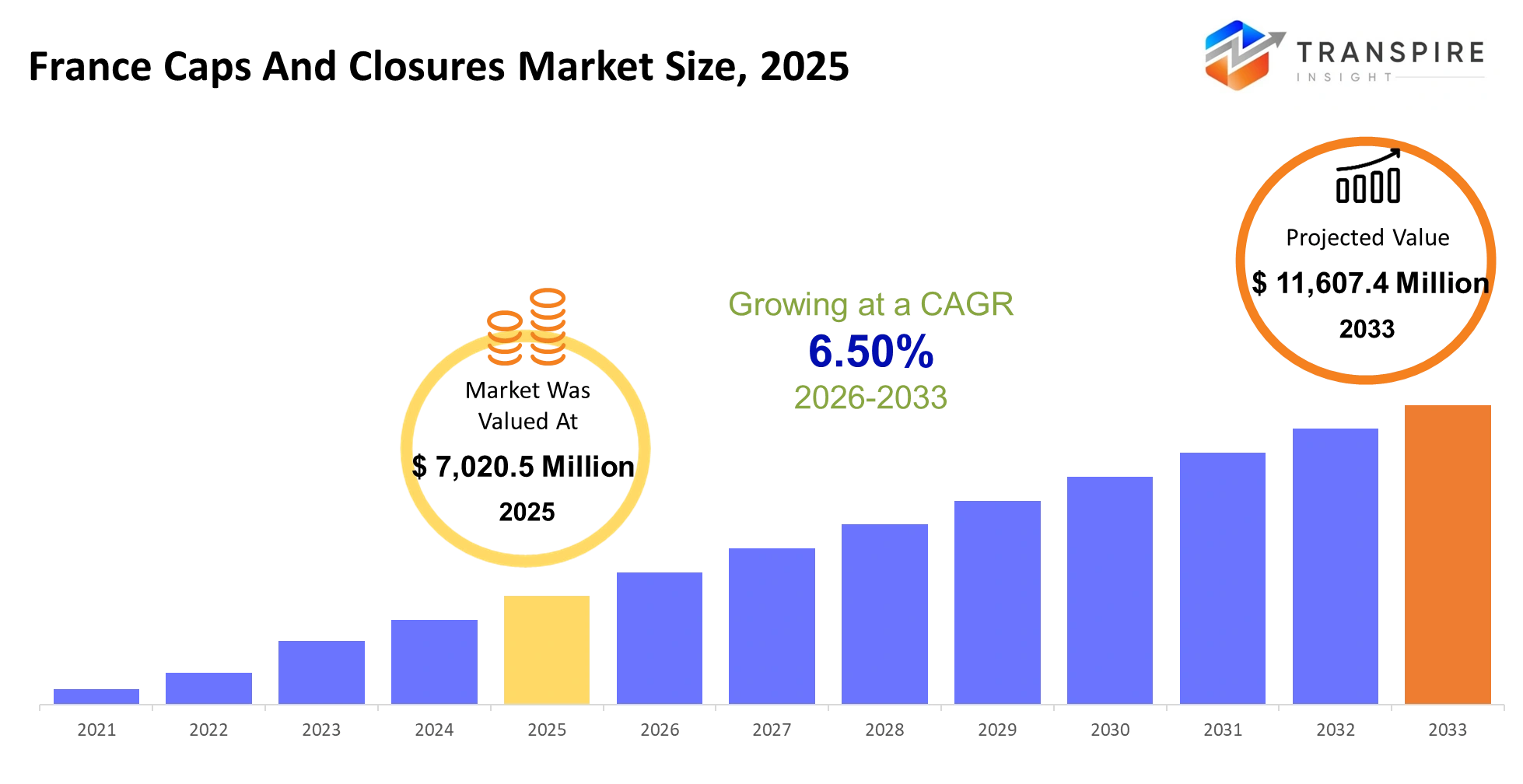
- France Caps And Closures Market Size 2025: USD 7,020.5 Million
- France Caps And Closures Market Size 2033: USD 11,607.4 Million
- France Caps And Closures Market CAGR: 6.50%
- France Caps And Closures Market Segments: By Type (Screw Caps, Snap-on Caps, Dispensing Caps, Others); By Application (Beverages, Food, Pharmaceuticals, Cosmetics, Others); By End-User (Food & Beverage Industry, Pharma, Cosmetics, Others); By Material (Plastic, Metal, Others).
To learn more about this report,  Download Free Sample Report
France Caps And Closures Market Summary
The France caps and closures market reached USD 7,020.5 Million in 2025 and is projected to expand to USD 11,607.4 Million by 2033, growing at 6.50% CAGR. Caps and closures seal containers across the food and beverage, pharmaceutical, and cosmetics industries, protecting product integrity while providing consumer convenience and brand differentiation. A plastic screw cap on a beverage bottle, a tamper-evident closure on a pharmaceutical vial, and a pump dispenser on a cosmetic container all represent functionality-specific closure solutions.
The structural shift reshaping the France market is the transition from single-material commodity closures to specialized, multi-functional designs that address regulatory compliance, sustainability, and user experience simultaneously. Traditional caps were simple plastic or metal containers that sealed a product. Modern closures integrate anti-counterfeiting technologies for pharmaceuticals, child-resistant mechanisms for household products, portion-control dispensers for food and beverages, and sustainable materials to meet circular economy requirements. This product complexity increase pulls closure vendors into technology partnerships and specialized manufacturing capabilities that commodity producers cannot match.
The real-world trigger accelerating market expansion is stringent EU packaging sustainability regulations and France's aggressive circular economy policies. The 2021 EU Single-Use Plastics Directive restricted single-use closure designs and created procurement demand for compliant alternatives. France went further, implementing additional measures including mandatory deposit return schemes for beverage containers and restrictions on certain plastic closure chemistries. These regulatory mandates force beverage and food manufacturers to replace incompatible closure inventories, directly driving replacement demand for compliant closures and creating growth opportunities for vendors offering sustainable alternatives.
Key France Caps And Closures Market Insights
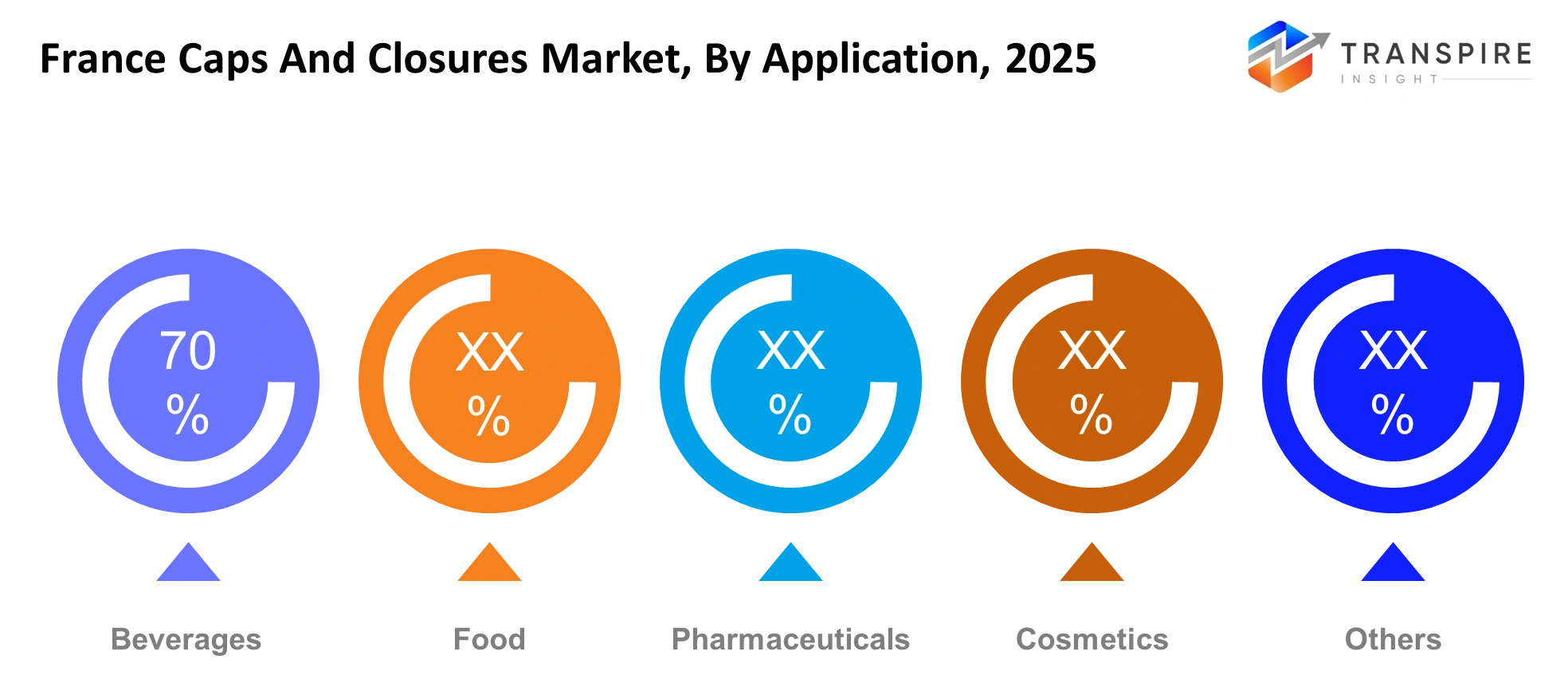
- Beverages dominate application segment at 70% of market revenue, driven by the largest container volumes among all end markets and regulatory mandates requiring compliant closures for deposit return schemes.
- Plastic closures command 58% of material segment revenue, but metal closures are growing 8.2% CAGR through 2033 as premium beverage and wine manufacturers specify metal caps for brand differentiation.
- Screw caps represent 52% of type segment revenue due to versatility across beverage, food, and pharmaceutical applications and compatibility with automated filling and capping equipment.
- Snap-on caps are the fastest-growing closure type at 7.8% CAGR, particularly in premium beverage and personal care segments where closure removal experience influences perceived product quality.
- Amcor and Berry Global collectively control 34% of France market share through integrated manufacturing capabilities and distribution networks spanning beverage and food industries.
- Tamper-evident and child-resistant closures account for 18% of pharmaceutical segment revenue, driven by regulatory requirements and consumer safety expectations that create design-specific procurement needs.
- Dispensing closure applications grew 11% year-over-year in 2024 as food manufacturers adopt portion-control caps for salad dressings, sauces, and cooking oils to support consumer health consciousness.
- Sustainability certifications including recycled content verification and compostability compliance became mandatory procurement criteria for 76% of major French food and beverage manufacturers by 2024.
- Cosmetics end-user segment is growing faster than beverages at 7.2% CAGR despite lower volume, driven by premium packaging trends and increased pressure to eliminate unsustainable closure designs.
- Supply chain resilience investments increased closure production costs by 3-5% as manufacturers built inventory buffers and diversified supplier bases following 2021-2023 supply disruptions.
What are the Key Drivers, Restraints, and Opportunities in the France Caps And Closures Market?
The primary expansion force is mandatory closure compliance with EU and France sustainability regulations. The EU Single-Use Plastics Directive, France's circular economy law, and emerging restrictions on problematic chemicals in food contact materials all require closure design modifications or material substitution. Beverage manufacturers must transition to deposit return scheme-compliant closures, food producers must eliminate certain plastic chemistries, and pharmaceutical manufacturers must verify supplier compliance with evolving regulatory standards. These mandates create replacement demand independent of volume growth: a food manufacturer cannot use existing closure inventory once regulatory deadlines pass. Regulatory-driven replacement demand ensures market stability even during economic slowdowns, making this the most predictable growth driver in the forecast period.
The most significant constraint is raw material cost volatility and supply chain complexity. Plastic resin costs fluctuate with petroleum prices, creating margin pressure for closure vendors that cannot immediately pass cost increases to customers. Metal closure production depends on aluminum and steel commodity pricing, which showed 18-24% price swings during 2022-2024. Supply chain complexity from single-source suppliers creates risk of production disruptions. These constraints limit margin expansion and force vendors to absorb cost increases, particularly during periods when customer contracts include fixed pricing provisions.
The highest-growth opportunity is closure integration with advanced functionality addressing sustainability, supply chain transparency, and consumer experience simultaneously. Smart closures embedding QR codes or NFC tags enable track-and-trace capability, fight counterfeiting in pharmaceuticals, and allow consumers to access product authenticity verification. Closures made from compostable or marine-degradable materials address regulatory compliance while differentiating premium brands. Portion-control dispensers in closures reduce food waste and resonate with environmentally conscious consumers. Closure vendors that bundle regulatory compliance, sustainability certification, anti-counterfeiting, and user experience functionality create differentiated offerings that command premium pricing compared to commodity closures.
What Has the Impact of Artificial Intelligence Been on the France Caps And Closures Market?
Machine learning algorithms are beginning to reshape closure design and manufacturing optimization. AI models trained on closure performance data including seal integrity test results, customer complaint patterns, and manufacturing defect rates now inform real-time design adjustments. Computer vision systems on production lines detect surface defects, dimensional variations, and assembly errors with accuracy exceeding manual inspection, reducing defect rates from 0.8-1.2% to 0.2-0.3%. This quality improvement is particularly valuable in pharmaceutical applications where closure integrity directly impacts product safety.
Predictive maintenance powered by AI is reducing unplanned production downtime at closure manufacturing facilities. Vibration sensors and production data streams feed machine learning models that forecast equipment failures 7-14 days before failure occurs, enabling preventive maintenance that avoids expensive line shutdowns. Within the supply chain, AI demand forecasting models analyze customer order patterns, seasonal trends, and external signals including weather patterns and promotional calendars to optimize inventory levels. These efficiency improvements compress working capital requirements and reduce inventory carrying costs, creating competitive advantages for vendors operating AI-enhanced manufacturing facilities.
Key Market Trends
- Beverages command 70% of application revenue, but pharmaceutical and cosmetics segments are growing faster at 7.8% and 7.2% CAGR respectively due to specialized design requirements and higher price realization.
- Screw caps maintained 52% type segment share in 2024, reflecting versatility and compatibility with existing beverage filling infrastructure across French manufacturers.
- Snap-on caps grew 7.8% year-over-year in 2024, gaining share in premium beverage positioning and personal care packaging where closure interaction influences brand perception.
- Plastic closures account for 58% of material revenue but growth decelerated to 5.1% CAGR in 2024 as manufacturers shift to metal, glass, and sustainable alternatives.
- Metal closures expanded 8.2% year-over-year in 2024, driven by wine producers adopting metal screw caps as premium alternative to cork and plastic closures.
- Tamper-evident and child-resistant closures represent 18% of pharmaceutical segment revenue, with strict regulatory compliance driving specialized procurement.
- Sustainable material closures achieved 24% market penetration among French food and beverage manufacturers by 2024, up from 8% in 2019.
- Recycled content closures grew 15% year-over-year in 2024 as manufacturers meet EU circular economy targets requiring minimum recycled content percentages.
- Supply chain resilience investments increased closure costs by 3-5%, with manufacturers building regional inventory and multi-source supplier strategies.
- Automation and Industry 4.0 integration expanded among major closure manufacturers, reducing production costs by 4-6% year-over-year despite wage inflation.
France Caps And Closures Market Segmentation
By Type
Screw caps command 52% of type segment revenue through universal compatibility with beverage, food, and pharmaceutical containers. The design provides secure sealing, tamper evidence when designed with specific features, and compatibility with both manual removal and automated capping equipment. Screw cap growth of 5.8% CAGR through 2033 is driven by pharmaceutical demand for child-resistant screw cap designs and beverage demand for compliance with deposit return scheme specifications. Margin profiles for screw caps remain compressed due to high manufacturing competition and limited product differentiation compared to specialty cap types.
Snap-on caps and dispensing caps represent the fastest-growing type segment at 7.8% and 10.2% CAGR respectively. Snap-on caps appeal to premium beverage and personal care manufacturers where closure interaction influences perceived quality. Dispensing caps integrate portion control or spray delivery mechanisms, commanding premium pricing of 40-60% compared to commodity screw caps. Growth in both segments is sustained by product innovation and manufacturer willingness to pay for solutions that enhance consumer experience and support sustainability claims.
By Application
Beverages generate 70% of application segment revenue, anchored by soft drinks, water, juices, and alcoholic beverages that represent the largest closure volume market. Beverage closure specifications are increasingly driven by regulatory compliance: deposit return scheme requirements mandate specific closure designs, non-detachable closure caps eliminate contamination risk, and sustainable material mandates require closure reformulation. Growth in beverages is constrained by volume saturation in developed markets, offset by sustainability-driven replacement demand and growth in emerging beverage categories including functional drinks and premium beverages with specialized closures.
Food applications account for 15% of application revenue, spanning sauces, condiments, oils, and packaged foods. This segment is growing at 7.1% CAGR driven by portion-control dispensing closures and child-resistant designs for household products. Pharmaceutical closures represent 10% of application revenue and grow at 7.8% CAGR, driven by increasing use of specialized closures for injectable drugs, oral medications, and drug delivery systems. Cosmetics represent 5% of application revenue and show fastest growth at 8.5% CAGR as premium beauty brands invest in distinctive, sustainable closure designs.
To learn more about this report, Download Free Sample Report
By End-User
Food and beverage manufacturers command 75% of end-user revenue, driven by beverage container volumes and food packaging applications. This segment's procurement is centralized, with major manufacturers negotiating master contracts with closure suppliers, creating stable revenue streams but constrained margin opportunities. Regulatory compliance requirements including sustainability certifications drive recurring replacement demand as manufacturers update closure specifications to meet evolving standards.
Pharmaceutical companies account for 15% of end-user revenue and show highest growth at 7.8% CAGR. Pharmaceutical procurement is specification-intensive, prioritizing safety, regulatory compliance, and supply reliability over cost. This creates higher margin opportunities compared to beverage and food segments. Cosmetics and personal care represent 10% of end-user revenue and grow at 8.5% CAGR as premium brand positioning requires distinctive, sustainable closure designs that differentiate products on retail shelves.
By Material
Plastic closures account for 58% of material segment revenue, comprising polypropylene, polyethylene terephthalate, and specialized polymers. Plastic dominance reflects cost efficiency and compatibility with existing production equipment. Growth is decelerating at 4.2% CAGR through 2033 as regulatory restrictions on certain plastic chemistries force material substitution and sustainability pressure drives migration to alternative materials. Plastic margin compression continues as manufacturers reduce resin content to lower costs while maintaining closure integrity.
Metal closures represent 28% of material segment revenue and grow at 8.2% CAGR. Metal (aluminum and steel) closures command premium pricing of 60-120% above plastic, reflecting higher production costs and brand positioning opportunities. Growth in metal closures is sustained by premium beverage manufacturers, wine producers, and pharmaceutical companies where closure material influences product perception and regulatory compliance. Sustainable alternatives including compostable plastics and recycled content materials account for 14% of material segment and grow at 18.5% CAGR, representing the fastest-growing material category as sustainability mandates intensify.
|
Report Metrics |
Details |
|
Market size value in 2025 |
USD 7,020.5 Million |
|
Market size value in 2026 |
USD 7,469.6 Million |
|
Revenue forecast in 2033 |
USD 11,607.4 Million |
|
Growth rate |
CAGR of 6.50% from 2026 to 2033 |
|
Base year |
2025 |
|
Historical data |
2021 - 2024 |
|
Forecast period |
2026 - 2033 |
|
Report coverage |
Revenue forecast, competitive landscape, growth factors, and trends |
|
Geographic scope |
France |
|
Key companies profiled |
Amcor, Berry Global, Crown Holdings, Silgan, AptarGroup, Closure Systems Intl, Albea, Bericap, RPC Group, Guala Closures, Nippon Closures, O.Berk, Mold-Rite, Tecnocap, CL Smith. |
|
Customization scope |
Free report customization (regional & segment scope). Avail customized purchase options to meet your exact research needs. |
|
Report Segmentation |
By Type (Screw Caps, Snap-on Caps, Dispensing Caps, Others); By Application (Beverages, Food, Pharmaceuticals, Cosmetics, Others); By End-User (Food & Beverage Industry, Pharma, Cosmetics, Others); By Material (Plastic, Metal, Others). |
Regional Analysis
France represents approximately 8% of the broader Western Europe caps and closures market and is characterized by mature beverage and food industries with established closure suppliers. Government sustainability regulations including France's circular economy law and aggressive plastic reduction targets create higher growth rates compared to peer European markets. The concentration of premium beverage and wine production in specific French regions including Bordeaux, Burgundy, and Champagne creates pockets of demand for specialized metal and premium closures that exceed French per-capita closure consumption averages. Urban regions including Ile-de-France and Rhone-Alpes show highest technology adoption and sustainability certification compliance due to larger corporate headquarters and sophisticated supply chain management.
The broader Western Europe market grows at 5.2% CAGR through 2033, with Germany and United Kingdom representing larger absolute markets but France showing faster regulatory-driven growth. Eastern Europe shows faster growth at 8.1% CAGR but from a smaller base, driven by emerging beverage manufacturing and sustainability mandate adoption lagging France by 2-3 years.
Who are the Key Players in the France Caps And Closures Market and How Do They Compete?
The France caps and closures market concentrates among large multinational suppliers with integrated manufacturing and distribution capabilities. Amcor and Berry Global lead through diversified product portfolios spanning beverage, food, and pharmaceutical closures, global manufacturing footprint enabling local supply relationships, and sustainability certifications addressing regulatory compliance across customer bases. Silgan and Crown Holdings maintain strong positions in specific segments: Silgan in rigid closures for beverages, Crown in premium metal closures for wine and spirits. These large players compete on production scale, supply chain reliability, and ability to absorb commodity cost volatility.
Mid-tier specialists including AptarGroup, Closure Systems International, and Bericap compete by offering advanced functional designs, technical support, and responsiveness to customer-specific requirements. AptarGroup dominates dispensing closure innovation, Closure Systems specializes in child-resistant designs, and Bericap maintains strong presence in metal closures. The strategic inflection point for vendors is embedding sustainability compliance and advanced functionality into core product offerings rather than treating them as premium add-ons. Vendors successfully integrating compostable materials, recycled content verification, and supply chain transparency into standard closure designs capture larger share of mandatory compliance-driven procurement.
France Caps And Closures Market Companies
- Amcor
- Berry Global
- Crown Holdings
- Silgan
- AptarGroup
- Closure Systems Intl
- Albea
- Bericap
- RPC Group
- Guala Closures
- Nippon Closures
- O.Berk
- Mold-Rite
- Tecnocap
- CL Smith
Recent Developments
In March 2026, Amcor announced completion of a new manufacturing facility in France specializing in compostable and recycled-content plastic closures, positioning the company to capture growing demand for sustainable alternatives and reducing import dependence on non-EU sources.
Source: https://www.amcor.com
In February 2026, Berry Global launched a new line of metal screw caps with integrated anti-counterfeiting features using nano-optical technology, addressing pharmaceutical manufacturer demand for tamper-evidence and supply chain transparency.
Source: https://www.berryglobal.com
In January 2026, the French government released updated circular economy guidelines specifying mandatory recycled content percentages for plastic closures beginning 2027, effective immediately for public procurement contracts, accelerating industry transition toward sustainable materials.
Source: https://www.gouvernement.fr
What Strategic Insights Define the Future of the France Caps And Closures Market?
Over the next five to seven years, the France caps and closures market will consolidate around sustainable, functionally advanced closures that address regulatory compliance, consumer experience, and supply chain transparency simultaneously. Commodity plastic closure competition will intensify as manufacturers compete primarily on cost, compressing margins for vendors unable to differentiate through technology or sustainability certifications. This margin compression will drive consolidation as mid-tier players merge to achieve scale economies or specialize in niche segments where functional differentiation supports premium pricing.
The hidden risk is accelerated material substitution rendering certain closure capabilities obsolete. If compostable or marine-degradable plastic alternatives achieve cost parity with traditional plastics within 3-4 years, the economic justification for plastic closures diminishes rapidly. Vendors invested heavily in optimizing traditional plastic closure manufacturing face stranded assets and competitive disadvantage relative to peers that diversified into alternative materials. This creates first-mover advantage for vendors that have already built manufacturing capability for sustainable materials.
The clearest opportunity lies in closure integration with supply chain transparency and anti-counterfeiting technology. Pharmaceutical manufacturers increasingly demand closures embedding track-and-trace capability through serialization, QR codes, or NFC tags to combat counterfeit drug distribution. Beverage manufacturers in premium segments adopt closures with compostability verification and sustainable material certifications that consumers can verify independently. Closure vendors that successfully bundle advanced functionality with sustainability compliance and transparency features will capture disproportionate share of premium and regulated market segments, offsetting margin pressure in commodity closures.
France Caps And Closures Market Report Segmentation
By Type
- Screw Caps
- Snap-on Caps
- Dispensing Caps
- Others
By Application
- Beverages
- Food
- Pharmaceuticals
- Cosmetics
- Others
By End-User
- Food & Beverage Industry
- Pharma
- Cosmetics
- Others
By Material
- Plastic
- Metal
- Others
Frequently Asked Questions
Find quick answers to common questions.
The France Caps And Closures Market size is expected to reach USD 11,607.4 Million by 2033.
The key segments are By Type (Screw Caps, Snap-on Caps, Dispensing Caps, Others); By Application (Beverages, Food, Pharmaceuticals, Cosmetics, Others); By End-User (Food & Beverage Industry, Pharma, Cosmetics, Others); By Material (Plastic, Metal, Others).
Major players include Amcor, Berry Global, Crown Holdings, Silgan, AptarGroup, Closure Systems Intl, Albea, Bericap, RPC Group, Guala Closures, Nippon Closures, O.Berk, Mold-Rite, Tecnocap, and CL Smith.
The France Caps And Closures Market size is USD 7,020.5 Million in 2025.
The France Caps And Closures Market CAGR is 6.50% from 2026 to 2033.
- Amcor
- Berry Global
- Crown Holdings
- Silgan
- AptarGroup
- Closure Systems Intl
- Albea
- Bericap
- RPC Group
- Guala Closures
- Nippon Closures
- O.Berk
- Mold-Rite
- Tecnocap
- CL Smith
Recently Published Reports
-
Apr 2026
Pharmaceutical Cold Chain Packaging Market
Pharmaceutical Cold Chain Packaging Market By Material (Plastic,(Polyethylene (PE), Polypropylene (PP), Polyethylene Terephthalate (PET), Expanded Polystyrene (EPS), Polyurethane (PU),Others), Paper, Metal, Others), By Product (Small Boxes, Pallets, Large Sized Pallet Containers, Others), By End Use (Biopharmaceutical Companies, Clinical Research Organizations, Hospitals, Research Institutes, Logistics and Distribution Companies, Others)”, By Industry Analysis, Size, Share, Growth, Trends, and Forecasts 2026-2033
-
Apr 2026
Active & Intelligent Packaging Market
Active & Intelligent Packaging Market By Type (Active Packaging, Smart Packaging), By Material (Polymer-Based, Paper & Board-Based, Metal-Based, Glass-Based), By Technology (Time-Temperature Indicators, Freshness Indicators, RFID, Antimicrobial Packaging, Modified Atmosphere Packaging), By Application (Food & Beverages, Pharmaceutical, Cosmetics & Personal Care, Electronics & Consumer Goods, Others), By Industry Analysis, Size, Share, Growth, Trends, and Forecasts 2026-2033
-
Apr 2026
Biodegradable Cut Flower Packaging Market
Biodegradable Cut Flower Packaging Market By Material Type (Paper & Paperboard, Biodegradable Plastics, Natural Fibers, Molded Pulp, Others), By Product Type (Sleeves, Wraps, Boxes & Cartons, Bags & Pouches, Inserts & Holders), By Application (Roses, Carnations, Tulips, Chrysanthemums, Mixed Flowers, Others) and By Distribution Channel (Direct Sales, Distributors & Wholesalers, Online Channels), By Industry Analysis, Size, Share, Growth, Trends, and Forecasts 2026-2033
-
May 2026
Pharmaceutical Packaging Market
Pharmaceutical Packaging Market By Material Type (Plastic, Glass, Metal, Paper & Paperboard, Others), By Packaging Type (Bottles, Blister Packs, Vials, Ampoules, Pouches & Sachets, Others) and By End User (Hospitals & Clinics, Retail Pharmacies, Online Pharmacies, Pharmaceutical Manufacturers), By Industry Analysis, Size, Share, Growth, Trends, and Forecasts 2026-2033