
Fixed Broadband Market Summary:
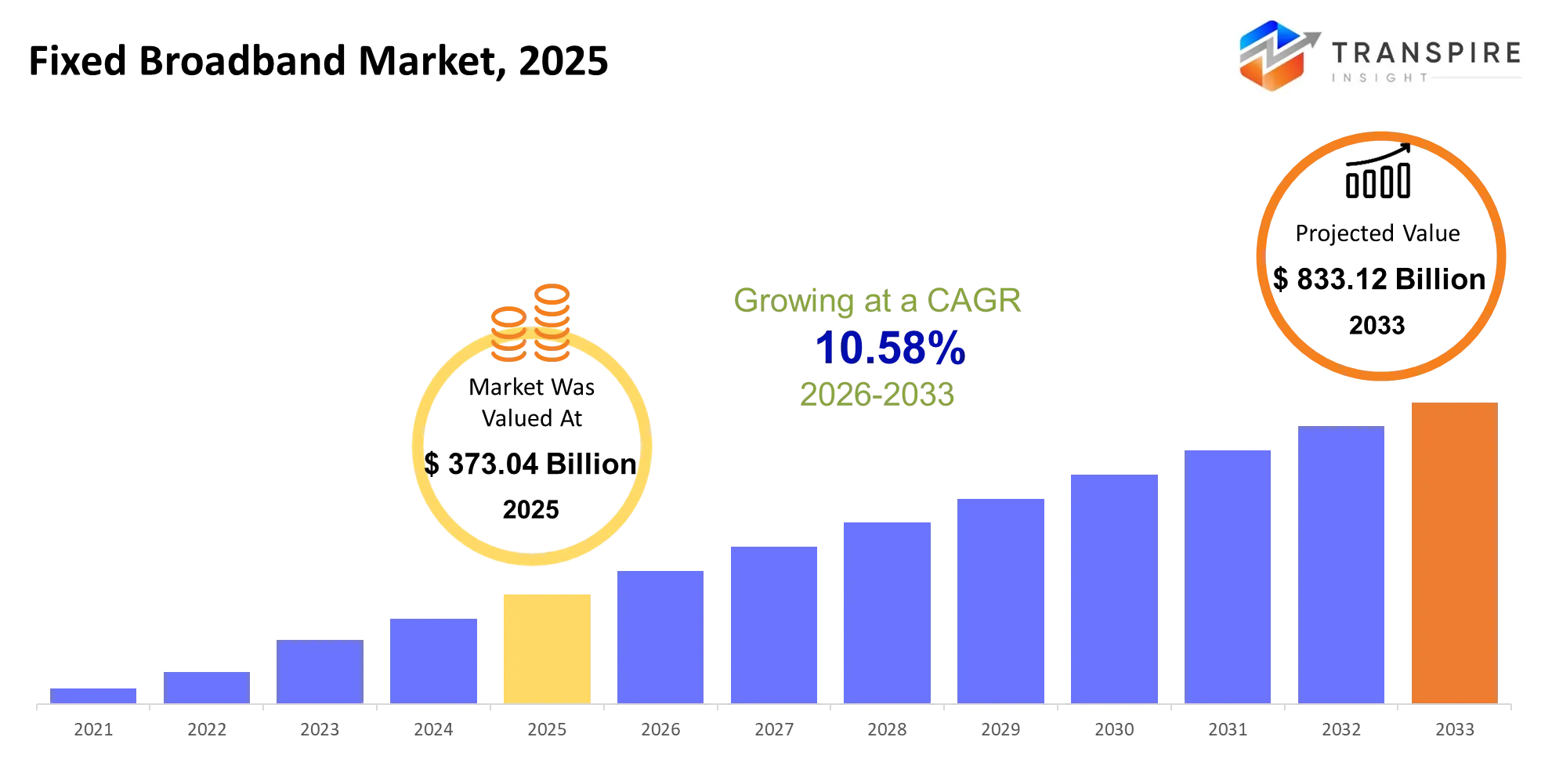
As per Transpire Insight, the Fixed Broadband Market size is estimated at USD 373.04 billion in 2025 and is anticipated to reach USD 833.12 billion by 2033, growing at a CAGR of 10.58% from 2026 to 2033.
The fixed broadband market provides homes, businesses, schools, healthcare centres, and public institutions with high-capacity internet networks. Over the last three to five years, operators have switched from copper lines to more recent fibre infrastructures. Simultaneously, fixed wireless access has emerged as a powerful competitor in areas where installation of cables can be expensive or take too long. Increasing demand for online education and high-definition video streaming, as well as the use of cloud computing, has made a good internet connection absolutely necessary today. Fibre network investments of governments and corporations contribute to improving internet access in underserved areas as well. India initiated the National Broadband Mission 2.0 to boost its network infrastructure. All of the aforementioned developments stimulate service providers' interest to update the current networks, provide new products and increase their customer base. Thus, the fixed broadband market develops owing to development of infrastructure and increasing customer demand.
Fixed Broadband Market Size & Forecast:
- Market Size 2025: USD 373.04 Billion
- Expected Market Value (2033): USD 833.12 Billion
- Forecast CAGR (2026–2033): 10.58%
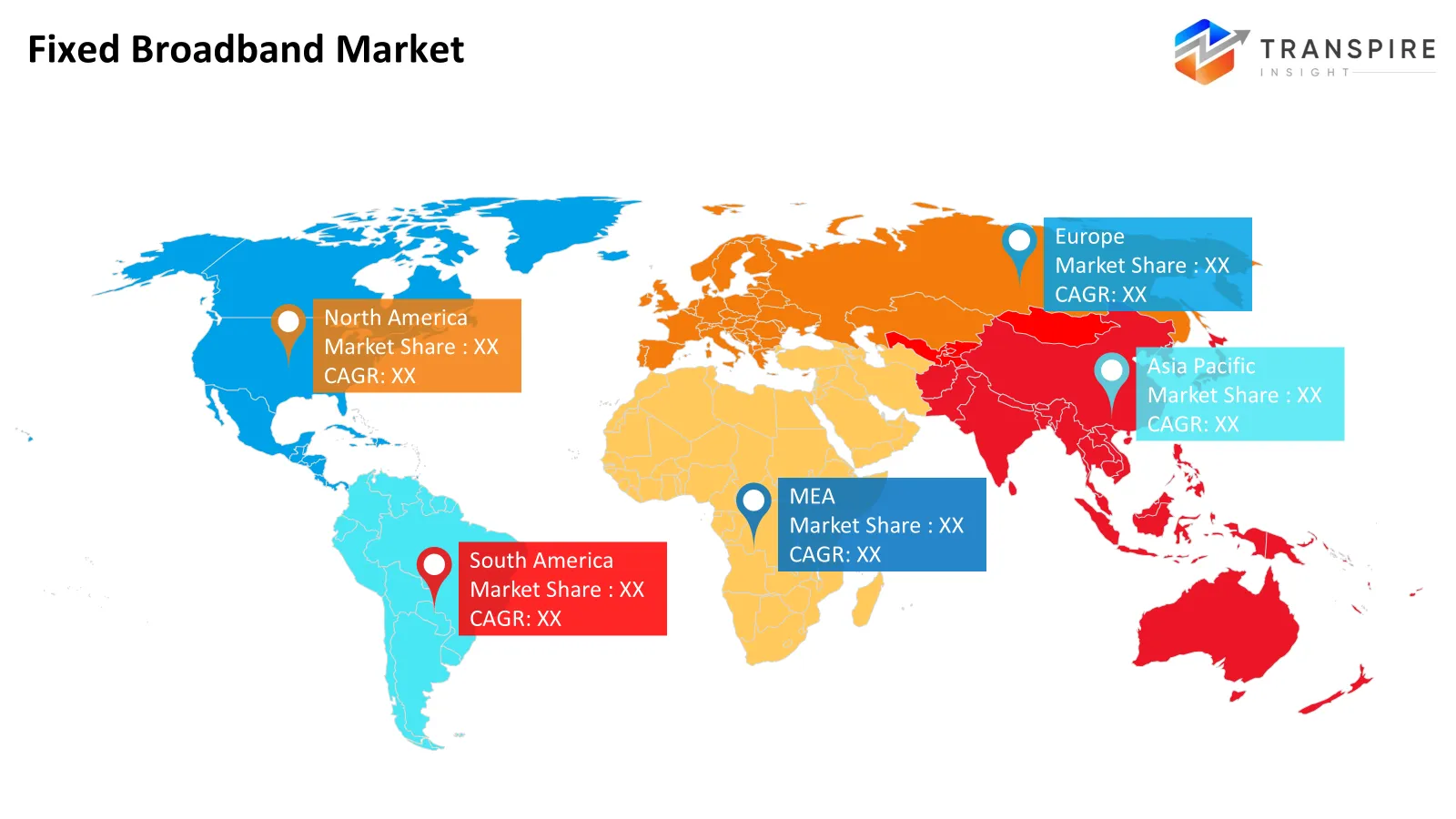
- Leading Region in 2025: Asia Pacific
- Fastest Growing Region: Middle East & Africa
- Key Company Profiles: AT&T, Verizon, Comcast, Charter Communications, Deutsche Telekom, Orange, Vodafone, China Telecom, China Mobile, China Unicom, Telefónica, BT Group, NTT, KDDI, Swisscom
Key Market Insights:
Markets are moving towards fibre-based broadband, widespread use of high-speed broadband services, and other deployment technologies.
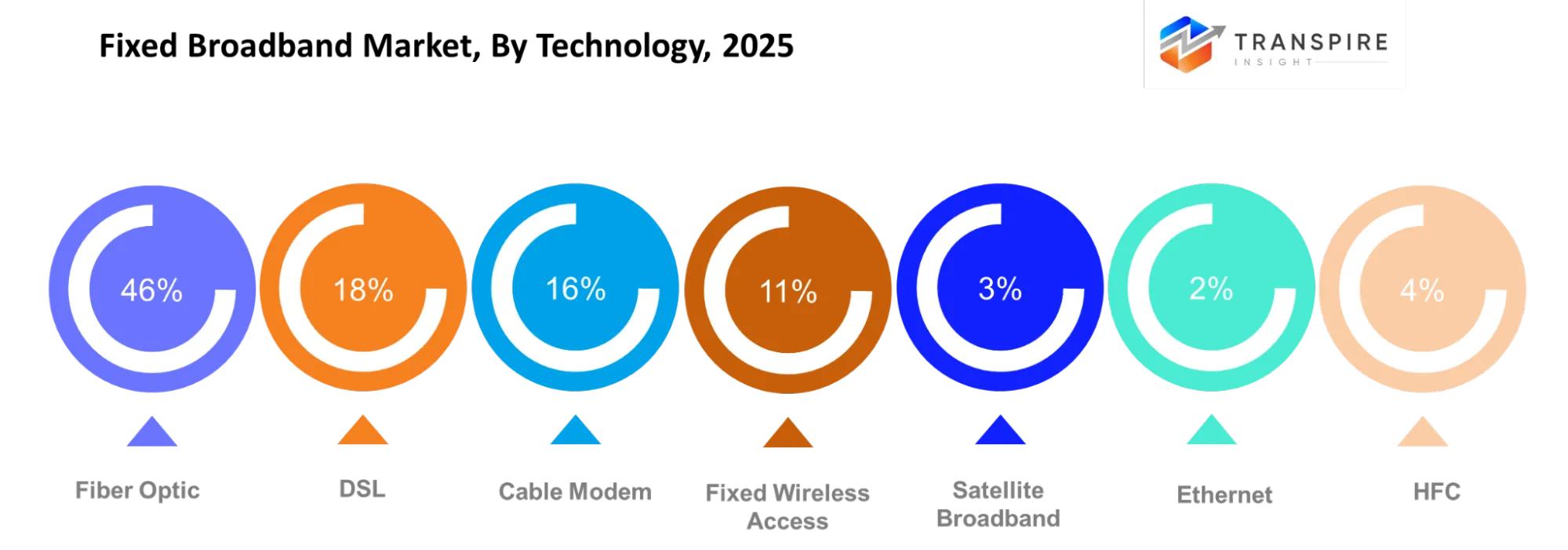
- Fibre broadband holds 46.0% of the market and is driven by consumer demand for high speed and streaming capabilities.
- DSL technology constitutes 18.0% of the market but needs to modernise existing copper technology due to the need for high performance from customers.
- Fixed Wireless technology is expected to grow at 17.3% CAGR through provision of broadband without the need to install a cable connection to each premises through wireless connections.
- Satellite broadband contributes 3.0% to the market as it provides broadband in remote areas without adequate existing infrastructure.
- Ethernet broadband takes 2.5% of the market due to its use by enterprises for reliable networking.
- HFC networks constitute 2.0% of the market because it enables cable broadband operators to use existing infrastructure with higher speeds.
What are the Key Drivers, Restraints, and Opportunities in the Fixed Broadband Market ?
Drivers:
The growth of fibre network deployment is mainly driven by the need for robust connectivity by households and enterprises that use cloud-based applications, video conferencing, online entertainment, and digital services. The growing trend towards data usage has compelled operators to upgrade from their old copper-based networks to newer and more advanced networks. Broadband government initiatives also help drive adoption through infrastructure-related benefits and extending coverage in underdeveloped regions. The National Broadband Mission 2.0 initiative by India addresses deployment issues such as obtaining right-of-way permissions.
Restraints:
Installation costs are high and continue to be a major barrier, especially in rural areas with sparse populations. Deployment involves laying cables, obtaining permissions, equipment, maintenance, and sometimes challenging terrain. Operators may have difficulty recovering their costs in places where population density and revenue per user are low.
Opportunities:
Fixed wireless access providers have an opportunity to connect customers when there is no economical use of fibre. Satellite broadband can help with connectivity challenges facing rural regions, while fibre-to-the-home networks can present opportunities for growth in urban or suburban markets. The development of open-access networks, public-private partnerships, and next-generation passive optical networks can enhance infrastructure efficiency. Providers who blend technology with cost-effective and customer-friendly services will attract more subscribers.
|
Driver |
Relative Impact on Growth (%) |
Geographic Relevance |
Impact Timeline |
Demand Strength |
Growth Mechanism (5–10 words) |
Key Beneficiaries (5–10 words) |
Major Constraint (5–10 words) |
|
Fibre-optic network expansion and legacy network upgrades |
30% |
Asia Pacific, North America, Europe |
Long-term (≥4 years) |
High |
Replaces legacy networks with faster, higher-capacity fibre connections |
Telecom operators, fibre manufacturers, network equipment vendors, subscribers |
High deployment costs and lengthy infrastructure installation |
|
Rising demand for high-speed internet and bandwidth-intensive applications |
25% |
North America, Asia Pacific, Europe |
Short-term (≤2 years) |
High |
Supports streaming, cloud computing, gaming, and remote work |
Internet service providers, content platforms, businesses, households |
Price sensitivity and limited willingness to upgrade |
|
Government broadband initiatives and rural connectivity expansion |
18% |
Asia Pacific, North America, Latin America, Africa |
Medium-term (2–4 years) |
High |
Public funding extends broadband access to underserved communities |
Rural households, telecom operators, infrastructure contractors, governments |
Funding gaps and low returns in remote areas |
|
Expansion of 5G fixed wireless access and alternative broadband technologies |
15% |
Asia Pacific, North America, Middle East and Africa |
Medium-term (2–4 years) |
High |
Wireless access expands coverage where fibre deployment remains uneconomical |
Telecom operators, equipment suppliers, rural users, small businesses |
Spectrum limitations and variable network performance |
|
Enterprise digitalisation, smart infrastructure, and connected-device adoption |
12% |
North America, Europe, Asia Pacific |
Long-term (≥4 years) |
High |
Connects cloud platforms, smart devices, and distributed business operations |
Enterprises, cloud providers, broadband operators, technology vendors |
Cybersecurity risks and increasing network operating costs |
|
Total |
100% |
Global |
— |
— |
— |
— |
— |
What Has Been the Impact of Artificial Intelligence on the Fixed Broadband Market
The use of artificial intelligence can assist fixed broadband providers in managing the increased complexity of their networks and providing more reliable services. Operators can use the capabilities of AI-powered network monitoring to analyse the traffic patterns, detect changes in performance, and predict potential failures before they affect the quality of service. Automated analytics can also assist in bandwidth allocation during peak hours to enhance the experience of the end-users. Predictive maintenance is one of the other applications of artificial intelligence. Through the analysis of performance, historical data about failures, and network telemetry, operators can find out the devices that may need maintenance.AI is especially valuable as providers introduce fibre networks, which have a higher capacity and are harder to manage. Nevertheless, implementation of AI technologies is not easy. Integration of AI tools with legacy systems is costly, and poor network data can result in inaccurate predictions. Cybersecurity, data privacy, and the requirement of qualified personnel also should be considered. Therefore, the largest benefit from AI will be gained by broadband operators when they use automated insights along with accurate data and goals.
Instance:
In October 2026, gFiber, Qualcomm, and Gemtek announced a Wi-Fi 8 broadband gateway with AI-powered smart network management, home personalisation, and network diagnostics in real time, demonstrating the role AI can play in improving broadband quality and customer experience.
Key Market Trends:
The market shifts from simple internet connection towards faster, robust, and smartly managed connectivity services.
- During recent years, fiber rollouts intensified as the telecoms started switching the old copper network for modern infrastructure that allows higher bandwidth with fast uploading.
- Operators start to merge internet connection services with TV, mobile connectivity, and other digital services as means of ensuring client loyalty and package differentiation.
- Fixed wireless access becomes more popular as a means of internet access without installing cables, which is more feasible if costs of installation are high or there are certain deployment barriers.
- Network management shifts from simple troubleshooting towards predicting failures and planning maintenance.
- Internet use in households changed from simple browsing to multiple applications like video streaming, online games, telecommuting and smart household appliances.
- Enterprise clients put more focus on service-level agreements, security, and performance of cloud connectivity.
Fixed Broadband Market Segmentation
By Technology:
Fibre-optic broadband has the highest market share of 46.0% owing to the speed and capability of handling data-intensive applications. DSL occupies 18.0% market share, and cable modem technology holds 16.0%, taking advantage of the existing infrastructure. Fixed wireless access makes up 11.0%, and satellite broadband has 3.0%. Ethernet takes 2.5%, the hybrid fibre-coaxial 2.0%, and other technologies have 1.5%. The expansion of fibre and other connectivity technologies will be instrumental in the future market development.
By Speed:
The market consists of low-speed connections below 25 Mbps, moderate connections 25–100 Mbps, higher speeds of 100–500 Mbps, very high-speed connections 500 Mbps–1 Gbps, ultra-high-speed connections of 1–2 Gbps, connections above 2 Gbps, gigabit fiber, and other speed categories. Low-speed connections can satisfy basic browsing and communication needs, and moderate-speed connections can provide streaming and online education services. The higher-speed connections become increasingly important for gaming, cloud computing, and use of multiple connected devices.
By Service Type:
Residential broadband provides basic functions such as entertainment, online learning, and video calling services. Business broadband helps small businesses to access cloud computing software, payment services, and consumer services. Enterprise broadband is needed by those organisations that require reliable internet connectivity and higher service-level agreements. Managed broadband provides the function of monitoring, whereas wholesale broadband enables the operator to use third-party infrastructure. The market for rural broadband aims to connect underserved communities with high-speed internet services, thus opening up avenues for the service provider.
By Deployment Type:
The market includes FTTH, FTTB, FTTC, HFC, DSL, fixed wireless access, satellite, and other deployment types. FTTH deploys fibre to the home and provides high-speed services, and FTTB/FTTC is used to provide high-speed internet access services to end-users by deploying fibre near them. HFC and DSL help operators make use of existing networks but with varying scope for upgradation. Fixed wireless access provides faster implementation in areas where laying cables is costly. Satellite deployment is used in remote areas.
By End User:
Connections help residential consumers access broadband for playing, remote working, e-learning, gaming, and connecting their appliances. Digital transactions, cloud software, and the everyday running of the business is common in SMEs with broadband connectivity, while large enterprises need reliable multi-site networks. Government agencies and authorities are increasingly relying on broadband for online administrative services; educational institutions for online learning and instruction; and health authorities for tele-consultation services. All this drives the operators to provide flexible packages across different speeds, with reliability and support.
By Region Type:
Urban markets have the advantage of existing telecom infrastructure, population density, and demand for high bandwidth connectivity, making fibre deployment more commercially feasible. Suburban markets have the potential to drive broadband coverage expansion as residential development continues to grow. Rural and remote areas face higher installation costs and challenges due to geography, raising the value of fixed wireless access, satellite, and government intervention programs. Developed markets tend to focus on service upgrades, while emerging markets tend to focus on access expansion.
What are the Key Use Cases Driving the Fixed Broadband Market?
Fibre broadband enables the fulfilment of use cases of the market because it provides sufficient capacity and stability to use it for home entertainment, telecommuting, distance learning, video conferencing, and connected devices. The high-speed connection is especially helpful when several people work with bandwidth-hungry applications at the same time. The scope of use cases related to business and institutional applications is growing. Small businesses depend on broadband for the provision of software through the cloud, payments, inventory management, and customer service. Larger companies use broadband for the connection of offices, the creation of remote teams, and using hosted applications. Schools, healthcare organisations, and governments need broadband connections for learning, teleconsultations, and government online services. Emerging use cases are smart buildings, connected industrial facilities, advanced home automation, and the use of AI services, which transfer more data than before. Fixed wireless access can provide the use cases of the broadband for those regions where there is no convenient access to fibre broadband. Satellite broadband can also be used in remote areas.
|
Report Metrics |
Details |
|
Market size value in 2025 |
USD 373.04 Billion |
|
Market size value in 2026 |
USD 411.96 Billion |
|
Revenue forecast in 2033 |
USD 833.12 Billion |
|
Growth rate |
CAGR of 10.58% from 2026 to 2033 |
|
Base year |
2025 |
|
Historical data |
2021 - 2024 |
|
Forecast period |
2026 - 2033 |
|
Report coverage |
Revenue forecast, competitive landscape, growth factors, and trends |
|
Regional scope |
United States; Canada; Mexico; United Kingdom; Germany; France; Italy; Spain; Denmark; Sweden; Norway; China; Japan; India; Australia; South Korea; Thailand; Brazil; Argentina; South Africa; Saudi Arabia; United Arab Emirates |
|
Key company profiled |
AT&T, Verizon, Comcast, Charter Communications, Deutsche Telekom, Orange, Vodafone, China Telecom, China Mobile, China Unicom, Telefónica, BT Group, NTT, KDDI, Swisscom |
|
Customization scope |
Free report customization (country, regional & segment scope). Avail customized purchase options to meet your exact research needs. |
|
Report Segmentation |
Technology (Fiber Optic, DSL, Cable Modem, Fixed Wireless Access, Satellite Broadband, Ethernet, Hybrid Fiber-Coaxial, Others)Speed (Below 25 Mbps, 25–100 Mbps, 100–500 Mbps, 500 Mbps–1 Gbps, 1–2 Gbps, Above 2 Gbps, Gigabit Fiber, Others)Service Type (Residential Broadband, Business Broadband, Enterprise Broadband, Dedicated Internet, Managed Broadband, Wholesale Broadband, Rural Broadband, Others)Deployment (FTTH, FTTB, FTTC, HFC, DSL, FWA, Satellite, Others)End User (Residential, SMEs, Large Enterprises, Government, Educational Institutions, Healthcare, Public Sector, Others)Region Type (Urban, Suburban, Rural, Remote, Developed Markets, Emerging Markets, Underserved Areas, Others) |
Which Regions are Driving the Fixed Broadband Market Growth?
North America:
North America accounts for 22.5% of the market share in fixed broadband worldwide due to the availability of a well-developed telecommunication infrastructure and the requirement for a reliable internet connectivity service. This is because the deployment of fibre, cable, and fixed wireless technologies makes it possible for operators to satisfy consumers with different requirements for internet connectivity. Competition among existing operators will lead to more investments in networks and customer experience. Opportunities for growth may be found in rural broadband expansion and infrastructure investments.
In September 2026, Verizon and Corning inked an agreement for the supply of fibre to help boost broadband growth and offer high-speed connectivity in the United States.
Europe:
Europe constitutes 25.0%. European market has developed telecommunications infrastructure, a regulatory framework, and investment in fibre networks. Unlike North America, the development of the market in Europe is driven by national broadband strategies, infrastructure sharing, and the need to enhance connectivity in member states and individual countries. Operators are modernising their networks and increasing full-fibre access to their customers.
In November 2025, the European Commission introduced the Gigabit Infrastructure Act to streamline fibre network installation and lower infrastructure costs to boost high-speed broadband rollout.
Asia Pacific:
Asia Pacific is the leading region in terms of fixed broadband market share with 40.5%, owing to the presence of large urban population centres, an increasing digital economy, and substantial telecom investments. Urbanisation and growth of e-commerce, digital education, and streaming services have also been fueling operators to enhance their network capacities. The government-driven initiatives towards connectivity as well as the increasing fibre footprint, are adding to the capabilities of the operators in connecting more homes and businesses.
In February 2025, Bharti Airtel and Nokia signed contracts to build 5G Fixed Wireless Access and Wi-Fi networks to bring high-speed broadband to Indian homes.
Who are the Key Players in the Fixed Broadband Market and how do they compete?
Competition in the international fixed broadband space is based on network coverage, network speed, pricing, reliability, customer support, and network investment. Competition among big companies includes the use of fibre optics, cable network upgrades, fixed wireless, and connectivity solutions. The needs of each of these competitors differ depending on their local network, regulatory environment, and customer requirements. In the US, AT&T and Verizon focus on fibre networks and high-speed connectivity. Their differentiation strategy involves network investment, residential and business services, and the provision of more fibre services. Comcast offers a competitive solution through its well-developed cable network, broadband packages, and network upgrades. Meanwhile, Charter Communications concentrates on the expansion and upgrading of its Spectrum network. While the current infrastructure allows them to reach a lot of customers, they should balance their upgrade investment and competition. In Asia, China Telecom and China Mobile take advantage of their large customer base and network investments. Indian players, like Reliance Jio and Bharti Airtel, compete through fibre broadband, fixed wireless, bundling, and expansion.
Fixed Broadband Market Companies
- AT&T
- Verizon
- Comcast
- Charter Communications
- Deutsche Telekom
- Orange
- Vodafone
- China Telecom
- China Mobile
- China Unicom
- Telefónica
- BT Group
- NTT
- KDDI
- Swisscom
|
Company |
Est. Revenue Share Range |
Key Offerings |
Strategic Positioning |
Geographic Strength |
Technology Focus |
|
Comcast Corporation |
Estimated 2–4% |
Xfinity Internet, DOCSIS cable broadband, fiber services, Wi-Fi gateways |
Scale-driven cable broadband leadership and bundled services |
North America |
DOCSIS 4.0, fibre upgrades, Wi-Fi 7 |
|
AT&T Inc. |
Estimated 2–4% |
AT&T Fiber, Internet Air, business broadband, managed connectivity |
Fibre expansion with converged connectivity bundles |
North America |
XGS-PON, fibre-to-the-premises, network automation |
|
China Telecom Corporation Limited |
Estimated 2–4% |
China Telecom Broadband, FTTH, gigabit internet, enterprise connectivity |
Large-scale fibre deployment and integrated digital services |
Asia Pacific |
FTTH, 10G-PON, intelligent network management |
|
China Mobile Limited |
Estimated 2–4% |
Home broadband, FTTH, gigabit access, enterprise internet |
Massive subscriber base and bundled mobile-fixed services |
Asia Pacific |
GPON, 10G-PON, fibre network intelligence |
|
Verizon Communications Inc. |
Estimated 1–3% |
Fios Fiber, 5G Home Internet, business internet, managed network services |
Premium fibre experience and converged connectivity |
North America |
XGS-PON, high-speed FTTH, fixed wireless integration |
|
Deutsche Telekom AG |
Estimated 1–3% |
MagentaZuhause, fibre broadband, VDSL, business connectivity |
Incumbent leadership and accelerated fibre migration |
Europe, North America |
FTTH, XGS-PON, IP network virtualisation |
|
Charter Communications, Inc. |
Estimated 1–2% |
Spectrum Internet, high-speed cable broadband, Wi-Fi services, business internet |
Competitive cable pricing and extensive last-mile coverage |
North America |
DOCSIS 4.0, high-split upgrades, distributed access architecture |
|
China Unicom Limited |
Estimated 1–2% |
Fixed broadband, FTTH, gigabit internet, enterprise connectivity |
Integrated fixed-mobile services and nationwide fibre access |
Asia Pacific |
FTTH, 10G-PON, cloud-network integration |
|
Orange S.A. |
Estimated 1–2% |
Orange Fibre, Livebox broadband, wholesale fibre, business connectivity |
Fibre-led growth and open-access network partnerships |
Europe, Middle East & Africa |
FTTH, XGS-PON, software-defined networking |
|
Vodafone Group Plc |
Estimated 1–2% |
Vodafone Broadband, full-fibre internet, cable broadband, business connectivity |
Multi-market expansion through fibre partnerships and convergence |
Europe, Africa |
FTTH, wholesale fibre access, Wi-Fi 7 |
Recent Development News
- In June 2026, Hinduja Solutions launched the initiative called Project GANGA. It is related to a digital inclusion project in collaboration with the government of Uttar Pradesh. The plan will help connect 2 million homes as well as provide them with local access to digital services. https://hgs.com/press-releases/uttar-pradesh-chief-minister-shri-yogi-adityanath-flags-off-project-ganga-initiative-in-association-with-hgss-broadband-vertical-to-connect-20-lakh-households/
- In September 2025, the expansion of full-fibre broadband in the houses of London became possible due to the collaboration between Vodafone and Community Fibre companies. As a result of this initiative, there is full fibre broadband coverage in more than 550,000 homes in London. https://www.vodafone.co.uk/newscentre/press-release/full-fibre-broadband-now-available-550000-london-homes-community-fibre/
What Strategic Insights Define the Future of the Fixed Broadband Market?
The fixed broadband market moving towards networks that comprise high-capacity fibre networks along with more versatile access options. Investment in fibre would still be important for highly populated areas, while fixed wireless access along with satellite connections can be helpful for locations that require expensive construction. One underappreciated risk associated with building out fixed broadband networks is building too much capacity without having enough subscribers who could potentially pay back the cost of construction and maintenance. There is competitive pressure on price, rising costs for equipment, and challenges with the integration of new network management systems into existing infrastructure.Shared infrastructure and wholesale networks are an interesting opportunity for the future, as it could allow more service providers to reach their customers without requiring duplicate construction projects. With proper data, AI-based network maintenance and optimisation services could be beneficial as well. It makes sense for providers to focus on rolling out fixed broadband technology based on local demand, population densities, and potential returns rather than just providing coverage.
Key Segmentations are:
Technology
- Fiber Optic
- DSL
- Cable Modem
- Fixed Wireless Access
- Satellite Broadband
- Ethernet
- Hybrid Fiber-Coaxial
- Others
Speed
- Below 25 Mbps
- 25–100 Mbps
- 100–500 Mbps
- 500 Mbps–1 Gbps
- 1–2 Gbps
- Above 2 Gbps
- Gigabit Fiber
- Others
Service Type
- Residential Broadband
- Business Broadband
- Enterprise Broadband
- Dedicated Internet
- Managed Broadband
- Wholesale Broadband
- Rural Broadband
- Others
Deployment
- FTTH
- FTTB
- FTTC
- HFC
- DSL
- FWA
- Satellite
- Others
End User
- Residential
- SMEs
- Large Enterprises
- Government
- Educational Institutions
- Healthcare
- Public Sector
- Others
Region Type
- Urban
- Suburban
- Rural
- Remote
- Developed Markets
- Emerging Markets
- Underserved Areas
- Others
By Regional Analysis
North America
- US
- Canada
- Mexico
Europe
- Germany
- UK
- France
- Italy
- Spain
- Russia
- Rest of Europe
Asia Pacific
- China
- Japan
- India
- South Korea
- Australia
- Rest of Asia Pacific
South America
- Brazil
- Argentina
- Rest of South America
Middle East & Africa
- UAE
- Saudi Arabia
- Qatar
- South Africa
- Rest of the Middle East & Africa
Frequently Asked Questions
Find quick answers to common questions.
The fixed broadband market size was valued at USD 373.04 Billion in 2025 and is poised to reach USD 833.12 Billion by 2033, expanding at a 10.58% CAGR.
Key segments for the fixed broadband market are Technology (Fiber Optic, DSL, Cable Modem, Fixed Wireless Access, Satellite Broadband, Ethernet, Hybrid Fiber-Coaxial, Others)Speed (Below 25 Mbps, 25–100 Mbps, 100–500 Mbps, 500 Mbps–1 Gbps, 1–2 Gbps, Above 2 Gbps, Gigabit Fiber, Others)Service Type (Residential Broadband, Business Broadband, Enterprise Broadband, Dedicated Internet, Managed Broadband, Wholesale Broadband, Rural Broadband, Others)Deployment (FTTH, FTTB, FTTC, HFC, DSL, FWA, Satellite, Others)End User (Residential, SMEs, Large Enterprises, Government, Educational Institutions, Healthcare, Public Sector, Others)Region Type (Urban, Suburban, Rural, Remote, Developed Markets, Emerging Markets, Underserved Areas, Others).
Growth is primarily driven by increasing demand for high-speed internet, increasing adoption of fibre-optic connections, growing use of cloud services and online streaming, expansion of remote work and digital education, and government initiatives to improve broadband connectivity.
The market is led by major manufacturers including AT&T, Verizon, Comcast, Charter Communications, Deutsche Telekom, Orange, Vodafone, China Telecom, China Mobile, China Unicom, Telefónica, BT Group, NTT, KDDI, Swisscom.
The Asia Pacific accounts for 40.5% of the world fixed broadband market share because of factors like urbanisation, increased internet penetration, growing demand for fast connections, government initiatives on digitalisation, and development of fibre-optic infrastructure in nations like China, India, and Japan.
Business opportunities associated with the fixed broadband industry encompass fiber optics network development, higher demand for high-speed internet, broadband reach-out programs to underserved regions, use of 5G fixed wireless technology, and provision of bundled internet streaming and smart home solutions.
- AT&T
- Verizon
- Comcast
- Charter Communications
- Deutsche Telekom
- Orange
- Vodafone
- China Telecom
- China Mobile
- China Unicom
- Telefónica
- BT Group
- NTT
- KDDI
- Swisscom
About the Authors

Mayur Shinde
I am Mayur Shinde, a Senior Research Analyst at Transpire Insight, specializing in the Automotive & Transportation and Information & Communication Technology (ICT) Industry. My work focuses on analyzing emerging market trends, technological advancements, competitive landscapes, and industry developments to deliver accurate, data-driven insights. I am passionate about transforming complex market information into clear, actionable content that helps businesses, professionals, and decision-makers stay informed and make confident strategic decisions.

Chakradhar Khansole
Chakradhar serves as the Research Director at Transpire Insight, bringing over 8 years of experience in technology, innovation, and strategic market intelligence. He specializes in transforming complex market data into actionable business insights that enable organizations to make informed, growth-oriented decisions. Recognized for his strategic vision and analytical expertise, Chakradhar leads high-impact research initiatives, delivering comprehensive market assessments, competitive intelligence, and forward-looking industry analysis.
Recently Published Reports
-
Apr 2026
3D Optical Profiler Market
3D Optical Profiler Market Size, Share & Analysis Report By Type (Desktop 3D Optical Profiler, and Portable 3D Optical Profiler), By Technology (Confocal Technology, and White Light Interference), By End-Use Industry (Manufacturing, Research Institutions, Automotive, Aerospace and Defense, Medical Devices, and Other), and Geography (North America, Europe, Asia-Pacific, Middle East and Africa, South and Central America), 2021 - 2031
-
Apr 2026
Depth Sensor Market
Depth Sensor Market Size, Share & Analysis Report By Type (Infrared Depth Sensors, Time-of-Flight (ToF) Sensors, Stereo Vision Sensors, Structured Light Sensors, Ultrasonic Depth Sensors), By Application (Automotive, Robotics, Gaming, Consumer Electronics, Industrial Automation, Healthcare, Security & Surveillance, Others), By End Users (Automotive Manufacturers, Consumer Electronics Companies, Healthcare Providers, Industrial Companies, Security Agencies, Gaming Companies, Robotics Companies, Others), and Geography (North America, Europe, Asia-Pacific, Middle East and Africa, South and Central America), 2021 – 2031
-
Apr 2026
Digital Manufacturing Market
Digital Manufacturing Market Size, Share & Analysis Report By Component (Hardware, Software, and Services), By Technology (Robotics, 3D Printing, Internet of Things (IoT), and Others), By Application (Automotive and Transportation, Aerospace and Defense, Consumer Electronics, Industrial Machinery, and Others), By Process Type (Computer-Based Designing, Computer-Based Simulation, Computer 3D Visualization, Analytics, and Others), and Geography (North America, Europe, Asia-Pacific, Middle East and Africa, South and Central America), 2021 – 2031
-
Apr 2026
Digital Visa Services Market
Digital Visa Services Market Size, Share & Analysis Report By Type (Individual Travelers, Group Travelers), By Application (Tourism, Business Travel, Others), and Geography (North America, Europe, Asia-Pacific, Middle East and Africa, South and Central America), 2021 – 2031