

Europe Xanthan Gum Market Summary
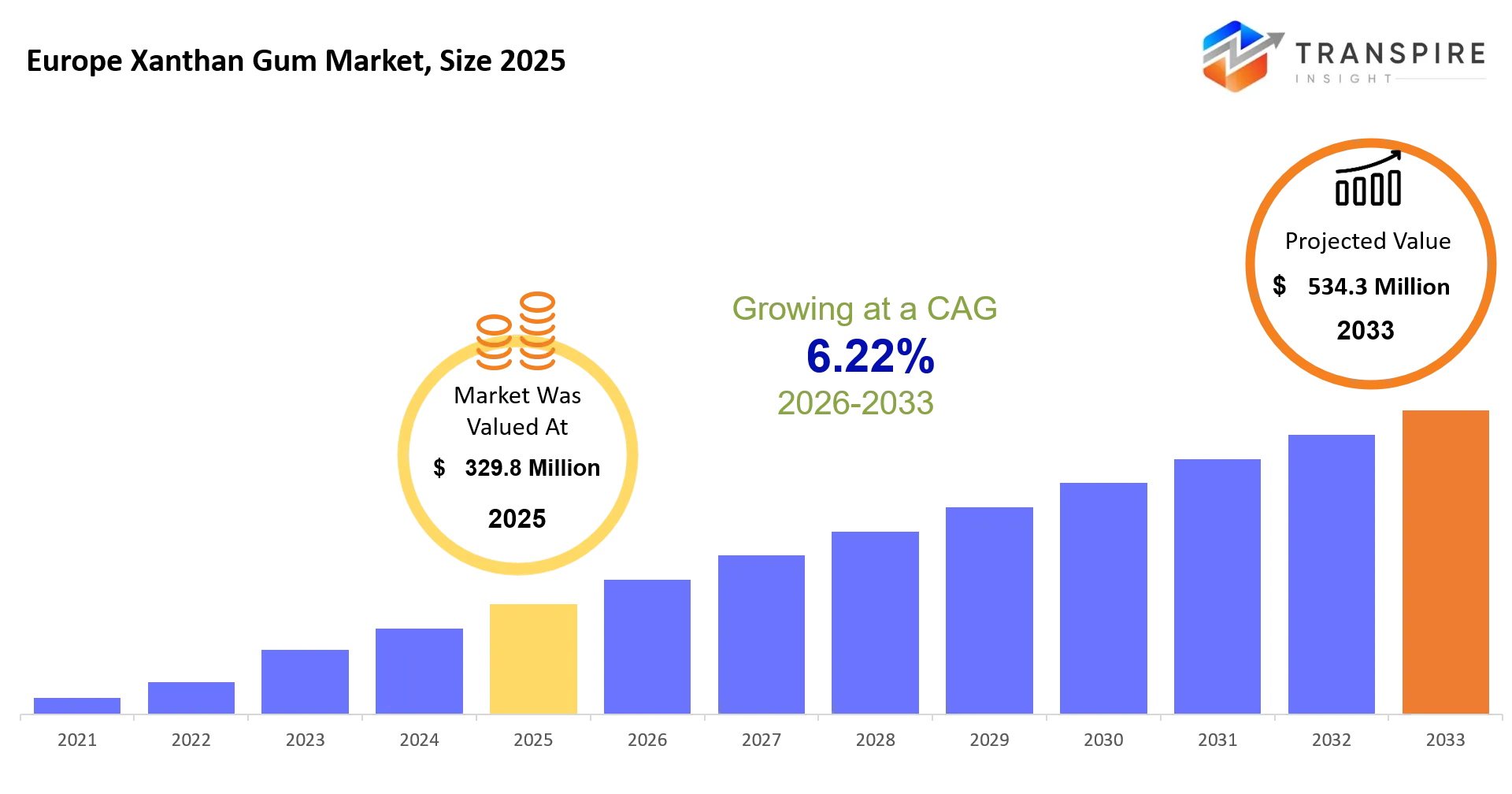
As per Transpire Insight Analysis, the Europe Xanthan Gum Market size is estimated at USD 329.8 Million in 2025 and is anticipated to reach USD 534.3 Million by 2033, growing at a CAGR of 6.22% from 2026 to 2033.
The Europe Xanthan Gum Market kind of plays a critical role in helping manufacturers keep texture, stability, and overall performance pretty much consistent, across food processing, pharmaceuticals, cosmetics, oil and gas operations, and various industrial formulations. By helping improve product quality under shifting temperatures, pH levels and processing conditions, xanthan gum can lower formulation failures, extend shelf life, and also support more efficient large-scale production. That practical value makes it feel like an essential ingredient across multiple industrial supply chains, not merely a niche specialty additive ,or something that’s limited, in the way some people think of it.
In the last three to five years the market sort of moved toward clean-label formulations and bio-based inputs, as European food regulations and customer buying behavior nudged manufacturers to replace certain synthetic stabilizers. Also global supply chain disruptions, plus raw material volatility after the pandemic period, made sourcing risks pretty obvious , so firms began diversifying suppliers and tightening regional procurement approaches.
As formulation expectations evolve, premium grade xanthan gum is grabbing more value, meaning stronger revenue possibilities via specialized, high-performance applications instead of relying only on volume driven sales.
Europe Xanthan Gum Market Size & Forecast:
- Europe Xanthan Gum Market Size 2025: USD 329.8 Million
- Expected Market Value 2033: USD 534.3 Million
- Forecast CAGR: 6.22%
- Leading region in 2025: Germany, France, Italy, and the United Kingdom
- Fastest Growing region: Poland, Czech Republic, Romania, and Hungary
- Key Profile: CP Kelco, Cargill, Jungbunzlauer, Fufeng Group, Deosen Biochemical, Ingredion, Archer Daniels Midland, Tate & Lyle, Hebei Xinhe Biochemical, Solvay, Merck KGaA, Hawkins Watts, DuPont, IFF, Brenntag
Key Market Insights
- Western Europe kind of dominated with about 58% market share in 2025 , and it was backed mainly by the known manufacturing base in Germany, France , Italy and the United Kingdom.
- Central and Eastern Europe will still look like the fastest-growing regional market during 2025–2033 , mainly because food processing and pharmaceutical investments keep expanding, especially in Poland and Romania.
- On the product side , food-grade xanthan gum basically led the landscape with nearly 67% market share in 2025 , this happened due to its broad use in bakery, dairy, sauces and beverage formulations.
- Industrial-grade xanthan gum came next as the second-largest segment because oilfield chemicals and specialty industrial formulations stayed with steadier procurement volumes across Europe, so demand didn’t really wobble.
- Meanwhile, pharmaceutical-grade xanthan gum will likely see the quickest expansion through 2033 , driven by advanced drug formulations and controlled-release excipient development.
- When it comes to end-use, food and beverage applications accounted for around 61% market share in 2025, since makers kept pushing clean-label recipes while not sacrificing texture or shelf stability.
- Pharmaceutical applications will register the fastest growth across the forecast period, because modern oral dosage formats need multifunctional stabilizing ingredients, not just one simple role.
- Food manufacturers remained the leading end-user group , hovering near 60% market share , supported by continuous product reformulation across processed and convenience foods.
- Last, biopharmaceutical manufacturers represent the fastest-growing end-user category through 2033, fueled by more investment in specialty excipients and advanced formulation technologies.
What are the Key Drivers, Restraints, and Opportunities in the Europe Xanthan Gum Market?
The main force, pushing the market forward, is a pretty noticeable and fast shift toward clean-label food formulation, across Europe. Tighter rules on ingredient transparency plus the reformulation initiatives from big food producers kinda sparked a more widespread use of multifunctional hydrocolloids. Xanthan gum lets manufacturers swap out a few different additives and still keep the texture steady as well as the overall processing performance. This not only pulls down reformulation costs, but also speeds up the product development window a bit, which then helps justify broader commercial adoption in bakery, dairy, drinks, and ready meals. In turn, production volumes rise and supplier revenue gets a steadier boost.
On the other side, raw material concentration and fermentation capacity still sit as the biggest structural wall. Basically, production relies on specialized fermentation infrastructure, and that sort of capacity can’t be scaled up quickly, even with strong demand. Also energy price swings and logistics hiccups have made manufacturing more expensive across Europe, in general. From the Transpire Insight review of regional procurement announcements and launch timing, supply chain concentration stays the leading execution risk. Those constraints tend to delay procurement choices, stretch delivery timelines, and dampen revenue chances for manufacturers rolling out new formulations.
The most compelling longer-term path seems to be in high-value pharmaceutical applications and specialty nutrition. Precision fermentation technologies, along with process optimization, are improving batch-to-batch consistency while cutting down production waste. Investment in regional bioprocessing facilities across Germany, the Netherlands, and Poland is creating decent conditions for local supply expansion. Higher-purity grades should support premium pricing, and having more diversified European manufacturing ought to strengthen supply resilience, then help unlock the next phase of overall market growth.
What Has the Impact of Artificial Intelligence Been on the Europe Xanthan Gum Market?
Artificial intelligence alongside digital technologies are kind of reshaping xanthan gum manufacturing, because fermentation control gets better, plus process monitoring and quality checks become more tight and, you know, reliable. More and more manufacturers start to deploy AI powered sensors that track pH, temperature, oxygen transfer, and nutrient uptake all in real time. With automated process nudges, the batches tend to vary less, and the final product feels more uniform. Then, machine learning helps with demand anticipation too, by looking at procurement patterns from food producers, pharmaceutical makers, and industrial buyers. That gives producers the chance to fine tune stock levels and production scheduling before those seasonal demand shifts show up.
Digital twins plus predictive analytics also improve how equipment is used, since they can flag maintenance needs ahead of time, before a surprise failure disrupts fermentation cycles. In practice, these setups raise operational uptime, cut down raw material waste, and boost manufacturing efficiency, while also reinforcing adherence to European quality requirements. AI assisted formulation support speeds up product development as well, by pointing toward better viscosity patterns for particular customer uses. Still, the roll out isn’t really widespread, because advanced AI platforms need a lot of integration work with older, legacy manufacturing setups, and they depend on big amounts of high quality production data. Smaller and medium sized manufacturers often have trouble justifying these expenses, so the digital shift slows, even if the operational gains are pretty measurable.
Key Market Trends
- Since 2022, European food manufacturers have been speeding up these sort of clean-label reformulation efforts, sort of swapping out synthetic stabilizers with multifunctional hydrocolloids in most major product groups.
- A bit after the whole pandemic-era disruption of supply , regional production approaches started moving around , and between 2023 and 2025 there was more push to invest in European sourcing partnerships.
- By 2024, a few pharmaceutical companies ended up expanding xanthan gum usage inside controlled release formulations, and that kinda boosted the demand for high purity specialty grades.
- At the same time, digital fermentation monitoring has gotten better since 2023, so production stays more consistent, fewer process deviations, and the batch quality looks more stable over time too.
- Because energy prices kept wobbling, producers leaned into modernizing fermentation facilities with efficiency-minded technologies, and that helped lower operational costs across multiple manufacturing sites.
- CP Kelco, Ingredion, and Jungbunzlauer also expanded their technical support services, in a way to improve customer collaboration , so formulation work could move faster across Europe.
- At the same time, food producers increasingly ask for locally sourced hydrocolloids in their procurement agreements, trimming down exposure to international logistics disruptions that were felt after 2021.
- Also, investment in precision fermentation technology has grown since 2024, which supports yield performance and enables more higher value production of specialty xanthan gum.
- Lastly, Central and Eastern European manufacturing hubs still manage to attract more processing investments, reinforcing regional competitiveness and backing longer-term supply chain diversification .
Europe Xanthan Gum Market Segmentation
By Product Type:
Food Grade Xanthan Gum kept taking the lead because food processors leaned on dependable thickening, holding, and texture steering across bakery items, dairy, sauces, beverages, and those quick convenience foods. Industrial Grade Xanthan Gum took the second biggest portion , largely because it shows up in industrial blends where viscosity and flow behavior have to stay dependable. Pharmaceutical Grade Xanthan Gum grew the fastest, as drug makers started using higher purity components for improved formats , especially for controlled-release kinds of products. Oilfield Grade Xanthan Gum stayed pretty steady from drilling needs and enhanced recovery uses , while Cosmetic Grade Xanthan Gum helped keep skincare and personal-care formulas stable.
High Purity Xanthan Gum got more attention where strict quality requirements and repeatable functionality matter. Modified Xanthan Gum added extra value , via specialized use cases that needed custom-made functional traits. Bulk production and ongoing product refinement kept pushing wider uptake across multiple sectors. Product diversification will keep reinforcing long term commercial chances across well known and newer application areas.
By Application:
Food & Beverages stayed the biggest application overall, mostly because stable texture, moisture holding, and shelf life upgrade were still kind of essential across processed food manufacturing. Oil & Gas kept its spot as the second-largest application, helped by drilling fluid formulations where dependable rheology control mattered a lot under heavy operating conditions. Pharmaceuticals showed up as the fastest-growing application as makers ramped up tablet, suspension, and specialty drug production that depended on reliable stabilizing ingredients. Cosmetics and Personal Care kept fairly steady consumption, by helping with product uniformity, and long-term formulation stability kind of stayed in focus.
Industrial Processing kept opening stable business chances through coatings, adhesives, and special formulations that needed controlled viscosity. Animal Feed grew bit by bit, since feed producers were prioritizing product consistency during manufacturing. Some smaller niche uses also supported wider commercial adoption across several industries. Having diversified application areas should help cut down reliance on just one end-use sector.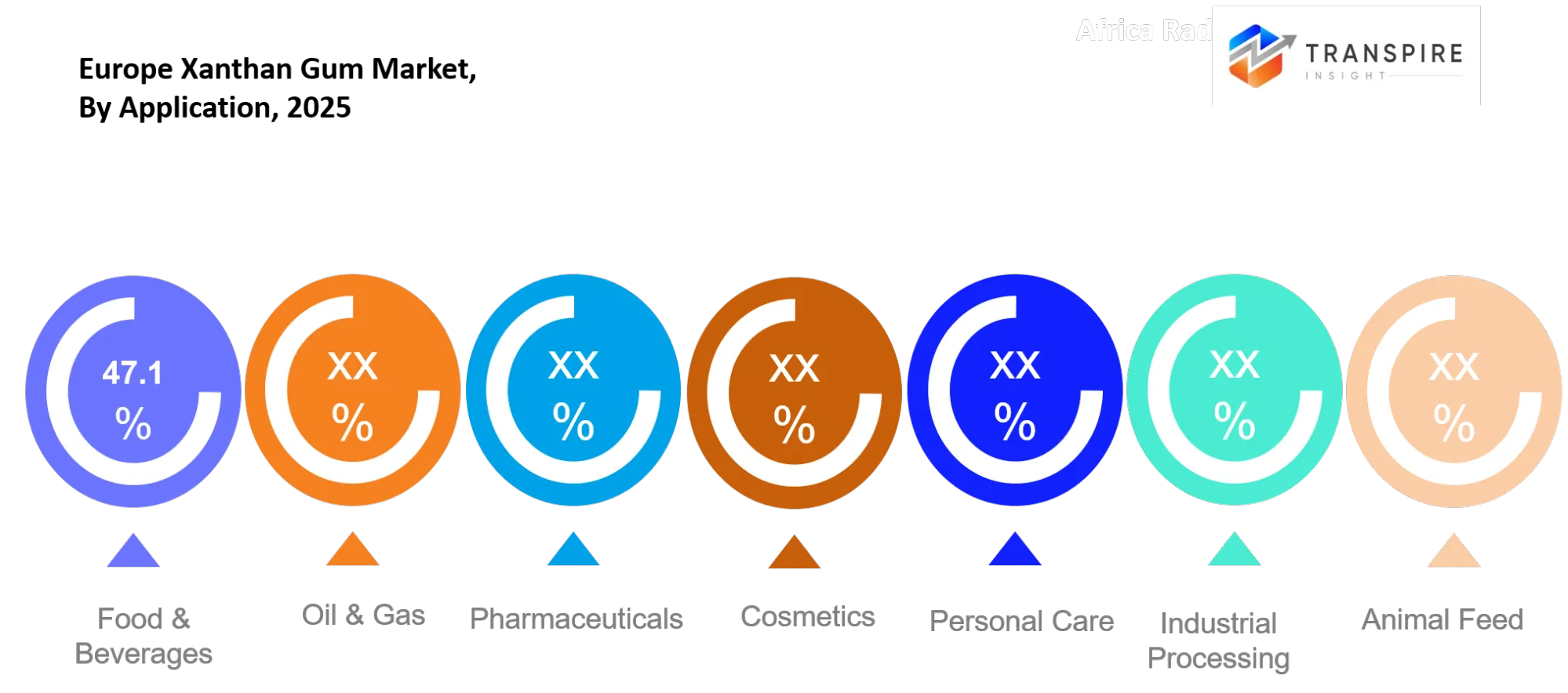
By End User:
Food Manufacturers ended up taking the largest share, mainly because big batch production really needs steady ingredients that could keep the product quality pretty stable even when formulations get pretty different or vary. Oilfield Companies stayed as the second biggest end user group, mostly because there’s ongoing demand for drilling fluid performance during exploration and production. Pharmaceutical Companies looked like the fastest growing category, since investment kept rising for advanced medicines, plus specialized excipient development, and so on. Cosmetic Manufacturers kept expanding their product ranges too, and that kind of growth depends on reliable thickening and suspension performance, basically it has to hold up.
Chemical Companies kept regular buying patterns for industrial formulations and specialty chemical production, rather consistent. Research Institutes were supporting formulation development, plus testing for new commercial uses across multiple industries. Industrial Users also pushed demand forward through broader adoption in manufacturing steps that need controlled viscosity traits, the whole process depends on it. And overall, a well balanced customer base should help maintain long term business stability across several sectors.
By Form:
Powder stayed the preferred format, mainly due to long shelf life and easier transport, plus storage that is more or less simple enough for large-scale industrial operations to run. Granules sat in the second-largest slice, not just because handling was a bit more practical, but also because dust goes down during processing. Liquid Formulations saw the quickest growth, since manufacturers wanted rapid mixing, and production workflows that are less tangled, for a few selected applications. Blended Products kept expanding steadily by acting as ready-to-use solutions, which can cut formulation time in a straightforward way.
Bulk Packs supported big-volume buying and smoother supply chain management for major manufacturers. Small Packs were more for laboratories, specialty producers, and smaller commercial operations where purchasing options need to be flexible, kind of flexible and quick. Customized Formulations opened chances for application-specific performance, and also for technical distinction. Ongoing product customization will keep building value creation across the different customer requirements, as needed.
By Distribution Channel:
Direct Sales drove the market for a while, mostly because big industrial customers liked long term supply agreements, plus technical support and a dependable procurement path. Distributors stayed in the #2 spot by pushing wider regional access, and then helping medium-sized manufacturers with flexible inventory availability. Online Sales showed the quickest growth too , since digital procurement platforms made ordering easier, product comparisons clearer, and inventory management less of a hassle for commercial buyers. Specialty Suppliers also held their ground, mainly by bringing technical know how, and application specific product guidance, right when it mattered.
Institutional Procurement kept demand steady through research organizations, healthcare providers, and public sector projects. Dealers kept widening regional availability via well-known commercial networks and long standing customer relationships. Contract Supply became more important as manufacturers secured long term agreements, not just for stability, but also for better production planning. Having several distribution channels will help broaden market access while also boosting supply chain resilience across Europe.
What are the Key Use Cases Driving the Europe Xanthan Gum Market?
Food manufacturing is still the biggest use case because steady, texture, suspension and shelf stability, like really matter for large scale production. Bakery, dairy, sauces, beverages, and convenience food producers typically buy xanthan gum so they can keep uniform quality while also staying aligned with European ingredient and labeling requirements.
Pharmaceutical manufacturing and personal care production keep growing as secondary applications that are becoming more important, not just a side thing. Drug manufacturers use xanthan gum to help tablet performance and to refine liquid formulations, while cosmetic companies put it into creams, gels and lotions to keep a stable feel, meaning consistent viscosity during production and storage period.
New opportunities are forming in plant based foods and in advanced nutrition products where careful texture control supports product development. Specialty industrial formulators are also looking into high purity grades for tailored processing applications. This creates fresh commercial potential as investment in bio based materials and performance driven formulations continues across European manufacturing industries, with more attention than before.
|
Report Metrics |
Details |
|
Market size value in 2025 |
USD 329.8 Million |
|
Market size value in 2026 |
USD 350.3 Million |
|
Revenue forecast in 2033 |
USD 534.3 Million |
|
Growth rate |
CAGR of 6.22% from 2026 to 2033 |
|
Base year |
2025 |
|
Historical data |
2021 - 2024 |
|
Forecast period |
2026 - 2033 |
|
Report coverage |
Revenue forecast, competitive landscape, growth factors, and trends |
|
Country scope |
Europe (Germany, United Kingdom, France, Italy, Spain and Rest of Europe) |
|
Key company profiled |
CP Kelco, Cargill, Jungbunzlauer, Fufeng Group, Deosen Biochemical, Ingredion, Archer Daniels Midland, Tate & Lyle, Hebei Xinhe Biochemical, Solvay, Merck KGaA, Hawkins Watts, DuPont, IFF, Brenntag . |
|
Customization scope |
Free report customization (country, regional & segment scope). Avail customized purchase options to meet your exact research needs. |
|
Report Segmentation |
By Product Type (Food Grade Xanthan Gum, Industrial Grade Xanthan Gum, Pharmaceutical Grade Xanthan Gum, Oilfield Grade Xanthan Gum, Cosmetic Grade Xanthan Gum, High Purity Xanthan Gum, Modified Xanthan Gum, Others); By Application (Food & Beverages, Oil & Gas, Pharmaceuticals, Cosmetics, Personal Care, Industrial Processing, Animal Feed, Others); By End User (Food Manufacturers, Oilfield Companies, Pharmaceutical Companies, Cosmetic Manufacturers, Chemical Companies, Research Institutes, Industrial Users, Others); By Form (Powder, Granules, Liquid Formulations, Blended Products, Bulk Packs, Small Packs, Customized Formulations, Others); By Distribution Channel (Direct Sales, Distributors, Online Sales, Specialty Suppliers, Institutional Procurement, Dealers, Contract Supply, Others) |
Which Regions are Driving the Europe Xanthan Gum Market Growth?
Western Europe kinda held the leading spot in the Europe Xanthan Gum Market around 58% market share in 2025, backed by advanced food processing practices and strict European quality rules. There are also strong compliance frameworks for food additives and pharmaceutical ingredients, so manufacturers mostly lean toward dependable, high quality xanthan gum solutions. Germany, France, Italy, and the United Kingdom bring a solid environment for food producers, pharmaceutical companies, specialty ingredient suppliers and distribution networks. This sort of control should keep going into 2033, because established manufacturing capabilities, innovation spending and premium-grade ingredient demand will keep supporting regional growth.
Southern Europe, on the other hand, shows up as a steady revenue contributor, mainly from continuous food manufacturing activity, mature regulatory systems, and steady investment in processed food plus personal care. Spain and Italy in particular keep demand fairly consistent, driven by strong culinary product manufacturing and a growing specialty formulation scene. Local producers tend to benefit from long standing supplier relationships, and efficient distribution networks that serve both domestic use and export markets. All of that together should help sustain market participation across the forecast window.
Central and Eastern Europe is expected to show the quickest momentum from 2026 to 2033, as manufacturing investments and supply chain diversification start to rearrange regional possibilities. Within that area, Poland, Romania Hungary, and the Czech Republic are pulling in food processing as well as pharmaceutical production projects, helped by stronger industrial infrastructure. As local production capacity grows, a fresh appetite is forming for functional ingredients and specialty additives. Overall, this movement should open up appealing pathways for suppliers, investors and even new participants that are trying to secure higher-growth positions across Europe.
Who are the Key Players in the Europe Xanthan Gum Market and How Do They Compete?
The Europe Xanthan Gum Market shows moderate consolidation, with competition shaped mostly by production efficiency , product quality , application knowhow , and regional supply abilities, kind of like a mix where nobody can fully ignore any part. Big manufacturers tend to hold their places via specialized formulations, certification back-up , and consistent customer care, while smaller suppliers try to win through tailored solutions and regional adaptability. What really counts isn’t just how much they ship, but the steady quality, technical assistance, and the ability to comply with strict European formulation requirements .
CP Kelco plays with advanced hydrocolloid technology and application support, delivering custom xanthan gum grades for food , pharmaceutical , and industrial customers. Jungbunzlauer leans into sustainable ingredient production and specialty blends, using fermentation competence to stand out in both product quality and environmental outcomes. Cargill strengthens its standing through a wide ingredient set and integrated supply networks that help major food manufacturers stay supplied .
Ingredion drives growth using clean-label formulation options and close technical cooperation with food producers who want better product performance . Fufeng Group competes by relying on broad-scale production capacity and expanding international sourcing, targeting buyers that want cost-efficient xanthan gum. Taken together these moves produce differentiation through know-how , specialization , supply reliability, and customer-first formulation guidance, even when the overall market feels a bit settled.
Company List
- CP Kelco
- Cargill
- Jungbunzlauer
- Fufeng Group
- Deosen Biochemical
- Ingredion
- Archer Daniels Midland
- Tate & Lyle
- Hebei Xinhe Biochemical
- Solvay
- Merck KGaA
- Hawkins Watts
- DuPont
- IFF
- Brenntag
Recent Development News
In April 2025, Tate & Lyle completed the first phase of its carbon reduction and energy efficiency investment at the Lille Skensved, Denmark ingredient manufacturing facility acquired from CP Kelco. The investment strengthened European production capabilities for specialty ingredients, including xanthan gum-related operations, by improving manufacturing efficiency and sustainability performance. Source https://www.tateandlyle.com/
In April 2026, Jungbunzlauer released a technical application update on xanthan gum as a natural thickener for face mask formulations. The formulation-focused development expanded awareness of xanthan gum usage in personal care applications and supported ingredient innovation across European cosmetics markets.
Source https://www.jungbunzlauer.com/
What Strategic Insights Define the Future of the Europe Xanthan Gum Market?
The Europe Xanthan Gum Market will likely drift toward higher-value, application specific growth in the next five to seven years, because food reformulation, clean label preferences, and the appetite for functional ingredients are quietly reshaping buying decisions. The main mover behind this change is the push for texture enhancement solutions that help companies use fewer added ingredients while also enabling alternative food formats.
There is also a less visible risk that still sits in the background, namely raw material and supply chain concentration, since reliance on a few production sources could make manufacturers feel cost volatility and availability disruptions. Still, a newer opening is appearing through biotechnology driven fermentation improvements, these can reduce environmental impact, and they may also pull in sustainability minded customers across Europe.
Market players should reinforce supply resilience by spreading sourcing options, putting money into efficient fermentation technologies, and designing customized xanthan gum grades that match specific needs in food, pharmaceutical, and personal care uses.
Europe Xanthan Gum Market Report Segmentation
By Product Type
- Food Grade Xanthan Gum
- Industrial Grade Xanthan Gum
- Pharmaceutical Grade Xanthan Gum
- Oilfield Grade Xanthan Gum
- Cosmetic Grade Xanthan Gum
- High Purity Xanthan Gum
- Modified Xanthan Gum
By Application
- Food & Beverages
- Oil & Gas
- Pharmaceuticals
- Cosmetics
- Personal Care
- Industrial Processing
- Animal Feed
By End User
- Food Manufacturers
- Oilfield Companies
- Pharmaceutical Companies
- Cosmetic Manufacturers
- Chemical Companies
- Research Institutes
- Industrial Users
By Form
- Powder
- Granules
- Liquid Formulations
- Blended Products
- Bulk Packs
- Small Packs
- Customized Formulations
By Distribution Channel
- Direct Sales
- Distributors
- Online Sales
- Specialty Suppliers
- Institutional Procurement
- Dealers
- Contract Supply
Frequently Asked Questions
Find quick answers to common questions.
The Expected Europe Xanthan Gum Market size for the Market will be USD 534.3 Million in 2033.
Key segments for the Europe Xanthan Gum Market are By Product Type (Food Grade Xanthan Gum, Industrial Grade Xanthan Gum, Pharmaceutical Grade Xanthan Gum, Oilfield Grade Xanthan Gum, Cosmetic Grade Xanthan Gum, High Purity Xanthan Gum, Modified Xanthan Gum, Others); By Application (Food & Beverages, Oil & Gas, Pharmaceuticals, Cosmetics, Personal Care, Industrial Processing, Animal Feed, Others); By End User (Food Manufacturers, Oilfield Companies, Pharmaceutical Companies, Cosmetic Manufacturers, Chemical Companies, Research Institutes, Industrial Users, Others); By Form (Powder, Granules, Liquid Formulations, Blended Products, Bulk Packs, Small Packs, Customized Formulations, Others); By Distribution Channel (Direct Sales, Distributors, Online Sales, Specialty Suppliers, Institutional Procurement, Dealers, Contract Supply, Others).
Major Europe Xanthan Gum Market players are CP Kelco, Cargill, Jungbunzlauer, Fufeng Group, Deosen Biochemical, Ingredion, Archer Daniels Midland, Tate & Lyle, Hebei Xinhe Biochemical, Solvay, Merck KGaA, Hawkins Watts, DuPont, IFF, Brenntag.
The Current Europe Xanthan Gum Market size is USD 329.8 Million in 2025.
The Europe Xanthan Gum Market CAGR is 6.22% from 2026 to 2033.
- CP Kelco
- Cargill
- Jungbunzlauer
- Fufeng Group
- Deosen Biochemical
- Ingredion
- Archer Daniels Midland
- Tate & Lyle
- Hebei Xinhe Biochemical
- Solvay
- Merck KGaA
- Hawkins Watts
- DuPont
- IFF
- Brenntag
About the Authors

Pankaj Ghogare Patil
I am Pankaj Ghogare Patil, a Senior Research Analyst at Transpire Insight, specializing in the Pharmaceutical, Chemicals & Materials, Healthcare IT, and Biotechnology industry. My expertise lies in conducting comprehensive market research, analyzing industry trends, evaluating competitive landscapes, and translating complex data into actionable insights. At Transpire Insight, I closely follow emerging technologies, regulatory developments, and market innovations to create accurate, well-researched, and informative content that helps businesses and professionals make informed decisions. I am committed to producing credible, evidence-based articles that reflect industry best practices while making technical topics accessible and valuable for a broad audience.

Chakradhar Khansole
Chakradhar serves as the Research Director at Transpire Insight, bringing over 8 years of experience in technology, innovation, and strategic market intelligence. He specializes in transforming complex market data into actionable business insights that enable organizations to make informed, growth-oriented decisions. Recognized for his strategic vision and analytical expertise, Chakradhar leads high-impact research initiatives, delivering comprehensive market assessments, competitive intelligence, and forward-looking industry analysis.
Recently Published Reports
-
May 2026
Healthcare Polymer Packaging Market
Healthcare Polymer Packaging Market Size, Share & Analysis Report By Packaging Type (Syringes, IV Bottles and Pouches, Clamshells, Blisters, Bottles & Jars, Containers, Tubes, IV Parental Packaging, Others), By Type (Regulated, Non-regulated), By Polymer Type (LDPE (Low-Density Polyethylene), HDPE (High-Density Polyethylene), Homo-polymer (Homo), Random Copolymer (Random), Block Copolymer (Block), PET, Polystyrene, Polyvinyl Chloride, Polyamide/EVOH, Others), and Geography (North America, Europe, Asia-Pacific, Middle East and Africa, South and Central America), 2021 - 2031
-
Apr 2026
Hydrophilic Tape (Waterstop) Market
Hydrophilic Tape (Waterstop) Market Size, Share & Analysis Report By Type (Bentonite-Based Hydrophilic Tape, Rubber-Based Hydrophilic Tape), By Application (Residential Buildings, Commercial Buildings, Infrastructure Projects), and Geography (North America, Europe, Asia-Pacific, Middle East and Africa, South and Central America), 2021 - 2031
-
Apr 2026
Metalens Market
Metalens Market Size, Share & Analysis Report By Type (Visible Light Metalens, and Infrared Metalens), By Application (Consumer Electronics, Automotive Electronics, Industrial, Medical, and Others), and Geography (North America, Europe, Asia-Pacific, Middle East and Africa, South and Central America), 2021 - 2031
-
Apr 2026
PBT Resin Market
PBT Resin Market Size, Share & Analysis Report By Type (Reinforced PBT Resin, Unreinforced PBT Resin), By Processing Method (Injection Molding, Extrusion, Blow Molding, Others), By End-User (Automotive, Electrical & Electronics, Consumer Appliances, Industrial Machinery, Medical Devices, Packaging, Others), and Geography (North America, Europe, Asia-Pacific, Middle East and Africa, South and Central America), 2021 - 2031