

Europe Hydrocolloids Market Size & Forecast:
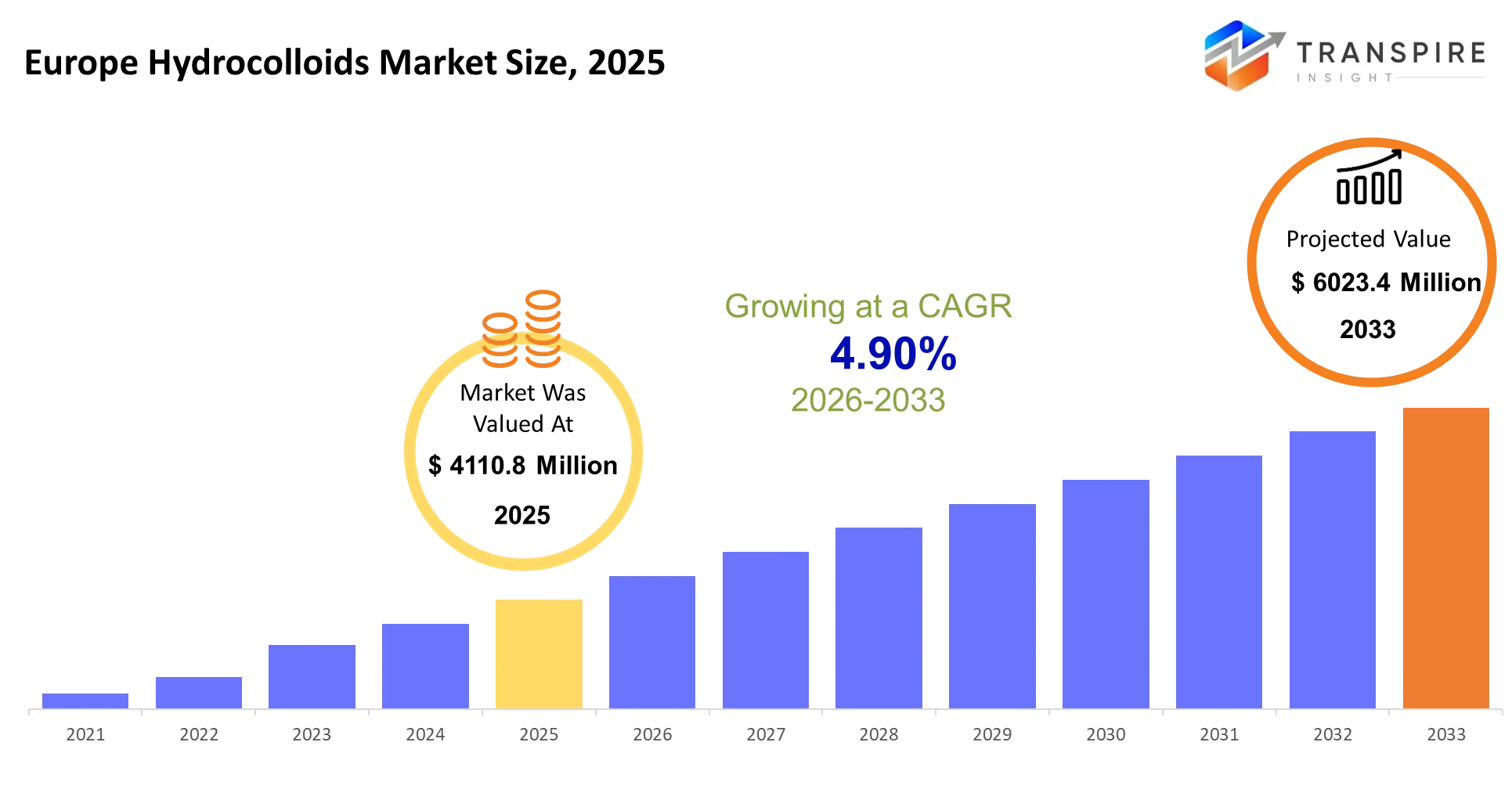
- Europe Hydrocolloids Market Size 2025: USD 4110.8 Million
- Europe Hydrocolloids Market Size 2033: USD 6023.4 Million
- Europe Hydrocolloids Market CAGR: 4.90%
- Europe Hydrocolloids Market Segments: By Type (Gelatin, Pectin, Xanthan Gum, Carrageenan, Guar Gum, Others), By Application (Food & Beverages, Pharmaceuticals, Cosmetics, Industrial Use, Others), By End-User (Food Industry, Pharma Companies, Cosmetic Industry, Industrial Firms, Others), By Form (Powder, Liquid, Others).
To learn more about this report,  Download Free Sample Report
Europe Hydrocolloids Market Summary:
The Europe Hydrocolloids Market size is estimated at USD 4110.8 Million in 2025 and is anticipated to reach USD 6023.4 Million by 2033, growing at a CAGR of 4.90% from 2026 to 2033. European hydrocolloids function as essential components which food products and pharmaceutical items and industrial processes use to achieve desired texture and stability and extended shelf life. The solution addresses a real-world challenge which maintains product quality during stress testing through two different applications which include frozen food ice crystal control and plant-based beverage stabilization and drug delivery system development.
Plant-based and clean-label products have become the market standard during the past three to five years which requires manufacturers to substitute synthetic substances with natural hydrocolloid materials that include pectin and carrageenan. EU countries have implemented stricter labeling regulations which particularly impact food manufacturers who must meet new requirements and reformulate their products. The COVID-19 pandemic created a major supply chain problem which revealed how companies relied on limited geographical sources and required them to establish multiple supply sources.
The current growth rate of our business shows its dependence on two factors the product reformulation process and the changes we make to our supplier relationships. Companies are not just buying more volume, they are redesigning products around functionality, which raises the value contribution of hydrocolloids and strengthens long-term supplier relationships.
Key Market Insights
- Western Europe holds the largest share of the Europe Hydrocolloids Market with its 45% market share which Germany, France and the UK food processing industries lead.
- The Eastern European market develops into the fastest expanding region until 2028 because of increasing packaged food needs and the establishment of local manufacturing facilities.
- The confectionery industry and pharmaceutical capsule production create a demand for gelatin which results in the material capturing more than 30% of the 2024 market.
- Pectin stands as the second largest market segment because European customers demand clean label products which use fruit-based ingredients.
- The rapid expansion of plant-based dairy alternatives will drive Carrageenan to become the fastest growing market segment until 2028.
- The food and beverage sector holds 60% of market share in 2024 because businesses use their products to maintain food texture and extend product freshness.
- The plant-based and functional nutrition markets experience their fastest growth because vegan product development and product reformulation initiatives propel demand.
- Food manufacturers control more than 55% of the Europe Hydrocolloids Market because they use hydrocolloid products for their industrial operations.
- The pharmaceutical and nutraceutical industry shows its highest growth rates through advanced drug delivery systems and capsule technology development.
What are the Key Drivers, Restraints, and Opportunities in the Europe Hydrocolloids Market?
The primary force that drives the growth of the Europe Hydrocolloids Market results from the food industry adoption of clean-label reformulation practices. EU labeling regulations became stricter and retailers demanded that products eliminate artificial stabilizers from their ingredient lists which created this change. Major companies established new product formulas based on natural hydrocolloids which include pectin and agar. The value of hydrocolloids increased because manufacturers began using them as essential ingredients instead of inexpensive additives, which allowed them to use hydrocolloids in all their premium products, starting from plant-based dairy to ready-to-eat meals.
The supply of raw materials which the company needs to produce goods faces two main challenges. Many hydrocolloids depend on specific regional materials which include seaweed and citrus peels, that face climate changes and limited harvesting areas. The solution to this problem needs extended time because it requires both agricultural development and establishment of processing facilities. Manufacturers encounter fluctuating input expenses which lead to postponed contract agreements while they attempt to use this method in price-sensitive markets that include mass-market packaged foods.
Pharmaceutical and nutraceutical fields offer an important future growth opportunity especially through their use in controlled-release drug delivery systems. Hydrocolloid-based encapsulation research now enables scientists to create exact release patterns which deliver active substances. Germany and Switzerland are increasing their funding for drug formulation research which provides hydrocolloids with the opportunity to enter advanced margin technology markets that extend beyond their typical food applications.
What Has the Impact of Artificial Intelligence Been on the Europe Hydrocolloids Market?
The manufacturing process of hydrocolloid production benefits from artificial intelligence which enhances control operations and boosts product formulation accuracy. Producers now use AI-driven automation to monitor viscosity temperature and pH levels in real time during extraction and blending. The process decreases batch fluctuations while it increases production consistency which results in reduced operational waste and higher manufacturing output. Automated quality control systems in large-scale facilities use computer vision technology to identify texture and particle defects at a speed that exceeds what human inspectors can achieve.
Machine learning models provide organizations with the ability to make predictions about future events. Companies apply predictive maintenance on processing equipment such as dryers and reactors which enables them to reduce unplanned downtime through early detection of equipment failure patterns. In formulation AI models create virtual simulations of ingredient combinations which allow food and pharmaceutical companies to enhance product texture and stability without needing physical testing until later development stages which results in a 20 to 30 percent decrease in product development time.
These technologies improve operational efficiency by increasing uptime while they decrease raw material waste and shorten product development cycles. The high implementation expenses and the scarcity of standardized datasets which small and medium-sized manufacturers need for this technology remain the primary barrier that prevents them from adopting it.
Key Market Trends
- European food manufacturers since 2021 have reformulated more than 35% of their processed products to eliminate synthetic additives and use plant-based hydrocolloids such as pectin and agar.
- Cargill and Ingredion Incorporated expanded their supplier network to various locations outside Asia after their operations faced major disruptions during supply chain problems that occurred in 2020.
- Labeling requirements from 2019 until 2024 led to decreased carrageenan usage in certain dairy products while manufacturers started using alternative ingredients for their premium offerings.
- The selection process for hydrocolloids now relies on functionality requirements because companies started choosing hydrocolloids based on their value to plant-based dairy products and ready-to-eat food items.
- European regulators established stricter rules for ingredient disclosure after 2020 which compelled manufacturers to make their product labels simpler thus driving the usage of naturally sourced stabilizers in packaged food items.
- German and Swiss pharmaceutical companies increased their usage of hydrocolloids for controlled-release drug development since 2021 which expanded their scientific applications beyond conventional food ingredients.
- Hydrocolloid usage in private-label brands increased by more than 25% during the last three years which allows these brands to compete with name-brand products through better texture and extended product freshness.
- DuPont and Tate & Lyle have dedicated their research and development budget since 2020 to create multi-functional product combinations which will make product development easier for their companies.
Europe Hydrocolloids Market Segmentation
By Type
The type segmentation system establishes a complete functional hierarchy which extends through various levels of regulatory acceptance. Gelatin maintains its market leadership because it serves as the primary ingredient in both confectionery products and pharmaceutical capsules while existing supply chains enable cost-effective distribution. Pectin serves as the second most important segment which active growth because clean-label reformulation and fruit-based applications drive demand in Western European markets.
The food industry requires xanthan gum and guar gum to provide stable viscosity control in both sauces and bakery products. Carrageenan experiences selective usage decline in specific dairy products because of labeling issues yet consumers still choose plant-based alternatives. The market will grow through the development of multi-functional blends together with plant-based hydrocolloids which will require manufacturers to create new extraction methods while diversifying their material resources to decrease dependence on specific suppliers.
By Application
The application-based segmentation shows food and beverages as the primary segment because they need stabilization and thickening and texture control in most situations. Hydrocolloids enable controlled-release drug delivery and capsule formation which makes pharmaceuticals increase their market presence. Emulsification and moisture retention are essential for cosmetics and personal care products which maintain their niche market demand.
The industrial sector uses paper and textile materials with decreasing speed but ongoing consumption. The growth pattern shows different paths because food applications need continuous reformulation while pharmaceutical growth depends on new drug delivery technologies. Future direction points toward higher-margin applications where hydrocolloids act as functional enablers rather than simple additives which increase value capture across sectors.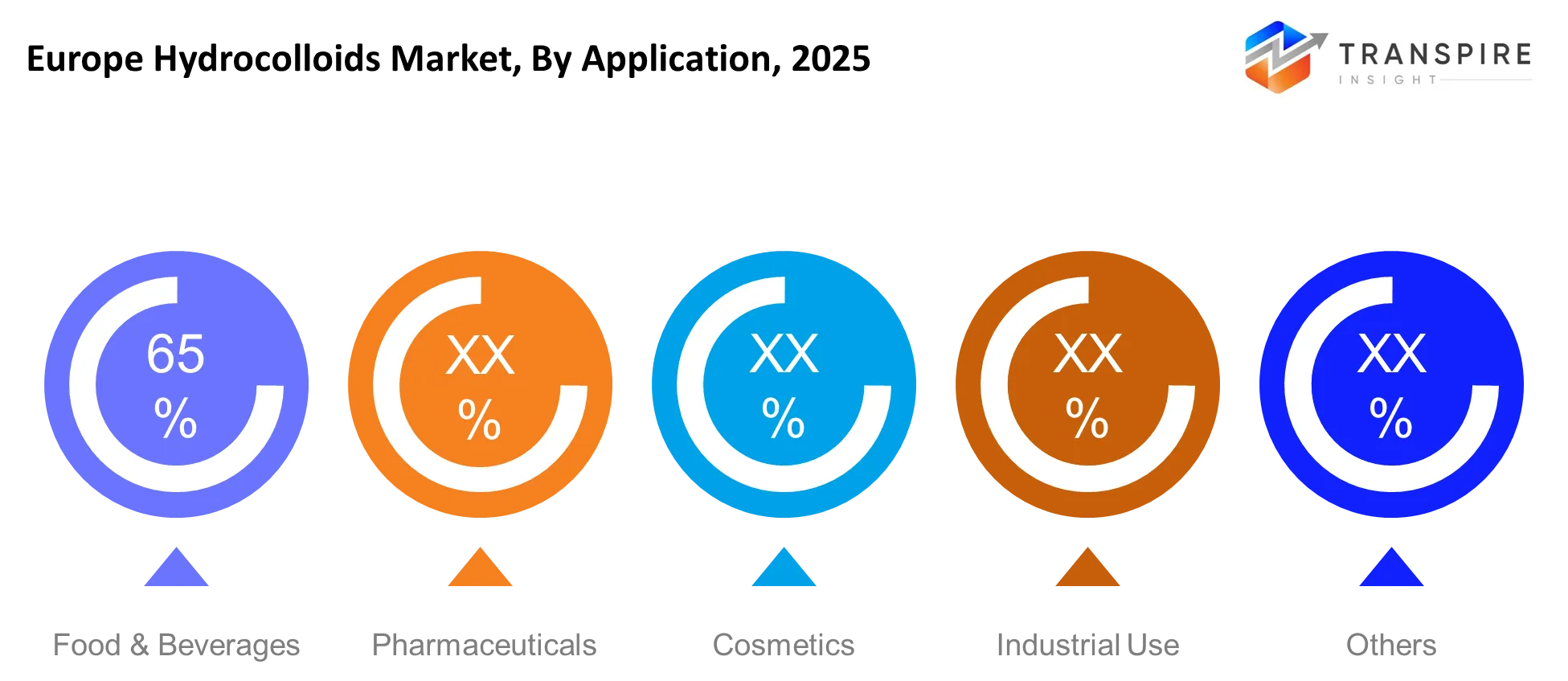
To learn more about this report, Download Free Sample Report
By End-User
The food industry leads end-user segmentation because it maintains its dominant market position through ongoing product development and extensive manufacturing capacity. The pharmaceutical sector constitutes a rapidly expanding market segment which benefits from increased funding dedicated to developing new drug formulations and nutraceutical products. The cosmetic industry creates moderate market demand which particularizes to premium skincare products that need stable emulsions. Industrial companies sustain their fundamental usage patterns while they experience minimal capacity expansion.
The different end-user groups show distinct ways of buying products because food manufacturers need to balance their needs while pharmaceutical buyers require their products to have both purity and consistency. Future business operations will require hydrocolloid manufacturers to work more closely with pharmaceutical companies because increasing regulatory requirements and performance standards will drive changes in supplier relationships and pricing systems.
By Form
Powder materials demonstrate their status as the primary form used in production because they provide better storage options and extended product life and match the requirements of dry blending operations used in food and pharmaceutical production. Liquid products are used in specialized situations which need their fast spreading ability to achieve even mixing results especially in beverage and cosmetic product development. The other available formats remain specialized for specific purposes. The demand for powder products keeps increasing because manufacturers need better capabilities to expand their operations and handle product distribution especially when conducting international business across European borders.
The liquid product category encounters challenges because of its transportation limitations and reduced product life yet it provides precise measurement capabilities for valuable usage situations. The upcoming years will bring ongoing progress in hybrid and ready-to-use product development which will enable industrial users to achieve faster processing times and better formulation results.
What are the Key Use Cases Driving the Europe Hydrocolloids Market?
The primary application leads to processed food manufacturing which uses hydrocolloids to maintain texture and stability while extending shelf life in dairy products and sauces and ready-to-eat meals. Major European companies create most product demand because they need to reformulate their products for clean-label requirements while maintaining storage and transport quality.
Hydrocolloids now have broader applications which extend to both pharmaceuticals and nutraceuticals through their use in creating capsules and managing drug release patterns. Cosmetic companies now use hydrocolloids more in their premium skincare products to stabilize emulsions and enhance product texture which European personal care companies use to create high-performance items.
Emerging use cases include plant-based meat and dairy alternatives, where hydrocolloids replicate texture and mouthfeel. The fields of 3D food printing and precision nutrition now develop advanced applications which receive initial support from innovation hubs located in Germany and the Netherlands.
|
Report Metrics |
Details |
|
Market size value in 2025 |
USD 4110.8 Million |
|
Market size value in 2026 |
USD 4308.3 Million |
|
Revenue forecast in 2033 |
USD 6023.4 Million |
|
Growth rate |
CAGR of 4.90% from 2026 to 2033 |
|
Base year |
2025 |
|
Historical data |
2021 - 2024 |
|
Forecast period |
2026 - 2033 |
|
Report coverage |
Revenue forecast, competitive landscape, growth factors, and trends |
|
Regional scope |
Europe (Germany, United Kingdom, France, Italy, Spain and Rest of Europe) |
|
Key company profiled |
Cargill, DuPont, Ingredion, Kerry Group, Tate & Lyle, CP Kelco, Ashland, ADM, DSM, Nexira, Gelita, Rousselot, Darling Ingredients, FMC, Jungbunzlauer |
|
Customization scope |
Free report customization (country, regional & segment scope). Avail customized purchase options to meet your exact research needs. |
|
Report Segmentation |
By Type (Gelatin, Pectin, Xanthan Gum, Carrageenan, Guar Gum, Others), By Application (Food & Beverages, Pharmaceuticals, Cosmetics, Industrial Use, Others), By End-User (Food Industry, Pharma Companies, Cosmetic Industry, Industrial Firms, Others), By Form (Powder, Liquid, Others) |
Which Regions are Driving the Europe Hydrocolloids Market Growth?
Western Europe maintains its leadership position because of its developed food processing system which implements rigorous regulations and hosts multiple international ingredient suppliers. The three countries of Germany, France, and the Netherlands maintain comprehensive labeling standards which require companies to continuously reformulate their products through the use of functional hydrocolloids. The combination of extensive research facilities and established supplier networks enables organizations to develop new products at a fast pace while maintaining high standards of quality. The entire system enables manufacturers to charge higher prices while they maintain enduring business relationships with international food and pharmaceutical companies.
Southern Europe supports its economic development through its availability of raw materials and its existing methods of traditional food production instead of needing to comply with European regulations. The citrus processing sector in Spain and Italy creates advantages for both countries through its production of pectin and establishment of local supply chains. The domestic market maintains stability while the region produces specialty food items that target international markets. The industry maintains stable growth because producers emphasize cost savings through local material sourcing instead of pursuing the rapid advances which northern producers adopt.
Eastern Europe has become the fastest developing area because of recent investments which improve its food processing capabilities and industrial facilities. Since 2022 Poland and Romania have received foreign direct investment which aims to boost their packaged food manufacturing sector. The region attracts manufacturing companies to shift their operations because of its lower labor expenses and enhanced compliance with European Union regulations. The market shift between 2026 and 2033 enables new businesses and investors to develop supply partnerships which support their business growth.
Who are the Key Players in the Europe Hydrocolloids Market and How Do They Compete?
The Europe Hydrocolloids Market demonstrates moderate market consolidation because multinational ingredient suppliers maintain control over major market share while regional processors focus on specialized market segments. The existing companies maintain their market position through their expertise in product applications and their long-term supply contracts which they use to compete with their rivals. Buyers now demand customized blends from suppliers who need to provide complete formulation support instead of offering single raw material products. The new companies encounter market entry obstacles because they need to obtain raw materials and fulfill governmental regulations which restrict their capacity to disrupt existing markets.
Cargill uses its supply chain management and operational size to maintain material supply security and manufacturing cost control which enables the company to handle market price changes. Ingredion Incorporated uses its formulation knowledge to create unique texturizing solutions that enhance customer switching costs because of their customized plant-based food products. CP Kelco develops its specialized hydrocolloids which meet superior purity levels to supply premium food and pharmaceutical markets that require dependable performance over cost considerations.
DuPont uses its biotechnology expertise to create new hydrocolloid products that deliver better performance through enhanced stability and functional properties which generate high-profit revenue streams. Tate & Lyle expands through partnerships with food manufacturers, co-developing clean-label solutions that align with evolving European regulations. The company employs these operational methods to achieve a competitive advantage through cooperative research development practices which create new market value for customers who face product development problems.
Company List
- Cargill
- DuPont
- Ingredion
- Kerry Group
- Tate & Lyle
- CP Kelco
- Ashland
- ADM
- DSM
- Nexira
- Gelita
- Rousselot
- Darling Ingredients
- FMC
- Jungbunzlauer
Recent Development News
In April 2026, Tate & Lyle and Van Triest CirQlar extend partnership to advance circular food systems: Tate & Lyle has extended its partnership with Van Triest CirQlar to strengthen circular food systems by managing citrus pulp co-products generated during pectin production in Germany. The agreement enhances value creation from production byproducts while supporting animal feed supply chains and improving sustainability in Europe’s ingredient processing ecosystem.
Source: https://www.fruit-processing.com
In March 2026, New Netherlands facility expands European bio-based ingredient supply chain: Cargill expanded its European production capacity in the Netherlands (Gouda facility), strengthening supply of bio-based functional ingredients used in food stabilization systems, including hydrocolloid-enabled formulations.
Source: https://www.cargill.com
What Strategic Insights Define the Future of the Europe Hydrocolloids Market?
The Europe Hydrocolloids Market is moving toward high-functionality application-specific systems that match particular needs because food reformulation cycles and pharmaceutical requirements need precise solutions. The next 5–7 years will bring value creation through customized blends which provide texture and stability and controlled release in a single product, resulting in revenue shifts from volume sales to formulation partnerships.
The main danger for the company stems from its dependency on particular raw materials which face threats from both climate change effects and seaweed and citrus farming operations. The supply disruption will result in price increases which will force major manufacturers to seek synthetic or fermentation-based alternatives, which will decrease the need for traditional hydrocolloids.
Microbial and fermentation-based hydrocolloids present an opportunity for growth because biotech advancements enable producers to maintain consistent product quality which does not depend on agricultural production cycles. Northern European innovation clusters have started to adopt this technology.
Market participants should create better formulation abilities through partnerships with suppliers and development of alternative sourcing methods which will help them capture higher-margin solution-based products while reducing their exposure to market fluctuations.
Europe Hydrocolloids Market Report Segmentation
By Type
- Gelatin
- Pectin
- Xanthan Gum
- Carrageenan
- Guar Gum
- Others
By Application
- Food & Beverages
- Pharmaceuticals
- Cosmetics
- Industrial Use
- Others
By End-User
- Food Industry
- Pharma Companies
- Cosmetic Industry
- Industrial Firms
- Others
By Form
- Powder
- Liquid
- Others
Frequently Asked Questions
Find quick answers to common questions.
The Approximate Europe Hydrocolloids Market size for the Market will be USD 6023.4 Million in 2033.
The key Segments of the Europe Hydrocolloids Market are By Type (Gelatin, Pectin, Xanthan Gum, Carrageenan, Guar Gum, Others), By Application (Food & Beverages, Pharmaceuticals, Cosmetics, Industrial Use, Others), By End-User (Food Industry, Pharma Companies, Cosmetic Industry, Industrial Firms, Others), By Form (Powder, Liquid, Others).
Major Players in the Europe Hydrocolloids Market are Cargill, DuPont, Ingredion, Kerry Group, Tate & Lyle, CP Kelco, Ashland, ADM, DSM, Nexira, Gelita, Rousselot, Darling Ingredients, FMC, Jungbunzlauer.
The Current Market size of the Europe Hydrocolloids Market is USD 4110.8 Million in 2025.
The Europe Hydrocolloids Market CAGR is 4.90%.
- Cargill
- DuPont
- Ingredion
- Kerry Group
- Tate & Lyle
- CP Kelco
- Ashland
- ADM
- DSM
- Nexira
- Gelita
- Rousselot
- Darling Ingredients
- FMC
- Jungbunzlauer
Recently Published Reports
-
Apr 2026
Healthcare Polymer Packaging Market
Healthcare Polymer Packaging Market Size, Share & Analysis Report By Packaging Type (Syringes, IV Bottles and Pouches, Clamshells, Blisters, Bottles & Jars, Containers, Tubes, IV Parental Packaging, Others), By Type (Regulated, Non-regulated), By Polymer Type (LDPE (Low-Density Polyethylene), HDPE (High-Density Polyethylene), Homo-polymer (Homo), Random Copolymer (Random), Block Copolymer (Block), PET, Polystyrene, Polyvinyl Chloride, Polyamide/EVOH, Others), and Geography (North America, Europe, Asia-Pacific, Middle East and Africa, South and Central America), 2021 - 2031
-
Apr 2026
Hydrophilic Tape (Waterstop) Market
Hydrophilic Tape (Waterstop) Market Size, Share & Analysis Report By Type (Bentonite-Based Hydrophilic Tape, Rubber-Based Hydrophilic Tape), By Application (Residential Buildings, Commercial Buildings, Infrastructure Projects), and Geography (North America, Europe, Asia-Pacific, Middle East and Africa, South and Central America), 2021 - 2031
-
Apr 2026
Metalens Market
Metalens Market Size, Share & Analysis Report By Type (Visible Light Metalens, and Infrared Metalens), By Application (Consumer Electronics, Automotive Electronics, Industrial, Medical, and Others), and Geography (North America, Europe, Asia-Pacific, Middle East and Africa, South and Central America), 2021 - 2031
-
Apr 2026
PBT Resin Market
PBT Resin Market Size, Share & Analysis Report By Type (Reinforced PBT Resin, Unreinforced PBT Resin), By Processing Method (Injection Molding, Extrusion, Blow Molding, Others), By End-User (Automotive, Electrical & Electronics, Consumer Appliances, Industrial Machinery, Medical Devices, Packaging, Others), and Geography (North America, Europe, Asia-Pacific, Middle East and Africa, South and Central America), 2021 - 2031