

Europe Rigid Industrial Packaging Market Summary
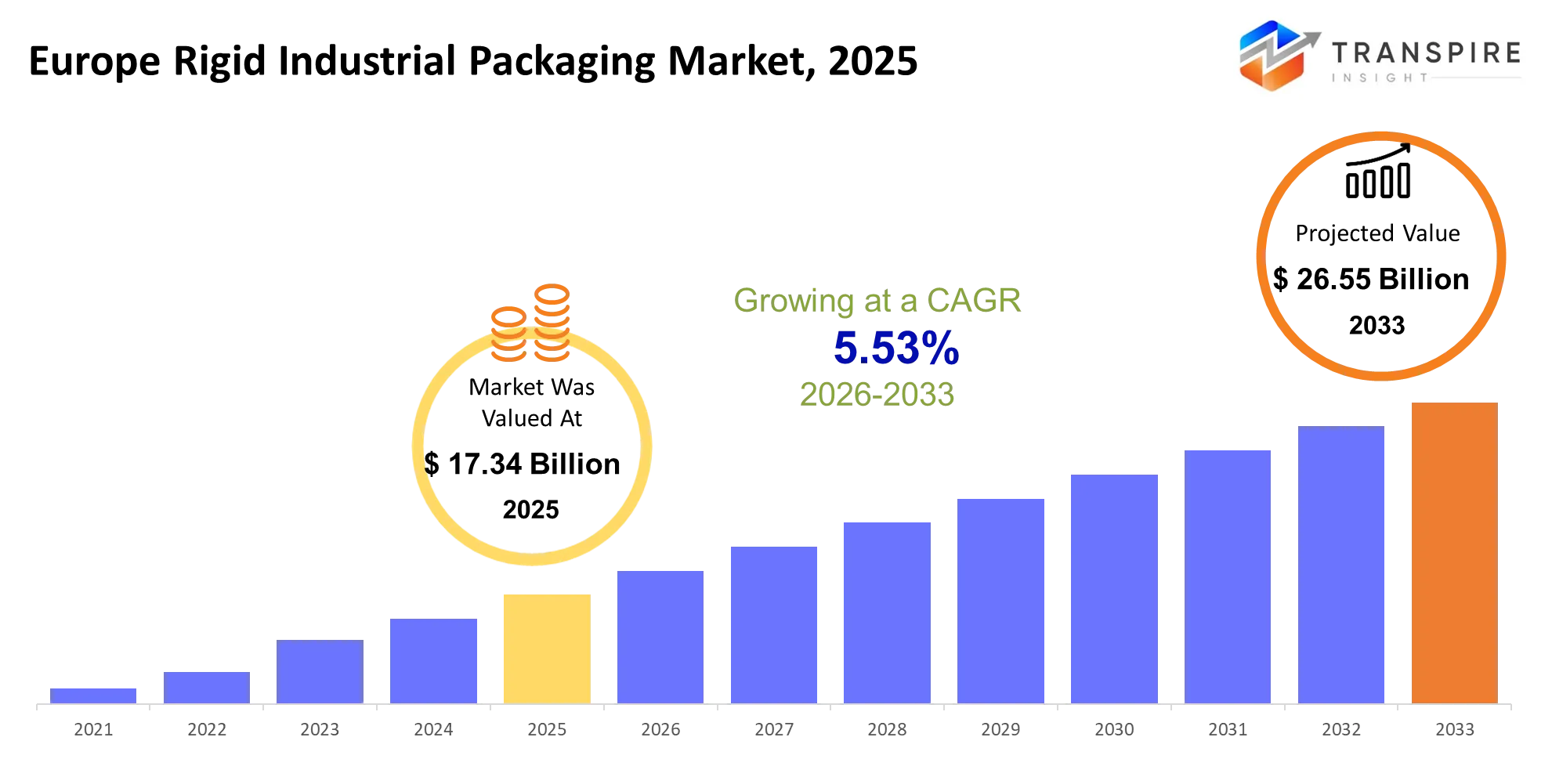
As per Transpire Insight, the Europe Rigid Industrial Packaging Market size is estimated at USD 17.34 Billion in 2025 and is anticipated to reach USD 26.55 Billion by 2033, growing at a CAGR of 5.53% from 2026 to 2033.
Rigid packaging is used to safeguard and ship many industrial goods. This includes chemicals and pharmaceuticals. It also covers food ingredients, lubricants, paints, and other materials used in factories. Products move through both production sites and wider distribution routes.
In the past three to five years, purchasing habits have shifted. Some buyers moved away from one-time containers. They now look more for options that can be reused or recycled. They also consider formats that can be reconditioned. In Europe, circular-economy rules have pushed this change.
The EU Packaging and Packaging Waste Regulation has increased the pressure on packaging makers. Firms are expected to raise recyclability. They are also pushed to use less material and improve how packaging performs after it is used.
At the same time, energy prices have been unstable. Supply chains have also faced interruptions. These issues have led many manufacturers to cut packaging weight. They are also working on better return and collection processes.
Because of this, money is going toward longer-lasting plastic containers. Investment also goes to IBCs. Some buyers are also using lighter metal options. Alongside that, more automated reconditioning setups are being adopted.Overall, these shifts help firms offer packaging with more value. They also open new ways to earn. Reuse programs, refurbishment work, and lifecycle services can bring in extra revenue.
Europe Rigid Industrial Packaging Market Size & Forecast:
- Europe Rigid Industrial Packaging MarketSize 2025: USD 17.34 Billion
- Expected Market Value 2033: USD 26.55 Billion
- Forecast CAGR: 5.53%
- Leading region in 2025: Germany
- Fastest Growing region: Poland
- Key Profile: Greif, Mauser Packaging Solutions, Berry Global, SCHÜTZ, WERIT, Hoover CS, Greif Flexibles, Mondi, Sonoco, Amcor, Jokey, IPL Plastics, RPC Group, Sigma Plastics Group, Berlin Packaging
Key Market Insights
- Germany led activity in rigid packaging across Europe. Poland showed the quickest expected rise among the big European markets up to 2031.
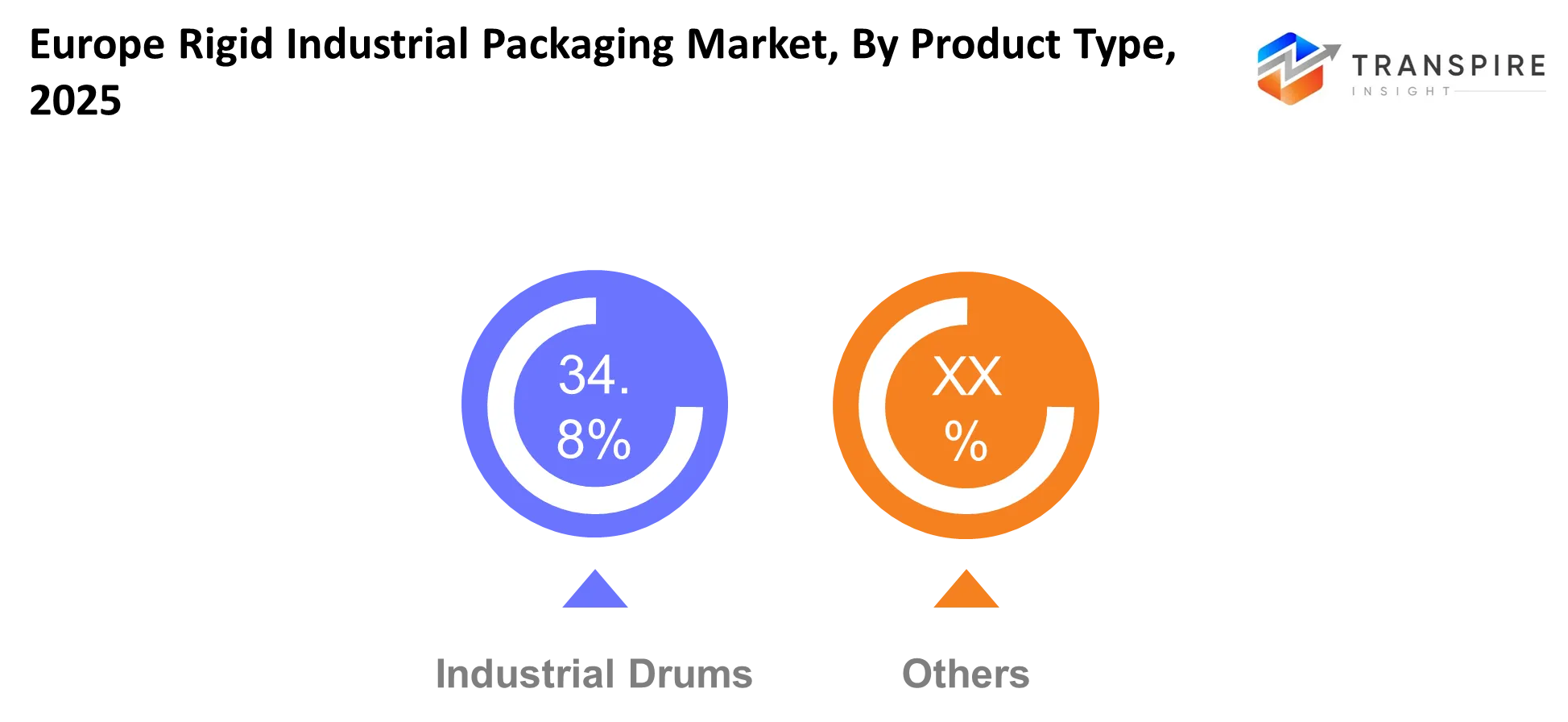
- Drums still matter a lot in industry. They fit chemical use, lubricants, food handling, and also the move of hazardous goods across European supply chains.
- Rigid IBC use keeps growing. Standard bulk containers take less room to move and make cross-border liquid and semi-solid shipments easier.
- In 2025, polymer packaging made up 53% of a like-for-like industrial packaging market. That share points to lighter builds, better chemical resistance, and lower costs.
- In 2025, chemical and pharma uses were about 47% of that industrial packaging demand. So regulated handling is a key driver.
- More reconditioned IBCs and reusable drums are being chosen. Many buyers in Europe want lower total lifecycle costs. They also focus more on packaging circularity.
- Digital tracking and smart packaging are no longer only trials. Firms want better container use, smoother return flows, and clearer inventory data.
- Lightweighting has picked up speed. Manufacturers are trying to balance material prices, freight efficiency, required strength, and sustainability targets.
- Automation is also changing the process. Blow molding and injection molding, plus inspection and reconditioning, help keep output more even. They also cut down on manual work.
- Big names are pushing hard in this space. Greif, Mauser Packaging Solutions, SCHÜTZ, Berry Global, Amcor, and Mondi compete on new materials, recycling skills, regional output, and tailored industrial packaging options.
What are the Key Drivers, Restraints, and Opportunities in the Europe Behavior Biometrics Market?
Companies across Europe are being pushed toward one big goal: meeting new rules and passing compliance checks. The EU Packaging and Packaging Waste Regulation started in February 2025. The general use phase is set for August 2026.
Right now, teams are looking at a short list of issues. Can the pack be recycled without a lot of hassle? How much of the material is used in the first place? What the pack is made from? What happens after customers throw it away Because of that, many firms are changing their container designs. Some want to add more recycled content. Others are testing reuse ideas. Even with a clear plan, the work takes time and can cost more. It may also raise spending for packs that have to meet the new rules.
This shift is not just about shape or design. Costs for material and energy can also delay progress. Prices can move for steel, aluminum, plastics, recycled resin, and the electricity or power used in production. If a new container turns out heavier, delivery and shipping costs can also go up.There are also strict limits on how packaging must be built. Manufacturers cannot cut material too far if they still need strength, good stacking behavior, chemical resistance, and safety compliance. These limits can slow moves away from older packaging types. They can also force more spending on new machines, molds, and production setups.
There is also a clear chance in circular industrial packaging services. Used IBCs that are restored, reusable drums, return shipments, and tracking of containers can support income over time. Collection systems that keep items in a loop can add value beyond the first sale of packaging. Many European industrial buyers want practical ways to cut waste and use assets better. That makes rental and refurbishment setups more appealing. Providers that pair long lasting containers with tracking, checks, cleaner processes, and reconditioning can earn more value across the full life of each container.
What Has the Impact of Artificial Intelligence Been on the Europe Behavior Biometrics Market?
AI is reshaping rigid packaging lines. It uses automated checks, demand estimates, line plans, and live equipment monitoring. With computer vision, defects can be spotted early. This includes bad surfaces, wrong size, closure issues, and molding flaws. The goal is to catch problems before items move off the line.
Machine learning can also look at machine logs. It may detect links between sensor signals and issues like mold wear, extrusion faults, or temperature swings. It can even flag patterns that show up before unplanned stops. When that happens, teams can plan repairs based on what the equipment shows, not only on a set calendar.
Forecasting helps match output to real orders. It can account for customer needs, material supply, and the demand for returnable containers. Tracking systems can also help with IBCs and drums. They can show where a container is, how it moved, whether it was returned, and what reconditioning is needed. In practice, this can lower waste, keep lines running longer, and tighten inventory control.
Still, costs can be high when many systems must be linked together. This is a bigger issue for smaller makers that run older machines. AI also needs clean, consistent production data. It must connect with shop-floor systems, sensor feeds, and quality tools before results show up. Even with these limits, digitalization and automation are viewed as key paths in European industrial packaging.
Key Market Trends
- Starting in 2025, packaging plans in Europe have leaned more on recyclability, using less material, and meeting end-of-life rules tied to PPWR. At the same time, the focus on polymers grew.
- Many makers wanted lighter packs, better chemical resistance, and parts that last longer, since that can also cut shipping costs.Reconditioned IBCs used to be a small option.
- Now they show up more in circular packaging schemes. The aim is to spend less on replacement and use fewer raw materials.Digital tracking is getting wider adoption too.
- Industrial buyers want higher use of each container. They also want smoother returns and clearer views of what is happening across distribution routes.More steps are being automated as well.
- Manual checks and handling are dropping in many sites. This is happening across molding, filling, sorting, and the reconditioning work.Germany still leads the European rigid plastic market.
- In 2025, it held 21.54% of that market, based on Mordor Intelligence.Poland is also gaining attention. It is forecast to grow at a 3.96% CAGR in the European rigid plastic packaging market up to 2031.
- Circular economy efforts are not only about recycling materials. They also include reusable drums, leasing IBCs, collection routes, and paid reconditioning services.
- In product design, firms are mixing light weight with stronger protection. They push for better barrier performance, better impact resistance, improved chemical resistance, and meeting compliance rules.
- The competition is changing focus. More companies now sell full packaging services. That can include production, tracking, collection, refurbishing, and help with recycling as part of the deal.
Europe Rigid Industrial Packaging Market Segmentation
By Product Type:
Drums are still widely used for chemicals, lubricants, paints, food ingredients, and other industrial liquids. Steel versions give solid strength and help during tough use. Plastic drums are lighter and still resist many chemicals well.
Intermediate Bulk Containers are for bigger moves and storage of liquids, powders, and thick or semi-solid mixes. Their set sizes make stacking easier. They also help forklifts in the yard and improve space use in warehouses. They can simplify shipping across borders.
Pails work when a smaller pack size is needed. They are common for paints, coatings, adhesives, lubricants, and chemical products. Rigid plastic containers are made to stay light while still handling impacts. They also protect against chemical contact in many industries.
Jerrycans are used to carry liquids and chemicals safely. They are made for transport of lubricants and farm products too, using a strong handled build. Industrial bottles are for smaller quantities such as chemical products, additives, cleaning liquids, and specialty fluids.Crates are made for repeated loading, storage, and moving of packed goods. Boxes give firm cover for components, parts, tools, and industrial materials while they sit or travel.
By Material:
Plastic is still used a lot in industrial packaging. It helps because it is light, resists many chemicals, handles impacts well, and works for many packaging shapes.Steel is chosen when toughness matters most. It brings high strength, long service life, good fire resistance, and firm containment.Aluminum is valued for specific jobs. It stays light, resists corrosion, and still keeps good strength for industrial packaging.
Fiberboard is used where low weight helps. It also supports transport and secondary packing. It can be a practical choice due to recyclability and lower material mass. HDPE is strong against many chemicals. It also lasts a long time. That is why it is used for drums, IBC bottles, jerrycans, and other industrial containers.PP gives stiffness and solid chemical resistance. It also performs well with heat. It is used for pails, containers, closures, and formats meant to be used again.PET is picked for clear bottles and containers. It has good strength and useful barrier properties for certain industrial uses.
Composite materials mix different material traits. This helps match strength, weight, barrier needs, and durability for special packaging tasks.Polymer materials held a strong role in industrial packaging. Their lightweight and chemical resistant design can cut handling and transport expenses.
By Application:
Chemicals: This category is a big deal in packaging. The container must hold the material safely. It should match the chemical. It also needs to withstand knocks and meet the rules.Pharmaceuticals: Drug packaging has its own needs. Materials have to be handled with care. Surfaces should stay clean. Records must be kept so batches can be traced. The container also needs to stay closed and secure.
Food and Beverage: Food packs must be built for hygiene. The material has to be safe for food contact. It should last through use. It must also protect the product during shipping.Paints and Coatings: These products need strong containers. The container must handle solvents, pigments, and added formulas. It should prevent drips. It must also survive normal handling without damage.Lubricants: Lubes are often stored and shipped in drums, pails, bottles, and similar packs. This helps keep oils and special fluids safe for transport.
Farms use sturdy containers to carry fertilizer, pesticide mixes, and other inputs for crops. The containers need to hold up in the field and keep the product inside. Car makers use firm packaging for lubricants, other fluids, parts, and materials used during build work. On job sites, construction crews rely on industrial containers for paints, glues, chemicals, sealants, and other supplies.In 2025, chemical and pharma use was close to 47% of industrial packaging like this. That shows how important regulated packs are.
By Packaging Capacity:
Tiny amounts, under 5 liters. Use small bottles or squeeze pouches for add-ins, lab chemicals, greases, sealants, coating stuff, and other runs you only make in small batches.Mid size, 5 to 20 liters. These are not too heavy to move by hand. They fit with paint, oils, blended chemical mixes, and some supplies used on farms.Bigger lots, 20 to 50 liters. Pick pails or jerrycans for day to day use in a workshop or a plant. They also fit repeat shipments for regular business needs.Large volume, 50 to 100 liters. Choose these for thick liquids or for bulky items. Handling is still manageable for most teams.Very large, 100 to 250 liters. Go with drums and larger tanks for chemical liquids, lubricants, coating materials, and other fluids used in industry.
From 250 to 500 liters: This range helps with mid-sized transport. Stacking and stronger handling matter more here.From 500 to 1,000 liters: These are for large volume runs. They are made for higher output sites and bigger storage needs.Over 1,000 liters: Big bulk packs hold large amounts of liquids and mixes. They are used for chemical loads, food ingredients, and industrial supplies. IBC units help with storage and shipping.Rigid IBC units are often built to run near 1,040 to 1,250 liters. This supports bulk logistics using set footprint sizes.
By Closure Type:
Screw caps seal tightly and let you open bottles, jerrycans, and other rigid small containers in a steady way. Snap closures let people open and close fast. They fit jobs where access happens often. Drum plugs help seal industrial drums that carry liquids, powders, or thick semi-solids. Lever closures are made for quick drum open and close, even when the drums are handled again and again.
Tamper-evident closures show when someone may have opened the package. That helps keep the product intact. Child-resistant closures add extra safety for items that are hazardous or fall under rules. Dispensing closures release material in a measured, controlled way. This is used for lubricants, chemicals, coatings, and other industrial fluids. Other closures cover special sealing setups made for each use case. Some focus on fit with a specific product, some aim at pressure control, some help limit leaks, and some are built for handling needs.Choosing a closure now often comes down to safety, product protection, ease of use, and rule compliance.
By End User:
Chemical makers need containers that hold up well with harsh chemicals. They also need tight caps that seal properly. The packaging must follow the rules for hazardous and safe goods.Pharma firms focus on clean packs and steady storage conditions. They want trace records for lots and batches. They also need strong protection so the contents stay safe from damage.Food producers look for containers that are clean and safe for food contact. The pack should keep ingredients stable in storage. It should also survive shipping without leaks or breaks.
Auto firms use drums, pails, bottles, and other hard containers. These hold lubricants, fluids, chemicals, and shop or production supplies.Paint makers need packs that resist solvents and wear. The container must handle pigments and coatings during use. It should also work through many moves and pours.Farm businesses often choose rigid packaging for fertilizers and pesticide products. They also package crop protection liquids and similar items. These packs must be strong for field use and transport.
Building firms use rigid packs for adhesives and coatings. Sealants, additives, and other job materials also go in these containers. The goal is reliable protection on site and during delivery.
Industrial makers use hard containers in many steps of production. They need safe handling and efficient storage. Durability matters, and so does protection during transport.Across chemical, pharma, food, construction, auto, and farm work, there is a wide need for industrial packaging styles.
What are the Key Use Cases Driving the Europe Behavior Biometrics Market?
Chemical and pharmaceutical material handling is still a main job. Industrial containers have to keep harsh or sensitive goods safe while they sit in storage, move through the plant, and travel under rules. For this reason, demand stays high for drums and IBCs.
Buyers focus on leak control. They also look for chemical fit with the product, enough strength for stacking, and proof that the container meets required standards. These points tie directly to day to day safety.
Rigid containers are also used widely in food manufacturing, paints and coatings, lubricants, auto work, and agriculture. IBCs are often chosen for bigger liquid loads. Smaller options like pails, jerrycans, bottles, and drums fit other steps in production and in shipping.Reusable packaging can lower how often companies must replace containers. That can also help the cost of the full packaging cycle.
New directions are showing up too. Some systems use digital tracking for returned containers. Others aim at automated reconditioning. Some firms are building closed-loop networks for packaging.
With tracking, companies can use containers more often and manage returns with less hassle. Inspection tools can also spot cracks or other harm before a unit goes back into use. This kind of setup may let packaging suppliers make money from collection, repair, monitoring, and lifecycle services, not just from the first sale of the container.
|
Report Metrics |
Details |
|
Market size value in 2025 |
USD 17.34 Billion |
|
Market size value in 2026 |
USD 18.22 Billion |
|
Revenue forecast in 2033 |
USD 26.55 Billion |
|
Growth rate |
CAGR of 5.53% from 2026 to 2033 |
|
Base year |
2025 |
|
Historical data |
2021 - 2024 |
|
Forecast period |
2026 - 2033 |
|
Report coverage |
Revenue forecast, competitive landscape, growth factors, and trends |
|
Regional scope |
Europe |
|
Key company profiled |
Greif, Mauser Packaging Solutions, Berry Global, SCHÜTZ, WERIT, Hoover CS, Greif Flexibles, Mondi, Sonoco, Amcor, Jokey, IPL Plastics, RPC Group, Sigma Plastics Group, Berlin Packaging |
|
Customization scope |
Free report customization (country, regional & segment scope). Avail customized purchase options to meet your exact research needs. |
|
Report Segmentation |
By Product Type (Drums, Intermediate Bulk Containers, Pails, Rigid Plastic Containers, Jerrycans, Industrial Bottles, Crates, Boxes); By Material (Plastic, Steel, Aluminum, Fiberboard, HDPE, PP, PET, Composite Materials); By Application (Chemicals, Pharmaceuticals, Food & Beverage, Paints & Coatings, Lubricants, Agriculture, Automotive, Construction); By Packaging Capacity (Below 5 Liters, 5–20 Liters, 20–50 Liters, 50–100 Liters, 100–250 Liters, 250–500 Liters, 500–1,000 Liters, Above 1,000 Liters); By Closure Type (Screw Caps, Snap Closures, Drum Plugs, Lever Closures, Tamper-Evident Closures, Child-Resistant Closures, Dispensing Closures, Other Closures); By End User (Chemical Manufacturers, Pharmaceutical Companies, Food Manufacturers, Automotive Companies, Paint Manufacturers, Agricultural Companies, Construction Companies, Industrial Manufacturers) |
Which Regions are Driving the Europe Rigid Industrial Packaging Market Growth?
Germany is still the leading country market. Its edge comes from a big manufacturing base, a strong chemical sector, major auto output, and solid logistics. In 2025, Germany made up 21.54% of the European rigid plastic packaging market. That share helps packaging suppliers reach a wide set of industrial clients. Recycling systems are in place too. Compliance processes are also well set. Because of this, standardized drums, IBCs, containers, and recyclable polymer types can be used more easily.
The United Kingdom has a different kind of demand. Growth is supported by pharma activity, chemical work, food processing, and industrial manufacturing. When you compare the UK with Germany’s total manufacturing scale, the UK stands out in another way. It has more focused packaging needs. It also has distribution networks that serve both local firms and companies that ship abroad. Supplier consolidation keeps pushing this trend forward. In June 2026, Berlin Packaging bought UK-based BlueSky. The goal was to grow its packaging range and widen its customer reach.
Poland looks like the fastest mover among the main European markets. It is expected to post a 3.96% CAGR through 2031. Several forces are helping. Costs for production can be lower. Manufacturing activity keeps rising. More packaging is needed across industrial and consumer supply chains. This mix is drawing investment into local packaging capability. From 2026 to 2033, there is also room for new plants and regional distributors. Investors may find it easier to enter the market because Poland is close to customers in Central and Western Europe.
Who are the Key Players in the Europe Rigid Industrial Packaging Market and How Do They Compete?
Competition is mostly shaped by big suppliers. They offer many products, run wide production sites, and provide long-term services. Smaller regional firms still matter, especially where local ties and know-how are key.Key points that decide deals are container strength. Buyers also look at how well materials are used, whether firms can handle recycled content, and if they have reconditioning facilities. Custom options matter too. Distance to industrial buyers can also be a deciding factor.Greif, Mauser Packaging Solutions, SCHÜTZ, Berry Global, and Berlin Packaging are working to gain ground. They do it with circular packaging options, niche formats, buys in new regions, and steady local growth.
Greif stands out with a large set of products across Europe. It also runs a reconditioning setup across many countries, including Germany, France, Italy, Belgium, Austria, Hungary, and the Netherlands. This approach is more than selling containers. It also takes back used packaging. It cleans and reuses parts that qualify for reuse, especially IBC components. Materials that do not fit reuse are recycled into post-consumer resin.
Mauser Packaging Solutions blends new units with reconditioning and recycling work. Its stainless-steel IBC line is aimed at demanding use cases. These include chemical handling, agricultural needs, food related uses, coatings, and petroleum applications.Berry Global competes by focusing on polymer engineering. It also pushes light weight designs. Recycled-content offerings and recyclable industrial containers are part of its main pitch.
Berlin Packaging is expanding mainly through acquisitions. It finished the Rixius buy in Germany in 2025. It also completed BlueSky in the UK in 2026. These steps help it serve local customers better and widen the range of packaging services.SCHÜTZ competes in IBC systems by pairing reusable container designs with services tied to the full lifecycle. This gives industrial customers options that center on ease of handling and reuse.
Company List
- Greif
- Mauser Packaging Solutions
- Berry Global
- SCHÜTZ
- WERIT
- Hoover CS
- Greif Flexibles
- Mondi
- Sonoco
- Amcor
- Jokey
- IPL Plastics
- RPC Group
- Sigma Plastics Group
- Berlin Packaging
Recent Development News
- "In June 2026, Greif announced acquisition of Envaplast. The acquisition expanded Greif's manufacturing presence in Spain and strengthened its Customized Polymer Solutions business, particularly for agrochemical packaging, supporting further European expansion.http://www.greif.com/pl/greif-expands-manufacturing-presence-in-spain-with-acquisition-of-envaplast/ (Greif)."
- "In June 2025, Mauser Packaging Solutions opened a new reconditioning and recycling facility at the BASF site in Tarragona, Spain. The facility reconditions IBCs and produces post-consumer resin while improving freight efficiency and supporting a circular packaging model in Spain.http://mauserpackaging.com/pl/mauser_news/mauser-packaging-solutions-opens-new-reconditioning-recycling-facility-at-basf-site-in-tarragona-spain/ (Mauser Packaging Solutions)."
- "In May 2025, Mauser Packaging Solutions launched a new line of stainless steel IBCs. The 125-to-550-gallon containers target demanding chemical, agricultural, food and beverage, coatings, and petroleum applications while supporting reuse through Mauser's Recover Syst-M program.http://mauserpackaging.com/tr/mauser_news/mauser-packaging-solutions-expands-product-range-with-new-line-of-stainless-steel-ibcs/ (Mauser Packaging Solutions)."
What Strategic Insights Define the Future of the Europe Behavior Biometrics Market?
The market is shifting toward circular packaging. More customers want reuse, repair, and recycled inputs. They also spend on services tied to packaging. Rules from governments will push this change faster. One risk is not talked about as much. Recycled resin may be hard to get, or it may cost more than expected. If the resin quality is low, or supply is tight, companies may struggle to use enough recycled content. There is also a real opening for on site work. Facilities that handle reconditioning at the customer location can help. Mauser’s Tarragona site is one example. When containers are collected, cleaned, processed, and sent back into use, transport costs can drop. Customers may also stay longer with the provider. For this reason, players should build local closed loop systems. That means container making plus pickup, tracking, reconditioning, and a steady supply of recycled material. It should not only be a fight over the lowest packaging price.
Europe Rigid Industrial Packaging Market Report Segmentation
By Product Type
- Drums
- Intermediate Bulk Containers
- Pails
- Rigid Plastic Containers
- Jerrycans
- Industrial Bottles
- Crates
- Boxes
By Material
- Plastic
- Steel
- Aluminum
- Fiberboard
- HDPE
- PP
- PET
- Composite Materials
By Application
- Chemicals
- Pharmaceuticals
- Food & Beverage
- Paints & Coatings
- Lubricants
- Agriculture
- Automotive
- Construction
By Packaging Capacity
- Below 5 Liters
- 5–20 Liters
- 20–50 Liters
- 50–100 Liters
- 100–250 Liters
- 250–500 Liters
- 500–1,000 Liters
- Above 1,000 Liters
By Closure Type
- Screw Caps
- Snap Closures
- Drum Plugs
- Lever Closures
- Tamper-Evident Closures
- Child-Resistant Closures
- Dispensing Closures
- Other Closures
By End User
- Chemical Manufacturers
- Pharmaceutical Companies
- Food Manufacturers
- Automotive Companies
- Paint Manufacturers
- Agricultural Companies
- Construction Companies
- Industrial Manufacturers
Frequently Asked Questions
Find quick answers to common questions.
The expected Europe Rigid Industrial Packaging Market size for the market will be USD 26.55 Billion in 2033.
Key segments for the Europe Rigid Industrial Packaging Market are By Product Type (Drums, Intermediate Bulk Containers, Pails, Rigid Plastic Containers, Jerrycans, Industrial Bottles, Crates, Boxes); By Material (Plastic, Steel, Aluminum, Fiberboard, HDPE, PP, PET, Composite Materials); By Application (Chemicals, Pharmaceuticals, Food & Beverage, Paints & Coatings, Lubricants, Agriculture, Automotive, Construction); By Packaging Capacity (Below 5 Liters, 5–20 Liters, 20–50 Liters, 50–100 Liters, 100–250 Liters, 250–500 Liters, 500–1,000 Liters, Above 1,000 Liters); By Closure Type (Screw Caps, Snap Closures, Drum Plugs, Lever Closures, Tamper-Evident Closures, Child-Resistant Closures, Dispensing Closures, Other Closures); By End User (Chemical Manufacturers, Pharmaceutical Companies, Food Manufacturers, Automotive Companies, Paint Manufacturers, Agricultural Companies, Construction Companies, Industrial Manufacturers).
Major Europe Rigid Industrial Packaging Market players are Greif, Mauser Packaging Solutions, Berry Global, SCHÜTZ, WERIT, Hoover CS, Greif Flexibles, Mondi, Sonoco, Amcor, Jokey, IPL Plastics, RPC Group, Sigma Plastics Group, Berlin Packaging
The Europe Rigid Industrial Packaging Market size is USD 17.34 Billion in 2025.
The Europe Rigid Industrial Packaging Market CAGR is 5.53% from 2026 to 2033.
- Greif
- Mauser Packaging Solutions
- Berry Global
- SCHÜTZ
- WERIT
- Hoover CS
- Greif Flexibles
- Mondi
- Sonoco
- Amcor
- Jokey
- IPL Plastics
- RPC Group
- Sigma Plastics Group
- Berlin Packaging
About the Authors

Kartik bhong
I am Kartik Bhong, a Senior Research Analyst at Transpire Insight, specializing in the Packaging, Manufacturing, and Construction industry. My work focuses on analyzing market trends, emerging technologies, industry regulations, and competitive landscapes to deliver accurate, data-driven insights. I am passionate about transforming complex industry information into clear, practical content that helps businesses, professionals, and decision-makers stay informed and make confident strategic decisions. Through continuous research and a strong commitment to accuracy, I strive to create reliable, well-researched content that reflects the latest developments across these dynamic industries and supports the vision of Transpire Insight in delivering valuable market intelligence.

Chakradhar Khansole
Chakradhar serves as the Research Director at Transpire Insight, bringing over 8 years of experience in technology, innovation, and strategic market intelligence. He specializes in transforming complex market data into actionable business insights that enable organizations to make informed, growth-oriented decisions. Recognized for his strategic vision and analytical expertise, Chakradhar leads high-impact research initiatives, delivering comprehensive market assessments, competitive intelligence, and forward-looking industry analysis.
Recently Published Reports
-
Apr 2026
Pharmaceutical Cold Chain Packaging Market
Pharmaceutical Cold Chain Packaging Market By Material (Plastic,(Polyethylene (PE), Polypropylene (PP), Polyethylene Terephthalate (PET), Expanded Polystyrene (EPS), Polyurethane (PU),Others), Paper, Metal, Others), By Product (Small Boxes, Pallets, Large Sized Pallet Containers, Others), By End Use (Biopharmaceutical Companies, Clinical Research Organizations, Hospitals, Research Institutes, Logistics and Distribution Companies, Others)”, By Industry Analysis, Size, Share, Growth, Trends, and Forecasts 2026-2033
-
Apr 2026
Active & Intelligent Packaging Market
Active & Intelligent Packaging Market By Type (Active Packaging, Smart Packaging), By Material (Polymer-Based, Paper & Board-Based, Metal-Based, Glass-Based), By Technology (Time-Temperature Indicators, Freshness Indicators, RFID, Antimicrobial Packaging, Modified Atmosphere Packaging), By Application (Food & Beverages, Pharmaceutical, Cosmetics & Personal Care, Electronics & Consumer Goods, Others), By Industry Analysis, Size, Share, Growth, Trends, and Forecasts 2026-2033
-
Apr 2026
Biodegradable Cut Flower Packaging Market
Biodegradable Cut Flower Packaging Market By Material Type (Paper & Paperboard, Biodegradable Plastics, Natural Fibers, Molded Pulp, Others), By Product Type (Sleeves, Wraps, Boxes & Cartons, Bags & Pouches, Inserts & Holders), By Application (Roses, Carnations, Tulips, Chrysanthemums, Mixed Flowers, Others) and By Distribution Channel (Direct Sales, Distributors & Wholesalers, Online Channels), By Industry Analysis, Size, Share, Growth, Trends, and Forecasts 2026-2033
-
May 2026
Pharmaceutical Packaging Market
Pharmaceutical Packaging Market By Material Type (Plastic, Glass, Metal, Paper & Paperboard, Others), By Packaging Type (Bottles, Blister Packs, Vials, Ampoules, Pouches & Sachets, Others) and By End User (Hospitals & Clinics, Retail Pharmacies, Online Pharmacies, Pharmaceutical Manufacturers), By Industry Analysis, Size, Share, Growth, Trends, and Forecasts 2026-2033