
Europe Polyethylene Terephthalate Market Size & Forecast:
- Europe Polyethylene Terephthalate Market Size 2025: 5.9 Million Tons
- Europe Polyethylene Terephthalate Market Size 2033: 8.21 Million Tons
- Europe Polyethylene Terephthalate Market CAGR: 4.23%
- Europe Polyethylene Terephthalate Market Segments: By Type (Virgin PET, Recycled PET, Bio-based PET, Others); By Application (Packaging, Bottles, Films, Fibers, Automotive Components, Others); By End-User (Food & Beverage Industry, Textile Industry, Packaging Industry, Automotive Industry, Electronics Industry, Others); By Form (Granules, Sheets, Fibers, Others)
To learn more about this report,  Download Free Sample Report
Europe Polyethylene Terephthalate Market Summary
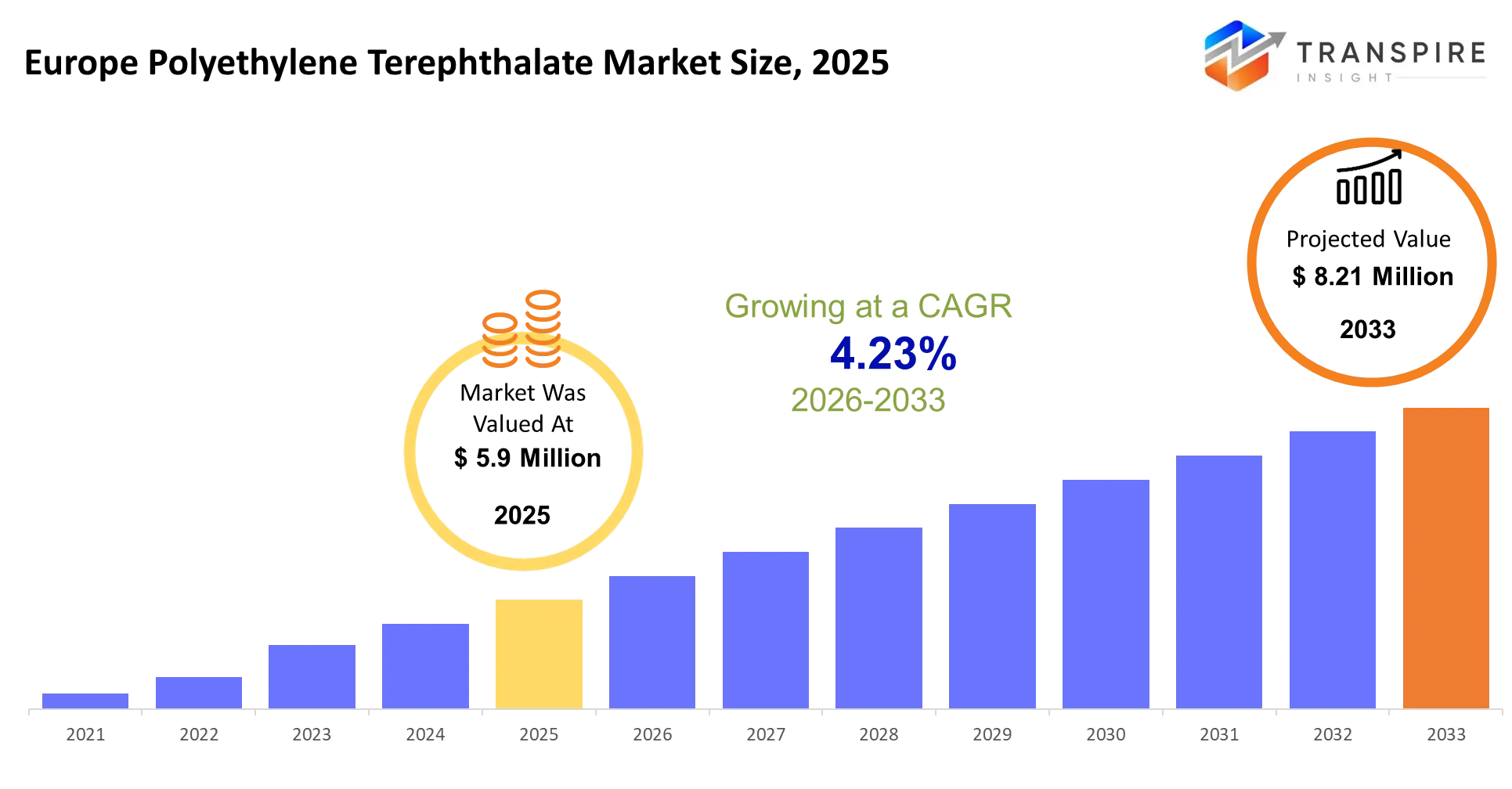
The Europe Polyethylene Terephthalate Market was valued at 5.9 Million Tons in 2025. It is forecast to reach 8.21 Million Tons by 2033. That is a CAGR of 4.23% over the period.
The European polyethylene terephthalate (PET) market functions as the central element for all daily packaging requirements and industrial freight operations because it produces lightweight containers which provide strong protection and recyclable materials that maintain food and beverage and chemical safety during extended transportation routes. The solution enables manufacturers to decrease their shipping expenses while establishing product longevity and fulfilling required sanitation protocols through its weightless implementation.
The market has undergone a permanent transformation toward circularity during the last three to five years because regulators now require companies to meet recycled PET (rPET) quotas and organizations redesign their packaging to enable recycling. The European Union established the Single-Use Plastics Directive which required businesses to develop new methods for material acquisition while they invested more resources into establishing recycling systems.
Converters have started to use rPET materials because regulatory requirements and virgin polymer supply disruptions create challenges for their operations. Producers are developing their processing technologies because revenue growth now depends on adding recycled materials instead of only increasing production output.
Key Market Insights
- The Europe Polyethylene Terephthalate Market in Western Europe expects to achieve a 45% market share in 2024 because of its effective recycling system and its strict regulatory practices.
- The industrial development in Eastern Europe together with international investments and better waste management systems will make it the most rapidly developing area until 2030.
- The market value of Virgin PET exceeds 60% in 2024 because it maintains constant quality which makes it suitable for food-grade packaging materials.
- The second biggest market segment is Recycled PET (rPET) which grows in popularity as brands meet EU sustainability requirements and use recycled content.
- The rPET segment exhibits the fastest growth because companies need to follow regulatory requirements while implementing supply chain decarbonization methods until 2030.
- The application of bottled beverages leads all other uses because it results in more than 55% market share for PET which functions as the main material used in lightweight transparent packaging that maintains durability.
- The food packaging sector currently experiences the fastest growth because companies require materials that extend product shelf life while they start using recyclable and reusable packaging solutions.
- The food and beverage industry leads end-user demand with over 65% share, supported by high consumption volumes and strict packaging safety requirements.
- The pharmaceutical and personal care sectors demonstrate fast development because customers want packaging that provides hygienic features and lightweight design and protection against tampering.
- Advanced recycling technologies such as chemical recycling provide competitive advantage by enhancing material recovery and quality consistency.
What are the Key Drivers, Restraints, and Opportunities in the Europe Polyethylene Terephthalate Market?
Driver:
The Europe Polyethylene Terephthalate market experiences its main growth driver through the EU regulations which require at least 25 percent recycled content in PET beverage bottles by 2025. The policy shift requires beverage producers to establish permanent contracts for rPET supply while packaging converters must develop their recycling capabilities.Producers increase their profits through recycled-grade PET, while converters adapt their packaging designs to achieve required compliance standards. The predictable nature of regulations enables businesses to expand their operations through capacity growth and permanent supply agreements which enhance their revenue prediction abilities throughout the entire supply chain.
Restraint:
The European countries experience a major structural obstacle because they lack sufficient high-quality food-grade recycled PET materials due to their unorganized collection systems and substandard sorting systems. The solution to this problem requires various organizations to invest together in waste collection systems and sorting technologies and to motivate consumers to participate in the process. The shortage makes rPET more expensive while it forces some companies to use virgin PET material which leads to production delays and decreases potential revenue from using recycled materials.
Opportunity:
Chemical recycling provides a major opportunity which can drive forward the next period of development. The depolymerization technology enables producers to transform polluted plastic waste into PET material which meets virgin-quality standards. The advanced recycling facilities which Germany and the Netherlands develop enable countries to create solutions which will stabilize feedstock supplies while decreasing their reliance on standard mechanical recycling methods.
What Has the Impact of Artificial Intelligence Been on the Europe Polyethylene Terephthalate Market?
Artificial intelligence and advanced digital technologies are increasingly embedded in PET production and recycling operations across Europe, driving measurable efficiency gains. The AI-based control systems at manufacturing plants track polymerization from processes by using real-time data to automatically control temperature and pressure and catalyst inputs to produce uniform resin output. The automation process decreases batch inconsistency while reducing energy needs for each ton of production. The computer vision systems at recycling facilities achieve higher plastic waste stream sorting accuracy because they can distinguish between food-grade PET plastic and contaminated materials, which leads to better recycling results and less need for human operators.
Machine learning models are also enabling predictive maintenance across extrusion lines and recycling equipment. Operators can predict when equipment will fail by studying vibration patterns and heat signatures and throughput data, which leads to increased equipment availability and decreased unexpected operational interruptions. Some facilities achieve maintenance cost reductions between 10 and 15 percent while experiencing throughput increases that result from diminished operational interruptions.
AI-driven forecasting tools enhance supply chain performance because they assess feedstock availability and pricing patterns, which assist producers in achieving optimal control over their virgin and recycled material usage.The adoption process faces obstacles because older plants require expensive system integration while their data management systems remain disjointed. The existing facilities continue to use outdated systems, which restrict their ability to implement AI-powered insights with both precision and extensive reach.
Key Market Trends
- The European Union has implemented regulations since 2021 which require beverage companies to use 25 percent recycled PET in their bottles by the year 2025.
- The period from 2020 to 2024 witnessed rPET prices increasing to levels above virgin PET prices, which resulted in a shift of historical pricing patterns and changes to buying procedures.
- Indorama Ventures and Alpek began their recycling activities after 2022 to obtain feedstock materials while their supply chain work remained unaffected.
- Since 2021, packaging converters have adopted mono-material PET designs instead of multi-layer plastics because this approach enhances recyclability and helps them achieve compliance targets.
- The period after 2022 saw higher investments in chemical recycling throughout Germany and the Netherlands that enabled processing of low-quality waste into food-grade PET.
- Retail brands increased their direct partnerships with recyclers after 2023 to bypass intermediaries while they ensured traceable and compliant rPET sourcing.
- Eastern Europe transformed into a production center after 2022 because its operational costs remained low and its financial support for polymer production and recycling facility development increased.
- The introduction of AI-based sorting systems started to increase after 2021 because this technology led to better recycling results and improved food-grade PET recovery rates at all facilities.
- The period between 2020 and 2023 saw crude oil prices rise and fall which led manufacturers to reduce their virgin PET usage as they required recycled materials to control their operating costs.
Europe Polyethylene Terephthalate Market Segmentation
By Type:
Virgin PET maintains its dominant position in the market because it provides consistent product quality together with food-grade certification and established supply networks. The market for recycled PET stands as the second-largest segment which is expanding because of government recycling requirements and brand recycling commitments. Bio-based PET remains niche because its production costs exceed commercial scalability limits while other specialty variants serve low-volume and high-performance needs.
The strongest growth path for recycled PET exists because EU directives and corporate sustainability targets require packaging materials to contain a minimum amount of recycled content. The industry faces growth challenges because it lacks access to high-quality feedstock which leads to costs that exceed those of virgin materials.Chemical recycling and collection infrastructure investment will increase supply throughout the forecast period which will lead product developers to select recycled materials while investors will adopt circular production methods.
By Application:
Packaging and bottles dominate usage, accounting for the majority share due to widespread adoption in beverages, food containers, and consumer goods. The lightweight and durable design of transparent packaging solutions drives customer demand for bottles which constitute a major packaging segment. The market includes both films and fibers, while automotive components and other applications exist as smaller yet essential technical fields.
The need for recycling materials and shelf-life requirements drives growth in food packaging as an emerging business sector. The fast growth of fiber applications faces obstacles because other textile materials provide competing options. The future of PET will see its use in high-performance packaging grow through ongoing progress in barrier technology and lightweight design. The automotive and industrial fields will expand through improvements in material engineering.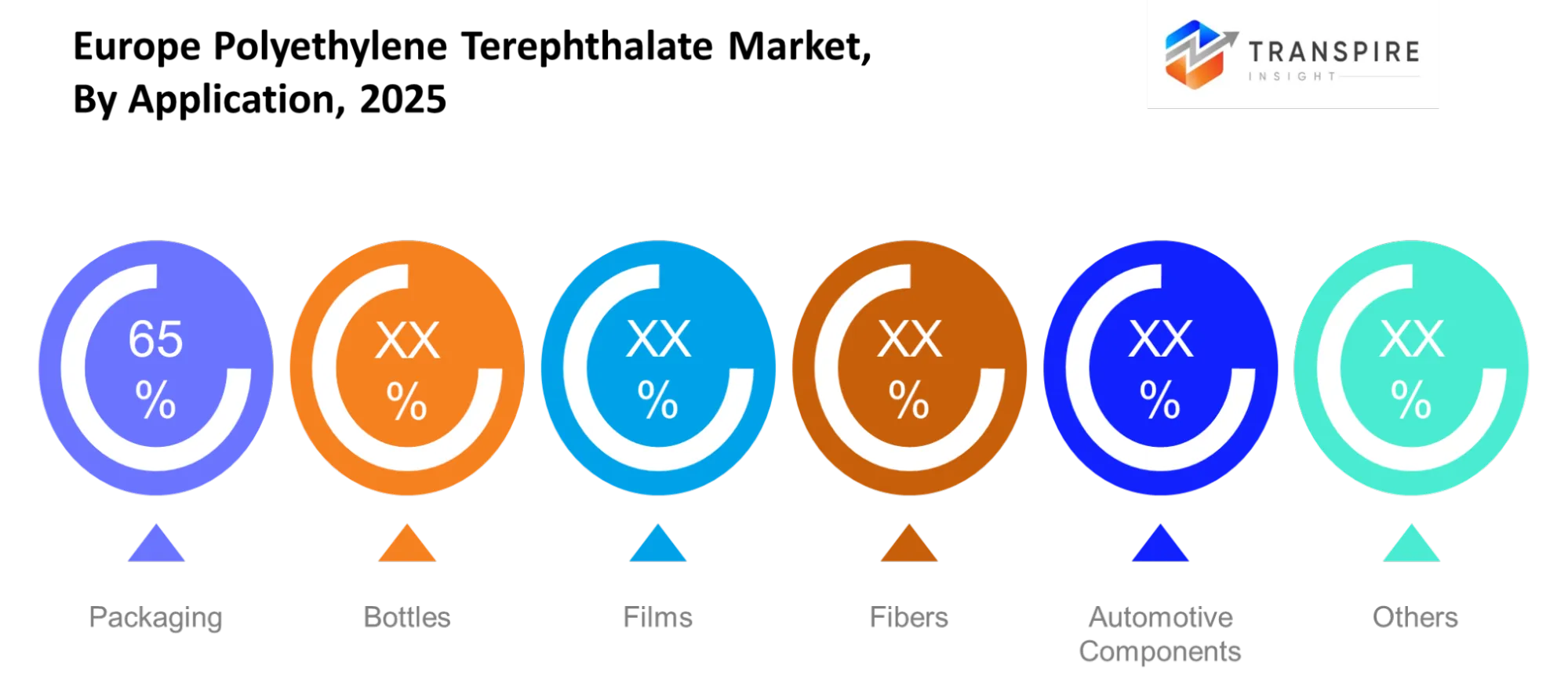
To learn more about this report, Download Free Sample Report
By End-User:
The food and beverage industry dominates consumption because it requires large-scale packaging to meet strict safety standards. The textile and packaging industries maintain their market position through constant demand for polyester fibers and flexible packaging solutions. The automotive and electronics sectors represent smaller market shares which support specific applications that need both durability and precision.
The pharmaceutical and personal care industries are expanding because they need hygienic products and packaging that prevents tampering. Textile demand stays constant but the industry now faces sustainability challenges which lead to recycled material usage. The ability of end-users to include recycled materials into their products without performance loss will determine market growth for suppliers who provide high-purity and compliant PET grades.
By Form:
Granules serve as the main raw material in molding and extrusion and bottle manufacturing activities which is why they dominate the market. The market shows minor shares for sheets and fibers which serve packaging films and textile applications respectively. Other forms cater to niche industrial uses with specific performance requirements.
The recycled polyester marketplace will expand continuously because of the demand for this material in fiber form, while sheet applications will benefit from oven-based advances in thermoforming technology. The industry will maintain its focus on granules because they serve various purposes, yet their demand will more frequently shift toward recycled materials and bio-based products. The new system will require manufacturers to adopt new processing techniques, while buyers must create reliable contracts to obtain sustainable material products.
What are the Key Use Cases Driving the Europe Polyethylene Terephthalate Market?
The primary reason companies choose to adopt technology exists because beverage companies need packaging materials that use PET to create lightweight shatterproof bottles which help them lower shipping expenses while keeping their products safe. High-volume beverage producers require PET because the material fulfills both their filling operations and safety standards. Carbonated beverages require this material because its transparent appearance and strong durability enable product safety during storage while showing customers its value through their product display.
The retail and consumer goods industries are establishing new uses for food packaging materials and personal care item containers. Manufacturers of ready-to-eat meal trays and thermoformed packaging materials select PET because it provides product protection against spoilage and complies with European Union recycling requirements. Personal care brands use PET to manufacture their bottles and jars because the material offers strength and visibility while supporting their goals for using recycled materials.
The new applications of recycling PET include both pharmaceutical blister packaging and the production of advanced textile fibers which use recycled PET. PET-based medical packaging uses its ability to block substances and meet hygiene standards while fiber advancements help sustain circular fashion practices. The current size of these applications appears limited, but their future growth will result from increasing government regulations and breakthroughs in material development.
|
Report Metrics |
Details |
|
Market size value in 2025 |
5.9 Million Tons |
|
Market size value in 2026 |
6.143 Million Tons |
|
Revenue forecast in 2033 |
8.21 Million Tons |
|
Growth rate |
CAGR of 4.23% from 2026 to 2033 |
|
Base year |
2025 |
|
Historical data |
2021 - 2024 |
|
Forecast period |
2026 - 2033 |
|
Report coverage |
Revenue forecast, competitive landscape, growth factors, and trends |
|
Regional scope |
Europe (Germany, United Kingdom, France, Italy, Spain, Rest of Europe) |
|
Key company profiled |
Indorama Ventures, Alpek, SABIC, Reliance Industries, BASF, Dow, Lotte Chemical, Far Eastern New Century, M&G Chemicals, Sinopec, ExxonMobil, Covestro, Lanxess, Eastman, SK Chemicals |
|
Customization scope |
Free report customization (country, regional & segment scope). Avail customized purchase options to meet your exact research needs. |
|
Report Segmentation |
By Type (Virgin PET, Recycled PET, Bio-based PET, Others); By Application (Packaging, Bottles, Films, Fibers, Automotive Components, Others); By End-User (Food & Beverage Industry, Textile Industry, Packaging Industry, Automotive Industry, Electronics Industry, Others); By Form (Granules, Sheets, Fibers, Others) |
Which Regions are Driving the Europe Polyethylene Terephthalate Market Growth?
The market in Western Europe operates at maximum capacity because businesses follow established regulations and have developed advanced recycling systems. The European countries Germany France and the Netherlands use deposit return systems together with minimum recycled content requirements to determine their material needs. The combination of strong collection systems together with advanced sorting facilities and established polymer producers creates a closed-loop system that guarantees continuous supply. The complete recycling system enables manufacturers to expand their recycled PET operations while they meet changing EU regulations.
Southern Europe presents a distinct growth pattern which relies on continuous consumption instead of strong government initiatives. The food and beverage sectors in Italy and Spain create a stable need for packaging because these industries maintain their operations throughout the year. The regulatory process progresses at a slow pace but Industrial output and tourism-related consumption patterns create dependable market demand. The area provides dependable income sources which established converters and balanced virgin and recycled material mixing support.
Eastern Europe experiences its highest growth rate because of recent development in manufacturing capacity and waste processing systems. Since 2022 Poland and Hungary have drawn foreign direct investment into their polymer production and recycling plants. Global companies have expedited their market entry because of two factors: reduced operating expenses and improved compliance with European Union regulatory standards. The current market expansion creates possibilities for investors who build new facilities and establish their presence in the developing supply network until 2033.
Who are the Key Players in the Europe Polyethylene Terephthalate Market and How Do They Compete?
The Europe Polyethylene Terephthalate market shows moderate competition because three main companies control most market share while local recyclers and specialized businesses provide needed products. The established companies use their operational size and material processing capabilities and their long-term supply agreements with beverage and packaging companies to keep their market positions. The main reason businesses compete today has changed from cost efficiency to their ability to obtain recycled materials of superior quality together with advanced recycling technology. Businesses need to comply with regulations and prove their capability to deliver food-grade rPET material which has become a decisive factor for winning contracts.
Indorama Ventures implements vertical integration through its recycling capacity expansion throughout Europe and its acquisition of post-consumer materials via partnerships with collection agencies. This method provides a steady supply of rPET material while giving the company complete authority over its product quality. Alpek achieves cost dominance through its extensive production capacity which enables the company to acquire businesses that strengthen its distribution network in various regions. LyondellBasell uses chemical recycling to create a unique market position which transforms low-grade waste materials into virgin-grade PET, which solves feedstock supply limitations. BASF develops advanced PET materials through material science expertise while working with packaging companies to enhance recyclability, whereas SABIC uses circular polymer methods and certified recycled content to fulfill EU compliance standards.
Company List
- Indorama Ventures
- Alpek
- SABIC
- Reliance Industries
- BASF
- Dow
- Lotte Chemical
- Far Eastern New Century
- M&G Chemicals
- Sinopec
- ExxonMobil
- Covestro
- Lanxess
- Eastman
- SK Chemicals
Recent Development News
“In March 2026, Indorama Ventures announced a merger of its subsidiary Indovida India with EPL Limited. The transaction strengthens its global packaging footprint and enhances integration across PET packaging value chains, supporting long-term supply and scale advantages. https://www.eplglobal.com
“In September 2025, Eastman entered a partnership with Doloop to launch a 100% recycled PET beverage bottle using molecular recycling technology. This development demonstrates commercial viability of chemically recycled PET and supports compliance with EU recycled content mandates. https://www.imarcgroup.com
What Strategic Insights Define the Future of the Europe Polyethylene Terephthalate Market?
The Europe Polyethylene Terephthalate market develops its operations through a circular model which restricts production capacity and bases competitive advantage on the ability to access high-quality recycled feedstock. The increasing regulatory requirements for recycled content and waste reduction have created a need for producers to obtain upstream control of their collection and recycling operations. The shift will benefit integrated companies who demonstrate their capacity to deliver stable rPET supplies while meeting all legal requirements in different regions.
The recycling process presents a hidden danger because it depends on a limited number of feedstock sources which face unpredictable price changes. The rising need for food-grade rPET exceeds the current capacity of collection systems to deliver rPET which results in financial difficulties for smaller converters who will either lose supply contracts or experience decreased profitability. Regulatory support will not increase adoption rates because of this existing imbalance between supply and demand.
Northern Europe currently experiences an emerging opportunity for commercial chemical recycling which has gained support through both policy frameworks and the establishment of investment pipelines. Market participants should create lasting partnerships with waste management companies while allocating resources to develop advanced recycling methods which will help them acquire feedstock resources and sustain their market control during times of restricted supply.
Europe Polyethylene Terephthalate Market Report Segmentation
By Type
- Virgin PET
- Recycled PET
- Bio-based PET
- Others
By Application
- Packaging
- Bottles
- Films
- Fibers
- Automotive Components
- Others
By End-User
- Food & Beverage Industry
- Textile Industry
- Packaging Industry
- Automotive Industry
- Electronics Industry
- Others
By Form
- Granules
- Sheets
- Fibers
- Others
Frequently Asked Questions
Find quick answers to common questions.
The Europe Polyethylene Terephthalate Market size is 8.21 Million Tons in 2033.
Key Segments for the Europe Polyethylene Terephthalate Market are By Type (Virgin PET, Recycled PET, Bio-based PET, Others); By Application (Packaging, Bottles, Films, Fibers, Automotive Components, Others); By End-User (Food & Beverage Industry, Textile Industry, Packaging Industry, Automotive Industry, Electronics Industry, Others); By Form (Granules, Sheets, Fibers, Others).
Major Europe Polyethylene Terephthalate Market players are Indorama Ventures, Alpek, SABIC, Reliance Industries, BASF, Dow, Lotte Chemical, Far Eastern New Century, M&G Chemicals, Sinopec, ExxonMobil, Covestro, Lanxess, Eastman, SK Chemicals.
The Current Europe Polyethylene Terephthalate Market size is 5.9 Million Tons in 2025.
The Europe Polyethylene Terephthalate Market CAGR is 4.23% from 2026 to 2033.
- Indorama Ventures
- Alpek
- SABIC
- Reliance Industries
- BASF
- Dow
- Lotte Chemical
- Far Eastern New Century
- M&G Chemicals
- Sinopec
- ExxonMobil
- Covestro
- Lanxess
- Eastman
- SK Chemicals
Recently Published Reports
-
Apr 2026
Healthcare Polymer Packaging Market
Healthcare Polymer Packaging Market Size, Share & Analysis Report By Packaging Type (Syringes, IV Bottles and Pouches, Clamshells, Blisters, Bottles & Jars, Containers, Tubes, IV Parental Packaging, Others), By Type (Regulated, Non-regulated), By Polymer Type (LDPE (Low-Density Polyethylene), HDPE (High-Density Polyethylene), Homo-polymer (Homo), Random Copolymer (Random), Block Copolymer (Block), PET, Polystyrene, Polyvinyl Chloride, Polyamide/EVOH, Others), and Geography (North America, Europe, Asia-Pacific, Middle East and Africa, South and Central America), 2021 - 2031
-
Apr 2026
Hydrophilic Tape (Waterstop) Market
Hydrophilic Tape (Waterstop) Market Size, Share & Analysis Report By Type (Bentonite-Based Hydrophilic Tape, Rubber-Based Hydrophilic Tape), By Application (Residential Buildings, Commercial Buildings, Infrastructure Projects), and Geography (North America, Europe, Asia-Pacific, Middle East and Africa, South and Central America), 2021 - 2031
-
Apr 2026
Metalens Market
Metalens Market Size, Share & Analysis Report By Type (Visible Light Metalens, and Infrared Metalens), By Application (Consumer Electronics, Automotive Electronics, Industrial, Medical, and Others), and Geography (North America, Europe, Asia-Pacific, Middle East and Africa, South and Central America), 2021 - 2031
-
Apr 2026
PBT Resin Market
PBT Resin Market Size, Share & Analysis Report By Type (Reinforced PBT Resin, Unreinforced PBT Resin), By Processing Method (Injection Molding, Extrusion, Blow Molding, Others), By End-User (Automotive, Electrical & Electronics, Consumer Appliances, Industrial Machinery, Medical Devices, Packaging, Others), and Geography (North America, Europe, Asia-Pacific, Middle East and Africa, South and Central America), 2021 - 2031