
Europe Mobility Scooters Market Summary
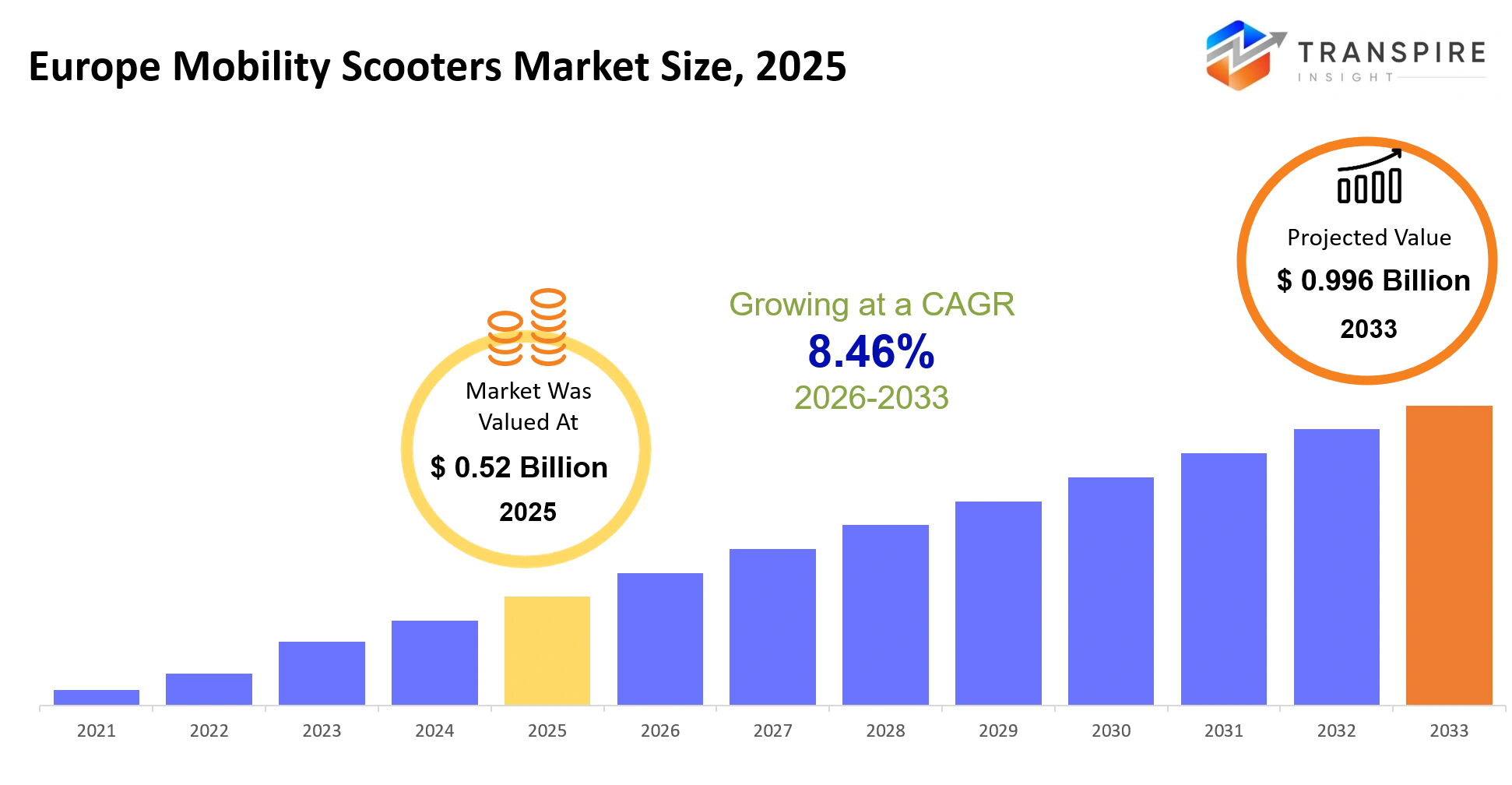
As per Transpire Insight Analysis the Europe Mobility Scooters Market size is estimated at USD 0.52 Billion in 2025 and is anticipated to reach USD 0.996 Billion by 2033, growing at a CAGR of 8.46% from 2026 to 2033.
Mobility scooters give a sort of practical, independent way to travel for people with limited mobility, so users can get around neighborhoods and shopping centers, healthcare facilities, public spaces, without always having to rely on caregivers. They make the whole thing feel more doable, even if the route is a bit unfamiliar. Across Europe, these vehicles have turned into a core element of everyday personal mobility, they help cover longer routes while also easing physical strain, which is a big deal over time. In the last three to five years, the market has kinda drifted away from only basic transport devices toward connected, lightweight, and lithium battery-powered models. Those newer versions usually bring a longer reach, more portability, and digital extras that weren’t really there before. The change picked up speed when governments expanded accessibility programs and when aging populations started putting more load on healthcare and mobility support services, especially after the COVID-19 pandemic. It’s this mix of healthcare policy updates, urban access improvements, and ongoing product innovation that has nudged adoption beyond the classic user groups. And now as manufacturers roll out safer, smarter, more compact models, customer expectations are shifting too, so premium products can take on greater value, plus that supports long-term revenue potential across both consumer buyers and institutional channels.
Europe Mobility Scooters Market Size & Forecast:
- Europe Mobility Scooters Market Size 2025: USD 0.52 Billion
- Expected Market Value 2033: USD 0.996 Billion
- Forecast CAGR: 8.46%
- Leading region in 2025: Western Europe
- Fastest Growing region: Eastern Europe
- Key Profile: Pride Mobility, Invacare, Sunrise Medical, Drive DeVilbiss, KYMCO Healthcare, Afikim, TGA Mobility, Golden Technologies, Permobil, Shoprider, Roma Medical, Van Os Medical, Quingo, Electric Mobility Euro, Merits Health Products
Key Market Insights
- Western Europe kinda dominated the Europe Mobility Scooters Market, with around 68% market share in 2025, and this is mainly backed by established healthcare systems, reimbursement schemes, plus better purchasing power overall.
- Eastern Europe is likely to move the quickest during 2025–2033, partly because of healthcare infrastructure upgrades and mobility assistance programs that are still growing, bit by bit.
- In terms of products, Class 2 mobility scooters led the pack with almost 58% market share in 2025.
- This was helped by the steady demand for indoor, and also city based movement solutions.
- Class 3 mobility scooters took the second place, since more distance travel ranges and faster speed options are expanding who actually want them, especially suburban riders.
- Foldable mobility scooters are set to be the quickest grower through 2033, mainly supported by lightweight lithium-ion batteries, and designs that feel more travel friendly, in everyday use.
- For applications, personal mobility held nearly 61% market share in 2025 and stayed on top because independent outdoor travel is becoming more important for older populations.
- Meanwhile healthcare and rehabilitation is forecast to climb the fastest pace through 2033, driven by home based patient support and rehab services, you know.
- Looking at end users, individual consumers stayed the main revenue group with roughly 72% in 2025. That momentum comes from direct retail plus online distribution, pretty straightforward.
- Hospitals, rehabilitation centers, and assisted living facilities are also expected to be the fastest-growing category because institutional procurement keeps widening across Europe.
What are the Key Drivers, Restraints, and Opportunities in the Europe Mobility Scooters Market?
Europe’s accessibility rules and healthy aging policies are still, like, the biggest push behind industry growth. Public funding tied to barrier free infrastructure, mobility reimbursement schemes, and home care support has made it easier for scooters to be taken up by a lot more people, not just the usual medical users. On top of that, lithium ion battery upgrades have stretched out the operating range, and at the same time they cut down charging time, while also lowering total product weight. With better real world performance, companies can justify premium pricing and customers tend to stay around longer. In response, manufacturers keep widening their model catalog, they grow dealer coverage, and they roll out connected features that quietly lift average selling prices, plus they strengthen the repeat service income stream.
That said, affordability is the main structural issue that keeps showing up. The more premium lithium powered versions typically cost far more upfront than the standard alternatives, so in price sensitive markets purchases slow down. The reimbursement systems themselves vary a lot from country to country across Europe, which causes procurement decisions to drag out and it also makes replacement cycles slower. And then there are certification hurdles plus patchwork national requirements, these also lengthen product launch timelines. From a Transpire Insight look at regional procurement notes and launch calendars, supply chain concentration stays the key execution risk. A further complication is that manufacturers rely on specialized battery packs and electronic components, meaning sourcing shocks can hit harder, and lead times can stretch longer than expected.
Connected mobility platforms really are the next stage, I mean of industry development, right. With GPS tracking, remote diagnostics, over the air software updates, and predictive maintenance showing up as commercially viable features for premium scooters, things are moving fast. Healthcare providers are starting to favor connected fleets because these can improve patient monitoring and make maintenance scheduling more consistent, in a kind of pragmatic way. In Eastern Europe there is also attractive expansion potential, since healthcare modernization programs and accessibility investments keep accelerating. The firms that mix digital services together with lightweight vehicle platforms, plus localized manufacturing, should end up with stronger competitive positioning while also widening recurring revenue opportunities.
What Has the Impact of Artificial Intelligence Been on the Europe Mobility Scooters Market?
Artificial intelligence is kind of reshaping the European mobility scooter industry, by boosting fleet management, product reliability, and after-sales support, in a way that feels pretty direct. More and more makers are folding in AI enabled diagnostics into their connected scooters, so they can keep an eye on battery health, motor efficiency, controller performance, plus usage behavior all at once, and in real time. After that, these setups basically trigger automated maintenance warnings, which cuts down on those surprise equipment breakdowns, and it helps keep scooters available for riders, as well as for the service teams. Then there’s machine learning that also leans into demand forecasting, because it looks at sales patterns, demographic shifts, seasonal buying cycles, and even what dealers have sitting in inventory, so manufacturers can tune production schedules and prevent excess stock.
On top of that, digital tools are improving how operations run across manufacturing, and service networks, too. Predictive maintenance methods can catch component wear, before it becomes a real failure ,so warranty costs drop a lot and repairs happen quicker with less dragging. Connected service platforms also make remote troubleshooting kind of a regular habit, meaning fewer technician trips, and in the end customer satisfaction gets better.During production, AI assisted quality checks help spot assembly issues earlier, which supports steadier manufacturing results, and reduces rework costs. Still, adoption is held back, somewhat, by the high costs of integration and by fragmented data environments across different hardware suppliers. Smaller manufacturers, in particular, may not have enough connected product data to train reliable predictive models, and at the same time, different connectivity standards across European markets keep limiting a smooth rollout of advanced AI enabled mobility solutions.
Key Market Trends
- Since 2022, the adoption of lithium-ion batteries has kinda sped up, moving away from more heavy lead-acid systems toward lighter platforms that also give longer operating range and faster charging, too.
- From around 2023 to 2025, foldable scooter designs have gotten better traction in the market, supporting commuting, public transit compatibility, and those everyday urban mobility needs.
- Since 2023, manufacturers have kept widening connected mobility capabilities, with GPS tracking , mobile apps, plus remote diagnostics showing up in their more premium product portfolios.
- European accessibility regulations have nudged municipalities to upgrade public infrastructure, which has meant mobility scooters are used more in practice across city environments.
- Invacare, Sunrise Medical, and Pride Mobility Products have been putting more money into lightweight chassis engineering and digital product development since 2024, honestly.
- Dealer networks are also leaning into preventive maintenance subscriptions and remote service monitoring more and more, so there’s a recurring revenue setup beyond the first equipment sale.
- Healthcare providers have shifted procurement toward premium models with upgraded safety systems, longer battery life and better ergonomic seating, starting in 2023.
- After the global component disruptions between 2021 and 2023, battery supply diversification strategies have broadened to reduce sourcing risk, where it really mattered.
- And the online direct-to-consumer sales channels have captured more of the premium scooter demand by mixing virtual product demonstrations with home delivery services.
Europe Mobility Scooters Market Segmentation
By Type:
Travel Scooters ended up taking a pretty notable share, because those compact dimensions and a lighter build just work well for everyday movement, mainly when you’re around town. Foldable Scooters caught on fast , partly thanks to space-saving designs which made it simpler to stash them at home or at the office, even inside a vehicle. Heavy-Duty Scooters stayed in demand too, since they manage more weight, they cover more distance, and they feel sturdier for long stretches outside. Portable Scooters kept pulling interest from people who just want quick commuting, but at the same time they still think about comfort and battery power output, so that balance was kind of the deciding factor.
Pavement Scooters stayed a go-to choice for short trips through residential blocks and busy commercial strips, because the steering stayed steady and predictable for everyday use. Road Scooters got more attention once they offered extra speed, bigger batteries, and upgraded safety systems meant for longer routes. Bariatric Scooters expanded the user base by bringing reinforced frames, wider seats, and a higher load capacity for specialized mobility needs. The other options covered smaller preferences too, with tailored add-ons, recreational versions, and designs built for specific use cases, so different expectations could actually be met.
By Number of Wheels:
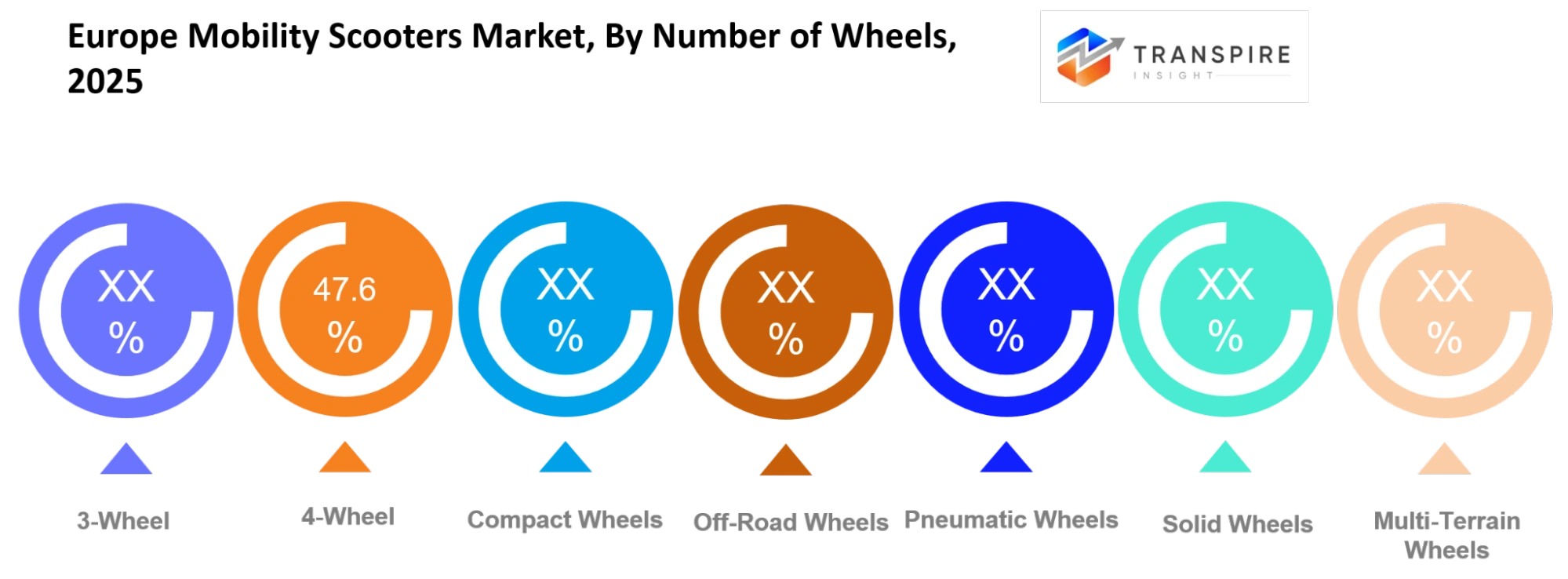
4-Wheel models seemed to keep the leading position, mainly due to more stability, stronger balance and extra confidence that made regular outdoor travel feel easier across different surfaces, kinda all of them. 3-Wheel models still did very well when you needed tighter turning radius and smoother maneuverability inside shopping centers, healthcare facilities and residential buildings where space gets weirdly limited. Compact wheels helped enable lightweight scooter designs, so storage and transportation stayed simpler, while still keeping a smooth run indoors. Off-Road Wheels boosted product appeal with better traction across uneven pathways, parks, and rural routes, so it looked like a practical upgrade, not just a marketing claim.
Pneumatic Wheels also gained wider acceptance, because better shock absorption results in a more comfortable ride on rough surfaces, you know the kind. Solid Wheels stayed popular for low-maintenance use and dependable long-term performance, without puncture concerns popping up. Multi-Terrain Wheels attracted more attention since people wanted flexible mobility across indoor and outdoor settings without swapping gear or changing equipment every time. Other options covered specialized mobility needs by using customized wheel configurations, tailored to specific operating conditions and that sort of thing.
By Application:
Personal Mobility was probably the biggest application, because basically independent transport stayed the main reason people bought scooters throughout Europe. Meanwhile Medical Use kept growing, since healthcare professionals were telling patients that mobility assistance helps with recovery, long term health issues, and also with limited physical movement. Rehabilitation programs started to mix scooters more often in their approach, to help patients keep a sense of independence during treatment but also, later on after. For Geriatric Care, adoption stayed strong, simply because populations are aging and they needed dependable assistance for daily chores and ordinary routines.
Outside, Outdoor Mobility did well thanks to a longer battery range, sturdier suspension systems, and better weather resistance, all of which made everyday travel easier even when you’re beyond residential areas. Indoor Mobility still mattered too, mostly due to compact designs that let people move around safely inside homes, hospitals and commercial buildings. Assisted Living facilities also increased their purchases, to boost resident mobility while reducing dependence on caregivers for short trips and quick errands. Other use cases covered specialized needs in commercial, institutional, and community settings, depending on the different operating environments.
By Distribution Channel:
Medical Stores held a top spot because professional guidance , and also product demos really helped people feel sure before they buy , like for real decisions. Dealers then kept pushing their market footprint via after-sales support, maintenance services, and more tailored product suggestions, which in turn supported better and steadier customer bonds over time. Specialty Stores kept pulling in customers who wanted higher-end mobility items, plus solid expert consultation and customized accessories, so it felt more like a fit, not just a sale. Online Retail also grew pretty fast since digital platforms made it easier to compare products, arrange home delivery, and reach a wider set of models.
Direct Sales stayed quite useful especially for institutional buying, like hospitals, rehabilitation centers, and assisted living places that often need bespoke purchasing agreements. Hypermarkets helped by putting products in front of more people, offering certain entry-level mobility scooters next to other healthcare goods. Rental Providers saw higher utilization as short-term mobility requirements rose for travelers , people recovering , and those using mobility temporarily for care. Other channels supported regional reach through independent retailers and local mobility equipment suppliers, more or less making sure things land where they should.
By End User:
Elderly users ended up taking the biggest slice of the market, mainly because age related mobility issues kept showing up and then demand stayed steady for transportation options that felt safe and comfortable. Disabled people were another big customer set, and they needed dependable equipment that actually helped them keep more independence day to day without too much friction. Folks with chronic illnesses used mobility scooters to cut down on physical strain, but also to stay involved in community life and family life, you know, more actively. Veterans too played a role in product demand, thanks to specialized mobility assistance programs together with healthcare support services that were already set up for them.
Healthcare facilities then expanded their buying, to move patients around inside medical campuses while still keeping daily operations running smoothly. Rehabilitation centers put mobility scooters right into recovery programs, which helped encourage gradual movement, and in turn more independence during treatment. Care homes increased their fleet deployments to support resident mobility, better social participation, and easier access to shared community spaces. Others included schools, community organizations, and public service providers, supporting accessible transportation across all those different groups, kinda like a whole ecosystem of needs.
What are the Key Use Cases Driving the Europe Mobility Scooters Market?
Personal mobility still seems, like the main thing people use these scooters for, especially elderly users and disabled individuals. They buy these devices so they can move on their own for everyday chores and daily life, kind of independent travel without help. Also, healthcare support programs and accessibility efforts really boost adoption, because customers want a secure transportation solution for home, community, and basically outdoor movement too.
Healthcare facilities, and rehabilitation centers take advantage of mobility scooters to support patient recovery, and to make movement easier inside care settings. Assisted living providers also bring in mobility scooters in order to raise resident self-reliance, and at the same time, lower the amount of caregiver support they need.
What’s starting to show up more often includes scooter rental services for tourism spots, plus smart mobility programs in cities. Municipal accessibility projects, and connected scooter technologies, may open up fresh possibilities during the forecast period, mainly through better tracking systems and service management.
|
Report Metrics |
Details |
|
Market size value in 2025 |
USD 0.52 Billion |
|
Market size value in 2026 |
USD 0.564 Billion |
|
Revenue forecast in 2033 |
USD 0.996 Billion |
|
Growth rate |
CAGR of 8.46% from 2026 to 2033 |
|
Base year |
2025 |
|
Historical data |
2021 - 2024 |
|
Forecast period |
2026 - 2033 |
|
Report coverage |
Revenue forecast, competitive landscape, growth factors, and trends |
|
Regional scope |
Europe (Germany, United Kingdom, France, Italy, Spain and Rest of Europe) |
|
Key company profiled |
Pride Mobility, Invacare, Sunrise Medical, Drive DeVilbiss, KYMCO Healthcare, Afikim, TGA Mobility, Golden Technologies, Permobil, Shoprider, Roma Medical, Van Os Medical, Quingo, Electric Mobility Euro, Merits Health Products. |
|
Customization scope |
Free report customization (country, regional & segment scope). Avail customized purchase options to meet your exact research needs. |
|
Report Segmentation |
By Type (Travel Scooters, Foldable Scooters, Heavy-Duty Scooters, Portable Scooters, Pavement Scooters, Road Scooters, Bariatric Scooters, Others); By Number of Wheels (3-Wheel, 4-Wheel, Compact Wheels, Off-Road Wheels, Pneumatic Wheels, Solid Wheels, Multi-Terrain Wheels, Others); By Application (Personal Mobility, Medical Use, Rehabilitation, Geriatric Care, Outdoor Mobility, Indoor Mobility, Assisted Living, Others); By Distribution Channel (Online Retail, Medical Stores, Dealers, Specialty Stores, Hypermarkets, Direct Sales, Rental Providers, Others); By End User (Elderly, Disabled Individuals, Healthcare Facilities, Rehabilitation Centers, Care Homes, Veterans, Individuals with Chronic Diseases, Others). |
Which Regions are Driving the Europe Mobility Scooters Market Growth?
Western Europe kinda held the dominant position in the Europe Mobility Scooters Market, with roughly 68% market share in 2025 , and it’s not surprising. There are strong accessibility regulations, plus healthcare reimbursement systems, and a set of developed mobility support programs that together made adoption conditions pretty favorable all around. Also there’s this mature ecosystem of manufacturers, medical equipment distributors, rehabilitation providers, and service networks. It basically keeps product availability steady and makes customer support feel more dependable. Leadership should keep going through 2033, since aging populations, public mobility initiatives, and premium product uptake are still sustaining regional revenue growth at a steady pace.
Northern Europe looks more stable than flashy. The market is supported by consistent healthcare policies, high purchasing power, and dependable public support systems. In general, countries here show strong regulatory alignment, and investments into healthcare infrastructure keep happening, so procurement patterns tend to be predictable and not too chaotic. There’s also a good mix of advanced care facilities and organized distribution channels, which makes Northern Europe a solid revenue contributor even if the expansion feels slower compared with emerging areas.
Eastern Europe, though, is the fastest-growing region. This is mainly because healthcare modernization programs are pushing forward, accessibility upgrades are getting rolled out, and private healthcare investment keeps expanding. Newer infrastructure improvements and better availability of mobility assistance products have sped up adoption among both residential users and institutional users. Through 2026–2033, that growth should give market entrants real openings to form regional partnerships, widen distribution networks, and capture demand from developing mobility support systems.
Who are the Key Players in the Europe Mobility Scooters Market and How Do They Compete?
Competition in the Europe Mobility Scooters Market is still kind of moderately fragmented, so yeah, manufacturers keep battling each other via product innovation, pricing, distribution reach, and after sales services too. Most of the time established brands push advanced battery systems, ergonomic layouts, and connected features, but the smaller players tend to go after a few specific customer groups, using cheaper and more tailored solutions. Pressure stays there because new digital mobility providers keep rolling out alternative buying , and service models, which kinda changes how people think.
Pride Mobility Products, on the other hand, keeps strengthening its stance with a wide portfolio centered on comfort , solid performance, and mobility solutions you can customize. They stand out with advanced seating systems, scooter designs that vary in form, and a fairly large dealer support network across European markets.
Invacare Corporation competes more from a healthcare angle, with mobility products that blend reliability, accessibility, and clinical support features. Their growth efforts lean on rehabilitation partnerships and ongoing product upgrades made for both institutional users , and individual users as well.
Sunrise Medical is more oriented toward technology driven mobility solutions, with lightweight construction and engineering that puts the user front and center. Differentiation comes from specialized rehabilitation products plus global distribution strength.
Drive DeVilbiss Healthcare expands by going after wider market reach with cost effective mobility solutions, lots of healthcare partnerships, and product lines that are easy to access and fit different needs. Their edge is basically the mix of affordability, together with dependable service availability.
Company List
- Pride Mobility
- Invacare
- Sunrise Medical
- Drive DeVilbiss
- KYMCO Healthcare
- Afikim
- TGA Mobility
- Golden Technologies
- Permobil
- Shoprider
- Roma Medical
- Van Os Medical
- Quingo
- Electric Mobility Euro
- Merits Health Products
Recent Development News
In May 2026, Sunrise Medical launched the STERLING S50 Carbon lightweight folding mobility scooter. The carbon fibre-based product expanded premium scooter offerings by combining portability, durability, and advanced lightweight engineering for European users seeking travel-friendly mobility solutions.
Source: https://sunrisemedical-group.com/
In May 2026, Motability Scheme added new powered wheelchairs and mobility scooters to its product selection. The update expanded consumer access to models including Monarch Obsidian, One Rehab Phoenix Marathon, Roma Medical P600, Sunrise Medical S50 Carbon, and TGA Whill C Lite through a major UK mobility support channel.
Source: https://news.motability.co.uk/
What Strategic Insights Define the Future of the Europe Mobility Scooters Market?
The Europe Mobility Scooters Market is starting to drift toward a more connected, service-led kind of mobility ecosystem over the next 5–7 years, mostly because of aging demographics , digital healthcare integration and the rising desire for self-reliant transportation options. Even so , the upside could hide a tricky risk tied to battery supply concentration. If operators end up depending on particular lithium inputs and a small set of suppliers, then pricing stability and even product availability might get hit during later disruptions.
At the same time there’s an emerging chance in smart mobility platforms, where GPS tracking, remote diagnostics and predictive maintenance come together , particularly across Eastern Europe. There , healthcare modernization is growing, so adoption paths look steadier. Players in the market should consider investing in modular product platforms, so they can support digital upgrades , local tailoring, and more adaptable battery technologies. This route, in turn , should help manufacturers defend their margins, react faster to shifting regulations , and unlock new revenue sources that go beyond plain equipment sales.
Europe Mobility Scooters Market Report Segmentation
By Type
- Travel Scooters
- Foldable Scooters
- Heavy-Duty Scooters
- Portable Scooters
- Pavement Scooters
- Road Scooters
- Bariatric Scooters
By Number of Wheels
- 3-Wheel
- 4-Wheel
- Compact Wheels
- Off-Road Wheels
- Pneumatic Wheels
- Solid Wheels
- Multi-Terrain Wheels
By Application
- Personal Mobility
- Medical Use
- Rehabilitation
- Geriatric Care
- Outdoor Mobility
- Indoor Mobility
- Assisted Living
By Distribution Channel
- Online Retail
- Medical Stores
- Dealers
- Specialty Stores
- Hypermarkets
- Direct Sales
- Rental Providers
By End User
- Elderly
- Disabled Individuals
- Healthcare Facilities
- Rehabilitation Centers
- Care Homes
- Veterans
- Individuals with Chronic Diseases
Frequently Asked Questions
Find quick answers to common questions.
The expected Europe Mobility Scooters Market size for the market will be USD 0.996 Billion in 2033.
Key segments for the Europe Mobility Scooters Market are By Type (Travel Scooters, Foldable Scooters, Heavy-Duty Scooters, Portable Scooters, Pavement Scooters, Road Scooters, Bariatric Scooters, Others); By Number of Wheels (3-Wheel, 4-Wheel, Compact Wheels, Off-Road Wheels, Pneumatic Wheels, Solid Wheels, Multi-Terrain Wheels, Others); By Application (Personal Mobility, Medical Use, Rehabilitation, Geriatric Care, Outdoor Mobility, Indoor Mobility, Assisted Living, Others); By Distribution Channel (Online Retail, Medical Stores, Dealers, Specialty Stores, Hypermarkets, Direct Sales, Rental Providers, Others); By End User (Elderly, Disabled Individuals, Healthcare Facilities, Rehabilitation Centers, Care Homes, Veterans, Individuals with Chronic Diseases, Others).
Major Europe Mobility Scooters Market players are Pride Mobility, Invacare, Sunrise Medical, Drive DeVilbiss, KYMCO Healthcare, Afikim, TGA Mobility, Golden Technologies, Permobil, Shoprider, Roma Medical, Van Os Medical, Quingo, Electric Mobility Euro, Merits Health Products.
The Europe Mobility Scooters Market size is USD 0.52 Billion in 2025.
The Europe Mobility Scooters Market CAGR is 8.46% from 2026 to 2033.
- Pride Mobility
- Invacare
- Sunrise Medical
- Drive DeVilbiss
- KYMCO Healthcare
- Afikim
- TGA Mobility
- Golden Technologies
- Permobil
- Shoprider
- Roma Medical
- Van Os Medical
- Quingo
- Electric Mobility Euro
- Merits Health Products
About the Authors

Mayur Shinde
I am Mayur Shinde, a Senior Research Analyst at Transpire Insight, specializing in the Automotive & Transportation and Information & Communication Technology (ICT) Industry. My work focuses on analyzing emerging market trends, technological advancements, competitive landscapes, and industry developments to deliver accurate, data-driven insights. I am passionate about transforming complex market information into clear, actionable content that helps businesses, professionals, and decision-makers stay informed and make confident strategic decisions.

Chakradhar Khansole
Chakradhar serves as the Research Director at Transpire Insight, bringing over 8 years of experience in technology, innovation, and strategic market intelligence. He specializes in transforming complex market data into actionable business insights that enable organizations to make informed, growth-oriented decisions. Recognized for his strategic vision and analytical expertise, Chakradhar leads high-impact research initiatives, delivering comprehensive market assessments, competitive intelligence, and forward-looking industry analysis.
Recently Published Reports
-
Apr 2026
ATV & UTV Market
ATV & UTV Market Size, Share & Analysis Report By Type (ATV, and UTV), By Variants (Less Than 400 CC, 400 CC To 800 CC, and More Than 800 CC), and Geography (North America, Europe, Asia-Pacific, Middle East and Africa, South and Central America), 2021 - 2031
-
Apr 2026
Automotive Central Gateway Module Market
Automotive Central Gateway Module Market Size, Share & Analysis Report By Type (Ethernet Central Gateway Module, CAN Central Gateway Module, LIN Central Gateway Module, and FlexRay), By Application (Powertrain Control, Body Control, Infotainment System, Advanced Driver Assistance Systems (ADAS), and Others), By End User (Passenger Vehicles, and Commercial Vehicles), and Geography (North America, Europe, Asia-Pacific, Middle East and Africa, South and Central America), 2021 - 2031
-
Apr 2026
Automotive Engine Oil Filter Market
Automotive Engine Oil Filter Market Size, Share & Analysis Report By Filter Type (Fuel Filter, Engine Oil Filter, Hydraulic Oil Filter, and Others), By Filter Media (Cellulose, Synthetic, and Micro), By Sales Channel (OEMs, and Aftermarket), By Vehicle Type (Passenger Cars, Light Commercial Vehicles, Heavy Duty Trucks, Buses and Coaches, and Off-road Vehicles), and Geography (North America, Europe, Asia-Pacific, Middle East and Africa, South and Central America), 2021 - 2031
-
Apr 2026
Automotive Parts Aluminium Die Casting Market
Automotive Parts Aluminium Die Casting Market Size, Share & Analysis Report By Production Process (Pressure Die Casting, Vacuum Die Casting, Squeeze Die Casting, Gravity Die Casting), By Application (Body Parts, Engine Parts, Transmission Parts, Battery And Related Components, Other Application Types), and Geography (North America, Europe, Asia-Pacific, Middle East and Africa, South and Central America), 2021 - 2031
Our Clients