
Europe Mine-Resistant Ambush Protected (MRAP) Vehicles Market Size & Forecast:
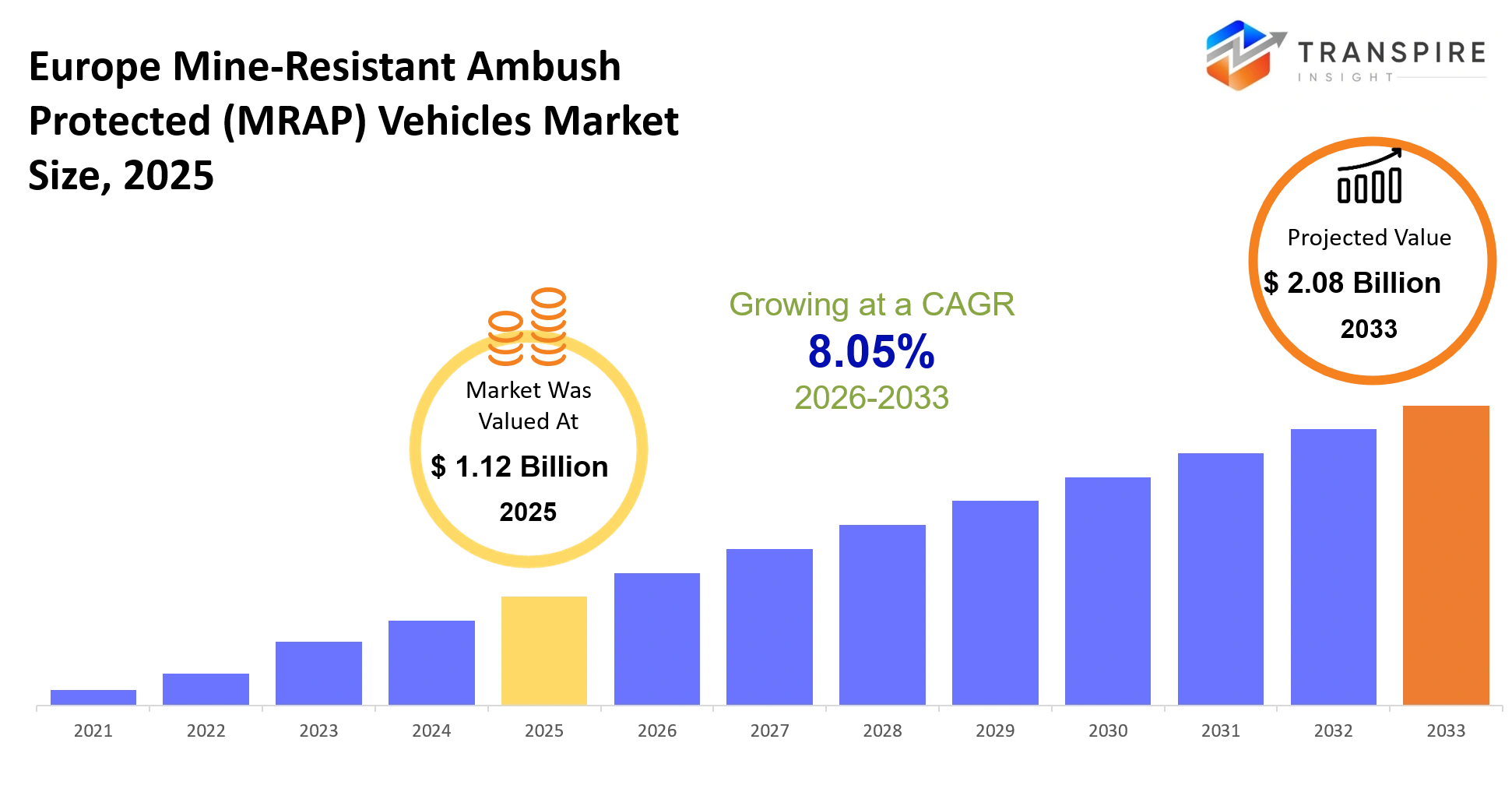
- Europe Mine-Resistant Ambush Protected (MRAP) Vehicles Market Size 2025: USD 1.12 Billion
- Europe Mine-Resistant Ambush Protected (MRAP) Vehicles Market Size 2033: USD 2.08 Billion
- Europe Mine-Resistant Ambush Protected (MRAP) Vehicles Market CAGR:8.05%
- Europe Mine-Resistant Ambush Protected (MRAP) Vehicles Market Segments: By Vehicle Type (Light MRAP, Medium MRAP, Heavy MRAP, Others); By Application (Military Operations, Peacekeeping, Border Security, Others); By Propulsion (Diesel, Hybrid, Others); By Protection Level (Level I, Level II, Level III, Others); By End User (Army, Special Forces, Law Enforcement, Others); By Sales Channel (Direct Procurement, Contracts, Others)
Europe Mine-Resistant Ambush Protected (MRAP) Vehicles Market Summary
The Europe Mine-Resistant Ambush Protected (MRAP) Vehicles Market was valued at USD 1.12 billion in 2025. It is forecast to reach USD 2.08 billion by 2033. That is a CAGR of 8.05% over the period.
The Europe MRAP vehicles market is about providing super armored tactical vehicles. These vehicles protect security personnel during convoy movement, border patrol and conflict-zone operations. They are used where regular armored transport can't handle bombs, ambushes and tough terrain.These vehicles are really important for forces and peacekeeping units in unstable areas. They help keep personnel safe.
Recently the market has changed. There is a focus on modular armor systems and digital communication. This allows for adaptation and better awareness during missions. The Russia–Ukraine conflict sped up procurement across defense forces. Governments are rebuilding their fleets after years of underinvestment.Problems in the defense manufacturing supply chain led to regional sourcing and local production partnerships. All these changes have increased budgets. Accelerated fleet replacement programs. This directly helps OEMs and defense contractors across Europe make revenue. The MRAP vehicles market is growing because of increased threats and modernization needs. MRAP vehicles are in demand.
Key Market Insights
- The Europe Mine-Resistant Ambush Protected Vehicles Market is moving towards using modular armor systems and digital battlefield tools from 2025 to 2033.
- Many NATO countries are updating their defense systems, which has led to a 30% increase in demand for MRAP vehicles in European armies since 2022.
- Western Europe has the share of the Europe Mine-Resistant Ambush Protected Vehicles Market with almost 45% in 2025 because of strong defense budgets.
- Eastern Europe is growing fast until 2033 as countries focus on securing their borders and quickly replacing vehicle fleets.
- Heavy MRAP vehicles are leading the Europe Mine-Resistant Ambush Protected Vehicles Market because they offer the protection in high-risk areas.
- Medium MRAP vehicles are the biggest segment as they balance movement, cost and the number of soldiers they can carry.
- Light MRAP vehicles are growing fast as armies want to deploy and be flexible in urban combat.
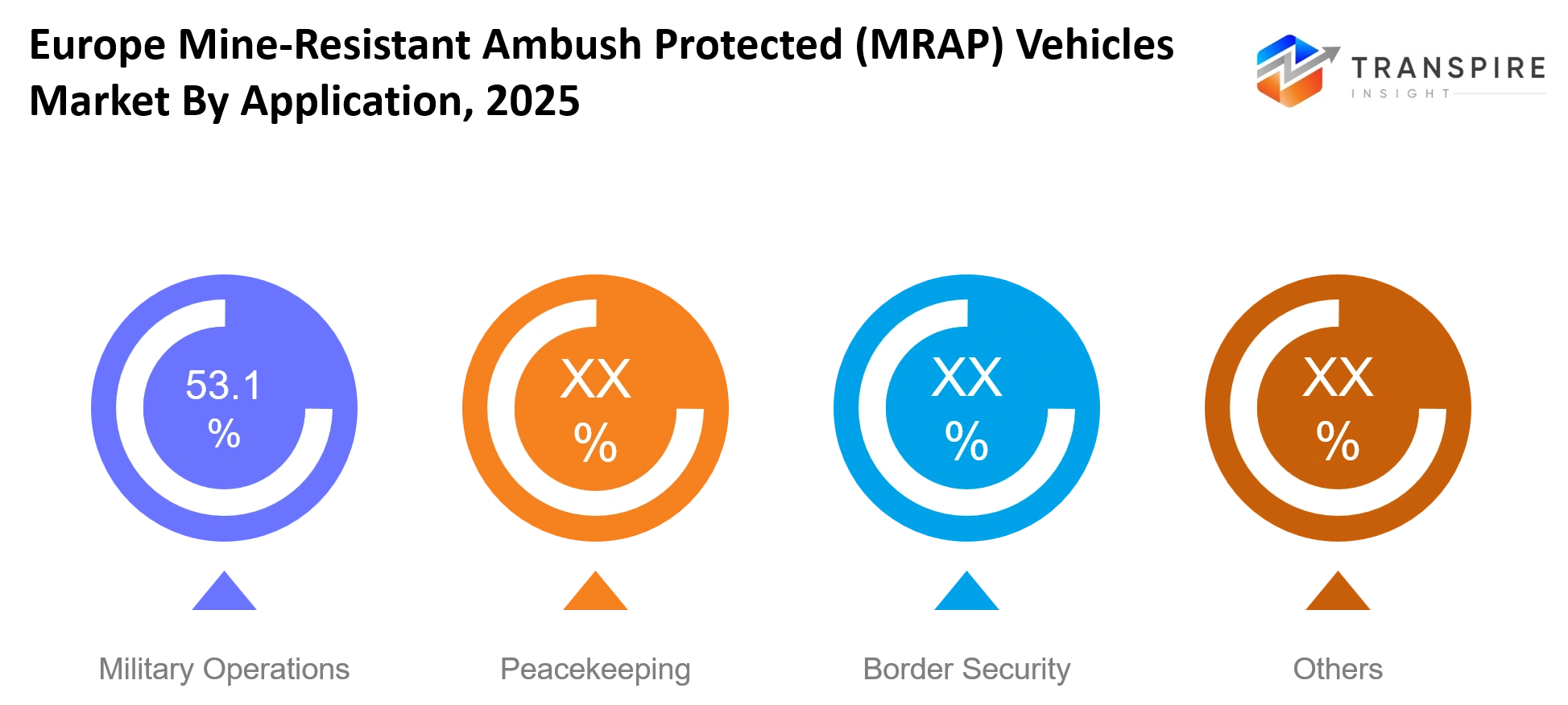
- Military operations use the MRAP vehicles with over 60% of demand because they are used a lot in preparing for conflicts and keeping the peace.
- Border security and fighting terrorism are becoming important uses of MRAP vehicles because of rising tensions in Eastern Europe.
- Major companies like Oshkosh Defense, Rheinmetall, BAE Systems, General Dynamics and Iveco Defence Vehicles are growing by upgrading vehicles, getting NATO contracts and offering next-generation protected mobility solutions.
- This situation of increased threat awareness and the need for modernization has led to money being spent on MRAP vehicles and faster replacement of old fleets, which directly helps the revenue of vehicle manufacturers and defense contractors in Europe.
What are the Key Drivers, Restraints, and Opportunities in the Europe Mine-Resistant Ambush Protected (MRAP) Vehicles Market?
Drivers
The Europe Mine-Resistant Ambush Protected Vehicles Market is mainly driven by the fact that there is a lot of uncertainty in the world and countries that're part of NATO are trying to modernize their defense systems. The conflict between Russia and Ukraine made a lot of countries buy new vehicles quickly because they wanted to replace their old armored vehicles with ones that can keep people safe. This has led to long-term contracts for companies that make these vehicles and they have to make more of them which is good for business.There is a need for vehicles that can protect troops when they are in dangerous situations or on peacekeeping missions and this is true for both Western and Eastern Europe. The Europe Mine-Resistant Ambush Protected Vehicles Market is growing because of this need.
Restraints
One big problem is that these vehicles are very expensive to buy and maintain and they are not very good in cities or places that are not meant for combat. These vehicles need a lot of money and special help which makes it hard for smaller countries to buy them. The way that countries budget for defense is a problem because it means that they cannot just spend more money to fix these problems. This means that countries are upgrading their vehicles at times and some countries are not getting these vehicles at all.
Opportunity
There is an opportunity for companies that make vehicles because some European countries are trying to make new vehicles that are powered by hybrid-electric systems. Countries like Germany and France are investing in vehicles that are safer and use less fuel. The Europe Mine-Resistant Ambush Protected Vehicles Market is going to change because companies are trying to make vehicles that're safe and also good for the environment. This is a thing for companies that can make these kinds of vehicles, especially because countries are starting to think about the environment when they buy vehicles for defense.
What Has the Impact of Artificial Intelligence Been on the Europe Mine-Resistant Ambush Protected (MRAP) Vehicles Market?
Artificial intelligence is being used more and more in the systems that manage the MRAP fleet. This is done to make the battlefield ready and to make operations work better. In Europe defense forces are using intelligence to help with command platforms. These platforms are used to check the vehicles track if they are ready for a mission and make sure the fleet is following the rules.
These systems help reduce the need for people to check the vehicles by hand. They also give people a view of how the vehicles are doing in real time. This helps people make decisions faster when things are very risky. The digital systems that control the vehicles also help with how they move on different terrain and how the systems on the vehicles work together.People are using something called machine learning to help predict when maintenance is needed. They do this by looking at how the engine's vibrating, how hot it is and how much stress is on the parts that make the vehicle move. This information is collected by sensors on the vehicles. This helps the people in charge of the defense anticipate when something might go wrong with a vehicle. They can fix it before it breaks down which means the vehicles are available to use often and they do not have to spend as much time being repaired.
Some programs have seen improvements of 10 to 20 percent in how the vehicles are working. This is because they are doing maintenance in a way and they are scheduling it better.With all these advances there is still a big problem. It is very expensive to get all these systems working together. There is not enough standard information from the battlefield to help train the artificial intelligence systems. It is also hard to send information in time when the vehicles are, in remote or contested areas. This makes it hard to use systems that can make decisions on their own in MRAP operations.
Key Market Trends
- The Europe Mine-Resistant Ambush Protected Vehicles Market moved towards using armor and digital systems on the battlefield from 2022 to 2026.
- NATO worked together more to set requirements for MRAP making it easier for different European countries to use their armored vehicles together since 2023.
- Western Europe spent more on defense, which meant they replaced their armored vehicles more often and upgraded their MRAP by almost 25% in recent years.
- Eastern Europe started using MRAP after their borders became less secure and the threats changed following the 2022 conflicts.
- Militaries started to prefer MRAP that can work well in cities and can be moved quickly to improve their readiness for urban warfare.
- The demand for MRAP went down a bit in some areas because they had trouble moving in complex terrains in recent years.
- Digital systems that help on the battlefield became a must-have in MRAP contracts in 2024 across many European defense programs.
- Companies like Rheinmetall and BAE Systems competed more to offer protected mobility options by upgrading their armored vehicles.
- Countries made more of an effort to produce defense components locally after 2023 to rely less on components from outside Europe.
- The use of intelligence to check on vehicle fleets grew slowly making it easier to maintain them and reducing the time they were out of use, across Europe.
Europe Mine-Resistant Ambush Protected (MRAP) Vehicles Market Segmentation
By Vehicle Type
The Europe MRAP Vehicles Market wants Light MRAP vehicles because military forces need to move fast and deploy quickly. Medium MRAP vehicles are still used a lot because they protect well and are flexible for missions. Heavy MRAP vehicles are very important in areas where there are threats and people need to stay safe in combat.The Europe MRAP Vehicles Market is also upgrading vehicle fleets with armor and electronics. Light MRAP vehicles are good for city operations where speed and movement're key. Medium MRAP vehicles help with long-distance patrols. Protecting convoys. Heavy MRAP vehicles are used in frontline operations where blast resistance's crucial.
By Application
The Europe MRAP Vehicles Market is mostly used for operations because of ongoing defense modernization programs. Peacekeeping missions also use MRAP vehicles to transport personnel in unstable areas. Border security is becoming more important due to surveillance needs and cross-border threats.Governments are strengthening security, which means MRAP vehicles are being used more. Military operations are still the reason for buying MRAP vehicles because battlefield requirements are changing. Peacekeeping forces rely on MRAP vehicles for protected mobility. Border security agencies use MRAP vehicles for patrol and rapid response.
By Propulsion
The Europe MRAP Vehicles Market mostly uses diesel propulsion because it is reliable and has an operational range. Hybrid propulsion systems are becoming more interesting as militaries look for fuel efficiency and reduced thermal signatures. Other propulsion systems are being built. Are not widely used.The Europe MRAP Vehicles Market is slowly moving towards systems with the help of European defense innovation. Diesel engines are still used for fleet operations. Hybrid systems improve efficiency in long missions. Alternative propulsion solutions are still being tested.
By Protection Level
The Europe MRAP Vehicles Market wants Level III protection the most because of high-intensity conflict zones. Level II vehicles provide protection for standard military operations. Level I and other variants are used in lower-risk missions and training.The Europe MRAP Vehicles Market prioritizes protection levels due to evolving threats. Level III vehicles provide survivability. Level II vehicles are widely used in operations. Lower protection variants serve support and non-combat functions.
By End User
The Europe MRAP Vehicles Market is driven by army procurement programs across Europe. Special forces use MRAP platforms for high-risk missions. Law enforcement agencies deploy MRAP vehicles in counter-terror and riot control.The Europe MRAP Vehicles Market is expanding across defense and security agencies. Army forces dominate procurement volumes to fleet modernization. Special forces require configurations. Law enforcement adoption increases in threat urban areas.
By Sales Channel
The Europe MRAP Vehicles Market relies on procurement through government defense budgets. Long-term contracts with manufacturers ensure supply and maintenance. Other procurement channels support niche requirements.The Europe MRAP Vehicles Market procurement relies on defense contracts for lifecycle support and upgrades. Direct procurement is central to defense strategies. Contract-based purchasing strengthens manufacturer relationships. Alternative channels support mission deployments.
What are the Key Use Cases Driving the Europe Mine-Resistant Ambush Protected (MRAP) Vehicles Market?
The main reason people want Europe Mine-Resistant Ambush Protected Vehicles is for convoy protection and troop transport. Armies use these vehicles in areas where there are a lot of risks because they need to be safe from things that can explode and hurt them. This is very important because armies need to be able to move around to complete their missions.
Some other ways that Europe Mine-Resistant Ambush Protected Vehicles are used include border security and peacekeeping. Special groups of soldiers and police officers are starting to use these vehicles often for things like stopping terrorists and controlling riots. They are also using them to patrol borders and keep people safe. This is happening more and more because there are a lot of tensions between countries and it is getting harder to keep people safe.
There are some ways that Europe Mine-Resistant Ambush Protected Vehicles might be used in the future. For example they could be used to help people after a disaster or to protect buildings and roads. Governments are also thinking about using them to help get people to safety in case of a big emergency. These are ideas for now but they could be very useful as a way to keep people safe in dangerous situations. Europe Mine-Resistant Ambush Protected Vehicles are very good at protecting people. They could be used in many different ways to help keep people safe.
|
Reports Metrics |
Details |
|
Market size value in 2025 |
USD 1.12 Billion |
|
Market size value in 2026 |
USD 1.21 Billion |
|
Revenue forecast in 2033 |
USD 2.08 Billion |
|
Growth rate |
CAGR of 8.05% from 2026 to 2033 |
|
Base year |
2025 |
|
Historical data |
2021 - 2024 |
|
Forecast period |
2026 - 2033 |
|
Report coverage |
Revenue forecast, competitive landscape, growth factors, and trends |
|
Regional scope |
Europe |
|
Key company profiled |
Oshkosh Defense, Rheinmetall, BAE Systems, General Dynamics, Arquus, Iveco Defence Vehicles, KNDS, Thales Group, Navistar Defense, ST Engineering, Patria, Textron, Paramount Group, Otokar, Jankel |
|
Customization scope |
Free report customization (country, regional & segment scope). Avail customized purchase options to meet your exact research needs. |
|
Report Segmentation |
By Vehicle Type (Light MRAP, Medium MRAP, Heavy MRAP, Others); By Application (Military Operations, Peacekeeping, Border Security, Others); By Propulsion (Diesel, Hybrid, Others); By Protection Level (Level I, Level II, Level III, Others); By End User (Army, Special Forces, Law Enforcement, Others); By Sales Channel (Direct Procurement, Contracts, Others) |
Which Regions are Driving the Europe Mine-Resistant Ambush Protected (MRAP) Vehicles Market Growth?
Western Europe remains the leading region in the Europe Mine-Resistant Ambush Protected (MRAP) Vehicles Market due to strong defense budgets, advanced military procurement frameworks, and established armored vehicle manufacturing capabilities. Countries such as Germany, France, and the United Kingdom maintain continuous fleet modernization programs supported by NATO readiness requirements. A well-developed defense industrial base and strong integration between government agencies and OEMs sustain high procurement volumes and long-term upgrade cycles for MRAP platforms.
Northern Europe represents the second-largest region and differs from Western Europe through its focus on defensive readiness and territorial security rather than large-scale force projection. Countries such as Sweden, Norway, and Finland invest steadily in armored mobility to strengthen border protection and crisis response capability. Stable economic conditions and consistent defense planning cycles support predictable procurement patterns, while cooperation with NATO frameworks ensures steady adoption of MRAP vehicles for specialized operational needs.
Eastern Europe is the fastest-growing region due to intensified security pressures and accelerated defense modernization following recent geopolitical conflicts. Increased NATO alignment and expanded military aid programs have driven rapid procurement of armored vehicles across Poland, Romania, and neighboring countries. Large-scale fleet replacement programs and new defense infrastructure investments are reshaping regional demand patterns. This growth signals strong opportunities for OEMs and defense contractors targeting long-term contracts and regional production partnerships through 2033.
Who are the Key Players in the Europe Mine-Resistant Ambush Protected (MRAP) Vehicles Market and How Do They Compete?
The Europe Mine-Resistant Ambush Protected (MRAP) Vehicles Market shows a moderately consolidated competitive structure, where a small group of established defense manufacturers dominate large NATO contracts while specialized suppliers compete for niche armored solutions. Incumbents defend their positions through long-term government procurement agreements, certified defense standards, and integrated lifecycle support services. Competition is driven primarily by technology advancement in blast protection systems, modular vehicle architecture, and battlefield digital integration rather than pricing, as defense procurement prioritizes survivability and interoperability.
Rheinmetall focuses on high-end armored mobility platforms with strong integration of modular protection systems and digital battlefield networking. Its differentiation comes from deep alignment with European defense ministries and its ability to deliver scalable MRAP configurations for both urban and high-intensity combat scenarios. The company expands through joint ventures with regional defense contractors and continued investment in next-generation armored vehicle platforms.
BAE Systems competes through advanced survivability engineering and proven battlefield-tested vehicle architectures. Its MRAP solutions stand out due to strong blast resistance design and integrated mission electronics systems. Expansion is driven by multinational defense contracts and collaboration programs with NATO-aligned procurement initiatives.Oshkosh Defense leverages cost-efficient production engineering and highly adaptable vehicle platforms that can be customized for multiple mission profiles. Its competitive edge lies in scalable manufacturing and rapid deployment capability. The company expands in Europe through defense partnerships and localized support agreements to strengthen its presence in NATO procurement programs.
Company List
- Oshkosh Defense
- Rheinmetall
- BAE Systems
- General Dynamics
- Arquus
- Iveco Defence Vehicles
- KNDS
- Thales Group
- Navistar Defense
- ST Engineering
- Patria
- Textron
- Paramount Group
- Otokar
- Jankel
Recent Development News
“In March 2026, Rheinmetall AG completed delivery phase expansion for Boxer armored vehicle production under the Australia–Germany export program. The ramp-up of Rheinmetall Military Vehicle Centre of Excellence output supported increased European supply of Boxer-based protected mobility platforms, reinforcing MRAP-class protected vehicle availability for NATO and allied forces.”https://www.reddit.com
“In December 2025, Rheinmetall UK secured a contract from the NATO Support and Procurement Agency (NSPA) to supply Trailblazer driver vision systems for the UK M270A2 MLRS upgrade program. The system enhances situational awareness and protected mobility integration for armored platforms, including Boxer and Challenger 3, indirectly strengthening MRAP-level survivability standards across UK tracked and wheeled fleets.”https://www.rheinmetall.com
“In November 2025, KNDS Deutschland secured a €117 million contract to upgrade 72 Boxer ambulance vehicles for the German Armed Forces. The modernization improves protected medical evacuation capability and digital battlefield systems, reinforcing Europe’s armored logistics and MRAP-class protected mobility segment.”https://defence-industry.eu
What Strategic Insights Define the Future of the Europe Mine-Resistant Ambush Protected (MRAP) Vehicles Market?
The Europe Mine-Resistant Ambush Protected (MRAP) Vehicles Market shows a moderately consolidated competitive structure, where a small group of established defense manufacturers dominate large NATO contracts while specialized suppliers compete for niche armored solutions. Incumbents defend their positions through long-term government procurement agreements, certified defense standards, and integrated lifecycle support services. Competition is driven primarily by technology advancement in blast protection systems, modular vehicle architecture, and battlefield digital integration rather than pricing, as defense procurement prioritizes survivability and interoperability.
Rheinmetall focuses on high-end armored mobility platforms with strong integration of modular protection systems and digital battlefield networking. Its differentiation comes from deep alignment with European defense ministries and its ability to deliver scalable MRAP configurations for both urban and high-intensity combat scenarios. The company expands through joint ventures with regional defense contractors and continued investment in next-generation armored vehicle platforms.
BAE Systems competes through advanced survivability engineering and proven battlefield-tested vehicle architectures. Its MRAP solutions stand out due to strong blast resistance design and integrated mission electronics systems. Expansion is driven by multinational defense contracts and collaboration programs with NATO-aligned procurement initiatives.Oshkosh Defense leverages cost-efficient production engineering and highly adaptable vehicle platforms that can be customized for multiple mission profiles. Its competitive edge lies in scalable manufacturing and rapid deployment capability. The company expands in Europe through defense partnerships and localized support agreements to strengthen its presence in NATO procurement programs.
Europe Mine-Resistant Ambush Protected (MRAP) Vehicles Market Report Segmentation
By Vehicle Type
- Light MRAP
- Medium MRAP
- Heavy MRAP
- Others
By Application
- Military Operations
- Peacekeeping
- Border Security
- Others
By Propulsion
- Diesel
- Hybrid
- Others
By Protection Level
- Level I
- Level II
- Level III
- Others
By End User
- Army
- Special Forces
- Law Enforcement
- Others
By Sales Channel
- Direct Procurement
- Contracts
- Others
Frequently Asked Questions
Find quick answers to common questions.
The expected Europe Mine-Resistant Ambush Protected (MRAP) Vehicles Market size for the market will be USD 2.08 Billion in 2033.
Key segments for the Europe Mine-Resistant Ambush Protected (MRAP) Vehicles Market are By Vehicle Type (Light MRAP, Medium MRAP, Heavy MRAP, Others); By Application (Military Operations, Peacekeeping, Border Security, Others); By Propulsion (Diesel, Hybrid, Others); By Protection Level (Level I, Level II, Level III, Others); By End User (Army, Special Forces, Law Enforcement, Others); By Sales Channel (Direct Procurement, Contracts, Others)
Major Europe Mine-Resistant Ambush Protected (MRAP) Vehicles Market players are Oshkosh Defense, Rheinmetall, BAE Systems, General Dynamics, Arquus, Iveco Defence Vehicles, KNDS, Thales Group, Navistar Defense, ST Engineering, Patria, Textron, Paramount Group, Otokar, Jankel
The Europe Mine-Resistant Ambush Protected (MRAP) Vehicles Market size is USD 1.12 Billion in 2025.
The Europe Mine-Resistant Ambush Protected (MRAP) Vehicles Market CAGR is 8.05% from 2026 to 2033.
- Oshkosh Defense
- Rheinmetall
- BAE Systems
- General Dynamics
- Arquus
- Iveco Defence Vehicles
- KNDS
- Thales Group
- Navistar Defense
- ST Engineering
- Patria
- Textron
- Paramount Group
- Otokar
- Jankel
About the Authors

Tejashri Dhatrak
I am Tejashri Dhatrak, a Senior Research Analyst at Transpire Insight, specializing in the Aerospace and Defence sector. My work focuses on analyzing industry trends, defence technologies, market developments, and emerging innovations that shape the global aerospace and security landscape. At Transpire Insight, I research complex topics, evaluate credible sources, and transform technical insights into accurate, well-structured, and easy-to-understand content for industry professionals and decision-makers. My goal is to provide reliable, research-backed information that helps readers stay informed about defence capabilities, aerospace advancements, strategic developments, and the evolving dynamics of the global defence ecosystem.

Chakradhar Khansole
Chakradhar serves as the Research Director at Transpire Insight, bringing over 8 years of experience in technology, innovation, and strategic market intelligence. He specializes in transforming complex market data into actionable business insights that enable organizations to make informed, growth-oriented decisions. Recognized for his strategic vision and analytical expertise, Chakradhar leads high-impact research initiatives, delivering comprehensive market assessments, competitive intelligence, and forward-looking industry analysis.
Recently Published Reports
-
Apr 2026
Aerospace Fluoropolymers Market
Aerospace Fluoropolymers Market Size, Share & Analysis Report By Type (PTFE, FEP, PFA, ETFE, and Others), By Application (Electrical Insulation, Seals & Gaskets, Coatings, and Others), By End User (Commercial Aviation, Military Aviation, General Aviation, and Others), and Geography (North America, Europe, Asia-Pacific, Middle East and Africa, South and Central America), 2021 - 2031
-
Apr 2026
Airborne SATCOM System Market
Airborne SATCOM System Market Size, Share & Analysis Report By Type (SATCOM Terminals, Transceivers, Airborne Radio, Modems and Routers, SATCOM Radomes, and Other), By Application (Government and Defense and Commercial), and Geography (North America, Europe, Asia-Pacific, Middle East and Africa, South and Central America), 2021 – 2031
-
Apr 2026
Ship Leasing Market
Ship Leasing Market Size, Share & Analysis Report By Vessel Type (Container Ships, Bulk Carriers, Tankers, and Specialized Vessels), By Lease Duration (Short-Term Lease (Less than 1 year), Medium-Term Lease (1-5 years), and Long-Term Lease (More than 5 years)), By Lease Type (Bareboat Charter, Time Charter, Financial Lease, and Others), By End-User Industry (Oil and Gas, Manufacturing and Industrial, Automotive, Agriculture and Food, Retail and Consumer Goods, and Others), and Geography (North America, Europe, Asia-Pacific, Middle East and Africa, South and Central America), 2021 – 2031
-
Apr 2026
Thread Rolling Dies Market
Thread Rolling Dies Market Size, Share & Analysis Report By Type (Flat Thread Rolling Dies, Circular (Cylindrical) Dies, Tangential Thread Rolling Dies, Planetary Thread Rolling Dies, and Other Types), By Material Type (High-Speed Steel (HSS), Carbide, Tool Steel, Alloy Steel, and Other Specialized Alloys), By Distribution Channel (Direct Sales, Distributors and Dealers, and Online Platforms), By Application (Automotive Industry, Aerospace and Defense, Construction and Infrastructure, Industrial Machinery, Electronics and Electrical Components, Medical Devices, and Fastener Production), and Geography (North America, Europe, Asia-Pacific, Middle East and Africa, South and Central America), 2021 – 2031
Our Clients