

Europe Lithium Hexafluorophosphate Market Size & Forecast:
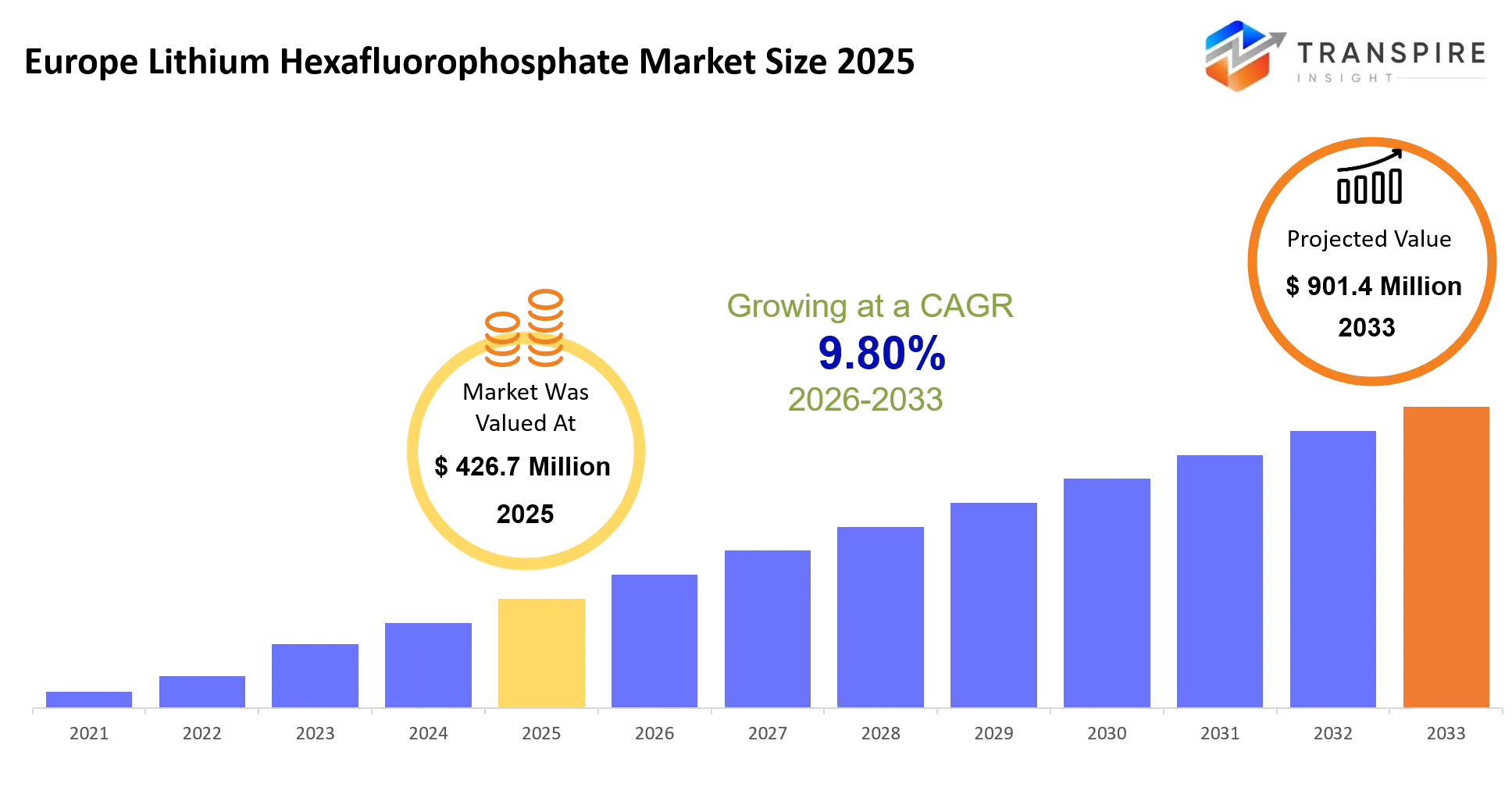
- Europe Lithium Hexafluorophosphate Market Size 2025:USD 426.7 Million
- Europe Lithium Hexafluorophosphate Market Size 2033: USD 901.4 Million
- Europe Lithium Hexafluorophosphate Market CAGR: 9.80%
- Europe Lithium Hexafluorophosphate Market Segments:By Purity (High Purity, Battery Grade, Industrial Grade, Others); By Application (Lithium-Ion Batteries, Energy Storage Systems, Consumer Electronics, EV Batteries, Others); By End User (Automotive, Electronics, Energy, Others); By Form (Liquid, Solid, Others); By Distribution Channel (Direct Sales, Distributors, Others); By Battery Type (LFP, NMC, NCA, Others)
Europe Lithium Hexafluorophosphate Market Summary
The Europe Lithium Hexafluorophosphate Market was valued at USD 426.7 Million in 2025. It is forecast to reach USD 901.4 Million by 2033. That is a CAGR of 9.80% over the period.
The Europe Lithium Hexafluorophosphate Market plays a role in the industrial ecosystem by providing a key component for lithium-ion batteries. In practice this market helps solve the problem of energy storage for various applications, including electric vehicles and renewable energy systems.
Over the 3-5 years a significant structural shift has occurred with the transition to more sustainable energy sources. The European Union's policy change to reduce carbon emissions has accelerated this shift. A real-world trigger that altered market behavior is the implementation of environmental regulations, which has driven companies to adopt lithium-ion batteries.
As a result the Europe Lithium Hexafluorophosphate Market is growing because companies are looking for ways to reduce their carbon footprint and comply with regulations. This growth means that adoption of lithium-ion batteries will continue to increase, leading to revenue for companies in the Europe Lithium Hexafluorophosphate Market.
Key Market Insights
- The Europe Lithium Hexafluorophosphate Market is getting bigger because of the growth in making batteries for electric vehicles and more money being invested in making batteries in Europe.
- A big thing happening in the market is that companies in Europe are trying to make their battery parts instead of relying on other countries for them.
- Germany is the leader in the Europe Lithium Hexafluorophosphate Market because it has a car industry, big battery projects and good manufacturing facilities.
- Batteries for vehicles use the most Europe Lithium Hexafluorophosphate, which is more than 60 percent of all the Europe Lithium Hexafluorophosphate used.
- Energy storage systems are growing fast because more people are using renewable energy and need big batteries to store it.
- The best kind of Europe Lithium Hexafluorophosphate for batteries is still the most popular because batteries need to be very good and pure to work
- More people are investing in kinds of lithium-ion batteries, which means they need the best Europe Lithium Hexafluorophosphate to make them work.
- Some problems with getting parts and worries about the world have made companies want to make their Europe Lithium Hexafluorophosphate and get their own raw materials.
- Big companies like Tinci Materials, Morita Chemical, Stella Chemical, Soulbrain, BASF and Honeywell are trying to make Europe Lithium Hexafluorophosphate come up with new products and work with other companies.
- New technologies are making batteries work better longer and be safer which is good for the Europe Lithium Hexafluorophosphate Market, in the long run.
What are the Key Drivers, Restraints, and Opportunities in the Europe Lithium Hexafluorophosphate Market?
Driver
The biggest thing driving the Europe Lithium Hexafluorophosphate Market is that companies are quickly making lithium-ion batteries in the region. This happened because European policies want to make the battery supply chain stronger and not rely on imports. Many countries like Germany, France and Sweden are investing a lot in battery factories. This means they need local ingredients for batteries like Lithium Hexafluorophosphate, which is very important for lithium-ion battery liquids. So when battery production goes up it directly means that more Lithium Hexafluorophosphate is used, which is good for the market and helps companies make long-term plans.
Restraint
The biggest problem for the Europe Lithium Hexafluorophosphate Market is that it needs materials and production methods. Making Lithium Hexafluorophosphate requires a lot of money, safety rules and advanced technology to make it pure. These things create obstacles that are hard to overcome. Because of this Europe still has to import a lot of materials which means manufacturers have to deal with changing prices, supply issues and long waiting times. This can slow down the growth of the market.
Opportunity
There is a chance for the Europe Lithium Hexafluorophosphate Market to grow with new battery technologies and big energy storage projects. More people are investing in battery storage and advanced electric vehicles, which need very pure Lithium Hexafluorophosphate. As European companies work on making batteries and producing them locally, suppliers who can provide high-quality Lithium Hexafluorophosphate can get long-term contracts and become more important in the battery industry.
What Has the Impact of Artificial Intelligence Been on the Europe Lithium Hexafluorophosphate Market?
The Europe Lithium Hexafluorophosphate Market is changing because of intelligence and new digital technologies. These things are helping to make manufacturing improve quality control and make supply chain management more efficient.Producers are using intelligence to control the manufacturing process. This means they can watch things like temperature, pressure and impurity levels all the time when they make Lithium Hexafluorophosphate.This helps to keep the product pure and consistent. It also reduces waste and things going wrong during manufacturing.Machine learning is also being used to predict when maintenance is needed in plants. This is done by looking at data from sensors on equipment like reactors and pumps.The systems can see when equipment is starting to break down and schedule maintenance before it fails.This means the plant can keep running there are fewer unexpected shutdowns and maintenance costs are lower.
Artificial intelligence is also being used to forecast demand for Lithium Hexafluorophosphate. This helps manufacturers to have the amount of inventory and buy the right amount of raw materials.It makes the supply chain more resilient and reduces the amount of money tied up in working capital.Some companies are using twin technologies to simulate manufacturing and make it better.However it is still expensive to set up intelligence systems and many facilities do not have good historical data.Many plants still have data systems that do not work well together.
This makes it hard to develop predictive models and get the most out of advanced analytics, for the Europe Lithium Hexafluorophosphate Market.
Key Market Trends
- European battery manufacturers have been focusing on getting electrolyte from suppliers since 2021. This is because they want to avoid problems with getting things from countries.
- There have been big announcements about building battery gigafactories in Germany, Sweden and France. Because of this companies are now signing long-term contracts to get Lithium Hexafluorophosphate.
- Battery manufacturers are not just trying to make batteries anymore. They are now trying to make high-quality batteries with ultra-high-purity grades to make electric vehicles work better.
- Since 2022 there have been a lot of problems between countries and this has made companies invest more in making battery materials in their own countries. They are also trying to make their supply chains more diverse.
- Some companies like Tinci Materials, BASF and Soulbrain are working together to make sure they have a supply of materials and can sell their products more easily.
- Battery producers are now looking for suppliers who can give them high-quality materials and tell them where the materials came from. They do not just want the option anymore.
- Many chemical manufacturing facilities are now using computers to monitor their processes. This helps them make things consistently and reduces the time when machines are not working.
- Since 2023 companies that make energy storage systems have become bigger customers. This is because many utility-scale batteries are being installed across Europe.
- The government is supporting the idea of making battery materials and products in the country. This has encouraged companies to invest more in making materials and improving their production technologies.
- Companies are now trying to be different from each other, by making good products, having efficient processes and using good purification technology. They are not just trying to make a lot of batteries.
Europe Lithium Hexafluorophosphate Market Segmentation
By Purity:
High purity materials are really important for making electrolytes because they need to have the chemical makeup and work well every time. Companies that make batteries want to make them better and safer so they need purity materials. This means that the demand for these materials will keep going up.Battery manufacturers need to make sure their batteries are good and work well so they use purity materials. They also use materials that are not as pure but still good enough for some jobs.
By Application:
Lithium-ion batteries need a lot of Lithium Hexafluorophosphate, which's a key part of the battery. Many companies in Europe are making batteries so they need more of this material.Energy storage systems are also important because they help use energy. People use a lot of consumer electronics like smartphones and laptops which need batteries. Electric vehicles are also a market for batteries because many companies are investing in them.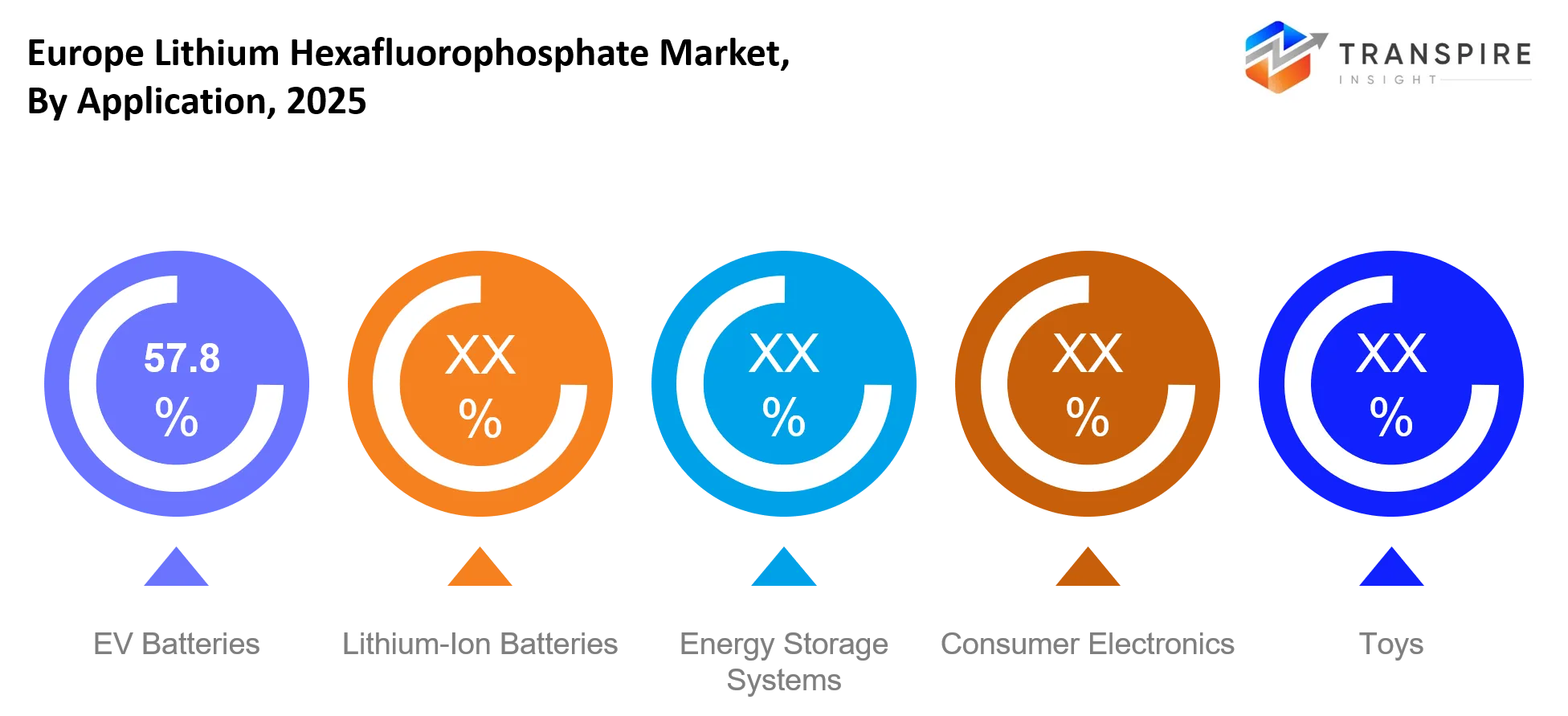
By End User:
The automotive industry needs a lot of battery materials because they are making electric vehicles. They need batteries that work well so they can make sure their cars are safe and reliable.The electronics industry also needs a lot of batteries for things like smartphones and laptops. The energy sector is using batteries to help with renewable energy and make the grid more stable. Other industries, like manufacturing, also use batteries to make their operations more efficient.
By Form:
Many companies use battery materials because they are easy to mix and use in batteries. They work well with the machines that make batteries. Many companies like to use them.Some companies are starting to use battery materials because they are safer and easier to transport. Researchers are looking for ways to make battery materials that are even better. Other companies use types of materials that are specific to their needs.
By Distribution Channel:
Many battery manufacturers like to buy materials from the companies that make them. This way they can make sure they get the materials they need and that they are quality.Some companies use distributors to buy materials because it is more flexible and convenient. Distributors help get the materials to companies and to different parts of the world. Other companies use channels to buy materials depending on what they need.
By Battery Type:
LFP batteries are getting more popular because they are safe and work well. Many companies are using them in vehicles and energy storage systems.NMC batteries are also popular because they have a lot of energy and are good for transportation and industry. NCA batteries are used in some applications where they need to be really good. Other types of batteries are also being used. Used in different industries.
What are the Key Use Cases Driving the Europe Lithium Hexafluorophosphate Market?
Electric vehicle battery production is the use for Lithium Hexafluorophosphate in Europe.Lithium Hexafluorophosphate is a part of the electrolyte in lithium-ion batteries that car makers use.There is a lot of money being invested in battery factories and programs to make electric vehicles, which means there is a big need for Lithium Hexafluorophosphate in the battery supply chain.People are also using Lithium Hexafluorophosphate for energy storage systems.Utility companies and renewable energy developers are building battery storage projects to make the power grid more stable and to help integrate wind power.Plus companies that make consumer electronics still use an amount of Lithium Hexafluorophosphate for things like portable devices and industrial electronics.
There are opportunities coming up in next-generation battery technologies and big energy storage projects.Research programs are working on making batteries, which means they need very pure electrolyte materials, like Lithium Hexafluorophosphate.As large energy storage projects and smart grid projects are built there will be even more chances for Lithium Hexafluorophosphate to be used.
|
Report Metrics |
Details |
|
Market size value in 2025 |
USD 426.7 Million |
|
Market size value in 2026 |
USD 468.5 Million |
|
Revenue forecast in 2033 |
USD 901.4 Million |
|
Growth rate |
CAGR of 9.80% from 2026 to 2033 |
|
Base year |
2025 |
|
Historical data |
2021 - 2024 |
|
Forecast period |
2026 - 2033 |
|
Report coverage |
Revenue forecast, competitive landscape, growth factors, and trends |
|
Regional scope |
Europe |
|
Key company profiled |
Tinci Materials, Morita Chemical, Stella Chemical, Do-Fluoride Chemicals, Soulbrain, Capchem, Tianji, Guangzhou Tinci, Kanto Denka Kogyo, Honeywell, BASF, Merck, Solvay, Mitsubishi Chemical, UBE |
|
Customization scope |
Free report customization (country, regional & segment scope). Avail customized purchase options to meet your exact research needs. |
|
Report Segmentation |
By Purity (High Purity, Battery Grade, Industrial Grade, Others); By Application (Lithium-Ion Batteries, Energy Storage Systems, Consumer Electronics, EV Batteries, Others); By End User (Automotive, Electronics, Energy, Others); By Form (Liquid, Solid, Others); By Distribution Channel (Direct Sales, Distributors, Others); By Battery Type (LFP, NMC, NCA, Others) |
Which Regions are Driving the Europe Lithium Hexafluorophosphate Market Growth?
Western Europe leads the Europe Lithium Hexafluorophosphate Market due to strong industrial policy support and a highly developed electric vehicle manufacturing base. Germany anchors this dominance with large-scale gigafactory investments and deep integration between automotive OEMs and battery suppliers. Strict EU Battery Regulation enforcement has pushed manufacturers to secure local, high-purity electrolyte supply chains. A mature chemical ecosystem and advanced logistics infrastructure further strengthen consistent production and distribution capacity.
Southern Europe holds the second position, supported by steady automotive assembly activity and gradual expansion of energy storage deployments. Countries such as France, Italy, and Spain maintain stable demand patterns driven by long-term industrial investment cycles rather than rapid capacity scaling. Port connectivity and established import networks support efficient raw material movement for battery-related chemical processing. This region contributes reliably to revenue stability through consistent, policy-aligned adoption across mobility and power sectors.
Northern Europe records the fastest growth in the Europe Lithium Hexafluorophosphate Market due to recent acceleration in clean energy infrastructure and battery manufacturing investments. Sweden and neighboring countries have attracted new battery plant developments linked to renewable energy integration and grid modernization programs. Government-backed decarbonization targets have accelerated fleet electrification and storage deployment projects. This momentum signals strong entry opportunities for investors and suppliers targeting long-term expansion from 2026 to 2033.
Who are the Key Players in the Europe Lithium Hexafluorophosphate Market and How Do They Compete?
The competitive landscape of the Europe Lithium Hexafluorophosphate Market remains moderately consolidated, with a small group of global chemical and electrolyte material producers controlling most high-purity supply. Europe continues to depend heavily on imports due to limited domestic production capacity and high technical barriers in fluorine chemistry. Competition is primarily driven by product purity, long-term supply security, regulatory compliance, and the ability to maintain stable contracts with battery manufacturers rather than pure price competition.
Tinci Materials follows a cost-efficient, large-scale production strategy supported by integration across fluorochemical raw material supply chains. The company strengthens its position through long-term contracts with battery manufacturers that prioritize stable volume delivery and consistent electrolyte quality. Morita Chemical focuses on ultra-high purity production standards and tight quality control systems, which help it serve premium electric vehicle battery applications requiring strict performance consistency.
Stella Chemical differentiates through advanced fluorine chemistry expertise and high-purity electrolyte development, expanding its reach through technology partnerships. Soulbrain builds competitive advantage through integrated electrolyte solutions and close collaboration with battery cell manufacturers on product development. Meanwhile, BASF and Honeywell leverage regional presence, regulatory alignment, and specialty materials capabilities to strengthen supply security and expand participation in Europe’s battery materials ecosystem.
Company List
- Soulbrain
- Capchem
- Tianji Lithium
- Guangzhou Tinci
- Kanto Denka Kogyo
- Honeywell
- BASF
- Merck
- Solvay
- Mitsubishi Chemical
- UBE Corporation
Recent Development News
In December 2025, Neogen Ionics and Morita Investment formed a joint venture to produce solid lithium hexafluorophosphate (LiPF₆) in India, strengthening regional electrolyte supply chains for battery manufacturing.https://www.energetica-india.net
In August 2025, Neogen Ionics and Morita Chemicals Industries finalized a strategic joint venture agreement to manufacture and commercialize LiPF₆ electrolyte salt in Gujarat, supporting India’s battery materials localization strategy.https://www.specchemonline.com
In December 2025, Morita Chemical Industries expanded its battery materials collaboration footprint through international partnerships aimed at scaling high-purity LiPF₆ production for global EV supply chains.https://www.indianchemicalnews.com
What Strategic Insights Define the Future of the Europe Lithium Hexafluorophosphate Market?
The Europe Lithium Hexafluorophosphate Market is moving toward deeper regional integration with battery manufacturing ecosystems, driven by Europe’s push to localize lithium-ion battery supply chains and reduce external dependency on electrolyte imports. Over the next 5–7 years, demand will increasingly align with gigafactory capacity expansion and stricter battery performance standards, which will favor high-purity and specification-driven procurement models rather than volume-led sourcing.
A less visible risk is rising supply concentration among a limited number of qualified global electrolyte producers, which may create pricing rigidity and vulnerability to upstream fluorine raw material disruptions. At the same time, a key emerging opportunity lies in solid-state and next-generation high-voltage battery development, where ultra-high-purity LiPF6 alternatives and hybrid electrolyte systems are beginning to gain pilot-scale traction in Europe’s advanced research programs.
Market participants should prioritize building localized production partnerships within Europe’s battery corridor and invest in purification technology upgrades, as early alignment with gigafactory ecosystems will define long-term contract access and competitive positioning.
Europe Lithium Hexafluorophosphate Market Report Segmentation
By Purity
- High Purity
- Battery Grade
- Industrial Grade
- Others
By Application
- Lithium-Ion Batteries
- Energy Storage Systems
- Consumer Electronics
- EV Batteries
- Others
By End User
- Automotive
- Electronics
- Energy
- Others
By Form
- Liquid
- Solid
- Others
By Distribution Channel
- Direct Sales
- Distributors
- Others
By Battery Type
- LFP
- NMC
- NCA
- Others
Frequently Asked Questions
Find quick answers to common questions.
The Expected Europe Lithium Hexafluorophosphate Market size for the Market will be USD 901.4 Million in 2033.
Key Segments for the Europe Lithium Hexafluorophosphate Market are By Purity (High Purity, Battery Grade, Industrial Grade, Others); By Application (Lithium-Ion Batteries, Energy Storage Systems, Consumer Electronics, EV Batteries, Others); By End User (Automotive, Electronics, Energy, Others); By Form (Liquid, Solid, Others); By Distribution Channel (Direct Sales, Distributors, Others); By Battery Type (LFP, NMC, NCA, Others).
Major Europe Lithium Hexafluorophosphate Market Players are Tinci Materials, Morita Chemical, Stella Chemical, Do-Fluoride Chemicals, Soulbrain, Capchem, Tianji, Guangzhou Tinci, Kanto Denka Kogyo, Honeywell, BASF, Merck, Solvay, Mitsubishi Chemical, UBE.
The Current Europe Lithium Hexafluorophosphate Market size is USD 426.7 Million in 2025.
The Europe Lithium Hexafluorophosphate Market CAGR is 9.80% from 2026 to 2033.
- Tinci Materials
- Morita Chemical Industries
- Stella Chemical
- Do-Fluoride Chemicals
- Soulbrain
- Capchem
- Tianji Lithium
- Guangzhou Tinci
- Kanto Denka Kogyo
- Honeywell
- BASF
- Merck
- Solvay
- Mitsubishi Chemical
- UBE Corporation
About the Authors

Pankaj Ghogare Patil
I am Pankaj Ghogare Patil, a Senior Research Analyst at Transpire Insight, specializing in the Pharmaceutical, Chemicals & Materials, Healthcare IT, and Biotechnology industry. My expertise lies in conducting comprehensive market research, analyzing industry trends, evaluating competitive landscapes, and translating complex data into actionable insights. At Transpire Insight, I closely follow emerging technologies, regulatory developments, and market innovations to create accurate, well-researched, and informative content that helps businesses and professionals make informed decisions. I am committed to producing credible, evidence-based articles that reflect industry best practices while making technical topics accessible and valuable for a broad audience.

Chakradhar Khansole
Chakradhar serves as the Research Director at Transpire Insight, bringing over 8 years of experience in technology, innovation, and strategic market intelligence. He specializes in transforming complex market data into actionable business insights that enable organizations to make informed, growth-oriented decisions. Recognized for his strategic vision and analytical expertise, Chakradhar leads high-impact research initiatives, delivering comprehensive market assessments, competitive intelligence, and forward-looking industry analysis.
Recently Published Reports
-
May 2026
Healthcare Polymer Packaging Market
Healthcare Polymer Packaging Market Size, Share & Analysis Report By Packaging Type (Syringes, IV Bottles and Pouches, Clamshells, Blisters, Bottles & Jars, Containers, Tubes, IV Parental Packaging, Others), By Type (Regulated, Non-regulated), By Polymer Type (LDPE (Low-Density Polyethylene), HDPE (High-Density Polyethylene), Homo-polymer (Homo), Random Copolymer (Random), Block Copolymer (Block), PET, Polystyrene, Polyvinyl Chloride, Polyamide/EVOH, Others), and Geography (North America, Europe, Asia-Pacific, Middle East and Africa, South and Central America), 2021 - 2031
-
Apr 2026
Hydrophilic Tape (Waterstop) Market
Hydrophilic Tape (Waterstop) Market Size, Share & Analysis Report By Type (Bentonite-Based Hydrophilic Tape, Rubber-Based Hydrophilic Tape), By Application (Residential Buildings, Commercial Buildings, Infrastructure Projects), and Geography (North America, Europe, Asia-Pacific, Middle East and Africa, South and Central America), 2021 - 2031
-
Apr 2026
Metalens Market
Metalens Market Size, Share & Analysis Report By Type (Visible Light Metalens, and Infrared Metalens), By Application (Consumer Electronics, Automotive Electronics, Industrial, Medical, and Others), and Geography (North America, Europe, Asia-Pacific, Middle East and Africa, South and Central America), 2021 - 2031
-
Apr 2026
PBT Resin Market
PBT Resin Market Size, Share & Analysis Report By Type (Reinforced PBT Resin, Unreinforced PBT Resin), By Processing Method (Injection Molding, Extrusion, Blow Molding, Others), By End-User (Automotive, Electrical & Electronics, Consumer Appliances, Industrial Machinery, Medical Devices, Packaging, Others), and Geography (North America, Europe, Asia-Pacific, Middle East and Africa, South and Central America), 2021 - 2031