

Europe Hip Replacement Market Summary
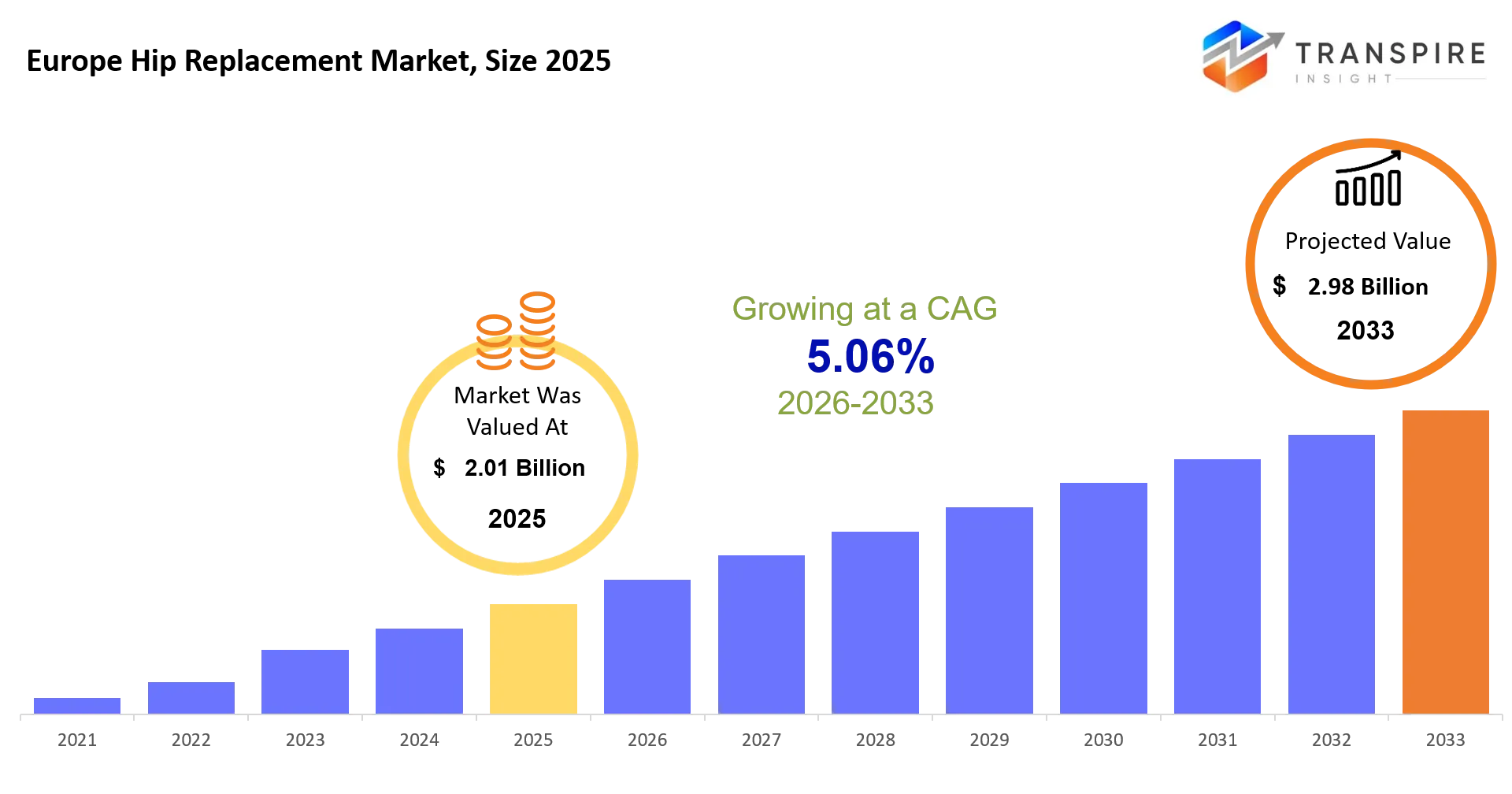
As per Transpire Insight Analysis, the Europe Hip Replacement Market size is estimated at USD 2.01 Billion in 2025 and is anticipated to reach USD 2.98 Billion by 2033, growing at a CAGR of 5.06% from 2026 to 2033.
The Europe Hip Replacement Market is all about supporting patients whose damaged hip joint stop moving the way they should , so they can get their mobility back. It helps restore range of motion , lessen long term discomfort , and generally improve overall quality of life, mainly via advanced orthopedic prostheses and surgical approaches that are sort of customized to the situation. In the last 3–5 years , there has been a noticeable pivot toward personalized implants, less invasive methods, and digital planning tools. Those tools help surgeons be more precise ,and may support better recovery results too, even if everyone measures it a little differently.
Also, the aging population plus longer life expectancy , along with a stronger emphasis on staying active, has boosted demand for durable joint repair and restoration procedures. Then came the COVID-19 pandemic, which interrupted elective operations and left many systems with procedure backlogs. After that, hospitals pushed harder to increase surgical capacity and speed up patient flow, even if it meant reorganizing teams and timelines. Meanwhile, supply chain adjustments and local manufacturing efforts have shaped procurement strategies in a big way. Together these shifts are encouraging adoption of newer implant designs and reinforcing investment across orthopedic care networks.
Europe Hip Replacement Market Size & Forecast:
- Europe Hip Replacement Market Size 2025: USD 2.01 Billion
- Expected Market Value 2033: USD 2.98 Billion
- Forecast CAGR: 5.06%
- Leading region in 2025: Germany
- Fastest Growing region: United Kingdom
- Key Profile: Zimmer Biomet, Stryker, Johnson & Johnson MedTech, Smith+Nephew, Medtronic, Exactech, Corin Group, B. Braun, MicroPort Orthopedics, LimaCorporate, DJO Global, Aesculap, Waldemar Link, Conformis, Enovis
Key Market Insights
- Germany kind of dominates Europe in 2025 with an estimated 30%+ market share, mostly due to advanced orthopedic infrastructure and really high procedure volumes, like it’s pretty clear.
- The United Kingdom shows up as the fastest-growing region during 2025–2033, because healthcare capacity is expanding and elective surgery recovery programs are catching up, steadily.
- In the product space, total hip replacement implants are leading that segment, they hold over 60% share, and that’s backed by wide clinical adoption across Europe.
- Revision hip replacement products come next in the second-largest segment position, since aging implants end up needing replacement procedures after long-term use, sooner or later.
- Robotic-assisted and personalized implant solutions are the fastest-grower segment through 2033, enabled by digital surgical planning, and it sort of ties everything together.
- On the applications side, osteoarthritis treatment dominates with around 70% share in 2025, largely driven by aging populations and mobility challenges that keep increasing.
- Meanwhile trauma-related hip replacement applications are expanding the quickest, because accident cases and emergency orthopedic interventions are rising across European hospitals.
- Looking at end users, hospitals lead adoption with more than 65% share, supported by specialized orthopedic departments and reimbursement systems that actually work in practice.
- Ambulatory surgical centers are the fastest-growing end-user category through 2033, as healthcare providers move toward more efficient outpatient procedures, bit by bit.
- Stryker, meanwhile, expanded its orthopedic portfolio via investments in robotic-assisted surgery, which strengthens precision joint replacement capabilities, and it sounds quite deliberate.
What are the Key Drivers, Restraints, and Opportunities in the Europe Hip Replacement Market?
Aging demographics still feel like the main thing pushing the Europe Hip Replacement Market forward, at least for now. The whole shift sort of started when many European healthcare systems saw more cases of osteoarthritis and also age-related joint deterioration. Then, as implant durability got better, and minimally invasive surgical methods showed up more often, recovery periods got shorter . That made it easier for hospitals to do additional procedures, not just the urgent ones. And yeah, this tech change kind of translates into higher procedure volumes , because patients and surgeons can think about replacement earlier, with better long-term outcomes overall. Germany, France and the United Kingdom are also boosting orthopedic capacity, so implant adoption grows, and healthcare revenue growth follows.
On the other side, the biggest structural obstacle is the high price of advanced implants, robotic systems, and specialized surgical training. Hospitals can not fix these issues quickly, because procurement cycles, reimbursement approvals, and infrastructure upgrades take a lot of time to align. So , based on a Transpire Insight review of regional procurement notices and launch timing, supply chain concentration is still the main execution risk. If there are delays in component availability, or if manufacturing needs adjustments, implant deliveries can get postponed, and then procedure scheduling gets squeezed. In the end, that slows revenue conversion for suppliers, even when demand stays steady.
The next growth phase is probably going to come from AI enabled surgical planning plus tailored implants. At the same time, investments in digital orthopedic platforms are opening some real windows for hospitals to push for higher precision and also lower revision risks. It looks like the United Kingdom and Germany should be able to take these solutions sooner, mostly because they have stronger healthcare digitization drives and more specialized orthopedic centers.
What Has the Impact of Artificial Intelligence Been on the Europe Hip Replacement Market?
Artificial intelligence and digital technologies are kind of reshaping hip replacement procedures, like through surgical planning that feels more precise, better patient assessment, and smoother operational coordination too. AI-based platforms look at medical imaging data to help with implant selection and also to automate preoperative measurements, while at the same time supporting workflow management for orthopedic teams. Machine learning models are additionally used to forecast procedure volumes, steer inventory planning, and even flag patients who might need intervention earlier. With these kinds of capabilities hospitals can reduce scheduling delays, make resource utilization feel less wasteful, and aim for more predictable surgical outcomes.
Digital navigation systems and robotic-assisted platforms are also improving procedural accuracy, and some facilities say they see better consistency in implant positioning, and they even report lower revision risks. Still, adoption is limited because implementation costs are high, integration with existing hospital systems gets complicated, and standardized clinical data isn’t always available in a consistent way. Smaller healthcare providers often struggle with investing in advanced infrastructure, plus they may lack time or budget for training staff properly. Even so, AI-driven tools are becoming a meaningful part of modern orthopedic care strategies across European healthcare networks.
Key Market Trends
- After 2020 robotic assisted hip surgery adoption started to speed up, in Europe especially, once hospitals put more money into precision technologies and tried to keep surgical steps more consistent, though in practice it was not always fully uniform.
- Between 2021 and 2025 personalized implants really took off, largely because digital imaging became more common and it supported orthopedic solutions that were more patient specific.
- Starting 2022, many European hospitals went further with outpatient joint replacement pathways, aiming to cut waiting lists and also to increase the actual surgical throughput, which sounds simple but the logistics got messy at times.
- Once the 2020 disruptions hit, supply chain diversification turned into a real focus , because device availability and implant procurement timelines were getting unpredictable.
- In Germany investment in orthopedic technology centers grew during 2023 to 2025, so the country leaned harder into advanced joint care and that helped its standing.
- After 2021 AI driven surgical planning platforms showed up more often, supporting surgeons with implant positioning, and even with preoperative decisions that used to be more experience based.
- Sustainability requirements also started shaping what implant manufacturers did after 2022, pushing efficient production methods and more disciplined material management.
- From 2023 onward private orthopedic facilities expanded across Europe, which created extra pathways for quicker-access joint replacement procedures, sometimes with shorter scheduling windows.
- Revision surgery solutions became more important starting around 2020, because people are living longer and that in turn lifted demand for durable implant performance.
- In 2024 strategic partnerships between technology providers and orthopedic manufacturers increased, as some companies chased integrated digital surgery ecosystems , tying planning data to the actual workflow.
Europe Hip Replacement Market Segmentation
By Product Type :
Total hip replacement kinda holds a big spot in modern practice, due to high usage when advanced osteoarthritis shows up, and also because age related joint damage keeps building over time. Partial hip replacement, well, fits selected situations where the joint damage is more limited. This is often useful for older patients who need faster recovery, kind of, you know, sooner. Revision hip replacement also matters, especially when earlier implants hit the end of their lifespan after long term use, and then replacement stages become unavoidable.
Cementless implants are being adopted more and more, mainly because fixation methods improved a lot, so the implant can stay stable longer and there is less dependence on bone cement. Hybrid implants mix cemented and cementless thinking, which gives surgeons more room to choose what fits the surgical setup. Custom implants are getting attention too, since personalized designs are now supported by digital planning tools and advanced manufacturing methods, so the fit feels more intentional than before.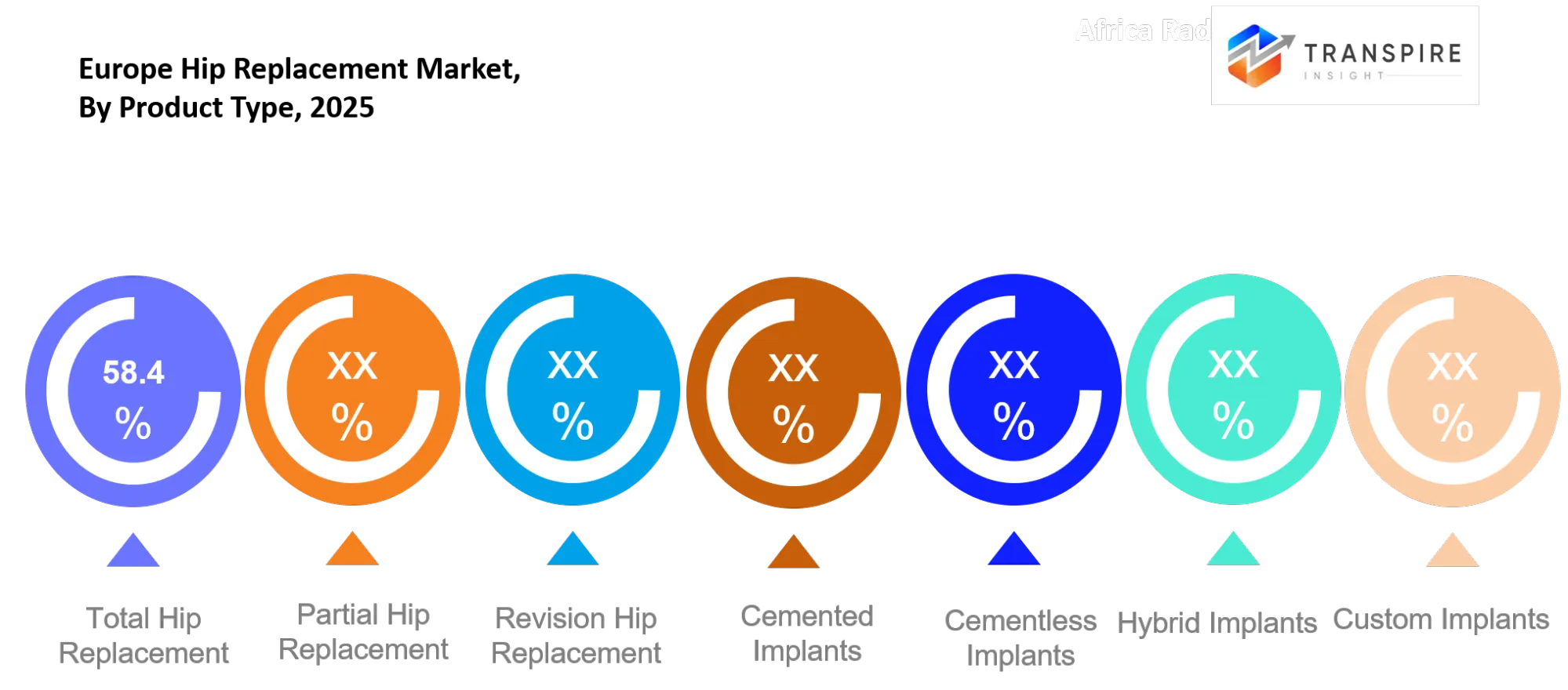
By Material :
In terms of bearings, metal on polyethylene stays in broad use. That’s largely because it’s cost friendly, it has proven clinical performance, and it’s widely available across many healthcare facilities. Ceramic on ceramic is leaning more favorable in recent years, due to lower wear rates and better durability compared with older pairings. Ceramic on polyethylene tries to strike a middle ground, giving a balance between performance and affordability for a lot of orthopedic procedures.
Material wise, titanium alloys and cobalt-chromium alloys are still key because they bring strength, corrosion resistance, and good biocompatibility, which helps long-term implant performance. Composite materials are also starting to show up more, through ongoing research focused on lighter structures, plus improved mechanical properties. And overall, material innovation will likely keep supporting advanced implant development, which should translate into improved surgical outcomes, even if the exact results depend on the case.
By End User :
Hospitals are still the biggest end-user slice, because they have advanced surgical infrastructure, plenty of specialists, and higher procedure volume. Orthopedic clinics keep growing their offerings too, sort of as healthcare systems lean toward specialized joint care and quicker treatment pathways. Also ambulatory surgical centers are getting more momentum for outpatient procedures, with shorter hospitalization periods and better day to day operations, so it feels more efficient.
Specialty centers , along with academic hospitals, help innovation move forward through clinical research, advanced training programs and the uptake of new surgical technologies. Rehabilitation centers matter a lot for after-surgery recovery, especially with mobility improvement programs. Meanwhile, government hospitals keep supporting access to joint replacement through public healthcare initiatives and reimbursement frameworks, even when budgets are tight.
By Application :
Osteoarthritis stays the leading application area, driven by aging populations, lifestyle factors, and more cases of joint degeneration. Rheumatoid arthritis still adds to the procedure counts, since chronic inflammation can slowly damage hip joints. On top of that, trauma and hip fractures add extra surgical needs, mainly among older people who are more vulnerable to falls.
Avascular necrosis needs a more careful approach, because reduced blood supply harms bone tissue and can limit mobility. Revision surgeries are becoming more noticeable too, as older implants often need replacement after longer usage periods. Congenital disorders are a smaller segment, but they continue to get attention via specialized orthopedic care and improved surgical techniques.
By Procedure Type :
Minimally invasive procedures are getting more traction because smaller incisions, quicker recovery windows, and fewer hospital stays seem to correlate with better patient outcomes. Robotic assisted procedures are also spreading, not just for improved accuracy, but for digital planning tools as well ,and a heightened feel of surgical control . Meanwhile, conventional procedures are still used a lot since established clinical methods are already in place and they’re available across most healthcare facilities.
Outpatient procedures are rising in number too, mainly because hospitals want a more cost-efficient care model and faster patient turnover. Bilateral procedures help patients who need treatment on both hips as part of a planned surgical path . Personalized procedures are picking up steam as advanced imaging improves, customized implants become more common, and data-driven surgical planning solutions help shape the whole workflow .
What are the Key Use Cases Driving the Europe Hip Replacement Market?
Hip replacement solutions still sit at the middle of the osteoarthritis treatment story , kinda. Most procedures are pushed forward by hospitals and orthopedic clinics. Older patients, joint deterioration situations, and mobility related constraints build up steady clinical demand, because care teams need dependable implants to help restore motion and support better patient results, overall.
At the same time trauma care and revision surgeries are starting to get more attention at specialty centers and rehabilitation networks. Hospitals tend to buy advanced replacement systems for fracture connected cases. Then orthopedic clinics handle the implant replacement work that comes after earlier surgeries, so it sort of cascades.
Robotic-assisted approaches, plus customized implants, are other directions that look promising. Academic hospitals and high end surgical centers are using digital tools to boost surgical accuracy, often tied to healthcare modernization efforts across Europe.
|
Report Metrics |
Details |
|
Market size value in 2025 |
USD 2.01 Billion |
|
Market size value in 2026 |
USD 2.11 Billion |
|
Revenue forecast in 2033 |
USD 2.98 Billion |
|
Growth rate |
CAGR of 5.06% from 2026 to 2033 |
|
Base year |
2025 |
|
Historical data |
2021 - 2024 |
|
Forecast period |
2026 - 2033 |
|
Report coverage |
Revenue forecast, competitive landscape, growth factors, and trends |
|
Country scope |
Europe (Germany, United Kingdom, France, Italy, Spain and Rest of Europe) |
|
Key company profiled |
Zimmer Biomet, Stryker, Johnson & Johnson MedTech, Smith+Nephew, Medtronic, Exactech, Corin Group, B. Braun, MicroPort Orthopedics, LimaCorporate, DJO Global, Aesculap, Waldemar Link, Conformis, Enovis . |
|
Customization scope |
Free report customization (country, regional & segment scope). Avail customized purchase options to meet your exact research needs. |
|
Report Segmentation |
By Product Type (Total Hip Replacement, Partial Hip Replacement, Revision Hip Replacement, Cemented Implants, Cementless Implants, Hybrid Implants, Custom Implants, Others); By Material (Metal-on-Polyethylene, Ceramic-on-Ceramic, Ceramic-on-Polyethylene, Metal-on-Metal, Titanium Alloys, Cobalt-Chromium Alloys, Composite Materials, Others); By End User (Hospitals, Orthopedic Clinics, Ambulatory Surgical Centers, Specialty Centers, Academic Hospitals, Rehabilitation Centers, Government Hospitals, Others); By Application (Osteoarthritis, Rheumatoid Arthritis, Trauma, Avascular Necrosis, Hip Fractures, Congenital Disorders, Revision Surgeries, Others); By Procedure Type (Minimally Invasive Procedures, Robotic Assisted Procedures, Conventional Procedures, Outpatient Procedures, Bilateral Procedures, Revision Procedures, Personalized Procedures, Others) |
Which Regions are Driving the Europe Hip Replacement Market Growth?
Germany makes up roughly 30% of regional revenue, so it is kind of the main market across Europe. The reimbursement rules stay strong, orthopedic hospitals are well advanced, and there is broad access to specialized surgeons which helps keep procedure volumes steady. There is also a matured network of implant manufacturers, research collaborations, and investments in medical technology, all of which bolster the regional supply chain and keep product availability reliable. Looking ahead, continued spend on digital surgery platforms and orthopedic innovation should help maintain leadership throughout the whole forecast window.
France sits as the second-largest regional market mostly because healthcare spending follows stable long term planning, and reimbursement policies are fairly predictable too. National healthcare programs push for timely access to joint replacement procedures while still keeping consistent quality benchmarks across public and private hospitals. Hospitals work in tandem with academic groups, and medical device suppliers, which creates a dependable buying setup. This balanced arrangement makes France a solid contributor to regional revenue even if its growth trajectory is a bit different than Germany.
The United Kingdom is projected to see the quickest growth in 2026–2033, after wider investment aimed at trimming elective surgery backlogs and making orthopedic care feel more modern,or at least the processes around it. Broader uptake of robotic-assisted procedures plus digital surgical planning has helped improve procedure efficiency across big healthcare providers. At the same time, increased spending on outpatient orthopedic services is opening extra room for joint replacement procedures. All of this momentum should make appealing opportunities for manufacturers, technology providers and also investors who are looking for longer-term expansion across the regional orthopedic sector.
Who are the Key Players in the Europe Hip Replacement Market and How Do They Compete?
Competition still feels moderately consolidated in a way, because only a handful of global orthopedic manufacturers end up taking most of the advanced implant sales. On the whole it’s not really price alone that drives the game , it’s more like technology innovation plus clinical results, and even surgeon support , all of that together. The bigger, established firms keep reinforcing their market positions using digital surgery platforms , while the more specialized players try to stand out via more differentiated implant designs and practical workflow solutions , or so it seems.
Stryker differentiates by robotic-assisted orthopedic systems, those help with implant placement and overall surgical accuracy. Their continued investment in digital surgery platforms keeps strengthening hospital partnerships and it also tends to expand procedure volumes across Europe, which is pretty central. Zimmer Biomet leans into personalized implants and connected surgical technologies that improve clinical planning and support patient specific care. They keep developing products so adoption grows across orthopedic centers, steadily.
DePuy Synthes pushes forward through advanced implant portfolios with surgeon education behind it and via clinical research collaborations. Smith+Nephew competes by pairing orthopedic implants with enabling technologies, which improves procedural efficiency and also recovery outcomes. B. Braun, for its part, builds regional strength through integrated surgical solutions, hospital partnerships, and continuous investment in orthopedic product development, and that— somehow— ends up giving broader access across European healthcare systems.
Company List
- Zimmer Biomet
- Stryker
- Johnson & Johnson MedTech
- Smith+Nephew
- Medtronic
- Exactech
- Corin Group
- B. Braun
- MicroPort Orthopedics
- LimaCorporate
- DJO Global
- Aesculap
- Waldemar Link
- Conformis
- Enovis
Recent Development News
In July 2025, Embody Orthopaedic received CE Mark certification for its H1 ceramic hip resurfacing implant, the first non-metal hip resurfacing device approved under the EU Medical Device Regulation. The approval expands treatment eligibility for women and smaller patients while supporting wider commercialization across Europe. Source https://www.imperial.ac.uk/
In June 2025, Exactech launched the Alteon® Short Tapered Wedge Hip Stem, with the first patient treated using the new implant system. The product expands the company's hip replacement portfolio by offering a bone-conserving stem designed to fit a broader range of patient anatomies. Source https://www.prnewswire.com/
What Strategic Insights Define the Future of the Europe Hip Replacement Market?
The Europe Hip Replacement Market is going to move in a more data-centric orthopedic care direction, kind of built around personalized implants, robotic assisted surgery, and digitally connected clinical flows, over the next five to seven years. That shift will be pushed by healthcare systems trying to secure better long term results, while still handling higher procedure counts with fewer clinical resources available, it’s like a balancing act. There is also a quieter kind of risk, which is the dependency on a fairly concentrated supplier base for advanced implant materials and precision parts. That can cause delays in production and make product availability wobble, even if real clinical demand is still strong.
At the same time an opportunity is starting to show up, mainly via AI supported surgical planning and patient specific implant manufacturing, especially in countries that are investing a lot in healthcare digitalization and in advanced orthopedic centers. The companies that manage to create hospital partnerships, expand localized manufacturing, and put money into integrated digital surgery platforms will likely be in a stronger spot. They can improve market access, boost supply resilience, and ultimately catch the longer term growth across the whole regional orthopedic industry.
Europe Hip Replacement Market Report Segmentation
By Product Type
- Total Hip Replacement
- Partial Hip Replacement
- Revision Hip Replacement
- Cemented Implants
- Cementless Implants
- Hybrid Implants
- Custom Implants
By Material
- Metal-on-Polyethylene
- Ceramic-on-Ceramic
- Ceramic-on-Polyethylene
- Metal-on-Metal
- Titanium Alloys
- Cobalt-Chromium Alloys
- Composite Materials
By End User
- Hospitals
- Orthopedic Clinics
- Ambulatory Surgical Centers
- Specialty Centers
- Academic Hospitals
- Rehabilitation Centers
- Government Hospitals
By Application
- Osteoarthritis
- Rheumatoid Arthritis
- Trauma
- Avascular Necrosis
- Hip Fractures
- Congenital Disorders
- Revision Surgeries
By Procedure Type
- Minimally Invasive Procedures
- Robotic Assisted Procedures
- Conventional Procedures
- Outpatient Procedures
- Bilateral Procedures
- Revision Procedures
- Personalized Procedures
Frequently Asked Questions
Find quick answers to common questions.
The Expected Europe Hip Replacement Market size for the Market will be USD 2.98 Billion in 2033.
Key Segments for the Europe Hip Replacement Market are By Product Type (Total Hip Replacement, Partial Hip Replacement, Revision Hip Replacement, Cemented Implants, Cementless Implants, Hybrid Implants, Custom Implants, Others); By Material (Metal-on-Polyethylene, Ceramic-on-Ceramic, Ceramic-on-Polyethylene, Metal-on-Metal, Titanium Alloys, Cobalt-Chromium Alloys, Composite Materials, Others); By End User (Hospitals, Orthopedic Clinics, Ambulatory Surgical Centers, Specialty Centers, Academic Hospitals, Rehabilitation Centers, Government Hospitals, Others); By Application (Osteoarthritis, Rheumatoid Arthritis, Trauma, Avascular Necrosis, Hip Fractures, Congenital Disorders, Revision Surgeries, Others); By Procedure Type (Minimally Invasive Procedures, Robotic Assisted Procedures, Conventional Procedures, Outpatient Procedures, Bilateral Procedures, Revision Procedures, Personalized Procedures, Others).
Major Europe Hip Replacement Market players are Zimmer Biomet, Stryker, Johnson & Johnson MedTech, Smith+Nephew, Medtronic, Exactech, Corin Group, B. Braun, MicroPort Orthopedics, LimaCorporate, DJO Global, Aesculap, Waldemar Link, Conformis, Enovis .
The Current Europe Hip Replacement Market size is USD 2.01 Billion in 2025.
The Europe Hip Replacement Market CAGR is 5.06% from 2026 to 2033.
- Zimmer Biomet
- Stryker
- Johnson & Johnson MedTech
- Smith+Nephew
- Medtronic
- Exactech
- Corin Group
- B. Braun
- MicroPort Orthopedics
- LimaCorporate
- DJO Global
- Aesculap
- Waldemar Link
- Conformis
- Enovis
About the Authors

Pankaj Ghogare Patil
I am Pankaj Ghogare Patil, a Senior Research Analyst at Transpire Insight, specializing in the Pharmaceutical, Chemicals & Materials, Healthcare IT, and Biotechnology industry. My expertise lies in conducting comprehensive market research, analyzing industry trends, evaluating competitive landscapes, and translating complex data into actionable insights. At Transpire Insight, I closely follow emerging technologies, regulatory developments, and market innovations to create accurate, well-researched, and informative content that helps businesses and professionals make informed decisions. I am committed to producing credible, evidence-based articles that reflect industry best practices while making technical topics accessible and valuable for a broad audience.

Chakradhar Khansole
Chakradhar serves as the Research Director at Transpire Insight, bringing over 8 years of experience in technology, innovation, and strategic market intelligence. He specializes in transforming complex market data into actionable business insights that enable organizations to make informed, growth-oriented decisions. Recognized for his strategic vision and analytical expertise, Chakradhar leads high-impact research initiatives, delivering comprehensive market assessments, competitive intelligence, and forward-looking industry analysis.
Recently Published Reports
-
Jul 2026
Alopecia Treatment Market
Alopecia Treatment Market Size, Share & Analysis Report By Disease Type (Alopecia Areata, Cicatricial Alopecia, Traction Alopecia, Alopecia Totalis, Androgenetic Alopecia, Alopecia Universalis, and Other Disease Types), By Treatment Type (Topical Treatments, Oral Medications, Injectable Therapies, and Hair Transplantation), By Gender (Male, and Female), By Distribution Channel (Hospitals and Clinics, Retail Pharmacies, and Online Retailers), and Geography (North America, Europe, Asia-Pacific, Middle East and Africa, South and Central America), 2021 - 2031
-
Jul 2026
Medical Ultrasound Probe Market
Medical Ultrasound Probe Market Size, Share & Analysis Report By Type (Linear Type, Convex Type, Endocavitary Probe, Phased Array/Cardiac Probe, Transesophageal (TEE) Probe, and Others), By Application (Ophthalmology, Cardiology, Musculoskeletal, Oncology, Obstetrics & Gynecology, General Imaging, and Others), By End User (Hospitals & Clinics, Diagnostic Centers, Ambulatory Surgical Centers, and Others), and Geography (North America, Europe, Asia-Pacific, Middle East and Africa, South and Central America), 2021 – 2031
-
May 2026
Biosimilars Market
Biosimilars Market By Product Type (Monoclonal Antibodies, Recombinant Hormones, Erythropoietin, G-CSF, Others), By Indication (Oncology, Autoimmune Diseases, Blood Disorders, Diabetes, Others), By Manufacturing Type (In-House Manufacturing, Contract Manufacturing), By Distribution Channel (Hospital Pharmacies, Retail Pharmacies, Online Pharmacies), By Industry Analysis, Size, Share, Growth, Trends, and Forecasts 2021-2033
-
Apr 2026
Gastrointestinal Endoscopy Market
Gastrointestinal Endoscopy Market By Type (Rigid Gastrointestinal Endoscope, Flexible Gastrointestinal Endoscopes, Disposable Gastrointestinal Endoscope), By Procedure Type (Colonoscopy, Gastroscopy, Duodenoscopy, Enteroscopy, Flexible Sigmoidoscopy, Others), By Application (Diagnosis, Treatment), By End-Users (Hospitals, Ambulatory Surgical Centers, Specialty Clinics, Laboratories, Others), By Industry Analysis, Size, Share, Growth, Trends, and Forecasts 2021-2033