
Europe Dropshipping Market Size & Forecast:
- Europe Dropshipping Market Size 2025: USD 73.38 Billion
- Europe Dropshipping Market Size 2033: USD 338.21 Billion
- Europe Dropshipping Market CAGR: 21.05%
- Europe Dropshipping Market Segments:By Product Category (Fashion, Electronics, Home & Living, Beauty Products, Toys, Others); By Platform (Shopify, WooCommerce, Marketplaces, Others); By Business Model (B2B, B2C, C2C, Others); By Supplier Type (Manufacturers, Wholesalers, Aggregators, Others); By Enterprise Size (Large Enterprises, SMEs, Others); By Distribution Channel (Direct Websites, Marketplaces, Social Commerce, Others)
Europe Dropshipping Market Summary
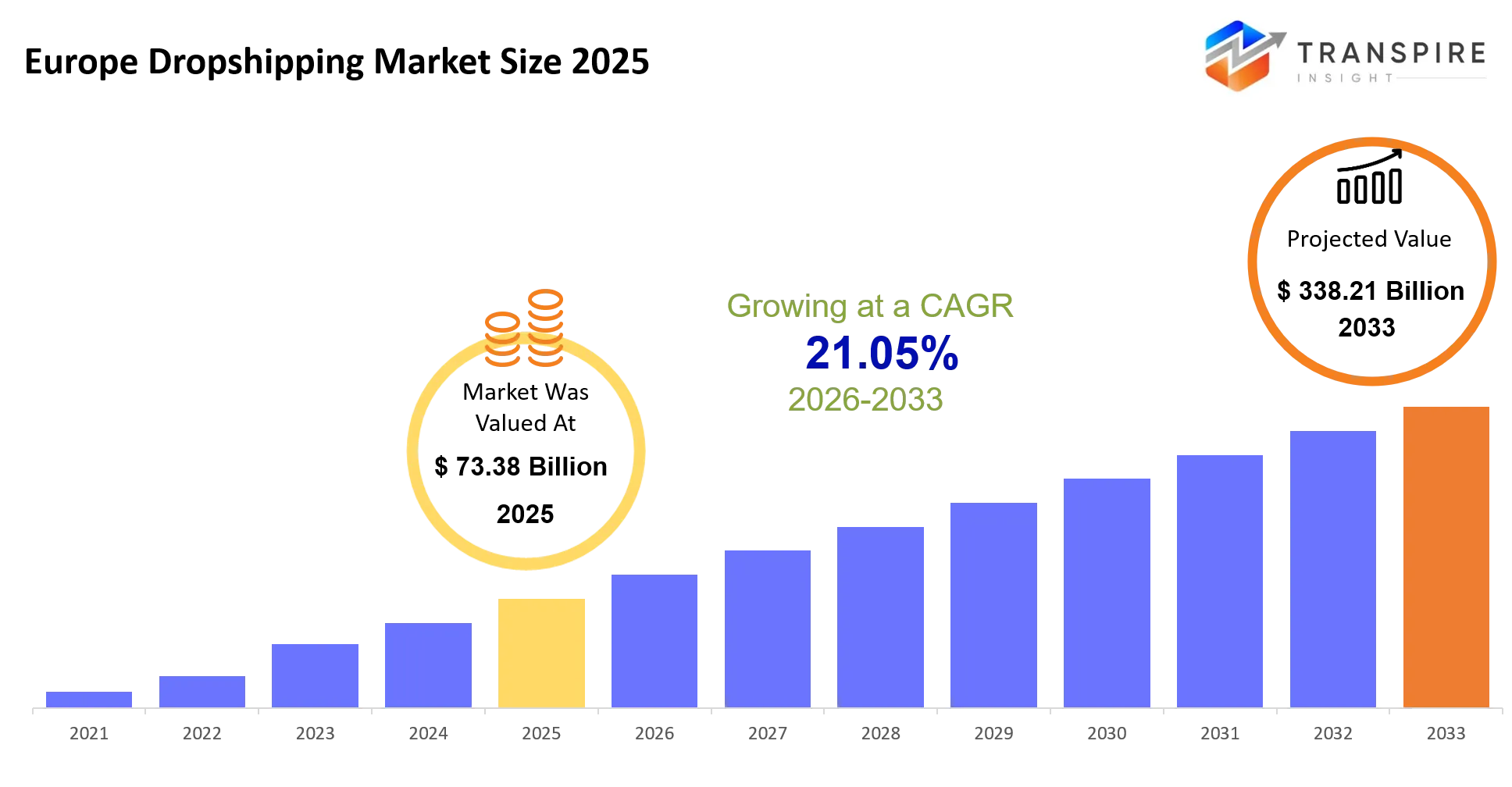
The Europe Dropshipping Market was valued at USD 73.38 billion in 2025. It is forecast to reach USD 338.21 billion by 2033. That is a CAGR of 21.05% over the period.
The Europe AI Agents Market is moving towards systems where AI agents make decisions on their own. These agents will change from helping with tasks to making main decisions in business software. This change is happening because AI is being added to cloud systems quickly. Also companies want to make their operations simpler and faster.
Over the 5 to 7 years companies will focus on using AI agents in their platforms. These platforms will bring together data, workflows and decision-making into automated systems that work all the time.
There is a risk that companies might depend much on a few big cloud providers. This could limit their options. Make it hard to switch to another provider. This might slow down ideas and increase costs for companies. This is especially true for industries that have strict rules.A new opportunity is appearing in Europe. Some countries, like Germany, France and the Nordics are developing their AI agent infrastructure. This infrastructure follows EU rules. Will let companies deploy AI agents safely. Companies should build AI agent platforms that can work in cloud environments. This will help them get long-term contracts and grow in the region.
Key Market Insights
- Western Europe has the part of the Europe Dropshipping Market with about 45 percent in 2025 because a lot of people in Germany, UK and France shop online.
- Eastern Europe is growing the fastest from 2025 to 2030 because more people are getting internet and digital payment systems are getting better.
- Southern Europe is also getting into dropshipping because small businesses are using platforms to sell across borders.
- When it comes to the Europe Dropshipping Market product-based dropshipping is the popular with about 60 percent because people really want to buy electronics and clothes online.
- Service-based dropshipping is growing the fastest because digital products and subscription services are getting more popular.
- Automated dropshipping platforms are getting bigger because they use intelligence to manage inventory and orders.
- Most of the time people use e- retail applications with about 70 percent and this is because of Shopify, WooCommerce and Amazon Marketplace.
- Social commerce is growing the fastest and this is because of TikTok Shop and Instagram where people can sell things.
- Small businesses are the users of dropshipping with about 65 percent because it is cheap to start and they can change their business easily.
- Individual entrepreneurs are growing the fastest. This is because they can use artificial intelligence tools and e-commerce platforms that do not need coding.
What are the Key Drivers, Restraints, and Opportunities in the Europe Dropshipping Market?
Drivers
The Europe Dropshipping Market is growing fast because of shopping platforms that let people sell products without holding any stock. This change happened because digital payment systems got better and online selling platforms like Shopify and WooCommerce became popular. These platforms help individuals and small businesses start stores easily without needing a warehouse. As a result more stores are being built. Products are being listed faster which means more transactions are happening and platform providers and logistics partners are making more money.
Restraints
A big problem with Dropshipping is that it relies heavily on suppliers from countries and complicated international delivery networks. This can cause delays, poor product quality and a lack of control over delivery making customers lose trust. This issue is hard to fix because it involves working with suppliers and governments across countries. As a result some customers don't complete their purchases. It's hard for new dropshipping businesses to keep customers especially in crowded markets.
Opportunity
One exciting opportunity for growth is using intelligence to automate dropshipping. This can help choose the products, set prices and match suppliers in real-time. Eastern Europe is becoming an area for this growth because more small businesses are using digital tools and e-commerce infrastructure is improving. With the help of AI platforms can predict demand. Deliver products faster which can lead to more sales and better profits for the Europe Dropshipping Market. The Europe Dropshipping Market can benefit from this. Dropshipping can become more efficient, with the help of AI. The Europe Dropshipping Market will grow with AI- dropshipping.
What Has the Impact of Artificial Intelligence Been on the Europe Dropshipping Market?
E-commerce is changing because of intelligence and new digital technologies. These things are helping with order fulfillment in the dropshipping world. They do this by choosing the best way to send orders, picking good suppliers and keeping track of inventory across many platforms.Tools that use intelligence are part of Shopify, WooCommerce and other automation software. These tools always check if products are available. How long it takes to ship them. This helps decide which orders to send where in time. It means people do not have to get involved much and things get done faster even when buying and selling across borders.
People use machine learning to figure out what products will be popular and how to make them sell better. This helps sellers find products that will do well before they spend a lot of money on them. These systems look at what sold what people in different areas like to buy and what is popular at different times of the year. This makes it easier to decide what to keep in stock and reduces mistakes with orders. Many sellers say they sell more and have fewer products returned because they can pick suppliers and set good prices.Artificial intelligence also helps with the day to day work. It makes things cheaper by not wasting money on ads and by using intelligence to answer customer questions. This means customers get answers faster and are more likely to come. However it is hard to set up because different suppliers have systems and the information from some vendors is not very good. Also different companies do logistics and fulfillment in ways, which makes it hard to optimize in real time. This is especially hard for sellers who work with many international marketplaces.
Key Market Trends
- Since 2023 the Europe Dropshipping Market changed from managing stores to using automation tools with AI that work with Shopify and WooCommerce.
- From 2024 to 2026 Shopify sellers started to use tools that automatically sync with suppliers, which helped reduce stockouts in e-commerce stores across Europe.
- AliExpress and CJ Dropshipping improved their logistics partnerships in Europe after 2024, which sped up -border deliveries and reduced delays.
- Sellers in Eastern Europe began to use dropshipping models after 2025 because digital payments got better and it became easier for small and medium-sized businesses to start.
- Social commerce platforms like TikTok Shop became popular after 2024. People started finding products through algorithms instead of searching for them.
- After 2023 most sellers started using automated pricing algorithms, which helped them change their prices based on what competitors were charging and how demand there was.
- There were suppliers in Europe because sellers started working with a smaller number of big Asian fulfillment partners.
- Over 60% of dropshipping stores that started in 2025 used AI chatbots instead of human customer support, which helped them respond faster.
- After 2024 there were rules about cross-border sales so sellers had to start using tools that helped them follow tax and customs rules.
- It got more competitive because it was easy for medium-sized businesses to start selling and they had to make their products different from others in their category.
Europe Dropshipping Market Segmentation
By Platform and Technology:
Dropshipping platforms help create stores and list products on many e-commerce sites. Shopify-based systems are popular because they have tools for setting up stores and managing orders. WooCommerce platforms are also used a lot because they can be customized for businesses. Automation tools are getting better at syncing products, updating prices and working with suppliers on marketplaces. AI technology helps make operations more accurate by tracking inventory in time and analyzing demand. Machine learning helps choose products and reduces order failures. Cloud-based platforms let online stores grow faster without investing in infrastructure. Technology keeps improving efficiency in -border retail.
By Product Type and Category:
Consumer electronics are in demand because many people buy them online and suppliers are available worldwide. Fashion and apparel are also popular with demand from European online shoppers. Home and lifestyle products are growing as more people shop online. Many different products support the growth of dropshipping businesses. Health and beauty products are growing as people shop online for wellness products. New product categories are emerging because of targeted marketing. Product variety helps new sellers join e-commerce platforms. More product categories make the market stronger.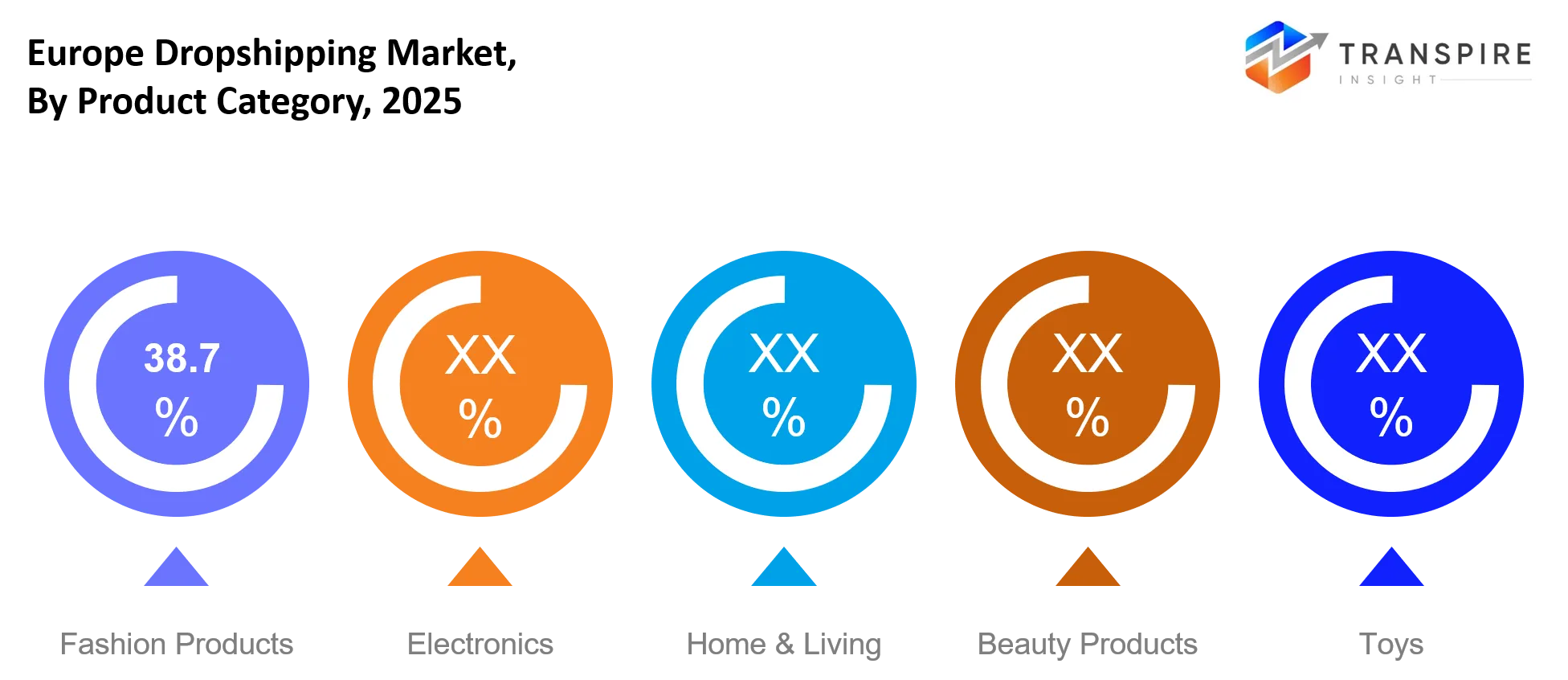
By End User and Business Model:
Small and medium enterprises use dropshipping the most because it's cheap to start. Independent online sellers are also growing because of storefronts. Large enterprises use dropshipping for online sales channels. More businesses are adopting dropshipping across retail categories. E-commerce startups are growing because it's easy to create stores and automate logistics. Retail entrepreneurs use platform-based systems for inventory- businesses. Cross-border sellers expand using fulfillment networks. More end-users support retail growth.
By Distribution and Sales Channel:
Online marketplaces are the distribution channels because sellers want product visibility. Direct-to-consumer websites are growing through branded stores. Social commerce channels are growing fast because of algorithm-driven product discovery. Channel diversification helps sellers reach customers across Europe. Third-party logistics integration improves delivery efficiency. Digital payment systems support transactions and order completion. Automated fulfillment systems reduce work for sellers. Distribution systems keep evolving with technology.
By Geography and Regional Demand:
Western Europe leads the Europe Dropshipping Market because of e-commerce and high digital adoption. Germany, France and the United Kingdom are demand centers for online retail. Advanced logistics infrastructure supports delivery and higher consumer trust. Western Europe stays dominant because of established retail ecosystems. Eastern Europe is growing fast because of increasing internet access and SME participation in e-commerce. Southern Europe is expanding steadily because of rising payment adoption. Regional diversification increases seller opportunities across countries. Geographic expansion strengthens the market.
What are the Key Use Cases Driving the Europe Dropshipping Market?
The main thing about Dropshipping in Europe is that it helps people make stores. Medium sized businesses and individual sellers use this to sell products without having to store them. This is an idea because it saves money on storage and you do not have to pay a lot of money to start. This means you can make your store bigger quickly using things like Shopify and WooCommerce.
There are ways that Dropshipping is used too. For example it can help with getting orders to people and selling to people in countries. It does this by working with companies that handle logistics and payments. Small. People who sell things online like to use these systems because they help with talking to suppliers and changing prices. They also help with sending things to people in countries, which makes things easier and saves time.
Some new ways that Dropshipping is being used are with computers that can pick products that will be popular. These computers can also predict what people will want to buy before everyone else is selling it. Dropshipping is also being used with media, like TikTok and Instagram. This lets people sell things directly to customers using tools that help people find products they like. This is a way for people to sell things and it is getting more popular.
|
Report Metrics |
Details |
|
Market size value in 2025 |
USD 73.38 Billion |
|
Market size value in 2026 |
USD 88.82 Billion |
|
Revenue forecast in 2033 |
USD 338.21 Billion |
|
Growth rate |
CAGR of 21.05% from 2026 to 2033 |
|
Base year |
2025 |
|
Historical data |
2021 - 2024 |
|
Forecast period |
2026 - 2033 |
|
Report coverage |
Revenue forecast, competitive landscape, growth factors, and trends |
|
Regional scope |
Europe |
|
Key company profiled |
Shopify, AliExpress, CJ Dropshipping, Spocket, SaleHoo, Printful, Oberlo, BigBuy, Syncee, Modalyst, Doba, AutoDS, Wholesale2B, Zendrop, BigCommerce |
|
Customization scope |
Free report customization (country, regional & segment scope). Avail customized purchase options to meet your exact research needs. |
|
Report Segmentation |
By Product Category (Fashion, Electronics, Home & Living, Beauty Products, Toys, Others); By Platform (Shopify, WooCommerce, Marketplaces, Others); By Business Model (B2B, B2C, C2C, Others); By Supplier Type (Manufacturers, Wholesalers, Aggregators, Others); By Enterprise Size (Large Enterprises, SMEs, Others); By Distribution Channel (Direct Websites, Marketplaces, Social Commerce, Others) |
Which Regions are Driving the Europe Dropshipping Market Growth?
Western Europe is the leader of the Europe Dropshipping Market. This is because Western Europe has a base for online shopping. People in Western Europe have a lot of money to spend and Western Europe has very good systems for moving things around. Countries like Germany, the United Kingdom and France are very good at helping people buy things online from countries. They have systems in place for paying for things online and many people use platforms like Shopify, Amazon and WooCommerce to buy and sell things. The rules and laws in Western Europe also help people trust that they can buy things online safely.
Northern Europe is also a contributor to the Europe Dropshipping Market. This is because people in Northern Europe are very good at using computers and the internet and they like to buy things. Northern Europe is different from Western Europe because it focuses more on using technology to make things easier than just trying to do a lot of things. Countries like Sweden, Denmark and the Netherlands use a lot of automated tools to help with shopping. They also have good internet connections and people trust that it is safe to pay for things online. Many medium-sized businesses are involved in online shopping in Northern Europe which helps keep the market stable.
Eastern Europe is growing quickly. This is because more and more people in Eastern Europe are getting access to the internet and medium-sized businesses are starting to sell things online. It is also getting easier for people to pay for things online and for businesses to move things around. Countries like Poland and Romania are seeing a lot of growth in shopping and people buying things from other countries. This will likely attract e-commerce companies and logistics providers which will create many opportunities for investment, between 2026 and 2033. The Europe Dropshipping Market in Eastern Europe will continue to grow and change in the coming years.
Who are the Key Players in the Europe Dropshipping Market and How Do They Compete?
The Europe Dropshipping Market shows a highly fragmented competitive structure where thousands of SMEs, independent sellers, and platform-based businesses operate simultaneously across digital storefront ecosystems. Competition is primarily driven by technology efficiency, supplier access, and fulfillment speed rather than traditional pricing models alone. Established e-commerce platforms defend their positions by strengthening automation tools, while new entrants continuously disrupt the market through niche product targeting and AI-powered store management systems. Rapid platform innovation has lowered entry barriers, intensifying competition across product categories.
Shopify strengthens its position by providing an integrated dropshipping ecosystem that combines storefront creation, payment processing, and supplier connectivity in a single platform. Its competitive advantage lies in automation tools that simplify store management for SMEs. Shopify expands across Europe through partnerships with logistics providers and AI-driven commerce features that improve seller conversion rates and operational efficiency.AliExpress competes through its large global supplier network, offering low-cost product sourcing and extensive catalog access for dropshipping businesses. Its differentiation comes from direct manufacturer integration, which reduces sourcing costs for sellers. Expansion is driven by improved European logistics partnerships and faster cross-border fulfillment capabilities.
CJ Dropshipping focuses on end-to-end fulfillment services, including product sourcing, warehousing, and shipping optimization. Its advantage lies in integrated logistics solutions that reduce delivery delays and improve order reliability. The company expands by building regional warehouses in Europe to shorten delivery times and improve service consistency.Spocket differentiates itself through strong integration with US and European suppliers, improving product quality and delivery speed for Western markets. Its competitive strategy focuses on curated supplier networks rather than mass listings. Expansion efforts include strengthening partnerships with EU-based suppliers and enhancing platform automation tools for small business sellers.
Company List
- SaleHoo
- Printful
- Oberlo
- BigBuy
- Syncee
- Modalyst
- Doba
- AutoDS
- Wholesale2B
- Zendrop
- BigCommerce
Recent Development News
In January 2026, Shopify announced the Universal Commerce Protocol (UCP) in partnership with Google, enabling AI agents to discover, recommend, and complete transactions across merchant platforms. The initiative strengthens agentic commerce adoption in Europe by allowing seamless integration of AI-driven shopping across Google AI Mode and Gemini ecosystems, improving automated retail conversion.
https://www.shopify.com
In September 2025, Shopify and OpenAI entered a strategic partnership enabling merchants to sell products directly inside ChatGPT conversations through instant checkout capabilities. This development significantly enhances dropshipping and e-commerce conversion efficiency by reducing friction between product discovery and purchase decision-making.
https://www.openai.com
In January 2026, Google introduced its AI Shopping and agentic commerce ecosystem, built on UCP, allowing AI agents to handle product research, checkout, and post-purchase support across retail platforms. This strengthens AI-driven retail automation across European e-commerce ecosystems and increases demand for structured product data integration.
https://about.google
What Strategic Insights Define the Future of the Europe Dropshipping Market?
The Europe Dropshipping Market is structurally moving toward AI-orchestrated commerce ecosystems where product discovery, pricing, and fulfillment will increasingly operate through automated agent-based systems. This direction is driven by rapid integration of generative AI into e-commerce platforms and the growing need for frictionless cross-border retail execution. Over the next five to seven years, platform-led ecosystems will replace fragmented seller operations, creating highly automated retail networks that reduce manual intervention and accelerate transaction cycles.
A less visible risk is increasing platform concentration, where a small number of global e-commerce and cloud providers control most dropshipping infrastructure. This dependency could reduce pricing flexibility for sellers and create vulnerability to algorithm or policy changes within dominant platforms. It may also limit innovation for smaller players who rely heavily on third-party ecosystem rules.
An emerging opportunity lies in localized EU fulfillment networks integrated with AI-driven demand forecasting, particularly in Eastern and Southern Europe where logistics modernization is still underway. These hybrid models will enable faster delivery and improved consumer trust in dropshipping businesses. Market participants should invest in platform diversification strategies and build direct supplier-to-fulfillment integrations to reduce dependency on single ecosystems while improving operational resilience and margin control.
Europe Dropshipping Market Report Segmentation
By Product Category
- Fashion
- Electronics
- Home & Living
- Beauty Products
- Toys
- Others
By Platform
- Shopify
- WooCommerce
- Marketplaces
- Others
By Business Model
- B2C
- B2B
- C2C
- Others
By Supplier Type
- Manufacturers
- Wholesalers
- Aggregators
- Others
By Enterprise Size
- Large Enterprises
- SMEs
- Others
By Distribution Channel
- Direct Websites
- Marketplaces
- Social Commerce
- Others
Frequently Asked Questions
Find quick answers to common questions.
The Expected Europe Dropshipping Market size for the Market will be USD 338.21 Billion in 2033.
Key Segments for the Europe Dropshipping Market are By Product Category (Fashion, Electronics, Home & Living, Beauty Products, Toys, Others); By Platform (Shopify, WooCommerce, Marketplaces, Others); By Business Model (B2B, B2C, C2C, Others); By Supplier Type (Manufacturers, Wholesalers, Aggregators, Others); By Enterprise Size (Large Enterprises, SMEs, Others); By Distribution Channel (Direct Websites, Marketplaces, Social Commerce, Others).
Major Europe Dropshipping Market Players are Shopify, AliExpress, CJ Dropshipping, Spocket, SaleHoo, Printful, Oberlo, BigBuy, Syncee, Modalyst, Doba, AutoDS, Wholesale2B, Zendrop, BigCommerce.
The Current Europe Dropshipping Market size is USD 73.38 Billion in 2025.
The Europe Dropshipping Market CAGR is 21.05% from 2026 to 2033.
- Shopify
- AliExpress
- CJ Dropshipping
- Spocket
- SaleHoo
- Printful
- Oberlo
- BigBuy
- Syncee
- Modalyst
- Doba
- AutoDS
- Wholesale2B
- Zendrop
- BigCommerce
About the Authors

Mayur Shinde
I am Mayur Shinde, a Senior Research Analyst at Transpire Insight, specializing in the Automotive & Transportation and Information & Communication Technology (ICT) Industry. My work focuses on analyzing emerging market trends, technological advancements, competitive landscapes, and industry developments to deliver accurate, data-driven insights. I am passionate about transforming complex market information into clear, actionable content that helps businesses, professionals, and decision-makers stay informed and make confident strategic decisions.

Chakradhar Khansole
Chakradhar serves as the Research Director at Transpire Insight, bringing over 8 years of experience in technology, innovation, and strategic market intelligence. He specializes in transforming complex market data into actionable business insights that enable organizations to make informed, growth-oriented decisions. Recognized for his strategic vision and analytical expertise, Chakradhar leads high-impact research initiatives, delivering comprehensive market assessments, competitive intelligence, and forward-looking industry analysis.
Recently Published Reports
-
Apr 2026
3D Optical Profiler Market
3D Optical Profiler Market Size, Share & Analysis Report By Type (Desktop 3D Optical Profiler, and Portable 3D Optical Profiler), By Technology (Confocal Technology, and White Light Interference), By End-Use Industry (Manufacturing, Research Institutions, Automotive, Aerospace and Defense, Medical Devices, and Other), and Geography (North America, Europe, Asia-Pacific, Middle East and Africa, South and Central America), 2021 - 2031
-
Apr 2026
Depth Sensor Market
Depth Sensor Market Size, Share & Analysis Report By Type (Infrared Depth Sensors, Time-of-Flight (ToF) Sensors, Stereo Vision Sensors, Structured Light Sensors, Ultrasonic Depth Sensors), By Application (Automotive, Robotics, Gaming, Consumer Electronics, Industrial Automation, Healthcare, Security & Surveillance, Others), By End Users (Automotive Manufacturers, Consumer Electronics Companies, Healthcare Providers, Industrial Companies, Security Agencies, Gaming Companies, Robotics Companies, Others), and Geography (North America, Europe, Asia-Pacific, Middle East and Africa, South and Central America), 2021 – 2031
-
Apr 2026
Digital Manufacturing Market
Digital Manufacturing Market Size, Share & Analysis Report By Component (Hardware, Software, and Services), By Technology (Robotics, 3D Printing, Internet of Things (IoT), and Others), By Application (Automotive and Transportation, Aerospace and Defense, Consumer Electronics, Industrial Machinery, and Others), By Process Type (Computer-Based Designing, Computer-Based Simulation, Computer 3D Visualization, Analytics, and Others), and Geography (North America, Europe, Asia-Pacific, Middle East and Africa, South and Central America), 2021 – 2031
-
Apr 2026
Digital Visa Services Market
Digital Visa Services Market Size, Share & Analysis Report By Type (Individual Travelers, Group Travelers), By Application (Tourism, Business Travel, Others), and Geography (North America, Europe, Asia-Pacific, Middle East and Africa, South and Central America), 2021 – 2031