
Europe Digitally Printed Wallpaper Market Summary
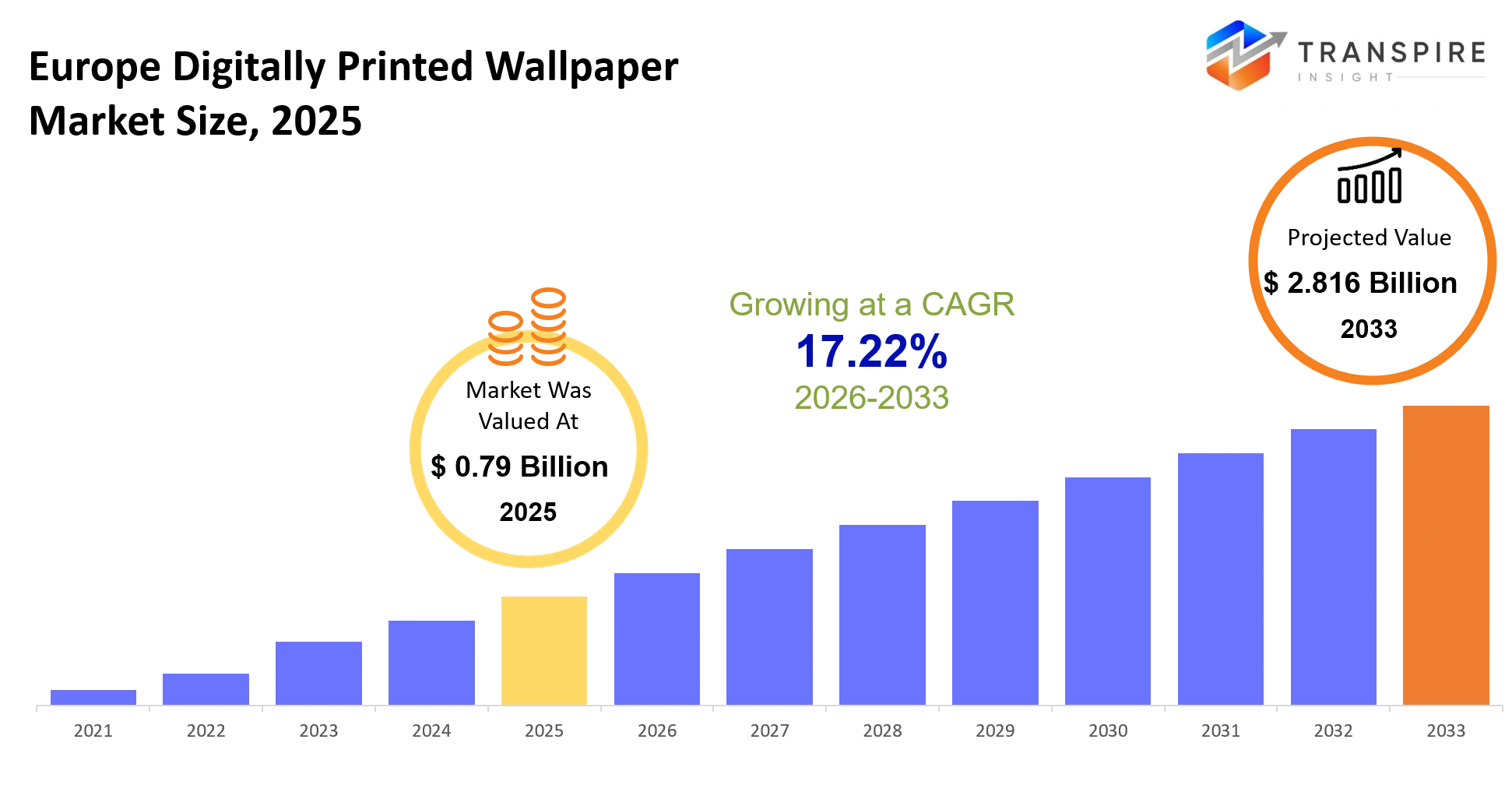
As per Transpire Insight Analysis the Europe Digitally Printed Wallpaper Market size is estimated at USD 0.79 Billion in 2025 and is anticipated to reach USD 2.816 Billion by 2033, growing at a CAGR of 17.22% from 2026 to 2033.
Europe Digitally Printed Wallpaper Market is basically about helping commercial rooms, hospitality places, retail setups, and even residential projects build custom interiors without needing those slow, old fashioned wallpaper production steps. You can see how architects, interior designers, and property owners can place crisp, detailed imagery, branded visuals, and custom patterns, and they usually get it with shorter lead times, plus way more room for design play. In the last 3–5 years things have kind of moved, away from standard decorative printing, and toward digital production tech that lets companies do on-demand manufacturing, leaner materials, and personalized looks. One big push behind this was the disruption in global supply chains during and then after the pandemic, so European buyers started to lean on localized and flexible printing options, rather than waiting. That change helped drive wider take-up among businesses, especially those aiming for quicker project completion and lower inventory needs. Market expansion keeps getting fuel from how digital printing cuts waste, makes customization less painful, and supports higher-end interior design needs across several sectors..
Europe Digitally Printed Wallpaper Market Size & Forecast:
- Europe Digitally Printed Wallpaper Market Size 2025: USD 0.79 Billion
- Expected Market Value 2033: USD 2.816 Billion
- Forecast CAGR: 17.22%
- Leading region in 2025: Western Europe
- Fastest Growing region: Eastern Europe
- Key Profile: A.S. Création, Graham & Brown, York Wallcoverings, Muraspec, Brewster Home Fashions, Sanderson Design Group, Wallquest, Arte International, Flavor Paper, Photowall, Rasch, Coordonné, F. Schumacher, MuralsWallpaper, 4Walls
Key Market Insights
- Western Europe is basically running the market in 2025 with roughly a 55% share, it is backed by high-end interior projects , and it also benefits from pretty strong design industries.
- Eastern Europe feels like the fastest mover through 2025–2033, mainly because urban renovation keeps going and commercial infrastructure gets built out .
- In terms of product types, vinyl digitally printed wallpaper takes the lead, sitting at about 40% share , and that’s mostly linked to durability as well as the easy maintenance kind of benefits.
- Next up, paper-based digitally printed wallpaper is still the second-largest segment, supported by more budget friendly residential décor uses .
- For growth speed though , textile-based digitally printed wallpaper becomes the fastest-growing option during 2026–2033 , as luxury interiors start adopting premium, customized materials.
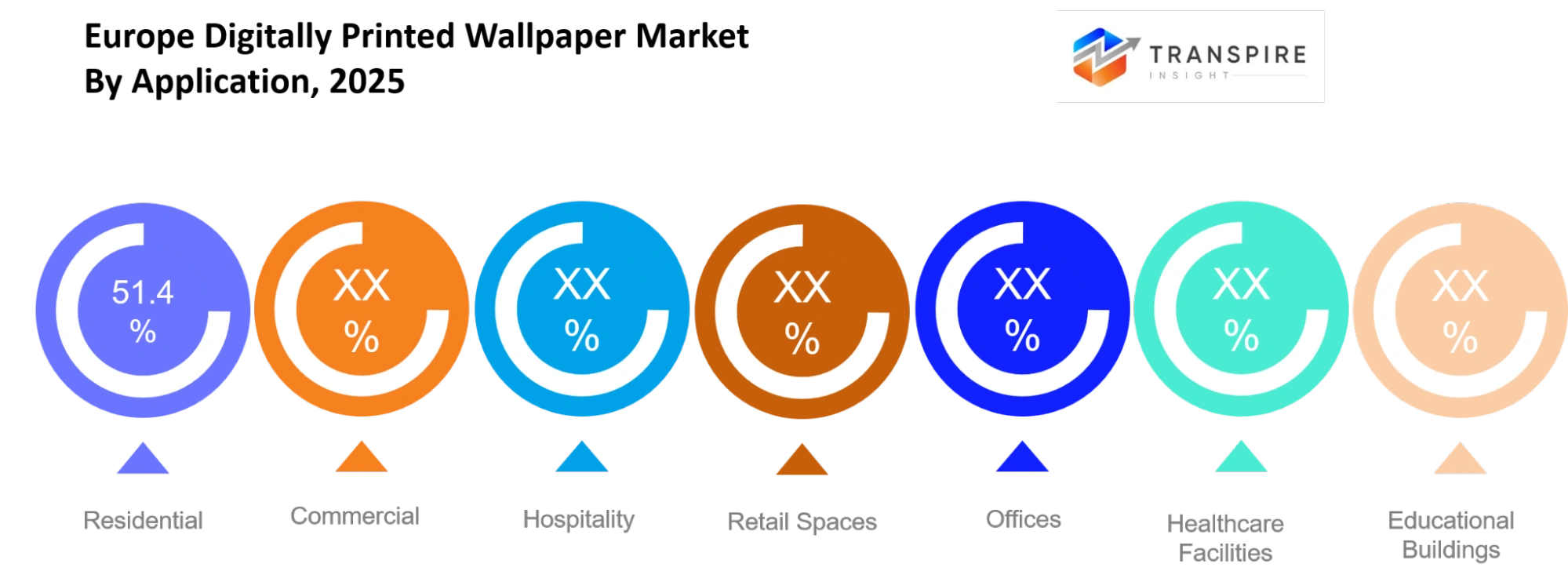
- When you look at applications, commercial interiors dominate around 45% share in 2025, with hospitality, retail, and corporate settings being the key drivers.
- Residential customization grows quicker , since after 2025, homeowners begin choosing personalized digital designs , pretty often .
- As end users, hospitality and retail lead together at nearly 50% share , largely because refurbishments happen frequently and branding needs keep coming.
- Healthcare facilities are expected to be the fastest-growing end-user category too , since customized calming environments gain more adoption after 2026.
What are the Key Drivers, Restraints, and Opportunities in the Europe Digitally Printed Wallpaper Market?
The main growth driver seems to be the move toward digital manufacturing in interior decoration , kinda like people switching from traditional workflows. Lately advances in inkjet printing tech helped bring down setup costs , and after 2020 it became way easier to do shorter production runs. That meant designers, hotels, and commercial developers can order customized wallpaper without having to hold big stock piles for months. In practice the shift boosts project efficiency, because digital production tends to support quicker delivery, more personal design options, and it also cuts down material waste. On top of that, sustainability rules across Europe kinda nudged manufacturers toward water based inks and recyclable substrates, so environmentally minded buyers are more likely to adopt these products.
The biggest restraint is still the limited availability of specialized raw materials and the broader printing infrastructure in smaller European markets. A lot of suppliers still lean on concentrated production networks, and that leads to longer lead times , plus higher logistics costs. Unfortunately this is not something you fix right away, since investment in industrial printers, trained operators, and certified materials needs serious capital. If there are any supply disruptions, commercial projects can slip, and manufacturers end up losing revenue chances, especially if they’re trying to expand regionally.
The next opportunity is AI powered design platforms and automated wallpaper customization. If European manufacturers keep investing in digital design tooling, they can shrink the concept to production timeline and better catch demand from architects and hospitality brands that want distinctive interiors. The growth chances look particularly strong in Eastern Europe, where renovation efforts and new commercial development are opening fresh demand paths.
What Has the Impact of Artificial Intelligence Been on the Europe Digitally Printed Wallpaper Market?
Artificial intelligence together with digital techs are quietly changing how digitally printed wallpaper makers design, produce, and sort out customized interior stuff. AI driven design platforms are making it easier to automate pattern creation, nail the color matching, and even suggest visuals that fit each customer. At the same time, automated production systems are starting to keep an eye on printing accuracy, how much material is used, and how well the equipment runs, so operational control is better across different manufacturing plants. On top of that, machine learning is being used to guess design preferences, tune inventory plans, and estimate material needs from the project pipeline(s). All these moves tend to cut down waste, make scheduling smoother, and keep delivery timelines quicker for custom jobs.
Digital workflow integration can also push manufacturing efficiency upward, mainly by reducing the amount of manual back and forth in design and by keeping production mistakes lower. Still, AI adoption is not that widespread among smaller manufacturers, mostly because the integration costs are heavy, the historical production data is not enough, and there are real issues linking older printing machines with newer analytics platforms. But as the digital infrastructure keeps improving, AI should become more of a defining competitive advantage for companies chasing operational efficiency and more personalized wallpaper solutions.
Key Market Trends
- Digital wallpaper customization really started to speed up after 2021, like architects were taking on shorter production cycles for hospitality, commercial work, and other kinds of schedules.
- Sustainable substrates got more momentum between 2022 and 2026 , because European manufacturers rolled out recyclable materials, and also lower-impact printing processes that sounded better on paper.
- Then after 2024, AI-assisted design tools appeared, and they made pattern generation faster for producers while also boosting the whole customer personalization side, somehow.
- Also, on-demand printing kept spreading after the supply chain disruptions in 2020–2022, which meant less dependence on the big high-volume inventory models.
- Commercial renovation projects used more digital wallpaper from 2022 onward, like offices, hotels, and retail spaces refreshing interiors in a quicker, cleaner way.
- Manufacturers put money into advanced inkjet systems during 2023–2026, aiming for higher print quality while cutting down on production waste.
- Regional suppliers expanded their digital capabilities after 2021, mainly so they could compete with the well-established European wallpaper manufacturers, not just wait around.
- Online customization platforms gained traction after 2024, letting both consumers and businesses order personalized wall designs directly.
- And luxury hospitality brands started adopting digitally printed wallcoverings more and more after 2023, to build distinctive branded environments that feel less generic.
Europe Digitally Printed Wallpaper Market Segmentation
By Product Type :
Vinyl Wallpaper keeps getting picked for both home and office interiors because it stays tough, handles moisture quite well, and is pretty easy to look after. Non-Woven Wallpaper also gets rolled into renovation plans pretty often, mainly for the installation that’s almost straight forward and for better design flexibility, you can adapt it easier. Paper Wallpaper still shows up for budget driven decoration jobs, mostly since the price stays friendly and there are lots of patterns to choose from.
Textile Wallpaper, plus Customized Wallpaper, are getting more attention lately in higher end interior work, they bring in distinctive textures and personalized aesthetics, basically a one off vibe. Peel & Stick Wallpaper works well for temporary looks, especially in rental spots or smaller commercial locations where you don’t want a long term commitment . Eco-Friendly Wallpaper is expected to move even more into the mainstream as manufacturers roll out recyclable materials and low impact production approaches. The other product categories kind of keep covering specific interior needs, across various customer groups, depending on what people actually want.
By Printing Technology :
Inkjet Printing is still leading the way in digital wallpaper production, mainly because it delivers high resolution output, captures detailed pattern work, and makes customization feel efficient. UV Printing supports commercial use cases too, for the strong color performance and that extra surface durability you want when things get handled. Laser Printing and Digital Screen Printing continue being used for specialized projects, where exact designs matter and consistent results can’t really slip.
Dye Sublimation technology backs textile based wallpaper applications, giving long lasting graphics and smoother finishes. Latex Printing is gaining traction due to the lower environmental footprint and how well it works with different materials. Hybrid Printing solutions will likely grow as manufacturers combine more than one printing approach, to push quality , speed, and overall production flexibility. Other technologies will keep showing up for those niche printing requirements tied to interior decoration projects.
By Application :
Residential applications really stand out, because homeowners pick customized wall designs when they’re doing renovation and that whole personalization thing. On the commercial side, companies often go with digitally printed wallpaper to push branding, give more visual lift and honestly to improve the customer experience. In hospitality, you’ll see customized wall coverings used to build distinctive settings across hotels, restaurants, and entertainment venues, it’s kind of the same story again and again.
Retail Spaces and Offices still keep adopting digital wallpaper solutions for interiors that look engaging and also because redesign can be done in a more flexible way. Healthcare Facilities use printed wall designs so patient areas feel calmer and comfortable, with visuals that don’t overwhelm. Educational Buildings are moving toward tailored layouts for learning environments that feel more inviting. Beyond that, other uses help with extra interior decoration requirements across both public and private properties.
By Distribution Channel :
Online Retail channels are growing fast, customers browse broader design collections, get more customization choices, and order directly through online platforms. Specialty Stores keep serving shoppers through expert guidance, support with material selection, and hands-on product evaluation. Home Improvement Stores and Hypermarkets make it easier for residential decoration projects, with ready-to-install wallpaper options that are basically grab-and-go.
Direct Sales channels also stay relevant, especially for big commercial projects that need customized specifications and bulk orders. Interior Designers often steer buying decisions with project recommendations, and by choosing premium design options. Distributors widen regional reach by linking manufacturers with different customer groups. And then other channels still exist to cover specific purchasing needs in residential and commercial segments, as the situation demands.
By End User :
Households are a pretty important user group, because personalized interior decoration is getting more reachable via digital printing solutions . At the business level, companies start using tailored wallpaper for offices, retail spaces and those branded environments. Hotels also go for premium wall designs , mostly to lift the guest experience and to build a really recognizable identity for the property.
Meanwhile architects , interior designers, and related professionals guide what gets chosen through project preparation and design suggestions. Real estate developers often move toward digital wallpaper services for newer homes as well as for commercial developments that need inviting interiors. Government buildings use bespoke wall coverings, aiming at both functionality and a cleaner visual result. And beyond that, other end users keep opening up opportunities across different institutional plus specialized interior projects.
What are the Key Use Cases Driving the Europe Digitally Printed Wallpaper Market?
Commercial interior projects stay pretty much the main use case, like hotels, retail brands, and corporate offices are still buying customized wall coverings for branding, atmosphere shaping and also quicker renovation cycles. With digital printing buyers can get to very unique looks without really needing big production volumes, or those long lead times that slow everything down.
On the hospitality side, and even in healthcare, adoption is growing because of personalized interiors—think hotel feature walls, plus spaces that feel more patient friendly. Architects and interior designers lean on digitally printed options for offices, educational facilities and commercial builds where flexible design choices matter a lot.
A few newer angles are starting to show up too, like smart home interiors and sustainable building programs. Real estate developers are also looking into tailored wallpaper solutions for premium housing, and more eco focused construction plans, where the design has to match the sustainability goal and still feel fresh.
|
Report Metrics |
Details |
|
Market size value in 2025 |
USD 0.79 Billion |
|
Market size value in 2026 |
USD 0.926 Billion |
|
Revenue forecast in 2033 |
USD 2.816 Billion |
|
Growth rate |
CAGR of 17.22% from 2026 to 2033 |
|
Base year |
2025 |
|
Historical data |
2021 - 2024 |
|
Forecast period |
2026 - 2033 |
|
Report coverage |
Revenue forecast, competitive landscape, growth factors, and trends |
|
Regional scope |
Europe (Germany, United Kingdom, France, Italy, Spain and Rest of Europe) |
|
Key company profiled |
A.S. Création, Graham & Brown, York Wallcoverings, Muraspec, Brewster Home Fashions, Sanderson Design Group, Wallquest, Arte International, Flavor Paper, Photowall, Rasch, Coordonné, F. Schumacher, MuralsWallpaper, 4Walls . |
|
Customization scope |
Free report customization (country, regional & segment scope). Avail customized purchase options to meet your exact research needs. |
|
Report Segmentation |
By Product Type (Vinyl Wallpaper, Non-Woven Wallpaper, Paper Wallpaper, Textile Wallpaper, Peel & Stick Wallpaper, Customized Wallpaper, Eco-Friendly Wallpaper, Others); By Printing Technology (Inkjet Printing, UV Printing, Laser Printing, Digital Screen Printing, Dye Sublimation, Latex Printing, Hybrid Printing, Others); By Application (Residential, Commercial, Hospitality, Retail Spaces, Offices, Healthcare Facilities, Educational Buildings, Others); By Distribution Channel (Online Retail, Specialty Stores, Hypermarkets, Home Improvement Stores, Direct Sales, Interior Designers, Distributors, Others); By End User (Households, Businesses, Hotels, Architects, Interior Designers, Real Estate Developers, Government Buildings, Others) |
Which Regions are Driving the Europe Digitally Printed Wallpaper Market Growth?
Western Europe kind of leads the Europe Digitally Printed Wallpaper Market, with roughly 55% share by 2025. You can see this in the strong renovation push, plus stricter sustainability rules, and also the building design regulations that are getting more advanced each year. So adoption keeps showing up in both commercial, and homes. The region also has that mix of established wallpaper brands, solid digital printing facilities, and a pretty good level of teamwork between designers, architects and material suppliers. And honestly this top position is likely to stick around until 2033, because premium interiors, tailored solutions, and sustainable decoration practices keep demand steady, and not really slowing down.
Northern Europe looks different in a structural sense, more like stable buying patterns rather than sudden spikes. That stability is mostly tied to energy-efficient buildings, modern housing projects, and environmental policies that stay consistent over time. Many countries there keep dependable investment conditions, largely because construction standards are strong, and commercial growth is fairly steady. Demand is still backed by architects and developers, who want long-lasting, customized interior solutions for offices, hospitality venues, and also public buildings. Because of that overall steadiness, Northern Europe stays a reliable revenue contributor for most of the forecast window.
Eastern Europe is the fastest growing region, and it’s mainly because urban redevelopment, new commercial builds, and ongoing modernization projects keep creating openings starting around 2026. Access to digital printing equipment is improving, and hospitality infrastructure keeps expanding which basically speeds up adoption across these emerging markets. Residential upgrade spending plus commercial interior demand is pulling in manufacturers that are hunting for fresh customer groups. Then for 2026–2033, the region should keep offering growth space for investors and for companies entering underserved markets where demand is still catching up.
Who are the Key Players in the Europe Digitally Printed Wallpaper Market and How Do They Compete?
In the Europe Digitally Printed Wallpaper Market, competition is still kinda fragmented, manufacturers keep pushing on printing technology, customization power, material upgrades and then the usual regional distribution networks. Big producers are trying to hold their ground using advanced production systems and sustainability oriented product lines, while smaller players show up with more individualized patterns, and even quicker delivery schemes. What really feels like the main edge is when digital printing efficiency and design flexibility are paired together, plus an environmental compliance mindset.
A.S. Création Tapeten AG goes after differentiation with wide design collections, digital printing capabilities and wallpaper solutions that are positioned as sustainable for both residential and commercial uses. They strengthen it further by keeping product variety high and using manufacturing processes that support better customization options. Muraspec, on the other hand, leans more into commercial interiors by offering customized wallcoverings for hospitality healthcare and workplace spaces, backed by project based design know-how, which kinda matters in real deployments.
Erismann Group develops digitally printed collections with a focus on fresh patterns and current interior directions. Grandeco Wallfashion Group expands by offering flexible design options and sustainable material development aimed at residential buyers as well as professional customers. Overall these companies are competing by tightening up customization, trimming production lead times, and then adapting what they sell to shifting architectural preferences, so the whole thing moves fast even when the market feels split.
Company List
- A.S. Création
- Graham & Brown
- York Wallcoverings
- Muraspec
- Brewster Home Fashions
- Sanderson Design Group
- Wallquest
- Arte International
- Flavor Paper
- Photowall
- Rasch
- Coordonné
- F. Schumacher
- MuralsWallpaper
- 4Walls
Recent Development News
In January 2025, Muraspec partnered with FARM Rio to deliver bespoke digitally printed wallcoverings for the brand’s second London store. The collaboration demonstrated the use of customized digital printing technology in premium retail interiors and strengthened demand for tailored commercial wall solutions. Source https://www.texintel.com/
In May 2026, Muraspec launched new digitally printed murals as part of its wallcovering portfolio. The product launch expanded large-format customized design options for commercial interiors and reinforced digital printing adoption across hospitality, retail, and workplace applications. Sourcehttps://www.materialsource.co.uk/
What Strategic Insights Define the Future of the Europe Digitally Printed Wallpaper Market?
The Europe Digitally Printed Wallpaper Market is likely to head toward a more personalized, technology centered kind of interior setup over the next 5–7 years, kind of driven by automation, faster production loops and also a growing push for adaptable design options. There is this subtle, hidden risk too about raw material concentration, because relying on specialized substrates and specific printing inputs from just a few suppliers could mess with production steadiness, and then it would slow down any expansion plans.
At the same time, a newer chance is showing up in AI assisted design platforms tied with digital printing workflows, which should help teams do faster personalization for architects, real estate developers, and hospitality work across Eastern Europe. Market players should probably put money into integrated digital platforms that link design, production and customer ordering, more like one connected chain. If they do that, response times should get better, inventory stress can be reduced, and differentiation can feel stronger as competition increases across the various regional markets.
Europe Digitally Printed Wallpaper Market Report Segmentation
By Product Type
- Vinyl Wallpaper
- Non-Woven Wallpaper
- Paper Wallpaper
- Textile Wallpaper
- Peel & Stick Wallpaper
- Customized Wallpaper
- Eco-Friendly Wallpaper
By Printing Technology
- Inkjet Printing
- UV Printing
- Laser Printing
- Digital Screen Printing
- Dye Sublimation
- Latex Printing
- Hybrid Printing
By Application
- Residential
- Commercial
- Hospitality
- Retail Spaces
- Offices
- Healthcare Facilities
- Educational Buildings
By Distribution Channel
- Online Retail
- Specialty Stores
- Hypermarkets
- Home Improvement Stores
- Direct Sales
- Interior Designers
- Distributors
By End User
- Households
- Businesses
- Hotels
- Architects
- Interior Designers
- Real Estate Developers
- Government Buildings
Frequently Asked Questions
Find quick answers to common questions.
The expected Europe Digitally Printed Wallpaper Market size for the market will be USD 2.816 Billion in 2033.
Key segments for the Europe Digitally Printed Wallpaper Market are By Product Type (Vinyl Wallpaper, Non-Woven Wallpaper, Paper Wallpaper, Textile Wallpaper, Peel & Stick Wallpaper, Customized Wallpaper, Eco-Friendly Wallpaper, Others); By Printing Technology (Inkjet Printing, UV Printing, Laser Printing, Digital Screen Printing, Dye Sublimation, Latex Printing, Hybrid Printing, Others); By Application (Residential, Commercial, Hospitality, Retail Spaces, Offices, Healthcare Facilities, Educational Buildings, Others); By Distribution Channel (Online Retail, Specialty Stores, Hypermarkets, Home Improvement Stores, Direct Sales, Interior Designers, Distributors, Others); By End User (Households, Businesses, Hotels, Architects, Interior Designers, Real Estate Developers, Government Buildings, Others).
Major Europe Digitally Printed Wallpaper Market players are A.S. Création, Graham & Brown, York Wallcoverings, Muraspec, Brewster Home Fashions, Sanderson Design Group, Wallquest, Arte International, Flavor Paper, Photowall, Rasch, Coordonné, F. Schumacher, MuralsWallpaper, 4Walls.
The Europe Digitally Printed Wallpaper Market size is USD 0.79 Billion in 2025.
The Europe Digitally Printed Wallpaper Market CAGR is 17.22% from 2026 to 2033.
- A.S. Création
- Graham & Brown
- York Wallcoverings
- Muraspec
- Brewster Home Fashions
- Sanderson Design Group
- Wallquest
- Arte International
- Flavor Paper
- Photowall
- Rasch
- Coordonné
- F. Schumacher
- MuralsWallpaper
- 4Walls
About the Authors

Chetan Dhatrak
I’m Chetan Dhatrak, a Senior Research Analyst at Transpire Insight, specializing in the Consumer Goods, Foods and Beverages industry. I focus on analyzing market trends, consumer behavior, competitive landscapes, and industry developments to deliver accurate, data-driven insights. My research at Transpire Insight is built on credible sources and in-depth analysis, helping businesses and readers better understand market dynamics, emerging opportunities, and evolving consumer preferences. I’m committed to creating reliable, well-researched content that supports informed decision-making and reflects the latest developments in the consumer goods and food & beverage sectors.

Chakradhar Khansole
Chakradhar serves as the Research Director at Transpire Insight, bringing over 8 years of experience in technology, innovation, and strategic market intelligence. He specializes in transforming complex market data into actionable business insights that enable organizations to make informed, growth-oriented decisions. Recognized for his strategic vision and analytical expertise, Chakradhar leads high-impact research initiatives, delivering comprehensive market assessments, competitive intelligence, and forward-looking industry analysis.
Recently Published Reports
-
Apr 2026
Bottled Water Market
Bottled Water Market Size, Share & Analysis Report By Product Type (Still Bottled Water, Carbonated Bottled Water, Functional Bottled Water, and Others), By Packaging (PET, Cans, and Others), By Sales Channel (Supermarkets/Hypermarkets, Convenience Stores/Drug Stores, Grocery Stores/Club Stores, Foodservice, and Others) and Geography (North America, Europe, Asia-Pacific, Middle East and Africa, South and Central America), 2021 - 2032
-
Apr 2026
Color Cosmetic Packaging Market
Color Cosmetic Packaging Market Size, Share & Analysis Report By Application (Mascara Packaging, Liquid Packaging, and Liquid Face), By Type (Tubes & Bottles, Pens & Markers, Compacts & Containers, and Droppers & Pumps), and Geography (North America, Europe, Asia-Pacific, Middle East and Africa, South and Central America), 2021 - 2031
-
Apr 2026
External Microphone For Camera Market
External Microphone For Camera Market Size, Share & Analysis Report By Type (Shotgun Microphone, Lavalier Microphone, and Others), By Application (Digital Camera, Professional Video Camera, and Others), and Geography (North America, Europe, Asia-Pacific, Middle East and Africa, South and Central America), 2021 - 2031
-
Apr 2026
Foot Orthotic Insoles Market
Foot Orthotic Insoles Market Size, Share & Analysis Report By Type (Pre-fabricated, and Custom-made), By Material (Thermoplastic, Composite Carbon Fiber, and Others), By Distribution Channel (Drug Stores, Hospitals & Clinics, and Others), and Geography (North America, Europe, Asia-Pacific, Middle East and Africa, South and Central America), 2021 - 2031