
Global Printed Circuit Board and PCBA Market Size & Forecast:
- Global Printed Circuit Board and PCBA Market Size 2025: USD 40.84 billion
- Global Printed Circuit Board and PCBA Market Size 2033: USD 67.05 billion
- Global Printed Circuit Board and PCBA Market CAGR: 6.42%
- Global Printed Circuit Board and PCBA Market Segments: By Type (Single-sided PCBs, Double-sided PCBs, Multilayer PCBs, Flexible PCBs, Rigid-flex PCBs, High-density Interconnect PCBs, Others); By Application (Consumer Electronics, Automotive Electronics, Industrial Equipment, Medical Devices, Telecommunications, Others); By End-User (Electronics Manufacturers, Automotive OEMs, Telecom Companies, Medical Device Companies, Others); By Assembly Type (Surface Mount Technology, Through-hole Technology, Mixed Technology, Automated PCBA Systems, Others)
Global Printed Circuit Board and PCBA Market Summary:
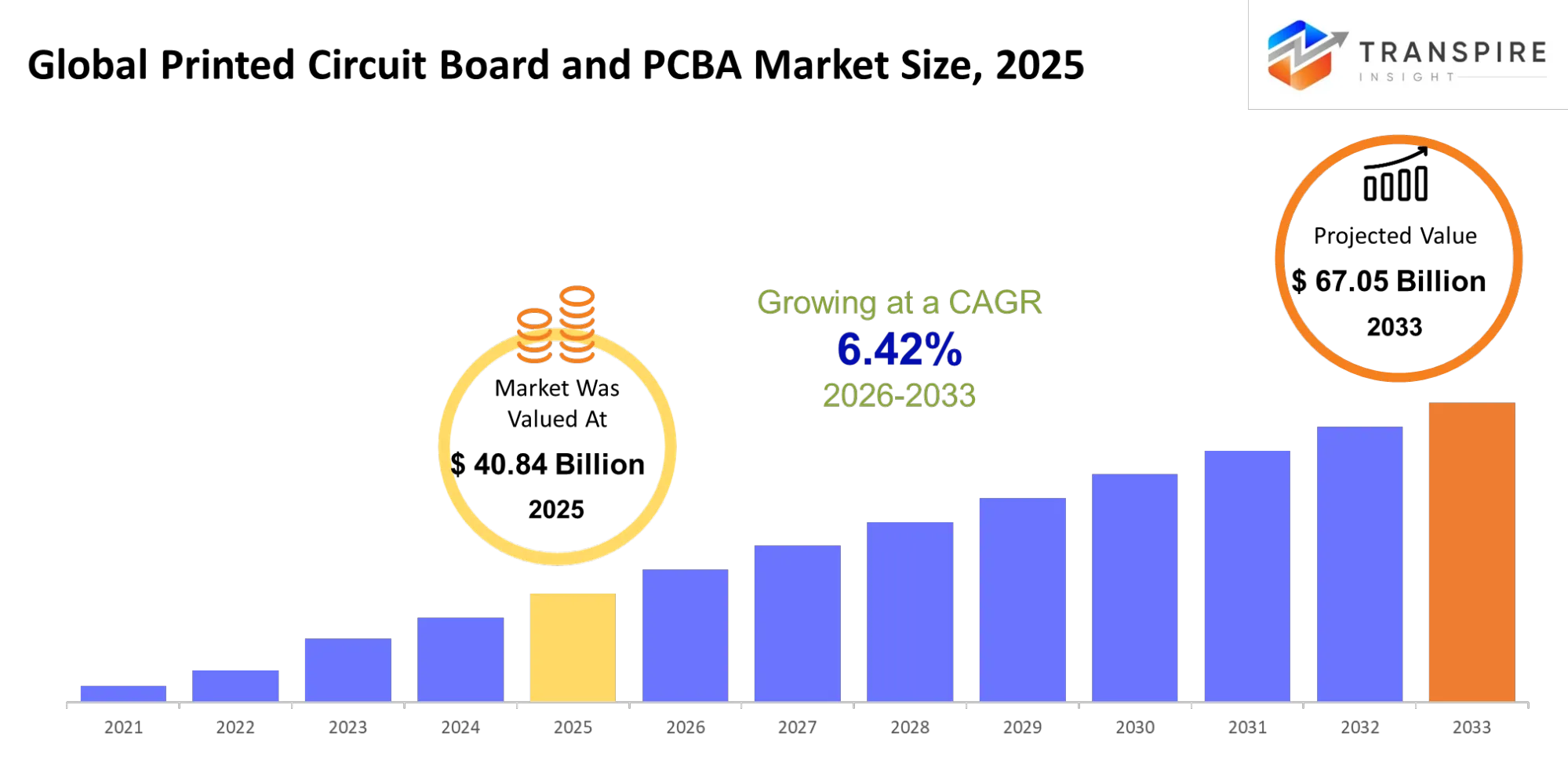
The Global Printed Circuit Board and PCBA Market size is estimated at USD 40.84 billion in 2025 and is anticipated to reach USD 67.05 billion by 2033, growing at a CAGR of 6.42% from 2026 to 2033.
The Printed Circuit Board (PCB) and Printed Circuit Board Assembly (PCBA) market is the backbone of electronics. It helps devices connect electrically. You can find these boards in smartphones, car control units and industrial automation systems. Over the past few years, the industry has changed a lot. It used to make traditional boards. Now it makes compact and performance-driven designs. These designs support computing, electric vehicles and connected technologies. The Printed Circuit Board and Printed Circuit Board Assembly are really important for this.
A big change in the industry is the move to higher density and miniaturised board architectures. These architectures support electronic functions in smaller spaces. The shift to vehicles, 5G infrastructure and smart consumer devices sped up this change. Now manufacturers need functionality in smaller spaces. So the demand for Printed Circuit Board technologies is rising. To meet this demand, companies are investing in automated assembly lines, precision manufacturing and new materials. This investment is creating a foundation for the market to grow in the long term. It is also improving production efficiency and product reliability for Printed Circuit Boards.
Key Market Insights:
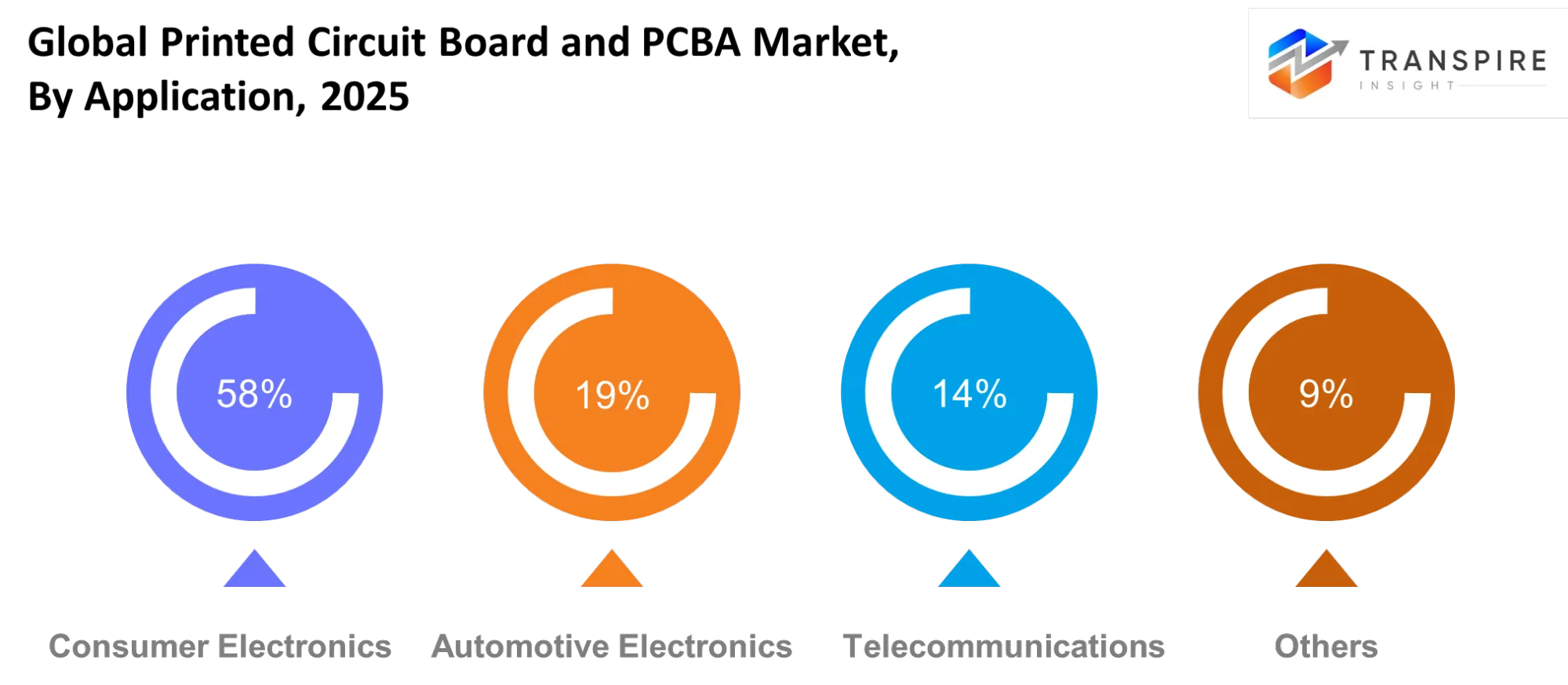
- Consumer electronics make up a part of the market for printed circuit boards about 58%. Companies that make these things are trying to make them thinner and pack circuits into smaller spaces so they are better for things like phones.
- Automotive electronics are 19% of the market. This is because cars are using electronics, especially electric and self-driving cars.
- Telecommunications are 14% of the market. This is because phone and internet companies are building networks that are faster and better.
- There are uses for printed circuit boards, like industrial automation and special equipment that make up about 9% of the market.
- One type of printed circuit board called High-Density Interconnect is growing fast. This is because people want powerful electronic things.
- Big companies that make printed circuit boards are using machines to help build them, which makes them faster and better.
- Suppliers of printed circuit boards are using technologies to make sure their products are good and can be tracked.
What are the Key Drivers, Restraints, and Opportunities in the Global Printed Circuit Board and PCBA Market?
Drivers
The primary driver of growth in this field is how much more complex electronic systems have become in things like electric cars, industrial gadgets, and communication gear. As we move towards more connected and smart systems, there's a big need for better circuit boards that handle faster processing and stuff packed tighter together. To meet this demand, makers are improving their production methods, leading to more income and wider use of these fancy PCB technologies.
Restraints
The super complicated global supply chains for parts and materials needed for making PCBs. These boards require special laminates, copper foil, semiconductors, and precise tools coming from all around the world. Disruptions, changing costs, and political tensions cause real issues for production and profit margins. Setting up backup supply routes is incredibly costly and takes a lot of time to get approved.
Opportunities
There's a huge chance, though, in the spread of next-gen tech, especially in electric vehicles, advanced medical devices, and AI gear. Since there's a push for semiconductor production in North America and Asia, companies might find fresh markets for their high-end PCBs. Those firms that hook into these growing tech sectors and boost local factory abilities could really come out ahead.
What Has the Impact of Artificial Intelligence Been on the Global Printed Circuit Board and PCBA Market?
Artificial intelligence is changing how PCB and PCBA manufacturing works, thanks to smarter processes and better predictions about what the machines need. AI inspections can spot tiny problems that people might miss, which makes products better and cuts down on wasted materials.
Machines learning from data can also guess when equipment might break, preventing big stops in production and boosting factory use. They help plan the work too, by looking at old data, checking what materials are available, and seeing how well things usually go so they can plan stuff out better.
As manufacturers start using AI-driven controls, automatic checks, and real-time tracking, everything gets more consistent, and there's less need for hands-on adjustments. Even so, smaller companies find it hard to jump on board because of high setup costs, tricky integrations, and needing lots of data to begin with. Yet, as these tools get easier to access, everyone expects big boosts in both production smoothness and the reliability of their end products.
Instance
In July 2025, Diode Computers boosted their AI-powered PCB design to auto develop circuit boards, spot design flaws, and fine-tune manufacturing processes. This move shows how AI aids makers by ramping up efficiency, speeding up product launches, and boosting production quality.
Key Market Trends:
- The designs for printed circuit boards are getting smaller and smaller compared to how they used to be. This is so they can support electronics.
- More and more people are using rigid-flex boards in things like wearables and medical devices.
- Car makers are putting electronic parts into their vehicles more than they ever have before.
- Smart factories are using automated systems to check the quality of things that people used to do by hand.
- Companies are trying to be more sustainable by making their production cleaner and using materials.
- Because computers are getting so powerful, there is a need for things that can help keep them cool.
- Manufacturers are making things in places around the world. This means they do not have to rely on one place for the things they need.
Global Printed Circuit Board and PCBA Market Segmentation
By Type
Multilayer PCBs keep a strong market presence thanks to their ability to handle complex systems. Flexible and rigid-flex PCBs are becoming more popular in devices where space needs to be saved. The High-Density Interconnect (HDI) PCBs have the edge when it comes to growth; they're perfect for cutting-edge phones, car tech, and supercomputers. As designs get more intricate, more folks will turn to HDI and fancy multilayer tech.
By Application
Consumer electronics take the lead in PCB usage, raking in about 58% from gadgets like our phones, laptops, wearables, and smart homes. Next up is automotive at around 19%, boosted by electric vehicles and driver aid systems. Telecoms hang onto about 14%, growing with infrastructure worldwide, while everything else accounts for roughly 9%.
By End Users
At the moment, electronics manufacturers still make up the bulk of PCB customers since they need these for both consumer and industrial goods. Auto Original Equipment Manufacturers (OEMs) are buying more high-end boards too, to back up their electric vehicle platforms. Meanwhile, telecom firms are leaning on complex PCB assemblies for network hardware. Medical device makers keep integrating tiny yet reliable boards into their products as well.
By Assembly Type
In terms of how boards are assembled, Surface Mount Technology leads the way due to its speed, small-size advantages, and smooth integration into automation. Through-hole tech persists for uses that call for extra durability and mechanical strength. There are also hybrid solutions, along with rising automation in PCBA processes as companies aim for better output and consistent quality.
What are the Key Use Cases Driving the Global Printed Circuit Board and PCBA Market?
The main use for circuit boards is still in consumer electronics like smartphones, tablets, laptops, and wearables. Companies constantly need to make newer products that are tinier but still super effective, so they keep coming up with new PCB solutions.
Besides gadgets, cars and telecom are using circuit boards more and more. As vehicles get fancier with safety tech and become electric, they need solid PCBs to deal with all that tech. And new comms infrastructure relies on them too.
Medical gear, robots, AI machines, and smart factory systems are the newest spots where circuit boards shine. For these, the boards must crank through lots of data while staying dependable and well-connected.
|
Report Metrics |
Details |
|
Market size value in 2025 |
USD 40.84 Billion |
|
Market size value in 2026 |
USD 43.37 Billion |
|
Revenue forecast in 2033 |
USD 67.05 Billion |
|
Growth rate |
CAGR of 6.42% from 2026 to 2033 |
|
Base year |
2025 |
|
Historical data |
2021 - 2024 |
|
Forecast period |
2026 - 2033 |
|
Report coverage |
Revenue forecast, competitive landscape, growth factors, and trends |
|
Regional scope |
United States; Canada; Mexico; United Kingdom; Germany; France; Italy; Spain; Denmark; Sweden; Norway; China; Japan; India; Australia; South Korea; Thailand; Brazil; Argentina; South Africa; Saudi Arabia; United Arab Emirates |
|
Key company profiled |
TTM Technologies, Jabil, Flex Ltd., Foxconn, Pegatron, Unimicron, Nippon Mektron, Zhen Ding Technology, Sanmina, Celestica, Benchmark Electronics, Wistron, PCBWay, Tripod Technology, Compeq Manufacturing |
|
Customization scope |
Free report customization (country, regional & segment scope). Avail customized purchase options to meet your exact research needs. |
|
Report Segmentation |
By Type (Single-sided PCBs, Double-sided PCBs, Multilayer PCBs, Flexible PCBs, Rigid-flex PCBs, High-density Interconnect PCBs, Others); By Application (Consumer Electronics, Automotive Electronics, Industrial Equipment, Medical Devices, Telecommunications, Others); By End-User (Electronics Manufacturers, Automotive OEMs, Telecom Companies, Medical Device Companies, Others); By Assembly Type (Surface Mount Technology, Through-hole Technology, Mixed Technology, Automated PCBA Systems, Others) |
Which Regions are Driving the Global Printed Circuit Board and PCBA Market Growth?
North America
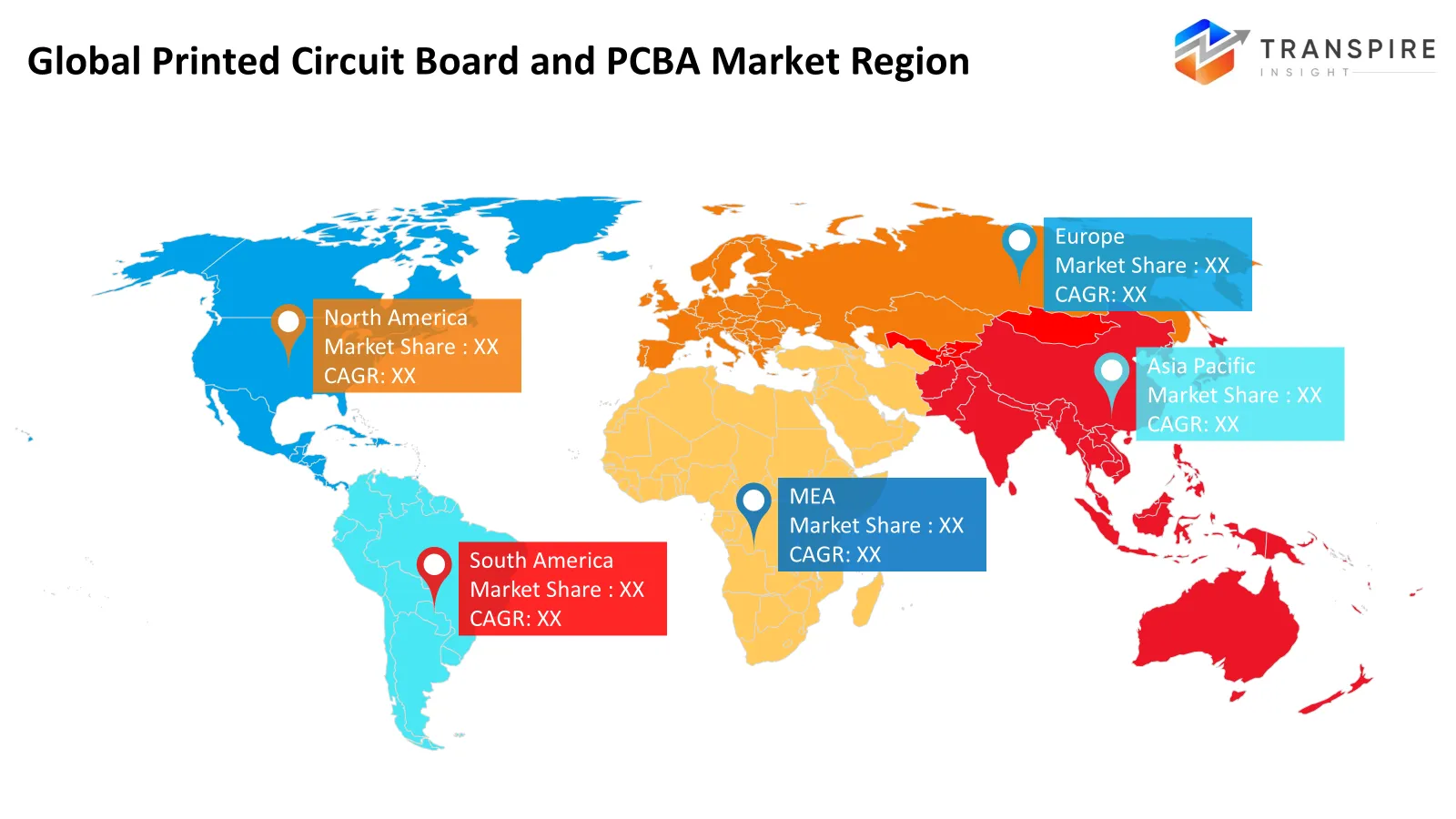
North America has the fastest growth rate and will see a 11.6% CAGR, holding a 26% share. The uptick happens because of increased investments in chip production, electronics reshoring programs, and government encouragement for top-tier manufacturing. Markets for AI, EVs, military electronics, and data center structures create exciting new chances for suppliers in this space. Expect these trends to keep driving expansion throughout North America.In March 2025, TSMC said it'd put another $100 billion into the U.S. The plan? Two advanced packaging sites and three fab plants in Arizona. This move should boost the local tech supply chain and amp up the need for fancy PCBs and related services too.
Europe
Europe controls 21% of the global market. While Asia Pacific churns out products in huge volumes, Europe takes a different route. They focus more on high-performance applications in areas like automotive, aerospace, industrial automation, and renewable energy. With top engineering skills, rigorous quality standards, and ongoing tech innovations, they've got market stability locked down. Investments in electric vehicles and smart manufacturing are giving the region an extra push too.In May 2025, AT&S, a top European PCB and IC substrate maker, celebrated the qualification of its new IC substrate plant and research centre in Leoben, Austria. Backed by the EU's IPCEI program, this facility bolsters Europe's semiconductor and electronics scene. It'll also likely boost demand for advanced PCB and PCBA tech in automotive, industrial, and high-performance electronic areas.
Asia Pacific
The Asia Pacific region is the part of the global PCB and PCBA market with 45%. This is because the Asia Pacific region has a lot of places that make electronics, it has a network of people who supply things, and it has a lot of demand from people who make things like phones, cars and telecom equipment. Countries like China, Japan, South Korea and Taiwan are good at making things because they have factories and their governments help them. This is why the Asia Pacific region is still the leader in the market.
Who are the Key Players in the Global Printed Circuit Board and PCBA Market and how do they Compete?
Competition in the industry comes from making expertise, new tech, how big you produce, and catering to specific customer needs. Companies now stand out thanks to fancy PCB skills, automating their work, and creating solutions that target certain uses.TTM Tech zeroes in on super-reliable stuff for places like aerospace, defence gear, and cutting-edge comm systems. Their edge? Solid know-how in both engineering and speciality building processes. To keep growing, they pour cash into new tech and team up with key clients. Unimicron Tech centres on advancements in HDI and top-tier substrate tech. They set themselves apart by backing high-performance gadgets for the consumer market, like computers and electronic toys. For growth, they're adding more juice to their output and tech side of things.
Nippon Mektron is a big player in bendy circuits used in vehicles and mobile devices. They grow by coming up with fresh products and working closely with makers. Their plan to expand involves their worldwide factories and lasting ties with customers.
Global Printed Circuit Board and PCBA Market Companies:
- TTM Technologies
- Jabil
- Flex Ltd.
- Foxconn
- Pegatron
- Unimicron
- Nippon Mektron
- Zhen Ding Technology
- Sanmina
- Celestica
- Benchmark Electronics
- Wistron
- PCBWay
- Tripod Technology
- Compeq Manufacturing
Recent Development News
In August 2025, Monash University researchers introduced SEConv-YOLO, a light yet precise object-detection system for the PCBA market. They tailored it to eliminate overcomplicated general-purpose AI structures. This lets them spot tiny flaws like minute structural issues, sweeping problems, and broken wires in high-speed manufacturing lines.
https://researchmgt.monash.edu
In March 2025, the Department of Applied Chemistry at DIAT teamed up with the DIA-CoE to launch NC3-PCB-2025. This conference connects academic and defence industry folks, speeding up progress on new military PCB materials. So, it links learning and tech developments tightly together.
What Strategic Insights Define the Future of the Global Printed Circuit Board and PCBA Market?
The market's heading towards smarter, more specialised PCB solutions for advanced computing, electric cars, and connected infrastructures. Future success hinges less on making tons of products and more on how cutting-edge the tech is, how precisely it’s manufactured, and strong partnerships within an ecosystem.
Relying heavily on intricate global supply chains for unique parts and materials. If anything goes wrong, it seriously hits production and profits fast. But there's a flip side – new chances pop up in areas like AI hardware, fancy car systems, and local manufacturing investments. Businesses need to focus on automation, top-tier PCB tech, and diversifying their supply chains. Companies managing to combine pushing limits with steady, resilient ops will be well-equipped for future demands and stay competitive in the market long-term.
Global Printed Circuit Board and PCBA Market Segmentation:
By Type
- Single-sided PCBs
- Double-sided PCBs
- Multilayer PCBs
- Flexible PCBs
- Rigid-flex PCBs
- High-density Interconnect (HDI) PCBs
By Application
- Consumer Electronics
- Automotive Electronics
- Industrial Equipment
- Medical Devices
- Telecommunications
By End-User
- Electronics Manufacturers
- Automotive OEMs
- Telecom Companies
- Medical Device Companies
By Assembly Type
- Surface Mount Technology (SMT)
- Through-hole Technology (THT)
- Mixed Technology
- Automated PCBA Systems
Regional Outlook
North America
- United States
- Canada
- Mexico
Europe
- Germany
- United Kingdom
- France
- Spain
- Italy
- Rest of Europe
Asia Pacific
- Japan
- China
- Australia & New Zealand
- South Korea
- India
- Rest of Asia Pacific
South America
- Brazil
- Argentina
- Rest of South America
Middle East & Africa
- Saudi Arabia
- United Arab Emirates
- South Africa
- Rest of the Middle East & Africa
Frequently Asked Questions
Find quick answers to common questions.
The global Printed Circuit Board and PCBA Market size was valued at USD 40.84 Billion in 2025 and is poised to reach USD 67.05 Billion by 2033, expanding at a 6.42% CAGR.
Key segments for the Global Printed Circuit Board and PCBA Market are By Type (Single-sided PCBs, Double-sided PCBs, Multilayer PCBs, Flexible PCBs, Rigid-flex PCBs, High-density Interconnect PCBs, Others); By Application (Consumer Electronics, Automotive Electronics, Industrial Equipment, Medical Devices, Telecommunications, Others); By End-User (Electronics Manufacturers, Automotive OEMs, Telecom Companies, Medical Device Companies, Others); By Assembly Type (Surface Mount Technology, Through-hole Technology, Mixed Technology, Automated PCBA Systems, Others).
Growth is primarily driven by Global Printed Circuit Board and PCBA Market growth is mainly due to surging consumer electronics sales, fast adoption of IoT and smart devices, spreading 5G networks, and more money being spent on automotive electronics and industrial automation. Companies are also investing more in telecoms, boosting the industry.
The global market is led by major manufacturers including TTM Technologies, Jabil, Flex Ltd., Foxconn, Pegatron, Unimicron, Nippon Mektron, Zhen Ding Technology, Sanmina, Celestica, Benchmark Electronics, Wistron, PCBWay, Tripod Technology, Compeq Manufacturing.
Asia-Pacific dominates around 45% of the global PCB and PCBA market. This is because of its strong electronics manufacturing and cheap production costs, along with sturdy supply chains. The demand from industries like consumer electronics, automotive, and telecom helps a lot too.
The Printed Circuit Board (PCB) and PCBA market is really hopping thanks to surging demand for stuff like consumer electronics, electric vehicles, IoT gadgets, 5G setups, and medical gear. Plus, there's a big push for top-notch, space-efficient tech, which is adding to this buzz. The rising trend of outsourcing PCB assembly helps too, laying down more chances for industry folks to grow and thrive.
- TTM Technologies
- Jabil
- Flex Ltd.
- Foxconn
- Pegatron
- Unimicron
- Nippon Mektron
- Zhen Ding Technology
- Sanmina
- Celestica
- Benchmark Electronics
- Wistron
- PCBWay
- Tripod Technology
- Compeq Manufacturing
About the Authors

Avinash Kumar
I’m Avinash Kumar, a Senior Research Analyst at Transpire Insight, with expertise in the Electronics and Semiconductor and Energy & Power industry. My work focuses on analyzing emerging technologies, market trends, industry developments, and innovation across these sectors. I specialize in transforming complex technical and market insights into clear, research-backed content that helps professionals, businesses, and decision-makers stay informed. Through continuous industry research and data-driven analysis, I strive to deliver accurate, reliable, and practical perspectives on the latest advancements shaping the semiconductor and energy landscape.

Chakradhar Khansole
Chakradhar serves as the Research Director at Transpire Insight, bringing over 8 years of experience in technology, innovation, and strategic market intelligence. He specializes in transforming complex market data into actionable business insights that enable organizations to make informed, growth-oriented decisions. Recognized for his strategic vision and analytical expertise, Chakradhar leads high-impact research initiatives, delivering comprehensive market assessments, competitive intelligence, and forward-looking industry analysis.
Recently Published Reports
-
Apr 2026
Fiber Optic Faceplates Market
Fiber Optic Faceplates Market Size, Share & Analysis Report By Type (< 300 mm2, 300-350 mm2, and > 350 mm2, By Application (Night Vision, Holographic Imaging, Medical, and Others), and Geography (North America, Europe, Asia-Pacific, Middle East and Africa, South and Central America), 2021 - 2031
-
Apr 2026
High Temperature Superconductors Market
High Temperature Superconductors Market Size, Share & Analysis Report By Type (1G HTS, and 2G HTS), By Application (Power Cable, Fault Current Limiter, and Transformer), and Geography (North America, Europe, Asia-Pacific, Middle East and Africa, South and Central America), 2021 - 2031
-
Apr 2026
Industrial Plugs and Socket Market
Industrial Plugs and Socket Market Size, Share & Analysis Report By Type (Industrial Plugs, Industrial Sockets), By Current (Up to 32 A, 32 to 125 A, Above 125 A), By Protection (Dustproof and Splash Proof, Waterproof, Explosion Proof), By End User (Heavy Industries, Oil and Gas, Chemicals and Pharmaceuticals, Power Generation, Others), and Geography (North America, Europe, Asia-Pacific, Middle East and Africa, South and Central America), 2021 - 2031
-
Apr 2026
InGaAs Avalanche Photodiodes Market
InGaAs Avalanche Photodiodes Market Size, Share & Analysis Report By Type (1100 - 1700 nm, and 1000 - 1600 nm), By Application (Missile Warning System, Muzzle Flash Detection, Wafer Defect Inspection, Laser Rangefinders, and Others), and Geography (North America, Europe, Asia-Pacific, Middle East and Africa, South and Central America), 2021 - 2031