

Europe Flexible Printed Circuit Boards Market Size & Forecast:
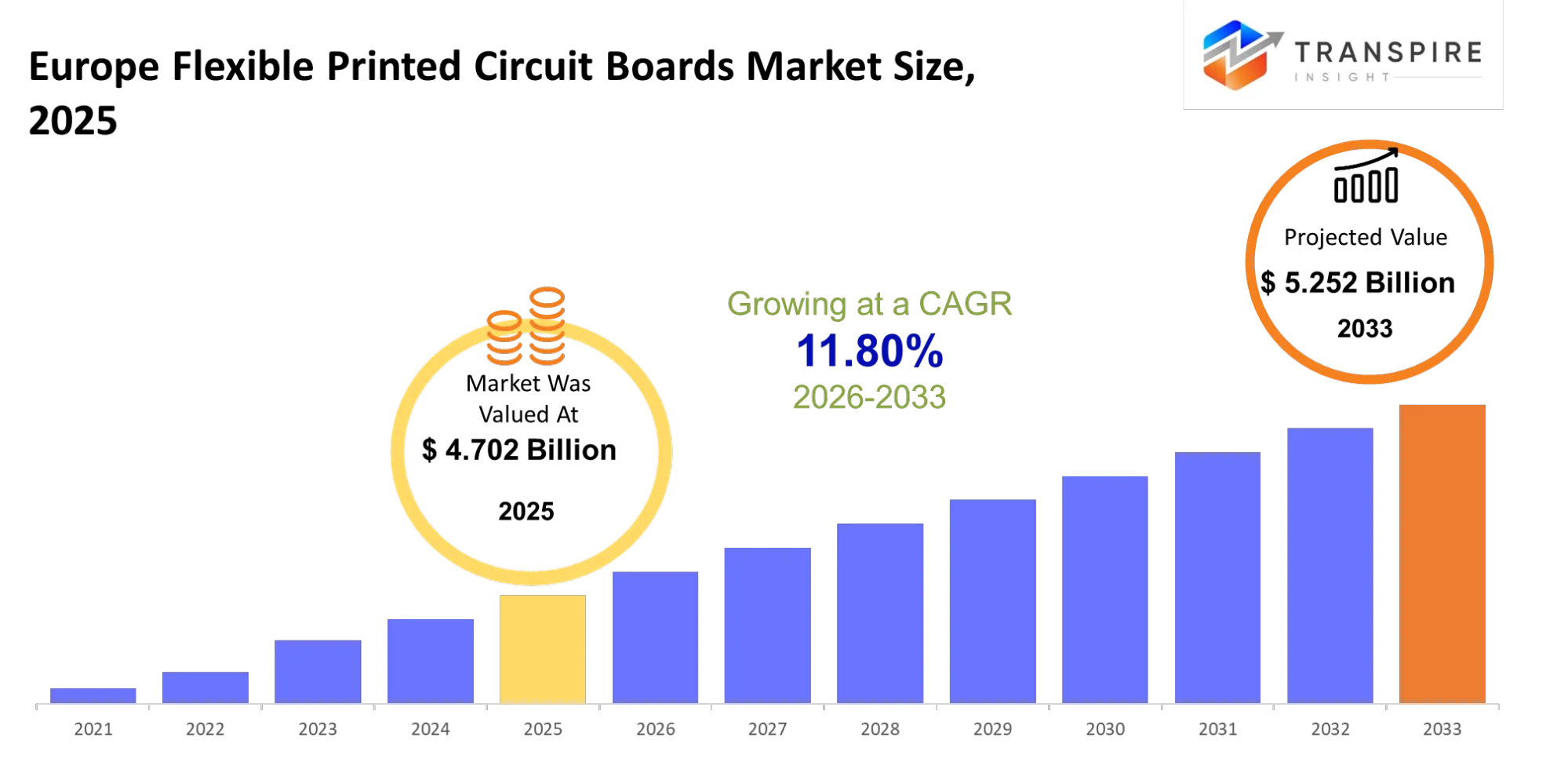
- Europe Flexible Printed Circuit Boards Market Size 2025: USD 4.702 Billion
- Europe Flexible Printed Circuit Boards Market Size 2033: USD 5.252 Billion
- Europe Flexible Printed Circuit Boards Market CAGR: 11.80%
- Europe Flexible Printed Circuit Boards Market Segments: By Type (Single-sided, Double-sided, Multilayer, Others); By Application (Consumer Electronics, Automotive, Healthcare, Aerospace, Others); By End-User (Electronics Manufacturers, Automotive OEMs, Healthcare, Others); By Material (Polyimide, Polyester, Others)
To learn more about this report,  Download Free Sample Report
Europe Flexible Printed Circuit Boards Market Summary
The Europe Flexible Printed Circuit Boards Market was valued at USD 4.702 Billion in 2025. It is forecast to reach USD 5.252 Billion by 2033. That is a CAGR of 11.80% over the period.
The system requires flexible printed circuit boards because they provide small and lightweight electronic connections which maintain high reliability standards. European automotive manufacturers, aerospace suppliers, medical device companies, and industrial automation firms depend on these circuits to provide miniature electronics and sensor integration and high-speed data transmission capabilities in their challenging operational environments. The market underwent a structural transformation during the past five years because it shifted from consumer electronics to high-value applications which include electric vehicles and advanced driver assistance systems and wearable healthcare technologies. The transition created a higher demand for multilayer flexible circuits which have high-density capabilities and can withstand extreme thermal and mechanical conditions.
The major trigger occurred when post-2021 supply chain disruptions combined with geopolitical trade uncertainty to reveal Europe’s reliance on Asian raw materials and fabrication capacity. In response, manufacturers expanded regional sourcing strategies, nearshoring partnerships, and localized engineering support operations. European vehicle emissions regulations which became more stringent during that period pushed automotive manufacturers to invest in EV production facilities. This development boosted the use of advanced flexible interconnect systems throughout automotive supply chains while it created better revenue forecasts for specialized PCB manufacturers.
Key Market Insights
- The 2025 Europe Flexible Printed Circuit Boards Market found Western Europe in control because of its 46% market share which stemmed from its automotive and industrial electronics production centers.
- The period from 2026 to 2033 showed Eastern Europe as the most rapidly expanding regional market because businesses invested in nearshoring to develop their electronics manufacturing capabilities.
- The market showed more than 42% of its share to multilayer flexible printed circuit boards because electric vehicle platforms needed small packages which contained their high-density circuit designs.
- The second-largest market segment for double-sided flexible circuits existed because European factories increased their use of industrial automation and mid-range communication devices.
- The market for high-density multilayer designs will see its highest growth rate until 2033 because AI infrastructure and advanced computing applications develop at a fast pace.
- European EV manufacturers began integrating radar sensors with battery management systems for their automotive applications which resulted in a 38% market share throughout 2025.
- The healthcare electronics market segment showed the fastest growth because wearable diagnostics and remote patient monitoring technologies achieved commercial success after 2024.
- Electronics manufacturers maintained their position as the top end-user group because their compact consumer devices and industrial control systems needed lightweight circuit designs which provided thermal stability.
- The automotive original equipment manufacturer market experienced a surge in demand after 2025 when European emissions regulations became more stringent which led to increased vehicle electrification and advanced driver assistance system adoption.
- TTM Technologies dedicated its resources to aerospace and defense electronics programs which required high-reliability certifications because this certification method enabled them to charge premium prices while establishing extended supply contracts.
What are the Key Drivers, Restraints, and Opportunities in the Europe Flexible Printed Circuit Boards Market?
The European automotive market experiences its most powerful market force through the quick implementation of electric vehicle systems. Electric vehicles need more electronic equipment than internal combustion vehicles because they use battery management systems and radar sensors and infotainment systems and advanced driver assistance systems. Manufacturers use flexible printed circuit boards to achieve three benefits which include decreasing wiring weight and bettering thermal performance in small vehicle systems and achieving better performance through efficient electrical system designs. European emissions regulations created regulatory requirements which drove automotive companies to increase their electric vehicle production activities after 2023, which resulted in a greater demand for multilayer and high-density flexible circuits throughout the automotive supply chain.
Europe needs to import its essential raw materials because its advanced manufacturing facilities exist only in Asian countries. The industrial manufacturing process for polyimide films and copper-clad laminates together with specialized processing equipment demands lengthy acquisition times since there are few suppliers who provide these materials. The dependency creates a structural weakness because local manufacturers need to spend money and develop skills and complete process checks before they can begin making products locally. Mid-sized European electronics companies experience production delays and decreases in profit margins because supply chain interruptions and fluctuations in raw material prices affect their businesses.
Flexible hybrid electronics have developed into a significant opportunity for the healthcare wearable market and smart industrial sensing systems. The development of remote patient monitoring systems together with Industry 4.0 automation solutions creates a need for ultra-thin flexible electronic assemblies which can function in fast-changing operational conditions.The pilot-scale commercialization of flexible electronics inventions is increasingly supported by innovation clusters in Northern Loser Aires.
What Has the Impact of Artificial Intelligence Been on the Europe Flexible Printed Circuit Boards Market?
The European manufacturing sector of flexible printed circuit boards benefits from artificial intelligence together with advanced digital technologies because they enable better production accuracy and enhanced ability to find defects and quicker response times to supply chain needs. The PCB manufacturing industry increasingly adopts AI-based optical inspection technology to detect micro defects and alignment errors and conductivity problems that occur in multilayer manufacturing operations. The automated process control system evaluates temperature changes and material strength and etching precision throughout the production process to assist manufacturers in decreasing waste while maintaining consistent output quality. Several automotive-focused suppliers have integrated machine learning models into production lines to optimize drilling accuracy and copper deposition performance for high-density interconnect boards used in electric vehicles.
The equipment maintenance and operational planning processes within advanced electronics manufacturing facilities are undergoing transformation through the implementation of predictive analytics tools. AI-based monitoring systems evaluate vibration patterns, machine calibration drift, and thermal fluctuations to predict equipment failure before unplanned downtime occurs. These systems have helped some manufacturers improve line uptime and reduce maintenance-related interruptions while supporting tighter quality tolerances demanded by aerospace and medical electronics customers. The application of digital twin technologies enables further enhancement of process simulation and product validation for advanced flexible circuit system architectures.
The implementation of AI systems faces challenges because organizations must spend large amounts of money to set up these technologies while they lack access to specific manufacturing data needed for their operations, which impacts AI system deployment among mid-sized PCB fabricators who still operate with outdated production systems.
Key Market Trends
- European automotive OEMs started using multilayer flexible circuits for their EV battery systems and their radar modules and their advanced driver assistance technologies since 2023.
- The period between 2024 and 2026 saw regional buyers changing their procurement methods because they wanted to use nearshoring suppliers from Poland Hungary and the Czech Republic to decrease supply interruptions.
- AT&S and Unimicron increased their financial backing for high-density interconnect technologies because AI infrastructure and high-performance computing requirements grew throughout Europe.
- Medical device manufacturers started using ultra-thin flexible circuits in their wearable diagnostics and remote patient monitoring systems since 2025.
- German and French aerospace electronics programs implemented lightweight flexible interconnect systems as their replacement for traditional rigid wiring assemblies to achieve better fuel efficiency.
- European manufacturers started choosing polyimide substrates after their electric mobility and industrial automation applications needed higher thermal requirements during 2024 and 2025.
- The period starting from late 2024 saw automotive electronics contracts demanding long-term reliability certifications which made it difficult for budget-friendly PCB manufacturers to enter the market.
- Nippon Mektron together with other Asian suppliers expanded their technical support network throughout Europe to meet OEMs which required quicker engineering assistance and onsite support needs.
- Northern Europe saw increased funding for flexible hybrid electronics research after healthcare and wearable technology companies started developing miniaturized sensor integration projects.
- Buyers moved away from using commodity single-sided circuits starting in 2025 and they began using premium multilayer designs which enable compact high-speed electronic systems.
Europe Flexible Printed Circuit Boards Market Segmentation
By Type:
Multilayer flexible printed circuit boards hold the strongest market position because automotive electronics, industrial automation systems, and compact communication devices require higher circuit density and advanced signal performance. European manufacturers increasingly adopt multilayer structures for electric vehicle battery systems, radar modules, and aerospace electronics which need both space optimization and thermal stability. Single-sided circuits continue to support cost-sensitive consumer devices and basic industrial controls whereas double-sided formats meet the needs of mid-range applications which require both moderate complexity and better routing options.
European manufacturing sectors are experiencing increased demand for multilayer designs because vehicle electrification and miniaturized electronics continue to escalate. Product developers are investing in thinner substrates which provide higher bend tolerance and better heat resistance to support next-generation electronics architectures. Buyers increasingly prioritize long-term durability and integration capability instead of low-cost production alone. The advanced multilayer solutions which drive capital investment during the forecast period will generate higher returns because premium applications produce better profit margins and extended supplier relationships.
By Application:
The automotive sector requires electric mobility, advanced driver assistance systems, and connected vehicle platforms to meet its growing demand throughout Europe. Flexible circuits enable vehicles to use lightweight wiring systems which create more space for sensor installation and provide better electronic performance in high-temperature environments. The demand for consumer electronics remains stable because wearable devices and compact communication products continue to sell well.
The two industries will experience continuous growth because their operational needs demand production of electronic components which must meet durability standards yet maintain small size requirements and dependable performance throughout their operational lifespan. The medical device industry has begun to use flexible circuits for their development of portable monitoring equipment and diagnostic imaging systems and smart wearable devices. Western European aerospace programs implement lightweight flexible electronics in their satellite and avionics systems to boost performance and decrease system weight. Investors will concentrate on suppliers who possess certification capabilities and specialized engineering skills instead of companies which produce standard products at high output levels.

To learn more about this report, Download Free Sample Report
By End-User:
Electronics manufacturers represent the dominant end-user group because consumer devices industrial automation equipment and communication systems require continuous integration of compact and lightweight circuitry. Automotive original equipment manufacturers rank second because electric vehicles now use more electronic components for their vehicle systems and safety features. The healthcare industry and medical equipment manufacturers have lower overall volume requirements but they create strong demand for flexible circuits which deliver high-performance and high-reliability performance in sensitive applications.
The automotive industry now demands more components from manufacturers than traditional electronics assembly because vehicle platforms require sensors and connectivity modules and battery management systems. Automotive program manufacturers obtain advantages from long-term contracts which ensure regular product deliveries but they must meet strict qualification standards. Healthcare buyers continue to prioritize biocompatibility and durability and miniaturization in portable diagnostic systems and wearable monitoring devices. The suppliers who provide application-specific engineering support together with their personalized manufacturing capabilities will attain better pricing authority and stronger customer loyalty for the entire forecast period.
By Material:
The segment of polyimide material maintains its status as the main segment because its high-temperature resistance together with its mechanical flexibility and chemical durability make it useful in automotive and aerospace and industrial applications. European manufacturers favor polyimide substrates for advanced multilayer circuit structures exposed to demanding operating environments. Polyester materials continue to serve lower-cost consumer and industrial applications where extreme thermal performance is not essential. The other specialty materials maintain minor market shares while they enable specific applications which require improved conductivity or reduced weight.
The demand for polyimide materials will increase because electric vehicles and aerospace systems and medical electronics require materials that can endure continuous mechanical stress and high temperatures. Material suppliers are investing in thinner and more durable substrate technologies to enable better flexibility and maintain their ability to transmit signals. Buyers increasingly evaluate substrate performance basedon long-term operational stability instead of initial production cost. The upcoming period will see advanced material innovation emerge as the primary distinction point for manufacturers who want to compete in premium and high-growth market segments.
What are the Key Use Cases Driving the Europe Flexible Printed Circuit Boards Market?
Flexible printed circuit boards find their main application in European automotive electronics which are used in electric vehicles and advanced driver assistance systems. Flexible circuits enable automakers to achieve weight savings through reduced wiring needs while they create better space utilization and ability to integrate multiple sensors in small vehicle designs.
The region experiences steady growth in both medical electronics and industrial automation applications throughout its territory. Flexible PCBs have found increasing use in wearable monitoring devices and robotic manufacturing systems and compact diagnostic equipment because they need to endure extreme conditions while maintaining miniaturization and reliable signal transmission for extended use.
The field of flexible hybrid electronics is developing new applications which include smart textiles and next-generation aerospace systems. European defense and aviation programs are testing lightweight flexible interconnects for satellite communication modules and advanced cockpit electronics. Healthcare innovators are exploring skin-mounted biosensors and disposable diagnostic patches that require ultra-thin circuit integration.
|
Report Metrics |
Details |
|
Market size value in 2025 |
USD 4.702 Billion |
|
Market size value in 2026 |
USD 5.252 Billion |
|
Revenue forecast in 2033 |
USD 5.252 Billion |
|
Growth rate |
CAGR of 11.80% from 2026 to 2033 |
|
Base year |
2025 |
|
Historical data |
2021 - 2024 |
|
Forecast period |
2026 - 2033 |
|
Report coverage |
Revenue forecast, competitive landscape, growth factors, and trends |
|
Regional scope |
Europe (Germany, United Kingdom, France, Italy, Spain, Rest of Europe) |
|
Key company profiled |
Nippon Mektron, Sumitomo Electric, Flexium, Zhen Ding Tech, Unimicron, Interflex, Career Tech, AT&S, TTM Technologies, Fujikura, Daeduck Electronics, Ibiden, Young Poong, Multek, Shenzhen Kinwong |
|
Customization scope |
Free report customization (country, regional & segment scope). Avail customized purchase options to meet your exact research needs. |
|
Report Segmentation |
By Type (Single-sided, Double-sided, Multilayer, Others); By Application (Consumer Electronics, Automotive, Healthcare, Aerospace, Others); By End-User (Electronics Manufacturers, Automotive OEMs, Healthcare, Others); By Material (Polyimide, Polyester, Others) |
Which Regions are Driving the Europe Flexible Printed Circuit Boards Market Growth?
The current European Flexible Printed Circuit Boards Market shows Western Europe as its leading region because this area combines advanced automotive manufacturing with aerospace engineering and industrial automation requirements in its strictly controlled manufacturing zones. The countries of Germany France and the Netherlands benefit from their strong electronics research networks which establish semiconductor ecosystems that enable direct integration with electric vehicle supply chains. The presence of high-value OEMs encourages suppliers to focus on multilayer flexible circuits, lightweight electronic systems, and high-reliability applications rather than commodity production. The region maintains its manufacturing dominance through its strong logistics infrastructure and its ability to efficiently conduct cross-border trade and its specialized engineering talent.
Northern Europe contributes differently to the market because its growth depends less on manufacturing scale and more on stable technology adoption across medical devices, telecommunications, and renewable energy systems. The countries of Sweden Denmark and Finland continue to invest in industrial digitization and high-performance electronics research despite the economic fluctuations that the country experiences. Regional demand remains resilient because local industries prioritize long product life cycles, reliability standards, and energy-efficient system design. The healthcare electronics sector together with advanced sensor applications creates stable procurement patterns which flexible PCB suppliers need to maintain.
The present growth of Eastern Europe as the fastest expanding region results from Western European manufacturers moving their production facilities closer to Eastern Europe and establishing new electronics assembly plants. The automotive electronics production sector in Poland, Hungary, and the Czech Republic attracts new investments because companies want to achieve supply-chain diversification and reduce their operational expenses. Government-supported industrial modernization initiatives together with infrastructure development activities have produced faster manufacturing capacity growth in the region throughout the last few years. The period from 2026 to 2033 will create strong growth possibilities for new businesses that deliver economical manufacturing solutions together with fast product customization and technical assistance to growing OEM distribution networks.
Who are the Key Players in the Europe Flexible Printed Circuit Boards Market and How Do They Compete?
The Europe Flexible Printed Circuit Boards Market stays at a level of moderate consolidation because Asian manufacturers who supply European automotive and industrial and medical device original equipment manufacturers control most of the market. Established producers use advanced multilayer designs and their ability to create smaller products and their existing supply partnerships to maintain their market presence instead of using price competition as their main business strategy. The main competitive advantage for technology companies lies in their ability to create products with accurate manufacturing processes which perform at high levels. The European market requires suppliers who offer high-density interconnect capabilities along with their regional technical support and strong supply chain systems.
Nippon Mektron develops its competitive advantage through ultra-thin and high-flexibility circuit technologies which customers use in compact automotive and wearable devices. The company has improved its European operations by merging its operations into a single system which enables better customer service and faster industrial client response times. AT&S uses its high-end substrate engineering and advanced packaging integration capabilities to establish itself as a leading player in automotive electronics and data infrastructure markets. The company concentrates on high-performance interconnect solutions because its investment strategy enables it to pursue premium-margin markets while avoiding low-value flexible circuit products.
TTM Technologies defines its core focus area through aerospace and defense and high-reliability industrial programs which require certification standards that create difficult access points for competing companies to enter. Unimicron expands its business through capacity investments which support AI infrastructure and advanced computing applications development because it uses its experience in high-density interconnect boards to capture demand from next-generation electronics manufacturers serving the European market.
Company List
- Nippon Mektron
- Sumitomo Electric
- Flexium
- Zhen Ding Tech
- Unimicron
- Interflex
- Career Tech
- AT&S
- TTM Technologies
- Fujikura
- Daeduck Electronics
- Ibiden
- Young Poong
- Multek
- Shenzhen Kinwong
Recent Development News
“In June 2025, AT&S officially opened its ‘Hinterberg 3’ competence center and IC substrate production facility in Leoben, Austria. The launch established Europe’s first local IC substrate development and manufacturing site, reinforcing the region’s advanced PCB and flexible electronics supply chain for AI, automotive, and high-performance computing applications.https://en.wikipedia.org
“In June 2025, Nippon Mektron integrated its group companies in Germany. The consolidation strengthened the company’s European operational footprint and improved coordination for automotive and industrial FPC customers across the Europe flexible printed circuit boards market.https://www.mektron.co.jp
What Strategic Insights Define the Future of the Europe Flexible Printed Circuit Boards Market?
The Europe Flexible Printed Circuit Boards Market is developing new high-density interconnect solutions which use ultra-lightweight connectors for specific applications according to the electric mobility markets and medical miniaturization industry and industrial automation sector. The upcoming five to seven years will see a demand shift away from standard consumer electronics towards mission-critical applications which need better thermal performance and multilayer design capabilities and advanced semiconductor packaging systems. European countries depend on Asian suppliers for polyimide films and copper laminates and advanced manufacturing capabilities which create hidden risks that impact OEMs through geopolitical trade restrictions and fluctuations in raw material costs despite strong demand from end markets. Flexible hybrid electronics development for wearable healthcare devices and smart diagnostic patches offers new opportunities which are growing because EU digital health regulations and remote patient monitoring programs create new demands. Market participants should focus on building regional supply-chain partnerships while developing application-specific R&D capabilities instead of trying to compete through manufacturing scale and pricing efficiency.
Europe Flexible Printed Circuit Boards Market Report Segmentation
By Type
- Single-sided
- Double-sided
- Multilayer
- Others
By Application
- Consumer Electronics
- Automotive
- Healthcare
- Aerospace
- Others
By End-User
- Electronics Manufacturers
- Automotive OEMs
- Healthcare
- Others
By Material
- Polyimide
- Polyester
- Others
Frequently Asked Questions
Find quick answers to common questions.
The Europe Flexible Printed Circuit Boards Market size is USD 5.252 Billion in 2033.
Key segments for the Europe Flexible Printed Circuit Boards Market are By Type (Single-sided, Double-sided, Multilayer, Others); By Application (Consumer Electronics, Automotive, Healthcare, Aerospace, Others); By End-User (Electronics Manufacturers, Automotive OEMs, Healthcare, Others); By Material (Polyimide, Polyester, Others).
Major Europe Flexible Printed Circuit Boards Market players are Nippon Mektron, Sumitomo Electric, Flexium, Zhen Ding Tech, Unimicron, Interflex, Career Tech, AT&S, TTM Technologies, Fujikura, Daeduck Electronics, Ibiden, Young Poong, Multek, Shenzhen Kinwong.
The Europe Flexible Printed Circuit Boards Market size is USD 4.702 Billion in 2025.
The Europe Flexible Printed Circuit Boards Market CAGR is 11.80% from 2026 to 2033.
- Nippon Mektron
- Sumitomo Electric
- Flexium
- Zhen Ding Tech
- Unimicron
- Interflex
- Career Tech
- AT&S
- TTM Technologies
- Fujikura
- Daeduck Electronics
- Ibiden
- Young Poong
- Multek
- Shenzhen Kinwong
Recently Published Reports
-
Apr 2026
Fiber Optic Faceplates Market
Fiber Optic Faceplates Market Size, Share & Analysis Report By Type (< 300 mm2, 300-350 mm2, and > 350 mm2, By Application (Night Vision, Holographic Imaging, Medical, and Others), and Geography (North America, Europe, Asia-Pacific, Middle East and Africa, South and Central America), 2021 - 2031
-
Apr 2026
High Temperature Superconductors Market
High Temperature Superconductors Market Size, Share & Analysis Report By Type (1G HTS, and 2G HTS), By Application (Power Cable, Fault Current Limiter, and Transformer), and Geography (North America, Europe, Asia-Pacific, Middle East and Africa, South and Central America), 2021 - 2031
-
Apr 2026
Industrial Plugs and Socket Market
Industrial Plugs and Socket Market Size, Share & Analysis Report By Type (Industrial Plugs, Industrial Sockets), By Current (Up to 32 A, 32 to 125 A, Above 125 A), By Protection (Dustproof and Splash Proof, Waterproof, Explosion Proof), By End User (Heavy Industries, Oil and Gas, Chemicals and Pharmaceuticals, Power Generation, Others), and Geography (North America, Europe, Asia-Pacific, Middle East and Africa, South and Central America), 2021 - 2031
-
Apr 2026
InGaAs Avalanche Photodiodes Market
InGaAs Avalanche Photodiodes Market Size, Share & Analysis Report By Type (1100 - 1700 nm, and 1000 - 1600 nm), By Application (Missile Warning System, Muzzle Flash Detection, Wafer Defect Inspection, Laser Rangefinders, and Others), and Geography (North America, Europe, Asia-Pacific, Middle East and Africa, South and Central America), 2021 - 2031