
Asia Pacific Interior Design Market Size & Forecast:
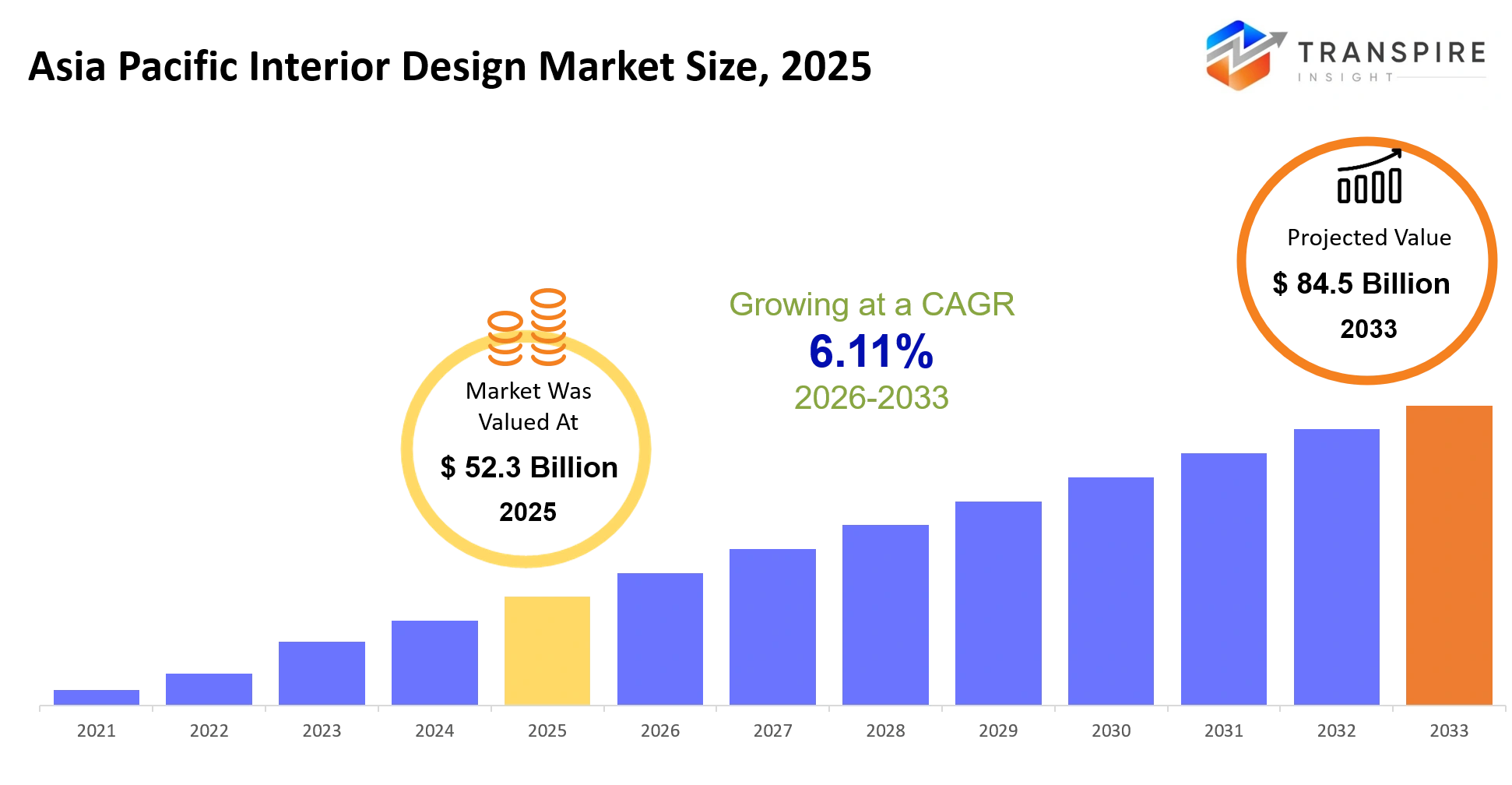
- Asia Pacific Interior Design Market Size 2025: USD 52.3 Billion
- Asia Pacific Interior Design Market Size 2033: USD 84.5 Billion
- Asia Pacific Interior Design Market CAGR:6.11%
- Asia Pacific Interior Design Market Segments: By Service Type (Residential Design, Commercial Design, Hospitality Design, Healthcare Design, Retail Design, Others); By Project Type (New Construction, Renovation, Remodeling, Others); By End User (Residential, Corporate, Hospitality, Retail, Others); By Style (Modern, Contemporary, Traditional, Minimalist, Others).
To learn more about this report,  Download Free Sample Report
Asia Pacific Interior Design Market Summary
The Asia Pacific Interior Design Market was valued at USD 52.3 Billion in 2025. It is forecast to reach USD 84.5 Billion by 2033. That is a CAGR of 6.11% over the period.
The Asia Pacific Interior Design Market is really important because it helps make residential, hospitality and institutional spaces better for people to use. It turns buildings into places that help people work better, feel happy and be healthy. The Asia Pacific Interior Design Market supports people who build properties, companies and hotels by making the most of the space, making it look nice and increasing its value over time.
In the five years the Asia Pacific Interior Design Market has changed a lot. Now designers use computers and special software to work and show what the spaces will look like. This is different from the way of drawing things by hand. The Asia Pacific Interior Design Market has also started to think more about the environment.The COVID-19 pandemic made this change happen faster. It made designers rethink how to make workplaces and hotels safe, flexible and easy to use.
Now people want spaces that're not just nice to look at but also work well and are good for the people using them. The Asia Pacific Interior Design Market is important because it helps make spaces that people want to use which means more people will rent them, stay longer and spend money. The Asia Pacific Interior Design Market is about making spaces that're good for people and good for business.
Key Market Insights
- The Asia Pacific Interior Design Market is really big in East Asia, which has 40 percent of the market in 2025. Southeast Asia is growing fast until 2030 because of cities getting bigger and more commercial buildings being built.
- In the Asia Pacific Interior Design Market people are using computer programs that can make pictures and designs which is replacing the old way of doing things and making projects more efficient and faster.
- After COVID many workplaces were redesigned to be more flexible and hotels were changed to be more modern which changed the way people wanted things to look in the Asia Pacific Interior Design Market from 2020 to 2025.
- More money is being invested in buildings and cities which means there are more interior design projects in the corporate, retail and hospitality sectors.
- 38 percent of the Asia Pacific Interior Design Market is made up of commercial offices and this is because many big companies are expanding and changing the way their offices look to be more mixed and modern.
- The healthcare and wellness sector is growing fast until 2030 because people want hospitals and other places to be designed with the patient in mind.
- Big companies are the people using the Asia Pacific Interior Design Market and they make up about 45 percent of the market in 2025.
- Hotels and tourism companies are also using the Asia Pacific Interior Design Market more and more as they invest a lot in making their interiors look nice and luxurious.
- Big companies like Gensler, Perkins&Will, AECOM, Jacobs, Woods Bagot and NBBJ are getting bigger in the Asia Pacific Interior Design Market by using technology working with other companies and expanding to new areas.
- Companies have to adopt computer-based designing techniques, environment-friendly materials and space-planning technologies in an efficient manner in order to become successful in the Asia Pacific Interior Design Market..
What are the Key Drivers, Restraints, and Opportunities in the Asia Pacific Interior Design Market?
Drivers
The drivers in the Asia Pacific Interior Design Market include people making cities commercial and wanting experiences from the space. There is a significant amount of investment taking place for office buildings, retail outlets, and hotels in cities such as Singapore, Shanghai, and Mumbai. Therefore, the developers are now considering interior designing as a method to add value to their project rather than just completing the project. Computer aided designing software such as BIM and the use of artificial intelligence in aiding the process of designing have resulted in faster completion of the design process, enabling firms such as Gensler and Perkins&Will to undertake more projects in the Asia Pacific Interior Design Market.
Restraints
One major issue here is that some firms have to pay huge amounts of cash in order to make use of the technology. Most of the small firms find it difficult to access the services offered by these tools since they are very costly and few people use them. The firms have continued with their old ways of doing things, thus making it difficult for them to cooperate with other firms in carrying out major projects. The result of all this is that there is no growth in the industry.
Opportunities
There is room for growth for the Asia Pacific Interior Design Market due to urban development projects which are taking place especially in Southeast Asia and India. The government is investing in urban development projects that involve the construction of houses, shopping centers, and places of worship in cities such as Jakarta and Bengaluru. Therefore, the design firms will have contracts to undertake such projects provided that they make use of technology and sustainable products in designing such spaces. It is possible that this would be the turning point of growth for the Asia Pacific Interior Design Market.
What Has the Impact of Artificial Intelligence Been on the Asia Pacific Interior Design Market?
Artificial intelligence is being used more and more in systems that control the performance of scrubbers on ships and help reduce emissions in the Asia Pacific area. This is changing the way ships check if they are following the rules and use fuel in a way.
AI is now used to automate systems that clean exhaust gas. It constantly checks how much sulfur is being released and makes changes to the scrubber flow rates. It also helps with reporting if ships are following the rules set by the International Maritime Organization. This means people do not have to get involved much and there are fewer mistakes.
Machine learning is also being used to predict when maintenance is needed. It looks at data from sensors on pumps, scrubbers and propulsion systems to see if any parts are worn out or if something is not working right. This helps shipping companies plan maintenance before something breaks down. This means ships can stay in use for longer and companies can save money on repairs. It also helps keep fuel use steady on trips.Some big shipping companies in the Asia Pacific area are using these systems. They are seeing real results. They are spending money on maintenance and are better at following the rules.
However there is a problem. Sometimes ships are in areas where they cannot connect to the internet. This means the systems do not have the data they need to work. This limits how well artificial intelligence can help make decisions on its own.. Companies are working on this problem. They are improving internet connections through satellites. Making computers smarter. This will help these systems work better and be used widely to control emissions from ships.
Key Market Trends
- Between 2020 and 2025 companies like Gensler and AECOM started to use Building Information Modeling or BIM a lot. This reduced the time it took to design things by 30 percent in some areas.
- Post-2021 people wanted to change their workplaces. They did not want offices that were the same all the time. Instead they wanted offices that could be used in ways. This led to projects with flexible layouts in cities in Asia Pacific.
- Since 2022 hotels in Singapore and Thailand have been trying to make their interiors more special. They do not want the old designs anymore. They want their hotels to be unique and have a brand.
- After 2020 Japan and Australia introduced rules about sustainability. These rules made designers think about using materials that're good for the environment. They also had to think about how to reuse buildings.
- In 2023, it became common practice to involve twins in complex constructions. The digital twin is basically a representation of the future building in the virtual world.
- This allowed us to understand how lighting, ventilation, and spatial organization can be realized in practice.
- New technologies that applied AI allowed making decisions in the interests of the clients more easily. As a result, it became possible to visualize the appearance of the construction prior to its construction, which greatly simplified matters in China and India.
- During 2020-2022, there were problems with the supply chain. For this reason, many corporations decided to acquire the required components from domestic sources rather than international ones.
- Companies like Perkins&Will and NBBJ started to work with companies in the same area. They did this so they could get contracts to build mixed-use developments.
- After 2023 people wanted buildings that were "smart". This means they wanted buildings that could connect to the internet and use systems to save energy and see how many people are in the building. Building Information Modeling or BIM was used to make this happen.
Asia Pacific Interior Design Market Segmentation
By Service Type:
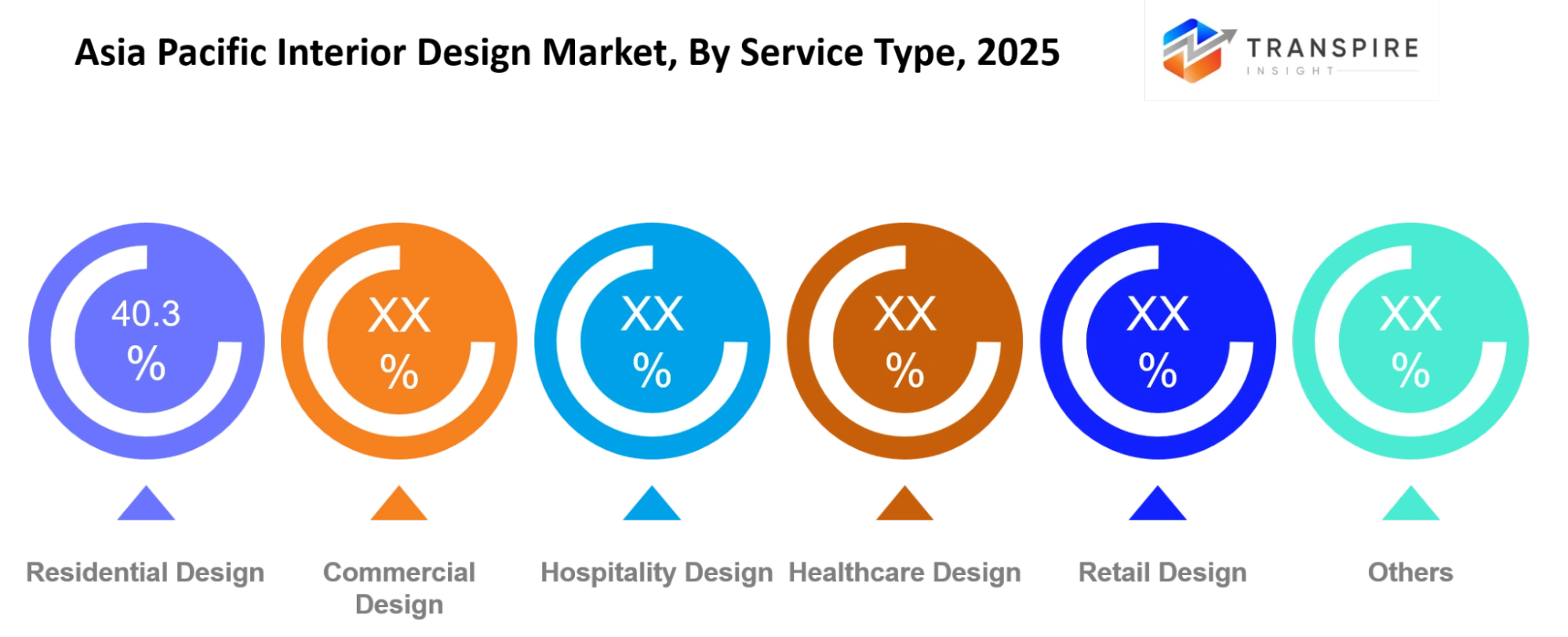
The Asia Pacific Interior Design Market will keep growing across services as people want spaces that work well and are fun to be in. Commercial Design is leading the way because companies are expanding their offices, retail spaces and co-working areas in cities. Hotels and resorts are also upgrading their interiors to match standards and make guests happier which is boosting Hospitality Design.
Healthcare Design and Retail Design are becoming more important too. Hospitals are focusing on making patients feel better with layouts and retail brands are creating immersive experiences for customers. People are realizing that good design is not about looks, but also about making things work better and lasting longer.The Asia Pacific Interior Design Market will keep getting investment because developers and businesses see design as a part of their strategy not just something to do at the end.
To learn more about this report, Download Free Sample Report
By Project Type:
Most interior design projects in Asia Pacific are still constructions because cities are growing fast and there are many new buildings and developments. Big cities are seeing lots of commercial and residential projects that need full interior design.
The trend of renovation and remodeling is also growing. Buildings and hotels are undergoing renovations and upgrades to meet the design and sustainability requirements. Renovation appeals to companies since they can save costs and improve efficiency.
By End User:
The demand for interior design by corporate organizations in the Asia Pacific region is increasing as companies redesign their office space in accordance with a new approach to work. They are investing heavily in designing the office interiors and making them more technology-oriented.
Individuals are increasingly demanding interior design of their living spaces due to urbanization. Retailers and hotels are renovating their properties to offer an experience to visitors and customers.
By Style:
Modern and Contemporary styles are popular in the Asia Pacific Interior Design Market because people like clean and functional spaces. These styles work well in offices, apartments and commercial developments.Minimalist design is also becoming popular in cities where space is limited.
Traditional styles are still used in some end residential and heritage projects. Designers are mixing styles to create spaces that reflect the brand or user's personality. The Asia Pacific Interior Design Market is moving towards a balance of simplicity, usability and cultural influence.
What are the Key Use Cases Driving the Asia Pacific Interior Design Market?
The Asia Pacific Interior Design Market is really about changing the corporate workspace. Companies are redesigning their offices to help people work together and be more productive. They want to make sure their employees are happy and want to stay with the company. So they are investing in offices that're flexible and have things that are good for people's health. They are also using a lot of technology to make their offices work better.Big companies are doing this in cities where a lot of businesses are. This is because more and more companies are moving into these cities and they need offices.
This is because more people are traveling again and companies want to make their hotels and stores really nice. Hotels want their guests to be happy and retail brands want people to buy things from them. They are making their stores really interesting so people will want to go and buy things.Hospitals are also changing the way they look. They want to make sure their patients are safe and that it is easy for them to get around the hospital.
The Asia Pacific Interior Design Market is also seeing things like smart building integration and digital twin-based interior planning. These are still ideas but people are getting really interested in them. They help companies plan their offices and buildings in a way that saves energy and is good for the people who work there. As computers and design tools get better more companies will start using these ideas to plan their big projects. The corporate workspace transformation and interior design will keep changing as companies try to make their offices the best they can be.
|
Report Metrics |
Details |
|
Market size value in 2025 |
USD 52.3 Billion |
|
Market size value in 2026 |
USD 55.8 Billion |
|
Revenue forecast in 2033 |
USD 84.5 Billion |
|
Growth rate |
CAGR of 6.11% from 2026 to 2033 |
|
Base year |
2025 |
|
Historical data |
2021 - 2024 |
|
Forecast period |
2026 - 2033 |
|
Report coverage |
Revenue forecast, competitive landscape, growth factors, and trends |
|
Regional scope |
Asia Pacific (India, China, Japan, Australia, South Korea, Rest of Asia Pacific) |
|
Key company profiled |
Gensler, HBA, Perkins&Will, AECOM, Jacobs, Woods Bagot, Wilson Associates, Hirsch Bedner, CCD, CallisonRTKL, DP Architects, Nikken Sekkei, Stantec, IA Interior Architects, NBBJ. |
|
Customization scope |
Free report customization (country, regional & segment scope). Avail customized purchase options to meet your exact research needs. |
|
Report Segmentation |
By Service Type (Residential Design, Commercial Design, Hospitality Design, Healthcare Design, Retail Design, Others); By Project Type (New Construction, Renovation, Remodeling, Others); By End User (Residential, Corporate, Hospitality, Retail, Others); By Style (Modern, Contemporary, Traditional, Minimalist, Others). |
Which Regions are Driving the Asia Pacific Interior Design Market Growth?
East Asia leads the Asia Pacific Interior Design Market due to its dense concentration of commercial real estate development and strong institutional investment capacity. China, Japan, and South Korea continue to drive large-scale demand for corporate offices, retail complexes, and mixed-use developments. Strong urban planning policies and consistent infrastructure upgrades support continuous interior design activity across major metropolitan hubs. A mature ecosystem of global firms and advanced design studios ensures high execution capability and rapid project delivery across high-value developments.
Oceania remains a stable contributor, supported by steady economic conditions and long-term real estate planning cycles. Australia and New Zealand show consistent demand driven by corporate office refurbishment, healthcare facility upgrades, and residential modernization projects. Unlike high-speed construction cycles in East Asia, this region follows a more regulated and compliance-driven development path that prioritizes quality and sustainability standards. This creates predictable revenue streams for design firms and encourages long-term partnerships with institutional clients.
Southeast Asia is the fastest-growing region, supported by rapid urban expansion and rising foreign direct investment in infrastructure and hospitality projects. Countries such as Vietnam, Indonesia, and Thailand have increased investment in smart cities, airports, and tourism infrastructure since 2022. Recent government-led urban redevelopment programs and transit-oriented projects have accelerated demand for modern interior design solutions. This growth signals strong entry opportunities for global and regional firms over the 2026 to 2033 period, particularly in large-scale mixed-use and hospitality developments.
Who are the Key Players in the Asia Pacific Interior Design Market and How Do They Compete?
The Asia Pacific Interior Design Market remains moderately fragmented, with global design giants competing alongside strong regional studios and specialized boutique firms. Competition is shaped more by service capability, digital design integration, and project execution speed rather than price alone. Large developers and corporate clients now evaluate firms based on BIM proficiency, sustainability compliance, and ability to deliver integrated design-build solutions. As a result, incumbents are defending share by investing in technology platforms and cross-disciplinary teams, while smaller firms compete through niche expertise in hospitality, retail, or residential customization.
Gensler focuses on technology-driven design delivery, using advanced visualization tools and data-led spatial planning to secure large corporate and mixed-use projects. Perkins&Will differentiates through strong sustainability integration, embedding low-carbon material frameworks and wellness-certified design standards into its project pipeline. AECOM leverages its engineering scale to combine interior design with infrastructure and urban planning projects, enabling bundled service contracts across smart city developments. Woods Bagot expands through regional offices in Asia-Pacific hubs, focusing on workplace and education interiors that emphasize flexible, human-centered environments. NBBJ strengthens its position through healthcare and life-science interior projects, using evidence-based design approaches to win institutional contracts across high-growth urban centers.
Company List
- Gensler
- HBA (Hirsch Bedner Associates)
- Perkins&Will
- AECOM
- Jacobs
- Woods Bagot
- Wilson Associates
- Hirsch Bedner Associates
- CannonDesign (CCD)
- CallisonRTKL
- DP Architects
- Nikken Sekkei
- Stantec
- IA Interior Architects
- NBBJ
Recent Development News
“In June 2026, Ricoh Asia Pacific acquired Global Vision Multimedia Group. The acquisition expanded Ricoh’s workplace services and AV integration capabilities across the Asia Pacific region, strengthening its end-to-end workplace experience offering for enterprise clients.
Source: https://www.plataformamedia.com
“In April 2026, AirTrunk acquired Lumina CloudInfra to expand its data center footprint into India. The transaction added approximately 600 MW of planned capacity, reinforcing hyperscale digital infrastructure development across major Indian cities and strengthening Asia Pacific expansion in cloud-ready real estate ecosystems.
Source: https://thenextweb.com
“In April 2026, Fiera Milano Asia Pacific advanced its regional expansion strategy through new design-focused trade initiatives in Southeast Asia. The move supported growing cross-border design collaboration and strengthened platform-led engagement across interior design and property development ecosystems.
Source: https://www.ansa.it
What Strategic Insights Define the Future of the Asia Pacific Interior Design Market?
The Asia Pacific Interior Design Market is structurally shifting toward technology-integrated and experience-led design ecosystems, where value creation depends on digital planning, sustainability compliance, and lifecycle performance rather than aesthetic delivery alone. This direction is being driven by the rapid convergence of real estate development, smart building adoption, and data-enabled design workflows across major urban clusters. Over the next 5 to 7 years, demand will increasingly concentrate around projects that combine mixed-use infrastructure with adaptive, digitally managed interior environments.
A less visible risk lies in technology substitution, where AI-driven design platforms and automated layout generation tools begin reducing reliance on traditional design service labor, compressing margins for mid-tier firms. At the same time, uneven regulatory alignment across Asia Pacific markets may slow cross-border project execution and create compliance fragmentation.
An emerging opportunity is the integration of digital twin ecosystems into interior planning for large-scale commercial and healthcare developments, particularly in India and Southeast Asia where smart city programs are expanding rapidly. Firms that embed real-time simulation and performance analytics into design workflows will gain long-term advantage. Market participants should invest early in AI-enabled design infrastructure and cross-disciplinary capability building to secure high-value institutional contracts.
Asia Pacific Interior Design Market Report Segmentation
By Service Type
- Residential Design
- Commercial Design
- Hospitality Design
- Healthcare Design
- Retail Design
- Others
By Project Type
- New Construction
- Renovation
- Remodeling
- Others
By End User
- Residential
- Corporate
- Hospitality
- Retail
- Others
By Style
- Modern
- Contemporary
- Traditional
- Minimalist
- Others
Frequently Asked Questions
Find quick answers to common questions.
The expected Asia Pacific Interior Design Market size for the market will be USD 84.5 Billion in 2033.
Key segments for the Asia Pacific Interior Design Market are By Service Type (Residential Design, Commercial Design, Hospitality Design, Healthcare Design, Retail Design, Others); By Project Type (New Construction, Renovation, Remodeling, Others); By End User (Residential, Corporate, Hospitality, Retail, Others); By Style (Modern, Contemporary, Traditional, Minimalist, Others).
Major Asia Pacific Interior Design Market players are Gensler, HBA, Perkins&Will, AECOM, Jacobs, Woods Bagot, Wilson Associates, Hirsch Bedner, CCD, CallisonRTKL, DP Architects, Nikken Sekkei, Stantec, IA Interior Architects, NBBJ.
The Asia Pacific Interior Design Market size is USD 52.3 Billion in 2025.
The Asia Pacific Interior Design Market CAGR is 6.11% from 2026 to 2033.
- Gensler
- HBA (Hirsch Bedner Associates)
- Perkins&Will
- AECOM
- Jacobs
- Woods Bagot
- Wilson Associates
- Hirsch Bedner Associates
- CannonDesign (CCD)
- CallisonRTKL
- DP Architects
- Nikken Sekkei
- Stantec
- IA Interior Architects
- NBBJ
About the Authors

Kartik bhong
I am Kartik Bhong, a Senior Research Analyst at Transpire Insight, specializing in the Packaging, Manufacturing, and Construction industry. My work focuses on analyzing market trends, emerging technologies, industry regulations, and competitive landscapes to deliver accurate, data-driven insights. I am passionate about transforming complex industry information into clear, practical content that helps businesses, professionals, and decision-makers stay informed and make confident strategic decisions. Through continuous research and a strong commitment to accuracy, I strive to create reliable, well-researched content that reflects the latest developments across these dynamic industries and supports the vision of Transpire Insight in delivering valuable market intelligence.

Chakradhar Khansole
Chakradhar serves as the Research Director at Transpire Insight, bringing over 8 years of experience in technology, innovation, and strategic market intelligence. He specializes in transforming complex market data into actionable business insights that enable organizations to make informed, growth-oriented decisions. Recognized for his strategic vision and analytical expertise, Chakradhar leads high-impact research initiatives, delivering comprehensive market assessments, competitive intelligence, and forward-looking industry analysis.
Recently Published Reports
-
Apr 2026
Handling and Lifting Equipment Market
Handling and Lifting Equipment Market Size, Share & Analysis Report By Product (Cranes and Hoists, Forklifts, Conveyor Systems, Aerial Work Platforms, Others), By Application (E-Commerce, Automotive and Railway, Food and Beverages, Aviation, Others), and Geography (North America, Europe, Asia-Pacific, Middle East and Africa, South and Central America), 2021 - 2031
-
Apr 2026
HVAC Equipment Market
HVAC Equipment Market Size, Share & Analysis Report By Heating Equipment Type (Boilers and Furnaces, Heat Pumps, and Unitary Heaters), By Ventilation Equipment (Air Handling Units, Humidifiers and Dehumidifiers, Air Filters, and Fan Coiling Units), By Air Conditioning Equipment (Unitary Air Conditioners, Room Air Conditioners, Packaged Terminal Air Conditioners, and Chillers), By End User (Commercial, Residential, Industrial, and others), and Geography (North America, Europe, Asia-Pacific, Middle East and Africa, South and Central America), 2021 – 2031
-
Apr 2026
Refrigeration Valves Market
Refrigeration Valves Market Size, Share & Analysis Report By Type (Solenoid Valves, Expansion Valves, Check Valves, Service Valves, Others), By Application (Commercial Refrigeration, Industrial Refrigeration, Transport Refrigeration, Residential Refrigeration, Air Conditioning Systems), By End User (Food and Beverage Industry, Pharmaceutical Industry, HVAC Industry, Chemical Industry, Others), and Geography (North America, Europe, Asia-Pacific, Middle East and Africa, South and Central America), 2021 – 2031
-
Apr 2026
E-Commerce Packaging Materials Market
E-Commerce Packaging Materials Market By Material Type (Corrugated Boxes, Paper & Paperboard, Foam & Cushioning Materials, Plastic Packaging, Flexible Packaging, Protective Packaging, Others), By Product(Primary Packaging, Secondary Packaging, Tertiary Packaging), By Packaging Function (Protective Packaging, Branding & Presentation Packaging, Transit & Logistic Packaging, Sustainable Packaging, Tamper Evidence Packaging), By End-User (Retail & Consumer Goods, Electronic Appliances, Food & Beverages, Healthcare & Pharmaceutical, Fashion & Apparel, Home & Furnishing, Others); By Industry Analysis, Size, Share, Growth, Trends, and Forecasts 2021-2033