

Europe Automotive Engine Cooling System Market Summary
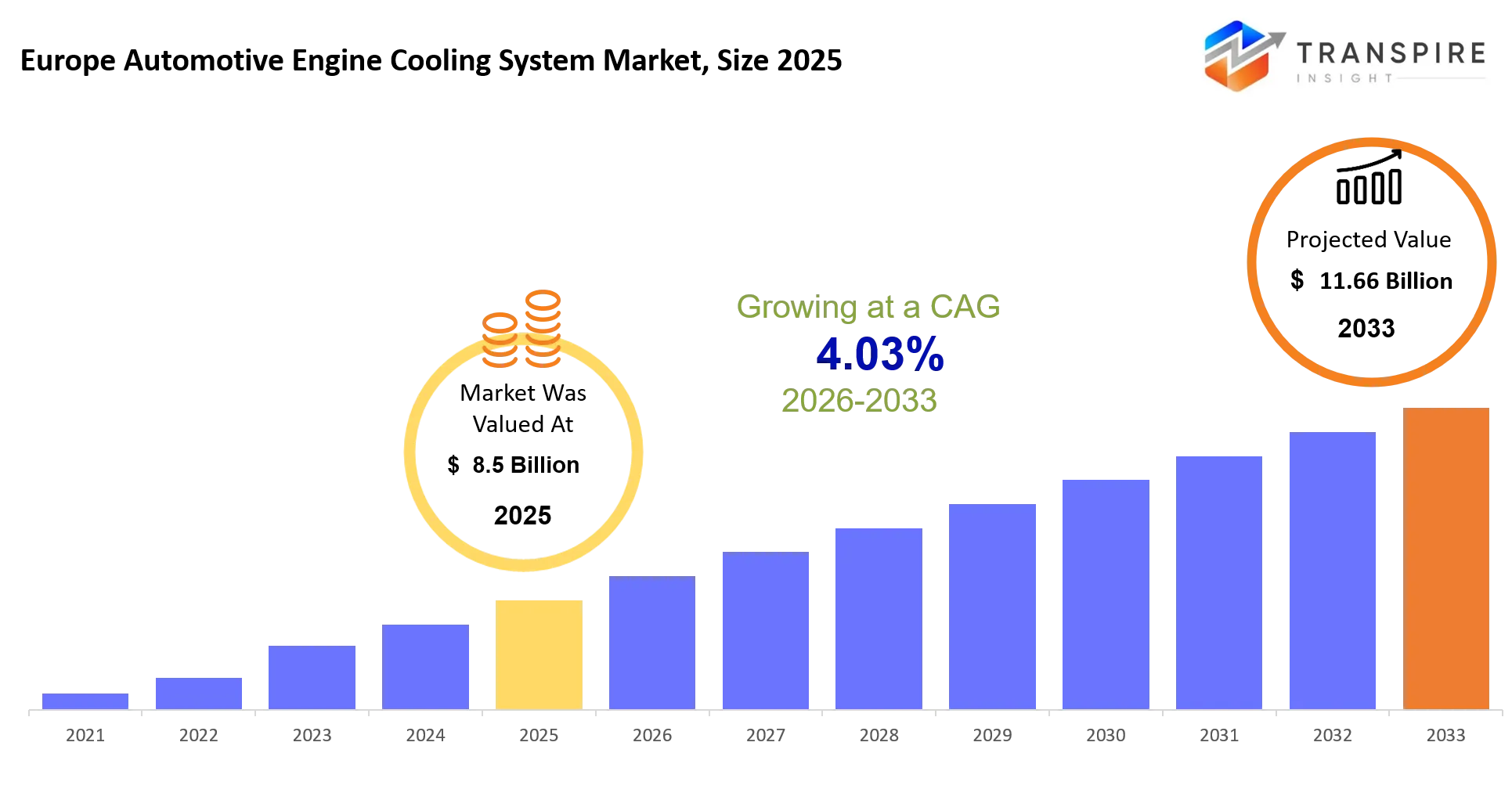
As per Transpire Insight Analysis, the Europe Automotive Engine Cooling System Market size is estimated at USD 8.5 Billion in 2025 and is anticipated to reach USD 11.66 Billion by 2033, growing at a CAGR of 4.03% from 2026 to 2033.
The Europe Automotive Engine Cooling System Market helps keep vehicles dependable, not just by cooling an engine, but by managing temperatures in a steady way, so overheating gets avoided, and modern cars can keep fuel efficiency, durability, and lower emissions while they’re doing the everyday routes. Over the last 3–5 years, it really seems the market has changed because automakers have been leaning more into advanced cooling solutions, those that fit hybrid powertrains and also electric vehicle thermal management, plus the stricter emissions rules that are now everywhere. With the arrival of Euro 7 emission standards, and the wider push toward decarbonization, manufacturers had to redesign their thermal systems for better performance, and less wasted energy, even if it feels a bit more complex. After the pandemic, supply chain issues also made a stronger case for localization,so suppliers started strengthening regional production abilities and keeping parts closer to assembly points. Market expansion is tied to the need for wiser, smarter cooling technologies that can cope with complicated vehicle layouts, and still work reliably. In the end, this move will open doors for component makers who provide lighter, more efficient, and electronically controlled cooling systems across passenger vehicles, and commercial vehicles too, at the same time.
Europe Automotive Engine Cooling System Market Size & Forecast:
- Europe Automotive Engine Cooling System Market Size 2025: USD 8.5 Billion
- Expected Market Value 2033: USD 11.66 Billion
- Forecast CAGR: 4.03%
- Leading region in 2025: Germany, France, the United Kingdom, Italy, Spain, and Belgium
- Fastest Growing region: Poland, Czech Republic, Hungary, Romania, Slovakia, and Turkey
- Key Profile: Valeo, MAHLE, Denso, Hanon Systems, Modine Manufacturing, BorgWarner, Marelli, Bosch, Continental, Schaeffler, T.RAD, Rheinmetall Automotive, Gentherm, Calsonic Kansei, Nissens Automotive
Key Market Insights
- Western Europe kind of dominates, with around 60% market share in 2025 , and it looks driven by Germany, France and UK automotive production upgrades that keep getting better over time.
- Eastern Europe, meanwhile, is the fastest-growing region during 2025–2033, with help from expanding manufacturing hubs in Poland, Hungary , and Romania.
- On the product side, liquid cooling systems are in front, taking more than 65% share , mostly because heat control is superior in modern vehicles.
- Electric cooling solutions sit next , they’re the second-largest segment, and adoption is increasing across hybrid and battery-electric vehicle platforms.
- Thermal management modules are growing fastest from 2025–2033, as automakers fold in smarter cooling architectures and kind of rethink how temperature gets handled.
- For applications, passenger vehicles lead, at nearly 70% share in 2025 , backed by rising vehicle production across European markets.
- Electric and hybrid vehicles are the fastest-growing applications too, because manufacturers prioritize temperature optimization for both batteries and powertrains.
- For end users, OEMs are the biggest group with over 75% share, mainly due to direct integration of cooling systems into the vehicle platforms.
- Aftermarket providers are growing the quickest, since older vehicle fleets increase replacement and maintenance needs across Europe.
What are the Key Drivers, Restraints, and Opportunities in the Europe Automotive Engine Cooling System Market?
The European automotive engine cooling system market is being pushed forward by tighter European Union emission rules and also that rapid shift toward electrified vehicles. The CO₂ reduction targets that came in through EU vehicle policies are nudging automakers to boost thermal efficiency, mainly because better cooling setups improve fuel economy and even battery output. So you see a move toward liquid cooling modules, electric water pumps, and more “smart” thermal controls. With hybrid and electric vehicle production continuing to grow, manufacturers are putting additional funding into upgraded cooling architectures , and that opens up new ways for component suppliers to get paid.
Even so, supply chain complexity still stays the big, structural obstacle for faster expansion. Looking at Transpire Insight review of regional procurement announcements and launch timetables, it seems supply chain concentration is the main execution risk. Semiconductor shortages, raw material cost swings, and reliance on specialized component suppliers can trigger production delays that are hard to fix quickly , since automotive cooling systems need designs that are validated, plus long qualification cycles. When this happens, vehicle launches can slip, manufacturing expenses go up, and supplier margins take a hit across different regional markets.
For the next growth stretch, the strongest opportunity looks like advanced thermal management integration. European automakers are investing in battery thermal management , heat pump systems, and software-driven cooling technologies to lift electric vehicle efficiency. Germany, Sweden, and France are positioned to benefit, because manufacturers are rolling out electric mobility platforms and also building localized supply networks.
What Has the Impact of Artificial Intelligence Been on the Europe Automotive Engine Cooling System Market?
Artificial intelligence along with digital technologies are kind of reshaping automotive thermal management across Europe, mostly by stepping up monitoring, automation, and overall system efficiency. With AI supported sensors and control algorithms, cooling architectures are being put together so they can automatically tune coolant flow, manage fan behavior, and handle temperature regulation, all depending on what the vehicle is doing in real time. In practice these solutions support manufacturers with compliance tracking that feels more organized, and they also help optimize thermal performance in hybrid as well electric platforms.
Machine learning models are being used too, for predictive maintenance, by digging through temperature trends , wear related signals, and other operational data to spot possible cooling malfunctions before a breakdown really starts. Digital simulation tools let engineers forecast the thermal behavior earlier and this can trim down development cycles during vehicle design, or at least it tends to. Overall, these advances may boost system reliability, lower maintenance needs, and improve energy efficiency, even if the gains vary by platform.
Still, AI adoption comes with limits. The integration costs can be high, data availability is not always consistent across different vehicle platforms, and getting accurate predictions in messy real world driving conditions is genuinely challenging. As connectivity keeps improving, intelligent thermal solutions will likely show up more often across European automotive manufacturing.
Key Market Trends
- From 2025 on, European car makers start speeding up smart cooling put together, sort of, to keep battery performance steadier and to trim the amount of energy the car uses.
- Electric water pumps picked up more ground after 2023, because several manufacturers swapped out the older mechanical approach with electronically managed thermal setups, not just for looks, but for control.
- Germany, during 2024, pushed harder on investments for EV thermal know-how through partnerships with automotive suppliers , aiming at better cooling efficiency, in a more focused way.
- After 2021, the EU emissions rules got more strict, and that pressure helped steer manufacturers toward thermal management systems that burn less energy overall.
- Battery thermal management systems show up more noticeably after 2022, when EV manufacturing grew across many European markets , and the demand for stable temperature control followed.
- Bosch and MAHLE also broadened their thermal technology ranges in 2024 , and they tuned it toward the cooling needs of both hybrid and electric vehicles.
- Between 2023 and 2025, digital monitoring solutions became more common as makers put in connected vehicle diagnostics, tying cooling health into the bigger telemetry picture.
- After 2022, Eastern European production hubs gained traction, since companies increased their capacity for making automotive parts.
- Lightweight cooling components became a priority starting around 2023, because automakers wanted better vehicle efficiency and lower emissions, at the same time.
- In 2025, AI driven thermal optimization got more attention, as suppliers built predictive cooling control systems that try to anticipate changes before they become a problem.
Europe Automotive Engine Cooling System Market Segmentation
By Component :
Component demand is really about better vehicle temperature control, more fuel efficiency, and stronger system reliability, you know. Radiators still keep a big role , because automotive manufacturers seem to focus on practical heat transfer solutions across both passenger cars and commercial fleets. Cooling fans, water pumps, and thermostats help the engine stay in a stable operating zone, mostly by organizing airflow better and keeping coolant moving around in a controlled way.
Water pumps are getting more attention lately with the rise of hybrid and electric vehicle production, since those advanced thermal systems ask for very precise temperature regulation. At the same time coolant reservoirs, and a few supporting units, will probably keep being adopted as part of replacement cycles and ongoing technology upgrades on many vehicle platforms. Component suppliers are also pushing lightweight materials and more efficient engineering, to match what upcoming vehicles will need.
By Vehicle Type :
Passenger cars are a major demand segment because vehicle production stays high across many European countries. Engine cooling systems remain important for keeping performance consistent, lowering overheating risks, and helping vehicle durability last longer. Light commercial vehicles and heavy commercial vehicles also keep a steady pull in demand, driven by logistics, transportation services, and industrial activity.
Electric vehicles are becoming one of the faster growth areas, mainly because battery temperature management needs advanced cooling solutions. Manufacturers are working on specialized thermal setups for electric powertrains, battery packs, and even charging performance improvement. Growth in electric mobility investments across Germany, France, Norway, and other European markets will further expand the vehicle mix, in a rather direct way.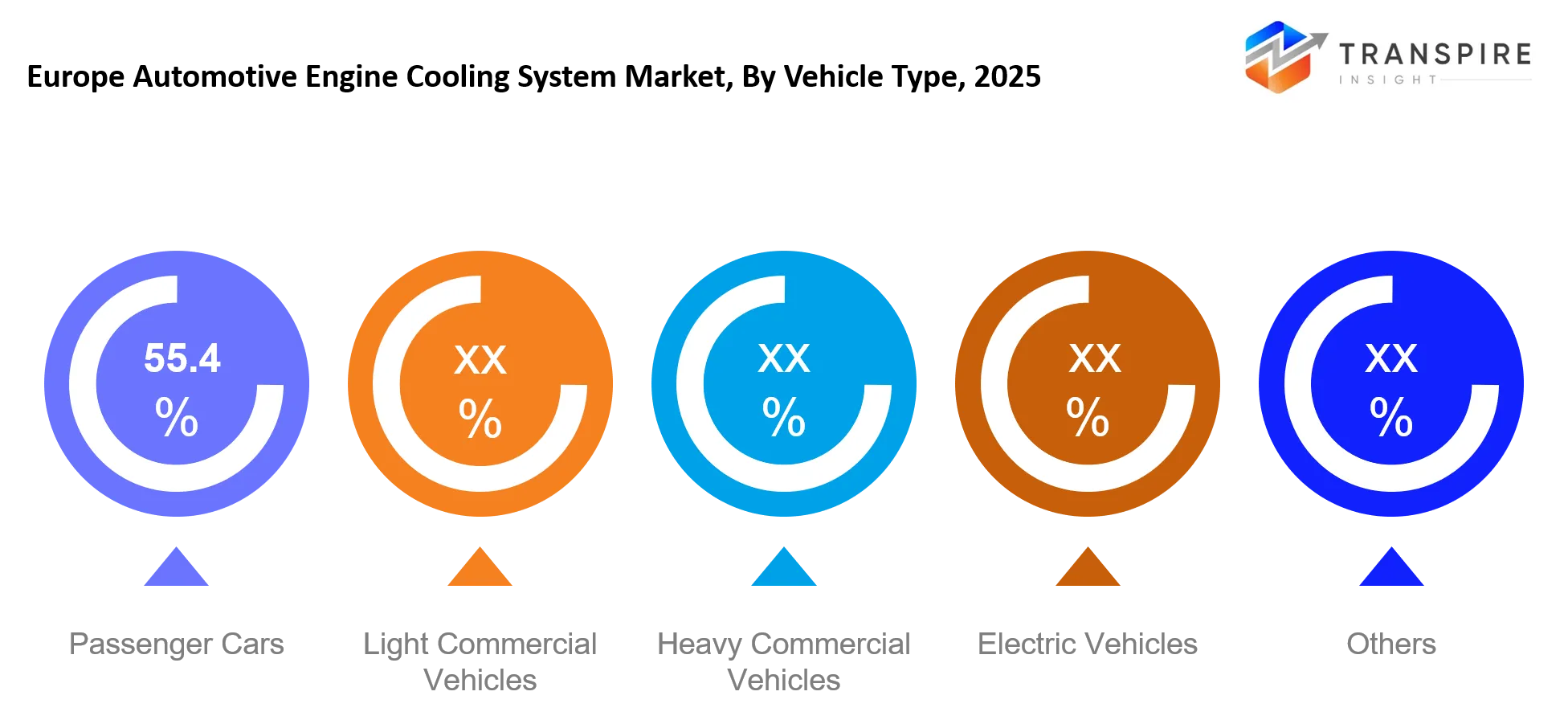
By Cooling Type :
Liquid cooling is still in a leading position, more or less because modern vehicles really need efficient heat management across different operating conditions. Most automotive manufacturers lean toward liquid based systems, mostly for steadier temperature control , better overall performance and also because it fits nicely with advanced powertrains. Meanwhile air cooling keeps showing up in selected vehicle applications where a simple design matters and lower maintenance requirements remain kind of important.
Hybrid cooling systems are getting more attention lately, as the demand for electrified vehicles rises and people are pushing for better thermal efficiency. A lot of the technology development seems to aim at mixing liquid and air based approaches, so the system behavior is improved in practice. Suppliers are also working on compact cooling solutions, to back up vehicle efficiency targets and the changing expectations within automotive engineering.
By Sales Channel :
OEM sales channels remain quite influential, because manufacturers integrate cooling systems during vehicle production, rather than adding them later. Direct supply agreements between automotive companies and component providers help keep demand consistent, and support quality control too. OEM partnerships also encourage development of custom cooling technologies for new vehicle models, which makes sense when timelines are tight.
Aftermarket channels are widening as vehicles get older, maintenance needs increase , and replacement demand grows across various European countries. Independent service providers and component distributors support repair work for both passenger and commercial vehicles. Plus digital sales platforms and improved distribution networks should further strengthen the aftermarket opportunities throughout the forecast period.
By Propulsion :
ICE vehicles keep pulling strong demand, mostly because internal combustion engines need dependable cooling setups, for smooth and efficient operation. In fact, the vehicle fleets in many European countries are still aging in parts, so there are constant replacement and service needs, kinda ongoing. Because of that, cooling technology suppliers are steadily polishing conventional systems, using better materials, making things more compact , and pushing higher efficiency levels.
At the same time, hybrid and electric vehicles seem to be the quickest growing propulsion groups, largely tied to how automotive manufacturers are leaning into electrification. Battery thermal management, along with cooling for power electronics, plus smart temperature controls are turning into real focus zones for development. And as investments in electric mobility infrastructure rise, while vehicle output expands, it should also feed demand for advanced cooling solutions built around newer propulsion approaches.
What are the Key Use Cases Driving the Europe Automotive Engine Cooling System Market?
Passenger cars basically sit at the center of how Europe's Automotive Engine Cooling System market demand grows, like this is the main thing people think about . Car makers as well as OEM suppliers, buy more advanced cooling parts so the engine stays steady, performs better , has fewer failures, and also still fits European emission standards. When production volumes are high , you get an almost steady need for dependable thermal management systems, all the time.
Commercial vehicles and electric vehicles are getting bigger too, not just in theory but in real adoption. Fleet operators, logistics companies , and EV manufacturers want cooling setups that handle heavy use, protect the battery , and even boost operating efficiency. These areas push upgrades in transport technology across multiple industries, kind of a domino effect.
More new use cases are showing up as well, like connected thermal management systems, plus AI based cooling controls. Automotive technology teams and premium vehicle manufacturers are putting money into smarter approaches, to squeeze out more energy efficiency and also prepare for future vehicle rules .
|
Report Metrics |
Details |
|
Market size value in 2025 |
USD 8.5 Billion |
|
Market size value in 2026 |
USD 8.84 Billion |
|
Revenue forecast in 2033 |
USD 11.66 Billion |
|
Growth rate |
CAGR of 4.03% from 2026 to 2033 |
|
Base year |
2025 |
|
Historical data |
2021 - 2024 |
|
Forecast period |
2026 - 2033 |
|
Report coverage |
Revenue forecast, competitive landscape, growth factors, and trends |
|
Country scope |
Europe (Germany, United Kingdom, France, Italy, Spain and Rest of Europe) |
|
Key company profiled |
Valeo, MAHLE, Denso, Hanon Systems, Modine Manufacturing, BorgWarner, Marelli, Bosch, Continental, Schaeffler, T.RAD, Rheinmetall Automotive, Gentherm, Calsonic Kansei, Nissens Automotive . |
|
Customization scope |
Free report customization (country, regional & segment scope). Avail customized purchase options to meet your exact research needs. |
|
Report Segmentation |
By Component (Radiators, Cooling Fans, Water Pumps, Thermostats, Coolant Reservoirs, Others); By Vehicle Type (Passenger Cars, Light Commercial Vehicles, Heavy Commercial Vehicles, Electric Vehicles, Others); By Cooling Type (Liquid Cooling, Air Cooling, Hybrid Cooling, Others); By Sales Channel (OEM, Aftermarket, Others); By Propulsion (ICE Vehicles, Hybrid Vehicles, Electric Vehicles, Others) |
Which Regions are Driving the Europe Automotive Engine Cooling System Market Growth?
Western Europe is basically carrying most of the Europe Automotive Engine Cooling System Market, with something like 60% market share in 2025. And it’s not just by luck… strong EU emission rules, efficiency targets for vehicles, plus the whole advanced automotive infrastructure thing, all together help keep this region in front. Germany, France, the UK, and Italy also look like they have a solid set up, because of automotive manufacturers, component suppliers and ongoing technology investments, kind of a loop that feeds itself. With all the continuous electric vehicle push and thermal management innovation going on, Western Europe should stay on top through 2033, even if the competition gets louder.
Southern Europe meanwhile brings steady revenue, mainly from consistent vehicle demand, active manufacturing, and those well connected automotive export networks. Spain and Italy, in particular, benefit from long running production facilities, skilled manufacturing capability, plus steady investment in vehicle technologies. Since the regulatory rules mostly line up with the European Union standards, cooling system suppliers get more predictable business conditions. So yeah, this area stays a dependable contributor, supported by continuous passenger vehicle production and replacement needs.
Eastern Europe is the one moving fastest, with countries like Poland, Hungary, Romania, and Slovakia bringing in new automotive investment and bigger manufacturing expansions. Industrial modernization is increasing, foreign direct investment is showing up more, and electric vehicle component production is opening fresh doors for growth. Supply chain infrastructure is getting better too, while production costs are lower, which makes manufacturers feel more comfortable expanding there. Overall, during 2026–2033, growth should create more chances for suppliers investing in localized production, plus advanced cooling technologies, all at once.
Who are the Key Players in the Europe Automotive Engine Cooling System Market and How Do They Compete?
Competition within the Europe Automotive Engine Cooling System Market is sort of moderately consolidated, i mean a few established players are already there, and they go head to head using technology innovation, better manufacturing efficiency and also through automotive partnerships. Most firms try to push advanced thermal management, go for lighter parts, and deliver customized setups for electric and hybrid vehicles. Meanwhile the incumbents keep their position, and the specialized technology providers kinda sneak in by creating new chances that are electrification-oriented, like cooling designs that fit the new powertrains.
Bosch shows up with intelligent thermal management, sensor integration, and major OEM partnerships at scale. They also invest in connected vehicle solutions, which helps cooling performance a bit, and makes it easier to get adoption across hybrid and electric platforms, you know. MAHLE differentiates using advanced thermal systems for electric mobility, including battery cooling solutions plus heat management methods that are more efficient overall. Valeo expands with electrification centered cooling technologies and more integrated vehicle thermal solutions, aimed at energy efficiency objectives. Denso competes through precision engineered cooling systems and broad global manufacturing reach, which helps reliability for vehicle manufacturers. BorgWarner keeps focus on electrified vehicle thermal solutions, and they invest in technologies that support battery performance along with advanced propulsion systems, even when the duty cycle gets demanding.
Company List
- Valeo
- MAHLE
- Denso
- Hanon Systems
- Modine Manufacturing
- BorgWarner
- Marelli
- Bosch
- Continental
- Schaeffler
- T.RAD
- Rheinmetall Automotive
- Gentherm
- Calsonic Kansei
- Nissens Automotive
Recent Development News
In February 2025, MAHLE secured a series order to supply high-performance cooling modules for European megawatt charging systems. The investment strengthens thermal management solutions for electric commercial vehicle charging infrastructure and expands cooling technology applications beyond vehicle platforms. Source https://www.mahle.com/
In November 2025, Valeo partnered with 2CRSi to develop advanced liquid cooling solutions using automotive thermal expertise for edge data centers. The partnership expands Valeo’s cooling technology capabilities and creates new applications for high-efficiency thermal management systems. Source https://www.valeo.com/
What Strategic Insights Define the Future of the Europe Automotive Engine Cooling System Market?
The European Automotive Engine Cooling System Market is likely to drift toward more intelligent thermal management systems in the next five to seven years, because electrification, efficiency rules, and newer vehicle architectures keep changing what components are expected to do. The main growth factors will still be tied to solutions that handle battery cooling, protect power electronics, and also raise overall energy performance, in a more measurable way.
There is also a not so obvious risk underneath it all, basically supply chain concentration for specialized materials and electronic components. That kind of concentration makes the whole thing a bit fragile when pricing jumps, or when production gets interrupted, even briefly. At the same time, a pretty clear opportunity is showing up with AI-enabled thermal control systems, when they’re paired with electric vehicle platforms, and this is especially noticeable across Eastern European manufacturing hubs.
So market participants should probably lean into localized supply networks, put money into software integrated cooling technologies, and build tighter partnerships with electric vehicle manufacturers, because that’s where the next wave of value may collect.
Europe Automotive Engine Cooling System Market Report Segmentation
By Component
- Radiators
- Cooling Fans
- Water Pumps
- Thermostats
- Coolant Reservoirs
By Vehicle Type
- Passenger Cars
- Light Commercial Vehicles
- Heavy Commercial Vehicles
- Electric Vehicles
By Cooling Type
- Liquid Cooling
- Air Cooling
- Hybrid Cooling
By Sales Channel
- OEM
- Aftermarket
By Propulsion
- ICE Vehicles
- Hybrid Vehicles
- Electric Vehicles
Frequently Asked Questions
Find quick answers to common questions.
The Expected Europe Automotive Engine Cooling System Market size for the Market will be USD 11.66 Billion in 2033.
Key segments for the Europe Automotive Engine Cooling System Market are By Component (Radiators, Cooling Fans, Water Pumps, Thermostats, Coolant Reservoirs, Others); By Vehicle Type (Passenger Cars, Light Commercial Vehicles, Heavy Commercial Vehicles, Electric Vehicles, Others); By Cooling Type (Liquid Cooling, Air Cooling, Hybrid Cooling, Others); By Sales Channel (OEM, Aftermarket, Others); By Propulsion (ICE Vehicles, Hybrid Vehicles, Electric Vehicles, Others).
Major Europe Automotive Engine Cooling System Market Players are Valeo, MAHLE, Denso, Hanon Systems, Modine Manufacturing, BorgWarner, Marelli, Bosch, Continental, Schaeffler, T.RAD, Rheinmetall Automotive, Gentherm, Calsonic Kansei, Nissens Automotive .
The Current Europe Automotive Engine Cooling System Market size is USD 8.5 Billion in 2025.
The Europe Automotive Engine Cooling System Market CAGR is 4.03% from 2026 to 2033.
- Valeo
- MAHLE
- Denso
- Hanon Systems
- Modine Manufacturing
- BorgWarner
- Marelli
- Bosch
- Continental
- Schaeffler
- T.RAD
- Rheinmetall Automotive
- Gentherm
- Calsonic Kansei
- Nissens Automotive
About the Authors

Mayur Shinde
I am Mayur Shinde, a Senior Research Analyst at Transpire Insight, specializing in the Automotive & Transportation and Information & Communication Technology (ICT) Industry. My work focuses on analyzing emerging market trends, technological advancements, competitive landscapes, and industry developments to deliver accurate, data-driven insights. I am passionate about transforming complex market information into clear, actionable content that helps businesses, professionals, and decision-makers stay informed and make confident strategic decisions.

Chakradhar Khansole
Chakradhar serves as the Research Director at Transpire Insight, bringing over 8 years of experience in technology, innovation, and strategic market intelligence. He specializes in transforming complex market data into actionable business insights that enable organizations to make informed, growth-oriented decisions. Recognized for his strategic vision and analytical expertise, Chakradhar leads high-impact research initiatives, delivering comprehensive market assessments, competitive intelligence, and forward-looking industry analysis.
Recently Published Reports
-
Apr 2026
ATV & UTV Market
ATV & UTV Market Size, Share & Analysis Report By Type (ATV, and UTV), By Variants (Less Than 400 CC, 400 CC To 800 CC, and More Than 800 CC), and Geography (North America, Europe, Asia-Pacific, Middle East and Africa, South and Central America), 2021 - 2031
-
Apr 2026
Automotive Central Gateway Module Market
Automotive Central Gateway Module Market Size, Share & Analysis Report By Type (Ethernet Central Gateway Module, CAN Central Gateway Module, LIN Central Gateway Module, and FlexRay), By Application (Powertrain Control, Body Control, Infotainment System, Advanced Driver Assistance Systems (ADAS), and Others), By End User (Passenger Vehicles, and Commercial Vehicles), and Geography (North America, Europe, Asia-Pacific, Middle East and Africa, South and Central America), 2021 - 2031
-
Apr 2026
Automotive Engine Oil Filter Market
Automotive Engine Oil Filter Market Size, Share & Analysis Report By Filter Type (Fuel Filter, Engine Oil Filter, Hydraulic Oil Filter, and Others), By Filter Media (Cellulose, Synthetic, and Micro), By Sales Channel (OEMs, and Aftermarket), By Vehicle Type (Passenger Cars, Light Commercial Vehicles, Heavy Duty Trucks, Buses and Coaches, and Off-road Vehicles), and Geography (North America, Europe, Asia-Pacific, Middle East and Africa, South and Central America), 2021 - 2031
-
Apr 2026
Automotive Parts Aluminium Die Casting Market
Automotive Parts Aluminium Die Casting Market Size, Share & Analysis Report By Production Process (Pressure Die Casting, Vacuum Die Casting, Squeeze Die Casting, Gravity Die Casting), By Application (Body Parts, Engine Parts, Transmission Parts, Battery And Related Components, Other Application Types), and Geography (North America, Europe, Asia-Pacific, Middle East and Africa, South and Central America), 2021 - 2031
Our Clients



