
Middle East and Africa Automotive Engine Management System Market Size & Forecast:
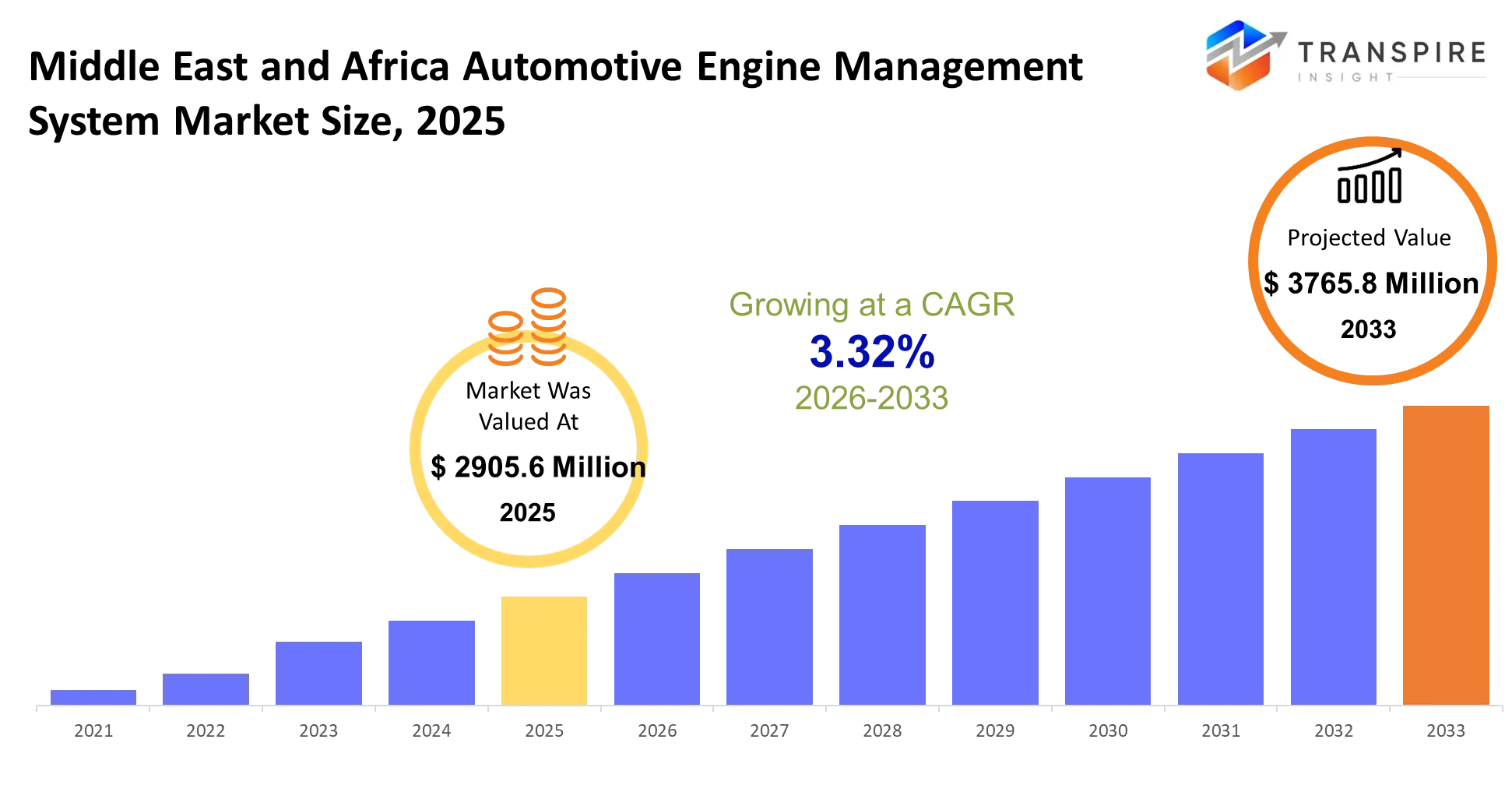
- Middle East and Africa Automotive Engine Management System Market Size 2025: USD 2905.6 Million
- Middle East and Africa Automotive Engine Management System Market Size 2033: USD 3765.8 Million
- Middle East and Africa Automotive Engine Management System Market CAGR: 3.32%
- Middle East and Africa Automotive Engine Management System Market Segments: By Type (Engine Control Unit, Sensors, Actuators, Others); By Application (Passenger Vehicles, Commercial Vehicles, Electric Vehicles, Hybrid Vehicles, Others); By End-User (Automotive OEMs, Aftermarket, Fleet Operators, Automotive Suppliers, Others); By Technology (Electronic Control Systems, Embedded Systems, AI-based Systems, Others)
To learn more about this report,  Download Free Sample Report
Middle East and Africa Automotive Engine Management System Market Summary
The Middle East and Africa Automotive Engine Management System Market was valued at USD 2905.6 Million in 2025. It is forecast to reach USD 3765.8 Million by 2033. That is a CAGR of 3.32% over the period.
The Middle East and Africa Automotive Engine Management System Market is basically about making sure engines do what they should, on the road, by coordinating fuel delivery, ignition timing, air intake, and emissions handling so vehicles stay efficient, compliant and dependable even when conditions are rough. In real life, it means fleets moving across hot Gulf highways or working long-haul African logistics routes can still hit stricter emission rules while holding onto fuel economy and engine durability too.
Over the past 3 to 5 years, the market has been moving in a noticeable way, from mechanical and semi-electronic control approaches toward fully software led ECU setups that connect to sensor networks running in real time. This shift picked up speed after GCC regulators tightened vehicle import and emission compliance expectations, especially in Saudi Arabia and the UAE, which basically forced OEMs to upgrade older engine platforms. Another big nudge was the pandemic era , plus the disruptions that followed after 2021 supply chains, which led manufacturers to standardize ECU platforms and cut down hardware complexity across multiple models.
So adoption behavior has changed a lot, with OEM led integration now pulling in most of the revenue, because software calibration, foresight based diagnostics, and hybrid power coordination are becoming the main value engines. Because of that, growth is tied more to digital engine tuning than to mechanical upgrades only, which in turn boosts repeat income from software enabled engine management offerings, even when hardware growth slows down.
Key Market Insights
- Gulf Cooperation Council countries were sitting at nearly 38% market share in 2025, which is pretty much pushed by Saudi Arabia and UAE emissions compliance upgrades across whole vehicle fleets, yeah.
- Meanwhile North Africa comes up as the fastest-growing region during 2024–2030 forecast period, mostly because commercial vehicle electrification is picking up, plus fleet modernization programs are getting more attention.
- When it comes to product segmentation, engine control units are still leading with around 45% share in 2025 , and that lines up with the quick replacement of mechanical fuel injection systems.
- Sensor integrated EMS modules show up as the second-largest segment. Oxygen, NOx, and temperature sensors are being adopted more and more , for real-time combustion optimization and that kind of things.
- Also AI-enabled adaptive EMS platforms are the fastest-growing product category from 2024 to 2030, driven by predictive tuning and fuel efficiency optimization, even if the data teams call it “autonomous adjustment” sometimes.
- For applications, passenger vehicles take the dominant slice of nearly 52% in the Middle East and Africa market, due to urban mobility expansion.
- Commercial fleet telematics is growing fastest too, helped by logistics digitization and regulatory tracking requirements across cross-border transport routes.
- On the end-user side, OEM integration leads with about 60% share, because manufacturers embed EMS at factory level, to meet emission and performance standards.
- And aftermarket solutions grow pretty quickly as vehicle fleets age, especially in Africa, where retrofit demand keeps long-term service revenue expanding, for real .
- With tech advancement in over the air updates and predictive diagnostics it really helps keep lifecycle revenue up and also makes the recurring software service models feel more solid, like it’s more dependable.
What are the Key Drivers, Restraints, and Opportunities in the Middle East and Africa Automotive Engine Management System Market?
The most powerful pressure that’s really pushing the Middle East and Africa Automotive Engine Management System market forward is the tightening of emission rules, roughly aligned with Euro 5 and Euro 6 -like standards across Gulf Cooperation Council countries. Saudi Arabia’s vehicle import requirements, and the UAE’s fuel economy obligations, have basically nudged OEMs into using more sophisticated ECU driven control setups, with tight combustion monitoring plus aftertreatment handling. And yes, this evolution has bumped revenue for Tier-1 suppliers like Bosch and Continental , because automakers are modernizing older engine platforms toward electronically controlled layouts in both passenger and commercial fleets.
A big, stubborn issue is the region’s uneven electrification, along with a service network that’s pretty fragmented, which makes consistent uptake of next generation engine management technologies hard to keep. A lot of fleets are still running mixed-age vehicle groups, and those often have incompatible ECU platforms. So the kind of full digital link up that’s needed ends up being pricey, and also technically tangled. That kind of disharmony, increases calibration work and retrofit costs. It slows down broad fleet modernization, and it also restrains aftermarket software earnings, especially across North African logistics and those older commercial transport corridors, where replacement cycles take longer than you’d hope.
A strong opening sits in hybrid vehicle adoption, backed by big mobility spending in Saudi Arabia through NEOM, and also in the UAE via smart mobility initiatives. Within these efforts, the ecosystems are starting to use AI enabled engine control units, connected alongside vehicle infrastructure, to improve fuel to electric power transitions in near real time.As pilot fleets expand, suppliers can kinda scale adaptive EMS platforms that mix cloud-based diagnostics with onboard control systems, which opens up a new revenue layer, via software updates and predictive optimization services too.
What Has the Impact of Artificial Intelligence Been on the Middle East and Africa Automotive Engine Management System Market?
Artificial intelligence is getting embedded more and more in engine management and exhaust control systems across the Middle East and Africa, where OEMs and fleet operators are basically leaning on software-driven calibration to squeeze better combustion efficiency and to meet emissions rules. In newer ECU platforms, AI-enabled control schemes are constantly tweaking air-fuel ratios, ignition timing, and aftertreatment behavior off real-time sensor readings, so manual tuning cycles get cut down, and day to day operations feel more uniform even when the driving mix changes a lot. On top of that, many fleet operators are rolling out machine learning models inside telematics frameworks, to kind of automate compliance tracking for emissions requirements and to time maintenance better for vehicles that run in brutal desert conditions or in the high-temperature city corridors.
Predictive analytics is also turning into a core piece of the whole performance optimization story, with algorithms that sift through past sensor data to anticipate injector wear, catalyst ageing, and the risk of emission spikes before anything actually fails. Some commercial fleets mention single-digit to low double-digit improvements in fuel efficiency and clear drops in unexpected downtime, because predictive maintenance lowers engine stress and keeps parts working longer. The same AI emissions forecasting tools are making it easier for operators to keep up with stricter regulatory frameworks, since they can simulate real-world driving patterns and proactively reshape engine maps ahead of time.
Still, the rollout is not fully smooth. Adoption is limited by the costly integration work, inconsistent data quality between vehicle platforms, and spotty connectivity in remote operating zones, all of which makes continuous model training harder and also complicates real-time optimization.
Key Market Trends
- Between 2020 and 2025, automakers kind of moved away from mechanical fuel control, and into ECU dominated engine management , mostly because Saudi and UAE emissions rules got a lot stricter.
- Starting 2021, OEMs kept on embedding more than one ECU per vehicle, so it was no longer just a single module doing everything , it turned into a more spread out control setup.
- In the span of 2023–2025, the sensor count went up faster, oxygen , knock , and temperature sensors became normal, and they’re used for real time combustion improvement.
- Ever since 2024, hybrid adoption has pushed EMS suppliers to redesign their systems so they can balance burning fuel , and electric power handling at the same time , more dynamically.
- From 2022 up to 2025, gasoline engines still basically stayed in front, but they had to lean on advanced EMS calibration to match Euro equivalent emission requirements.
- Over 2020–2024, demand for aftermarket ECU tuning slowed, because OEM integrated software became more attractive , due to tougher regulatory oversight and warranty enforcement.
- Starting in 2023, regional manufacturers began using over the air update capability in their ECUs, and that shifted things toward ongoing engine performance tuning.
- Between 2021 and 2024, the supply chains consolidated around global Tier 1 players such as Bosch and Continental , which reduced a lot of regional breakup.
- Since 2024, electrification momentum has nudged EMS design toward energy flow control approaches, rather than only combustion focused engine regulation.
Middle East and Africa Automotive Engine Management System Market Segmentation
By Type
Engine Control Units basically hold the dominant place in this segment, because they end up being at the center of combustion efficiency management, emissions compliance, and overall drivetrain performance. Strong OEM integration in imported vehicles across Gulf markets, keeps ECU penetration steady, and commercial fleet modernization adds more tailwind. Sensors and actuators land in the secondary position though, they get supported by the rising complexity in engine calibration , and the tighter emission thresholds that push for higher data precision. The rest of the components stay pretty niche, mostly tied to specific aftermarket repairs and small step system upgrades.
Growth here mostly comes from the increasing move toward software-defined vehicle architectures, where ECUs work like centralized control hubs. Sensor demand is also widening, as stricter fuel efficiency regulations show up more often, and real-time engine monitoring becomes normal. But limited local semiconductor manufacturing constrains cost flexibility, which makes the market more dependent on global supply chains. Because of that, the setup tends to favor vertically integrated suppliers, with solid chip partnerships and in-house calibration know-how.
Over the forecast period, ECUs will keep evolving into modular, upgradable platforms that can support hybrid and electrified powertrains. Component suppliers will concentrate on integration efficiency, rather than chasing standalone hardware novelty. Investors will likely favor firms with dependable semiconductor access and electronic architectures that scale. Competitive advantage will drift toward software-enabled control precision, and not just raw hardware capability.

To learn more about this report, Download Free Sample Report
By Application
Passenger vehicles tend to be the biggest slice because import volumes of technologically advanced models stay high across the Gulf Cooperation Council countries, so yeah it’s not exactly surprising. Commercial vehicles trail them closely too, mostly pushed by logistics scaling, construction activity and long haul freight needs along regional trade corridors. Electric vehicles still have a relatively small presence, but their share is slowly nudging system design expectations, you can feel the shift. Hybrid vehicles sit somewhere in between, sort of mirroring how urban fleets are in a transitional adoption phase.
The growth story is not the same everywhere though, commercial vehicles show stronger pull for durability-minded engine management systems. Passenger vehicles are more about regulatory compliance, and also the fact that OEM installed ECU sophistication is already baked in. With electric vehicles, adoption is held back by infrastructure gaps, but it’s being propped up by government led mobility transition programs. Hybrid setups, meanwhile, benefit from dual compatibility needs, which kind of encourages advanced control system uptake.
Looking ahead, expansion is likely to concentrate on commercial and hybrid scenarios as fleet operators push harder for fuel optimization and day to day operational efficiency. Passenger vehicle growth should level off once penetration reaches maturity in premium segments. Electric vehicle adoption may climb at a slower pace, but it will still reshape the system architecture requirements. Technology providers will need flexible platforms that can support multi powertrain compatibility, without too much friction, for different use cases.
By End-User
Honestly, the automotive OEMs still run most of this segment , because they pretty much control the factory-installed engine management systems, in both imported and locally assembled vehicles. Fleet operators are also moving up, not at the same speed but still, as logistics companies and industrial users start pushing performance monitoring and fuel economy tuning— kind of like they want less waste, more control. In Africa, the aftermarket pull continues to be structurally relevant , since the whole vehicle aging issue stretches the replacement cycle, so parts and upgrades get “kept alive” longer. Automotive suppliers then sit in the middle , doing the component-level blending work and the calibration services, that kind of supporting role.
The growth picture comes mainly from OEMs folding in newer electronic control systems into fresh vehicle platforms. Fleet operators add momentum due to operational cost stress and tight fuel efficiency objectives. Meanwhile aftermarket growth is kind of shaped by repair-led economics and the reality that vehicles get replaced more slowly than people expect. Also, supply chain partnerships help, like when global Tier-1 suppliers team up with regional distributors , it keeps adoption consistent, more or less, across markets.
Looking ahead, future development should raise fleet operator influence, especially once data-driven maintenance arrangements start catching on. OEMs will probably stay dominant but in a different way , more tied to software-enabled service ecosystems. The aftermarket side should remain firm, particularly in price-sensitive areas where people can’t easily switch vehicles. Investors will likely lean into hybrid distribution models that connect OEM platforms with long-term service agreements, not just one-off product sales.
By Technology
Electronic control systems hold the largest share, mostly because they’re kinda foundational for how combustion engine regulation works in both passenger and commercial vehicles. Embedded systems follow closely behind, pushed by the growing integration of microcontrollers and real-time processing abilities. AI-based systems are still in early adoption mode, though they’re getting more attention for predictive diagnostics and adaptive engine calibration. The other approaches stay pretty narrow, mostly experimental, or they appear only in niche scenarios.
Growth gets powered by rising system complexity in modern engines, which then demands better computational precision and faster reaction times. Embedded systems keep spreading as vehicles move toward centralized electronic layouts. AI-based systems are growing out of fleet optimization efforts and predictive maintenance demands inside logistics operations. The limitations, however, include high development expenditures and also limited local engineering knowhow , in many regions.
Over the forecast period, AI-enabled engine management systems should shift from trial deployments to a more selective mainstream rollout in commercial fleets. Embedded architectures will likely become the baseline for ECU evolution. Electronic control systems will slowly add extra software layers to accommodate hybrid powertrains. Tech providers will compete on algorithm efficiency, and also on how well their systems interoperate.
What are the Key Use Cases Driving the Middle East and Africa Automotive Engine Management System Market?
The real core use case is engine control in internal combustion passenger vehicles and commercial vehicles, where ECUs sort of steer fuel injection, ignition timing, and emissions performance. The demand is pretty strong in GCC fleets because regulatory compliance along with fuel efficiency targets they hit operating costs right away .
There are also other expansions like logistics fleet management and off-highway equipment, especially in mining and construction. People in South Africa and on Gulf infrastructure projects lean on dependable engine control systems for uptime, and at the same time the aftermarket ECU replacement for older vehicle fleets helps keep demand steady, too.
Some newer use cases are hybrid-compatible engine management systems and predictive maintenance that’s powered by connected vehicle data. Retrofit electrification for urban delivery fleets, as well as for mining vehicles, is also getting more attention, and that means ECU platforms need to handle a gradual shift from combustion into hybrid operation, not just a sudden switch.
|
Report Metrics |
Details |
|
Market size value in 2025 |
USD 2905.6 Million |
|
Market size value in 2026 |
USD 2995.8 Million |
|
Revenue forecast in 2033 |
USD 3765.8 Million |
|
Growth rate |
CAGR of 3.32% from 2026 to 2033 |
|
Base year |
2025 |
|
Historical data |
2021 - 2024 |
|
Forecast period |
2026 - 2033 |
|
Report coverage |
Revenue forecast, competitive landscape, growth factors, and trends |
|
Regional scope |
Middle East and Africa (Saudi Arabia, United Arab Emirates, South Africa, Rest of Middle East and Africa) |
|
Key company profiled |
Bosch, Continental, Denso, Delphi, Hitachi Automotive, Magneti Marelli, Valeo, ZF Friedrichshafen, Hyundai Mobis, Aptiv, Infineon, NXP, STMicroelectronics, Renesas, Texas Instruments |
|
Customization scope |
Free report customization (country, regional & segment scope). Avail customized purchase options to meet your exact research needs. |
|
Report Segmentation |
By Type (Engine Control Unit, Sensors, Actuators, Others); By Application (Passenger Vehicles, Commercial Vehicles, Electric Vehicles, Hybrid Vehicles, Others); By End-User (Automotive OEMs, Aftermarket, Fleet Operators, Automotive Suppliers, Others); By Technology (Electronic Control Systems, Embedded Systems, AI-based Systems, Others) |
Which Regions are Driving the Middle East and Africa Automotive Engine Management System Market Growth?
The Middle East still kind of leads the automotive engine management system market , mainly because it has a big commercial vehicle base and very strict emissions alignment across the Gulf Cooperation Council countries. In Saudi Arabia and the UAE the authorities are tightening both fuel efficiency and emissions requirements, so it makes the uptake of more advanced engine control units speed up across passenger fleets and also heavy-duty operations. Add to that the strong automotive distribution hubs plus fleet modernization programs in logistics and construction, and you get even more pressure on demand. Overall, this whole setup is also backed by a high import dependency for premium vehicles, and those vehicles already ship with pretty sophisticated engine management architectures at the OEM level.
Africa, even if the scale is smaller, still shows a more steady contribution, mostly from slow but consistent expansion of the vehicle parc, and also from a strong aftermarket dependence. Here, unlike the Middle East where OEM-driven adoption is the headline, African buying behavior is more influenced by vehicle longevity and repair-driven economics. That mix keeps ECU replacement and refurbishment cycles going longer than you might expect. Places like South Africa and Kenya are steadily moving forward with emissions and roadworthiness rules, which then indirectly nudges gradual upgrades in engine management systems. So you end up with a baseline market that’s more predictable, but also less technology-intensive compared with Gulf markets.
Sub Saharan Africa is kinda emerging as the fastest moving region, mainly because of recent investments in road infrastructure and that commercial fleet renewal push, tied to logistics and mining expansion. New trade corridor builds and various regional transport agreements are raising cross border freight activity, so fleet operators are, in practice, moving toward more efficient durable engine control technologies even if it takes time. Electrification interest is still somewhat limited, but hybrid compatible engine management systems are getting early momentum in urban fleet niches. For market entrants and investors, there is a clear long term upside here, through aftermarket services and cost optimized ECU offerings, that can scale as infrastructure led mobility growth builds from 2026 to 2033 .
Who are the Key Players in the Middle East and Africa Automotive Engine Management System Market and How Do They Compete?
The Middle East and Africa automotive engine management system market is moderately consolidated at the Tier-1 supplier level, with a small group of global ECU and powertrain electronics providers kind of shaping most OEM programs. Still, competition is getting tougher, since semiconductor firms and software-oriented automotive suppliers are moving closer to the vehicle control layer , even if the handoff boundaries stay blurry. Incumbents are trying to defend share less by going with aggressive price ,and more by leaning on deep ECU integration, calibration muscle, and those long term OEM validation cycles that take ages. At the same time, access to advanced chips and software defined engine control platforms is turning into the decisive factor, so advantage is slowly shifting toward companies with strong semiconductor relationships and real system integration depth.
Bosch shows up with full stack engine management solutions , it pulls together sensors, ECUs, and software calibration so OEM powertrain platforms stay locked in. It also leans on high reliability in emission critical control systems , and it grows its presence in MEA indirectly via global OEM supply contracts rather than direct regional manufacturing scale . Continental goes for modular ECU architectures and, more and more , software-defined vehicle platforms, and it strengthens its position through cross domain integration with braking plus powertrain electronics. Denso, meanwhile, uses precision control systems and fuel efficiency optimization know how, keeping momentum through close OEM collaboration in Asian brands that export vehicles into MEA markets.
Aptiv pursues a software first architecture strategy, differentiating via vehicle electrical distribution and control platforms that reduce ECU complexity across modern powertrains.NXP Semiconductors really strengthens its stance by shipping secure automotive processors alongside engine control chips, and there s this sort of steady growth that comes from partnerships with global Tier-1 suppliers. Infineon Technologies, on the other hand, leans hard into power electronics plus microcontrollers for engine and hybrid setups. They seem to gain an edge by playing a key part in the electrified powertrain shift, and they keep expanding thanks to long term semiconductor supply agreements with automotive OEM ecosystems, which are now entering MEA.
Company List
- Bosch
- Continental
- Denso
- Delphi
- Hitachi Automotive
- Magneti Marelli
- Valeo
- ZF Friedrichshafen
- Hyundai Mobis
- Aptiv
- Infineon
- NXP
- STMicroelectronics
- Renesas
- Texas Instruments
Recent Development News
In June 2025, Continental established a new Advanced Electronics & Semiconductor Solutions organization focused on designing automotive-grade semiconductor components in-house with GlobalFoundries as manufacturing partner. This move aims to reduce geopolitical supply risks and secure ECU-grade chip supply resilience, a critical factor for supply stability in import-dependent MEA automotive markets.https://www.continental.com
What Strategic Insights Define the Future of the Middle East and Africa Automotive Engine Management System Market?
Over the next 5–7 years , the Middle East and Africa automotive engine management system market is expected to slide more and more toward software-defined and sensor integrated architectures, since tightening emissions norms in GCC countries, and also the slow electrification in urban Africa are changing how OEMs decide priorities. Growth is likely to stop relying only on raw vehicle count and instead get pulled by compliance intricacy, plus efficiency optimization, in a way that is kinda less visible day to day. There’s also a quieter risk, the region leans heavily on imported semiconductor components which can, in real terms expose the whole market to geopolitical supply chain shocks, and pricing volatility, and that can push back ECU adoption cycles. Meanwhile, a smaller but accelerating chance is showing up in retrofit engine management solutions for older commercial fleets , especially along logistics corridors across South Africa and Saudi Arabia. Strategically , players should consider putting money into modular , upgradable ECU platforms that can cover both ICE tuning and hybrid transition routes, so they can monetize over a longer lifecycle while also lowering the chance that a platform becomes obsolete too soon.
Middle East and Africa Automotive Engine Management System Market Report Segmentation
By Type
- Engine Control Unit
- Sensors
- Actuators
- Others
By Application
- Passenger Vehicles
- Commercial Vehicles
- Electric Vehicles
- Hybrid Vehicles
- Others
By End-User
- Automotive OEMs
- Aftermarket
- Fleet Operators
- Automotive Suppliers
- Others
By Technology
- Electronic Control Systems
- Embedded Systems
- AI-based Systems
- Others
Frequently Asked Questions
Find quick answers to common questions.
The estimated Middle East and Africa Automotive Engine Management System Market size will be USD 3765.8 Million in 2033.
Key segments for the Middle East and Africa Automotive Engine Management System Market are By Type (Engine Control Unit, Sensors, Actuators, Others); By Application (Passenger Vehicles, Commercial Vehicles, Electric Vehicles, Hybrid Vehicles, Others); By End-User (Automotive OEMs, Aftermarket, Fleet Operators, Automotive Suppliers, Others); By Technology (Electronic Control Systems, Embedded Systems, AI-based Systems, Others)
Major Middle East and Africa Automotive Engine Management System Market players are Bosch, Continental, Denso, Delphi, Hitachi Automotive, Magneti Marelli, Valeo, ZF Friedrichshafen, Hyundai Mobis, Aptiv, Infineon, NXP, STMicroelectronics, Renesas, Texas Instruments.
The Middle East and Africa Automotive Engine Management System Market size is USD 2905.6 Million in 2025.
The Middle East and Africa Automotive Engine Management System Market CAGR is 3.32% from 2026 to 2033.
- Bosch
- Continental
- Denso
- Delphi
- Hitachi Automotive
- Magneti Marelli
- Valeo
- ZF Friedrichshafen
- Hyundai Mobis
- Aptiv
- Infineon
- NXP
- STMicroelectronics
- Renesas
- Texas Instruments
Recently Published Reports
-
Apr 2026
ATV & UTV Market
ATV & UTV Market Size, Share & Analysis Report By Type (ATV, and UTV), By Variants (Less Than 400 CC, 400 CC To 800 CC, and More Than 800 CC), and Geography (North America, Europe, Asia-Pacific, Middle East and Africa, South and Central America), 2021 - 2031
-
Apr 2026
Automotive Central Gateway Module Market
Automotive Central Gateway Module Market Size, Share & Analysis Report By Type (Ethernet Central Gateway Module, CAN Central Gateway Module, LIN Central Gateway Module, and FlexRay), By Application (Powertrain Control, Body Control, Infotainment System, Advanced Driver Assistance Systems (ADAS), and Others), By End User (Passenger Vehicles, and Commercial Vehicles), and Geography (North America, Europe, Asia-Pacific, Middle East and Africa, South and Central America), 2021 - 2031
-
Apr 2026
Automotive Engine Oil Filter Market
Automotive Engine Oil Filter Market Size, Share & Analysis Report By Filter Type (Fuel Filter, Engine Oil Filter, Hydraulic Oil Filter, and Others), By Filter Media (Cellulose, Synthetic, and Micro), By Sales Channel (OEMs, and Aftermarket), By Vehicle Type (Passenger Cars, Light Commercial Vehicles, Heavy Duty Trucks, Buses and Coaches, and Off-road Vehicles), and Geography (North America, Europe, Asia-Pacific, Middle East and Africa, South and Central America), 2021 - 2031
-
Apr 2026
Automotive Parts Aluminium Die Casting Market
Automotive Parts Aluminium Die Casting Market Size, Share & Analysis Report By Production Process (Pressure Die Casting, Vacuum Die Casting, Squeeze Die Casting, Gravity Die Casting), By Application (Body Parts, Engine Parts, Transmission Parts, Battery And Related Components, Other Application Types), and Geography (North America, Europe, Asia-Pacific, Middle East and Africa, South and Central America), 2021 - 2031
Our Clients