

Europe Automotive Aerodynamics Market Size & Forecast:
- Europe Automotive Aerodynamics Market Size 2025: USD 9.04 Billion
- Europe Automotive Aerodynamics Market Size 2033: USD 14.52 Billion
- Europe Automotive Aerodynamics Market CAGR: 6.10%
- Europe Automotive Aerodynamics Market Segments: By Component (Spoilers, Air Dams, Diffusers, Grilles, Others); By Vehicle Type (Passenger Cars, Commercial Vehicles, Electric Vehicles, Others); By Material (Plastic, Carbon Fiber, Composites, Others); By Application (Fuel Efficiency, Vehicle Stability, Emission Reduction, Others); By Sales Channel (OEM, Aftermarket, Others); By Technology (Active Aerodynamics, Passive Aerodynamics, Others).
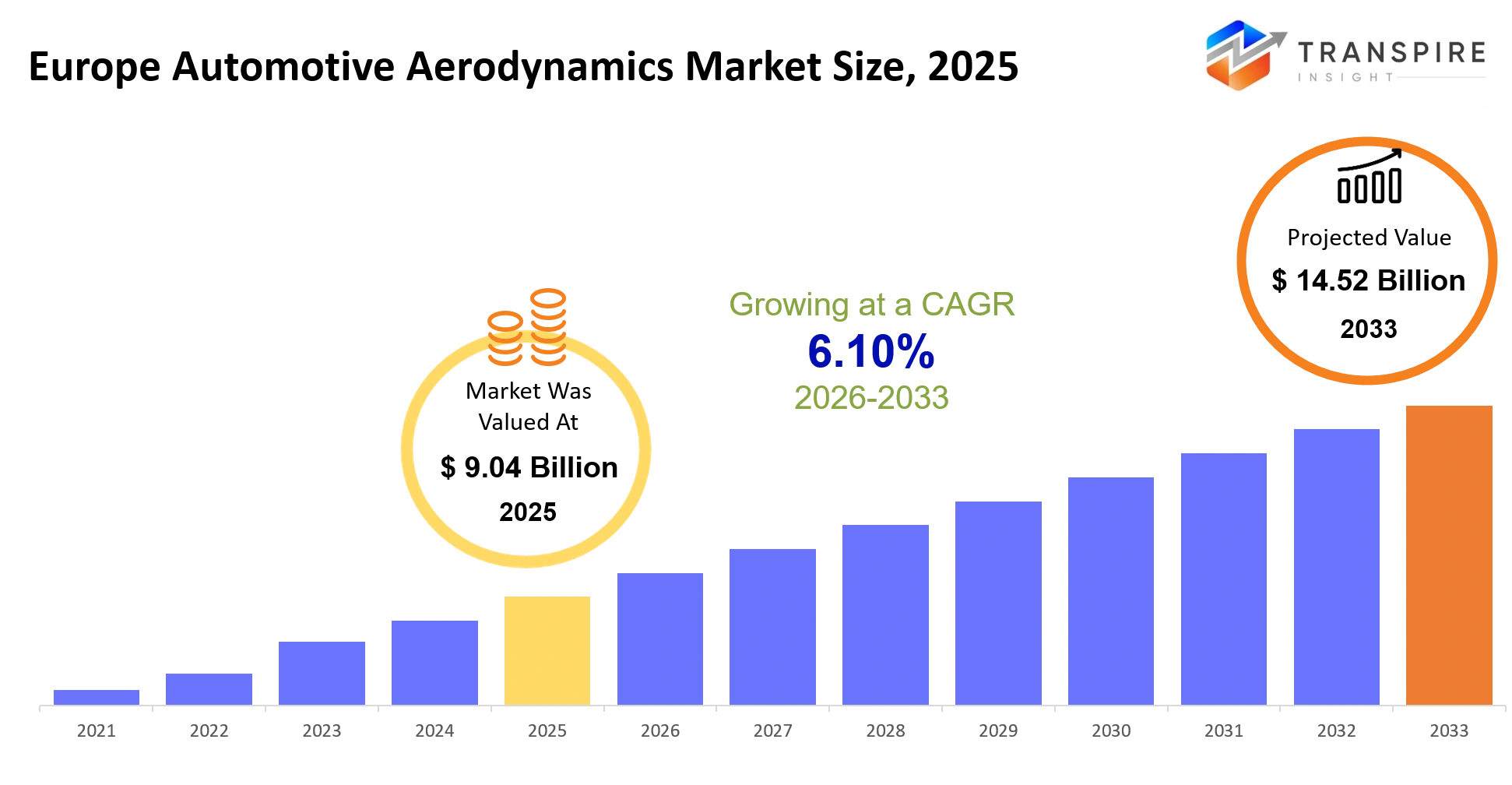
Europe Automotive Aerodynamics Market Summary
The Europe Automotive Aerodynamics Market was valued at USD 9.04 Billion in 2025. It is forecast to reach USD 14.52 Billion by 2033. That is a CAGR of 6.10% over the period.
The Europe Automotive Aerodynamics Market is about making vehicles go through the air more easily. This helps to reduce drag which makes the Europe Automotive Aerodynamics Market work better. It also makes vehicles more stable. Uses less energy. The Europe Automotive Aerodynamics Market does this for all kinds of vehicles like cars, trucks and electric vehicles.
There are parts like spoilers and air dams that help with this. These parts make vehicles use energy, which is good for electric vehicles because they can go further. They also make vehicles handle better when they are going fast. When vehicles have aerodynamics they can follow the rules about emissions and energy use. This also saves money for the people who make vehicles and for the people who own a lot of vehicles.
In the five years the Europe Automotive Aerodynamics Market has changed. Now people are using aerodynamic systems instead of old systems. These new systems can change how air flows around the vehicle depending on how it's being driven. This change happened because of rules about emissions, in Europe and because more electric vehicles are being made. The Europe Automotive Aerodynamics Market helps vehicles go further and use fuel, which makes people want to buy them more.The Europe Automotive Aerodynamics Market will keep growing because people are investing in materials and technologies. These new things will help vehicles be more efficient and follow the rules. The people who make vehicles want to make them better so they will keep working on the Europe Automotive Aerodynamics Market.
Key Market Insights
- The Europe Automotive Aerodynamics Market is moving towards aerodynamic systems because car makers want to save energy reduce emissions and make electric vehicles go further.
- Western Europe has the share of the market because it has a lot of car factories good research facilities and strict rules about vehicle emissions.
- Central and Eastern Europe is expected to grow the fastest from 2026 to 2033 because car production is increasing and suppliers are investing more in the region.
- Passenger cars make up the part of the market because aerodynamic parts are being used more and more in both regular and electric vehicles.
- Active aerodynamic technologies are expected to grow the fastest by 2033 because manufacturers are starting to use systems that can control airflow.
- Saving fuel is still the reason for using aerodynamics but making vehicles more stable and improving the range of electric vehicles is also becoming important.
- When car makers sell parts to companies they make the most money because aerodynamic parts are built into vehicles when they are designed and made.
- People are using materials like plastics, composites and carbon fiber to replace heavier parts, which helps improve how air moves around vehicles and reduces their weight.
- Companies, like Magna International, Plastic Omnium, Valeo, SRG Global, Röchling Automotive and HBPO are growing by making products working with other companies and investing in research.
- Using computers to simulate how air moves, testing vehicles in wind tunnels and using a method called Computational Fluid Dynamics is helping to reduce the time it takes to develop new products and make them work better.
What are the Key Drivers, Restraints, and Opportunities in the Europe Automotive Aerodynamics Market?
Drivers
The Europe Automotive Aerodynamics Market is driven by European carbon emission standards and the fast growth of electric vehicle production. Car makers are working to improve the aerodynamics of vehicles to reduce drag make batteries last longer and improve fuel efficiency without making vehicles heavier or needing batteries. They use things like grille shutters, adaptive spoilers and better underbody designs to meet regulations and make vehicles perform better. This helps them follow the rules and make vehicles more efficient which is why advanced aerodynamic technologies are being used in new vehicles.
Restraints
One big problem is that advanced aerodynamic systems are expensive to develop and put into vehicles. These systems need parts like sensors, actuators and electronic control units and they have to be tested a lot using computers and wind tunnels. This makes vehicle development more expensive. It is hard for smaller car makers and vehicles that are not as expensive to pay for it. It also takes a time to develop new products, which slows down how fast new technologies are used in the automotive industry.
Opportunity
There is a chance for growth in using software to control aerodynamics with the help of artificial intelligence and digital engineering tools. By using computer simulations digital copies of vehicles and optimizing airflow in time car makers can develop vehicles faster and make them more aerodynamic. The fact that more money is being invested in the industry in Central and Eastern Europe also creates new opportunities for companies that make parts do engineering and develop technology for the next generation of electric and connected vehicles at least, until 2033. Europe Automotive Aerodynamics Market will likely keep growing because of these things.
What Has the Impact of Artificial Intelligence Been on the Europe Automotive Aerodynamics Market?
Artificial intelligence is changing how cars are made by making them look better and work better. It helps with the air moving around the car, which makes the car go faster and use gas. Artificial intelligence looks at a lot of information from computers to make the car parts better which reduces the drag and makes the car go faster. It also helps make the car faster by reducing the time it takes to make it.Digital copies of the car called twins let the people making the car try out different designs before they make a real one. This saves money and time. The car also has systems that can change how the air moves around it like the grille and the spoiler, based on how fast the car is going and the temperature outside.
Artificial intelligence looks at how the car's doing to figure out how the air is moving around it which helps make the car cooler and use less energy. This is good for cars and regular cars. It also helps the people making the car see if any parts are getting worn out so they can fix them before they break. This makes the car last longer and work better. If the car is more aerodynamic it can go farther on a charge use gas and meet the rules about how much bad stuff it can put into the air.
The problem is that it is expensive to use intelligence to make cars. It is also hard to get information, about how the air moves around new kinds of cars so the people making the car have to do a lot of real-world testing before they can sell the car.
Key Market Trends
- Since 2022 European car makers have started using grille shutters and adaptive spoilers more often to make cars more aerodynamic and use less energy.
- Computer simulations and digital models have replaced some testing, which helps get cars to market faster and makes sure they are designed correctly.
- Electric car platforms have changed what is most important for aerodynamics from cooling the engine to making the car go farther on a charge by reducing drag.
- Car makers are using materials like composites and special plastics more and more to make cars more efficient without making them less safe or strong.
- Rules about carbon emissions in Europe have made car makers and truck manufacturers invest more in technologies that help cars move through the air more easily since 2023.
- Companies like Magna International, Valeo, Plastic Omnium and Röchling Automotive are investing more in systems that control airflow and making car parts lighter.
- Car makers are working with suppliers earlier in the process to add features that help with aerodynamics to cars before they are even made.
- Car manufacturers are using computer tools with intelligence to make airflow better while spending less on engineering and making fewer prototype cars.
- To make car manufacturing flexible and reliable supply chains are being set up to produce parts locally and source advanced materials, in Europe.
Europe Automotive Aerodynamics Market Segmentation
By Component
Spoilers are a part of the market because they help cars move more smoothly through the air. This makes cars more stable. Reduces drag when they're going fast. Many passenger cars and performance vehicles use spoilers, which keeps production steady. Also spoilers help cars use fuel and go farther on a charge, which is good for electric vehicles.Air dams and diffusers are becoming more popular for all kinds of vehicles because they help air move under the car making it more efficient and easier to handle. Grilles are getting smarter with some able to open and close to control cooling and airflow.
Other aerodynamic parts include side skirts, underbody panels and special components designed for vehicles.
By Vehicle Type
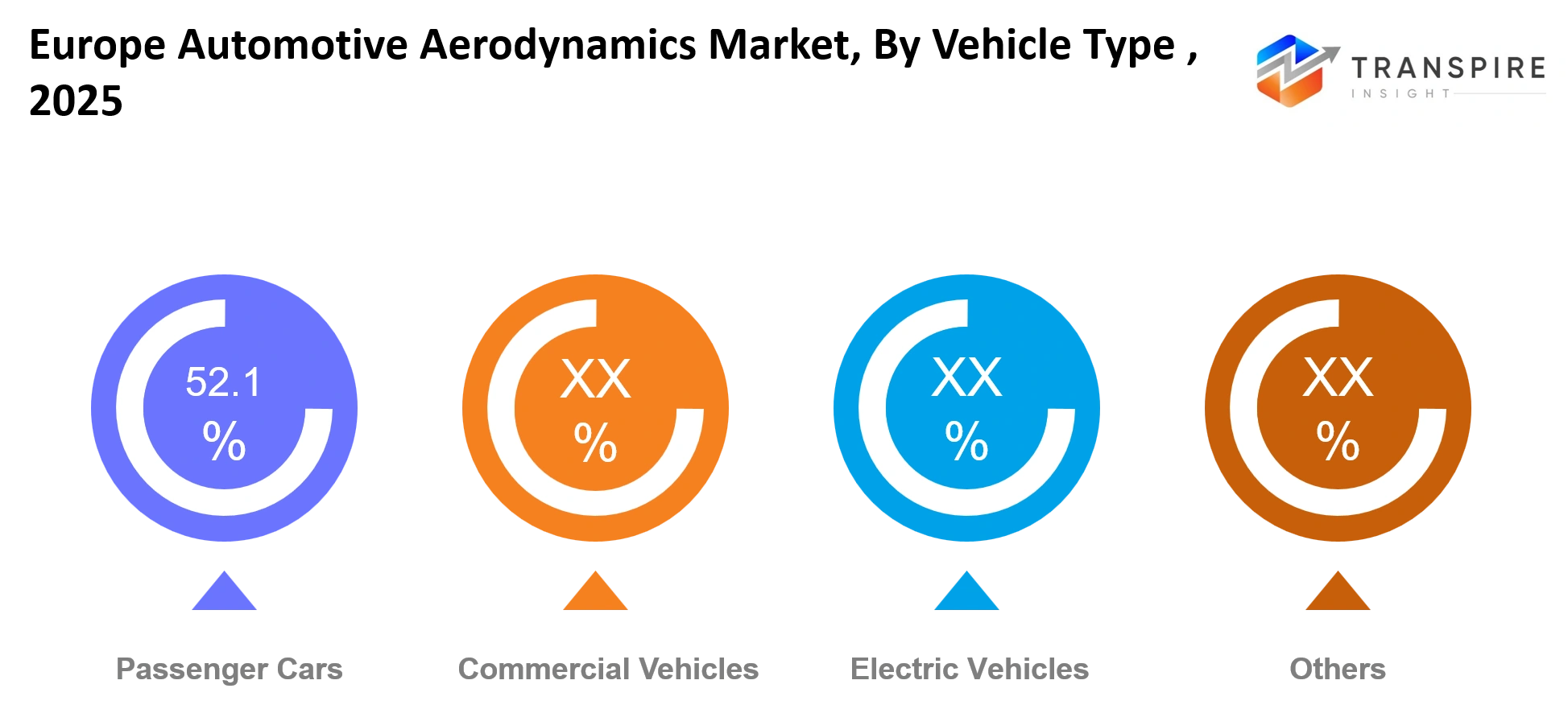
Passenger cars make up the share of the market because aerodynamics help them use less fuel drive more smoothly and perform better. In Europe, where a lot of cars are made there's demand for aerodynamic parts. Luxury car makers also invest a lot in aerodynamics.Commercial vehicles use aerodynamics to reduce fuel consumption on trips. Electric vehicles are growing fast because aerodynamics help them go farther on a charge.Other types of vehicles that use aerodynamics include sports cars and special transportation platforms.
By Material
Plastic is the popular material for aerodynamic parts because its light, cheap and easy to design with. It's also durable and easy to make which is why its used much.Carbon fiber is used in luxury cars because its super strong and light. Composites are used in performance vehicles because they balance strength and lightness.Other materials used include aluminum and hybrid materials for applications.
By Application
Fuel efficiency is the reason for aerodynamics because it reduces drag and energy consumption. This helps car makers meet efficiency standards and improves performance.Vehicle stability is also important because it affects safety and performance at speeds. Aerodynamics also help reduce emissions by lowering fuel consumption.Other applications include noise reduction and thermal management.
By Sales Channel
Most aerodynamic parts are sold to car makers, who integrate them into their vehicles. This ensures the parts work well with the vehicle and meet regulations.The aftermarket is growing because car owners want to upgrade their vehicles or replace parts. This demand is strong among performance car enthusiasts and commercial fleets.Other sales channels include sales from manufacturers and customized engineering services.
By Technology
Passive aerodynamics is still the share because fixed parts provide reliable airflow improvement without complex electronics. This makes them popular for mass-market vehicles.Active aerodynamics is growing fast because controlled parts adjust to driving conditions and cooling needs. This improves energy efficiency. Extends electric vehicle range.Other technologies include emerging airflow solutions, for connected and autonomous vehicles.
What are the Key Use Cases Driving the Europe Automotive Aerodynamics Market?
Passenger cars are still the thing people use because making them more aerodynamic helps them use less fuel stay stable and drive better. The rules about emissions, in Europe are making companies put airflow systems in their new cars so they use less energy and make less pollution.Commercial vehicles are starting to use things to save money on fuel and make long trips more efficient. Electric vehicles are also using these things because they help the cars go farther and the batteries work better without needing to be bigger.
There are some things that are starting to happen. Autonomous vehicles are using aerodynamic systems that can change in real time. Some vehicles are also connected to the internet. Use artificial intelligence to control the airflow. Fast electric sports cars and new premium vehicles are also using these things because the companies that make them want to make them more efficient, safe and fun to drive. Passenger cars and electric vehicles and commercial vehicles are all going to keep using these technologies.
|
Report Metrics |
Details |
|
Market size value in 2025 |
USD 9.04 Billion |
|
Market size value in 2026 |
USD 9.59 Billion |
|
Revenue forecast in 2033 |
USD 14.52 Billion |
|
Growth rate |
CAGR of 6.10% from 2026 to 2033 |
|
Base year |
2025 |
|
Historical data |
2021 - 2024 |
|
Forecast period |
2026 - 2033 |
|
Report coverage |
Revenue forecast, competitive landscape, growth factors, and trends |
|
Regional scope |
Europe |
|
Key company profiled |
Magna International, Plastic Omnium, Valeo, SRG Global, Polytec, Rehau, SMP Deutschland, Gestamp, AP Plasman, INOAC, Montaplast, Bosch, Continental, Marelli, Denso. |
|
Customization scope |
Free report customization (country, regional & segment scope). Avail customized purchase options to meet your exact research needs. |
|
Report Segmentation |
By Component (Spoilers, Air Dams, Diffusers, Grilles, Others); By Vehicle Type (Passenger Cars, Commercial Vehicles, Electric Vehicles, Others); By Material (Plastic, Carbon Fiber, Composites, Others); By Application (Fuel Efficiency, Vehicle Stability, Emission Reduction, Others); By Sales Channel (OEM, Aftermarket, Others); By Technology (Active Aerodynamics, Passive Aerodynamics, Others). |
Which Regions are Driving the Europe Automotive Aerodynamics Market Growth?
Western Europe holds the largest share because Germany, France, the United Kingdom, and Italy serve as major automotive manufacturing and engineering centers. Strict European carbon emission regulations encourage automakers to improve aerodynamic performance across passenger cars, commercial vehicles, and electric vehicles. Strong investment in research, wind tunnel testing, and digital vehicle development supports continuous innovation. A well-established supplier network and close collaboration between OEMs and component manufacturers sustain regional leadership.
Northern Europe remains a stable contributor through strong investment in premium vehicles, sustainable mobility, and advanced engineering capabilities. Unlike Western Europe, growth depends more on high-value innovation than production volume. Sweden and Finland continue supporting development of lightweight materials, electric vehicle technologies, and intelligent vehicle systems. Stable economic conditions and consistent investment in automotive research strengthen long-term market performance.
Central and Eastern Europe is expected to record the fastest growth during 2026–2033 as international automakers expand manufacturing operations across Poland, Hungary, Slovakia, and the Czech Republic. Recent investment in electric vehicle production facilities and automotive supplier networks has accelerated demand for advanced aerodynamic components. Government incentives supporting automotive manufacturing and industrial modernization continue creating new business opportunities. This momentum will provide attractive expansion prospects for component suppliers, engineering firms, and technology developers throughout the forecast period.
Who are the Key Players in the Europe Automotive Aerodynamics Market and How Do They Compete?
Competition in the Europe Automotive Aerodynamics Market is moderately consolidated, with global automotive suppliers competing through engineering expertise, lightweight materials, and advanced airflow technologies. Established manufacturers continue protecting market share by strengthening partnerships with vehicle OEMs and expanding active aerodynamic product portfolios. Competition depends on technology innovation, simulation capabilities, manufacturing quality, and the ability to support multiple vehicle platforms. Smaller suppliers focus on specialized components and customized engineering solutions for premium and performance vehicle segments.
Magna International develops active aerodynamic systems and lightweight exterior components that improve vehicle efficiency while supporting electric vehicle platforms. Valeo differentiates through electronically controlled airflow technologies that integrate with advanced vehicle thermal management systems. Plastic Omnium focuses on lightweight composite solutions and continues expanding production capabilities through investments in next-generation mobility technologies and close collaboration with European automakers.
SRG Global specializes in aerodynamic exterior components with advanced surface finishing technologies that combine functional performance with vehicle styling. Röchling Automotive strengthens competitiveness through lightweight underbody panels and airflow management systems designed to reduce drag and improve energy efficiency. Companies continue expanding through regional manufacturing investments, joint development programs with OEMs, and digital engineering tools that shorten product development cycles and accelerate integration into future passenger and electric vehicle platforms.
Company List
- Magna International
- Plastic Omnium
- Valeo
- SRG Global
- Polytec
- Rehau
- SMP Deutschland
- Gestamp
- AP Plasman
- INOAC
- Montaplast
- Bosch
- Continental
- Marelli
- Denso
Recent Development News
In April 2026, Magna International announced the divestment of its European automotive lighting business and rooftop systems business to Mutares. The transaction strengthens integrated exterior and lighting system capabilities in Europe, supporting the development of advanced aerodynamic vehicle components and lightweight exterior platforms.
Source: https://www.reuters.com
In January 2026, Valeo entered a partnership with NATIX to develop one of the world's largest open-source multi-camera foundation models for physical AI. The collaboration enhances AI-enabled perception technologies that support smarter vehicle exterior systems, improving aerodynamic efficiency and advanced driver assistance capabilities.
Source: https://www.valeo.com
In March 2026, Valeo partnered with POWEN to develop a 7.8 MW self-consumption solar project under a Power Purchase Agreement (PPA). The investment supports more sustainable manufacturing of automotive components, including exterior and aerodynamic systems, while reducing the company's operational carbon footprint.
Source: https://www.valeo.com
What Strategic Insights Define the Future of the Europe Automotive Aerodynamics Market?
The Europe water softening systems market is changing in a way. It is moving towards solutions that make water softening better and more efficient. These solutions use monitoring and predictive maintenance. Over the five to seven years the market will grow because of stricter rules on water usage, old water infrastructure and the need to stop equipment from scaling.
Manufacturers of water softening systems will try to stand out from each other by offering solutions that use less salt and water. They will also offer systems that do more than just soften water. The old way of using ion exchange technology is not enough anymore.
There is a risk that people may not see coming. The rules about getting rid of brine from salt-based water softeners are getting stricter. This could lead to costs for companies that have to follow these rules in some European countries.
On the hand there is a big opportunity for companies that make hybrid and salt-efficient water treatment systems. These systems are perfect for apartment buildings and commercial buildings that want to be more sustainable without losing performance. Companies should invest in solutions that are easy to maintain and work with other companies that do plumbing, construction and facility management. This will help them get customers and keep them for a long time. The Europe water softening systems market will be, about water softening systems that are smart and efficient.
Europe Automotive Aerodynamics Market Report Segmentation
By Component
- Spoilers
- Air Dams
- Diffusers
- Grilles
- Others
By Vehicle Type
- Passenger Cars
- Commercial Vehicles
- Electric Vehicles
- Others
By Material
- Plastic
- Carbon Fiber
- Composites
- Others
By Application
- Fuel Efficiency
- Vehicle Stability
- Emission Reduction
- Others
By Sales Channel
- OEM
- Aftermarket
- Others
By Technology
- Active Aerodynamics
- Passive Aerodynamics
- Others
Frequently Asked Questions
Find quick answers to common questions.
The expected Europe Automotive Aerodynamics Market size for the market will be USD 14.52 Billion in 2033.
Key segments for the Europe Automotive Aerodynamics Market are By Component (Spoilers, Air Dams, Diffusers, Grilles, Others); By Vehicle Type (Passenger Cars, Commercial Vehicles, Electric Vehicles, Others); By Material (Plastic, Carbon Fiber, Composites, Others); By Application (Fuel Efficiency, Vehicle Stability, Emission Reduction, Others); By Sales Channel (OEM, Aftermarket, Others); By Technology (Active Aerodynamics, Passive Aerodynamics, Others).
Major Europe Automotive Aerodynamics Market players are Magna International, Plastic Omnium, Valeo, SRG Global, Polytec, Rehau, SMP Deutschland, Gestamp, AP Plasman, INOAC, Montaplast, Bosch, Continental, Marelli, Denso.
The Europe Automotive Aerodynamics Market size is USD 9.04 Billion in 2025.
The Europe Automotive Aerodynamics Market CAGR is 6.10% from 2026 to 2033.
- Magna International
- Plastic Omnium
- Valeo
- SRG Global
- Polytec
- Rehau
- SMP Deutschland
- Gestamp
- AP Plasman
- INOAC
- Montaplast
- Bosch
- Continental
- Marelli
- Denso
About the Authors

Mayur Shinde
I am Mayur Shinde, a Senior Research Analyst at Transpire Insight, specializing in the Automotive & Transportation and Information & Communication Technology (ICT) Industry. My work focuses on analyzing emerging market trends, technological advancements, competitive landscapes, and industry developments to deliver accurate, data-driven insights. I am passionate about transforming complex market information into clear, actionable content that helps businesses, professionals, and decision-makers stay informed and make confident strategic decisions.

Chakradhar Khansole
Chakradhar serves as the Research Director at Transpire Insight, bringing over 8 years of experience in technology, innovation, and strategic market intelligence. He specializes in transforming complex market data into actionable business insights that enable organizations to make informed, growth-oriented decisions. Recognized for his strategic vision and analytical expertise, Chakradhar leads high-impact research initiatives, delivering comprehensive market assessments, competitive intelligence, and forward-looking industry analysis.
Recently Published Reports
-
Apr 2026
ATV & UTV Market
ATV & UTV Market Size, Share & Analysis Report By Type (ATV, and UTV), By Variants (Less Than 400 CC, 400 CC To 800 CC, and More Than 800 CC), and Geography (North America, Europe, Asia-Pacific, Middle East and Africa, South and Central America), 2021 - 2031
-
Apr 2026
Automotive Central Gateway Module Market
Automotive Central Gateway Module Market Size, Share & Analysis Report By Type (Ethernet Central Gateway Module, CAN Central Gateway Module, LIN Central Gateway Module, and FlexRay), By Application (Powertrain Control, Body Control, Infotainment System, Advanced Driver Assistance Systems (ADAS), and Others), By End User (Passenger Vehicles, and Commercial Vehicles), and Geography (North America, Europe, Asia-Pacific, Middle East and Africa, South and Central America), 2021 - 2031
-
Apr 2026
Automotive Engine Oil Filter Market
Automotive Engine Oil Filter Market Size, Share & Analysis Report By Filter Type (Fuel Filter, Engine Oil Filter, Hydraulic Oil Filter, and Others), By Filter Media (Cellulose, Synthetic, and Micro), By Sales Channel (OEMs, and Aftermarket), By Vehicle Type (Passenger Cars, Light Commercial Vehicles, Heavy Duty Trucks, Buses and Coaches, and Off-road Vehicles), and Geography (North America, Europe, Asia-Pacific, Middle East and Africa, South and Central America), 2021 - 2031
-
Apr 2026
Automotive Parts Aluminium Die Casting Market
Automotive Parts Aluminium Die Casting Market Size, Share & Analysis Report By Production Process (Pressure Die Casting, Vacuum Die Casting, Squeeze Die Casting, Gravity Die Casting), By Application (Body Parts, Engine Parts, Transmission Parts, Battery And Related Components, Other Application Types), and Geography (North America, Europe, Asia-Pacific, Middle East and Africa, South and Central America), 2021 - 2031
Our Clients



