
Europe Authentication and Brand Protection Market Summary
This market serves makers, brand owners, retailers, customs staff, and shoppers. Its work centers on confirming that items are genuine, watching products as they travel through supply paths, and catching fake goods or diverted stock.The aim is to reduce money loss and safety threats before they turn into real problemsIn the last three to five years, the main tools have changed. Firms moved beyond plain tags and holograms. Many now use connected methods such as QR codes, RFID, NFC, serialization, and digital checks. Some also use blockchain style records for verification.Online shopping has also shifted the threat. Counterfeits can get to buyers through split and cross-border pathways. This makes the risk harder to control.
Enforcement across the EU has also picked up. In 2024, officials stopped 112 million counterfeit items. That haul was judged at about €3.8 billion. With numbers like that, more companies are changing how they protect products. Many now use layered steps. They run physical checks and also track digital records. That approach can help in several areas too, including medicines, high-end goods, electronics, cosmetics, and industrial supplies.
Europe Authentication and Brand Protection Market Size & Forecast:
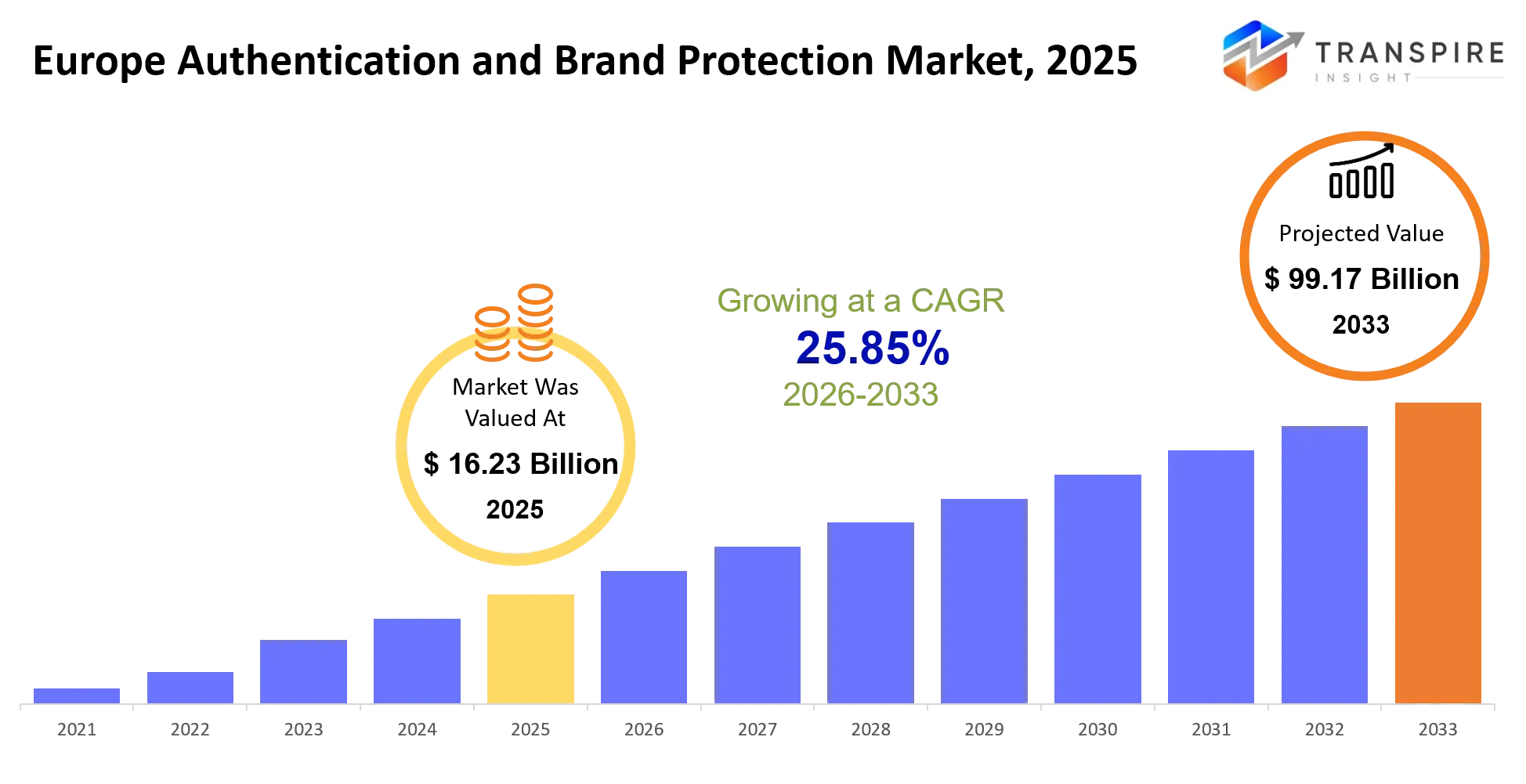
- Europe Authentication and Brand Protection Market Size 2025: USD 16.23 Billion
- Expected Market Value 2033: USD 99.17 Billion
- Forecast CAGR: 25.85%
- Leading region in 2025:Germany
- Fastest Growing region:Italy
- Key Profile: Authentix, SICPA, De La Rue, OpSec Security, Avery Dennison, Zebra Technologies, Savi Technology, CCL Industries, TruTag Technologies, Applied DNA Sciences, AlpVision, TraceLink, OPTEL Group, Markem-Imaje, HID Global
Key Market Insights
- Germany leads regional performance. Its industrial output stays strong, with solid work in manufacturing and pharma. Customs work is also firm. The area’s supply chain has the tools needed to move goods smoothly.
- Italy is growing quicker than the rest. Luxury items drive much of the demand. Fashion and cosmetics also add weight. Food products play a role too. On top of that, more firms are using digital checks to confirm products.
- In 2024, EU officials seized 112 million fake items. They put the total at about €3.8 billion. That number points to how wide the enforcement task is.
- Border stops rose to nearly 20 million items in 2024. This is up 12% from 17.5 million in 2023. The rise shows the pressure at ports and crossings.
- The declared value of the goods caught at EU borders reached €1.5 billion in 2024. It is the top figure in the last ten years.
- Track and trace tools matter in many sectors. They let makers link a product’s identity to shipment records and to each verification step.
- Digital authentication is taking on more weight. Systems like QR codes, NFC, and RFID help move checks beyond what is printed on a box. Digital product identity can also be used for pro
- Drug packaging stays under tight rules. EU requirements call for unique identifiers and anti-tamper features on medicine packs where the rules apply.
- Luxury, beauty, electronics, and clothing are adding multiple layers of defense. Many now use a mix of visible security steps, hidden marks, and digital verification.
- Enforcement supported by AI is getting more attention. European authorities are pushing fresh tech to spot and stop intellectual property violations.
What are the Key Drivers, Restraints, and Opportunities in the Europe Authentication and Brand Protection Market?
Fake products keep growing across Europe’s supply lanes. In 2024, EU bodies logged roughly 112 million counterfeit items. Border stops caught nearly 20 million pieces. The rough value was about 1.5 billion euros.
Online buying adds pressure. Split shipments across multiple countries also slow checks at the border. Staff cannot examine every item in detail. Because of this, many groups push for serialized IDs, digital verification, track and trace tools, and stronger border review. Drug counterfeiting is a related problem. It brings a steady flow of money for criminals. Many medicines require one-of-a-kind codes and tamper-evident design features.
Rolling this out widely is the hard part. Factories must add authentication steps to packaging lines. They also have to connect the new work to existing IT. That setup can involve warehouse systems, retailer platforms, and customs steps. Protection levels do not match for all product types. Some items need more safeguards than others.
For smaller companies, costs come early. They may need serialization, secure printing, RFID setup, and software work. They might also pay for paid validation or verification help. Even when everyone agrees counterfeits are a risk, timelines can slip. The process can run longer than expected.
The main path starts with linked product identity. The goal is to link a physical check to a digital record. EU discussions increasingly point to Digital Product Passports. The aim is better compliance checks across supply chains. Companies can attach QR, NFC, RFID, or hidden markers to product history. Then a single digital source can help manufacturers, customs staff, shops, and buyers confirm the item they see.
These systems can also support continuing revenue. That can come from software access and monitoring. It is not limited to basic security labels.
What Has the Impact of Artificial Intelligence Been on the Europe Authentication and Brand Protection Market?
AI is shifting how people verify identities and protect brands. Instead of checking things at fixed times, teams can watch activity all the time in digital space.With computer vision, systems can look at packs, labels, logos, serial codes, hologram details, and photos of items. The goal is to spot visual changes that often show up with fake goods. Monitoring tools online can also use learning systems to flag odd listings. They may catch patterns like the same seller repeating posts, strange pricing, reused images, and other clues tied to unauthorized items. The European Commission also pushes for more use of new tools, including AI, to find and stop violations of intellectual property.
For supply chains, machine learning can help assess risk. It can join data on products, places, deals, and shipping routes to find movements that do not fit normal behavior. Customs teams can use scoring rules to choose which shipments get attention first. Brand owners can then spend time on sellers, areas, and product types that look more risky. When this is done automatically, fewer checks may be needed by hand. It can also speed up when counterfeit activity is caught. AI can further help with digital checks by noticing odd sign in attempts and unusual scanning behavior.
Even with all this, one big problem stays. Data quality can make or break the results. The models need many real and fake images, along with past transactions, seller details, and outcomes from enforcement. Smaller companies may not have enough training material. At the same time, counterfeiters keep changing packaging and sales tactics. That constant change lowers accuracy unless teams refresh the models often.
Key Market Trends
- Security tags are changing. More of them now use QR, NFC, and RFID to confirm details in digital form. This also helps track items at the product level.
- In Europe, enforcement is no longer limited to what happens at the border. Checks are shifting toward online monitoring. E-commerce makes it easier for fake goods to spread through new routes.
- Authentication is also evolving. Old holograms were often a single layer. Now some systems mix plain marks, hidden checks, lab style verification, and digital steps-*
- For medicines, serialization has moved ahead. It started as paperwork and compliance tools. It has turned into something wider. It supports supply chain visibility, plus checks on products and movement.
- AI use is spreading fast. It is moving past simple trials for detection. Teams now look at automated image analysis. They also add seller watch routines, risk scores, and actions to protect intellectual property.
- Customs groups are adjusting how they inspect. Shipments of fakes are getting smaller and harder to spot. They arrive in more pieces. They also connect more often to online selling. That means more focused inspections.
- Digital product identity matters more now. EU policy work is looking at Digital Product Passports. The goal is quicker and smoother compliance checks.
- Brands in luxury, beauty, clothing, and electronics are pushing consumer tools. Buyers can scan items and match results to authenticity records.
- Security vendors are changing too. They are not only making printed labels. They now offer software, analytics, serialization support, and cloud monitoring services.
- Brand protection is getting more shared. Manufacturers, retailers, logistics firms, customs offices, and online marketplaces swap data on products and enforcement steps.
Europe Authentication and Brand Protection Market Segmentation
By Solution Type
Product Authentication relies on physical or digital traits to tell real goods from fake ones. Digital Authentication links an item’s ID to an online check page, a database, or a protected digital file. Track and Trace watches where goods go from maker to distributor to store. It can point to diversion and odd routing. Anti-Counterfeit Labels use special inks, codes, paper, or security tools that make copying less likely.
Tamper-Evident Packaging gives a clear sign if someone opens or changes the pack. Serialization gives each item or package a one of a kind number. That helps with tracking at the sales or transaction level. Brand Monitoring looks at online shops, websites, and sellers. The goal is to catch fake listings or misuse of brand rights. Document Authentication checks certificates, permits, invoices, credentials, and other key papers. It uses secure printing, stored digital records, or unique markers.
By Technology
RFID is used for tap-free identification. It also helps move items through warehouses and distribution routes without manual checks. NFC lets a phone verify a product. It links what you hold to a digital check. QR Codes are cheap to use for verification. They also show product details meant for shoppers. Holograms add a clear security look. They can make copying basic packaging harder.
Blockchain can store history in a way that is hard to alter. It can record authentication steps too. Digital watermarks hide identification inside images or packaging files. This can apply to printed or digital items. AI and computer vision can flag odd visuals. That can include fake pack patterns, strange sale posts, and abnormal check behavior. IoT ties products and packs to sensors and supply-chain tools. It keeps sending data about where things are and what conditions they go through.
By Application
Pharma needs solid proof checks. Fake drugs can harm people fast, so weak security is not an option. In the EU, the rules call for one-of-a-kind codes and packaging that shows if it has been opened or changed.
Food and drink teams care more about where the item came from and if the pack is still intact. They also track the item through the chain so it is harder to swap it with another one. They add layers to stop replacement and confusion at handoff.
Cosmetics also use proof systems. The goal is to guard valued formulas and cut down on fake items in the supply stream.
Luxury items lean on strong authentication too. High prices make fake goods more tempting to produce.
Car brands use these checks on spare parts and key items. That includes parts, fluids, and named add ons that could be swapped without permission.
Electronics often rely on serial numbers plus RFID, QR marks, and other ways to confirm a device is real. This helps with products that cost a lot.
Clothing and accessories use tags and labels, along with digital ID checks. Some groups also watch for misuse online to reduce counterfeit items.
In industry, authentication matters for parts and tools. It also applies to spare pieces and special materials. When the wrong substitute is used, it can lead to poor operation or safety issues.
By Authentication Level
Overt Authentication gives signs that people can see or check right away. Consumers, store staff, and inspectors can use these without any special tools.
Covert Authentication relies on marks that are not meant to be obvious. To confirm them, you need the right gear or a set of steps.
Forensic Authentication depends on lab work. Analysts look at molecular traces, chemical traits, and other tests to reach a strong level of proof.
Digital Authentication ties a real item to records on the web. It may use one-time codes or secure digital IDs.
Multi-Level Authentication uses more than one protection method at the same time. The goal is to make copying harder.
Serialized Authentication gives each item or pack its own ID. This supports checks at the product level.
Smart Authentication links checks with sensors and online tools. It can also use analytics or phone-based verification.
Hybrid Authentication mixes several methods together. It can pull from physical, digital, overt, covert, and forensic options. This is meant for products that face higher risk.
By End User
Factories put in place checks that confirm items are real. This helps guard what gets made, limits where goods go, and lowers the risk of unauthorized swaps.
Brand teams roll out product codes, tamper resistant stickers, and online checks. They also add ways for buyers to verify what they see. The goal is to keep trade assets safe and protect the worth of the brand.
Shops and online sellers also use proof methods. They check stock records and scan items to reduce fake goods reaching their shelves or their sites.
Middle handlers often depend on trace records. These records help them confirm where products were at each step of the supply route.
Public offices use authentication tools to meet rules and keep proper records. They also watch markets for problems.
Customs offices use product ID checks along with risk review and inspection tools. These help them spot suspicious counterfeit loads at ports and border points.
People now often scan QR codes or use NFC tags. Some also rely on online or app based checks to see if an item is genuine.
Shipping firms use RFID, item level codes, and linked tracking services. This lets them see where a product is while it moves through transport and distribution.
By Region
Germany is the biggest regional market. It has strong industrial output and a large role in pharmaceutical making. Its supply-chain setup is also well developed, and customs work is active. The country is regularly listed for serious action against fake items.
In the UK, several sectors drive demand. Pharmaceuticals matter, but so do luxury goods and retail. E-commerce is also a key part of the picture. Because of this, firms need wider checks on products and ongoing brand monitoring.
France benefits from luxury items and cosmetics. Pharmaceuticals and fashion also bring weight. When authenticity is confirmed, it helps protect brands that carry high value.
Italy is a solid place for growth. Luxury goods, fashion, and footwear are central. Food products and cosmetics also contribute.
Spain sees strong retail work and lots of cross-border movement. That creates chances to use authentication and traceability systems.
The Netherlands functions as a major logistics and distribution hub. This helps support needs around supply-chain identification. It also supports customs-focused checks.
Switzerland stands out for pharmaceuticals, luxury items, and other high-end manufacturing. That increases the need for stronger ways to verify products.
Sweden backs adoption in a different way. Its technology-heavy industries and digital commerce push more advanced supply-chain management.
What are the Key Use Cases Driving the Europe Authentication and Brand Protection Market?
Pharma authentication is in high demand. Fake medicines can put patients at risk. It also creates trouble for regulators who must enforce the rules.
Because of this, companies use clear ID rules. They also add proof against tampering. This means every step has to support serialization and checks. The work spans makers, distributors, pharmacies, and other approved partners.
Other sectors are joining in. Luxury items, makeup, electronics, and clothing all face counterfeits. Those fakes can harm a brand. They can also drain money through sales done online or in stores.
Owners now often use multiple protections at once. They may use secure labels plus QR codes. Some use NFC and RFID too. Many also watch listings on online marketplaces. The goal is to guard a product after it leaves the plant and while it moves in retail.
New ideas keep showing up. Some teams want digital product IDs. Others are trying AI tools to spot fakes. There is also interest in connected checks for parts used in industry. Spare parts are a common focus.
In Europe, efforts like Digital Product Passports may push this further. Tighter market checks could link compliance data with trace records. This could improve authenticity tracking across supply routes in the region.
|
Report Metrics |
Details |
|
Market size value in 2025 |
USD 16.23 Billion |
|
Market size value in 2026 |
USD 20.42 Billion |
|
Revenue forecast in 2033 |
USD 99.17 Billion |
|
Growth rate |
CAGR of 25.85% from 2026 to 2033 |
|
Base year |
2025 |
|
Historical data |
2021 - 2024 |
|
Forecast period |
2026 - 2033 |
|
Report coverage |
Revenue forecast, competitive landscape, growth factors, and trends |
|
Regional scope |
Europe |
|
Key company profiled |
Authentix, SICPA, De La Rue, OpSec Security, Avery Dennison, Zebra Technologies, Savi Technology, CCL Industries, TruTag Technologies, Applied DNA Sciences, AlpVision, TraceLink, OPTEL Group, Markem-Imaje, HID Global |
|
Customization scope |
Free report customization (country, regional & segment scope). Avail customized purchase options to meet your exact research needs. |
|
Report Segmentation |
By Solution Type (Product Authentication, Digital Authentication, Track & Trace, Anti-Counterfeit Labels, Tamper-Evident Packaging, Serialization, Brand Monitoring, Document Authentication); By Technology (RFID, NFC, QR Codes, Holograms, Blockchain, Digital Watermarks, AI & Computer Vision, IoT); By Application (Pharmaceuticals, Food & Beverage, Cosmetics, Luxury Goods, Automotive, Electronics, Apparel, Industrial Products); By Authentication Level (Overt Authentication, Covert Authentication, Forensic Authentication, Digital Authentication, Multi-Level Authentication, Serialized Authentication, Smart Authentication, Hybrid Authentication); By End User (Manufacturers, Brand Owners, Retailers, Distributors, Government Agencies, Customs Authorities, Consumers, Logistics Companies); By Region (Germany, UK, France, Italy, Spain, Netherlands, Switzerland, Sweden) |
Which Regions are Driving the Europe Authentication and Brand Protection Market Growth?
Germany looks like the top European buyer for authentication tech. The main reasons are strict customs control, solid manufacturing, and many brand holders. These factors keep demand steady over time. In 2024, Germany was one of the EU states that made the top 10 list for both the count and the estimated worth of fake items seized at outside border points. Its industry also covers cars, pharma, electronics, chemicals, and high end consumer goods. In these areas, proper product ID and traceability matter for sales and trust. Digital customs work adds more weight. Starting in October 2024, Germany plans to require electronic filings for customs steps taken against suspected goods that break IPR rules.
France is another key market, but it is not shaped the same way. It leans more toward luxury items. It also has weight in cosmetics, pharma, food, and well known global consumer brands. France sits behind a large slice of counterfeit seizures across the EU. At the same time, its role in European luxury and production chains keeps the need high for security labels, serialization, digital ID tools, and tracking. Strong cross border shipping helps too. Brand protection rules are strict across many premium categories. So France feels like a dependable market, not just a smaller echo of Germany.
Italy is showing the quickest growth in the region. Counterfeit risk is rising there. Luxury making, fashion production, and customs action also push the market forward. That mix leaves more space for wider use of authentication systems.
Who are the Key Players in the Europe Authentication and Brand Protection Market and How Do They Compete?
The European market is still split up. Authentication touches security inks, label printing, RFID and NFC, serialization, digital identities, trace systems, and online controls. Because of that, firms do not win only on low cost. They win by showing stronger security, smoother system fit, clearer data, and solid ways to link the real world with digital checks. SICPA stands out with layered protection that uses visible, hidden, lab level, and digital methods in one stack. Authentix goes another way. It mixes physical checks with online brand and IP monitoring. That lets buyers tie counterfeits they find to follow up enforcement actions.
Avery Dennison leans on smart labels plus RFID and NFC, along with digital product identities. It does not depend only on standard security labels. In February 2026, it grew its NFC line after teaming at mass scale with Pragmatic Semiconductor. The goal was to support product checks and Digital Product Passport use. CCL Industries has pursued growth through purchases. It has tried to widen its identification and security work. One example is its March 2026 deal to buy France based Sleever International. That move brought shrink sleeve labels and related equipment to European production sites. TraceLink concentrates on pharma serialization and supply chain coordination. The company is strongest when rules are strict and product level trace needs heavy data work.
Company List
- Authentix
- SICPA
- De La Rue
- OpSec Security
- Avery Dennison
- Zebra Technologies
- Savi Technology
- CCL Industries
- TruTag Technologies
- Applied DNA Sciences
- AlpVision
- TraceLink
- OPTEL Group
- Markem-Imaje
- HID Global
Recent Development News
"In February 2026, Avery Dennison announced a mass-scale integration of Pragmatic Semiconductor’s NFC Connect chips. The collaboration supports low-cost item-level authentication and Digital Product Passport applications across retail and healthcare. [https://rfid.averydennison.com/content/rfid/na/en/home/news-insights/press-releases/avery-dennison-announces-first-to-market-integration-of-pragmatic-semiconductors-chip-on-a-mass-scale.html]"
"In March 2026, CCL Industries signed an agreement to acquire Sleever International. The transaction expands CCL’s European label and packaging capabilities across France, Germany, Belgium, Ireland, and Poland, strengthening its position in security-related packaging applications. [https://www.cclind.com/download/5150/] (CCL Industries)."
"In June 2025, CCL Industries acquired We Print Lanyards in the United Kingdom. The acquisition expanded Avery’s portfolio of access-control, badging, credential, and identification technologies for European and international customers. [https://www.cclind.com/investors/press-releases] "
What Strategic Insights Define the Future of the Europe Authentication and Brand Protection Market?
Europe’s authentication and brand protection market is shifting away from just using standalone anti-counterfeit labels. More companies are moving toward product identities that link the physical item to digital checks. This includes security features, verification on phones, tracking details, and data about the product’s life.
A big driver is how enforcement is tightening alongside the EU’s Digital Product Passport plan. That plan is meant to tie products to steady identifiers and data that can work across systems.
There is also a downside that can be easy to miss. Technology can end up split across different providers. Brands may run into high costs if the systems do not match, like when data formats, platforms, or identifiers do not line up.
At the same time, there is room to grow. NFC that can be read by smartphones, along with Digital Product Passport support, could be useful for luxury goods, healthcare items, cosmetics, and other expensive consumer products.
Avery Dennison’s NFC work in 2026 shows how the move to connected authentication is taking shape in a way that can scale. Because of this, market players should focus on authentication systems that can work together and cover both physical and digital identity. They should not sink money into separate labeling setups alone.
Europe Authentication and Brand Protection Market Report Segmentation
By Solution Type
- Product Authentication
• Digital Authentication
• Track & Trace
• Anti-Counterfeit Labels
• Tamper-Evident Packaging
• Serialization
• Brand Monitoring
• Document Authentication
By Technology
- RFID
• NFC
• QR Codes
• Holograms
• Blockchain
• Digital Watermarks
• AI & Computer Vision
• IoT
By Application
- Pharmaceuticals
• Food & Beverage
• Cosmetics
• Luxury Goods
• Automotive
• Electronics
• Apparel
• Industrial Products
By Authentication Level
- Overt Authentication
• Covert Authentication
• Forensic Authentication
• Digital Authentication
• Multi-Level Authentication
• Serialized Authentication
• Smart Authentication
• Hybrid Authentication
By End User
- Manufacturers
• Brand Owners
• Retailers
• Distributors
• Government Agencies
• Customs Authorities
• Consumers
• Logistics Companies
By Region
- Germany
• UK
• France
• Italy
• Spain
• Netherlands
• Switzerland
• Sweden
Frequently Asked Questions
Find quick answers to common questions.
The expected Europe Authentication and Brand Protection Market size for the market will be USD 99.17 Billion in 2033.
Key segments for the Europe Authentication and Brand Protection Market are By Solution Type (Product Authentication, Digital Authentication, Track & Trace, Anti-Counterfeit Labels, Tamper-Evident Packaging, Serialization, Brand Monitoring, Document Authentication); By Technology (RFID, NFC, QR Codes, Holograms, Blockchain, Digital Watermarks, AI & Computer Vision, IoT); By Application (Pharmaceuticals, Food & Beverage, Cosmetics, Luxury Goods, Automotive, Electronics, Apparel, Industrial Products); By Authentication Level (Overt Authentication, Covert Authentication, Forensic Authentication, Digital Authentication, Multi-Level Authentication, Serialized Authentication, Smart Authentication, Hybrid Authentication); By End User (Manufacturers, Brand Owners, Retailers, Distributors, Government Agencies, Customs Authorities, Consumers, Logistics Companies); By Region (Germany, UK, France, Italy, Spain, Netherlands, Switzerland, Sweden)
Major Europe Authentication and Brand Protection Market players are Authentix, SICPA, De La Rue, OpSec Security, Avery Dennison, Zebra Technologies, Savi Technology, CCL Industries, TruTag Technologies, Applied DNA Sciences, AlpVision, TraceLink, OPTEL Group, Markem-Imaje, HID Global
The Europe Authentication and Brand Protection Market size is USD 16.23 Billion in 2025.
The Europe Authentication and Brand Protection Market CAGR is 25.85% from 2026 to 2033.
- Authentix
- SICPA
- De La Rue
- OpSec Security
- Avery Dennison
- Zebra Technologies
- Savi Technology
- CCL Industries
- TruTag Technologies
- Applied DNA Sciences
- AlpVision
- TraceLink
- OPTEL Group
- Markem-Imaje
- HID Global
About the Authors

Kartik bhong
I am Kartik Bhong, a Senior Research Analyst at Transpire Insight, specializing in the Packaging, Manufacturing, and Construction industry. My work focuses on analyzing market trends, emerging technologies, industry regulations, and competitive landscapes to deliver accurate, data-driven insights. I am passionate about transforming complex industry information into clear, practical content that helps businesses, professionals, and decision-makers stay informed and make confident strategic decisions. Through continuous research and a strong commitment to accuracy, I strive to create reliable, well-researched content that reflects the latest developments across these dynamic industries and supports the vision of Transpire Insight in delivering valuable market intelligence.

Chakradhar Khansole
Chakradhar serves as the Research Director at Transpire Insight, bringing over 8 years of experience in technology, innovation, and strategic market intelligence. He specializes in transforming complex market data into actionable business insights that enable organizations to make informed, growth-oriented decisions. Recognized for his strategic vision and analytical expertise, Chakradhar leads high-impact research initiatives, delivering comprehensive market assessments, competitive intelligence, and forward-looking industry analysis.
Recently Published Reports
-
Apr 2026
Pharmaceutical Cold Chain Packaging Market
Pharmaceutical Cold Chain Packaging Market By Material (Plastic,(Polyethylene (PE), Polypropylene (PP), Polyethylene Terephthalate (PET), Expanded Polystyrene (EPS), Polyurethane (PU),Others), Paper, Metal, Others), By Product (Small Boxes, Pallets, Large Sized Pallet Containers, Others), By End Use (Biopharmaceutical Companies, Clinical Research Organizations, Hospitals, Research Institutes, Logistics and Distribution Companies, Others)”, By Industry Analysis, Size, Share, Growth, Trends, and Forecasts 2026-2033
-
Apr 2026
Active & Intelligent Packaging Market
Active & Intelligent Packaging Market By Type (Active Packaging, Smart Packaging), By Material (Polymer-Based, Paper & Board-Based, Metal-Based, Glass-Based), By Technology (Time-Temperature Indicators, Freshness Indicators, RFID, Antimicrobial Packaging, Modified Atmosphere Packaging), By Application (Food & Beverages, Pharmaceutical, Cosmetics & Personal Care, Electronics & Consumer Goods, Others), By Industry Analysis, Size, Share, Growth, Trends, and Forecasts 2026-2033
-
Apr 2026
Biodegradable Cut Flower Packaging Market
Biodegradable Cut Flower Packaging Market By Material Type (Paper & Paperboard, Biodegradable Plastics, Natural Fibers, Molded Pulp, Others), By Product Type (Sleeves, Wraps, Boxes & Cartons, Bags & Pouches, Inserts & Holders), By Application (Roses, Carnations, Tulips, Chrysanthemums, Mixed Flowers, Others) and By Distribution Channel (Direct Sales, Distributors & Wholesalers, Online Channels), By Industry Analysis, Size, Share, Growth, Trends, and Forecasts 2026-2033
-
May 2026
Pharmaceutical Packaging Market
Pharmaceutical Packaging Market By Material Type (Plastic, Glass, Metal, Paper & Paperboard, Others), By Packaging Type (Bottles, Blister Packs, Vials, Ampoules, Pouches & Sachets, Others) and By End User (Hospitals & Clinics, Retail Pharmacies, Online Pharmacies, Pharmaceutical Manufacturers), By Industry Analysis, Size, Share, Growth, Trends, and Forecasts 2026-2033