
Europe Aircraft Tires Market Summary
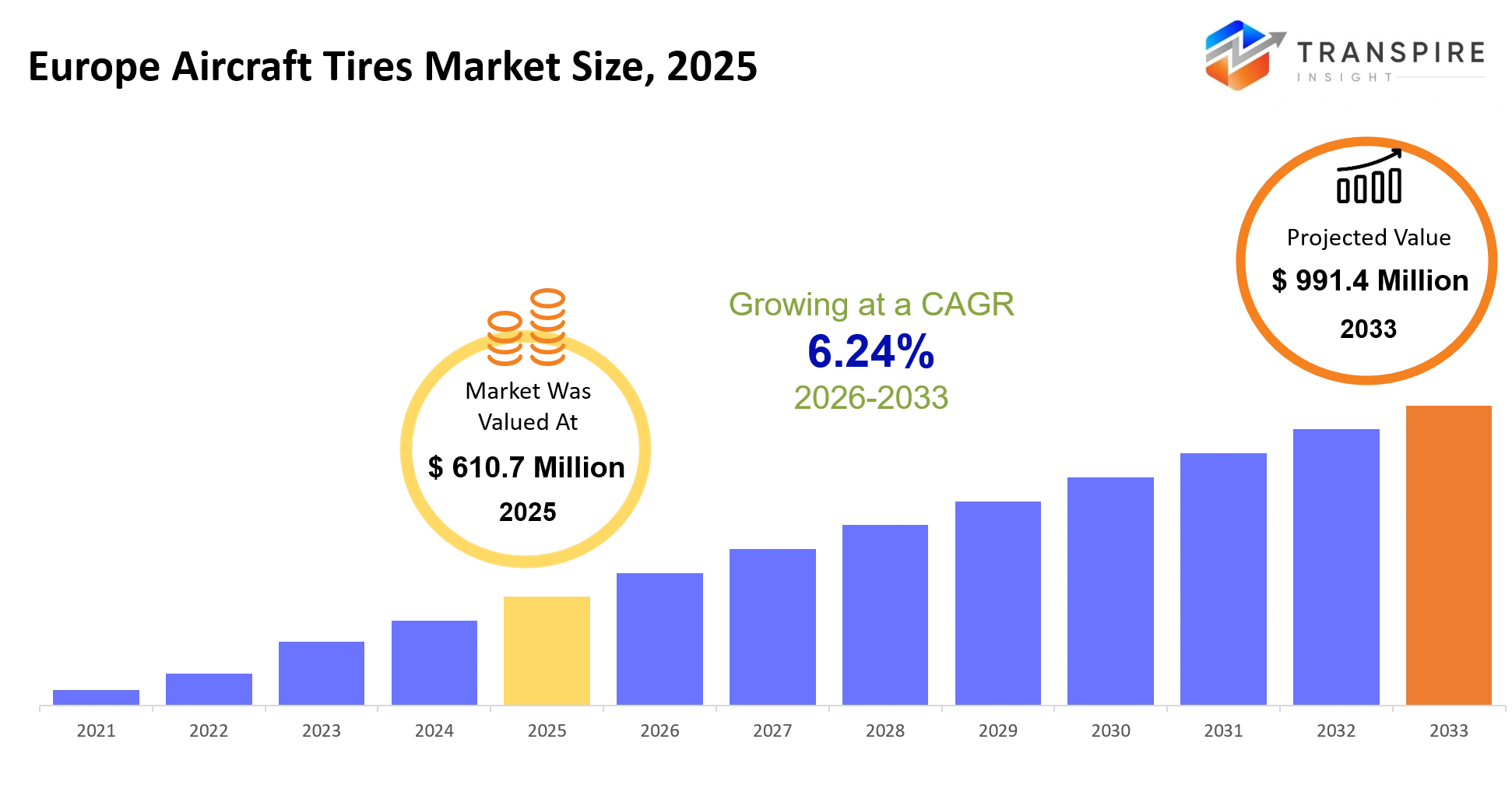
As per Transpire Insight Analysis the Europe Aircraft Tires Market size is estimated at USD 610.7 Million in 2025 and is anticipated to reach USD 991.4 Million by 2033, growing at a CAGR of 6.24% from 2026 to 2033.
Aircraft tires sort of keep commercial, military, and corporate aircraft operating safely through a bunch of repeated takeoffs, landings and even high speed taxiing, while also handling extreme loads and temperature shifts that can be pretty brutal. Across Europe airlines, maintenance providers , and defense operators lean on tough tire performance so they can cut aircraft downtime, stretch maintenance intervals, and keep flight schedules running in a dependable way. Over the last five years the market has sort of tilted toward more advanced radial tire designs, predictive upkeep routines, and retread related approaches, all of which push operational efficiency up while also lowering overall life cycle costs.
Supply chain problems after the COVID-19 recovery, plus geopolitical tensions, showed where things were weak in terms of raw material availability and aircraft parts logistics, so operators started to tighten inventory planning and also diversify sourcing. Meanwhile higher fleet utilization, more maintenance activity, and fleet modernization programs have sped up replacement cycles, which boosts aftermarket revenue, and it also nudges manufacturers to focus on tires that last longer, are more fuel efficient, and come with digital monitoring options.
Europe Aircraft Tires Market Size & Forecast:
- Europe Aircraft Tires Market Size 2025: USD 610.7 Million
- Expected Market Value 2033: USD 991.4 Million
- Forecast CAGR: 6.24%
- Leading region in 2025: Germany, France, and the United Kingdom
- Fastest Growing region: Poland, the Czech Republic, Romania, and Hungary
- Key Profile: Michelin, Goodyear, Bridgestone, Dunlop Aircraft Tyres, Continental, Sentury Tire, Petlas, Specialty Tires of America, Qingdao Sentury, Wilkerson Company, Trelleborg, Nokian Tyres, Mitas, Pirelli, Yokohama Rubber.
Key Market Insights
- Western Europe was kind of the Europe Aircraft Tires Market leader, grabbing roughly 68% of the market share in 2025, mostly because of huge airline fleets and a pretty established MRO setup, you know the kind that already works well.
- Central and Eastern Europe, though, will stay the quickest moving regional market over 2025–2033, supported by things like airport upgrades, fleet growth, and that steady rise in regional connectivity.
- On the product side, radial aircraft tires went first, with nearly 72% share in 2025, since airlines kept choosing durability, reduced mass, and longer operating cycles.
- Bias aircraft tires sat as the second-largest segment, largely due to military platforms and a few selected regional aircraft still leaning on familiar, tested tire configurations.
- Retread aircraft tires will likely show the fastest growth through 2033, supported by airline cost discipline and the broader rollout of certified retreading capabilities.
- For application demand, commercial aviation dominated with about 74% market share in 2025, which lines up with continued replacement cycles across passenger and cargo fleets.
- Military aviation is expected to emerge as the fastest-growing application through 2033 , pushed by higher defense spending and aircraft readiness programs across Europe.
- Looking at end users, commercial airlines accounted for almost 66% of demand in 2025, mainly due to frequent touch downs and increasing aircraft utilization rates.
- Meanwhile, MRO service providers will become the fastest-growing end-user category during 2025–2033, helped by outsourced maintenance arrangements, plus the expanding regional repair capacity.
What are the Key Drivers, Restraints, and Opportunities in the Europe Aircraft Tires Market?
The main thing pushing broader market expansion, like more or less, is commercial aviation fleet renewal, but it’s also backed by stricter fuel efficiency and operational performance requirements. As new generation aircraft get into service , they need lighter yet more durable tire systems that can cope with higher operating cycles and all that. Airlines also put more money into maintenance after passenger traffic started rebounding across Europe. Then higher aircraft utilization kicked in, and that directly raised how often tires get replaced. Every extra landing effectively shortens the replacement intervals. In the end, that whole chain turns into stronger aftermarket revenue, while still keeping original equipment demand alive for aircraft manufacturers and the maintenance providers.
The biggest structural obstacle stays pretty concentrated manufacturing capacity for certified aviation tires and specialized raw materials. Making these tires involves lengthy qualification steps, aviation certifications, and manufacturing tools that are highly specialized , and basically can’t be scaled up fast. When supply gets disrupted, lead times for replacement inventories stretch out, and fleet maintenance calendars get pushed. From what Transpire Insight reviewed in regional procurement announcements and launch schedules, this supply chain concentration is still the primary execution risk. So during supply shortages aftermarket revenue gets suppressed, and aircraft return-to-service timelines get delayed for operators across Europe.
A big opportunity sits in smart tire monitoring, mixed with cutting edge retreading know how. Digital sensors that can track pressure temperature and tire wear will help plan maintenance better, and likely push the service life further. There are also more investments going into predictive maintenance platforms, plus certified retread facilities, and this is growing across Western and Central Europe. Airlines moving toward these solutions can bring down total lifecycle operating costs while at the same time boosting fleet availability, and making maintenance scheduling much more precise.
What Has the Impact of Artificial Intelligence Been on the Europe Aircraft Tires Market?
Artificial intelligence and digital technologies are sorta reshaping aircraft tire operations, by turning maintenance more data driven and at the same time cutting down those annoying, unexpected failures. Smart tire monitoring systems keep collecting pressure temperature load and wear information nonstop, during actual aircraft operations. Then AI algorithms do the heavy lifting, they spot abnormal performance patterns automatically and they send alerts to the maintenance teams , before any safety limits get crossed. Machine learning models also help with predictive maintenance by forecasting remaining tire life, based on things like historical landing data, runway conditions, and broader operational profiles. In the end these insights help with replacement scheduling, without triggering as many unnecessary tire removals.
Meanwhile digital forecasting tools optimize inventory planning too, they predict replacement demand across airline fleets and in maintenance facilities. With better forecasting, warehouse costs usually go down and aircraft downtime from unavailable components becomes less frequent. A few maintenance organizations are even weaving AI together with digital maintenance records, to make inspections more consistent, support regulatory compliance, and shorten turnaround times. All of this tends to raise fleet availability while reducing maintenance expenses across the whole regional aviation ecosystem. Still, wide deployment is somewhat limited, mainly because integration costs are high , aircraft data sources are pretty fragmented, and there are strict certification requirements for aviation-grade digital systems. Many operators still operate on a patchwork of legacy platforms, which limits real-time data sharing. So adoption slows, even though the operational benefits are pretty clear.
Key Market Trends
- Airlines sort of accelerated the adoption of radial tire tech after 2022, uh improving fuel efficiency, landing performance, and also the whole operating life across those expanding commercial fleets.
- European MRO providers put more money into certified retreading between 2023 and 2025, which brought lifecycle costs down, while also backing circular maintenance strategies in a more practical way.
- Tire manufacturers expanded their digital pressure along with temperature monitoring, and that made predictive maintenance programs easier to run with fewer surprise aircraft groundings.
- Defense modernization programs across Germany, France, and Poland lifted demand for high performance military aircraft tires, plus specialized replacement inventories, kind of indirectly, yet noticeably.
- Manufacturers also strengthened regional supply chains after 2021, cutting down reliance on any single-source production, and improving delivery reliability across Europe overall.
- Michelin and Bridgestone then sped up research into lightweight compounds that enhance durability , while still supporting fuel efficiency goals for next generation aircraft.
- Airlines started using data-driven inventory forecasting during 2024 and 2025, boosting spare tire availability, and lowering the chances of maintenance scheduling disruptions.
- Airport expansion and the rising regional air connectivity in Central and Eastern Europe pushed replacement demand toward emerging maintenance hubs , even when routes change.
- And finally, sustainability initiatives nudged wider adoption of certified retread programs, lowering material consumption while keeping aviation safety and regulatory compliance standards in place .
Europe Aircraft Tires Market Segmentation
By Product Type :
Radial tires seem to stay in the leading spot for quite a while , mainly because they offer longer service life , reduced rolling resistance , and this better heat control that helps keep airline operations running smoother. With commercial fleets that keep getting larger and schedules that are frequent, the demand for radial designs across European aviation should keep getting a boost. Also, high performance tires are drawing steady investment, modern aircraft need products that can handle heavier loads and those repeated touchdown cycles, again and again.
Bias tires still keep a solid role in military aviation, plus in selected regional aircraft, because their long proven durability fits rough operating conditions. Retread tires are also getting more acceptance, since operators are trying to lower total life costs without giving up the certified safety levels. Tubeless tires and the main landing gear tires, plus the nose landing gear tires, specialty designs and other categories will likely benefit as fleets get upgraded more often and as maintenance activity expands across regional aviation networks .
By Aircraft Type :
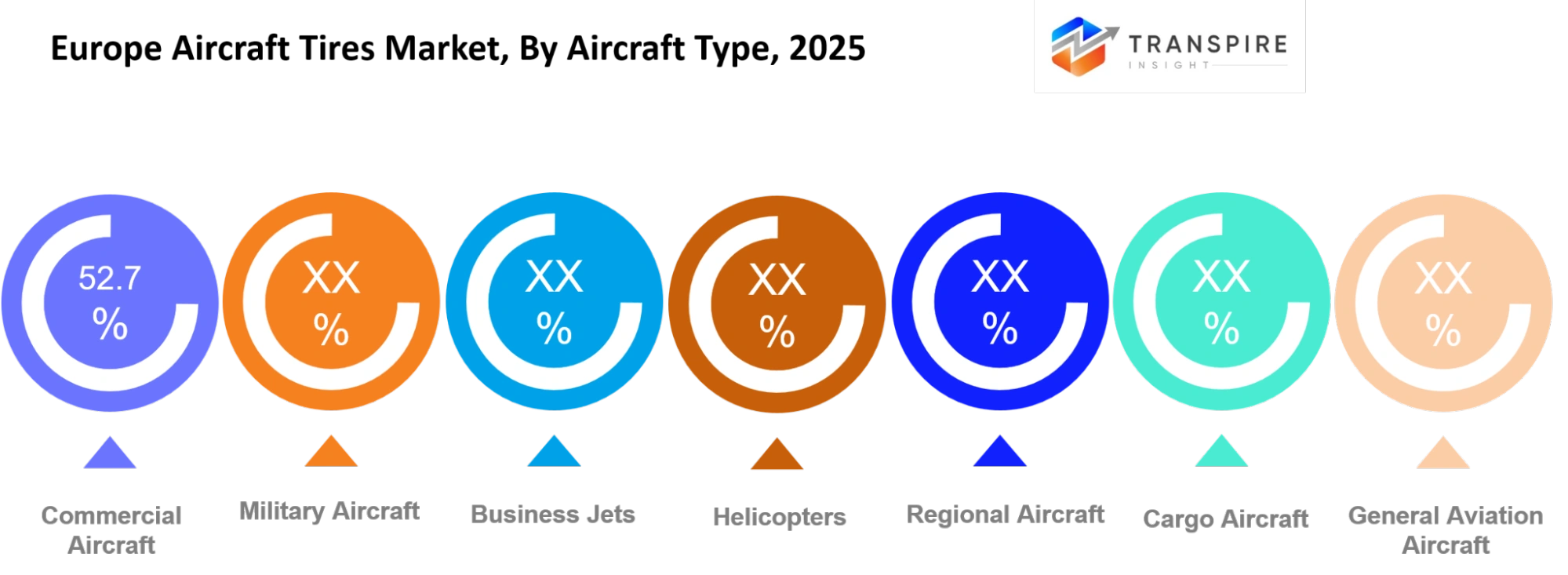
Commercial aircraft come in with the biggest slice of demand, mostly because the frequent takeoffs and landings keep making tire replacement feel sort of mandatory, again and again, so it’s regular in a way. Also passenger traffic keeps expanding and airline fleet renewal is going on, which should help steady buying across both original equipment and replacement pathways. Cargo aircraft aren’t left out either , since air freight keeps operating with high aircraft utilization through most of the year, so demand stays fairly stable.
On the military side, aircraft are still showing solid growth, driven by defense modernization plans and better operational readiness in multiple European countries. Then you have business jets, helicopters, regional aircraft, general aviation aircraft and other aviation platforms, all of which add extra openings via fleet expansion, plus the scheduled maintenance work that inevitably follows. With strong utilization across many aviation segments, the market should keep supporting replacement demand, at least over the long run.
By Application :
Replacement applications end up driving the biggest slice of revenue, mainly because aircraft tires really do need scheduled replacement after set operating cycles. When aircraft utilization stays high, that basically means ongoing, almost steady demand coming in from airlines and maintenance providers, so the aftermarket keeps selling again and again. In the meantime, Maintenance Repair and Overhaul work also pushes buying behavior, since operators tend to chase operational reliability and regulatory compliance, kind of like a “must have” checklist.
On the OEM side, demand should stay rather stable, because aircraft manufacturers are still delivering new aircraft around Europe. Fleet upgrades, leasing operations, training aircraft, and a few other uses will open more chances as operators seek better fleet performance and try to stretch aircraft service life. More spending on maintenance planning will also back the replacement plus overhaul cycle throughout the forecast period, and it will not just fade out.
By Material :
Synthetic rubber is often the leading material, mostly because stable performance across shifting temperatures and tough operating settings helps meet aviation safety needs. Reinforced materials… and yes, even steel reinforced materials help bump up structural strength, while also prolonging service life, especially when landing stress happens again and again. There’s also that push for continuous material innovation which should make durability better and operating efficiency more solid for both commercial and military aviation, in general.
Natural rubber still keeps a meaningful role, mainly by giving flexibility and a sort of balanced behavior in certified tire construction. Composite materials, carbon materials, specialty compounds, and a few other advanced material options keep getting more attention because stronger wear resistance and lower weight translate into better aircraft efficiency. In the end, material development will remain a key competitive factor for manufacturers throughout the forecast period.
By End User :
Airlines are still the biggest, more or less, end user segment since large operating fleets need constant tire replacement and routine maintenance during the whole aircraft lifespan. More passenger traffic, plus more flight frequency, should keep fueling repeat purchasing across regional and international carriers. Aircraft builders, too, keep getting traction via original equipment installations on newly delivered aircraft so demand stays steady in a pretty direct way.
MRO providers also show the fastest growth because maintenance outsourcing keeps moving forward across commercial and defense aviation. Defense organizations push procurement by fleet modernization programs and by running higher operational readiness initiatives. Leasing firms , flight schools, government agencies, and other end users will add more demand too, as aircraft utilization, and the required upkeep, continues to rise across Europe.
What are the Key Use Cases Driving the Europe Aircraft Tires Market?
Commercial airline operations stay arguably the strongest use case because the takeoffs and landings never really stop, so there is always that ongoing replacement appetite. Airlines buy certified tire solutions to keep operational reliability intact, minimize aircraft downtime, and also to satisfy the strict European aviation safety rules. With regular fleet utilization, procurement cycles stay active across the bigger passenger carriers, all the time.
On the military side, aviation and aircraft maintenance organizations keep pushing demand forward via scheduled overhaul programs, plus fleet readiness requirements that don t really bend. Cargo aircraft operators are doing something similar too, they increase purchases since high tempo flight schedules speed up tire wear, and they need dependable replacement planning so logistics stays uninterrupted.
Also, digital tire health monitoring together with advanced retread programs are showing up as emerging applications with solid forward potential. Airport testing facilities and next generation aircraft programs are trialing intelligent tire technologies, these help with maintenance planning while still supporting regulatory compliance and day to day operational efficiency. Over time, these applications should spread wider as certification requirements and digital maintenance systems keep improving across Europe.
|
Report Metrics |
Details |
|
Market size value in 2025 |
USD 610.7 Million |
|
Market size value in 2026 |
USD 648.8 Million |
|
Revenue forecast in 2033 |
USD 991.4 Million |
|
Growth rate |
CAGR of 6.24% from 2026 to 2033 |
|
Base year |
2025 |
|
Historical data |
2021 - 2024 |
|
Forecast period |
2026 - 2033 |
|
Report coverage |
Revenue forecast, competitive landscape, growth factors, and trends |
|
Country scope |
Europe (Germany, United Kingdom, France, Italy, Spain and Rest of Europe) |
|
Key company profiled |
Michelin, Goodyear, Bridgestone, Dunlop Aircraft Tyres, Continental, Sentury Tire, Petlas, Specialty Tires of America, Qingdao Sentury, Wilkerson Company, Trelleborg, Nokian Tyres, Mitas, Pirelli, Yokohama Rubber. |
|
Customization scope |
Free report customization (country, regional & segment scope). Avail customized purchase options to meet your exact research needs. |
|
Report Segmentation |
By Product Type (Radial Tires, Bias Tires, Tubeless Tires, Retread Tires, Main Landing Gear Tires, Nose Landing Gear Tires, High Performance Tires, Others); By Aircraft Type (Commercial Aircraft, Military Aircraft, Business Jets, Helicopters, Regional Aircraft, Cargo Aircraft, General Aviation Aircraft, Others); By Application (OEM, Replacement, Maintenance, Repair & Overhaul, Fleet Upgrades, Training Aircraft, Leasing Operations, Others); By Material (Natural Rubber, Synthetic Rubber, Reinforced Materials, Composite Materials, Carbon Materials, Steel Reinforced Materials, Specialty Compounds, Others); By End User (Airlines, Aircraft Manufacturers, MRO Providers, Defense Organizations, Leasing Companies, Flight Schools, Government Agencies, Others). |
Which Regions are Driving the Europe Aircraft Tires Market Growth?
Western Europe still seems to hold the dominant spot, with roughly 68% of regional revenue in 2025. The blend of strict aviation safety rules, lots of airport infrastructure, and reliable maintenance standards ends up being pretty favorable for certified aircraft tire suppliers. There are also big manufacturing sites , plus established MRO networks, and these long-standing supplier ties that make production and distribution easier across the whole aviation sector. Looking ahead, ongoing fleet modernization, replacement buying, and money put into more advanced maintenance capabilities should help the region stay in front through most of the forecast window.
Northern Europe, meanwhile, acts like a steady revenue source, since consistent aviation policies and a fairly disciplined approach to infrastructure spending help keep fleet operations predictable. Economic resilience matters here too, because airlines and maintenance providers can usually keep their scheduled procurement plans, even when things feel operationally uncertain. Advanced maintenance facilities and dependable regulatory compliance also form a rather balanced setting for durable supplier agreements. With stable replacement cycles and continued investment in aviation services, this region should remain a meaningful contributor to overall market results.
Central and Eastern Europe is showing up as one of the fastest-growing regional markets, because airport expansion, fleet modernization, and defense investment have all picked up during the last few years. In other words, Government backing for aviation infrastructure and improved regional air connectivity have helped push higher aircraft utilization across both commercial and military work. At the same time, maintenance capacity is growing, plus airline networks keep expanding, which is opening fresh procurement possibilities for certified tire manufacturers and service providers. Overall, these shifts should translate into solid expansion prospects for manufacturers, distributors, and investors who are looking for sustained growth during 2026–2033.
Who are the Key Players in the Europe Aircraft Tires Market and How Do They Compete?
Competition stays fairly consolidated , mainly because aviation certification requirements and specialized manufacturing know how act like big walls for new suppliers. The way companies compete mostly comes down to technology innovation, overall product durability, service support, and also the regional maintenance footprint. The main players keep pushing their advantage by rolling out more advanced tire designs, adding digital monitoring capabilities, and locking in long term supply agreements with airlines and maintenance organizations, while a few regional manufacturers try to gain ground with more specialized offerings and quicker, more responsive customer support.
Michelin zeroes in on advanced radial tire technology that boosts durability, improves fuel efficiency and supports better operational performance for commercial aviation . Bridgestone puts weight on research , manufacturing upgrades, and performance driven tire compounds , aiming to stretch service life even in demanding operating conditions. Goodyear stands out through aviation-certified product development and engineering expertise , which supports both commercial and military aircraft use.
Dunlop Aircraft Tyres focuses on aviation tire manufacturing and also retreading services, and they create value via lifecycle support plus fast replacement options for European operators. Continental improves its competitive position by expanding digital tire monitoring technologies, and by blending in intelligent maintenance solutions so inspection planning and operational efficiency get better. Ongoing investment in product development, strategic partnerships, and regional service capabilities lets these companies keep building customer ties while also responding to evolving airline and maintenance needs.
Company List
- Michelin
- Goodyear
- Bridgestone
- Dunlop Aircraft Tyres
- Continental
- Sentury Tire
- Petlas
- Specialty Tires of America
- Qingdao Sentury
- Wilkerson Company
- Trelleborg
- Nokian Tyres
- Mitas
- Pirelli
- Yokohama Rubber
Recent Development News
In March 2026, Michelin and Dassault Aviation unveiled the first rollout of the MICHELIN Air X SKY LIGHT tire on the Falcon 10X business jet. The partnership introduced a next-generation lightweight radial aircraft tire designed to extend tire life, reduce aircraft weight, and support lower fuel consumption, strengthening innovation in the European aircraft tire market.
Source: https://aircraft.michelin.com/
In July 2025, Michelin launched a new MICHELIN Pilot General Aviation tire size developed in collaboration with Beringer Aero. The product launch expanded fitment options for homebuilt, aerobatic, and light aircraft while improving durability and tubeless performance for the general aviation segment.
Source: https://michelinmedia.com/
What Strategic Insights Define the Future of the Europe Aircraft Tires Market?
Europe Aircraft Tires Market is going to shift, kinda slowly but surely, to a more technology-led and service focused shape over the next five to seven years. Airlines, maintenance operators, and defense users are already putting more weight on lifecycle results than just the purchase cost, even if it looks less “wow” on day one. You’ll probably see digital condition monitoring, predictive maintenance platforms , and more mature retreading solutions turning into real competitive signals as aircraft fleet usage keeps climbing.
There is also a risk that does not get talked about much. The market keeps leaning on a small set of certified manufacturers and a few specialized raw material suppliers. That means procurement can get pushed around by production interruptions and longer aircraft qualification timeframes, which is a pain nobody wants.
Meanwhile, an opportunity is also getting clearer. Smart tire systems that can send real-time performance insights are becoming an emerging option, especially as European aviation adopts more connected maintenance workflows.
So, firms that enter, or even those that expand in this space, should tighten regional manufacturing partnerships, and back it up with digital service abilities along with certified product development. This approach helps supply resilience and supports more durable customer value over time.
Europe Aircraft Tires Market Report Segmentation
By Product Type
- Radial Tires
- Bias Tires
- Tubeless Tires
- Retread Tires
- Main Landing Gear Tires
- Nose Landing Gear Tires
- High Performance Tires
By Aircraft Type
- Commercial Aircraft
- Military Aircraft
- Business Jets
- Helicopters
- Regional Aircraft
- Cargo Aircraft
- General Aviation Aircraft
By Application
- OEM
- Replacement
- Maintenance
- Repair & Overhaul
- Fleet Upgrades
- Training Aircraft
- Leasing Operations
By Material
- Natural Rubber
- Synthetic Rubber
- Reinforced Materials
- Composite Materials
- Carbon Materials
- Steel Reinforced Materials
- Specialty Compounds
By End User
- Airlines
- Aircraft Manufacturers
- MRO Providers
- Defense Organizations
- Leasing Companies
- Flight Schools
- Government Agencies
Frequently Asked Questions
Find quick answers to common questions.
The expected Europe Aircraft Tires Market size for the market will be USD 991.4 Million in 2033.
Key segments for the Europe Aircraft Tires Market are By Product Type (Radial Tires, Bias Tires, Tubeless Tires, Retread Tires, Main Landing Gear Tires, Nose Landing Gear Tires, High Performance Tires, Others); By Aircraft Type (Commercial Aircraft, Military Aircraft, Business Jets, Helicopters, Regional Aircraft, Cargo Aircraft, General Aviation Aircraft, Others); By Application (OEM, Replacement, Maintenance, Repair & Overhaul, Fleet Upgrades, Training Aircraft, Leasing Operations, Others); By Material (Natural Rubber, Synthetic Rubber, Reinforced Materials, Composite Materials, Carbon Materials, Steel Reinforced Materials, Specialty Compounds, Others); By End User (Airlines, Aircraft Manufacturers, MRO Providers, Defense Organizations, Leasing Companies, Flight Schools, Government Agencies, Others).
Major Europe Aircraft Tires Market players are Michelin, Goodyear, Bridgestone, Dunlop Aircraft Tyres, Continental, Sentury Tire, Petlas, Specialty Tires of America, Qingdao Sentury, Wilkerson Company, Trelleborg, Nokian Tyres, Mitas, Pirelli, Yokohama Rubber.
The Europe Aircraft Tires Market size is USD 610.7 Million in 2025.
The Europe Aircraft Tires Market CAGR is 6.24% from 2026 to 2033.
- Michelin
- Goodyear
- Bridgestone
- Dunlop Aircraft Tyres
- Continental
- Sentury Tire
- Petlas
- Specialty Tires of America
- Qingdao Sentury
- Wilkerson Company
- Trelleborg
- Nokian Tyres
- Mitas
- Pirelli
- Yokohama Rubber
About the Authors

Tejashri Dhatrak
I am Tejashri Dhatrak, a Senior Research Analyst at Transpire Insight, specializing in the Aerospace and Defence sector. My work focuses on analyzing industry trends, defence technologies, market developments, and emerging innovations that shape the global aerospace and security landscape. At Transpire Insight, I research complex topics, evaluate credible sources, and transform technical insights into accurate, well-structured, and easy-to-understand content for industry professionals and decision-makers. My goal is to provide reliable, research-backed information that helps readers stay informed about defence capabilities, aerospace advancements, strategic developments, and the evolving dynamics of the global defence ecosystem.

Chakradhar Khansole
Chakradhar serves as the Research Director at Transpire Insight, bringing over 8 years of experience in technology, innovation, and strategic market intelligence. He specializes in transforming complex market data into actionable business insights that enable organizations to make informed, growth-oriented decisions. Recognized for his strategic vision and analytical expertise, Chakradhar leads high-impact research initiatives, delivering comprehensive market assessments, competitive intelligence, and forward-looking industry analysis.
Recently Published Reports
-
Apr 2026
Aerospace Fluoropolymers Market
Aerospace Fluoropolymers Market Size, Share & Analysis Report By Type (PTFE, FEP, PFA, ETFE, and Others), By Application (Electrical Insulation, Seals & Gaskets, Coatings, and Others), By End User (Commercial Aviation, Military Aviation, General Aviation, and Others), and Geography (North America, Europe, Asia-Pacific, Middle East and Africa, South and Central America), 2021 - 2031
-
Apr 2026
Airborne SATCOM System Market
Airborne SATCOM System Market Size, Share & Analysis Report By Type (SATCOM Terminals, Transceivers, Airborne Radio, Modems and Routers, SATCOM Radomes, and Other), By Application (Government and Defense and Commercial), and Geography (North America, Europe, Asia-Pacific, Middle East and Africa, South and Central America), 2021 – 2031
-
Apr 2026
Ship Leasing Market
Ship Leasing Market Size, Share & Analysis Report By Vessel Type (Container Ships, Bulk Carriers, Tankers, and Specialized Vessels), By Lease Duration (Short-Term Lease (Less than 1 year), Medium-Term Lease (1-5 years), and Long-Term Lease (More than 5 years)), By Lease Type (Bareboat Charter, Time Charter, Financial Lease, and Others), By End-User Industry (Oil and Gas, Manufacturing and Industrial, Automotive, Agriculture and Food, Retail and Consumer Goods, and Others), and Geography (North America, Europe, Asia-Pacific, Middle East and Africa, South and Central America), 2021 – 2031
-
Apr 2026
Thread Rolling Dies Market
Thread Rolling Dies Market Size, Share & Analysis Report By Type (Flat Thread Rolling Dies, Circular (Cylindrical) Dies, Tangential Thread Rolling Dies, Planetary Thread Rolling Dies, and Other Types), By Material Type (High-Speed Steel (HSS), Carbide, Tool Steel, Alloy Steel, and Other Specialized Alloys), By Distribution Channel (Direct Sales, Distributors and Dealers, and Online Platforms), By Application (Automotive Industry, Aerospace and Defense, Construction and Infrastructure, Industrial Machinery, Electronics and Electrical Components, Medical Devices, and Fastener Production), and Geography (North America, Europe, Asia-Pacific, Middle East and Africa, South and Central America), 2021 – 2031
Our Clients