
South Korea Synthetic Rubber Market Size & Forecast:
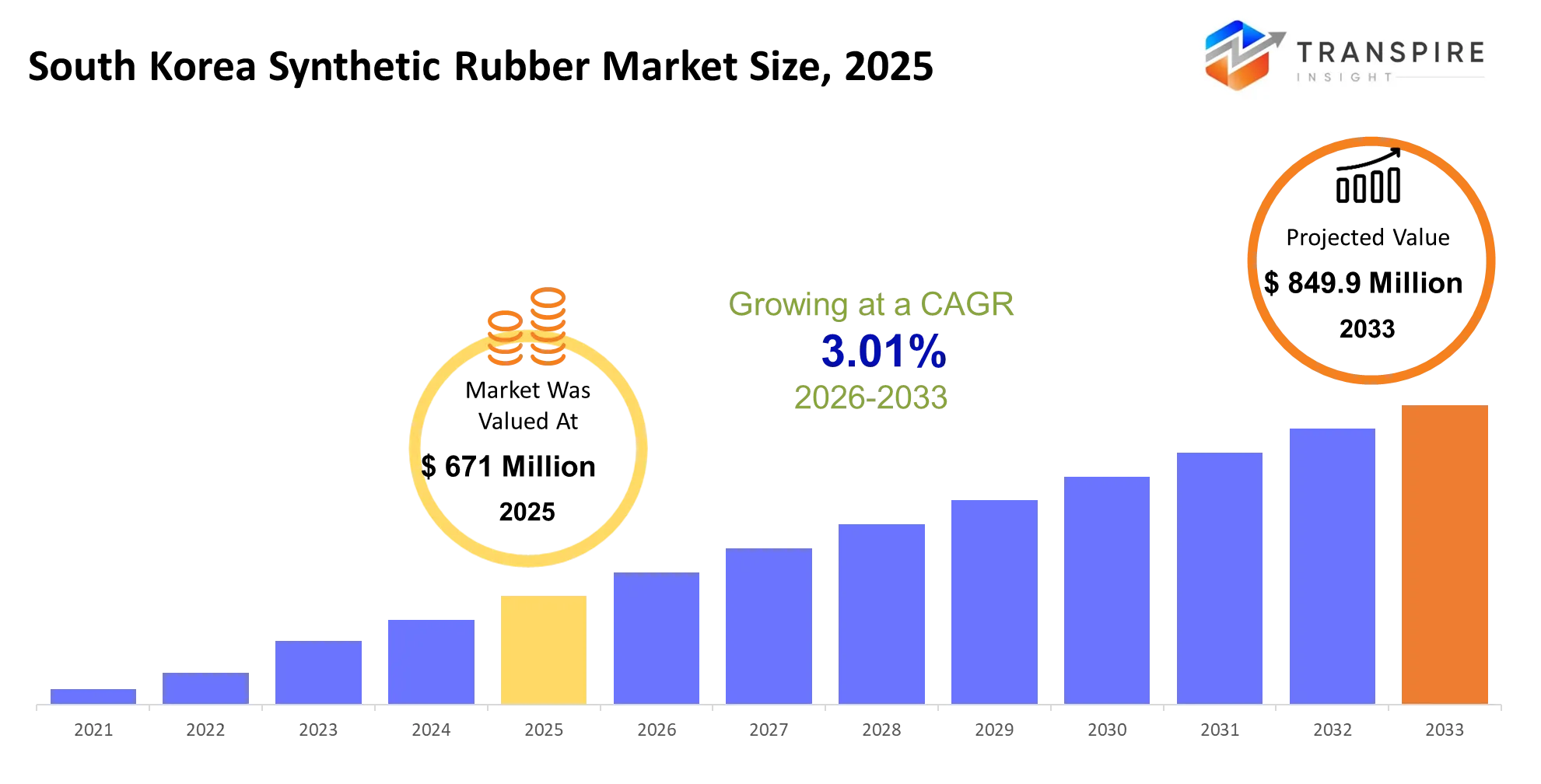
- South Korea Synthetic Rubber Market Size 2025: USD 671 Million
- South Korea Synthetic Rubber Market Size 2033: USD 849.9 Million
- South Korea Synthetic Rubber Market CAGR: 3.01%
- South Korea Synthetic Rubber Market Segments: By Product Type (Styrene Butadiene Rubber, Polybutadiene Rubber, Nitrile Butadiene Rubber, Ethylene Propylene Diene Monomer, Others); By Application (Tires, Automotive Components, Industrial Goods, Footwear, Others); By Form (Solid Rubber, Liquid Rubber, Latex Rubber, Others); By End User (Automotive Industry, Construction Industry, Industrial Manufacturing, Consumer Goods Industry, Others); By Production Process (Emulsion Polymerization, Solution Polymerization, Gas-phase Polymerization, Others)
To learn more about this report,  Download Free Sample Report
South Korea Synthetic Rubber Market Summary
The South Korea Synthetic Rubber Market was valued at USD 671 Million in 2025. It is forecast to reach USD 849.9 Million by 2033. That is a CAGR of 3.01% over the period.
South Korea's synthetic rubber industry really plays this critical part in keeping the country's automotive electronics and industrial equipment sectors running, even when the performance demands get… pretty intense. Basically synthetic rubber helps tire manufacturers push better heat resistance, and also improves fuel efficiency, while battery cable producers can keep insulation reliability where it belongs. Then you have industrial seals, hoses, and adhesives too, they’re used across heavy manufacturing lines , day after day.
Over the last five years the market kind of moved away from just volume led commodity production and into high performance and specialty elastomers. These are tailored for electric vehicles, low rolling resistance tires, and even advanced semiconductor applications. After the global supply chain disruptions in 2021–2022 the shift felt stronger, like the whole thing suddenly made sense in a harsher way. It showed how much the system leaned on imported feedstocks ,and how risky that reliance can get. Then the push became clearer, more deliberate really, localized sourcing that’s resilient not only reactive, you know ,less “wait and patch,” more prepared.
South Korean producers then started investing in premium synthetic rubber grades with tighter performance specifications, so they could meet stricter customer needs without stalling production. And as EV exports advanced mobility systems, and industrial automation keep expanding, manufacturers are landing more higher margin contracts. That, in turn, supports longer term revenue visibility across both automotive and industrial supply chains.
Key Market Insights
- The South Korea Synthetic Rubber Market keeps leaning more and more toward solution styrene butadiene rubber, for EV tires that need lower rolling resistance and better heat staying power , kind of durability if you will.
- Ulsan and Yeosu together, made up more than 55% of domestic production capacity in 2025, largely because the petrochemical infrastructure is already there and acts like a head start.
- Automotive uses stayed in the lead for the South Korea Synthetic Rubber Market share, driven by EV growth and also by export-focused vehicle production that didn’t slow down.
- Nitrile butadiene rubber demand grew steadily after 2022, as semiconductor and electronics makers bought more insulation and sealing materials , to keep up with tighter requirements.
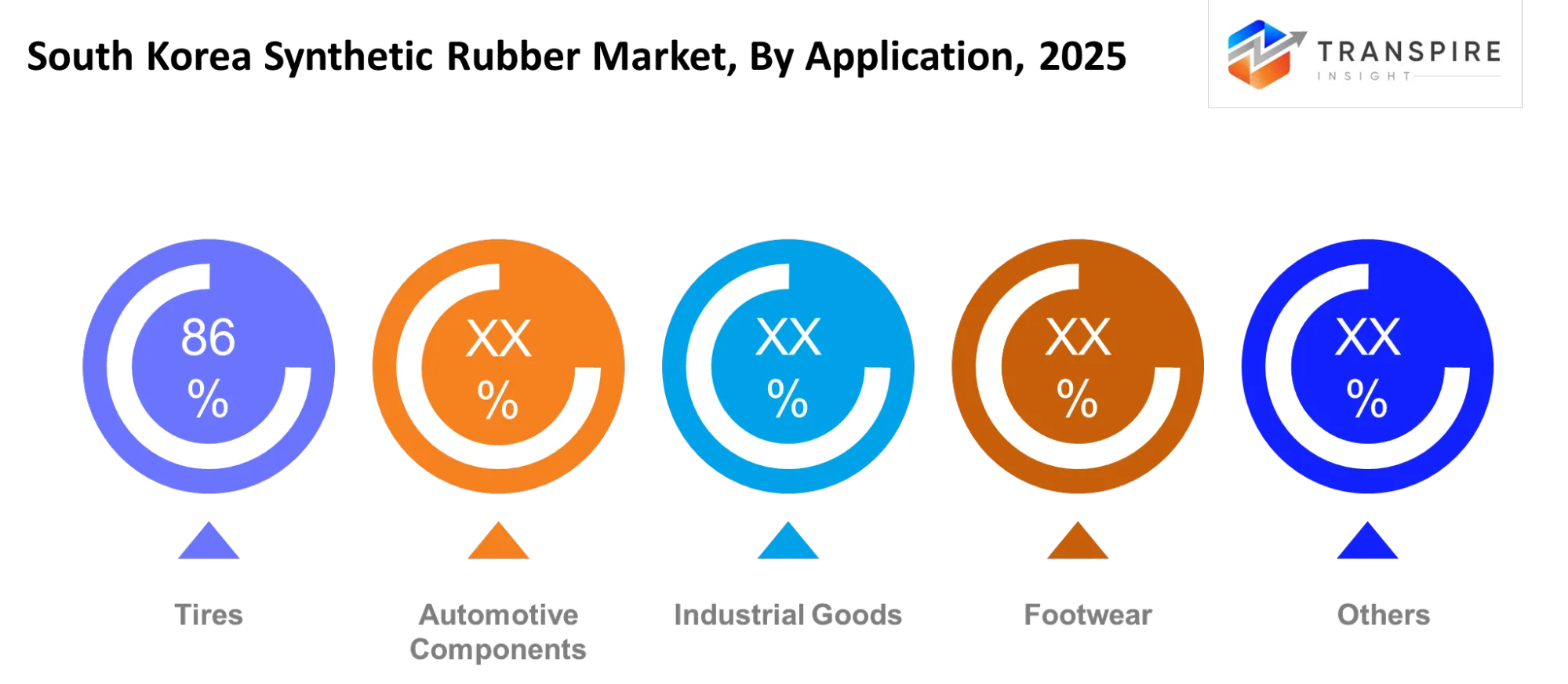
- For applications, tire manufacturing remained dominant, with almost 48% market share, mostly linked to replacement tire needs and also premium vehicle exports that keep rising.
- Specialty elastomers showed up as the fastest-moving category between 2026 and 2033, because EV platforms really need stronger thermal resistance plus better abrasion durability.
- Industrial machinery makers also ramped up synthetic rubber sourcing, for conveyor belts, seals, and vibration-control setups, supporting smart factory automation investments that are being rolled out faster.
- Kumho Petrochemical, LG Chem, ARLANXEO, and Zeon Corporation increased their R&D spend on bio-based feedstocks, and on low-emission production technologies that aim to cut the footprint without losing performance.
- South Korean producers moved more aggressively into Southeast Asia after logistics disruptions revealed concentration concerns in Northeast Asian supply chains.
- Digital manufacturing platforms improved process yield consistency by nearly 10% across several regional plants, using AI-assisted quality monitoring systems , which sounds straightforward but the impact was noticeable.
What are the Key Drivers, Restraints, and Opportunities in the South Korea Synthetic Rubber Market?
The strongest growth driver in the South Korea synthetic rubber industry i think comes from the messy structural shift in the automotive sector toward electric mobility, and also that premium tire manufacturing trend. EV makers need improved elastomer formulations that can lower rolling resistance but still keep strong grip, plus thermal stability and durability when the vehicle carries higher battery mass. This change really picked up speed after automakers globally started tightening fuel-efficiency and emissions rules across export corridors in Europe and North America. So as a consequence, local tire and auto suppliers began buying more high-performance synthetic rubber grades, which helped producers lock in better value agreements and lift operating margins, bit by bit.
The biggest restraint still looks like the market’s structural reliance on unstable petrochemical feedstocks, like butadiene and styrene. South Korea’s producers work inside a tightly linked global supply network where crude oil swings , geopolitical tensions, and even refinery interruptions hit production economics right away. And those cost ups or downs can’t be smoothed out quickly, because large scale feedstock diversification and bio related substitution take years of capex and process redesign, not weeks. Margin strain often pushes expansion plans farther out and it also limits pricing flexibility for downstream industrial customers.
A major opportunity is now taking shape via sustainable and bio-attributed synthetic rubber development. More and more, global automotive OEMs ask suppliers to reveal carbon intensity and recycled material content in procurement requirements. South Korean manufacturers that invest in mass-balance certified elastomers and circular feedstock methods could secure longer term export deals especially in Europe
What Has the Impact of Artificial Intelligence Been on the South Korea Synthetic Rubber Market?
Artificial intelligence together with more advanced industrial analytics are kind of reshaping the way synthetic rubber is produced across South Korea’s petrochemical manufacturing hubs. In practice, many producers now lean on AI-enabled monitoring setups, to tune polymerization temperature , keep pressure stability more consistent, and push catalyst efficiency during elastomer manufacturing. By doing this they often lower batch weirdness and make yield outcomes more predictable, especially for high-performance tire compounds where exacting specs are basically non negotiable. On top of that, machine learning models help with predictive maintenance too, by reading vibration signals, tracking equipment stress levels, and spotting thermal anomalies across reactors , as well as extrusion systems, before failures even show up.
Digital twins plus process simulation platforms are also playing a role, since they allow manufacturers to forecast energy usage, estimate production output, and improve raw material efficiency when operating conditions shift around. A few bigger producers have mentioned a directional improvement in plant uptime and fewer unplanned shutdown events after they integrated AI-assisted maintenance scheduling into daily production routines. There’s also advanced analytics that help companies deal with feedstock procurement during petrochemical price swings, which improves cost management and inventory planning, more or less.
Still, AI adoption has some practical limits. A lot of older production facilities do not have fully digitized infrastructure, so integration becomes costly and technically complicated. Plus, data standardization stays uneven across multi-site operations, and that inconsistency can reduce how accurate predictive models stay once they’re used in real manufacturing settings.
Key Market Trends
- Tire manufacturers kind of shifted toward solution SBR compounds after 2022, mostly to back EV efficiency standards and then those premium export vehicle performance needs too.
- Producers also upped their investment in bio-attributed elastomers when European procurement rules got tighter , and it pushed lifecycle emissions disclosure obligations more during 2025.
- Domestic manufacturers, meanwhile, reduced reliance on spot feedstock sourcing after really sharp butadiene price swings showed up amid global refinery disruptions.
- AI-assisted process controls spread across major petrochemical sites, and that helped yield stay more consistent, plus fewer unscheduled maintenance interruptions, overall.
- South Korean exporters diversified customer exposure toward Southeast Asia after logistics disruptions weakened confidence in trade networks that were more concentrated in just one region.
- Electronics manufacturers have increased nitrile rubber consumption for semiconductor equipment seals, and also for advanced cable insulation applications since 2023, pretty much.
- Strategic alliances between petrochemical companies and tire producers then accelerated co-development of lightweight , heat-resistant elastomer compounds aimed at EV platforms.
- Regional producers expanded recycled feedstock trials to satisfy multinational automotive supplier sustainability benchmarks, those benchmarks that are set to enter force before 2030.
- Industrial automation growth boosted demand for high-durability rubber components used in robotics, conveyor systems, and precision manufacturing equipment.
- And in general, competitive differentiation has been moving away from pricing only, toward material performance certification , carbon transparency, and customized compound engineering capabilities.
South Korea Synthetic Rubber Market Segmentation
By Product Type
Styrene Butadiene Rubber keeps the dominant market position, mostly because tire makers use it in passenger cars, commercial fleets , and even electric mobility setups. Its strong abrasion resistance, plus support for fuel efficiency and lower rolling resistance, keeps pushing adoption forward across the more premium tire lines. Polybutadiene Rubber still holds a big share too, largely from its high elasticity and wear resistance, which heavy duty tire manufacturing and industrial rubber products still really need. Nitrile Butadiene Rubber keeps getting more commercial traction as well, since electronics, automotive sealing systems, and industrial machinery applications want an oil resistant and chemically steady elastomer type.
Styrene Butadiene Rubber is also likely to stay the leader, since electric vehicle production is leaning more and more toward high performance tire compounds that can handle battery heavy vehicle platforms. Polybutadiene Rubber tends to gain from infrastructure development and the ongoing expansion of commercial transportation, which keeps replacement tire demand moving. Nitrile Butadiene Rubber is projected to grow more quickly because semiconductor tools, industrial automation systems, and advanced sealing uses call for tougher chemical resistance and better thermal stability. Ethylene Propylene Diene Monomer stays in steadier demand for roofing membranes, automotive weather seals, and industrial insulation systems where long term environmental durability matters, perhaps more than people think. Others cover specialty elastomers and bio based rubber compounds, made for sustainable production and next generation mobility uses.
By Application
Tires are kind of the leading application segment, because South Korea keeps up strong automotive manufacturing capacity, and export oriented tire production networks, they’re really solid. Tire producers also need synthetic rubber materials that can enhance durability, grip ability, and overall operational efficiency when you get all kinds of road situations. Automotive Components still take a big slice of the market too, mainly because seals, hoses, bushings and vibration-control systems lean on durable elastomer materials a lot. Industrial Goods also hold steadier commercial demand, coming from conveyor systems, industrial belts, machinery insulation, and the production of factory automation equipment, yes.
In the near term, Tires are expected to stay commercially dominant since electric vehicle adoption continues climbing, which boosts the need for advanced tire compounds that deliver lower rolling resistance, plus stronger thermal stability. Automotive Components are gaining traction as electronic integration keeps increasing and lightweight vehicle engineering pushes manufacturers toward elastomer systems that are both tougher and more flexible. Industrial Goods are still expanding , a bit of the reason is smart manufacturing setups and the automation side pushing purchases for high performance rubber materials. Footwear is moving forward at a moderate pace, mostly connected to sportswear production and the way consumers prefer lightweight flexible sole components. There are also other uses like medical products, adhesives, and some niche consumer areas, where customized synthetic rubber recipes are required, and the exact performance traits need to line up with each separate application.
To learn more about this report, Download Free Sample Report
By Form
Solid Rubber basically owns the dominant market spot, i mean tire production industrial machinery and automotive manufacturing really depend on durable , and also structurally stable rubber mixes. Its high tensile strength helps a lot, plus it has easier processing compatibility, and it keeps fitting a lot of different industrial uses , so commercial adoption stays big, on a large scale. Liquid Rubber stays pretty visible too, because adhesives, coatings, sealants, and those industrial bonding systems need flexible yet process-efficient elastomer materials. Latex Rubber keeps getting more attention in healthcare products and protective equipment, and also in specialty industrial applications, where flexibility and elasticity are still the main thing.
Solid Rubber is expected to keep leading, since transportation infrastructure growth and vehicle output are still pushing high-volume tire and industrial component manufacturing. Liquid Rubber also should keep benefiting from the demand for advanced adhesives and protective coatings, especially for electronics assembly, construction systems, and general industrial maintenance work. Latex Rubber is projected to expand steadily, mostly tied to growing healthcare manufacturing, and the need for precision protective products. Others in the mix include recycled rubber blends, and specialty compound forms, created for lightweight mobility systems, newer industrial equipment, and sustainable material processing initiatives.
By End User
In South Korea, the Automotive Industry still basically holds the most dominant market position because vehicle manufacturing along with tire production stay as the largest buyers of synthetic rubber materials. In other words, car platforms need durable elastomers for things like tires, seals, hoses, suspension components, and those vibration-control parts that work in pretty demanding, harsh conditions. Industrial Manufacturing also keeps a substantial market share since factories, heavy machinery systems and automated production lines rely on industrial-grade rubber products to improve operational efficiency, and to protect equipment during daily use. Construction Industry keeps supporting steady material consumption through roofing membranes, insulation systems, waterproofing products and infrastructure sealing applications that kind of “stay there” for a long time.
The Automotive Industry is expected to keep strong growth momentum too, mainly because electric mobility platforms more and more call for advanced elastomer compounds with better heat resistance and lower energy loss characteristics. Industrial Manufacturing should benefit from the expanding wave of automation investments, and also from rising demand for tough machinery components that can handle high-stress industrial environments without failing too quickly. Construction Industry continues to grow steadily, driven by infrastructure modernization and commercial building projects that need long-lasting insulation plus sealing materials. Consumer Goods Industry is getting more attention as footwear appliances and household products increasingly use lightweight, flexible synthetic rubber materials, for better durability, and easier design flexibility. Others cover healthcare equipment, sports products, and specialty industrial sectors that require customized elastomer formulations, depending on what the application actually demands.
By Production Process
Emulsion Polymerization, kind of holds the dominant market position, since big-scale tire making and industrial rubber production depend on manufacturing methods that are not only cost-efficient but also very scalable. In practice it helps keep production output pretty steady, and it supports consistent material properties that high volume elastomer uses really need. Solution Polymerization also keeps a notable market share, largely because premium tire makers are moving toward advanced rubber compounds, with lower rolling resistance and more stable performance. Gas-phase Polymerization stays comparatively smaller, but it still gets attention for niche industrial needs, and for advanced material production use-cases.
Solution Polymerization is projected to grow the fastest, mainly because electric vehicle tire manufacturers are increasingly chasing high-performance elastomers that can meet energy efficiency and durability demands. Product developers keep putting money into advanced polymer technologies, aiming for better compound purity, plus smoother operational performance in tough automotive conditions. Emulsion Polymerization will stay commercially important, because large-scale industrial production still favors cost competitiveness and reliable processing efficiency. Gas-phase polymerization might become more relevant over the long term, as manufacturers look into energy-saving processing approaches and specialty elastomer development for advanced industrial applications. Other pathways include hybrid, customized polymerization technologies as well, focused on sustainable feedstock integration and next-generation specialty rubber manufacturing systems, in a way that’s more tailored.
What are the Key Use Cases Driving the South Korea Synthetic Rubber Market?
Most of the synthetic rubber consumption gets pulled in by tire manufacturing, and especially for passenger vehicles, electric vehicles, plus automotive production that is export-oriented. In practice, tire producers lean on newer elastomers to nudge rolling resistance down, keep wet traction steady, and hold durability up when conditions get pretty demanding. South Korea’s fairly robust automotive export ecosystem keeps basically anchoring this whole application lane.
Then there are the industrial machinery and electronics manufacturing uses, which look like they are expanding as a secondary story. Companies commonly turn to nitrile rubber and ethylene propylene rubber for seals, gaskets, conveyor setups, insulation materials, and also vibration-control parts. Those parts support semiconductor fabrication facilities, and automated factories too, where uptime matters and downtime is costly. Construction equipment and heavy industrial systems likewise need long-wearing elastomer compounds that can keep working even under high mechanical stress, even with continuous use
On the emerging side, there are bio-attributed elastomers, along with specialty compounds aimed at EV battery insulation systems, hydrogen mobility infrastructure, and next-generation robotics. These uses are still relatively small, but they are getting more commercial notice lately. The general reason is that South Korea is pushing investment into advanced mobility and smart manufacturing technologies and it shows in what is getting prioritized.
|
Report Metrics |
Details |
|
Market size value in 2025 |
USD 671 Million |
|
Market size value in 2026 |
USD 690.8 Million |
|
Revenue forecast in 2033 |
USD 849.9 Million |
|
Growth rate |
CAGR of 3.01% from 2026 to 2033 |
|
Base year |
2025 |
|
Historical data |
2021 - 2024 |
|
Forecast period |
2026 - 2033 |
|
Report coverage |
Revenue forecast, competitive landscape, growth factors, and trends |
|
Regional scope |
South Korea |
|
Key company profiled |
Kumho Petrochemical, LG Chem, ExxonMobil, ARLANXEO, Synthos, JSR Corporation, Versalis, TSRC Corporation, Sibur, Goodyear Chemical, Asahi Kasei, Lion Elastomers, Zeon Corporation, Sinopec, Reliance Industries |
|
Customization scope |
Free report customization (country, regional & segment scope). Avail customized purchase options to meet your exact research needs. |
|
Report Segmentation |
By Product Type (Styrene Butadiene Rubber, Polybutadiene Rubber, Nitrile Butadiene Rubber, Ethylene Propylene Diene Monomer, Others); By Application (Tires, Automotive Components, Industrial Goods, Footwear, Others); By Form (Solid Rubber, Liquid Rubber, Latex Rubber, Others); By End User (Automotive Industry, Construction Industry, Industrial Manufacturing, Consumer Goods Industry, Others); By Production Process (Emulsion Polymerization, Solution Polymerization, Gas-phase Polymerization, Others) |
Which Regions are Driving the South Korea Synthetic Rubber Market Growth?
Southeastern industrial areas like Ulsan, Yeosu, and Busan, kinda dominate the South Korea synthetic rubber market, mostly because they have dense petrochemical manufacturing ecosystems and export focused infrastructure. In practice these places also host integrated refining, chemical processing and elastomer production, and that combo helps cut logistics costs. At the same time it makes feedstock easier to secure. Nearby large automotive plus tire manufacturing clusters create pretty stable downstream demand, for high performance rubber compounds. On top of that government backed industrial modernization efforts and strong port connectivity really keep reinforcing this region’s overall production leadership.
The Seoul Capital Area plays a more different role, it works more as a technology and R&D, plus advanced materials coordination hub rather than a big manufacturing base. Major chemical firms here run innovation centers and customer engineering facilities, so they can support high value elastomer development. The area also gets steady financing access, solid corporate partnerships, and close collaboration with automotive and electronics players. So the ecosystem tends to generate consistent long term revenue support, but more through innovation led material upgrades, than through capacity expansion alone.
Chungcheong, and parts of southwestern South Korea are showing up as some of the fastest growing regional markets, driven by expanding advanced manufacturing investment and industrial diversification programs. New semiconductor , battery, and precision machinery projects have increased demand for specialty elastomers and industrial rubber components, starting around 2024. Infrastructure upgrades along with decentralized industrial policy incentives also pushed suppliers to grow outside the usual petrochemical hubs.
Who are the Key Players in the South Korea Synthetic Rubber Market and How Do They Compete?
Competition in the South Korea synthetic rubber space is still pretty moderately consolidated, but yeah the big petrochemical manufacturers keep, most of the domestic production capacity and the core know-how. In practice, firms tend to fight more on specialty product quality, feedstock integration efficiency, export tie-ins, and this kind of application specific compound engineering, not so much on plain price. The older, established producers keep their share by holding long-term arrangements with automotive and tire makers… meanwhile the international suppliers usually go after the higher margin specialty elastomer pockets.
Kumho Petrochemical stands out because of its deep linkage with local tire manufacturing networks and because they keep investing aggressively in solution styrene butadiene rubber technologies. Those are tuned for EV tire use, and it shows. LG Chem instead leans into high performance industrial materials and sustainable feedstock innovation, and they use a lot of R&D muscle to lock in premium overseas customers. ARLANXEO goes the specialty route, using elastomer engineering plus tailored industrial formulations aimed at high temperature endurance and oil resistant performance.
Zeon Corporation relies on its nitrile rubber strengths, especially for electronics and semiconductor related uses, while Sibur leans toward cost-efficient feedstock integration and wider regional export expansion. A few global players also keep tightening partnerships with automotive OEMs and tire manufacturers to co-develop next generation lightweight, and more sustainable, elastomer compounds.
Company List
- Kumho Petrochemical
- LG Chem
- ExxonMobil
- ARLANXEO
- Synthos
- JSR Corporation
- Versalis
- TSRC Corporation
- Sibur
- Goodyear Chemical
- Asahi Kasei
- Lion Elastomers
- Zeon Corporation
- Sinopec
- Reliance Industries
Recent Development News
In April 2026, Kumho Petrochemical announced the commercial production launch of solution styrene butadiene rubber (SSBR) for electric vehicle tire applications. The expansion strengthened South Korea’s specialty synthetic rubber capacity and improved supply availability for premium EV tire manufacturers across Asia.https://www.asiae.co.kr
In February 2026, Kumho Petrochemical expanded its EPDM synthetic rubber production system through a 70,000-ton capacity increase operated by Kumho Polychem. The investment enhanced the company’s competitiveness in high-performance automotive, shipbuilding, and industrial elastomer applications.https://en.sedaily.com
In October 2025, LG Chem showcased new sustainable rubber and specialty material solutions at K 2025 in Germany. The launch reinforced the company’s strategic push toward low-emission and high-performance elastomer technologies for global tire and industrial customers.https://www.specialchem.com
What Strategic Insights Define the Future of the South Korea Synthetic Rubber Market?
The South Korea synthetic rubber market is kind of shifting in a structural way, toward high performance, low emission, and elastomer production that is more specific to each application, not just chasing commodity-driven volume growth. Tt is being pulled along by electric mobility needs, stricter manufacturing standards, and the usual global procurement pressure to use more lower carbon industrial materials. Over the next five to seven years, firms that can bring specialty compound engineering together with sustainable feedstock sourcing will likely see the best margin expansion.
There is also a less obvious risk that can sneak in, and it comes from feedstock concentration plus petrochemical cyclicality. Even if downstream demand stays solid, longer periods of volatility in butadiene and styrene markets may squeeze profitability for producers, and also slow down the timing of capital investment cycles. Meanwhile, bio-attributed elastomers and recycled feedstock technologies look like a real, emerging opportunity, especially for suppliers aiming at European automotive and industrial buyers, who now deal with tougher emissions reporting rules and expectations.
Market players should, at minimum, focus on strategic collaborations with tire manufacturers, EV suppliers, and advanced industrial equipment producers, in order to lock in long term, specification led contracts before sustainability requirements turn mandatory across broader global supply chains.
South Korea Synthetic Rubber Market Report Segmentation
By Product Type
- Styrene Butadiene Rubber
- Polybutadiene Rubber
- Nitrile Butadiene Rubber
- Ethylene Propylene Diene Monomer
- Others
By Application
- Tires
- Automotive Components
- Industrial Goods
- Footwear
- Others
By Form
- Solid Rubber
- Liquid Rubber
- Latex Rubber
- Others
By End User
- Automotive Industry
- Construction Industry
- Industrial Manufacturing
- Consumer Goods Industry
- Others
By Production Process
- Emulsion Polymerization
- Solution Polymerization
- Gas-phase Polymerization
- Others
Frequently Asked Questions
Find quick answers to common questions.
The expected South Korea Synthetic Rubber Market size for the market will be USD 849.9 Million in 2033.
Key segments for the South Korea Synthetic Rubber Market are By Product Type (Styrene Butadiene Rubber, Polybutadiene Rubber, Nitrile Butadiene Rubber, Ethylene Propylene Diene Monomer, Others); By Application (Tires, Automotive Components, Industrial Goods, Footwear, Others); By Form (Solid Rubber, Liquid Rubber, Latex Rubber, Others); By End User (Automotive Industry, Construction Industry, Industrial Manufacturing, Consumer Goods Industry, Others); By Production Process (Emulsion Polymerization, Solution Polymerization, Gas-phase Polymerization, Others).
Major South Korea Synthetic Rubber Market players are Kumho Petrochemical, LG Chem, ExxonMobil, ARLANXEO, Synthos, JSR Corporation, Versalis, TSRC Corporation, Sibur, Goodyear Chemical, Asahi Kasei, Lion Elastomers, Zeon Corporation, Sinopec, Reliance Industries.
The South Korea Synthetic Rubber Market size is USD 671 Million in 2025.
The South Korea Synthetic Rubber Market CAGR is 3.01% from 2026 to 2033.
- Kumho Petrochemical
- LG Chem
- ExxonMobil
- ARLANXEO
- Synthos
- JSR Corporation
- Versalis
- TSRC Corporation
- Sibur
- Goodyear Chemical
- Asahi Kasei
- Lion Elastomers
- Zeon Corporation
- Sinopec
- Reliance Industries
Recently Published Reports
-
May 2026
Healthcare Polymer Packaging Market
Healthcare Polymer Packaging Market Size, Share & Analysis Report By Packaging Type (Syringes, IV Bottles and Pouches, Clamshells, Blisters, Bottles & Jars, Containers, Tubes, IV Parental Packaging, Others), By Type (Regulated, Non-regulated), By Polymer Type (LDPE (Low-Density Polyethylene), HDPE (High-Density Polyethylene), Homo-polymer (Homo), Random Copolymer (Random), Block Copolymer (Block), PET, Polystyrene, Polyvinyl Chloride, Polyamide/EVOH, Others), and Geography (North America, Europe, Asia-Pacific, Middle East and Africa, South and Central America), 2021 - 2031
-
Apr 2026
Hydrophilic Tape (Waterstop) Market
Hydrophilic Tape (Waterstop) Market Size, Share & Analysis Report By Type (Bentonite-Based Hydrophilic Tape, Rubber-Based Hydrophilic Tape), By Application (Residential Buildings, Commercial Buildings, Infrastructure Projects), and Geography (North America, Europe, Asia-Pacific, Middle East and Africa, South and Central America), 2021 - 2031
-
Apr 2026
Metalens Market
Metalens Market Size, Share & Analysis Report By Type (Visible Light Metalens, and Infrared Metalens), By Application (Consumer Electronics, Automotive Electronics, Industrial, Medical, and Others), and Geography (North America, Europe, Asia-Pacific, Middle East and Africa, South and Central America), 2021 - 2031
-
Apr 2026
PBT Resin Market
PBT Resin Market Size, Share & Analysis Report By Type (Reinforced PBT Resin, Unreinforced PBT Resin), By Processing Method (Injection Molding, Extrusion, Blow Molding, Others), By End-User (Automotive, Electrical & Electronics, Consumer Appliances, Industrial Machinery, Medical Devices, Packaging, Others), and Geography (North America, Europe, Asia-Pacific, Middle East and Africa, South and Central America), 2021 - 2031