
South Korea EPDM Rubber Market Size & Forecast:
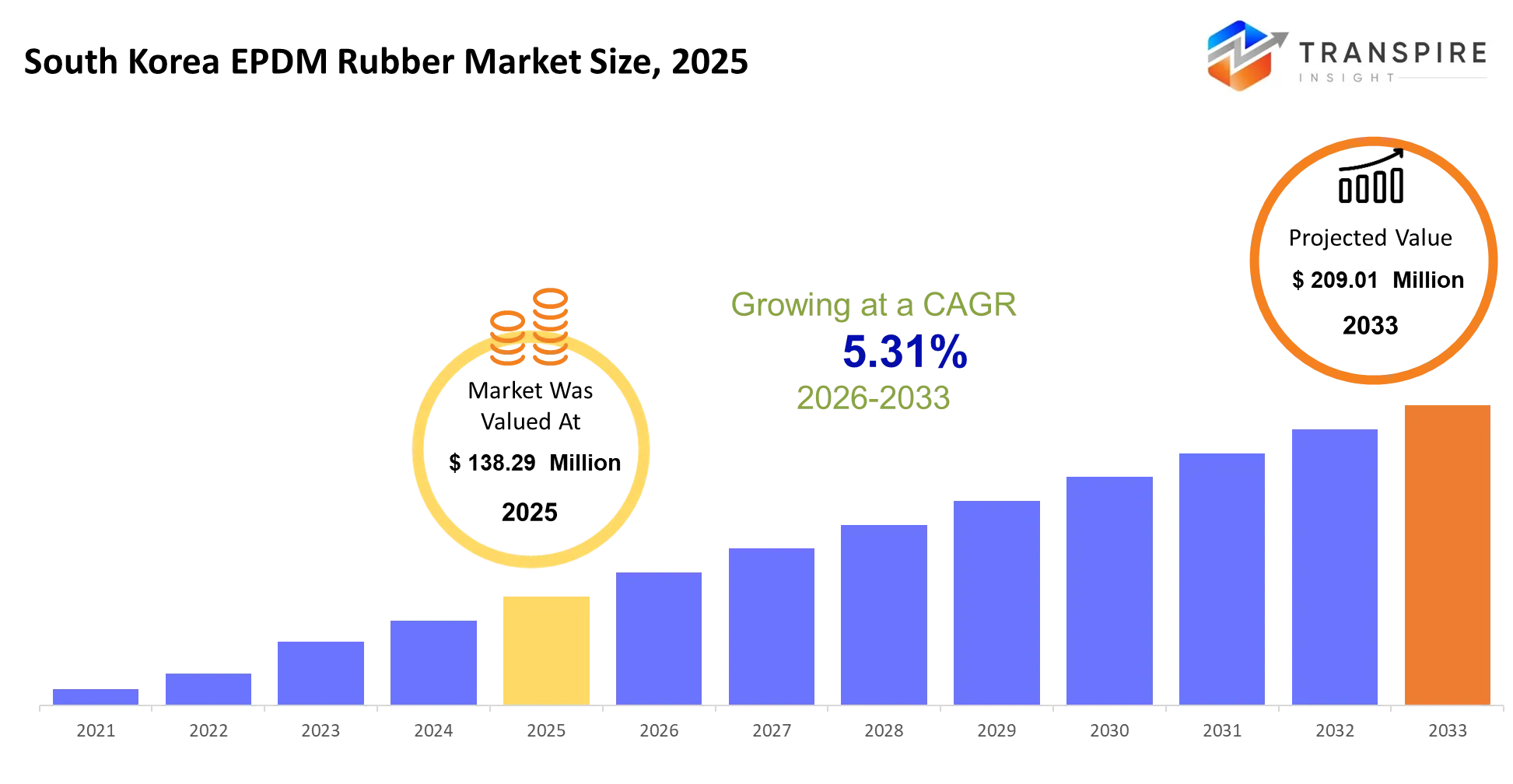
- South Korea EPDM Rubber Market Size 2025: USD 138.29 Million
- South Korea EPDM Rubber Market Size 2033: USD 209.01 Million
- South Korea EPDM Rubber Market CAGR: 5.31%
- South Korea EPDM Rubber Market Segments: By Product Type (Solution Polymerized EPDM, Suspension Polymerized EPDM, Thermoplastic EPDM, Others); By Application (Automotive Components, Roofing Membranes, Wire & Cable Insulation, Industrial Hoses, Plastic Modification, Others); By End User (Automotive Industry, Construction Industry, Electrical Industry, Industrial Manufacturing, Others); By Form (Granules, Bales, Pellets, Powders, Others)
To learn more about this report,  Download Free Sample Report
South Korea EPDM Rubber Market Summary
The South Korea EPDM Rubber Market was valued at USD 138.29 Million in 2025. It is forecast to reach USD 209.01 Million by 2033. That is a CAGR of 5.31% over the period.
In practice, EPDM rubber in South Korea kind of operates as a crucial sealing and durability material, you know, to keep vehicles, buildings, and industrial setups resistant to heat, ozone, and that long-term weather exposure stuff. It’s used almost everywhere in a practical way like automotive weatherstrips, HVAC insulation, roofing membranes, and electrical cable protection, and if it fails then safety , efficiency, even maintenance expenses can get hit directly. Over the last 3–5 years, the market has shifted in a more structural way toward higher-performance, low-VOC EPDM grades, because manufacturers are lining up with tighter emission and material compliance rules across industrial and automotive production.
One big accelerator behind this change was the post-pandemic supply chain disruption, it made domestic converters and OEMs chase more localized and steadier elastomer sourcing rather than leaning heavily on imports. That whole move, in turn, helped bolster local processing capacity and made procurement more resilient too. So now the demand growth is not only about raw volume expanding, but also more about replacement cycles, where customers favor improved longer-lasting formulations that cut maintenance down-time and lower total lifecycle cost.
Key Market Insights
- South Korea EPDM Rubber Market has been seeing a rising shift toward low-VOC grades, sort of because stricter industrial emission compliance rules came into play in 2023.
- For applications, automotive weatherseal is still the main use, sitting at about 35% share in the South Korea EPDM Rubber Market, helped along by EV production expansion and you know, more demand for sealing.
- Roofing membranes show up as the fastest-growing application in the South Korea EPDM Rubber Market, backed by urban infrastructure retrofitting projects that are turning into a steady pipeline.
- On the regional side, Southern industrial hubs hold nearly 40% share in the South Korea EPDM Rubber Market , mostly linked to dense automotive manufacturing clusters around there.
- Northern urban infrastructure is the fastest-moving regional demand center in the South Korea EPDM Rubber Market, through smart city projects.
- When it comes to end-users, automotive players dominate the South Korea EPDM Rubber Market, due to strong OEM integration in sealing and vibration-resistance components .
- Construction comes next as the second-largest end-user in the South Korea EPDM Rubber Market, driven by waterproofing needs and insulation demand.
- EPDM compound innovation is accelerating competitiveness in the South Korea EPDM Rubber Market, via upgraded heat tolerance and UV resistant formulation improvements.
- Strategic partnerships between OEMs and elastomer producers are reshaping supply chains in the South Korea EPDM Rubber Market since 2024 , like re-routing relationships and contracts earlier than before.
- Globally, companies such as ExxonMobil, Lanxess, and JSR Corporation are reinforcing their competitive positioning in the South Korea EPDM Rubber Market, and keeping pressure on local producers.
What are the Key Drivers, Restraints, and Opportunities in the South Korea EPDM Rubber Market?
The main driver behind the South Korea EPDM Rubber Market is the fast adoption of high-durability elastomers within automotive electrification programs. EV makers really need sealing materials that keep their elasticity while they face thermal stress coming from battery systems , so OEM requirements are slowly shifting toward higher-grade EPDM compounds. As a result procurement volumes have gone up for domestic processors , because automakers are trying to lock in localized, performance-stable supply chains to lower production risk and reduce downtime.
One big restraint is how exposed the business is to petrochemical feedstock price cycles, especially the ups and downs in ethylene and propylene. Since EPDM manufacturing is very raw-material intensive , any fluctuation in upstream naphtha pricing can turn into cost instability that downstream converters can’t simply neutralize or hedge. This kind of structural issue then makes margin improvements harder, and it can also stall longer term agreements between suppliers and industrial buyers , in particular when construction buyers are very price sensitive.
A promising opportunity is showing up through infrastructure modernization linked to smart city plans and green building retrofits. In Seoul and Busan , government-supported urban redevelopment is increasingly calling for high-performance waterproofing membranes and insulation solutions. That adds another demand layer for long-life EPDM formulations outside the automotive space . Firms that are putting money into tailored compound development for extreme weather endurance are better positioned to catch this next wave of adoption.
What Has the Impact of Artificial Intelligence Been on the South Korea EPDM Rubber Market?
Artificial intelligence is slowly, like really slowly, reshaping production efficiency and quality assurance inside EPDM rubber manufacturing across South Korea, especially during compounding and extrusion phases. A number of producers are rolling out AI-enabled monitoring arrangements to nudge temperature, viscosity, and blending proportions in real time. That kind of steering reduces batch to batch irregular wobbles and gives more steady material for automotive parts, as well as construction-grade output. In more advanced plants, machine learning models dig through earlier production logs to adjust the curing schedule, and they also warn on deviations before real defects show up. Usually, this lifts yield, and it also means less waste, scrap material, ends up created.
For predictive maintenance, AI systems are being used to track extruder wear, mixer dynamics, and polymer breakdown trends, so maintenance teams can plan service before anything actually fails. Because of that equipment uptime tends to improve, and those annoying unplanned stoppages get reduced across larger elastomer sites. A few manufacturers are even using AI forecasting tools to line up their production with the later demand coming from automotive OEMs, which helps reduce inventory misbalance and can shrink logistics costs.
Still, uptake is constrained by expensive system integration, plus the reality that many mid-sized processors run on fragmented older setups. Plenty of facilities continue with semi automated machinery and that can lead to weak sensor matching, so full scale AI rollout feels hard in practice. On top of that, real world production records aren’t always clean or consistent, so model dependability drops, most noticeably when companies swap between separate EPDM formulations or remix additive blends, since those shifts can scramble the predictions, even if the equipment looks fine.
Key Market Trends
- EPDM formulation upgrades kind of kicked into a higher gear after 2023 , mainly because VOC and industrial emission rules got stricter and that seems to have touched nearly 60% of the new compound work coming out of South Korea elastomer circles.
- Automotive OEMs , especially for EVs, leaned more on EPDM sealing systems from 2024 to 2026, largely to cope with higher thermal stress and it looks like EV related uses make up more than 35% of the added demand growth.
- On the construction side , the shift since 2022 has been away from PVC membranes and toward EPDM roofing systems, mostly for better longer service life, and this move now grabs about 25–30% of new commercial roofing installs.
- Local manufacturers also expanded capacity in 2025 , as a way to lower import reliance following global elastomer supply hiccups, and that translated to roughly 18–22% more output compared with the year before.
- At the same time, compound customization kept rising since buyers wanted application tuned EPDM grades for tough weather endurance, so these specialized orders now land around 40% of total specialty EPDM requests.
- Then there are recycling efforts for elastomer waste, those gained real momentum in 2024 under industrial circular economy policies.
- Supplier consolidation also moved faster, since bigger international firms boosted their distribution setups in the South Korea EPDM Rubber Market, and the top five companies control something like nearly 65% of the supply routes.
- Digital process control systems are now basically standard in newly built EPDM plants, to make batch behavior steadier and improve yield, which in advanced sites boosts production efficiency by about 15–20%.
- Finally export minded production has expanded too, as South Korean EPDM converters chased Southeast Asia construction demand.
South Korea EPDM Rubber Market Segmentation
By Product Type
Polymerized EPDM still has the leading role in the market, mostly because its molecular uniformity is really strong which gives better elasticity, heat resistance and longer durability for automotive seals and roofing uses. There is also solid adoption in EV weatherstripping and high-performance construction membranes, and this basically keeps it in the top position across industrial supply chains, even when demand shifts around a bit.
Meanwhile, Suspension Polymerized EPDM stays in the second-largest space. It is mainly because production is cost-effective ,and it works well in general-purpose industrial applications where extreme performance is not really a must. Thermoplastic EPDM is picking up some niche momentum in lightweight automotive parts and recyclable material approaches ,while the Others group remains relatively limited since usage is more specialized, or it relies on more experimental patterns, and that slows down wider penetration.
Solution Polymerized EPDM also continues to broaden because manufacturers are trying to pick low-defect, high-consistency materials for precision engineering. Suspension grades stay fairly steady, largely due to their affordability and because they fit bulk industrial processing for hoses and insulation products. Thermoplastic EPDM is moving fastest, pushed by higher demand for recyclable elastomer blends inside sustainable manufacturing programs. Over the forecast period, product innovation will probably lean toward hybrid formulations, combining thermal stability with recyclability, so compound developers focusing on EV and green construction markets should see more opportunities.
By Application
Automotive Components kind of dominate the application segment because they show up a lot in seals, gaskets, vibration dampers and thermal-resistant EV battery enclosures , you know the usual. Also, high vehicle production density, plus fast electrification trends really keep pushing it forward in industrial demand. Then Roofing Membranes land as the second-largest slice, mostly due to long lifecycle waterproofing requirements in commercial, and tighter urban infrastructure projects. Wire & Cable Insulation keeps expanding too, largely because electrification of infrastructure is moving ahead, while Industrial Hoses and Plastic Modification do their part but in smaller , more supporting roles.
Automotive Components keep growing as EV output climbs, since thermal stability along with weather resistance are basically make-or-break for performance reliability. Roofing Membranes are actually starting to grow the fastest, helped by more strict energy efficiency requirements, and broader use of tougher waterproofing systems in urban redevelopment. Wire & Cable Insulation is also getting more attention as renewable energy grids and smart infrastructure spread across industrial zones. Over the forecast stretch, application demand will shift toward high-performance, multi-functional EPDM materials, designed for electrified mobility, and energy-efficient construction systems.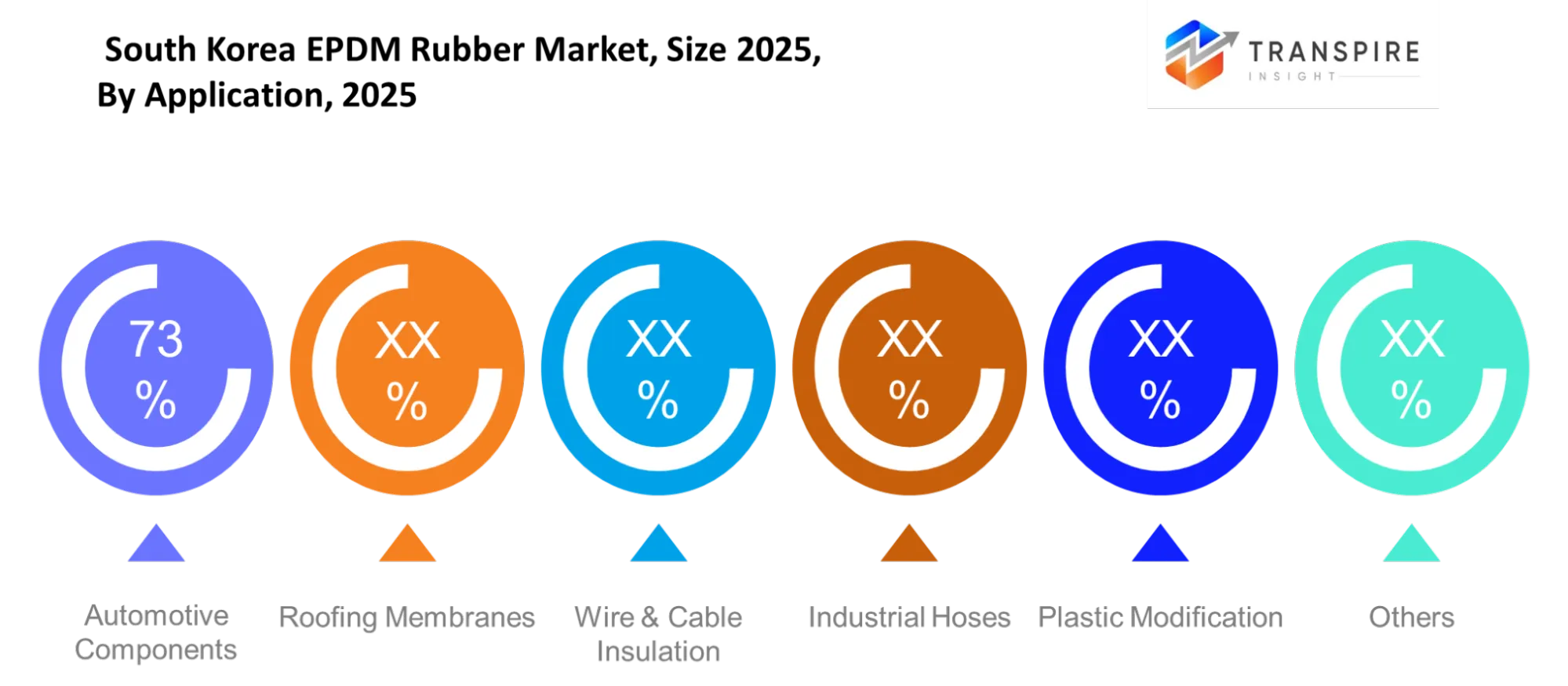
To learn more about this report, Download Free Sample Report
By End User
The Automotive Industry keeps a dominant position because EPDM rubber is deeply involved in vehicle sealing systems, heat regulation components, and vibration dampening structures. Strong EV production momentum, along with OEM localization efforts, just reinforces its leadership in material sourcing. The Construction Industry comes next as the second-largest segment, mainly from steady needs for roofing membranes, insulation products, and moisture barrier solutions. Meanwhile the Electrical Industry keeps moving forward steadily, driven by higher demand for cable guarding, and Industrial Manufacturing still shows diversified use, but on a smaller scale.
For Automotive, the demand keeps rising as more EV platform development happens, where EPDM is sort of central for thermal resistance and long service durability. Construction looks like the fastest-growing end-user area, pulled by smart city investments and infrastructure upgrades that need long-life sealing choices. Electrical Industry growth is supported by grid expansion and renewable integration, where dependable insulation materials matter. Through the forecast period, end-user demand will get more varied over time as sustainability-led construction and electrified mobility end up reshaping material requirements, maybe in ways that also change procurement timing.
By Form
Granules sort of hold the dominant position, because they’re easy to handle, they behave pretty consistently during processing, and they fit really well for high volume compounding in auto and industrial uses. You know, the strong adoption across automated production lines kinda locks in their leadership for production efficiency, at least for now. Bales come next as the second-largest segment since they stay broadly in use for bulk transportation plus large scale processing in more traditional rubber manufacturing settings. Pellets are getting more attention in precision compounding use cases, and Powders and Others stay mostly limited to specialized blending and smaller niche industrial applications.
Granules keep growing, largely tied to the ongoing increase of automation in rubber processing plants, where a uniform feedstock improves productivity and cuts down processing variability. Bales keep a steadier demand curve because of their cost efficiency when it comes to large scale purchasing and storage logistics. Pellets are showing up as the fastest growing form, mainly because they work nicely with advanced compounding systems and with high performance material formulations. Over the forecast period, form innovation will likely drift toward processing friendly low waste formats, that support precise manufacturing and more sustainable production practices across automotive and construction industries.
What are the Key Use Cases Driving the South Korea EPDM Rubber Market?
The dominant use case in the South Korea EPDM Rubber Market is kind of automotive sealing systems, like door seals, window gaskets, and vibration dampers. This slice keeps pulling the highest demand, because EV platforms really need strong heat tolerance, plus weather resilience, so the battery and cabin stay intact under extreme operating conditions, 24/7.
On the expanding side, EPDM is also being picked for HVAC insulation and industrial waterproofing membranes. You see this mainly in commercial buildings and manufacturing facilities, and it’s moving upward as energy efficiency rules tighten across urban infrastructure, and industrial zones.
As for emerging use cases, there is cable insulation for renewable energy setups, and also flexible roofing solutions for smart buildings. Those uses are still sort of early stage, but they’re starting to gather momentum as South Korea pushes further into renewable generation and invests in smart infrastructure.
|
Report Metrics |
Details |
|
Market size value in 2025 |
USD 138.29 Million |
|
Market size value in 2026 |
USD 145.48 Million |
|
Revenue forecast in 2033 |
USD 209.01 Million |
|
Growth rate |
CAGR of 5.31% from 2026 to 2033 |
|
Base year |
2025 |
|
Historical data |
2021 - 2024 |
|
Forecast period |
2026 - 2033 |
|
Report coverage |
Revenue forecast, competitive landscape, growth factors, and trends |
|
Regional scope |
South Korea |
|
Key company profiled |
Kumho Polychem, ExxonMobil, Dow, LANXESS, Mitsui Chemicals, JSR Corporation, SK geo centric, Lion Elastomers, Versalis, SABIC, Sumitomo Chemical, PetroChina, Arlanxeo, ENEOS Corporation, LG Chem |
|
Customization scope |
Free report customization (country, regional & segment scope). Avail customized purchase options to meet your exact research needs. |
|
Report Segmentation |
By Product Type (Solution Polymerized EPDM, Suspension Polymerized EPDM, Thermoplastic EPDM, Others); By Application (Automotive Components, Roofing Membranes, Wire & Cable Insulation, Industrial Hoses, Plastic Modification, Others); By End User (Automotive Industry, Construction Industry, Electrical Industry, Industrial Manufacturing, Others); By Form (Granules, Bales, Pellets, Powders, Others) |
Which Regions are Driving the South Korea EPDM Rubber Market Growth?
South Korea’s southeastern industrial corridor, more or less led by Ulsan, Yeosu and Busan, ends up dominating EPDM rubber consumption because there’s this dense petrochemical plus automotive manufacturing web. It kind of works well, since the area has tight linkage between refineries, elastomer producers, and downstream OEM facilities, so it cuts supply chains quicker, and also trims logistics expenses, sometimes by a noticeable margin. Also the port setup around Busan, supports bulk importing of feedstock and then shipping finished rubber compounds out to global markets. On top of that, enforcement of environmental rules in the industrial zones has been getting stricter, so manufacturers keep leaning toward better-grade EPDM formulations. So overall, the leadership sticks, from a mix of output scale, export access, and kind of vertically knit petrochemical hubs.
Meanwhile the Seoul–Gyeonggi industrial belt plays as a steadier secondary hub, and it feels driven more by demand staying consistent than by really massive manufacturing concentration. Unlike the southeastern cluster, it’s more grounded by automotive R&D sites, electronics production, and procurement hubs for construction materials, rather than big chemical production footprints. Its expansion is supported by ongoing infrastructure spending, plus strict energy-efficiency regulations for buildings, which keep sustaining EPDM demand for roofing and insulation uses. Also, long term contracts from OEM suppliers and construction firms help lock in predictable consumption, so it doesn’t swing around as much. That’s why it can be considered less volatile, a dependable revenue contributor, and not exactly a production powerhouse.
Then there’s the central Chungcheong region, which is starting to look like the fastest-growing EPDM demand zone, mainly because logistics routes and industrial park expansions around Cheonan and Daejeon have accelerated recently. With government backed decentralization initiatives, plus new investments tied to EV component manufacturing, incremental production capacity has been shifting inland since 2023.
Who are the Key Players in the South Korea EPDM Rubber Market and How Do They Compete?
The South Korea EPDM Rubber Market feels moderately consolidated, with the big global petrochemical players and a handful of connected domestic producers pretty much owning most of the high performance grades. You can see competition mostly coming from, formulation know-how, feedstock linkages and those long term supply pacts with automotive plus construction OEMs. In standard grade materials there is some price back and forth, but specialty EPDM compounds tend to be steered by performance distinction and certification based buying, like it’s less about cost and more about proof. For new entrants it’s hard because capital heavy production is required and downstream industries push strict quality needs, so even getting in is kind of barrier-ish.
Kumho Polychem plays it through lower cost output and very tight alignment with South Korea’s automotive procurement network, they focus on weatherseal-grade EPDM that’s tuned for EV platform needs. LANXESS leans on polymer engineering improvements and high performance elastomer formulations, especially for situations with harsh thermal stress and brutal UV exposure. ExxonMobil uses global feedstock scale and process steadiness to deliver standardized EPDM grades, and they also have export strength across Asia-Pacific. JSR Corporation sticks more to tailored niche work for electronics plus precision industrial use cases, where material uniformity and small batch specialization help maintain pricing firmness. LG Chem goes for vertical integration with its petrochemical operations, then expands into low VOC options and elastomer lines that match sustainability expectations, so compliance oriented demand gets grabbed more effectively.
Company List
- Kumho Polychem
• ExxonMobil
• Dow
• LANXESS
• Mitsui Chemicals
• JSR Corporation
• SK geo centric
• Lion Elastomers
• Versalis
• SABIC
• Sumitomo Chemical
• PetroChina
• Arlanxeo
• ENEOS Corporation
• LG Chem
Recent Development News
In February 2025, LANXESS announced expansion of its elastomer production optimization program. The company upgraded its EPDM compounding line to improve energy efficiency and reduce emissions in high-spec automotive applications.https://lanxess.com
In September 2025, ExxonMobil launched an upgraded EPDM product grade targeting EV sealing systems. The new formulation was designed to improve thermal resistance and extend component lifespan under battery heat cycles.https://corporate.exxonmobil.com
What Strategic Insights Define the Future of the South Korea EPDM Rubber Market?
South Korea EPDM Rubber Market is slowly kind of tilting toward demand that is application-led and higher-spec, not just chasing raw volume growth, mostly because mobility is getting electrified and the industrial material rules are getting tighter. In the next 5–7 years, most value will likely show up in custom formulations, the kind that fit EV thermal management, smart infrastructure sealing, and low-emission building systems. There’s also a less obvious risk in upstream petrochemical concentration, because if the whole supply leans on a small set of feedstocks, then when global oil volatility kicks in, pricing shocks can get louder, and margins may get squeezed more quickly, yes.
At the same time there’s a chance starting to form around decentralized manufacturing clusters, often backed by inland industrial parks, and these will pull for localized elastomer supply chains. Companies in the market should focus on deeper ties and vertical integration with OEMs, and also put money into modular production systems that let them switch grades fast. That ability to pivot—grade switching without much delay—will turn into a real competitive edge as demand starts fragmenting across end-use industries.
South Korea EPDM Rubber Market Report Segmentation
By Product Type
- Solution Polymerized EPDM
- Suspension Polymerized EPDM
- Thermoplastic EPDM
- Others
By Application
- Automotive Components
- Roofing Membranes
- Wire & Cable Insulation
- Industrial Hoses
- Plastic Modification
- Others
By End User
- Automotive Industry
- Construction Industry
- Electrical Industry
- Industrial Manufacturing
- Others
By Form
- Granules
- Bales
- Pellets
- Powders
- Others
Frequently Asked Questions
Find quick answers to common questions.
The Estimated South Korea EPDM Rubber Market size for the Market will be USD 209.01 Million in 2033.
Key Segments for the South Korea EPDM Rubber Market are By Product Type (Solution Polymerized EPDM, Suspension Polymerized EPDM, Thermoplastic EPDM, Others); By Application (Automotive Components, Roofing Membranes, Wire & Cable Insulation, Industrial Hoses, Plastic Modification, Others); By End User (Automotive Industry, Construction Industry, Electrical Industry, Industrial Manufacturing, Others); By Form (Granules, Bales, Pellets, Powders, Others).
Major South Korea EPDM Rubber Market players are Kumho Polychem, ExxonMobil, Dow, LANXESS, Mitsui Chemicals, JSR Corporation, SK geo centric, Lion Elastomers, Versalis, SABIC, Sumitomo Chemical, PetroChina, Arlanxeo, ENEOS Corporation, LG Chem.
The Current South Korea EPDM Rubber Market size is USD 138.29 Million in 2025.
The South Korea EPDM Rubber Market CAGR is 5.31% from 2026 to 2033.
• Kumho Polychem
• ExxonMobil
• Dow
• LANXESS
• Mitsui Chemicals
• JSR Corporation
• SK geo centric
• Lion Elastomers
• Versalis
• SABIC
• Sumitomo Chemical
• PetroChina
• Arlanxeo
• ENEOS Corporation
• LG Chem
Recently Published Reports
-
May 2026
Healthcare Polymer Packaging Market
Healthcare Polymer Packaging Market Size, Share & Analysis Report By Packaging Type (Syringes, IV Bottles and Pouches, Clamshells, Blisters, Bottles & Jars, Containers, Tubes, IV Parental Packaging, Others), By Type (Regulated, Non-regulated), By Polymer Type (LDPE (Low-Density Polyethylene), HDPE (High-Density Polyethylene), Homo-polymer (Homo), Random Copolymer (Random), Block Copolymer (Block), PET, Polystyrene, Polyvinyl Chloride, Polyamide/EVOH, Others), and Geography (North America, Europe, Asia-Pacific, Middle East and Africa, South and Central America), 2021 - 2031
-
Apr 2026
Hydrophilic Tape (Waterstop) Market
Hydrophilic Tape (Waterstop) Market Size, Share & Analysis Report By Type (Bentonite-Based Hydrophilic Tape, Rubber-Based Hydrophilic Tape), By Application (Residential Buildings, Commercial Buildings, Infrastructure Projects), and Geography (North America, Europe, Asia-Pacific, Middle East and Africa, South and Central America), 2021 - 2031
-
Apr 2026
Metalens Market
Metalens Market Size, Share & Analysis Report By Type (Visible Light Metalens, and Infrared Metalens), By Application (Consumer Electronics, Automotive Electronics, Industrial, Medical, and Others), and Geography (North America, Europe, Asia-Pacific, Middle East and Africa, South and Central America), 2021 - 2031
-
Apr 2026
PBT Resin Market
PBT Resin Market Size, Share & Analysis Report By Type (Reinforced PBT Resin, Unreinforced PBT Resin), By Processing Method (Injection Molding, Extrusion, Blow Molding, Others), By End-User (Automotive, Electrical & Electronics, Consumer Appliances, Industrial Machinery, Medical Devices, Packaging, Others), and Geography (North America, Europe, Asia-Pacific, Middle East and Africa, South and Central America), 2021 - 2031