
Europe Advanced Recycling Market Size & Forecast:
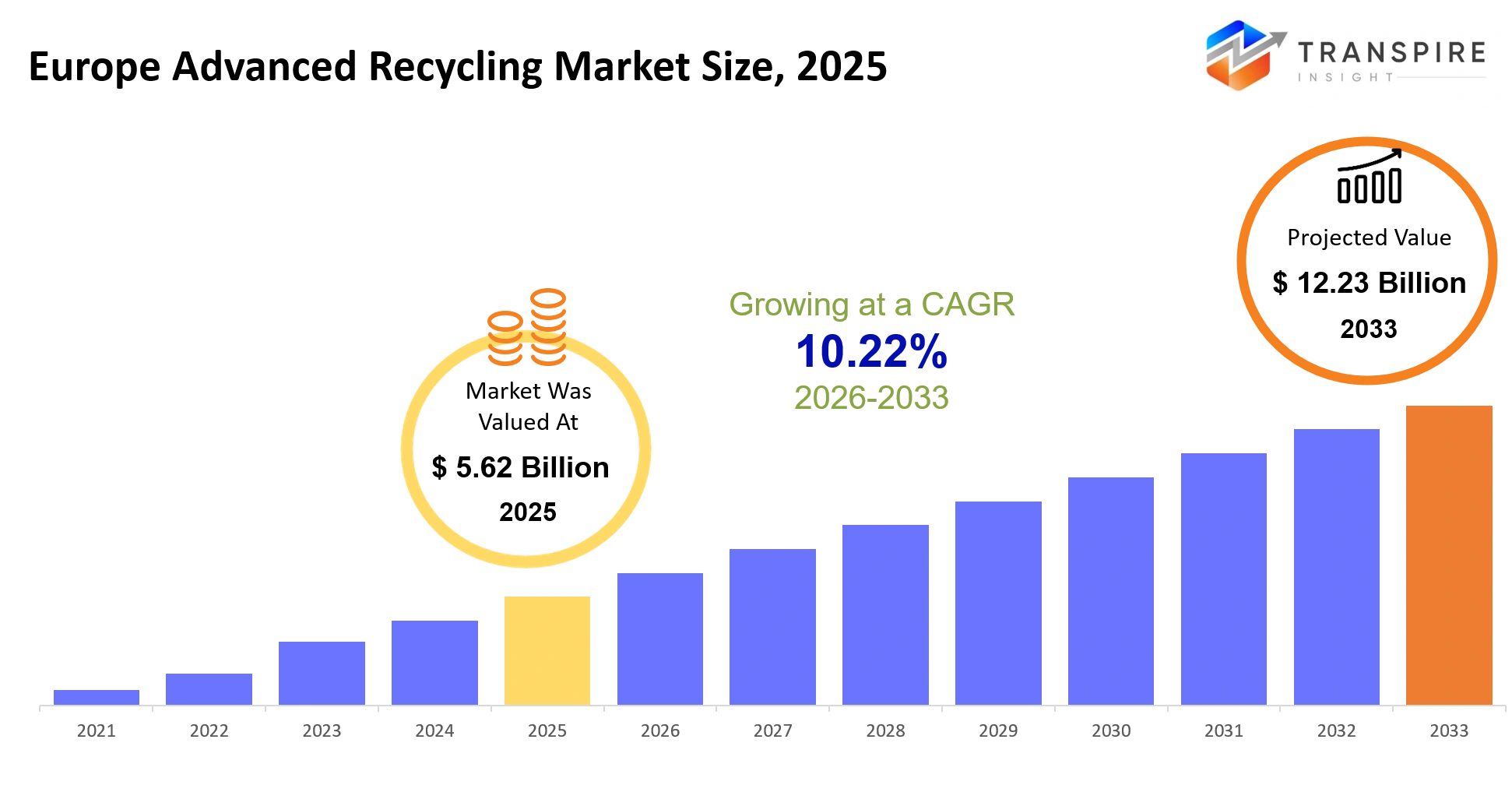
- Europe Advanced Recycling Market Size 2025: USD 5.62 Billion
- Europe Advanced Recycling Market Size 2033: USD 12.23 Billion
- Europe Advanced Recycling Market CAGR: 10.22%
- Europe Advanced Recycling Market Segments:By Technology (Pyrolysis, Gasification, Solvolysis, Depolymerization, Dissolution, Others); By Feedstock (Plastic Waste, Biomass, Rubber Waste, Electronic Waste, Others); By Product (Monomers, Fuels, Chemicals, Recycled Polymers, Others); By End User (Packaging, Automotive, Construction, Electronics, Others); By Process (Chemical Recycling, Mechanical Recycling Integration, Others); By Distribution Channel (Direct Sales, Others).
Europe Advanced Recycling Market Summary
The Europe Advanced Recycling Market was valued at USD 5.62 Billion in 2025. It is forecast to reach USD 12.23 Billion by 2033. That is a CAGR of 10.22% over the period.
The Europe Advanced Recycling Market is about taking complicated plastic waste and turning it into something that can be used again in the production of petrochemicals. This is really helpful because it solves a problem. What to do with plastics that cannot be recycled using traditional methods. It helps companies use new plastic made from fossil fuels and meet the new rules for reducing waste in Europe.
Over the few years the Europe Advanced Recycling Market has changed a lot. It used to be about projects that tested new ways of recycling but now it is about building big facilities that can break down plastics into their basic parts. This change happened because the European Union made new rules about packaging waste and companies promised to reduce their carbon footprint. Another reason for this change was that the price of oil kept going down which made companies look for other ways to get the materials they need.
As a result recycling companies and petrochemical companies are now working together closely. They are making agreements to buy and sell materials, which makes it easier to invest in new projects and build more facilities. The Europe Advanced Recycling Market is growing because companies and governments are working together to reduce waste and use recycled materials. This is making it easier for new recycling technologies to become available and for companies to make money from recycling. The Europe Advanced Recycling Market is becoming a part of the solution to the problem of plastic waste, in Europe.
Key Market Insights
- The Europe Advanced Recycling Market is changing from pilot plants to big industrial recycling plants. This change has increased the output of plastic by over 35% since 2022. New rules from the EU are pushing manufacturers to recycle plastic. This means they need to get plastic waste to recycle.
- Chemical recycling is becoming a part of recycling plastic waste. By 2025 it is expected to be used than 20% in Western Europe.
- The North of Europe has the share in the Europe Advanced Recycling Market. This is because they have factories that make chemicals and oil.
- Eastern Europe is growing fast. New recycling plants are being built there. The land is cheap.
- Pyrolysis is still the used technology. It can handle plastic waste and can be scaled up easily.
- Depolymerization is growing fast. It makes pure recycled plastic and packaging manufacturers want it.
- The packaging industry uses the recycled plastic. They need a lot of plastic for their products.
- The car and building industries are starting to use recycled plastic. Recycled plastic is becoming good enough to use in buildings and cars.
- Companies, like BASF, Dow, Neste and LyondellBasell are working together to recycle plastic. They want to make sure they have plastic to recycle.
What are the Key Drivers, Restraints, and Opportunities in the Europe Advanced Recycling Market?
Drivers
The Europe Advanced Recycling Market is mainly driven by rules under the EU circular economy and packaging waste directives. These rules require companies to use recycled materials when they make things. This has made companies that make petrochemicals and recyclers work together closely which helps them make more money and invest in better recycling facilities. As the deadlines to follow these rules get closer more companies that make packaging and use a lot of plastic are starting to use materials to make their products.
Restraints
Even though things are moving forward there is still a problem. Building and running recycling facilities is very expensive and complicated. New technologies like breaking down plastic into pieces and using high temperatures to turn plastic into other things require a lot of money upfront take a long time to get started and need good quality materials to work with.. The waste collection systems in Europe are not very good at providing these materials so it takes a long time to get these projects started and only big companies can afford to do it. This means that not many new companies can enter the market and it is hard to increase the amount of recycling that gets done in some parts of Europe.
Opportunity
There is an opportunity coming up in the Europe Advanced Recycling Market. More and more companies are signing long-term contracts to buy materials that can be used to make new chemicals. Countries, like Germany and the Netherlands are investing in centers where waste is turned into chemicals. This will make it easier for companies to get the materials they need which will make investors more confident and help new recycling technologies become widely used in the Europe Advanced Recycling Market over the next few years. The Europe Advanced Recycling Market will keep growing as more companies start to use materials and new technologies become available.
What Has the Impact of Artificial Intelligence Been on the Europe Advanced Recycling Market?
The Europe Advanced Recycling Market is getting better because of intelligence and advanced digital systems. These systems are making things more efficient by sorting waste controlling processes and running chemical recycling plants. Artificial intelligence is being used to identify the types of plastic in streams, which makes the plastic better before it is broken down.In the recycling plants machine learning is used to control things like temperature, pressure and the chemicals used. This makes the output more consistent. Uses less energy.
Artificial intelligence is also being used to predict when maintenance is needed and to make the plants run better. The machine learning models look at things like how the equipment's vibrating, the temperature and how much is being produced. This helps to predict when something might go wrong so it can be fixed before the plant has to stop.This has made a difference like the plants being able to run more often and having lower maintenance costs. It also helps to make sure the recycled materials are quality, which is important, for the petrochemical industry.
There is still a problem, which is that it is very expensive to get all the systems working together. Many plants are still using equipment, which makes it hard to use artificial intelligence. Also the waste that comes into the plants is not always the same, which makes it harder for the artificial intelligence to work well.
Key Market Trends
- The Europe Advanced Recycling Market has changed a lot. Before 2020 it was about small test plants.. Since 2023 big factories that break down old things have been opening really fast.
- The European Union made rules about packaging waste. These rules say that companies have to use recycled material. This is making companies use chemical recycling often in their work.
- After 2024 many companies started making long-term agreements to get the materials they need. This helps people who invest in recycling projects feel more sure about their investments.
- Big companies like BASF, Dow and Neste are working together with recyclers. This is helping them make their production processes more circular.
- A lot of people started using pyrolysis technology after 2022. This is because it is good, at handling dirty plastic waste.
- Since 2023 people have been using depolymerization more. This is because it makes good quality materials that can be used for food and packaging.
- Western Europe still has the share of the Europe Advanced Recycling Market. This is because it has petrochemical plants and the government makes sure the rules are followed.
- Eastern Europe is starting to catch up. Since 2024 it has been easier for companies to start recycling projects there because it is cheaper.
- Car and packaging companies are buying recycled plastic. This is because they have to report on how sustainable they're this has been getting stricter since 2025 and 2026.
- Using computers and artificial intelligence to sort materials is making the process more efficient. It is reducing the amount of materials and increasing the amount of good materials that can be used.
Europe Advanced Recycling Market Segmentation
By Technology
Pyrolysis, gasification and other technologies are changing the Europe Advanced Recycling Market. Industries are shifting to recycling solutions that can be scaled up.Pyrolysis and depolymerization are becoming popular because they can handle plastic waste and improve efficiency.This is happening because of EU rules that promote an economy. Manufacturers are using recycled materials in packaging and industrial applications.Depolymerization is being adopted faster because it produces high-purity outputs. These outputs can be used for food-grade and advanced manufacturing.
By Feedstock
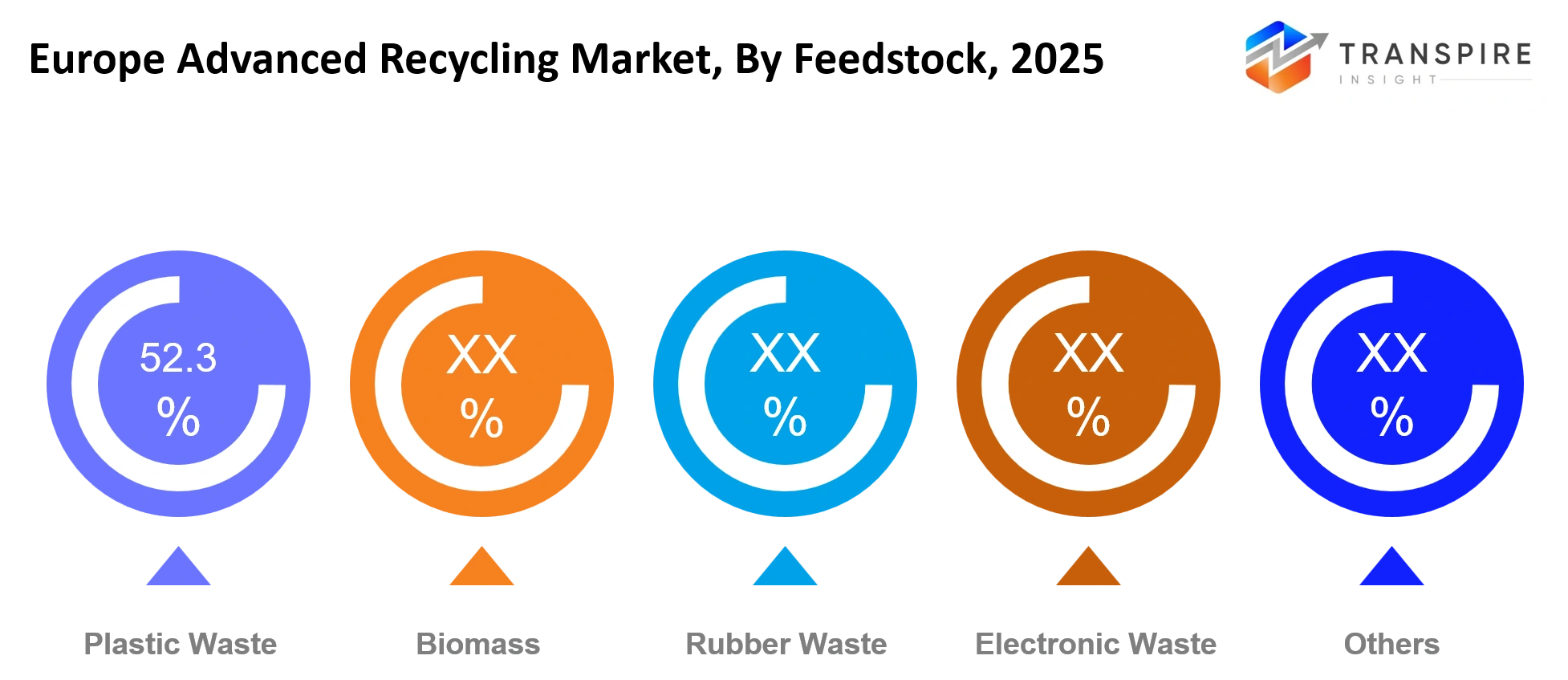
Plastic waste is the material used in the Europe Advanced Recycling Market. This is because municipal collection systems and industrial recovery programs are expanding.Biomass and rubber waste are being used more as industries look for raw materials.Electronic waste processing is also increasing due to EU regulations and demand for materials.Using feedstocks makes the supply chain more stable. This helps advanced recycling capacity grow in Europe.
By Product
The Europe Advanced Recycling Market produces monomers, fuels and recycled polymers.Recycled polymers are in demand because packaging and automotive sectors want sustainable materials.Monomer recovery is growing because chemical recycling is becoming more efficient.Industries prefer chemical-grade outputs over fuel applications. They want closed-loop material systems.
By End User
Packaging needs are driving the Europe Advanced Recycling Market. This is because of recycled content rules and corporate sustainability goals.The automotive and construction sectors are using recycled materials.Electronics adoption is slower but increasing as material compliance requirements get stricter.End-user adoption is growing as certification systems and traceability frameworks improve recycling credibility.
By Process
Chemical recycling is leading the change in the Europe Advanced Recycling Market. Industries are moving away from landfill and incineration.Mechanical recycling is still used for cost efficiency and scalability.Process innovation is improving yield quality and operational efficiency.Technology convergence is supporting large-scale deployment of recycling infrastructure.
By Distribution Channel
Direct sales are dominant in the Europe Advanced Recycling Market. This is because of long-term contracts between recyclers and chemical producers.These agreements ensure a feedstock supply and predictable revenue streams.Secondary distribution channels are growing gradually through partnerships and waste management networks.
Integrated supply systems are replacing procurement models, in Europes recycling ecosystem.
What are the Key Use Cases Driving the Europe Advanced Recycling Market?
The Europe Advanced Recycling Market is really taking off because people are finding ways to turn old plastic into something useful. This is especially true for companies that make packaging because they need to follow rules about using recycled materials. These companies need quality recycled materials all the time so they are driving the demand for advanced recycling.Some new ways of recycling like pyrolysis and depolymerization are helping with this. These methods can handle plastic that other recycling methods cannot which means we can recycle more things and get more consistent results.
People are finding uses for recycled materials like making car parts and building materials. Car makers want to use materials to reduce emissions and make their cars more environmentally friendly. Construction companies are using recycled materials in buildings, which's good for the environment and also helps them meet new sustainability standards in Europe.There are more new ways that recycled materials can be used, like making food packaging and electronic components. As technology gets better and rules change we will see more of these uses for recycled materials. Some companies are already trying out ways of recycling and reusing materials, which could lead to big changes, in the future.
|
Report Metrics |
Details |
|
Market size value in 2025 |
USD 5.62 Billion |
|
Market size value in 2026 |
USD 6.19 Billion |
|
Revenue forecast in 2033 |
USD 12.23 Billion |
|
Growth rate |
CAGR of 10.22% from 2026 to 2033 |
|
Base year |
2025 |
|
Historical data |
2021 - 2024 |
|
Forecast period |
2026 - 2033 |
|
Report coverage |
Revenue forecast, competitive landscape, growth factors, and trends |
|
Regional scope |
Europe |
|
Key company profiled |
BASF, SABIC, Dow, Plastic Energy, Quantafuel, Agilyx, Veolia, Suez, Eastman Chemical, Loop Industries, OMV, Neste, LyondellBasell, TotalEnergies, Brightmark. |
|
Customization scope |
Free report customization (country, regional & segment scope). Avail customized purchase options to meet your exact research needs. |
|
Report Segmentation |
By Technology (Pyrolysis, Gasification, Solvolysis, Depolymerization, Dissolution, Others); By Feedstock (Plastic Waste, Biomass, Rubber Waste, Electronic Waste, Others); By Product (Monomers, Fuels, Chemicals, Recycled Polymers, Others); By End User (Packaging, Automotive, Construction, Electronics, Others); By Process (Chemical Recycling, Mechanical Recycling Integration, Others); By Distribution Channel (Direct Sales, Others). |
Which Regions are Driving the Europe Advanced Recycling Market Growth?
Western Europe leads the Europe Advanced Recycling Market due to strong regulatory enforcement and early adoption of circular economy policies. Countries such as Germany, France, and the Netherlands have established advanced waste collection systems and large-scale chemical recycling infrastructure. Strict recycled content mandates and extended producer responsibility rules accelerate investment from packaging and petrochemical industries. A mature industrial ecosystem and strong collaboration between waste processors and chemical manufacturers further support continuous technology deployment and capacity expansion.
Northern and Southern Europe form the second key regional contributor, supported by stable industrial demand and gradual regulatory alignment. Northern Europe benefits from consistent sustainability investments from large manufacturing and consumer goods companies, ensuring steady feedstock supply and recycling output demand. Southern Europe, particularly Spain and Italy, shows balanced growth driven by improving waste management systems and expanding industrial recycling partnerships. Unlike Western Europe, growth here is more infrastructure-led than regulation-heavy, creating a stable but slower scaling environment.
Eastern Europe represents the fastest-growing region due to recent infrastructure investments and rising alignment with EU waste directives. New recycling facilities and foreign direct investment are improving processing capacity across Poland, Hungary, and Czech Republic. Lower operational costs and increasing industrial collaboration are accelerating project deployment. This rapid expansion signals strong entry opportunities for investors focusing on long-term capacity building from 2026 to 2033.
Who are the Key Players in the Europe Advanced Recycling Market and How Do They Compete?
Competition in the Europe Advanced Recycling Market remains moderately fragmented, with a mix of large chemical producers and specialized recycling technology firms. Incumbent petrochemical companies focus on integrating recycling into existing production chains, while newer entrants introduce niche technologies for chemical conversion of waste streams. Competition is increasingly driven by technology efficiency, feedstock access, and long-term supply agreements rather than price alone. Firms that secure stable waste streams and achieve higher yield conversion rates gain stronger positioning as regulatory pressure increases across Europe.
BASF focuses on technology integration by scaling chemical recycling units within its existing production network, allowing tighter control over recycled polymer quality and output consistency. The company strengthens its advantage through partnerships with waste management firms that secure long-term feedstock supply. Dow emphasizes collaborative recycling projects with converters and brand owners, differentiating through product certification capabilities that ensure recycled outputs meet packaging-grade standards. Expansion efforts focus on pilot-to-commercial scaling across Western Europe.
Neste builds its competitive edge through advanced liquefaction technology that converts mixed plastic waste into refinery-ready feedstock. The company expands through joint ventures that increase processing capacity and strengthen access to industrial waste streams. LyondellBasell focuses on mechanical and chemical hybrid recycling solutions, differentiating through flexible processing systems that handle diverse feedstock types. Expansion continues through acquisitions and new facility development across strategic European industrial hubs.
Company List
- BASF
- SABIC
- Dow
- Plastic Energy
- Quantafuel
- Agilyx
- Veolia
- Suez
- Eastman Chemical
- Loop Industries
- OMV
- Neste
- LyondellBasell
- TotalEnergies
- Brightmark
Recent Development News
In January 2026, BASF expanded its chemical recycling operations by increasing the procurement of pyrolysis oil under ISCC PLUS-certified supply chains. This development strengthens circular feedstock integration and enhances recycled polymer output for packaging and industrial applications.
Source: https://report.basf.com
In March 2026, Eastman Chemical advanced its molecular recycling strategy by scaling partnerships with waste management operators to secure consistent plastic waste feedstock supply. This initiative improves operational stability for polyester renewal technology and increases production capacity for high-quality recycled materials.
Source: https://www.snsinsider.com
In February 2026, LyondellBasell expanded its advanced recycling footprint through additional commercial-scale deployment of chemical recycling units in Europe. This expansion improves mixed plastic waste processing capacity and strengthens circular economy output for downstream chemical manufacturing.
Source: https://www.lyondellbasell.com
What Strategic Insights Define the Future of the Europe Advanced Recycling Market?
The Europe Advanced Recycling Market is structurally moving toward integrated circular feedstock systems where chemical recycling becomes embedded within large-scale petrochemical and packaging supply chains. Over the next 5–7 years, growth will be driven by tightening EU recycled content mandates and increasing industrial demand for high-purity recycled polymers. This shift will reduce reliance on virgin fossil-based inputs and push producers toward long-term feedstock security agreements and vertically integrated recycling models.
A less obvious risk lies in feedstock fragmentation and collection inefficiencies, where inconsistent waste quality limits operational efficiency of chemical recycling plants. Even with strong demand signals, variability in input material can suppress yield rates and increase production costs, creating financial pressure on large-scale facilities. This structural constraint cannot be resolved quickly due to uneven waste infrastructure across European regions.
A key emerging opportunity is the development of AI-enabled sorting and molecular recycling optimization systems that improve feedstock purity and conversion efficiency. Northern and Eastern Europe are becoming early testing grounds for these technologies due to new infrastructure investments. Market participants should prioritize long-term partnerships with waste aggregators and invest in scalable pre-processing technologies to secure competitive advantage as capacity expansion accelerates through 2033.
Europe Advanced Recycling Market Report Segmentation
By Technology
- Pyrolysis
- Gasification
- Solvolysis
- Depolymerization
- Dissolution
- Others
By Feedstock
- Plastic Waste
- Biomass
- Rubber Waste
- Electronic Waste
- Others
By Product
- Monomers
- Fuels
- Chemicals
- Recycled Polymers
- Others
By End User
- Packaging
- Automotive
- Construction
- Electronics
- Others
By Process
- Chemical Recycling
- Mechanical Recycling Integration
- Others
By Distribution Channel
- Direct Sales
- Others
Frequently Asked Questions
Find quick answers to common questions.
The expected Europe Advanced Recycling Market size for the market will be USD 12.23 Billion in 2033.
Key segments for the Europe Advanced Recycling Market are By Technology (Pyrolysis, Gasification, Solvolysis, Depolymerization, Dissolution, Others); By Feedstock (Plastic Waste, Biomass, Rubber Waste, Electronic Waste, Others); By Product (Monomers, Fuels, Chemicals, Recycled Polymers, Others); By End User (Packaging, Automotive, Construction, Electronics, Others); By Process (Chemical Recycling, Mechanical Recycling Integration, Others); By Distribution Channel (Direct Sales, Others).
Major Europe Advanced Recycling Market players are BASF, SABIC, Dow, Plastic Energy, Quantafuel, Agilyx, Veolia, Suez, Eastman Chemical, Loop Industries, OMV, Neste, LyondellBasell, TotalEnergies, Brightmark.
The Europe Advanced Recycling Market size is USD 5.62 Billion in 2025.
The Europe Advanced Recycling Market CAGR is 10.22% from 2026 to 2033.
- BASF
- SABIC
- Dow
- Plastic Energy
- Quantafuel
- Agilyx
- Veolia
- Suez
- Eastman Chemical
- Loop Industries
- OMV
- Neste
- LyondellBasell
- TotalEnergies
- Brightmark
About the Authors

Pankaj Ghogare Patil
I am Pankaj Ghogare Patil, a Senior Research Analyst at Transpire Insight, specializing in the Pharmaceutical, Chemicals & Materials, Healthcare IT, and Biotechnology industry. My expertise lies in conducting comprehensive market research, analyzing industry trends, evaluating competitive landscapes, and translating complex data into actionable insights. At Transpire Insight, I closely follow emerging technologies, regulatory developments, and market innovations to create accurate, well-researched, and informative content that helps businesses and professionals make informed decisions. I am committed to producing credible, evidence-based articles that reflect industry best practices while making technical topics accessible and valuable for a broad audience.

Chakradhar Khansole
Chakradhar serves as the Research Director at Transpire Insight, bringing over 8 years of experience in technology, innovation, and strategic market intelligence. He specializes in transforming complex market data into actionable business insights that enable organizations to make informed, growth-oriented decisions. Recognized for his strategic vision and analytical expertise, Chakradhar leads high-impact research initiatives, delivering comprehensive market assessments, competitive intelligence, and forward-looking industry analysis.
Recently Published Reports
-
May 2026
Healthcare Polymer Packaging Market
Healthcare Polymer Packaging Market Size, Share & Analysis Report By Packaging Type (Syringes, IV Bottles and Pouches, Clamshells, Blisters, Bottles & Jars, Containers, Tubes, IV Parental Packaging, Others), By Type (Regulated, Non-regulated), By Polymer Type (LDPE (Low-Density Polyethylene), HDPE (High-Density Polyethylene), Homo-polymer (Homo), Random Copolymer (Random), Block Copolymer (Block), PET, Polystyrene, Polyvinyl Chloride, Polyamide/EVOH, Others), and Geography (North America, Europe, Asia-Pacific, Middle East and Africa, South and Central America), 2021 - 2031
-
Apr 2026
Hydrophilic Tape (Waterstop) Market
Hydrophilic Tape (Waterstop) Market Size, Share & Analysis Report By Type (Bentonite-Based Hydrophilic Tape, Rubber-Based Hydrophilic Tape), By Application (Residential Buildings, Commercial Buildings, Infrastructure Projects), and Geography (North America, Europe, Asia-Pacific, Middle East and Africa, South and Central America), 2021 - 2031
-
Apr 2026
Metalens Market
Metalens Market Size, Share & Analysis Report By Type (Visible Light Metalens, and Infrared Metalens), By Application (Consumer Electronics, Automotive Electronics, Industrial, Medical, and Others), and Geography (North America, Europe, Asia-Pacific, Middle East and Africa, South and Central America), 2021 - 2031
-
Apr 2026
PBT Resin Market
PBT Resin Market Size, Share & Analysis Report By Type (Reinforced PBT Resin, Unreinforced PBT Resin), By Processing Method (Injection Molding, Extrusion, Blow Molding, Others), By End-User (Automotive, Electrical & Electronics, Consumer Appliances, Industrial Machinery, Medical Devices, Packaging, Others), and Geography (North America, Europe, Asia-Pacific, Middle East and Africa, South and Central America), 2021 - 2031