
Endpoint Detection and Response (EDR) Market Summary:
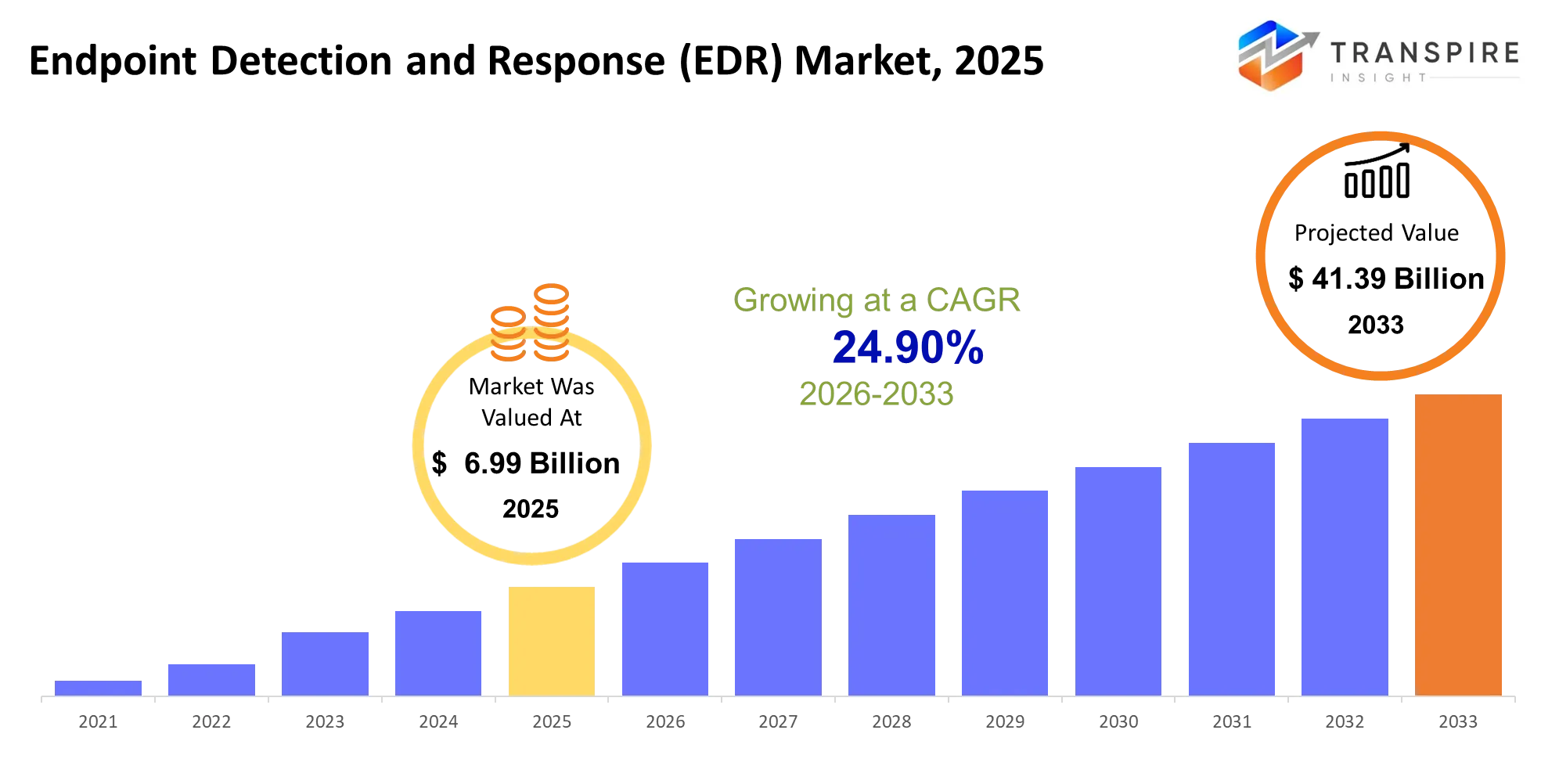
As per the Transpire Insight analysis, The Endpoint Detection and Response (EDR) Market size is estimated at USD 6.99 billion in 2025 and is anticipated to reach USD 41.39 billion by 2033, growing at a CAGR of 24.90% from 2026 to 2033.
The Endpoint Detection and Response (EDR) market helps companies detect and remediate exploits on laptops, servers, mobile devices, and cloud workloads before users are impacted. Its value rests in its ability to help identify ransomware, credential theft, and fileless attacks commonly missed by traditional antivirus software. EDR has advanced from being an endpoint-only product five years ago to a cloud-delivered, AI-enabled add-on for identity, network, and cloud telemetry in the form of Extended Detection and Response (XDR). A major structural evolution involves a shift to zero-trust security, where constant endpoint verification is no longer a feature but a requirement. The push to zero-trust security has been accelerated by the commercialisation of ransomware-as-a-service, which has rendered sophisticated attacks affordable for unsophisticated criminals. As intrusions have become increasingly automated, enterprises buy EDR tools to shorten detection times, reduce the impact of breaches, and adhere to incident reporting obligations under the Network and Information Systems Directive 2 (NIS2).
Endpoint Detection and Response (EDR) Market Size & Forecast:
- Market Size 2025: USD 6.99 Billion
- Expected Market Value (2033): USD 41.39 Billion
- Forecast CAGR (2026-2033): 24.90%
- Leading Region in 2025: North America
- Fastest Growing Region: Asia Pacific
- Key Company Profiles: CrowdStrike, SentinelOne, Microsoft, Palo Alto Networks, Trellix, Sophos, Broadcom, Cisco, Trend Micro, VMware, Check Point, Fortinet, Bitdefender, Cybereason, Secureworks.
Key Endpoint Detection and Response (EDR) Market Insights:
The focus of EDR is moving from detecting endpoint malware to providing all-in-one security solutions with behavioural analytics, automated response, and AI-agent monitoring and control.
Regional leadership is based on proven security investment, and the future of growth will rely on cloud adoption, ease of use, and security for new digital workloads.
- Threat detection accounts for 41.0% of market share, and CrowdStrike is rolling out Falcon to identity protection, attack-surface management, and AI-agent governance.
- Cloud-based EDR is expected to expand at 28.1% CAGR, driven by SentinelOne's agentic Purple AI Auto Investigation and Purple AI Agent Security for generative-AI environments.
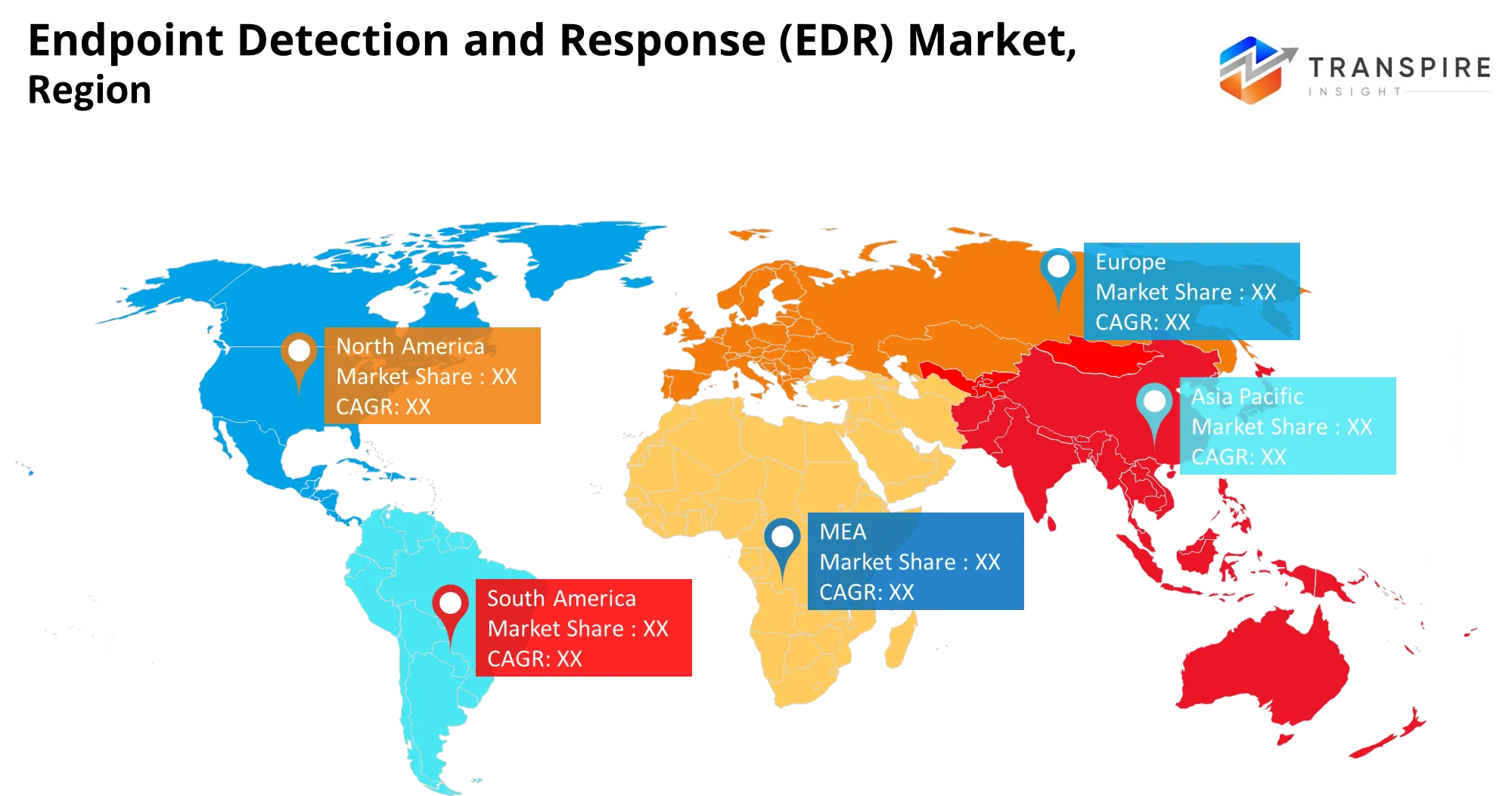
- Microsoft differentiates in North America with Defender, Entra, Sentinel, and Copilot integration in Windows estates, identity estates, and productivity estates, accounting for 38.0% of demand.
- Asia Pacific is the largest segment, representing 28.0% of the market, and Palo Alto Networks is bringing endpoint, cloud, browser, and AI-security controls together under the Cortex and Prisma banner.
- 26.0% comes from Europe, where Trellix and Sophos aim to win compliance-driven customers with endpoint portfolios and managed detection services.
- In Latin America, the market share is 4.5%, with channel-led vendors, like Fortinet, Check Point, and Trend Micro, competing in a bundled security ecosystem; while in the Middle East & Africa, it is 3.5%.
- Broadcom is using VMware and Symantec assets to go after enterprise consolidation; Cisco is focusing on network-to-endpoint correlation.
- While Bitdefender and Cybereason are dedicated to specialized detection innovation, Secureworks is dedicated to managed detection and response for resource-constrained security teams.
- The message from the behavioural movement is loud and clear: fewer agents, a single console, and AI-powered triage are preferred by buyers over endpoint tools.
What are the Key Drivers, Restraints, and Opportunities in the Endpoint Detection and Response (EDR) Market?
Driver:
Ransomware, credential theft, and fileless attacks are pushing organizations beyond conventional antivirus protection toward continuous endpoint telemetry and rapid containment. The expansion of hybrid work and cloud-connected devices has created more pathways for attackers, making behavioral detection and centralized investigation operational priorities. Regulatory obligations, including the European Union’s NIS2 incident-reporting framework, further encourage affected organizations to improve incident visibility and response readiness. These requirements support adoption of advanced endpoint controls and integrated security platforms.
Restraint:
Deployment complexity remains a major constraint. EDR platforms generate large volumes of telemetry, require continuous tuning, and must integrate with legacy systems, cloud workloads, and identity tools. The problem persists because security teams face budget limits, integration challenges, and a shortage of analysts capable of interpreting alerts; in SMBs, budget constraints, complexity, and skills gaps are leading barriers to faster cybersecurity improvement.
Opportunity:
Cloud-native EDR, managed detection and response, and AI-assisted investigations offer vendors opportunities to reach resource-constrained organisations. For example, automated investigation capabilities can correlate related alerts, examine suspicious files, and quarantine malicious artefacts, reducing repetitive analyst work. Providers that combine transparent pricing, explainable detection, identity context, and support for cloud and mobile endpoints can expand adoption across SMEs, healthcare providers, manufacturers, and digitally transforming businesses.
Driver Impact Analysis - Endpoint Detection and Response (EDR) Market
|
Driver |
Relative Impact on Growth (%) |
Geographic Relevance |
Impact Timeline |
Demand Strength |
Growth Mechanism |
Key Beneficiaries |
Major Constraint |
|
Rising ransomware attacks and advanced persistent threats (APTs) |
30% |
North America, Europe, Asia-Pacific |
Short-term (≤2 years) |
High |
Detects malicious behavior and enables rapid endpoint isolation. |
EDR vendors, MDR providers, enterprise security teams. |
EDR evasion techniques and sophisticated attacker tactics. |
|
AI-powered threat detection and automated incident response |
23% |
North America, Europe, Asia-Pacific |
Medium-term (2-4 years) |
High |
Uses behavioral analytics to identify threats and automate containment. |
AI security vendors, EDR manufacturers, security operations centers. |
False positives, model limitations, and integration complexity. |
|
Regulatory compliance and government cybersecurity initiatives |
18% |
North America, Europe, Asia-Pacific |
Short-term (≤2 years) |
High |
Strengthens endpoint monitoring, auditability, and incident response compliance. |
Compliance-focused vendors, government agencies, cybersecurity service providers. |
Budget limitations and differing regional compliance requirements. |
|
Cloud adoption, remote work, and expanding endpoint attack surfaces |
16% |
North America, Asia-Pacific, Europe |
Medium-term (2-4 years) |
High |
Extends endpoint visibility across distributed and cloud-connected devices. |
Cloud EDR vendors, managed security providers, distributed enterprises. |
Legacy infrastructure and endpoint deployment complexity. |
|
EDR integration with XDR, zero-trust architectures, and managed security services |
13% |
North America, Europe, Middle East |
Long-term (≥4 years) |
High |
Unifies endpoint telemetry with identity and cross-platform threat intelligence. |
XDR vendors, MSSPs, cloud security providers, enterprise users. |
Vendor lock-in, skills shortages, and platform integration costs. |
|
Total |
100% |
— |
— |
— |
— |
— |
— |
What Has the Impact of Artificial Intelligence Been on the Endpoint Detection and Response (EDR) Market?
AI evolves EDR into a decision layer above mere detection. AI models add autonomous process behaviour, file-encryption activity, registry changes, and logon anomalies to detect ransomware and fileless attacks without relying solely on known signatures. AI automates Tier-1 investigations by grouping related alerts, enriching them with threat intelligence, recommending containment actions, and firing playbooks to isolate devices and shut off access. It lightens SOC analysts' load and accelerates EDR response times.
Predictive models trained on vast datasets of endpoint telemetry are already becoming a reality, helping teams spot signs of lateral movement or credential abuse. Vendors are also building out AI-assisted threat hunting, automated rollback, and XDR correlations spanning endpoint, cloud, identity, and network signals. At the same time, AI doesn't entirely substitute for the human analysts' sharp eye. Poorly configured models can result in an avalanche of alerts; false positives sap analyst time and contribute to alert fatigue. Integration costs, model fine-tuning, and potential adversarial interference limit the proliferation of AI, especially for organisations that have yet to integrate their disparate security tools.
In October 2026, SentinelOne launched Singularity Agentic Detection and Response (ADR) to discover and monitor corporate AI agents in real time. This product allows security teams to track what an AI agent was instructed to do versus its actual actions, providing the capability to halt a malicious agent mid-action without interrupting surrounding endpoint workflows. https://in.investing.com/news/stock-market-news/sentinelone-launches-ai-agent-security-products-at-onecon-2026-93CH-5645611
Key Endpoint Detection and Response (EDR) Market Trends:
EDR is moving beyond endpoint control to an automated security operations capability. The quality of investigations, response times, and visibility into the distributed infrastructure are becoming critical competitive differentiators.
- Endpoint security is shifting from signature-based antivirus to the ability to identify ransomware, process injection, and credential misuse in real time using behavioural analytics.
- EDR is merging with XDR, which is combining endpoint signals with cloud, network, identity, and application telemetry to uncover multi-stage attacks.
- As businesses put greater emphasis on fast deployment, remote employee support, and scalable updates, cloud-native delivery is taking the place of on-premises deployments.
- Managed EDR is growing because of SMEs' lack of security staff and need to outsource alert triage, monitoring, and incident escalation.
- The use of AI-driven triage is streamlining manual investigation by matching alerts, prioritising risks and triggering automated containment processes.
- Continuous endpoint validation is becoming a compliance and architecture requirement, rather than a security preference, as more organisations adopt zero trust.
- NIS2, SEC disclosure requirements and cyber-insurance mandates are making firms respond and react quickly.
- Ransomware-as-a-service is influencing the buyer's mindset and driving more demand for rollback, isolation and sub-hour containment.
- The endpoint perimeter is growing with the proliferation of IoT, virtual machines, and cloud workloads, and EDR needs to extend beyond the traditional endpoint of laptops and servers.
Endpoint Detection and Response (EDR) Market Segmentation
Component:
Solutions form the foundation of the EDR market by providing endpoint telemetry, threat detection, investigation, and containment capabilities. Services support deployment, configuration, optimisation, and ongoing security operations. Managed EDR enables organisations without dedicated security operations centres to access continuous monitoring and expert incident response. Professional services, consulting, implementation, training, and technical support improve integration with existing IT infrastructure. As security environments become more complex, buyers increasingly prioritise measurable protection outcomes, operational efficiency, and sustained expertise over standalone software deployment.
Point of Sale:
Workstations and laptops remain important EDR endpoints because employees use them for business applications, remote access, and communication. Servers require protection against privilege escalation, unauthorized access, and lateral movement across corporate networks. Cloud systems and virtual machines need scalable monitoring as workloads become more distributed. Mobile devices introduce risks through remote connectivity, while IoT devices expand the attack surface in manufacturing and healthcare. These differences are encouraging vendors to develop endpoint visibility and response capabilities suited to diverse device environments.
Deployment:
Cloud-based EDR is projected to grow at a 28.1% CAGR, supported by centralised administration, faster updates, and protection for geographically distributed endpoints. On-premises deployments remain relevant for organisations requiring greater infrastructure control and customised security policies. Hybrid models balance local data handling with cloud-based analytics, while SaaS and hosted services simplify deployment. Private and public cloud configurations address different governance requirements, whereas edge deployment supports distributed environments requiring timely threat detection and response.
Application:
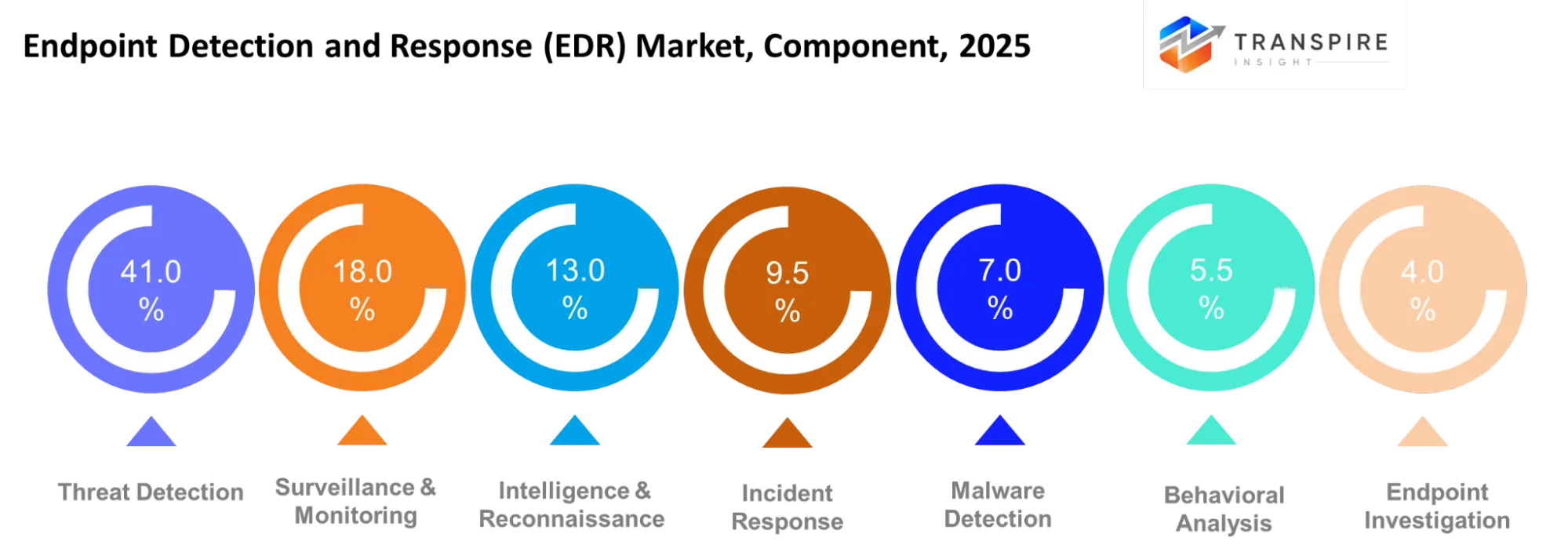
Threat detection represents the largest segment, at 41.0%, as organisations place significant value on identifying suspicious activity before a major security incident occurs. Surveillance and monitoring accounts for 18.0%, followed by intelligence and reconnaissance with 13.0%. Incident response accounts for 9.5%, malware detection 7.0%, behavioural analysis 5.5%, endpoint investigation 4.0%, and other applications 2.0%. Overall, these applications collectively enable continual monitoring, the identification of threats, forensic investigation, and containment of malicious activity. When combined, they help organisations correlate suspicious activity, accelerate decision-making around managing incidents, provide a reduction of disruption to operations and heighten the resilience of the organization's infrastructure against sophisticated attacks.
End User:
BFSI organizations prioritize endpoint protection to safeguard financial transactions, customer information, and privileged access. Government agencies require visibility across sensitive systems and stronger incident documentation. Healthcare providers focus on protecting patient records and maintaining clinical-system availability, where disruptions can affect essential services. Telecom operators secure distributed infrastructure, while retailers protect payment systems and customer data. Manufacturers need controls for connected production environments, and IT companies and educational institutions must manage diverse devices, users, and access privileges across increasingly distributed digital environments.
Organization Size:
Large enterprises and multinational corporations require centralised endpoint policies, consistent threat visibility, and coordinated incident response across multiple locations. Mid-sized enterprises seek scalable protection that accommodates expanding IT infrastructure without creating excessive administrative workloads. SMEs and startups often favour managed EDR services because they lack dedicated security operations teams and extensive cybersecurity budgets. Government agencies need governance, accountability, and appropriate access controls, while critical infrastructure operators prioritise operational continuity and rapid containment. Flexible licensing, simplified deployment, and automation can help providers address these differing organisational requirements.
What are the Key Use Cases Driving the Endpoint Detection and Response (EDR) Market?
The major use case is early threat detection and containment, which accounts for 41.0% of the application segment. EDR can detect suspicious processes, unauthorised access, and ransomware activity, allowing security teams to quarantine infected endpoints before they can be propagated throughout enterprise systems.
The applications are expanding to include threat hunting, malware investigation, and continuous monitoring in the BFSI, healthcare, government, and manufacturing sectors. These areas rely on endpoint evidence to uncover breaches, safeguard sensitive data, and reduce downtime. Cloud-based EDR empowers distributed teams and virtual infrastructure, enhancing centralised security management.
New use cases include monitoring of AI workflows, mobile and IoT endpoint protection, and identity signal correlation with endpoint activity. Managed EDR also provides SMEs with round-the-clock monitoring and incident-response expertise without the need to have an on-site SOC.
|
Report Metrics |
Details |
|
Market size value in 2025 |
USD 6.99 Billion |
|
Market size value in 2026 |
USD 8.73 Billion |
|
Revenue forecast in 2033 |
USD 41.39 Billion |
|
Growth rate |
CAGR of 24.90% from 2026 to 2033 |
|
Base year |
2025 |
|
Historical data |
2021 - 2024 |
|
Forecast period |
2026 - 2033 |
|
Report coverage |
Revenue forecast, competitive landscape, growth factors, and trends |
|
Regional scope |
United States; Canada; Mexico; United Kingdom; Germany; France; Italy; Spain; Denmark; Sweden; Norway; China; Japan; India; Australia; South Korea; Thailand; Brazil; Argentina; South Africa; Saudi Arabia; United Arab Emirates |
|
Key companies profiled |
CrowdStrike, SentinelOne, Microsoft, Palo Alto Networks, Trellix, Sophos, Broadcom, Cisco, Trend Micro, VMware, Check Point, Fortinet, Bitdefender, Cybereason, Secureworks |
|
Customization scope |
Free report customization (country, regional & segment scope). Available customized purchase options to meet your exact research needs. |
|
Report Segmentation |
Component (Solutions, Services, Managed EDR, Professional Services, Consulting, Implementation, Training, Support)Point of Sale (Workstation, Laptop, Server, Cloud System, Mobile Device, IoT Device, Virtual Machine, Others)Deployment (Cloud-Based, On-Premise, Hybrid, SaaS, Hosted, Private Cloud, Public Cloud, Edge)Application (Threat Detection, Threat Hunting, Incident Response, Surveillance & Monitoring, Intelligence & Reconnaissance, Malware Detection, Behavioral Analysis, Others)End User (BFSI, Government, Telecom, Healthcare, Retail, Manufacturing, IT & Telecom, Education)Organization Size (Large Enterprises, SMEs, Government Agencies, Startups, Mid-Sized Enterprises, Multinational Corporations, Critical Infrastructure, Others). |
Which Regions are Driving the Endpoint Detection and Response (EDR) Market Growth?
North America is the largest market for EDR with a 38.0% share ly. The presence of large enterprises, ransomware incidents, and compliance requirements in financial services, healthcare, and defence contracting are some of the factors boosting demand for Endpoint Detection and Response (EDR). North America has a mature cloud infrastructure, high cyber budgets, and adoption of AI-supported security operations at an early stage. This region's market is also driven by incident reporting and a show of quick containment skills.
In October 2026, CrowdStrike expanded its strategic collaboration with NVIDIA to integrate its Falcon Guardian AI Detection and Response (AIDR) solution with NVIDIA OpenShell secure runtime software and NVIDIA Sentry. This integration extends advanced enterprise protection and autonomous AI threat detection from software layers directly down to hardware-based, silicon-level policy enforcement across critical workloads. https://ir.crowdstrike.com/news-releases/news-release-details/crowdstrike-and-nvidia-expand-ai-agent-security-software-silicon
Europe represents 26.0% and takes a more regulation-focused stance than North America. European Union NIS2 Directive, when combined with the General Data Protection Regulation (GDPR) and sector-specific regulations, is motivating operators of critical infrastructure and other essential services to deploy Endpoint Detection and Response and managed detection services to demonstrate operational resilience. While the intensity of spend is not as high as in North America, Europe can offer a measure of stability with institutional requirements for regulatory compliance, mature managed security providers, and sustained public sector spending.
In March 2026, cybersecurity provider CrowdStrike partnered with European IT infrastructure provider Schwarz Digits to deploy the AI-native CrowdStrike Falcon platform on the EU-operated STACKIT cloud infrastructure. This deployment keeps sensitive telemetry and detection data completely within the European region, providing critical infrastructure operators with sovereignty. https://q-sec.com/en/mdr-knowledge-base/best-mdr-services-europe
Asia Pacific is the fastest-growing region with a 26.1% compound annual growth rate and contributes 28.0% of the market share. The emerging digital transformation in China, Japan, India, and Australia, across the financial services, manufacturing, government, and technology industries, will extend the endpoint attack surface immensely. The future market opportunity will be cloud-native Endpoint Detection and Response, managed services for small and medium-sized organisations, and data residency, as organisations are looking to modernise their security architectures without building larger internal Security Operations Centers (SOCs).
In August 2026, NTT DATA and Palo Alto Networks signed a multi-year strategic alliance to accelerate AI-driven cybersecurity transformation across markets, including the Asia-Pacific region. https://www.paloaltonetworks.in/company/press/2026/ntt-data-and-palo-alto-networks-sign--strategic-alliance-to-accelerate-secure-ai-transformation
Who are the Key Players in the Endpoint Detection and Response (EDR) Market, and how do they compete?
The competition in EDR has moved past detection accuracy into breadth of platform, automation with artificial intelligence, and delivery of managed services. Vendors are trying to reduce the number of security agents, relate endpoint signals to those from identity and cloud, and close the gap from alert to containment.
CrowdStrike has a growth-by-innovation approach to driving revenue from endpoint to identity, cloud, data, browser, and AI-agent security, driven by the Falcon platform. Its differentiation comes from one lightweight agent, a broad telemetry platform, and growing through acquisitions as well as cross-selling into adjacent security areas. SentinelOne has an AI-native automation approach to growing with Purple AI investigations and adding new capabilities to protect generic-AI agents. Its differentiator is autonomous response, with growth through cloud, MSSP, and channel. Microsoft's cost-and-ecosystem strategy involves including Defender with Windows, Entra, Azure, Sentinel, and M365 to create high switching costs and exclusivity. Palo Alto Networks uses platformization by connecting Cortex endpoint enforcement with its cloud, network, and AI-security suite. Trellix, Sophos, Broadcom, Cisco, Trend Micro, Check Point and Fortinet leverage channel reach and integrated portfolios. Bitdefender, Cybereason and Secureworks differentiate with detection, threat intelligence and managed detection, respectively.
Key Players are:
- CrowdStrike
- SentinelOne
- Microsoft
- Palo Alto Networks
- Trellix
- Sophos
- Broadcom
- Cisco
- Trend Micro
- Vmware
- Check Point
- Fortinet
- Bitdefender
- Cybereason
- Secureworks
Endpoint Detection and Response (EDR) Market — Enhanced Competitive Benchmarking
|
Company |
Est. Revenue Share Range |
Key Offerings |
Strategic Positioning |
Geographic Strength |
Technology Focus |
|
CrowdStrike |
Estimated 14-20% |
Falcon Insight XDR; Falcon Prevent; Falcon Complete MDR |
Premium cloud-native endpoint security leadership |
North America, Europe, Asia Pacific |
AI-native detection, threat intelligence, automated response |
|
Microsoft |
Estimated 14-20% |
Defender for Endpoint; Defender XDR; Defender for Business |
Ecosystem-led adoption and enterprise platform integration |
North America, Europe, Asia Pacific |
Cloud analytics, behavioral detection, cross-domain correlation |
|
SentinelOne |
Estimated 8-13% |
Singularity Endpoint; Singularity XDR; Purple AI |
AI-led automation and autonomous endpoint response |
North America, Europe, Asia Pacific |
Autonomous remediation, AI threat hunting, single-agent architecture |
|
Palo Alto Networks |
Estimated 7-12% |
Cortex XDR; Cortex XSIAM; Cortex XDR Pro |
Cross-domain security platform differentiation |
North America, Europe, Asia Pacific |
Endpoint-network analytics, behavioral AI, automated investigation |
|
Trend Micro (TrendAI) |
Estimated 6-10% |
Trend Vision One; endpoint security; server and workload protection |
Broad workload coverage and integrated XDR |
Asia Pacific, North America, Europe |
Cross-layer telemetry, threat intelligence, risk-based detection |
|
Sophos |
Estimated 3-7% |
Intercept X; Sophos XDR; Sophos MDR |
Managed security and channel-partner differentiation |
Europe, North America, Asia Pacific |
Deep learning, exploit prevention, analyst-assisted response |
|
Broadcom (Symantec) |
Estimated 3-7% |
Symantec Endpoint Security; Endpoint Detection and Response; Adaptive Protection |
Enterprise installed-base and endpoint policy strength |
North America, Europe, Asia Pacific |
Endpoint hardening, threat intelligence, behavior-based protection |
|
Bitdefender |
Estimated 2-5% |
GravityZone EDR; GravityZone XDR; MDR services |
Prevention-led value and security efficacy |
Europe, North America, Asia Pacific |
Machine learning, behavioural analytics, attack-chain investigation |
|
Cisco |
Estimated 2-5% |
Cisco Secure Endpoint; Cisco XDR; Secure Malware Analytics |
Network-security ecosystem and cross-product integration |
North America, Europe, Asia Pacific |
Endpoint-network correlation, threat intelligence, automated containment |
|
Trellix |
Estimated 2-5% |
Trellix Endpoint Security; Trellix EDR; Trellix XDR |
Large-enterprise threat defence and heterogeneous estate support |
North America, Europe, Asia Pacific |
Behavioural analytics, threat intelligence, adaptive detection |
Recent Development News
- In August 2026, SonicWall launched SonicWall Endpoint Security, a unified endpoint protection solution offering standalone EDR and optional managed detection and response services for managed service providers serving small and medium-sized businesses. The launch expands access to automated threat response, real-time threat detection, and ransomware recovery capabilities for organisations seeking cost-effective endpoint security.https://www.prnewswire.com/news-releases/sonicwall-expands-msp-portfolio-with-simplified-endpoint-protection-302847876.html
- In April 2026, Palo Alto Networks completed its acquisition of Koi to strengthen endpoint protection against risks associated with AI agents and autonomous development tools. The acquisition supports the development of Agentic Endpoint Security by integrating Koi's technology with Prisma AIRS, helping enterprises improve visibility and control over AI-driven activity across employee endpoints.https://www.prnewswire.com/news-releases/palo-alto-networks-completes-acquisition-of-koi-to-secure-the-agentic-endpoint-302741432.html
- In October 2026, Canon Europe launched its pioneering Printer EDR technology, extending traditional computer and server endpoint security methodologies into the commercial printing infrastructure. This deployment introduces behavioural tracking aligned with the MITRE ATT&CK framework directly into multifunction printer firmware, allowing corporate networks to automatically isolate endpoint vulnerabilities and intercept internal threats before lateral data breaches occur.https://www.canon-europe.com/press-centre/press-releases/2026/10/canon-launches-pioneering-printer-edr-technology-to-enhance-security-for-office-printers/
What Strategic Insights Define the Future of the Endpoint Detection and Response (EDR) Market?
The Endpoint Detection and Response (EDR) market is moving toward intelligent, consolidated platforms via AI agents that combine endpoint, identity, cloud, and data signals into a unified response. A major risk of this development is over-automation, as excessive AI triage may cause false positives, reduce analyst confidence, and make organisations vulnerable to adversarial manipulation. A major opportunity is safeguarding non-human and AI-agent identities, as enterprises introduce autonomous workflows beyond the capabilities of existing endpoint solutions. Vendors should focus on explainable automation, integration-ready architectures, and managed EDR services for SME rather than detection performance. North America has a 38.0% market share, Europe has 26.0%, while Asia Pacific is expected to grow at 26.1% CAGR. Firms that combine platform richness with regional compliance considerations, flexible deployment options, and reliable service delivery are best placed to win sustainable market demand.
Key Segmentations are:
Component
- Solutions
- Services
- Managed EDR
- Professional Services
- Consulting
- Implementation
- Training
- Support
Point of Sale
- Workstation
- Laptop
- Server
- Cloud System
- Mobile Device
- IoT Device
- Virtual Machine
- Others
Deployment
- Cloud-Based
- On-Premise
- Hybrid
- SaaS
- Hosted
- Private Cloud
- Public Cloud
- Edge
Application
- Threat Detection
- Threat Hunting
- Incident Response
- Surveillance & Monitoring
- Intelligence & Reconnaissance
- Malware Detection
- Behavioural Analysis
- Others
End User
- BFSI
- Government
- Telecom
- Healthcare
- Retail
- Manufacturing
- IT & Telecom
- Education
Organization Size
- Large Enterprises
- SMEs
- Government Agencies
- Startups
- Mid-Sized Enterprises
- Multinational Corporations
- Critical Infrastructure
- Others
By Regional Analysis
North America
- US
- Canada
- Mexico
Europe
- Germany
- UK
- France
- Italy
- Spain
- Russia
- Rest of Europe
Asia Pacific
- China
- Japan
- India
- South Korea
- Australia
- Rest of Asia Pacific
South America
- Brazil
- Argentina
- Rest of South America
Middle East & Africa
- UAE
- Saudi Arabia
- Qatar
- South Africa
- Rest of the Middle East & Africa
Frequently Asked Questions
Find quick answers to common questions.
The endpoint detection and response (EDR) market size was valued at USD 6.99 billion in 2025 and is poised to reach USD 41.39 billion by 2033, expanding at a 24.90% CAGR
Key segments for the endpoint detection and response (EDR) market are Component (Solutions, Services, Managed EDR, Professional Services, Consulting, Implementation, Training, Support)Point of Sale (Workstation, Laptop, Server, Cloud System, Mobile Device, IoT Device, Virtual Machine, Others)Deployment (Cloud-Based, On-Premise, Hybrid, SaaS, Hosted, Private Cloud, Public Cloud, Edge)Application (Threat Detection, Threat Hunting, Incident Response, Surveillance & Monitoring, Intelligence & Reconnaissance, Malware Detection, Behavioral Analysis, Others)End User (BFSI, Government, Telecom, Healthcare, Retail, Manufacturing, IT & Telecom, Education)Organization Size (Large Enterprises, SMEs, Government Agencies, Startups, Mid-Sized Enterprises, Multinational Corporations, Critical Infrastructure, Others).
Growth is primarily driven by ransomware attacks, sophisticated cyber threats, hybrid work environments, cloud adoption, regulatory compliance requirements, and the integration of AI-powered threat detection and automated incident response.
The endpoint detection and response (EDR) market is led by major manufacturers, including CrowdStrike, SentinelOne, Microsoft, Palo Alto Networks, Trellix, Sophos, Broadcom, Cisco, Trend Micro, VMware, Check Point, Fortinet, Bitdefender, Cybereason, and Secureworks
North America holds a 38.0% market share, supported by mature cybersecurity infrastructure, high enterprise security spending, established technology providers, stringent compliance requirements, and widespread adoption of advanced endpoint protection.
Key opportunities include cloud-based EDR, AI-driven automated threat response, managed EDR services for SMEs, AI-agent identity protection, and scalable security solutions for emerging digital infrastructure.
- CrowdStrike
- SentinelOne
- Microsoft
- Palo Alto Networks
- Trellix
- Sophos
- Broadcom
- Cisco
- Trend Micro
- Vmware
- Check Point
- Fortinet
- Bitdefender
- Cybereason
- Secureworks
About the Authors

Mayur Shinde
I am Mayur Shinde, a Senior Research Analyst at Transpire Insight, specializing in the Automotive & Transportation and Information & Communication Technology (ICT) Industry. My work focuses on analyzing emerging market trends, technological advancements, competitive landscapes, and industry developments to deliver accurate, data-driven insights. I am passionate about transforming complex market information into clear, actionable content that helps businesses, professionals, and decision-makers stay informed and make confident strategic decisions.

Chakradhar Khansole
Chakradhar serves as the Research Director at Transpire Insight, bringing over 8 years of experience in technology, innovation, and strategic market intelligence. He specializes in transforming complex market data into actionable business insights that enable organizations to make informed, growth-oriented decisions. Recognized for his strategic vision and analytical expertise, Chakradhar leads high-impact research initiatives, delivering comprehensive market assessments, competitive intelligence, and forward-looking industry analysis.
Recently Published Reports
-
Apr 2026
3D Optical Profiler Market
3D Optical Profiler Market Size, Share & Analysis Report By Type (Desktop 3D Optical Profiler, and Portable 3D Optical Profiler), By Technology (Confocal Technology, and White Light Interference), By End-Use Industry (Manufacturing, Research Institutions, Automotive, Aerospace and Defense, Medical Devices, and Other), and Geography (North America, Europe, Asia-Pacific, Middle East and Africa, South and Central America), 2021 - 2031
-
Apr 2026
Depth Sensor Market
Depth Sensor Market Size, Share & Analysis Report By Type (Infrared Depth Sensors, Time-of-Flight (ToF) Sensors, Stereo Vision Sensors, Structured Light Sensors, Ultrasonic Depth Sensors), By Application (Automotive, Robotics, Gaming, Consumer Electronics, Industrial Automation, Healthcare, Security & Surveillance, Others), By End Users (Automotive Manufacturers, Consumer Electronics Companies, Healthcare Providers, Industrial Companies, Security Agencies, Gaming Companies, Robotics Companies, Others), and Geography (North America, Europe, Asia-Pacific, Middle East and Africa, South and Central America), 2021 – 2031
-
Apr 2026
Digital Manufacturing Market
Digital Manufacturing Market Size, Share & Analysis Report By Component (Hardware, Software, and Services), By Technology (Robotics, 3D Printing, Internet of Things (IoT), and Others), By Application (Automotive and Transportation, Aerospace and Defense, Consumer Electronics, Industrial Machinery, and Others), By Process Type (Computer-Based Designing, Computer-Based Simulation, Computer 3D Visualization, Analytics, and Others), and Geography (North America, Europe, Asia-Pacific, Middle East and Africa, South and Central America), 2021 – 2031
-
Apr 2026
Digital Visa Services Market
Digital Visa Services Market Size, Share & Analysis Report By Type (Individual Travelers, Group Travelers), By Application (Tourism, Business Travel, Others), and Geography (North America, Europe, Asia-Pacific, Middle East and Africa, South and Central America), 2021 – 2031