
Computer-Aided Detection Market Summary:
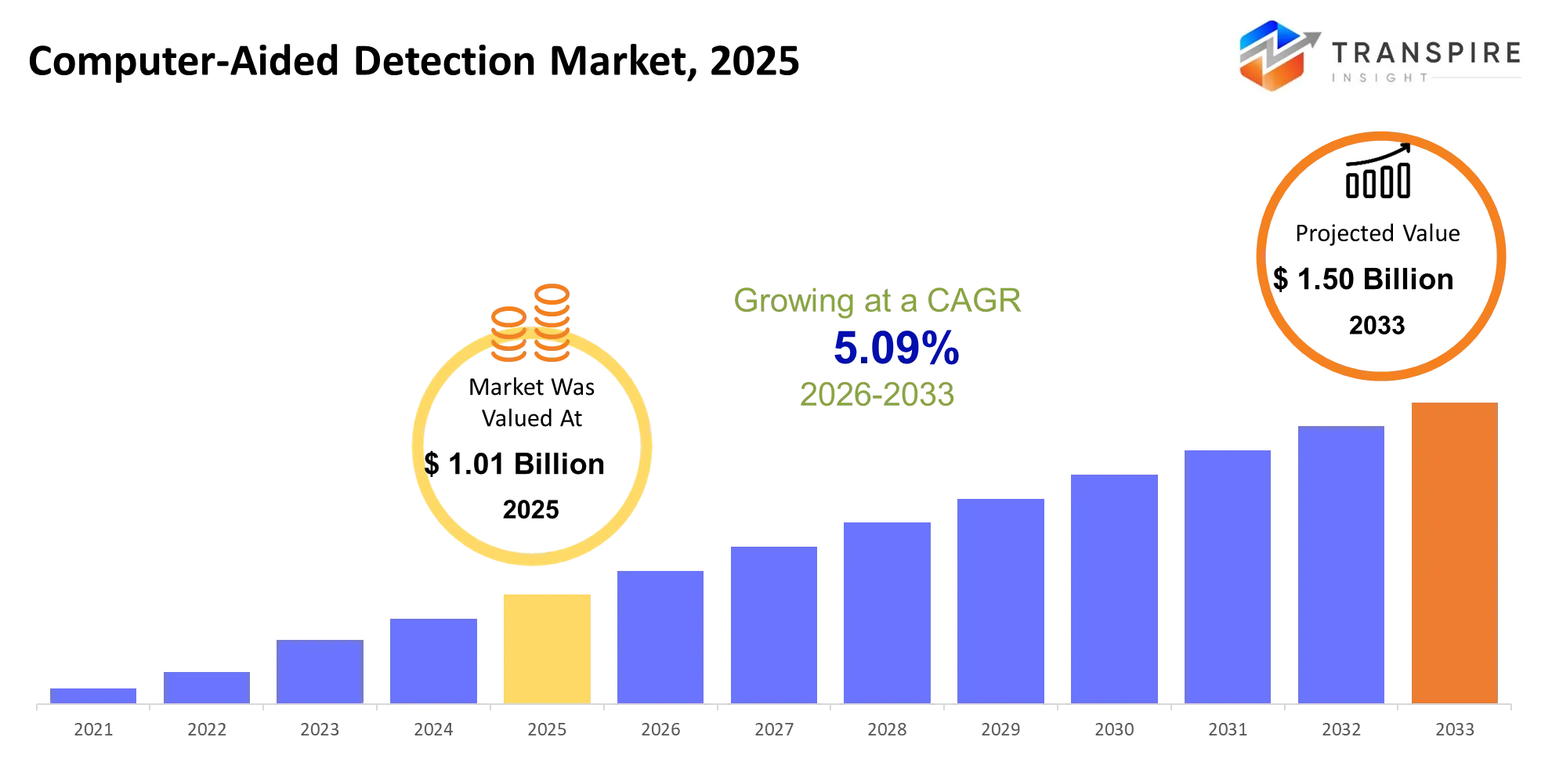
As per Transpire Insight, The Computer-Aided Detection Market size is estimated at USD 1.01 billion in 2025 and is anticipated to reach USD 1.50 billion by 2033, growing at a CAGR of 5.09% from 2026 to 2033.
The market for computer-aided detection (CAD) is evolving from simple image flagging to clinical, workflow-integrated decision support. Advances in workflows and formal clinical validation of tools have been oriented toward helping radiologists identify suspicious findings, prioritise examinations, quantify findings, and create links from detection to subsequent decisions - in mammography, CT, and other modalities. Deep learning has replaced pattern matching logic in the past three to five years, with cloud delivery and PACS integration making it easier to deploy over imaging groups' infrastructures. One is seeing a change in the structural business model from stand-alone systems to AI-enabled systems integrated into diagnostic workflows. The FDA has cleared over 1,600 AI-enabled medical devices, including ongoing FDA clearances of CAD in breast and lung imaging, driven by a simple cause-and-effect dynamic: imaging work volume increases make automated lesion detection a valuable clinical tool, and regulatory validation reduces adoption hurdles.
Computer-Aided Detection Market Size & Forecast:
- Market Size 2025: USD 1.01 Billion
- Expected Market Value (2033): USD 1.50 Billion
- Forecast CAGR (2026–2033): 5.09%
- Leading Region in 2025: North America
- Fastest Growing Region: Asia-Pacific
- Key Company Profiles: Hologic, GE HealthCare, Siemens Healthineers, Philips, FUJIFILM, Canon Medical Systems, iCAD, EDDA Technology, Riverain Technologies, NANO-X Imaging, ScreenPoint Medical, Agfa-Gevaert, CureMetrix, Median Technologies, IBM.
Key Computer-Aided Detection Market Insights:
CAD is shifting from a stand-alone image marking application to an embedded, AI-driven workflow solution that enables radiology practices to handle scan backlogs, ensure consistency in detection, and automatically record follow-up actions. More and more, growth relies not only on algorithm novelty but also on clinical utility, interoperability, and reimbursement readiness.
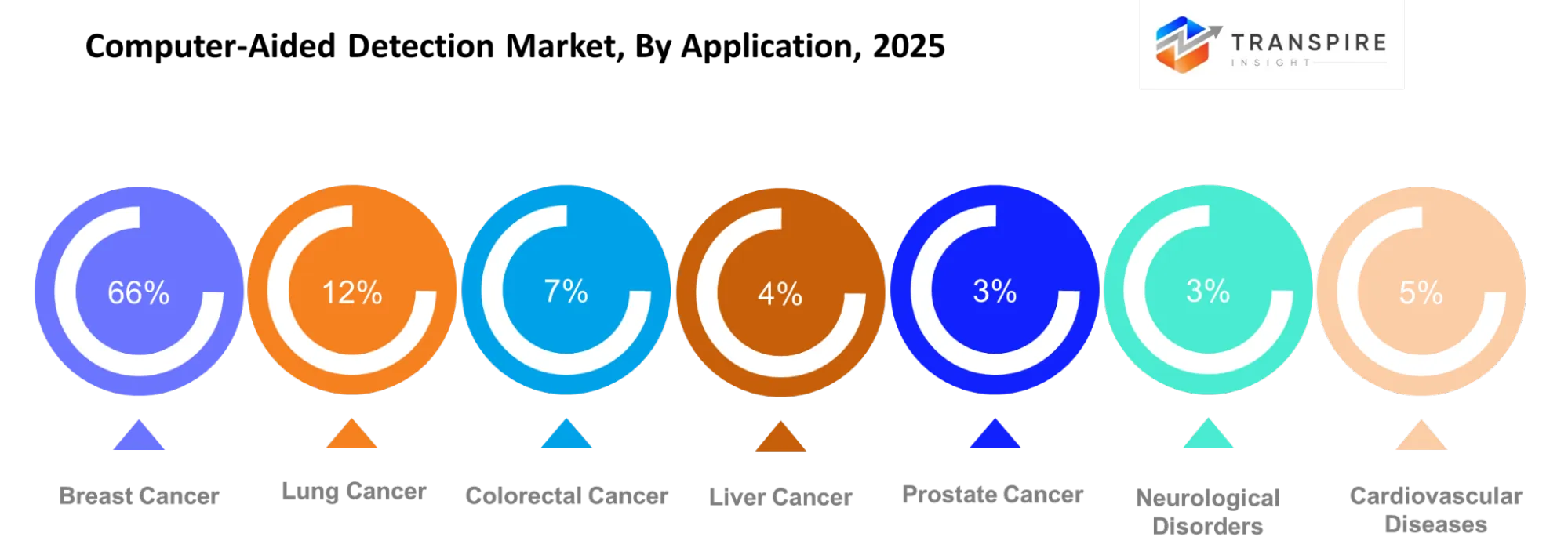
- Breast cancer is the largest application segment, accounting for 66.13% of applications, which is the area where iCAD has a strong focus on breast-imaging workflow tools with the aid of AI.
- Lung cancer has 12.00%, and the Riverain-type chest-CT solutions represent the increasing automated measurement and tracking of nodules over time.
- Computer vision is being extended to endoscopy by vendors to reduce missed polyps during high-throughput procedures, which account for 7.00% of colorectal cancer.
- Lung detection's 6.81% CAGR is an indicator that investment in low-dose CT triage is warranted because screening programs must be consistent in nodule prioritisation.
- Liver cancer is 4.00%; Fujitsu-style imaging analytics helps to characterise lesions earlier in complex multiphase scans.
- Other applications account for 3.50%, with niche algorithms becoming more accessible for hospitals to test and deploy via cloud AI marketplaces.
- Prostate cancer accounts for 3.00%, and multiparametric MRI analysis is moving away from manual image analysis and toward targeted biopsy planning.
- Neurological disorders make up 2.50% of the total, and AI lesion quantification is improving longitudinal monitoring in stroke and neurodegenerative care.
- Cardiovascular diseases account for 1.87%, and automated CT and echocardiogram measurements are bringing CAD into time-sensitive clinical decision support.
What are the Key Drivers, Restraints, and Opportunities in the Computer-Aided Detection Market?
Driver:
Screening demand is becoming more operationally demanding rather than merely more widespread. Population-based breast screening, low-dose CT lung screening, and follow-up imaging generate large image volumes that radiology departments must interpret within limited turnaround-time targets. The practical trigger is the mismatch between scan growth and specialist capacity. AI-enabled CAD addresses this gap by pre-screening studies, highlighting suspicious regions and prioritising examinations that may need faster review. AI-based lung-nodule software can identify, segment and classify nodules in chest CT, allowing radiologists to focus attention on higher-risk cases. This raises adoption because providers can use existing imaging capacity more productively while vendors increasingly sell recurring software, cloud and enterprise-integration contracts.
Restraint:
Clinical validation, interoperability and reimbursement remain structural barriers. CAD output cannot be treated as a diagnosis, so hospitals require evidence across their own patient mix, scanner fleet and reporting workflow before clinicians trust it. Integration with PACS, RIS, electronic health records, and cybersecurity controls can add implementation cost and delay procurement. Payment is also uneven: only a limited number of AI algorithms had Category I CPT codes as of late 2024, weakening the direct financial case for many tools.
Opportunity:
The next expansion can come from multimodal and longitudinal AI that combines image findings with prior examinations, clinical history, and structured data. The September 2026 FDA clearance of Qure.ai’s qCT Lung illustrates continued movement toward specialised lung CAD, while the agency’s lifecycle-focused AI framework supports controlled software updates. Investment in cloud-native orchestration, edge inference, and explainable outputs can help regional diagnostic networks deploy CAD without rebuilding their entire imaging infrastructure.
What Has the Impact of Artificial Intelligence Been on the Computer-Aided Detection Market?
Artificial intelligence has elevated computer-aided detection (CAD) from rule-based, pre-specified highlighting to sophisticated image-analysis software that can identify subtle markers of disease, prioritise cases, and quantify lesion characteristics. Deep-learning models can analyse mammograms, CTs, MRI, and X-ray images and identify candidate abnormalities to help focus the radiologist's gaze on where risk signals tend to gather. Our predictive ability is also improving: A 2026 study found mammogram AI-CAD scores could be used to predict breast cancer indicators years in advance of diagnosis, marking a shift from detecting disease to predicting risk years earlier.
Operationally, AI has the potential to automate boring measurements, enable triaging, create standardized second reads, and significantly reduce manual comparison of large image datasets. When integrated with picture archiving and communication systems (PACS) and cloud environments, AI results could be integrated into normal reporting systems without requiring separate review applications. But cost barriers and technical integration issues persist, and the accuracy of AI models may differ between populations, scanners, acquisition protocols, and clinical settings, necessitating ongoing validation, monitoring, and cautious software updates as models evolve from pilots to widespread clinical practice.
In July 2026, DeepHealth achieved FDA 510(k) clearance for its AI-powered Breast Ultrasound software, expanding its existing automated clinical portfolio. This newly cleared solution automates lesion detection, characterisation, and reporting during both scanning and interpretation to bridge diagnostic workflows.
Key Computer-Aided Detection Market Trends:
CAD is becoming more than just an aid to detection and is becoming a layer of embedded intelligence in imaging workflows, where the value is becoming more tied to prioritization, quantification, and longitudinal decision support. The trend is to turn validated AI into interoperable clinical processes.
- The mammography CAD is moving beyond simple marks to AI-driven cancer detection and breast-density assessment and recall optimization.
- Low-dose CT increasingly can divide and count lung nodules, rather than making subjective comparisons with follow-up, and provide reproducible measurements.
- Radiology departments are turning to triage features that prioritize potentially urgent exams over the regular reporting line.
- Centralized updates on multi-site imaging networks are becoming more relevant for cloud deployment as health systems look to receive them.
- Dedicated AI development is being drawn to digital breast tomosynthesis due to its higher image volume, which leads to higher reader workload.
- CAD vendors are integrating algorithms into PACS and reporting environments instead of selling standalone workstation applications.
- Buyers want local validation evidence and are looking to replace the competition among vendors with algorithm accuracy claims with implementation support.
- Vendors are pairing imaging with previous scans and clinical history to facilitate multimodal analysis, which is improving.
- The number of regulatory clearances for AI-powered imaging devices has grown quickly, with over 75% of the FDA-approved AI-powered imaging devices reported as being used in radiology through July 2023.
- Uncertainty about reimbursement is driving providers to focus on tools that have measurable workflow, quality, or capacity benefits.
Computer-Aided Detection Market Segmentation
Product Type:
CAD Software remains central as algorithms can be upgraded without hardware replacement, reducing lifecycle costs. CAD Services support implementation, validation, and workflow optimization across healthcare networks. Integrated CAD Systems are gaining relevance as providers embed detection within imaging platforms, whereas Standalone CAD Systems remain useful across legacy environments. AI-Based CAD Platforms are reshaping procurement through multi-condition analytics and centralized intelligence. Cloud CAD enables scalable deployment, while On-Premise CAD remains important where data governance, security, or connectivity requirements constrain cloud adoption.
Imaging Modality:
Mammography remains important because screening generates high image volumes and repetitive interpretation tasks suited to automated analysis. CT is expanding through lung-nodule detection, lesion measurement, and triage, increasing the value of real-time image assessment. MRI supports complex tissue characterisation, while X-Ray broadens CAD across routine diagnostics and emergency care. Ultrasound benefits from AI-assisted interpretation in breast and abdominal imaging. PET/SPECT, alongside Digital Tomosynthesis, extends detection capabilities into functional imaging, advanced breast screening, and multimodal diagnostic workflows.
Application:
Breast Cancer 66.13% leverages an array of established screening programs, high volume of mammography, and AI to assist in interpretation for this application to help spot subtle anomalies. Lung Cancer 12.00% with a CAGR of 6.81% is an indication for further analysis due to automated nodule detection, characterisation, triaging, and comparison over time (image-to-image for the same patient) of CT exams. Colorectal Cancer 7.00% computer-aided localisation of findings; Liver Cancer 4.00% automated lesion assessment and time-based comparison; Prostate Cancer 3.00%; Neurological Disorders 2.50%; Cardiovascular Disease 1.87%; Other Applications 3.50% all show that disease-specific applications are emerging, with algorithms becoming more specialised, validated, and /or implemented for wider use compared to traditional breast imaging applications across hospitals and networks.
Technology:
Deep Learning and Neural Networks are advancing CAD through stronger pattern recognition, enabling algorithms to identify subtle abnormalities across high-resolution medical images. Machine Learning continues to support classification, risk scoring, and structured decision assistance, while Computer Vision improves localisation and segmentation. AI Analytics adds quantitative interpretation and workflow intelligence, helping clinicians prioritise cases. Traditional CAD remains relevant where validated rule-based approaches provide consistency and explainability. Hybrid AI combines established methods with newer models, supporting controlled adoption where accuracy, transparency and clinical validation remain priorities.
End User:
Hospitals remain central because they combine high imaging volumes, multidisciplinary care and established digital infrastructure. Diagnostic Centres are expanding CAD use through standardised reporting and centralised interpretation across multiple facilities. Speciality Clinics adopt targeted algorithms for oncology, cardiology and other focused pathways, while Research Centres and Academic Institutions contribute validation data and algorithm development. Imaging Centres benefit from workflow automation and faster case prioritisation. Ambulatory Centres increasingly represent a decentralised deployment opportunity as outpatient diagnostics expand and compact AI-enabled imaging workflows become increasingly practical.
Deployment:
Cloud models support centralised algorithm management, rapid updates and multi-site access, making them attractive for distributed imaging networks. Hybrid architectures balance cloud scalability with local data controls, while Edge deployment reduces latency where immediate analysis is required. Integrated PACS configurations place CAD outputs directly within established radiology workflows, improving usability and minimising application switching. SaaS models simplify subscription-based access and lower infrastructure requirements. Nevertheless, On-Premise and Standalone deployments remain important where hospitals prioritise strict data governance, security controls, legacy compatibility, or limited connectivity.
What are the Key Use Cases Driving the Computer-Aided Detection Market?
The first use case, breast cancer screening, currently makes up 66.13% of the market. AI-CAD detects masses, calcifications, and asymmetries, while Deep Health's 2026 FDA-cleared prior-exam comparison scans past with present mammograms to give the radiologist an idea of minute changes and reduce recalls.
Lung cancer's role as a focal use case is growing at 6.81% CAGR as CT-based nodule detection advances into characterisation and follow-up, including Qure.ai's qCT Lung for automated detection of suspicious pulmonary findings to allow clinicians to prioritise faster.
Growing use cases include expanding CAD into multimodal decision support with automation of breast ultrasound, cross-modality AI platforms, cardiovascular-risk signals from mammograms, and cloud deployment to allow hospital sites to scale validated algorithms.
|
Report Metrics |
Details |
|
Market size value in 2025 |
USD 1.01 Billion |
|
Market size value in 2026 |
USD 1.06 Billion |
|
Revenue forecast in 2033 |
USD 1.50 Billion |
|
Growth rate |
CAGR of 5.09% from 2026 to 2033 |
|
Base year |
2025 |
|
Historical data |
2021 - 2024 |
|
Forecast period |
2026 - 2033 |
|
Report coverage |
Revenue forecast, competitive landscape, growth factors, and trends |
|
Regional scope |
United States; Canada; Mexico; United Kingdom; Germany; France; Italy; Spain; Denmark; Sweden; Norway; China; Japan; India; Australia; South Korea; Thailand; Brazil; Argentina; South Africa; Saudi Arabia; United Arab Emirates |
|
Key companies profiled |
Hologic, GE HealthCare, Siemens Healthineers, Philips, FUJIFILM, Canon Medical Systems, iCAD, EDDA Technology, Riverain Technologies, NANO-X Imaging, ScreenPoint Medical, Agfa-Gevaert, CureMetrix, Median Technologies, IBM. |
|
Customization scope |
Free report customisation (country, regional & segment scope). Available customised purchase options to meet your exact research needs. |
|
Report Segmentation |
Product Type (CAD Software, CAD Services, Integrated CAD Systems, Standalone CAD Systems, AI-Based CAD Platforms, Cloud CAD, On-Premise CAD); Imaging Modality (Mammography, CT, MRI, X-Ray, Ultrasound, PET/SPECT, Digital Tomosynthesis); Application (Breast Cancer, Lung Cancer, Colorectal Cancer, Liver Cancer, Prostate Cancer, Neurological Disorders, Cardiovascular Diseases, Other Applications); Technology (Deep Learning, Machine Learning, Computer Vision, Traditional CAD, Neural Networks, AI Analytics, Hybrid AI); End User (Hospitals, Diagnostic Centers, Specialty Clinics, Research Centers, Academic Institutions, Imaging Centers, Ambulatory Centers); Deployment (Cloud, On-Premise, Hybrid, Edge, Integrated PACS, Standalone, SaaS). |
Which Regions are Driving the Computer-Aided Detection Market Growth?
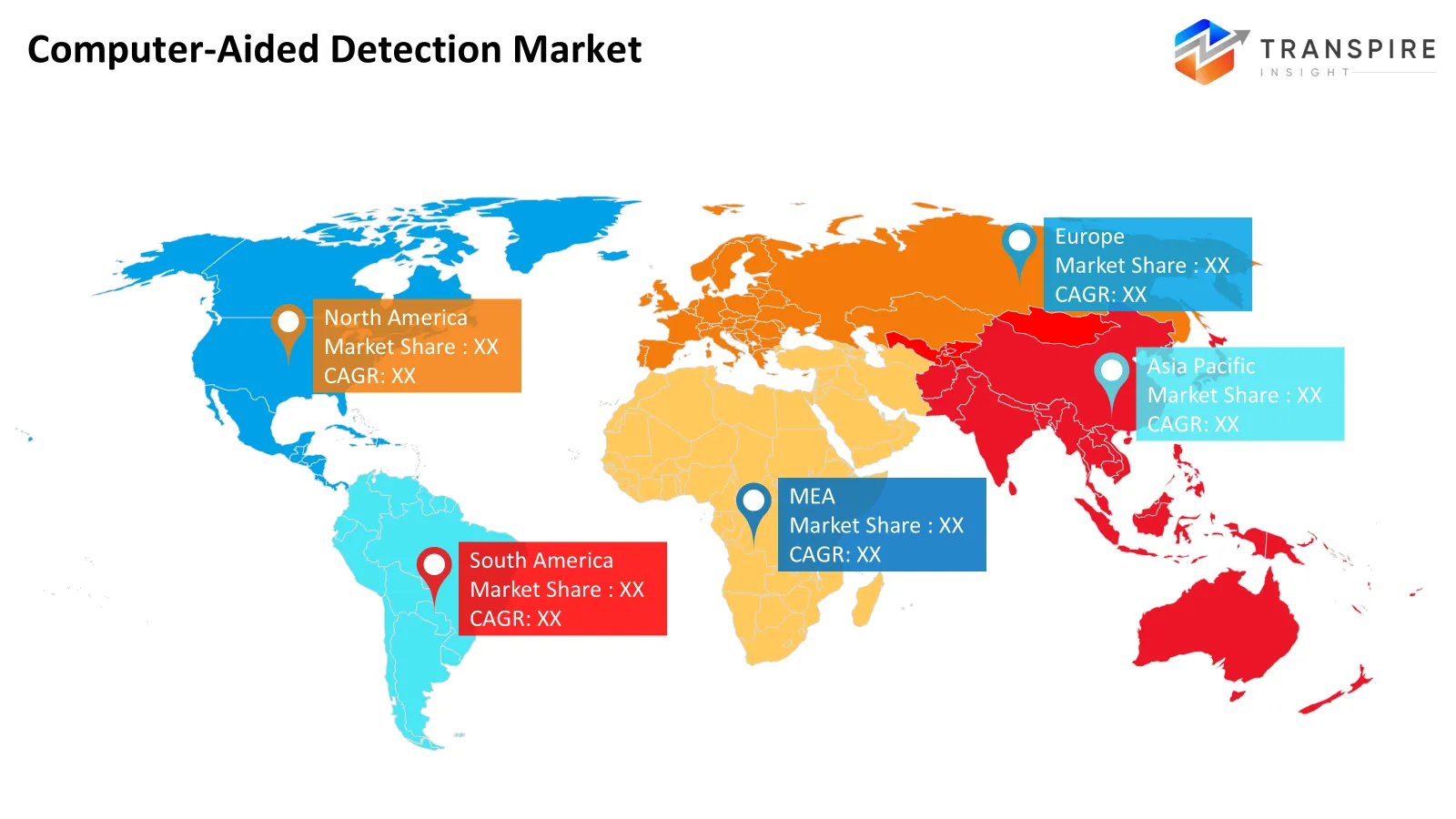
North America represents the largest market for CAD, accounting for 45.60% of the market. The region has a legacy imaging ecosystem, high screening penetration, and a diverse supply landscape (comprising AI vendors, cloud infrastructure, and imaging-system manufacturers). The active and mature FDA approval ecosystem, specifically, makes North America an attractive region, with radiology accounting for around 75% of AI-enabled medical device approvals in the region, allowing for a shorter bridge from technology readiness to commercialization. Reimbursement exploration and radiologist capacity issues, meanwhile, extend the business rationale for CAD solutions that can be shown to provide workflow and quality benefits.
In April 2026, Aidoc closed a $150 million Series E funding round to scale its comprehensive AI foundation model covering multiple CT conditions across thousands of hospital networks.
Europe's market share is 25.00% and benefits from well-established breast-screening services, universal healthcare structures and clinical-quality governance. Deployment has been slower in this zone, due to slower adoption of decentralised purchasing across national and regional healthcare systems and a greater level of evidence required before decision-making can take place. Its stability is driven by public-sector investment in imaging upgrades and data protection; the establishment of a number of consortia to support multinational research. European providers value computer-aided detection solutions that have proven effectiveness without delay, and fit into disparate Picture Archiving and Communication Systems environments.
In September 2026, Lunit deployed its AI-powered mammography solution, Lunit INSIGHT MMG, as an independent second reader across the entire Stockholm Region's breast cancer screening program in Sweden.
Asia Pacific represents 19.00% of the market and is experiencing the fastest growth at 6.94% CAGR. Expanded diagnostic imaging capacity, growing digital health investments, and greater access to cancer screening have resulted in a larger addressable workflow gap for AI-assisted detection. While reimbursement-driven adoption is guiding North American growth, scaled cloud deployment, private diagnostic chains, and uneven distribution of radiologists are factors in Asia Pacific growth. The biggest opportunity is in localised algorithms and enterprise platforms working across languages, different scanners, and clinical environments. Latin America (5.00%), the Middle East (3.00%) and Africa (2.40%) make up the remaining market share, where cheaper cloud-based computer-aided detection and centralised teleradiology could improve access.
In April 2026, AstraZeneca and Qure.ai partnered with the Telangana Government to deploy AI-powered lung cancer screening across 20 public healthcare facilities. This scalable rollout integrates localized algorithms into routine chest X-ray workflows to identify high-risk oncology cases early, directly addressing the region's uneven radiologist distribution across urban and rural clinical settings.
Who are the Key Players in the Computer-Aided Detection Market, and how do they compete?
The competition includes both incumbent medical imaging companies and niche artificial intelligence vendors, with differentiation moving to clinical workflow integration, regulatory evidence, and modality-specific accuracy. The FDA's approval of AI tools has made digital breast tomosynthesis, CT, and enterprise PACS connectivity much more commercially relevant for companies that can combine detection algorithms with imaging platforms.
Hologic leverages a breast-imaging ecosystem and Genius AI Detection as GE Health Care, Siemens Healthineers, Philips, FUJIFILM, and Canon Medical Systems include AI-enabled detection in a modality portfolio, PACS, and service contracts. All these players focus on upgrading their installed bases, multi-site health-system contracts, and workflow synergies. In this niche, Agfa-Gevaert focuses on imaging informatics, IBM on hybrid-cloud data governance and AI rollout support (rather than scanner-related CAD products). ICAD and Screen Point Medical compete on breast-imaging algorithms with the FDA-cleared Pro Found and Transpara platforms, providing clinical validation and subscription to screening networks. EDDA Technology focuses on oncology imaging and surgical planning workflows; Riverain Technologies and NANO-X Imaging focus on chest imaging, low-dose CT, and accessible imaging pathways; and Cure Metrix focuses on breast screening supported by AI, with Median Technologies on oncology-trial imaging biomarkers. Their niche approach allows faster algorithm tuning, and agreements with imaging OEMs and distributors expand their reach geographically.
Key Players are:
- Hologic
- GE HealthCare
- Siemens Healthineers
- Philips
- FUJIFILM
- Canon Medical Systems
- iCAD
- EDDA Technology
- Riverain Technologies
- NANO-X Imaging
- ScreenPoint Medical
- Agfa-Gevaert
- CureMetrix
- Median Technologies
- IBM
Recent Development News
- In March 2026, Bracco Imaging announced a strategic partnership with Avicenna.AI to develop AI applications for computer-aided detection and diagnosis in contrast-enhanced brain CT angiography. The collaboration is advancing clinical validation and is expected to support planned regulatory submission for the new AI applications. https://www.prnewswire.com/news-releases/rfa-unveils-its-next-chapter-the-first-ai-native-msp-redefining-it-services-for-financial-institutions-302842193.html
- In August 2026, Coreline Soft announced a collaboration with Optellum to integrate its FDA-cleared AVIEW Lung Nodule CAD software with Optellum’s LungOS platform. The partnership is expected to connect lung-nodule detection with risk assessment and follow-up workflows, supporting a more integrated AI pathway for lung cancer care. https://www.prnewswire.com/news-releases/coreline-soft-and-optellum-announce-intent-to-collaborate-to-advance-ai-across-the-lung-cancer-pathway-302850282.html
- In March 2026, Bracco announced a strategic co-development and commercial partnership with Avicenna.AI. This collaboration focuses on advancing AI-driven computer-aided detection and diagnosis applications inside contrast-enhanced computed tomography (CT) angiography for brain imaging. https://www.prnewswire.com/news-releases/bracco-announces-eu-launch-of-aimify-and-expands-ai-portfolio-with-avicennaai-partnership-at-ecr-2026-302700528.html
What Strategic Insights Define the Future of the Computer-Aided Detection Market?
The industry is heading towards workflow-native multimodal CAD solutions with detection, quantification, prior-image comparison, and clinical context combined in one single confined, governed layer. Model drift in scanners, patient populations, and protocols over time can lead to performance degradation after deployment, despite the model passing the initial approval test. Regulators are also moving from single product approval towards lifecycle monitoring, controlled upgrades, and traceable human reviewer actions. One now emerging opportunity is in regional AI orchestration: both cloud and edge platforms can host multiple validated models but keep sensitive imaging data under hospital or national control. Vendors should support portable, interoperable architectures, audit-ready monitoring, and disease pathways with quantifiable workflow performance better than isolated accuracy metrics. When choosing vendors and models, ensure you are testing local performance across patient population subgroups, designing escalation rules for discordant AI, and driving transparent update controls so that clinical teams retain command of their models.
Key Segmentations are:
Product Type
- CAD Software
- CAD Services
- Integrated CAD Systems
- Standalone CAD Systems
- AI-Based CAD Platforms
- Cloud CAD
- On-Premise CAD
- Imaging Modality
- Mammography
- CT
- MRI
- X-Ray
- Ultrasound
- PET/SPECT
- Digital Tomosynthesis
Application
- Breast Cancer
- Lung Cancer
- Colorectal Cancer
- Liver Cancer
- Prostate Cancer
- Neurological Disorders
- Cardiovascular Diseases
- Other Applications
Technology
- Deep Learning
- Machine Learning
- Computer Vision
- Traditional CAD
- Neural Networks
- AI Analytics
- Hybrid AI
End User
- Hospitals
- Diagnostic Centers
- Speciality Clinics
- Research Centres
- Academic Institutions
- Imaging Centres
- Ambulatory Centres
Deployment
- Cloud
- On-Premise
- Hybrid
- Edge
- Integrated PACS
- Standalone
- SaaS
By Regional Analysis
North America
- US
- Canada
- Mexico
Europe
- Germany
- UK
- France
- Italy
- Spain
- Russia
- Rest of Europe
Asia Pacific
- China
- Japan
- India
- South Korea
- Australia
- Rest of Asia Pacific
South America
- Brazil
- Argentina
- Rest of South America
Middle East & Africa
- UAE
- Saudi Arabia
- Qatar
- South Africa
- Rest of the Middle East & Africa
Frequently Asked Questions
Find quick answers to common questions.
The computer-aided detection market size was valued at USD 1.01 billion in 2025 and is poised to reach USD 1.50 billion by 2033, expanding at a 5.09% CAGR.
Key segments for the computer-aided detection market are Product Type (CAD Software, CAD Services, Integrated CAD Systems, Standalone CAD Systems, AI-Based CAD Platforms, Cloud CAD, On-Premise CAD); Imaging Modality (Mammography, CT, MRI, X-Ray, Ultrasound, PET/SPECT, Digital Tomosynthesis); Application (Breast Cancer, Lung Cancer, Colorectal Cancer, Liver Cancer, Prostate Cancer, Neurological Disorders, Cardiovascular Diseases, Other Applications); Technology (Deep Learning, Machine Learning, Computer Vision, Traditional CAD, Neural Networks, AI Analytics, Hybrid AI); End User (Hospitals, Diagnostic Centers, Specialty Clinics, Research Centers, Academic Institutions, Imaging Centers, Ambulatory Centers); Deployment (Cloud, On-Premise, Hybrid, Edge, Integrated PACS, Standalone, SaaS).
Growth is primarily driven by AI-powered image analysis, rising radiology workloads, broader adoption of automated screening, improved PACS integration, and expanding regulatory clearances for clinically validated CAD solutions.
The computer-aided detection market is led by major manufacturers, including Hologic, GE HealthCare, Siemens Healthineers, Philips, FUJIFILM, Canon Medical Systems, iCAD, EDDA Technology, Riverain Technologies, NANO-X Imaging, ScreenPoint Medical, Agfa-Gevaert, CureMetrix, Median Technologies, and IBM.
North America accounts for 45.60% of the market, supported by advanced imaging infrastructure, high AI adoption, extensive PACS connectivity, strong healthcare investment, and established FDA pathways for AI-enabled diagnostic devices.
Opportunities include cloud-based CAD, multimodal AI, lung and colorectal screening, real-time edge analytics, interoperable PACS platforms, and expansion across emerging Asia Pacific healthcare networks.
- Hologic
- GE HealthCare
- Siemens Healthineers
- Philips
- FUJIFILM
- Canon Medical Systems
- iCAD
- EDDA Technology
- Riverain Technologies
- NANO-X Imaging
- ScreenPoint Medical
- Agfa-Gevaert
- CureMetrix
- Median Technologies
- IBM
About the Authors

Pankaj Ghogare Patil
I am Pankaj Ghogare Patil, a Senior Research Analyst at Transpire Insight, specializing in the Pharmaceutical, Chemicals & Materials, Healthcare IT, and Biotechnology industry. My expertise lies in conducting comprehensive market research, analyzing industry trends, evaluating competitive landscapes, and translating complex data into actionable insights. At Transpire Insight, I closely follow emerging technologies, regulatory developments, and market innovations to create accurate, well-researched, and informative content that helps businesses and professionals make informed decisions. I am committed to producing credible, evidence-based articles that reflect industry best practices while making technical topics accessible and valuable for a broad audience.

Chakradhar Khansole
Chakradhar serves as the Research Director at Transpire Insight, bringing over 8 years of experience in technology, innovation, and strategic market intelligence. He specializes in transforming complex market data into actionable business insights that enable organizations to make informed, growth-oriented decisions. Recognized for his strategic vision and analytical expertise, Chakradhar leads high-impact research initiatives, delivering comprehensive market assessments, competitive intelligence, and forward-looking industry analysis.
Recently Published Reports
-
Apr 2026
AI in Diabetic Retinopathy Market
AI in Diabetic Retinopathy Market Size, Share & Analysis Report By Type (Screening AI Systems, Diagnostic AI Systems, and Predictive AI Models), By Application Segment (Hospitals, Ophthalmology Clinics, Diagnostic Centers, and Research and Development), and Geography (North America, Europe, Asia-Pacific, Middle East and Africa, South and Central America), 2021 - 2031
-
Apr 2026
Psychometric Tests Market
Psychometric Tests Market Size, Share & Analysis Report By Type (Personality Tests, Ability/Aptitude Tests, Skill/Knowledge Tests, and Others), By Application (Talent Acquisition and Talent Management), and Geography (North America, Europe, Asia-Pacific, Middle East and Africa, South and Central America), 2021 – 2031
-
Apr 2026
Rare Biological Sample Collection Market
Rare Biological Sample Collection Market Size, Share & Analysis Report By Type (Isolation Kits & Reagent, Blood Collection Tubes, and Others), By Application (Oncology, Transcriptomics, Pharmacogenomics, and Others), and Geography (North America, Europe, Asia-Pacific, Middle East and Africa, South and Central America), 2021 – 2031
-
Jul 2026
Diabetic Retinopathy Market
Diabetic Retinopathy Market Size, Share & Analysis Report By Type (Proliferative Diabetic Retinopathy, and Diabetic Macular Edema (DME)), By Treatment Type (Anti VEGF Drug, Steroid Implants, Laser Surgeries, and Vitrectomy), and Geography (North America, Europe, Asia-Pacific, Middle East and Africa, South and Central America), 2021 – 2031
Our Clients







