

Edge Computing In Automotive Market Summary:
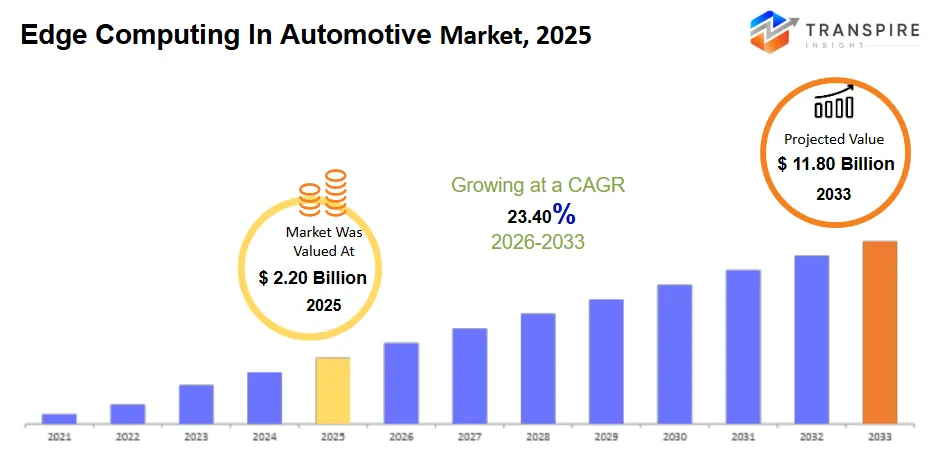
As per the Transpire Insight Analysis, The Edge Computing in Automotive Market size is estimated at USD 2.20 billion in 2025 and is anticipated to reach USD 11.80 billion by 2033, growing at a CAGR of 23.40% from 2026 to 2033.
The Edge Computing in the Automotive Market allows intelligent vehicles and transportation systems to process data locally and make faster decisions without solely depending on remote cloud servers. Over the last three to five years, there has been a transition from independent electronic control units to centralised and zonal computing architectures within this industry, which requires powerful onboard processors and software integration. The industry is undergoing a structural change with the proliferation of software-defined vehicles, where the computing architecture has become more instrumental in determining how vehicles are updated, enhanced, and monetised throughout their lifecycle. This shift is further emphasized by the adoption of a regulatory framework for automated driving introduced by the United Nations Economic Commission for Europe (UNECE) based on geographies, which highlights the importance of locally processed vehicle intelligence that offers the promise of faster reactions, availability, and control over sensitive vehicle data. This approach is also promoting the adoption of ADAS, real-time perception, and connected services.
Edge Computing In Automotive Market Size & Forecast:
- Market Size 2025: USD 2.20 Billion
- Expected Market Value (2033): USD 11.80 Billion
- Forecast CAGR (2026–2033): 23.40%
- Leading Region in 2025: Asia Pacific
- Fastest Growing Region: North America
- Key Company Profiles: NVIDIA, Intel, Qualcomm, NXP Semiconductors, Bosch, Continental, Denso, Aptiv, Harman, Huawei, AWS, Microsoft, Google, IBM, Siemens.
Key Edge Computing In Automotive Market Insights:
The market is shifting from driver-assistance electronics platforms as islands of technology to vehicle compute platforms that are software-centric and house safety, cockpit, connectivity, and cybersecurity workloads on edge platforms. This change moves in-vehicle intelligence from a one-time hardware sale to a recurring revenue opportunity and an opportunity to differentiate.
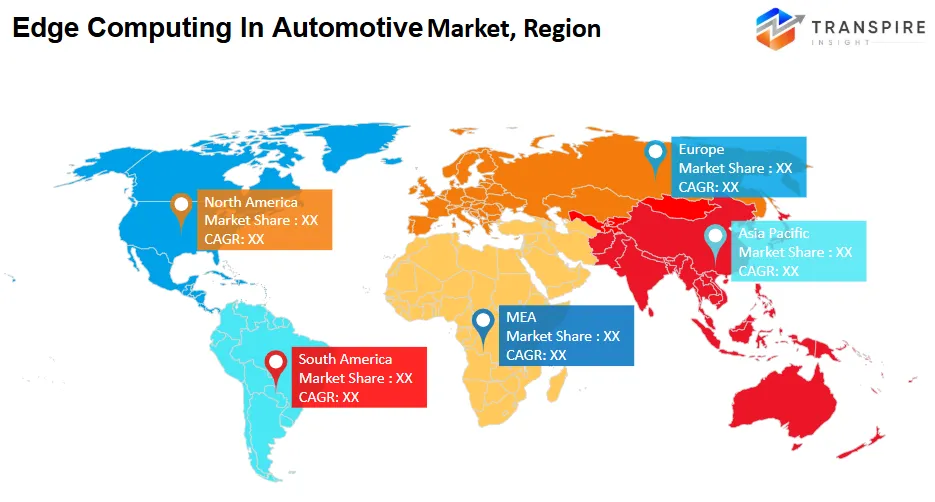
- Asia Pacific accounts for 41.0% of revenue, bolstered by the high concentration of vehicle production, 5G rollout, and growing EV initiatives.
- High-end ADAS, AI cockpit, and commercial-fleet platforms are fueling North America's emergence as a premium compute market, accounting for 29.0% of the market.
- Europe accounted for 23.0%, and regulatory stress is driving OEMs to secure and updatable edge architectures.
- Latin America has a 4.0% share, while the Middle East & Africa has a 3.0% share, and their growth is led by fleet telematics, logistics, and smart city pilots.
- NVIDIA's DRIVE AGX Thor is a mid-tier offering of consolidated vehicle computing, combining ADAS, cockpit and in-vehicle AI workloads with up to 2,000 TOPS of performance.
- Qualcomm is taking Snapdragon Ride from connectivity to mixed-criticality ADAS and cockpit compute, building on its automotive design-win foundation.
- Vehicle integration platforms and zone ECUs that split the centralized “thinking” compute from distributed sensing and actuation are coming to market through Bosch.
- Aptiv's Smart Vehicle Architecture is a scalable software-defined platform that separates input/output from compute, which results in lighter wiring systems.
- Continental is bringing together high-performance computers, edge computers, and zonal controllers to challenge on the level of hardware and automotive software.
- Component buyers are moving away from buying components and moving towards platform partnerships, as validated safety, cybersecurity, and OTA-update ecosystems become a necessity.
What are the Key Drivers, Restraints, and Opportunities in the Edge Computing In Automotive Market?
Driver:
The primary growth driver is the shift to software-defined vehicles, where OEMs consolidate safety, perception, infotainment, and connectivity functions onto centralised edge platforms. This was triggered by the rising complexity of Level 2+ and Level 3 automated-driving features, which require local sensor fusion, object detection, and path planning within strict timing limits. The result is higher content per vehicle: automakers procure AI accelerators, secure gateways, middleware, and over-the-air update infrastructure, while Tier-1 suppliers monetise validated compute and software stacks.
Restraint:
Integration complexity remains the principal constraint. Legacy vehicle electrical architectures are fragmented, and edge platforms must coexist with safety-critical control systems, cybersecurity requirements, and supplier-specific interfaces. The problem persists because functional-safety validation, cybersecurity certification, and interoperability testing are expensive and slow; UNECE R155 and R156 have made cybersecurity and software-update management formal type-approval requirements, raising engineering costs rather than eliminating them.
Opportunity:
Lightweight AI models, automotive-grade system-on-chips, and cloud-edge collaboration create significant growth opportunities. Investment in 5G-enabled roadside infrastructure and automotive manufacturing ecosystems, particularly across Asia-Pacific, can accelerate connected mobility, fleet intelligence, and real-time vehicle data processing. Meanwhile, advancements in distributed computing and energy-efficient AI enable automakers to deploy intelligent functions with lower latency and reduced cloud dependence. UNECE’s automated-driving framework could further encourage investment in scalable, safety-validated computing architectures, strengthening opportunities for technology suppliers and automotive manufacturers.
Driver Impact Analysis – Edge Computing in Automotive Market
|
Driver |
Relative Impact on Growth (%) |
Geographic Relevance |
Impact Timeline |
Demand Strength |
Growth Mechanism |
Key Beneficiaries |
Major Constraint |
|
1. Increasing Adoption of ADAS and Autonomous Driving Technologies |
30% |
North America, Europe, China |
Medium-term (2–4 years) |
High |
Enables real-time perception, sensor fusion, and autonomous decision-making. |
Automotive OEMs, semiconductor manufacturers, ADAS technology providers. |
High computational costs and stringent functional safety requirements. |
|
2. Rising Adoption of Software-Defined Vehicles (SDVs) |
25% |
North America, Europe, Asia-Pacific |
Medium-term (2–4 years) |
High |
Centralised computing enables scalable software integration and vehicle-wide updates. |
Automotive OEMs, edge hardware vendors, middleware providers. |
Legacy vehicle architectures complicate centralised computing integration. |
|
3. Growing Vehicle Connectivity and 5G-V2X Infrastructure Deployment |
20% |
China, North America, Europe |
Medium-term (2–4 years) |
High |
Low-latency connectivity supports localised traffic coordination and connected mobility services. |
Telecom operators, automotive OEMs, V2X infrastructure providers. |
Inconsistent network coverage and interoperability limitations. |
|
4. Increasing Demand for Real-Time Edge AI and In-Vehicle Data Processing |
15% |
North America, China, Japan |
Short-term (≤2 years) |
High |
Onboard AI processing reduces latency and cloud dependency. |
AI chipmakers, automotive electronics suppliers, technology vendors. |
Power consumption, thermal management, and computing limitations. |
|
5. Growing Regulatory Emphasis on Vehicle Safety, Cybersecurity, and Sustainable Mobility |
10% |
Europe, North America, Asia-Pacific |
Long-term (≥4 years) |
Medium |
Safety and cybersecurity requirements accelerate secure edge-computing adoption. |
Automotive OEMs, cybersecurity providers, regulatory-compliance technology vendors. |
Compliance complexity and rising vehicle development costs. |
|
Total |
100% |
— |
— |
— |
— |
— |
What has the Impact of Artificial Intelligence been on edge computing in the automotive market?
AI overcomes the time delay associated with using automotive edge computing as a data transfer function; it turns this element into a real-time intelligence decision-making function. For example, in-vehicle models fuse camera, radar, and lidar inputs for object detection, lane detection, camera and sensor fusion, pedestrian detection, and emergency braking decisions. Intelligent driver-monitoring systems, which can identify distracted or drowsy driving, also use AI, as do, in some cases, in-vehicle assistants that can learn and adapt the climate, nav, and infotainment preferences of vehicle occupants without transmitting sensitive cabin data to the cloud.
The other big use case is automation. With predictive maintenance, robust analytics on batteries, powertrain, brakes, and sensors can identify issues locally and support preemptive scheduling of repairs and avoid downtime, and predictive insights on road conditions-classifying, abstracting, and sharing with fleet manager platforms and roadside infrastructure-can improve traffic and fleet management. The core challenge here is the "accuracy versus bill of materials cost" factor: The most powerful AI acceleration hardware, redundant safety architecture, validation of neural network models for rare events and bad weather, and the regulatory environment for AI all work to raise bill of materials costs and slow deployment.
In November 2026, Mercedes-Benz partnered with Liquid AI to integrate edge-native conversational artificial intelligence into its vehicles to personalize in-cabin features without relying on cloud roundtrips. This deployment aims to streamline driver-vehicle interactions and cut latency while navigating software scaling hurdles. https://www.pymnts.com/news/artificial-intelligence/2026/mercedes-hopes-to-woo-motorists-with-in-car-conversational-ai/
Key Edge Computing in the Automotive Market Trends:
The automotive computing landscape is moving from individual processing units to intelligent, connected, car architectures. The competitive emphasis is moving towards software flexibility, onboard intelligence, cybersecurity, and lifecycle optimisation.
- The trend is towards zonal and centralised architectures, as well as distributed ECUs, with dozens of controllers now replaced by fewer, high-performance compute nodes.
- AI inference is also being done in-vehicle, which lessens reliance on cloud connectivity for safety-critical perception and control.
- Driver-monitoring systems are becoming "standard" or "required" instead of optional high-dollar features.
- Cybersecurity is increasingly a requirement for procurement – it is a key criterion for vehicle approval under UNECE R155 and R156.
- OEMs are focusing on edge platforms to enable over-the-air updates, diagnostics and periodic software services, instead of selling one-off hardware.
- Edge analytics is used by fleet operators for predictive maintenance, routing, fuel usage, and downtime reduction.
- Roadside edge nodes are becoming a part of vehicle intelligence, facilitating cooperation with other vehicles on the road in perception and traffic management.
- Chipmakers are consolidating cockpit, ADAS, and connectivity functions into one auto-grade platform, altering supplier dynamics.
- OEMs are moving towards local processing and selective cloud transmission due to data sovereignty and privacy concerns.
Edge Computing In Automotive Market Segmentation
Component:
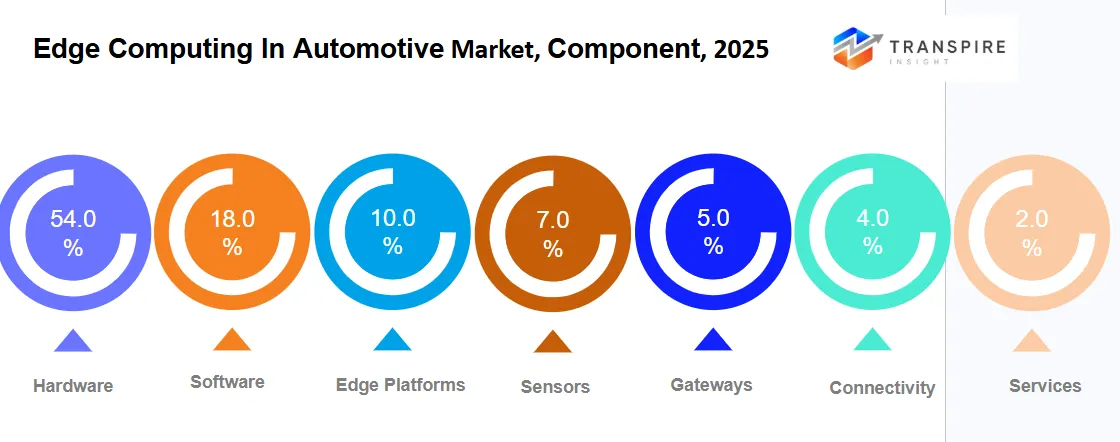
Hardware represents 54.0% of the market, reflecting the fact that all new vehicles will need to support automotive-grade processors, AI accelerators, domain controllers, and secure edge gateways to enable safety-critical workloads locally. Software is 18.0% of the market but is gaining strategic attention from automakers as middleware, cybersecurity, operating systems, and OTA update platforms provide a foundation on which to safely introduce new features by OEMs. Edge platforms represent 10.0%, sensors 7.0%, gateways 5.0%, connectivity 4.0%, and services 2.0%. While hardware revenue currently dominates, software and services are expected to grow rapidly to meet the needs of automakers and suppliers who want to monetize continuous updates, diagnostics, and managed security.
Vehicle Type:
Passenger cars form the largest base because ADAS, infotainment, and connectivity features are being standardised across mass-market models. Electric vehicles create additional demand for battery analytics, thermal management, and charging optimisation, while hybrid vehicles require edge systems to coordinate combustion and electric powertrains. Autonomous vehicles and heavy trucks represent higher-value deployment opportunities because their perception, safety, and fleet-management workloads are more compute-intensive. Commercial vehicles, buses, and heavy trucks increasingly adopt edge computing for predictive maintenance, driver monitoring, route optimisation, and regulatory compliance.
Application:
Autonomous driving is the fastest-growing application, with an approximate 25% CAGR, driven by real-time sensor fusion, hazard detection, and path planning. ADAS maintains broad commercial adoption through emergency braking, lane keeping, and driver monitoring. Predictive maintenance, fleet management, V2X, infotainment, and in-cabin monitoring extend edge computing into operational efficiency, personalization, and data-driven services, creating opportunities for OEMs, fleet operators, and technology suppliers.
Deployment:
Vehicle edge remains foundational because safety-critical functions require uninterrupted local processing. Roadside edge and multi-access edge computing are expanding alongside 5G and V2X infrastructure, enabling cooperative safety and traffic optimization. Cloud-edge hybrid architectures support model training, fleet analytics, and non-critical services. Meanwhile, on-premises and distributed edge deployments address automotive manufacturing, testing facilities, and fleet-specific operational requirements, strengthening flexibility across connected mobility ecosystems.
Connectivity:
5G enables low-latency vehicle-to-infrastructure communication, while LTE supports broader coverage and existing fleets. Wi-Fi and Bluetooth facilitate in-cabin connectivity and short-range communication. Ethernet provides high-bandwidth connections between onboard computing systems, while V2X enables communication with surrounding vehicles and infrastructure. Satellite connectivity creates opportunities for remote freight, mining operations, and vehicles operating beyond terrestrial network coverage, supporting geographically distributed fleet intelligence and connected transportation applications.
End User:
OEMs and Tier-1 suppliers drive substantial procurement through integration of edge computing into vehicle platforms. Fleet operators and mobility providers prioritize predictive maintenance, vehicle utilization, and driver safety. Infrastructure operators and government agencies support adoption through smart-road development, V2X infrastructure, and traffic management initiatives. Technology providers contribute automotive-grade processors, AI software, cybersecurity, and cloud platforms, creating opportunities for partnerships across vehicle manufacturing, transportation infrastructure, and connected mobility services.
What are the Key Use Cases Driving the Edge Computing In Automotive Market?
The core use case is real-time ADAS and autonomous-driving support, where edge hardware processes camera, radar, and lidar data to detect obstacles and enable braking or steering without cloud delays. This directly supports hardware’s dominant market position.
Expanding applications include predictive maintenance, fleet management, connected infotainment, and in-cabin monitoring. These technologies help fleet operators reduce downtime, enable OEM software upgrades, and improve vehicle personalization.
Emerging opportunities involve cooperative perception and smart-road integration. V2X and 5G connectivity enable vehicles to exchange hazard and traffic information with roadside edge nodes, creating opportunities for automakers, telecom operators, and infrastructure providers.
|
Report Metrics |
Details |
|
Market size value in 2025 |
USD 2.20 Billion |
|
Market size value in 2026 |
USD 2.71 Billion |
|
Revenue forecast in 2033 |
USD 11.80 Billion |
|
Growth rate |
CAGR of 23.40% from 2026 to 2033 |
|
Base year |
2025 |
|
Historical data |
2021 - 2024 |
|
Forecast period |
2026 - 2033 |
|
Report coverage |
Revenue forecast, competitive landscape, growth factors, and trends |
|
Regional scope |
United States; Canada; Mexico; United Kingdom; Germany; France; Italy; Spain; Denmark; Sweden; Norway; China; Japan; India; Australia; South Korea; Thailand; Brazil; Argentina; South Africa; Saudi Arabia; United Arab Emirates |
|
Key companies profiled |
NVIDIA, Intel, Qualcomm, NXP Semiconductors, Bosch, Continental, Denso, Aptiv, Harman, Huawei, AWS, Microsoft, Google, IBM, Siemens. |
|
Customization scope |
Free report customization (country, regional & segment scope). Available customized purchase options to meet your exact research needs. |
|
Report Segmentation |
Component (Hardware, Software, Edge Platforms, Sensors, Gateways, Connectivity, Services); Vehicle Type (Passenger Cars, Commercial Vehicles, Electric Vehicles, Hybrid Vehicles, Autonomous Vehicles, Heavy Trucks, Buses); Application (ADAS, Autonomous Driving, Predictive Maintenance, Infotainment, Fleet Management, Vehicle-to-Everything, In-Cabin Monitoring); Deployment (Vehicle Edge, Roadside Edge, Cloud-Edge Hybrid, MEC, On-Premises Edge, Distributed Edge, Centralized Edge); Connectivity (5G, LTE, Wi-Fi, Bluetooth, V2X, Ethernet, Satellite); End User (OEMs, Tier-1 Suppliers, Fleet Operators, Mobility Providers, Infrastructure Operators, Government, Technology Providers). |
Which Regions are Driving the Edge Computing In Automotive Market Growth?
Asia Pacific is the largest market with a 41.0% market share due to the combination of the world's largest vehicle manufacturing base and a forward-looking attitude towards EV, ADAS, and connected cars. China, Japan, South Korea, and India provide an extensive supplier ecosystem of semiconductors, batteries, vehicle electronics, and software engineering. Demand is driven by government support for smart vehicle infrastructure, expansion of 5G coverage, and acceptance of more sophisticated cockpit and driver assistance technology by consumers. Cost-competitive manufacturing bases also enable OEMs to deploy Edge Platforms on mass-market vehicles rather than on premium vehicles alone.
In November 2026, QNX and Valeo announced a partnership to integrate the safety-certified QNX OS for Safety software into Valeo's front-view smart camera platform. This deployment provides automakers across China with a flexible, cost-efficient, and highly scalable foundation that accelerates production timelines and streamlines development complexity for next-generation vehicle safety programs. https://www.motortradenews.com/industry-market-news/qnx-and-valeo-collaborate-on-platform-for-safer-adas/
Europe has a 23.0% share of the market and differs from Asia Pacific because of a focus on regulation and safety rather than volume. German, French, and Swedish OEMs are transitioning to centralized electrical and electronic architectures to overcome challenges with software complexity, security, and over-the-air software updates over the long vehicle lifetime. UN Economic Commission for Europe Regulations R155 and R156 have made software-update management and cybersecurity management a part of vehicle compliance, increasing the demand for secure edge gateways and software-lifecycle management. Europe's advantage comes from tier-1 suppliers, well-developed automotive engineering, and the end-user demand for luxury vehicles.
In October 2026, the European Connected and Autonomous Vehicle Alliance (ECAVA) presented a series of collaborative technology roadmaps in Paris designed to establish an open, standardized European software-defined vehicle ecosystem by 2030. https://www.automotiveworld.com/news/ecava-roadmaps-map-europes-software-defined-vehicle-plan/
North America is the fastest-growing of the three regional markets with an estimated CAGRs of around 24% and a 29.0% share. North America has recently gained momentum due to artificial intelligence-ready vehicle platforms, commercial fleet automation and digitization, and roadside connectivity investments. While the regional market will not benefit from the same production-scale advantage as APAC, North America will benefit from high-value software, AI inference, fleet analytics, and autonomous mobility solutions. The future growth drivers are expected to be 5G-connected roadside edge networks, V2X (vehicle-to-everything) pilot programs, and commercial fleet edge analytics to reduce downtime and optimize asset utilization.
In November 2026, Kodiak AI delivered the first two Western Star 49X heavy-duty vocational day-cab semi-trucks integrated with its seventh-generation (Gen7) physical AI autonomous driving system to Atlas Energy Solutions. https://finance.yahoo.com/energy/articles/kodiak-ai-delivers-western-star-220000242.html
Who are the Key Players in edge computing in the automotive market, and how do they compete?
The competition is shifting from standalone electronic components to compute platforms in the cloud, in which semiconductor suppliers, Tier-1 suppliers, and cloud providers all dominate a different layer of the value chain. The evolving competitive battleground is no longer against silicon but instead about providing OEMs with safety-certified, cybersecurity-ready, upgradable platforms to use across multiple vehicle programs. NVIDIA takes an innovation-led approach with DRIVE AGX Thor, combining autonomous driving, cockpit and AI workloads on a single platform, delivering up to 2,000 TOPs. Its uniqueness lies in the combination of high-performance AI silicon, DRIVE OS and a partner ecosystem, and in expanding into premium OEM programs and commercial vehicles.
Qualcomm pursues platform-driven and connectivity-led differentiation, with expansion through OEM platform design wins. It leverages its platform and spectrum hold to push Snapdragon Ride and automotive modems into ADAS, cockpit, and telematics. The mix-criticality computing and integrated 5G connectivity give it an edge, but scale comes from OEM platform wins and software ecosystem success. Bosch, Continental, Aptiv and Denso compete via system-integration approaches. Bosch encapsulates vehicle computers, zone ECUs, Ethernet and software; Aptiv iterates its innovative separation of input/output from centralized computing with its Smart Vehicle Architecture; Continental combines zonal controllers and high-performance computing with software. Their differentiation comes from automotive-grade safety and wiring optimization, expansion from OEM design wins rather than component sales, and automotive OEM integrations. AWS, Microsoft, Google, IBM, and Huawei play in cloud-to-edge software, data management and AI development, and fleet platforms. Their differentiation is in developer ecosystems, hybrid cloud architecture, and enterprise AI tooling, with expansion via platform-based contracts to leverage entire OEM fleets.
Key Players are:
- NVIDIA
- Intel
- Qualcomm
- NXP Semiconductors
- Bosch
- Continental
- Denso
- Aptiv
- Harman
- Huawei
- AWS
- Microsoft
- IBM
- Siemens
|
Company |
Est. Revenue Share Range |
Key Offerings |
Strategic Positioning |
Geographic Strength |
Technology Focus |
|
Qualcomm Technologies |
9–12% |
Snapdragon Ride; Snapdragon Digital Chassis; automotive connectivity platforms; vehicle compute SoCs |
Integrated automotive compute and connectivity platform leadership |
North America, Asia Pacific, Europe |
Automotive SoCs, AI acceleration, 5G-V2X, zonal architectures |
|
Continental AG |
6–9% |
High-performance computers; automotive gateways; ADAS computing; vehicle control systems |
Tier-1 integration leadership across vehicle computing architectures |
Europe, North America, Asia Pacific |
Domain controllers, vehicle networking, centralised computing, sensor fusion |
|
HARMAN International |
5–8% |
Digital cockpit platforms; automotive compute systems; connected vehicle solutions; OTA software capabilities |
Connected cockpit and automotive electronics ecosystem differentiation |
North America, Europe, Asia Pacific |
Cockpit edge computing, connected vehicle platforms, embedded AI, OTA |
|
Mobileye |
5–8% |
EyeQ processors; Mobileye Drive; REM mapping; advanced driver-assistance platforms |
Specialised autonomous driving compute and software leadership |
North America, Europe, Asia Pacific |
Computer vision, automotive AI, ADAS processing, autonomous driving |
|
NXP Semiconductors |
5–8% |
S32 automotive processors; vehicle networking; automotive gateway solutions; secure connectivity platforms |
Automotive-grade semiconductor and secure networking specialisation |
Europe, North America, Asia Pacific |
Automotive MCUs, edge processing, Ethernet, V2X, hardware security |
|
NVIDIA Corporation |
4–7% |
DRIVE AGX; DRIVE Hyperion; DRIVE OS; automotive AI development platforms |
Premium AI computing and autonomous vehicle platform differentiation |
North America, Asia Pacific, Europe |
GPU acceleration, deep learning, sensor fusion, autonomous driving |
|
Robert Bosch GmbH |
3–6% |
Vehicle computers; automotive gateways; connected vehicle systems; embedded control solutions |
Vertically integrated automotive systems and engineering expertise |
Europe, Asia Pacific, North America |
Embedded AI, automotive control, sensor integration, real-time computing |
|
Aptiv PLC |
2–5% |
Smart vehicle architecture; ADAS computing; automotive connectivity; software-defined vehicle solutions |
Integrated vehicle architecture and electronics systems specialization |
North America, Europe, Asia Pacific |
Zonal architectures, edge processing, automotive Ethernet, ADAS |
|
Amazon Web Services (AWS) |
1–4% |
AWS IoT Greengrass; automotive cloud infrastructure; edge deployment services; connected mobility solutions |
Cloud-edge ecosystem and automotive data infrastructure strategy |
North America, Europe, Asia Pacific |
Distributed edge computing, cloud-edge orchestration, IoT, AI analytics |
|
Microsoft Corporation |
1–4% |
Azure IoT Edge; Azure cloud automotive services; connected vehicle data platforms; edge AI infrastructure |
Enterprise cloud integration and automotive software ecosystem expansion |
North America, Europe, Asia Pacific |
Hybrid cloud-edge, edge AI, vehicle data analytics, digital twins |
Recent Development News
- In March 2026, Visteon Corporation partnered with NVIDIA to develop and deploy an edge-to-cloud AI architecture for software-defined vehicles. The collaboration enables real-time AI workload distribution between in-vehicle computing and cloud infrastructure, supporting low-latency processing, data privacy, and scalable intelligent vehicle applications. https://www.visteon.com/investors/investor-news/news-details/2026/Visteon-Launches-Edge-to-Cloud-AI-Platform-for-Intelligent-Vehicles-Powered-by-NVIDIA-Technologies/default.aspx
- In February 2026, Kvaser launched Kvaser Edge, a secure Linux-based edge computing platform designed for automotive and industrial applications. The platform enables real-time data processing, remote diagnostics, predictive maintenance, and intelligent data filtering directly at the vehicle or testing environment, improving operational efficiency and reducing unnecessary data transfers to cloud systems. https://kvaser.com/introducing-kvaser-edge-a-secure-linux-edge-platform-for-automotive-and-industrial-applications/ \
- In November 2026, STMicroelectronics launched the STM32A microcontroller family featuring dedicated neural network hardware accelerators built for high-safety edge AI car compute. This rollout enables automotive original equipment manufacturers (OEMs) to consolidate electronics control units into scalable, ASIL D-capable zonal endpoints that process real-time perception data directly at the vehicle's edge. https://www.automotiveworld.com/news/st-launches-stm32a-family-for-edge-ai-car-compute/
What Strategic Insights Define the Future of Edge Computing in the Automotive Market?
The market will evolve towards the configuration of fewer, more powerful in-car computers that are networked by zonal architecture. In-car AI inference will be performed more and more locally, while software is delivered continuously to the vehicle throughout its lifecycle. Hardware is the largest revenue pool (54.0%), but the competitive edge will be in software, cybersecurity, and updatable platform architecture.
Original Equipment Manufacturers (OEMs) are integrating ADAS, cockpit, connectivity and cybersecurity onto one common edge platform, where a single silicon or software dependency will limit product roadmaps, increase switching costs and introduce cybersecurity risks. The new opportunity in vehicle perception is in roadside edge computing, where 5G, V2X and infrastructure operators can expand the perception space for vehicles beyond onboard sensors. OEMs should put in place modular edge architectures with separable safety, cockpit, and connectivity domains while giving choice on multi-vendor software and silicon options. Suppliers should focus on certified cybersecurity, functional safety validation, and OTA lifecycle management since these will be more valuable than TOPS.
Key Segmentations are:
Component (Hardware, Software, Edge Platforms, Sensors, Gateways, Connectivity, Services);
Vehicle Type (Passenger Cars, Commercial Vehicles, Electric Vehicles, Hybrid Vehicles, Autonomous Vehicles, Heavy Trucks, Buses);
Application (ADAS, Autonomous Driving, Predictive Maintenance, Infotainment, Fleet Management, Vehicle-to-Everything, In-Cabin Monitoring);
Deployment (Vehicle Edge, Roadside Edge, Cloud-Edge Hybrid, MEC, On-Premises Edge, Distributed Edge, Centralized Edge);
Connectivity (5G, LTE, Wi-Fi, Bluetooth, V2X, Ethernet, Satellite);
End User (OEMs, Tier-1 Suppliers, Fleet Operators, Mobility Providers, Infrastructure Operators, Government, Technology Providers)
By Regional Analysis
North America
- US
- Canada
- Mexico
Europe
- Germany
- UK
- France
- Italy
- Spain
- Russia
- Rest of Europe
Asia Pacific
- China
- Japan
- India
- South Korea
- Australia
- Rest of Asia Pacific
South America
- Brazil
- Argentina
- Rest of South America
Middle East & Africa
- UAE
- Saudi Arabia
- Qatar
- South Africa
- Rest of the Middle East & Africa
Frequently Asked Questions
Find quick answers to common questions.
The edge computing in the automotive market size was valued at USD 2.20 billion in 2025 and is poised to reach USD 11.80 billion by 2033, expanding at a 23.40% CAGR.
Key segments for edge computing in the automotive market are Component (Hardware, Software, Edge Platforms, Sensors, Gateways, Connectivity, Services); Vehicle Type (Passenger Cars, Commercial Vehicles, Electric Vehicles, Hybrid Vehicles, Autonomous Vehicles, Heavy Trucks, Buses); Application (ADAS, Autonomous Driving, Predictive Maintenance, Infotainment, Fleet Management, Vehicle-to-Everything, In-Cabin Monitoring); Deployment (Vehicle Edge, Roadside Edge, Cloud-Edge Hybrid, MEC, On-Premises Edge, Distributed Edge, Centralized Edge); Connectivity (5G, LTE, Wi-Fi, Bluetooth, V2X, Ethernet, Satellite); End User (OEMs, Tier-1 Suppliers, Fleet Operators, Mobility Providers, Infrastructure Operators, Government, Technology Providers)
Growth is primarily driven by software-defined vehicles, real-time ADAS processing, autonomous driving development, connected vehicle technologies, AI integration, and demand for low-latency onboard computing
The edge computing in the automotive market is led by major manufacturers including NVIDIA, Intel, Qualcomm, NXP Semiconductors, Bosch, Continental, Denso, Aptiv, Harman, Huawei, AWS, Microsoft, Google, IBM, and Siemens
Asia-Pacific holds 41.0% of the market, supported by automotive manufacturing leadership, EV production, semiconductor ecosystems, connected mobility investments, and expanding intelligent transportation infrastructure
Opportunities include automotive-grade AI chips, lightweight AI models, cloud-edge integration, 5G-enabled roadside infrastructure, predictive fleet analytics, and scalable software-defined vehicle platforms
- NVIDIA
- Intel
- Qualcomm
- NXP Semiconductors
- Bosch
- Continental
- Denso
- Aptiv
- Harman
- Huawei
- AWS
- Microsoft
- IBM
- Siemens
About the Authors

Mayur Shinde
I am Mayur Shinde, a Senior Research Analyst at Transpire Insight, specializing in the Automotive & Transportation and Information & Communication Technology (ICT) Industry. My work focuses on analyzing emerging market trends, technological advancements, competitive landscapes, and industry developments to deliver accurate, data-driven insights. I am passionate about transforming complex market information into clear, actionable content that helps businesses, professionals, and decision-makers stay informed and make confident strategic decisions.

Chakradhar Khansole
Chakradhar serves as the Research Director at Transpire Insight, bringing over 8 years of experience in technology, innovation, and strategic market intelligence. He specializes in transforming complex market data into actionable business insights that enable organizations to make informed, growth-oriented decisions. Recognized for his strategic vision and analytical expertise, Chakradhar leads high-impact research initiatives, delivering comprehensive market assessments, competitive intelligence, and forward-looking industry analysis.
Recently Published Reports
-
Apr 2026
3D Optical Profiler Market
3D Optical Profiler Market Size, Share & Analysis Report By Type (Desktop 3D Optical Profiler, and Portable 3D Optical Profiler), By Technology (Confocal Technology, and White Light Interference), By End-Use Industry (Manufacturing, Research Institutions, Automotive, Aerospace and Defense, Medical Devices, and Other), and Geography (North America, Europe, Asia-Pacific, Middle East and Africa, South and Central America), 2021 - 2031
-
Apr 2026
Depth Sensor Market
Depth Sensor Market Size, Share & Analysis Report By Type (Infrared Depth Sensors, Time-of-Flight (ToF) Sensors, Stereo Vision Sensors, Structured Light Sensors, Ultrasonic Depth Sensors), By Application (Automotive, Robotics, Gaming, Consumer Electronics, Industrial Automation, Healthcare, Security & Surveillance, Others), By End Users (Automotive Manufacturers, Consumer Electronics Companies, Healthcare Providers, Industrial Companies, Security Agencies, Gaming Companies, Robotics Companies, Others), and Geography (North America, Europe, Asia-Pacific, Middle East and Africa, South and Central America), 2021 – 2031
-
Apr 2026
Digital Manufacturing Market
Digital Manufacturing Market Size, Share & Analysis Report By Component (Hardware, Software, and Services), By Technology (Robotics, 3D Printing, Internet of Things (IoT), and Others), By Application (Automotive and Transportation, Aerospace and Defense, Consumer Electronics, Industrial Machinery, and Others), By Process Type (Computer-Based Designing, Computer-Based Simulation, Computer 3D Visualization, Analytics, and Others), and Geography (North America, Europe, Asia-Pacific, Middle East and Africa, South and Central America), 2021 – 2031
-
Apr 2026
Digital Visa Services Market
Digital Visa Services Market Size, Share & Analysis Report By Type (Individual Travelers, Group Travelers), By Application (Tourism, Business Travel, Others), and Geography (North America, Europe, Asia-Pacific, Middle East and Africa, South and Central America), 2021 – 2031