Rail Components Market Summary:
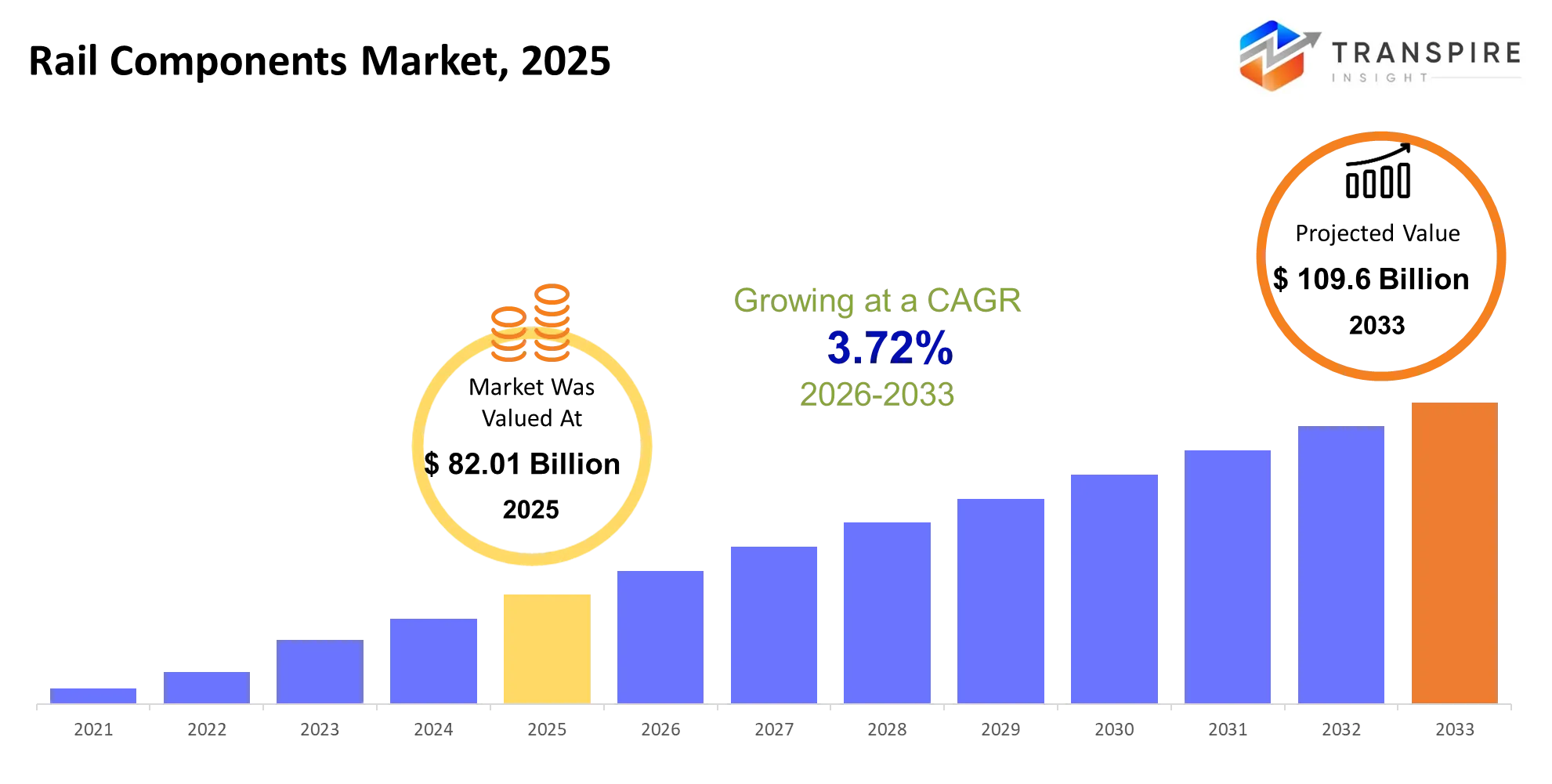
As per Transpire Insight, the Rail Components Market size is estimated at USD 82.01 billion in 2025 and is anticipated to reach USD 109.6 billion by 2033, growing at a CAGR of 3.72% from 2026 to 2033.
The Rail Components Market supports the manufacturing, maintenance and modernisation of railway systems. It provides parts such as braking systems, wheelsets, bogies, couplers, bearings, signalling equipment and electrical assemblies. In the last three to five years, there have been changes within the market, whereby the main area is now changing into replacing aged infrastructure within railway systems. This is done in order to improve the level of safety while operating and reducing the cost of maintaining. In this case, the increasing application of monitoring devices, predictive maintenance, and energy-saving rail technologies has been the trend. The government initiatives for upgrading railway systems and the high-speed rail networks development projects require railway companies to modernise their train fleet as well as purchase the new rail components. All the above mentioned trends contribute to the increasing demand for efficient components, which can help in increasing the train performance, life of the equipment and reducing unplanned downtime. In addition, the increasing number of passengers and the growth of freight transport as well as the safety requirements necessitate maintenance and purchasing durable components..
Rail Components Market Size & Forecast:
- Market Size 2025: USD 82.01 Billion
- Expected Market Value (2033): USD 109.6 Billion
- Forecast CAGR (2026–2033): 3.72%
- Leading Region in 2025: Asia Pacific
- Fastest Growing Region: Europe
- Key Company Profiles: Alstom, Siemens Mobility, CRRC Corporation, Hitachi Rail, Wabtec, Knorr-Bremse, CAF, Stadler Rail, Thales, Voith, Mitsubishi Electric, Toshiba, Faiveley Transport, Dellner, Schaltbau
Key Market Insights:
Market trends include modernisation of fleets, electrification, and improving railway safety without complicating maintenance issues. Bogies make up the largest component category, while battery-electric propulsion components are among the emerging markets
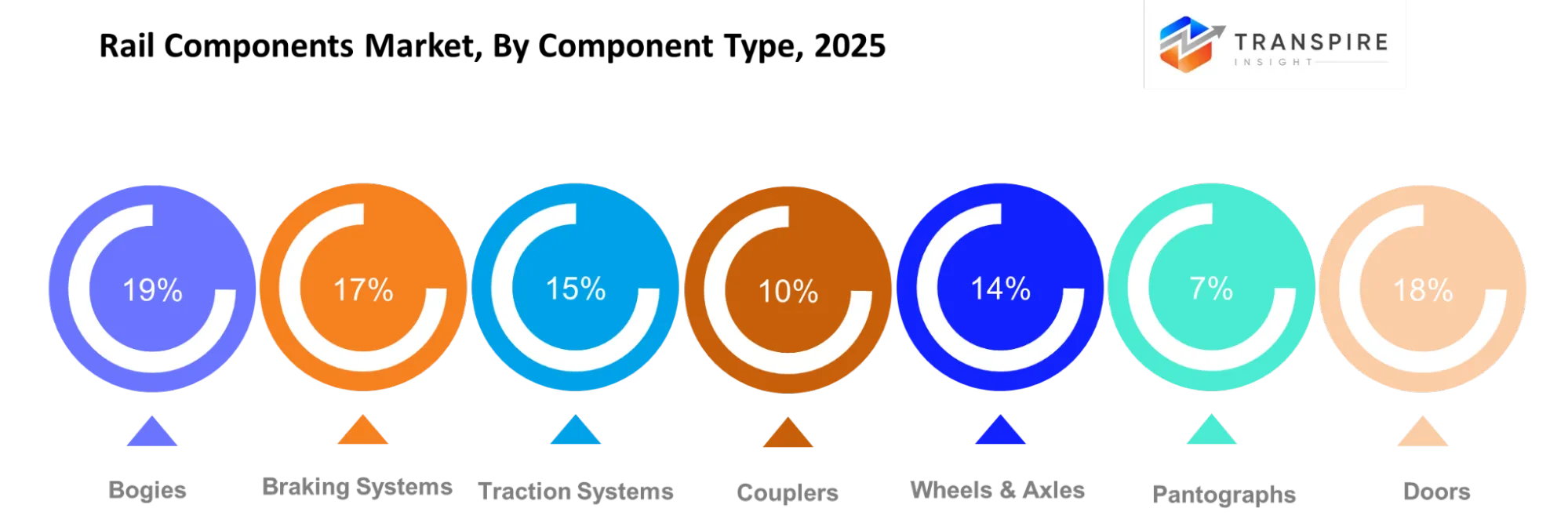
- Bogies make up 18.8% of the component market due to their critical function in train stability, load balancing, and proper functioning of trains.
- Brakes make up 16.5% of the component market as companies such as Knorr-Bremse are motivated to develop new brakes.
- The traction systems market comprises 15.5% as train manufacturers focus on energy efficiency and management of train performance.
- Wheels and axles account for 14% of the market due to investments in good material quality, wheelset monitoring, and maintenance based on condition.
- Couplers are 10.5% of the component market because dependable connection of trains is essential in rail transportation.
- Pantographs comprise 7.5% of the market due to the presence of electrified rail networks that allow for current collection.
What are the Key Drivers, Restraints, and Opportunities in the Rail Components Market?
Drivers:
Recapitalisation of the railway fleet and proliferation of infrastructure development is the primary driver for component sourcing. New metro corridors, high-speed rail corridors and congestion capacity enhancement of freight corridors are all driving requirements for integrated braking, traction, bogie, wheelset, and control systems. Continual focus on safety is driving the replacement of aging assets by opting to leverage from modernised component architectures instead of sticking to traditional maintenance practices; for instance, Indian Railways modernisation and proliferation of automated inspection vehicles are driving part sourcing requirements for more efficient asset management. These assets provide revenue for suppliers through OEM contracts, spare parts and periodic maintenance contracts.
Restraints:
High engineering costs, complex certification procedures and long procurement times can make it difficult for products or substitutes to get on the market. Rail components must meet stringent safety, durability and compatibility requirements and in many instances demand that the OEM develop a solution specific to each fleet. Fluctuations in the cost of copper, steel and specialised electronics can adversely affect margins, particularly when there are fixed price contracts.
Opportunities:
Electrification and alternative propulsion can offer great growth potential. Battery-powered and hydrogen trains require special energy storage, conversion, cooling and control components, and suppliers can consider remote monitoring and diagnostics, lightweight materials and refurbishment services. Cooperation between technology leaders and local suppliers can improve localisation, reduce supply risks and allow companies to bid on railway contracts in developing countries.
|
Driver |
Relative Impact on Growth (%) |
Geographic Relevance |
Impact Timeline |
Demand Strength |
Growth Mechanism (5–10 words) |
Key Beneficiaries (5–10 words) |
Major Constraint (5–10 words) |
|
Expansion of railway networks and rolling stock procurement |
28% |
Asia-Pacific, Europe, Middle East |
Long-term (≥4 years) |
High |
New rail lines increase demand for components and trainsets |
Rail OEMs, component manufacturers, infrastructure suppliers, maintenance providers |
High capital expenditure and prolonged project execution timelines |
|
Modernization of aging rail infrastructure and fleet replacement |
24% |
Europe, North America, Asia-Pacific |
Medium-term (2–4 years) |
High |
Fleet renewal creates replacement and retrofit component demand |
Bogie, braking, wheelset, coupler, and signalling manufacturers |
Budget limitations and lengthy procurement approval processes |
|
Urbanization and expansion of metro and high-speed rail |
20% |
Asia-Pacific, Europe, Middle East |
Long-term (≥4 years) |
High |
Rising passenger volumes accelerate metro and high-speed rail procurement |
Rolling stock OEMs, traction system suppliers, door and brake manufacturers |
Land acquisition challenges and infrastructure financing gaps |
|
Railway safety regulations and advanced signalling adoption |
16% |
Europe, North America, Asia-Pacific |
Medium-term (2–4 years) |
High |
Safety mandates accelerate upgrades to braking and control systems |
Safety equipment manufacturers, signalling vendors, railway operators |
Certification complexity and compatibility with legacy railway systems |
|
Electrification, energy efficiency, and digital rail technologies |
12% |
Europe, Asia-Pacific, North America |
Long-term (≥4 years) |
Medium |
Electrification and predictive maintenance increase advanced component adoption |
Traction equipment suppliers, sensor vendors, software providers, train operators |
High technology integration costs and uneven electrification progress |
|
Total |
100% |
Global |
— |
— |
— |
— |
— |
What Has the Impact of artificial intelligence on the Rail Components Market?
The application of artificial intelligence in the railway industry involves new methods of checking and maintaining the rolling stock. By using various sensors, operators can check the state of components, find potential failures and schedule maintenance based on the obtained data. The application of these technologies is applicable to bogies, wheels, axles, bearings, braking equipment and propulsion equipment. Automation is another important area of using artificial intelligence in the railway industry. Machine vision systems can be used for analysing trains that are in motion and finding loose, damaged, hanging or missing parts. Predictive models can be used for detecting unusual wear patterns, prioritising repairs and scheduling spare parts. The implementation of artificial intelligence requires investments in sensors, data infrastructure and staff training. Inconsistent data and false alerts can also have an impact on the accuracy of predictive models.
Instance:
In July 2025, Indian Railways inked an MoU with Dedicated Freight Corridor Corporation of India Limited (DFCCIL) for the installation of AI-based Machine Vision Inspection Systems (MVIS). The system can detect loose, missing, or hanging components of trains, which allows for early detection and maintenance of faults.
https://www.pib.gov.in/PressReleasePage.aspx?PRID=2143819&lang=2®=48
Key Market Trends:
Rail components production trends toward interconnectedness, efficiency, and longer lifecycles. The rivalry between suppliers moves toward the quality of system operation and service provision besides the price of individual components.
- Railway industry participants seek lighter materials such as aluminium and composites to optimise energy consumption and manage maintenance needs.
- Development of traction motors, converters, and controllers as one complex improves their interconnection and integration.
- Machine vision, automated diagnosis, and digital maintenance become more important in the search for defects and fast maintenance.
- Upgrades of metros and passenger trains pay much attention to the optimisation of doors, seating arrangement, and interior design.
- Providers of components are increasing their services, restoration, parts, and technical support to gain additional income from ongoing business relations.
Rail Components Market Segmentation
By Component Type:
Bogies dominate the component type with 18.8% market share due to their function of ensuring stability, suspension, and weight distribution for passenger and freight vehicles. The braking system holds a 16.5% market share, whereas the traction system accounts for 15.5%. Wheels and axles hold 14.0%, while couplers account for 10.5%. Seats and interiors account for 10.7%, pantographs hold 7.5%, and doors hold 6.5% of the market share. They meet various functional needs ranging from mechanical integrity to passenger convenience and power supply. Future investments will probably be directed towards components that are durable and easy to inspect digitally.
By Train Type:
The primary segments of rail vehicles are passenger trains, high-speed trains, metro trains, light-rail, freight trains, locomotive trains, monorail trains and tramway. Expansion of metro trains and light-rail leads to opportunities for doors, brake blocks, driver control equipment and passenger spaces, while high-speed trains need parts designed to operate at high speed, vibration and under extreme safety conditions. Freight operators use bogies, wheels, wheels and couplings to carry heavy loads with high-duty cycles. Locomotives have the prospect of modernisation, again likely to lead to propulsion equipment and electrical equipment, while monorails and tramways will use similar parts depending on the configuration of each system. The extent to which these segments will continue to develop will depend on the project pipeline, the replacement of fleets and the demands of individual systems.
By Propulsion:
The primary categories are electric, diesel, hybrid, battery-electric, hydrogen, dual-mode, fuel-cell, and others. Electric propulsion takes advantage of existing railway electrification, and the trend to improve energy efficiency; diesel-based propulsion remains important on routes without extensive electrical networks, and hybrid and dual-mode operation can help to address a mixture of routes with and without electrical capabilities. Battery-electric propulsion components are the fastest-growing in your supplied data, with a 9.1% CAGR, and this will open opportunities for energy storage, power electronics, thermal management, and charging infrastructure.But the extent of adoption will depend on charging infrastructure, operating economics, and the state of the technology.
By Application:
The application market covers OEM, aftermarket, maintenance, refurbishment, retrofit, new build railways, urban transit and freight rail. OEM demand is tied to new train orders and fleet size. Aftermarket activity is tied to mature installed equipment, railway activity and fleet renewal. Maintenance and refurbishment allow operators to extend the life of a fleet of trains rather than replacing the entire fleet with new equipment. Upgrades can provide enhanced safety, energy efficiency, and passenger comfort. New railway projects present the first demand for an integrated suite of components, and freight rail investments require components designed for heavy-duty hauling and continuous operation. Lifecycle service contracts and digital maintenance services may eventually prove to be major sources of revenue.
By Component Material:
Steel, aluminium, composite, copper, rubber, carbon fibre, titanium, and other materials are used to achieve various performance and cost targets. Steel will continue to be needed in load-carrying parts like bogies, wheels, and axles, and structural elements because of its inherent strength and the ease with which it can be manufactured. Aluminium can be used to save weight in certain parts of the vehicle, composites for certain lightweight parts with corrosion resistance, copper for the electrical wiring, and rubber for sealing, vibration control, and parts associated with suspension. Carbon fibre and titanium may be appropriate for some specialised uses requiring very high strength or light weight, but material choice will be driven by the effect on durability, ease of manufacture, safety certification, repair, and total cost of ownership during lifecycle.
By End User:
Rail operators, transit agencies, freight operators, government agencies, original equipment manufacturers (OEMs), maintenance providers, infrastructure companies and others. What passenger train operators want to see in their service is reliable and safe operation, accessibility and good fleet availability. They want trains to be able to operate in all types of conditions and provide a quality ride. What freight train operators want is high load capacity, durability and low downtime. OEMs' orders include new equipment and integrated system components, while maintenance providers contribute to demand through inspections, repairs and end-of-life replacements. Infrastructure companies may buy equipment related to electrification and rail upgrades. Suppliers that ensure timely delivery, technical service and end-of-life replacement parts have the best chance to develop long-term customer relationships.
What are the Key Use Cases Driving the Rail Components Market?
The use cases of bogies, brakes, wheels, and axles are critical to the effective operation of railways owing to their significance in ensuring stability, braking, loading, and movement. The significance of the four components in coaches, locomotives, and freight wagons makes it important that there is always a need for original equipment, spare parts, and maintenance. There has been an increased use of traction systems, pantographs, automated doors, and passenger carriages in urban transport developments. While the metros and light rails require equipment that is able to cope with frequent stops and heavy loads, the high-speed trains require equipment that is capable of coping with difficult circumstances. The new uses include battery-electric power, AI inspections, and digital freight wagons. The three innovations might help in effective energy utilisation and early identification of problems in the equipment to avoid any breakdowns.
|
Report Metrics |
Details |
|
Market size value in 2025 |
USD 82.01 Billion |
|
Market size value in 2026 |
USD 84.89 Billion |
|
Revenue forecast in 2033 |
USD 109.6 Billion |
|
Growth rate |
CAGR of 3.72% from 2026 to 2033 |
|
Base year |
2025 |
|
Historical data |
2021 - 2024 |
|
Forecast period |
2026 - 2033 |
|
Report coverage |
Revenue forecast, competitive landscape, growth factors, and trends |
|
Regional scope |
United States; Canada; Mexico; United Kingdom; Germany; France; Italy; Spain; Denmark; Sweden; Norway; China; Japan; India; Australia; South Korea; Thailand; Brazil; Argentina; South Africa; Saudi Arabia; United Arab Emirates |
|
Key company profiled |
Alstom, Siemens Mobility, CRRC Corporation, Hitachi Rail, Wabtec, Knorr-Bremse, CAF, Stadler Rail, Thales, Voith, Mitsubishi Electric, Toshiba, Faiveley Transport, Dellner, Schaltbau |
|
Customization scope |
Free report customization (country, regional & segment scope). Avail customized purchase options to meet your exact research needs. |
|
Report Segmentation |
Component Type (Bogies, Braking Systems, Traction Systems, Couplers, Wheels & Axles, Pantographs, Doors, Seats & Interiors)Train Type (Passenger Trains, High-Speed Trains, Metro, Light Rail, Freight Trains, Locomotives, Monorails, Tramways)Propulsion (Electric, Diesel, Hybrid, Battery-Electric, Hydrogen, Dual-Mode, Fuel Cell, Others)Application (OEM, Aftermarket, Maintenance, Refurbishment, Upgrades, New Railways, Urban Transit, Freight Rail)Component Material (Steel, Aluminum, Composite, Copper, Rubber, Carbon Fiber, Titanium, Others)End User (Rail Operators, Transit Authorities, Freight Operators, Government Agencies, OEMs, Maintenance Providers, Infrastructure Companies, Others) |
Which Regions are Driving the Rail Components Market Growth?
North America:
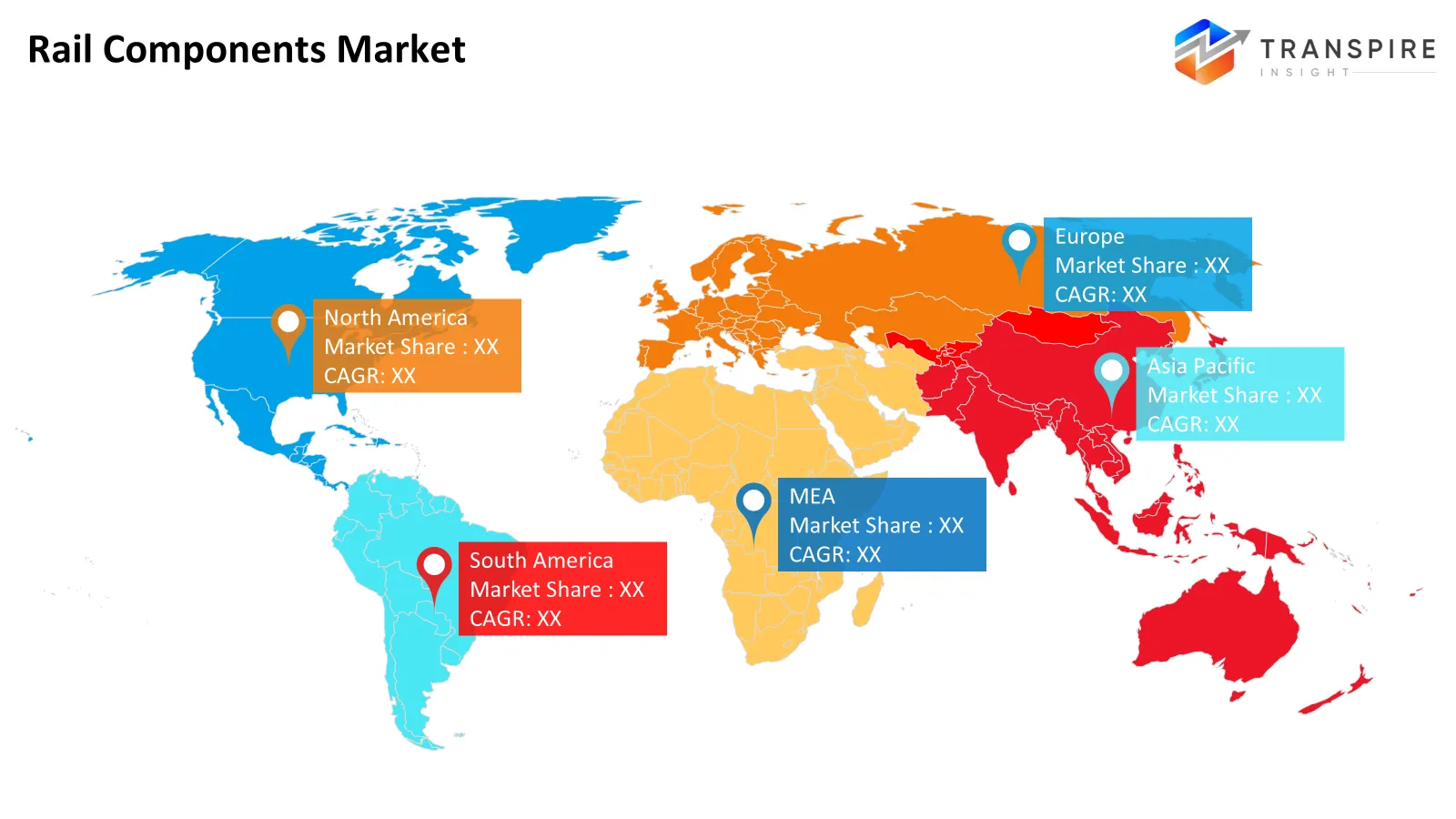
The North American region constitutes 18.9% of the rail components market due to the presence of freight railways, established rail network infrastructure, and the necessity to replace aged components. Freight railways require strong wheels, axles, bogies, braking systems, and couplers to bear high loads. The safety regulations and expenditure on maintenance promote replacement of old components and inspection technologies. The modernisation of passenger trains and urban transit systems offers opportunities for traction equipment, doors, and electrical components.
In January 2026, Wabtec obtained an order from New York’s MTA for additional hybrid battery-diesel locomotives, which boosted the demand for locomotive systems and components.
Europe:
Europe has the highest share of 27.5% in the market and is the fastest-growing region in the supplied data, with a CAGR of 7.8%. Its growth is driven by rail electrification, interconnectivity, fleet replacement, and investments in low-emission transport systems. The presence of rail engineering firms and a focus on interoperability promotes the development of advanced braking, traction, signalling, and monitoring technologies.
In March 2025, Siemens Mobility launched a distribution centre of rail components in Goole, UK, to aid component supply for train maintenance depots.
Asia Pacific:
Asia Pacific dominates the rail components industry with a market share of 43.5%, driven by large railway networks, rising urban population, and significant investments in rail network expansion. China and India, among other nations, are improving their passenger transport, metro networks, freight rail, and electrifying railways, thus generating opportunities in several component types. Increased investments in new trainsets and safety systems are expected to drive purchases of bogies, braking systems, traction systems, wheels, and electrical components.
In September 2025,CRRC & Ningbo Rail Transit Group launched a metro train with the innovative bogie system that increased the comfort level, braking efficiency, and energy savings.
https://www.crrcgc.cc/zjen/2025-09/16/article_2025091615011840820.html
Who are the Key Players in the Rail Components Marketand how do they compete?
In the worldwide rail components market, there are diversified railway technology groups, component manufacturers, and regional suppliers. Competitiveness in the industry is determined by engineering, safety certification, production capacity, product compatibility, delivery reliability, and lifecycle support. Competitive advantage may be achieved through long-term agreements and meeting the technical specifications of different railway networks. Knorr-Bremse offers unique products through braking technology and rail vehicle systems with engineering and after-market services. Wabtec offers railway equipment, digital monitoring, and freight-related technologies for helping clients solve reliability and efficiency problems. The company's contracts for pantographs in India prove its involvement in the development of electric passenger and urban transit systems. Siemens Mobility competes with integrated propulsion, control, digital rail, and maintenance solutions. Its June 2026 contract for the delivery of propulsion systems and train control technology for Pune Metro shows an example of a partnership approach to regional production and project implementation. Alstom relies on its rolling stock engineering, traction equipment, and maintenance services to take part in new projects and modernisation programs.
Rail Components Market Companies
- Alstom
- Siemens Mobility
- CRRC Corporation
- Hitachi Rail
- Wabtec
- Knorr-Bremse
- CAF
- Stadler Rail
- Thales
- Voith
- Mitsubishi Electric
- Toshiba
- Faiveley Transport
- Dellner
- Schaltbau
|
Company |
Est. Revenue Share Range |
Key Offerings |
Strategic Positioning |
Geographic Strength |
Technology Focus |
|
CRRC Corporation Limited |
Estimated: 8–14% |
Bogies, traction systems, braking equipment, wheelsets |
Scale-driven manufacturing and integrated component supply |
Asia Pacific, Latin America, Middle East & Africa |
High-efficiency traction and lightweight components |
|
Siemens Mobility |
Estimated: 5–9% |
Traction motors, bogies, braking systems, rail electronics |
Premium engineering and integrated mobility solutions |
Europe, North America, Asia Pacific |
Digital rail systems and energy-efficient propulsion |
|
Alstom |
Estimated: 5–9% |
Bogies, traction equipment, braking systems, onboard electronics |
Broad portfolio with lifecycle service integration |
Europe, Asia Pacific, North America |
Predictive maintenance and energy-efficient rail technologies |
|
Wabtec Corporation |
Estimated: 4–8% |
Braking systems, locomotive components, couplers, control systems |
Freight-focused expertise and aftermarket service leadership |
North America, Latin America, Asia Pacific |
Digital diagnostics and advanced braking controls |
|
Knorr-Bremse AG |
Estimated: 3–6% |
Brake systems, door systems, HVAC, onboard systems |
Safety-critical component specialization and OEM partnerships |
Europe, North America, Asia Pacific |
Intelligent braking and condition monitoring |
|
Hitachi Rail |
Estimated: 2–5% |
Traction systems, onboard control equipment, signaling interfaces, train electronics |
Integrated rail technology and system-level differentiation |
Europe, Asia Pacific, North America |
Digital signaling and connected train systems |
|
Stadler Rail AG |
Estimated: 1–4% |
Bogies, traction equipment, onboard systems, train doors |
Modular engineering and customized fleet solutions |
Europe, North America |
Modular platforms and energy-efficient propulsion |
|
Voith Group |
Estimated: 1–3% |
Rail drive systems, couplings, transmission components, braking-related technologies |
Specialized drivetrain engineering and component expertise |
Europe, Asia Pacific, North America |
Advanced drivetrains and mechanical efficiency |
|
Construcciones y Auxiliar de Ferrocarriles (CAF) |
Estimated: 1–3% |
Bogies, traction systems, braking equipment, onboard electronics |
Integrated manufacturing with customized component solutions |
Europe, Latin America, Asia Pacific |
Modular traction and fleet digitalization |
|
The Greenbrier Companies |
Estimated: 1–3% |
Freight wagon components, bogies, wheelsets, railcar structures |
Freight rail specialization and cost-efficient manufacturing |
North America, Latin America |
Lightweight wagon design and manufacturing efficiency |
Recent Development News
- In June 2026, Titagarh Rail Systems has placed an order with Siemens for Pune Metro. The order comprises train control and monitoring systems and propulsion systems for 12 trainsets. The contract facilitates local production and opens up scope for traction converters and motors, and other electrical equipment. https://press.siemens.com/in/en/pressrelease/siemens-receives-order-titagarh-rail-systems-limited-deliver-advanced-metro-propulsion
- In January 2025, Alstom announced a Vande Bharat sleeper train order. The contract includes traction equipment and other electrical systems for 17 trainsets plus associated maintenance and technical assistance. It is part of a project to upgrade passenger train technology in India that demands bespoke propulsion equipment and long-term service offerings. https://www.alstom.com/press-releases-news/2025/1/alstom-supply-traction-components-and-maintenance-services-vande-bharat-sleeper-trains-india
What Strategic Insights Define the Future of the Rail Components Market?
The market for rail components is evolving into a model of business where reliability of components, energy savings, and lifecycle management have become as much of an importance as purchase prices. Bogies remain strong due to their applicability to several types of trains; battery-electric engines provide potential for suppliers manufacturing new electrical systems. Asia Pacific accounts for the highest existing market capacity, while the forecasted growth in Europe implies an opportunity related to electrification and upgrading of existing fleets. Another risk that is not that obvious relates to incompatibility due to the integration of new technological components into the existing railroad fleets. An expensive certification process, diverse standards of equipment, and lack of access to operational data may become barriers to the successful realisation and financial success of projects. In addition to innovations, suppliers should give preference to modularity, integration into existing systems, and solid after-sales support. Cooperation with railway companies and local producers will also facilitate gaining access to markets.
Key Segmentations are:
Component Type
- Bogies
- Braking Systems
- Traction Systems
- Couplers
- Wheels & Axles
- Pantographs
- Doors
- Seats & Interiors
Train Type
- Passenger Trains
- High-Speed Trains
- Metro
- Light Rail
- Freight Trains
- Locomotives
- Monorails
- Tramways
Propulsion
- Electric
- Diesel
- Hybrid
- Battery-Electric
- Hydrogen
- Dual-Mode
- Fuel Cell
- Others
Application
- OEM
- Aftermarket
- Maintenance
- Refurbishment
- Upgrades
- New Railways
- Urban Transit
- Freight Rail
Component Material
- Steel
- Aluminum
- Composite
- Copper
- Rubber
- Carbon Fiber
- Titanium
- Others
End User
- Rail Operators
- Transit Authorities
- Freight Operators
- Government Agencies
- OEMs
- Maintenance Providers
- Infrastructure Companies
- Others
By Regional Analysis
North America
- US
- Canada
- Mexico
Europe
- Germany
- UK
- France
- Italy
- Spain
- Russia
- Rest of Europe
Asia Pacific
- China
- Japan
- India
- South Korea
- Australia
- Rest of Asia Pacific
South America
- Brazil
- Argentina
- Rest of South America
Middle East & Africa
- UAE
- Saudi Arabia
- Qatar
- South Africa
- Rest of the Middle East & Africa
Frequently Asked Questions
Find quick answers to common questions.
The rail components market size was valued at USD 82.01 Billion in 2025 and is poised to reach USD 109.6 Billion by 2033, expanding at a 3.72% CAGR.
Key segments for the rail components market are Component Type (Bogies, Braking Systems, Traction Systems, Couplers, Wheels & Axles, Pantographs, Doors, Seats & Interiors)Train Type (Passenger Trains, High-Speed Trains, Metro, Light Rail, Freight Trains, Locomotives, Monorails, Tramways)Propulsion (Electric, Diesel, Hybrid, Battery-Electric, Hydrogen, Dual-Mode, Fuel Cell, Others)Application (OEM, Aftermarket, Maintenance, Refurbishment, Upgrades, New Railways, Urban Transit, Freight Rail)Component Material (Steel, Aluminum, Composite, Copper, Rubber, Carbon Fiber, Titanium, Others)End User (Rail Operators, Transit Authorities, Freight Operators, Government Agencies, OEMs, Maintenance Providers, Infrastructure Companies, Others).
Growth is primarily driven by increasing investments in railway infrastructure, expanding metro and high-speed rail networks, rising demand for railway electrification, modernization of aging rail systems, and the growing adoption of advanced technologies to improve safety, efficiency, and reliability.
The market is led by major manufacturers including Alstom, Siemens Mobility, CRRC Corporation, Hitachi Rail, Wabtec, Knorr-Bremse, CAF, Stadler Rail, Thales, Voith, Mitsubishi Electric, Toshiba, Faiveley Transport, Dellner, Schaltbau.
The Asia Pacific region leads in the rail components market with 43.5% market share due to fast-growing railway infrastructure, urbanisation, expansion of subway systems, government funding for high-speed railways, and increased demand for trains and rail components.
The commercial opportunities in the international market for rail components include the increasing construction of high-speed rail and metro systems, railway electrification, renovation of old railway infrastructure, increased demand for energy-efficient rail components, and application of intelligent technology for prediction and preventive maintenance in railways.
- Alstom
- Siemens Mobility
- CRRC Corporation
- Hitachi Rail
- Wabtec
- Knorr-Bremse
- CAF
- Stadler Rail
- Thales
- Voith
- Mitsubishi Electric
- Toshiba
- Faiveley Transport
- Dellner
- Schaltbau
About the Authors

Mayur Shinde
I am Mayur Shinde, a Senior Research Analyst at Transpire Insight, specializing in the Automotive & Transportation and Information & Communication Technology (ICT) Industry. My work focuses on analyzing emerging market trends, technological advancements, competitive landscapes, and industry developments to deliver accurate, data-driven insights. I am passionate about transforming complex market information into clear, actionable content that helps businesses, professionals, and decision-makers stay informed and make confident strategic decisions.

Chakradhar Khansole
Chakradhar serves as the Research Director at Transpire Insight, bringing over 8 years of experience in technology, innovation, and strategic market intelligence. He specializes in transforming complex market data into actionable business insights that enable organizations to make informed, growth-oriented decisions. Recognized for his strategic vision and analytical expertise, Chakradhar leads high-impact research initiatives, delivering comprehensive market assessments, competitive intelligence, and forward-looking industry analysis.
Recently Published Reports
-
Apr 2026
ATV & UTV Market
ATV & UTV Market Size, Share & Analysis Report By Type (ATV, and UTV), By Variants (Less Than 400 CC, 400 CC To 800 CC, and More Than 800 CC), and Geography (North America, Europe, Asia-Pacific, Middle East and Africa, South and Central America), 2021 - 2031
-
Apr 2026
Automotive Central Gateway Module Market
Automotive Central Gateway Module Market Size, Share & Analysis Report By Type (Ethernet Central Gateway Module, CAN Central Gateway Module, LIN Central Gateway Module, and FlexRay), By Application (Powertrain Control, Body Control, Infotainment System, Advanced Driver Assistance Systems (ADAS), and Others), By End User (Passenger Vehicles, and Commercial Vehicles), and Geography (North America, Europe, Asia-Pacific, Middle East and Africa, South and Central America), 2021 - 2031
-
Apr 2026
Automotive Engine Oil Filter Market
Automotive Engine Oil Filter Market Size, Share & Analysis Report By Filter Type (Fuel Filter, Engine Oil Filter, Hydraulic Oil Filter, and Others), By Filter Media (Cellulose, Synthetic, and Micro), By Sales Channel (OEMs, and Aftermarket), By Vehicle Type (Passenger Cars, Light Commercial Vehicles, Heavy Duty Trucks, Buses and Coaches, and Off-road Vehicles), and Geography (North America, Europe, Asia-Pacific, Middle East and Africa, South and Central America), 2021 - 2031
-
Apr 2026
Automotive Parts Aluminium Die Casting Market
Automotive Parts Aluminium Die Casting Market Size, Share & Analysis Report By Production Process (Pressure Die Casting, Vacuum Die Casting, Squeeze Die Casting, Gravity Die Casting), By Application (Body Parts, Engine Parts, Transmission Parts, Battery And Related Components, Other Application Types), and Geography (North America, Europe, Asia-Pacific, Middle East and Africa, South and Central America), 2021 - 2031
Our Clients