Automotive EPS Market Summary:
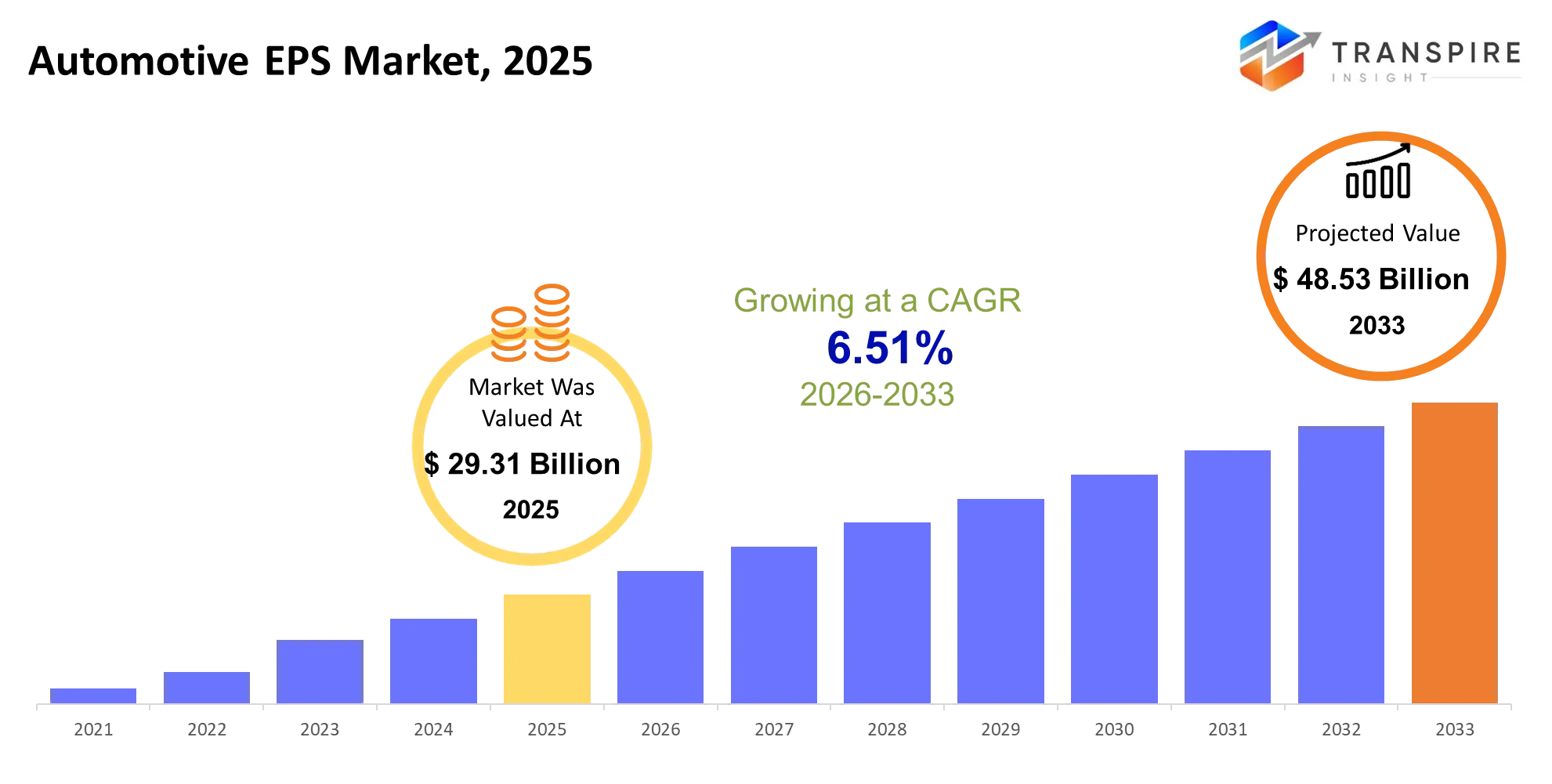
As per the Transpire Insight, The Automotive EPS Market size is estimated at USD 29.31 billion in 2025 and is anticipated to reach USD 48.53 billion by 2033, growing at a CAGR of 6.51% from 2026 to 2033.
The automotive EPS market supplies a system that replaces the conventional engine-driven hydraulic pump with an electronically powered, motor-driven power steering mechanism to reduce fuel consumption and allow for electronic control. In the past three to five years, EPS has been redefined from a convenience to a safety platform for lane-keep assist, autonomous parking, and driver assistance systems. A major structural change is on the horizon and is truly transformative: vehicle electrification- battery-electric and hybrid platforms can benefit from EPS because they only draw current when steering action is required, and it integrates easily into the digital, sensing, and control domain of the chassis. The real-world driver in recent years has been emissions legislation and the fast adoption of cars with ADAS systems that demand free steering torque that can be electronically controlled- a follow-on-to-identify sequence: the regulator and the OEM advocate for electrification and assistance, vehicles demand electronically controlled steering, and suppliers expand EPS production, software, and sensor-based architecture in core models.
Automotive EPS Market Size & Forecast:
- Market Size 2025: USD 29.31 Billion
- Expected Market Value (2033): USD 48.53 Billion
- Forecast CAGR (2026–2033): 6.51%
- Leading Region in 2025: Asia Pacific
- Fastest Growing Region: Europe
- Key Company Profiles: JTEKT, Nexteer Automotive, NSK, ZF, Bosch, DENSO, Hitachi Astemo, Hyundai Mobis, Mando, Thyssenkrupp, Mitsubishi Electric, Nidec, Valeo, NSK Steering Systems, Schaeffler.
Key Automotive EPS Market Insights:
The competition has progressed from steering assistance to software-defined, safety-certified chassis control. Suppliers who are able to offer high-torque hardware, redundancy, and ADAS-ready calibration are being successful in securing new programmes.
- Rack EPS is 42.5%, and in 2026, JTEKT named its linkless steering system Syncusteer, which is steer-by-wire, advancing software-defined steering.
- The CAGR of electric vehicle EPS is 9.8%, and Nexteer started ASIL-D certified steer-by-wire production for a Chinese NEV manufacturer in April 2026.
- In the column-assist EPS, Nexteer's high-output version has reached 110 Nm, allowing EPS to be used in crossovers and entry EVs, where it is used at 18.0%.
- Pinion EPS is 24.0%, with Bosch increasing Hungarian EPS production, bolstering European supply, with an investment of USD 117 million.
- Dual-pinion EPS supports 7.0%, and ZF has started series steer-by-wire production for NIO ET9, which puts a focus on redundant actuators and software.
- The partnership between Belt-driven EPS and DENSO for 2025 aims at efficiency and torque control for BEV and PHEV.
- Direct-drive EPS has a 2.5% share in JTEKT's Lexus RZ fail-operational steering; the Lexus RZ has Direct-Drive EPS with Syncusteer and Libuddy backup power.
- Electric steering columns make up 1.5% of the market, and Hyundai Mobis and Mando are using Korean OEM platforms to expand ADAS-integrated steering.
- OEM and Tier-1 channels are the most dominant, with the NIO deal extended by Bosch to three vehicle brands in February 2026.
What are the Key Drivers, Restraints, and Opportunities in the Automotive EPS Market?
Driver:
Electrification and ADAS adoption are accelerating EPS demand. The trigger is the shift to battery-electric platforms and regulatory pressure for safer, energy-efficient vehicles; EPS draws power only when assistance is needed, improving range and emissions performance. As lane-centring, automated parking and emergency-steering functions move from premium models into mainstream vehicles, OEMs specify EPS to obtain precise, software-controlled torque. This raises electronic content, sensor requirements and revenue per vehicle, while creating recurring opportunities in calibration software and over-the-air updates.
Restraint:
High development, validation and certification costs continue to limit adoption, particularly among smaller suppliers and price-sensitive vehicle programmes. The constraint persists because EPS must satisfy functional-safety, cybersecurity and redundancy requirements. Integrating motors, sensors and control units with legacy vehicle architectures also demands extensive testing, supplier co-engineering and long qualification cycles, slowing hydraulic-system replacement.
Opportunity:
Steer-by-wire and software-defined steering can unlock the next growth phase. By removing the mechanical column connection, OEMs can redesign cabins, vary steering ratios by driving mode and support higher automation levels. Investment in redundant actuators, AI-based steering-feel algorithms and ASIL-D-certified control software visible in Bosch, ZF and JTEKT programmes positions EPS suppliers to capture higher-value contracts as automated and electric vehicle platforms scale globally.
Automotive EPS Market – Driver Impact Analysis
|
Driver |
Relative Impact on Growth (%) |
Geographic Relevance |
Impact Timeline |
Demand Strength |
Growth Mechanism |
Key Beneficiaries |
Major Constraint |
|
Rising Electric Vehicle Production and EPS Adoption |
30% |
Asia Pacific, Europe, North America |
Short-term (≤2 years) |
High |
EV production increases demand for energy-efficient electric steering systems. |
EPS manufacturers, EV OEMs, electric motor suppliers |
High component costs and automotive supply chain disruptions. |
|
Growing Integration of ADAS and Autonomous Driving Technologies |
25% |
North America, Europe, China, Japan |
Medium-term (2–4 years) |
High |
Lane-keeping and automated driving require precise electronic steering control. |
Tier-1 suppliers, ADAS developers, steering technology manufacturers |
Functional safety certification and complex system integration requirements. |
|
Stricter Fuel Efficiency and Vehicle Emission Regulations |
20% |
Europe, North America, Asia Pacific |
Medium-term (2–4 years) |
High |
Hydraulic steering replacement reduces parasitic energy consumption and emissions. |
Automotive OEMs, EPS component suppliers, technology providers |
Regulatory uncertainty and high vehicle platform conversion costs. |
|
Advancements in Steer-by-Wire and Intelligent Steering Systems |
15% |
Japan, China, Germany, United States |
Long-term (≥4 years) |
High |
Redundant electronics enable software-defined steering and automated vehicle architectures. |
Steering system manufacturers, semiconductor suppliers, software developers |
High development costs and stringent safety validation requirements. |
|
Increasing Passenger Vehicle Production and Consumer Comfort Expectations |
10% |
India, Southeast Asia, China, Latin America |
Short-term (≤2 years) |
Medium |
Affordable EPS improves maneuverability, parking assistance, and driving comfort. |
Passenger car manufacturers, steering suppliers, automotive component producers |
Price-sensitive consumers and intense OEM component pricing pressure. |
|
Total |
100% |
Global |
Short- to Long-term |
High |
Electrification, automation, and efficiency accelerate EPS market expansion. |
Automotive OEMs, Tier-1 suppliers, technology developers |
Cost pressures, integration complexity, and regulatory compliance challenges. |
What Has the Impact of Artificial Intelligence Been on the Automotive EPS Market?
AI is evolving the Electric Power Steering (EPS) from a static assist device to an adjustable, steward-style control system. Through machine learning, data collected through a torque sensor, vehicle speed, and road surface data are used to optimise assistance levels, minimise noise levels, and deliver acceptable steering feel under various conditions. In automation, AI enables the vehicle to maintain a lane, park itself, and execute emergency/intentional avoidance manoeuvres by utilising torque output with camera, radar, and brake input. Condition monitoring is also evolving as algorithms can flag anomalies in motor current, sensor drift, and mechanical wear for predictive maintenance and warranty exposure. From an operational standpoint, AI-enabled calibration reduces development time, while over-the-air updates allow OEMs to continue learning driver response, lane-tracing, and steering characteristics post-sale. While these benefits are potential positives for users, OEMs and suppliers face challenges that centre on low system accuracy, safety impact, and integration time. AI models must be able to predict torque outputs and sensor data reliably, and suppliers must provide extensive testing, functional safety certification, and redundant hardware until production.
In May 2026, NIO launched its ES9 with China’s first mass-produced steer-by-wire system certified by MIIT, alongside AI-powered driving software and automatic emergency steering. The launch brings electronically controlled steering and AI-enabled safety functions together in a production EV, expanding real-world deployment of software-integrated steering.
https://www.emove360.com/nio-launches-es9/
Key Automotive EPS Market Trends:
EPS is transitioning from a hydraulic replacement system to a chassis-control system using software. It is now not only about steering assistance but also about compatibility with ADAS, electrification, and steer-by-wire.
- As electronic architectures become commonplace, it is not only premium cars that are adopting EPS.
- Rack-assist EPS is being specified more and more by OEMs for larger torque, stability, and highway assist requirements on SUVs and EVs.
- The EPS is becoming an active safety interface, with ADAS functions such as lane centring and automated parking.
- Platforms that are battery electric are driving EPS demand, due to the weight, complexity and losses of hydraulic systems.
- Steer-by-wire development is separating the driver's input from the road-wheel activation, which allows for flexible cabins and variable steering ratios.
- Suppliers are introducing duplicate sensors, actuators, and cybersecurity protection to prepare for automated driving.
- After-sales improvement of steering feel, lane-tracing and assistance parameters are possible with the help of over-the-air updates.
- The regulatory process for UN R79 is clarifying the approval process for full power steering and automated steering systems.
- The competition is moving away from hardware and into control software, sensor fusion, and certified functional-safety capability.
Automotive EPS Market Segmentation
Type:
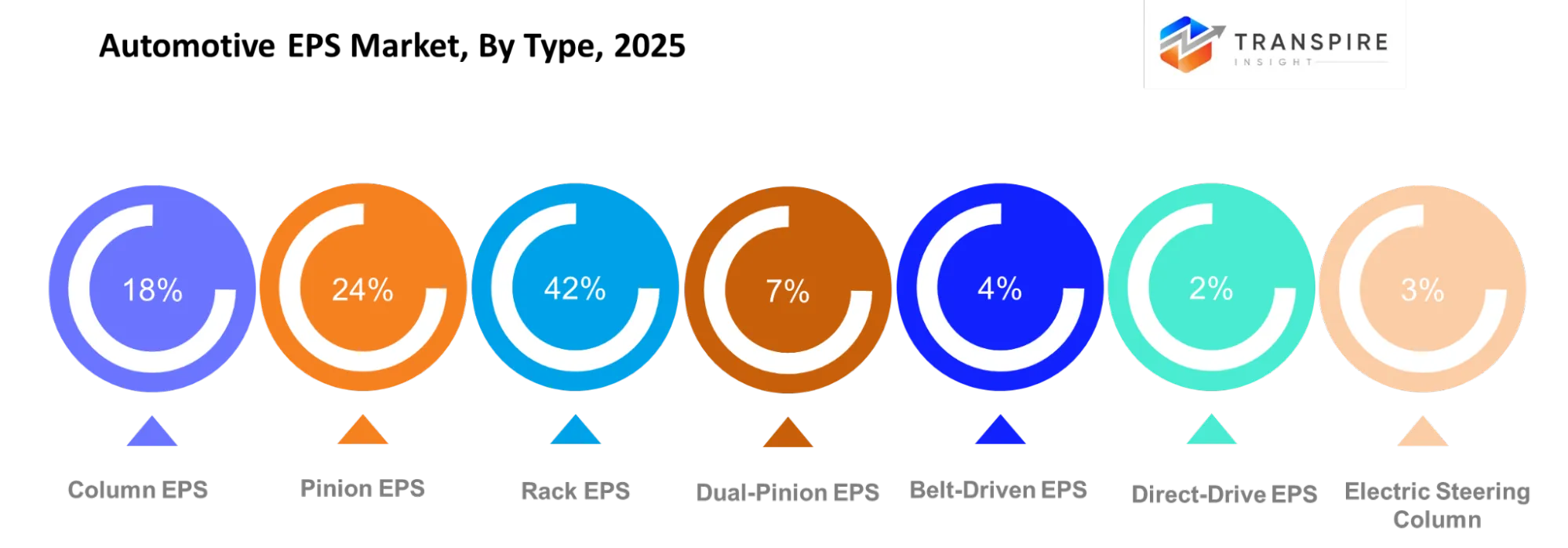
Rack EPS leads with a 42.5% share because its higher assist capacity suits SUVs, EVs and vehicles requiring precise ADAS control; its growth logic rests on heavier vehicles, performance models and advanced assistance features, pointing to continued premiumisation. Column EPS holds 18.0%, retaining strength in compact and mid-size passenger cars through lower cost, simpler packaging and established manufacturing scale. Pinion EPS accounts for 24.0%, balancing performance and affordability across mainstream platforms, while dual-pinion EPS represents 7.0% and targets vehicles needing more refined feedback. Belt-driven EPS holds 4.0%, direct-drive EPS 2.5%, electric steering columns 1.5%, and others 0.5%, reflecting niche, cost-focused, or transitional designs.
Vehicle Type:
Passenger cars remain the largest base, but EPS for electric vehicles is the fastest-growing category at 9.8% CAGR because EV architectures favour efficient, electronically integrated steering. SUVs and light commercial vehicles support rack-based systems, while hybrid and autonomous vehicles create demand for redundant, high-precision steering architectures. This shift is pushing suppliers to develop scalable motor and control platforms rather than vehicle-specific hardware, improving cost efficiency and supporting faster adaptation across multiple vehicle programmes and regional manufacturing networks globally.
Component:
Electric motors, ECUs, torque sensors and steering racks capture the largest value as electrification shifts spending toward electronics and control software. Brushless and permanent-magnet motors dominate technology preferences due to efficiency, durability and compatibility with high-torque applications. Suppliers are increasingly integrating sensors, control units and reduction gears into compact modules, allowing OEMs to reduce assembly complexity, improve diagnostic capability and support over-the-air calibration across electric, hybrid and advanced driver-assistance vehicle platforms worldwide.
Technology:
Brushless and permanent-magnet motors dominate technology preferences due to efficiency, durability and compatibility with high-torque applications. Their maintenance and controllable output suit electrified platforms, where steering must deliver reliable assistance without wasting battery energy. Brushed motors remain relevant in cost-sensitive applications, while belt-drive, dual-pinion and direct-drive designs offer alternative ways to balance force, packaging and steering feel. Sensor-based control adds precision by adjusting support to operating conditions. Development will increasingly favour compact, quieter motor units with validated software and redundancy.
Application:
Demand is led by passenger vehicles, EV steering, ADAS, lane keeping and parking assistance. EPS is becoming a core interface for automated functions, translating driver input and sensor data into precise torque control. As lane-centring and automated parking expand beyond premium models, OEMs are specifying higher-resolution torque sensors and faster control modules. This transition increases system value while requiring suppliers to balance responsiveness, safety redundancy and consistent steering feel across diverse vehicle platforms and operating conditions.
Sales Channel:
OEMs and Tier-1 suppliers remain the principal sales channels, although replacement, retrofit and independent-workshop demand will expand as installed EPS fleets age and software-based servicing grows. OEM partnerships increasingly involve long-term platform contracts covering motors, sensors and calibration software. Meanwhile, aftermarket providers are preparing for electronic diagnostics, component replacement and software updates. This shift creates recurring service revenue opportunities while raising expectations for cybersecurity protection, repairability and compatible replacement parts across ageing vehicle fleets and evolving service networks.
What are the Key Use Cases Driving the Automotive EPS Market?
Rack EPS, holding 42.5% of the market, is the core use case in passenger cars, SUVs and electric vehicles, where high steering torque, lane-centring support and precise highway assistance are required. Its fitment is expanding as OEMs standardise ADAS-ready steering across mainstream vehicle platforms.
Expanding applications include automated parking, emergency steering and EV-specific steering calibration. Electric vehicles, growing at a 9.8% CAGR in EPS demand, use EPS to conserve energy and integrate smoothly with digital chassis controls.
Emerging use cases centre on steer-by-wire, rear-wheel steering and autonomous driving. Dual-actuator EPS and software-defined steering enable tighter turning radii, adjustable steering feel and redundant control for higher automation levels.
|
Report Metrics |
Details |
|
Market size value in 2025 |
USD 29.31 Billion |
|
Market size value in 2026 |
USD 31.21 Billion |
|
Revenue forecast in 2033 |
USD 48.53 Billion |
|
Growth rate |
CAGR of 6.51% from 2026 to 2033 |
|
Base year |
2025 |
|
Historical data |
2021 - 2024 |
|
Forecast period |
2026 - 2033 |
|
Report coverage |
Revenue forecast, competitive landscape, growth factors, and trends |
|
Regional scope |
United States; Canada; Mexico; United Kingdom; Germany; France; Italy; Spain; Denmark; Sweden; Norway; China; Japan; India; Australia; South Korea; Thailand; Brazil; Argentina; South Africa; Saudi Arabia; United Arab Emirates |
|
Key companies profiled |
JTEKT, Nexteer Automotive, NSK, ZF, Bosch, DENSO, Hitachi Astemo, Hyundai Mobis, Mando, Thyssenkrupp, Mitsubishi Electric, Nidec, Valeo, NSK Steering Systems, Schaeffler. |
|
Customization scope |
Free report customization (country, regional & segment scope). Available customized purchase options to meet your exact research needs. |
|
Report Segmentation |
Type (Column EPS, Pinion EPS, Rack EPS, Dual-Pinion EPS, Belt-Driven EPS, Direct-Drive EPS, Electric Steering Column, Others)Vehicle Type (Passenger Cars, Light Commercial Vehicles, Heavy Commercial Vehicles, SUVs, Electric Vehicles, Hybrid Vehicles, Autonomous Vehicles, Others)Component (Electric Motor, ECU, Steering Rack, Torque Sensor, Steering Column, Reduction Gear, Control Module, Others)Technology (Brushless Motor, Brushed Motor, Permanent Magnet Motor, Dual-Pinion, Belt Drive, Direct Drive, Sensor-Based, Others)Application (Passenger Vehicles, Commercial Vehicles, EV Steering, ADAS, Autonomous Driving, Parking Assistance, Lane Keeping, Others)Sales Channel (OEM, Aftermarket, Replacement, Retrofit, Tier-1 Suppliers, Dealer Networks, Independent Workshops, Others) |
Which Regions are Driving the Automotive EPS Market Growth?
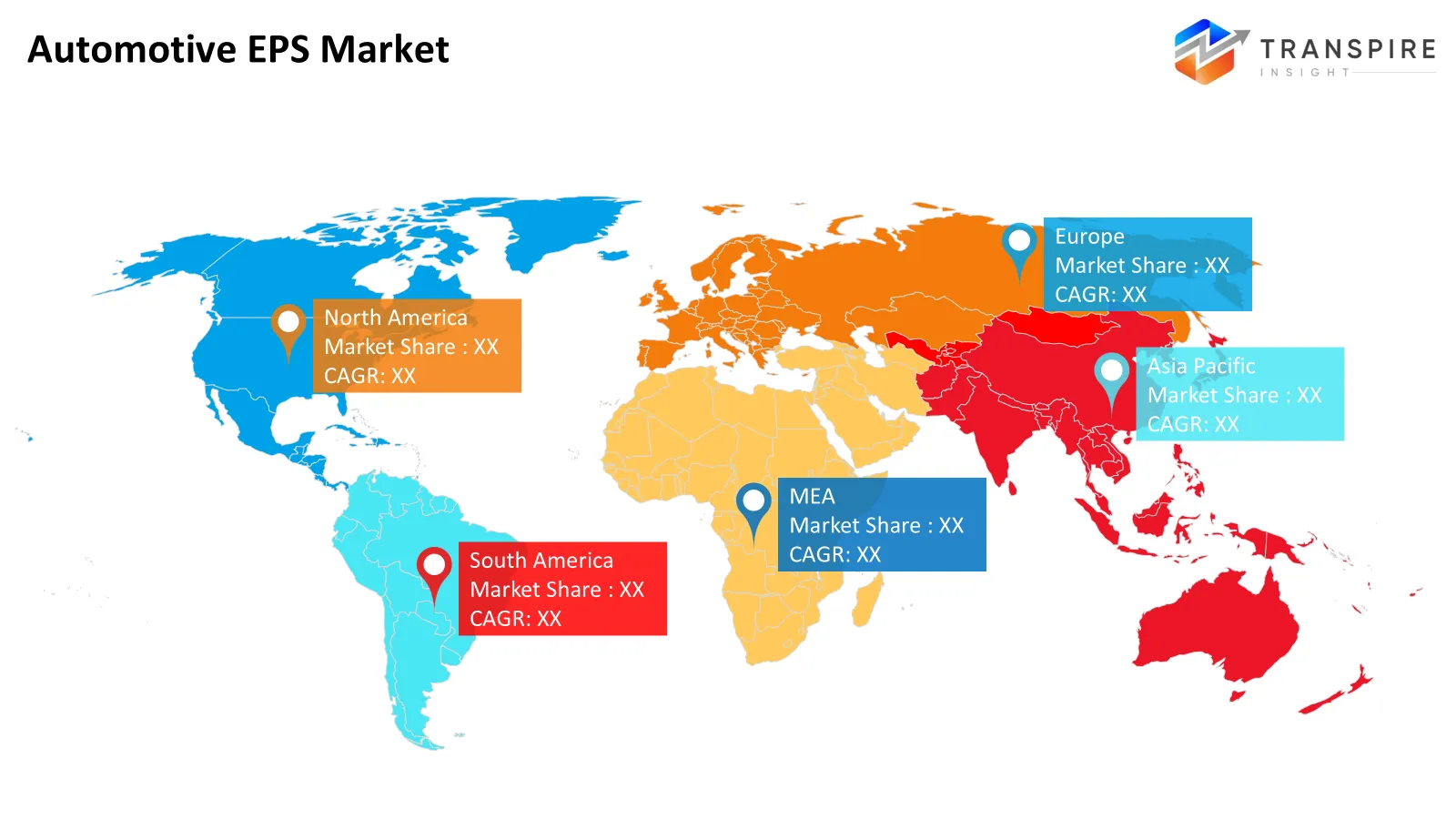
Asia Pacific holds 46.0% of the automotive EPS market because of China's electric-vehicle production volume and Japan's large concentration of steering part suppliers. The region holds the largest market share because OEMs, Tier-1 suppliers, motor manufacturers, and software developers have long-established, highly coordinated supply chain networks. China's GB 17675-2025 standard, which takes effect in July 2026, has eliminated the requirement for a mechanical steering linkage and opened the door for steer-by-wire. As a result of policy and the burgeoning NEV market, Asia Pacific is becoming the primary centre of innovation.
In July 2026, NIO deployed its production steer-by-wire system on its flagship ET9 model, aligning directly with the official enforcement of China's new GB17675-2025 steering safety standard.
North America accounts for 20.0% and provides a relatively more stable and regulation-oriented market environment compared to Asia Pacific's volume-driven growth. Demand is mainly driven by the production of SUVs and light trucks, which have a heavier mass that requires rack-assist EPS and higher torque. The main specification driver is safety-oriented ADAS adoption instead of steer-by-wire commercialisation. Latin America accounts for 4.0% and the Middle East & Africa 3.0%, where imported platforms and replacement demand enable smaller-scale growth.
In July 2026, ZF Friedrichshafen AG reached a production milestone of 100 million electric power steering (EPS) systems, highlighting how EPS has shifted from basic hydraulic replacement into a vital building block for advanced safety software and software-defined vehicle architectures.
https://www.zf.com/mobile/en/homepage/homepage.html
Europe at 27.0% and 8.6% CAGR is the fastest-growing market thanks to premium OE use of steer-by-wire and autonomous-driving functions. Mercedes-Benz EQS 2026 application and ZF technology in Europe have moved the technology into series supply. Opportunities exist in premium software-defined steer-by-wire architectures ready for cybersecurity, as well as in redundancy systems. As the European Union tighter safety regulations lead to stronger demand for certified, fail-operational steer-by-wire platforms.
In April 2026, Mercedes-Benz launched the steer-by-wire option on its updated production EQS saloon. This deployment eliminates the mechanical steering column in favour of two independent digital signal paths, providing full fail-operational redundancy paired with the vehicle's standard rear-axle steering system.
https://media.mercedes-benz.com/
Who are the Key Players in the Automotive EPS Market, and how do they compete?
Competition is intensifying in the automotive EPS market across high-torque actuation, functional-safety certification, and software-defined steering in the eyes of automakers. Companies such as JTEKT, Nexteer, ZF, and Bosch are setting the industry standard in the market through steer-by-wire programs. Others, such as NSK, DENSO, Hitachi Astemo, and Hyundai Mobis, are maintaining their share with OEM platform selections. Mando, Thyssenkrupp, Mitsubishi Electric, Nidec, Valeo, Schaeffler, and NSK Steering Systems are competing by providing specific subsystems, sensors, gears, or motors.
JTEKT is pursuing an innovation-led differentiation strategy with its Syncusteer linkless steer-by-wire solution and Libuddy backup-power architecture; its growth strategy is driven by premium BEV programs such as Lexus. Nexteer leverages a platform-scaling strategy with its modular column, dual-pinion, and rack-assist EPS components as it grows its steer-by-wire production in Chinese NEV markets. ZF employs a chassis-level integration strategy, with steer-by-wire in series production for NIO, with capacity growth in Zhangjiagang. Bosch leverages scale in the ecosystem with its NIO contract, expansion in Hungarian capacity, and steer-by-wire alliances to offer comprehensive software and hardware packages.
Key Players are:
- JTEKT
- Nexteer Automotive
- NSK
- ZF
- Bosch
- DENSO
- Hitachi Astemo
- Hyundai Mobis
- Mando
- Thyssenkrupp
- Mitsubishi Electric
- Nidec, Valeo
- NSK Steering Systems
- Schaeffler
Automotive EPS Market — Enhanced Competitive Benchmarking
|
Company |
Est. Revenue Share Range |
Key Offerings |
Strategic Positioning |
Geographic Strength |
Technology Focus |
|
JTEKT Corporation |
Estimated 13–17% |
Column-assist EPS, pinion-assist EPS, rack-assist EPS, steering control systems |
volume leader leveraging integrated steering manufacturing expertise. |
Asia Pacific, North America, Europe |
Compact EPS architectures, advanced torque sensing, redundant control. |
|
Robert Bosch GmbH |
Estimated 11–15% |
Servoelectric EPS, rack-assist steering, electric steering control units, steering actuators |
Premium technology leader integrating steering with vehicle dynamics. |
Europe, Asia Pacific, North America |
Redundant EPS electronics, ADAS integration, software-defined steering control. |
|
Nexteer Automotive |
Estimated 10–14% |
Column EPS, rack EPS, modular pinion EPS, steer-by-wire systems |
High-volume specialist emphasizing modular platforms and OEM customisation. |
North America, Asia Pacific, Europe |
Modular EPS, high-output rack assist, steer-by-wire redundancy. |
|
ZF Friedrichshafen AG |
Estimated 9–13% |
Column EPS, dual-pinion EPS, belt-drive EPS, steer-by-wire systems |
Integrated chassis leader targeting premium automated driving applications. |
Europe, North America, Asia Pacific |
Steer-by-wire, redundant actuation, integrated vehicle motion control. |
|
NSK Ltd. |
Estimated 7–10% |
Column-type EPS, steering columns, EPS mechanical assemblies, steering bearings |
Precision engineering specialist serving established Asian automotive OEMs. |
Asia Pacific, Europe, North America |
Low-friction mechanisms, compact column assist, precision steering components. |
|
HL Mando Corporation |
Estimated 6–9% |
Column EPS, rack EPS, steering control units, steer-by-wire systems |
Korean technology challenger expanding advanced steering platform capabilities. |
Asia Pacific, North America, Europe |
Steer-by-wire, fail-operational redundancy, electronically controlled steering assistance. |
|
Hyundai Mobis Co., Ltd. |
Estimated 5–8% |
Motor-driven power steering, rack-mounted EPS, steering control modules, steer-by-wire |
Vertically integrated supplier leveraging Hyundai-Kia platform relationships. |
Asia Pacific, North America, Europe |
Motor-driven steering, integrated ECUs, EV platform compatibility. |
|
Astemo, Ltd. |
Estimated 4–7% |
Electric power steering systems, steering actuators, control electronics, steering assistance systems |
Japanese systems integrator combining steering and chassis electronics. |
Asia Pacific, North America, Europe |
EPS motor control, chassis integration, electronic steering actuation. |
|
thyssenkrupp Automotive Technology |
Estimated 3–6% |
Electric steering systems, steering columns, steering gears, steering actuators |
European engineering specialist emphasizing modular steering system integration. |
Europe, Asia Pacific, North America |
Modular steering gears, electric actuation, advanced steering architectures. |
|
China Automotive Systems, Inc. |
Estimated 2–5% |
Column EPS, rack EPS, electronic steering controllers, electric steering assemblies |
Cost-competitive regional challenger serving Chinese automotive manufacturers. |
Asia Pacific, North America |
Cost-optimized EPS, electronic controllers, localized electric steering production. |
Recent Development News
- In August 2026, JTEKT India reported developing a column-type electric power steering system with improved response, a more compact architecture, and greater robustness. The update points to continued refinement of EPS for vehicle packaging and performance needs. https://www.marklines.com/en/news/348687
- In January 2026, Bosch partnered with Kodiak AI to supply automotive-grade components, including steering technologies, for autonomous trucks. The collaboration supports development of a production-grade, redundant platform for commercial deployment. https://www.reuters.com/business/autos-transportation/kodiak-ai-teams-up-with-bosch-scale-hardware-self-driving-trucks-2026-01-05/
- In August 2026, Nexteer Automotive reported its first High-Output Column EPS launch in China, alongside new steering program wins. The launch expands its EPS offering for regional OEMs and supports demand across vehicle platforms. https://www.nexteer.com/release/nexteer-reports-record-first-half-2026-results/
What Strategic Insights Define the Future of the Automotive EPS Market?
The road to software-defined, fail-operational steering leads toward redundant actuators, sensors, cybersecurity, and calibration software, rather than motors and racks. This extends the life of rack EPS as the volume backbone at 42.5%; however, EPS for electric vehicles (growing at 9.8% CAGR) will lead to premium growth. A potential risk is skewing too much toward the few Tier-1 suppliers of safety-critical software and validated redundancy, which could create bottlenecks for OEMs, should steer-by-wire adoption gain pace. Another trend and an opportunity is modular steer-by-wire platforms for mid-priced EVs in China and Europe, which is benefiting from clearer regulation and OEM programs. Suppliers would be better off offering ASIL-D control stacks, scalable 12V/48V architectures, and OEM co-development programs instead of just competing on unit cost, and turning the mechanical device into a recurring software and safety revenue platform.
Key Segmentations are:
Type
- Column EPS
- Pinion EPS
- Rack EPS
- Dual-Pinion EPS
- Belt-Driven EPS
- Direct-Drive EPS
- Electric Steering Column
- Others
Vehicle Type
- Passenger Cars
- Light Commercial Vehicles
- Heavy Commercial Vehicles
- SUVs
- Electric Vehicles
- Hybrid Vehicles
- Autonomous Vehicles
- Others
Component
- Electric Motor
- ECU
- Steering Rack
- Torque Sensor
- Steering Column
- Reduction Gear
- Control Module
- Others
Technology
- Brushless Motor
- Brushed Motor
- Permanent Magnet Motor
- Dual-Pinion
- Belt Drive
- Direct Drive
- Sensor-Based
- Others
Application
- Passenger Vehicles
- Commercial Vehicles
- EV Steering
- ADAS
- Autonomous Driving
- Parking Assistance
- Lane Keeping
- Others
Sales Channel
- OEM
- Aftermarket
- Replacement
- Retrofit
- Tier-1 Suppliers
- Dealer Networks
- Independent Workshops
- Others
By Regional Analysis
North America
- US
- Canada
- Mexico
Europe
- Germany
- UK
- France
- Italy
- Spain
- Russia
- Rest of Europe
Asia Pacific
- China
- Japan
- India
- South Korea
- Australia
- Rest of Asia Pacific
South America
- Brazil
- Argentina
- Rest of South America
Middle East & Africa
- UAE
- Saudi Arabia
- Qatar
- South Africa
- Rest of the Middle East & Africa
Frequently Asked Questions
Find quick answers to common questions.
The automotive EPS market size was valued at USD 29.31 billion in 2025 and is poised to reach USD 48.53 billion by 2033, expanding at a 6.51% CAGR.
Key segments for the automotive EPS market are Type (Column EPS, Pinion EPS, Rack EPS, Dual-Pinion EPS, Belt-Driven EPS, Direct-Drive EPS, Electric Steering Column, Others)Vehicle Type (Passenger Cars, Light Commercial Vehicles, Heavy Commercial Vehicles, SUVs, Electric Vehicles, Hybrid Vehicles, Autonomous Vehicles, Others)Component (Electric Motor, ECU, Steering Rack, Torque Sensor, Steering Column, Reduction Gear, Control Module, Others)Technology (Brushless Motor, Brushed Motor, Permanent Magnet Motor, Dual-Pinion, Belt Drive, Direct Drive, Sensor-Based, Others)Application (Passenger Vehicles, Commercial Vehicles, EV Steering, ADAS, Autonomous Driving, Parking Assistance, Lane Keeping, Others)Sales Channel (OEM, Aftermarket, Replacement, Retrofit, Tier-1 Suppliers, Dealer Networks, Independent Workshops, Others).
Growth is primarily driven by vehicle electrification, demand for energy-efficient steering, integration with ADAS features such as lane keeping and automated parking, and the shift toward software-controlled vehicle platforms.
The automotive EPS market is led by major manufacturers, including JTEKT, Nexteer Automotive, NSK, ZF, Bosch, DENSO, Hitachi Astemo, Hyundai Mobis, Mando, Thyssenkrupp, Mitsubishi Electric, Nidec, Valeo, NSK Steering Systems, and Schaeffler.
Asia Pacific holds a 46.0% share, supported by its large vehicle manufacturing base, established automotive supply chains, expanding EV production, and strong OEM demand for locally produced steering systems.
Opportunities include supplying high-output EPS for heavier EVs and commercial vehicles, developing modular ADAS-ready systems, and expanding steer-by-wire-compatible platforms and regional production.
- JTEKT
- Nexteer Automotive
- NSK
- ZF
- Bosch
- DENSO
- Hitachi Astemo
- Hyundai Mobis
- Mando
- Thyssenkrupp
- Mitsubishi Electric
- Nidec, Valeo
- NSK Steering Systems
- Schaeffler
About the Authors

Mayur Shinde
I am Mayur Shinde, a Senior Research Analyst at Transpire Insight, specializing in the Automotive & Transportation and Information & Communication Technology (ICT) Industry. My work focuses on analyzing emerging market trends, technological advancements, competitive landscapes, and industry developments to deliver accurate, data-driven insights. I am passionate about transforming complex market information into clear, actionable content that helps businesses, professionals, and decision-makers stay informed and make confident strategic decisions.

Chakradhar Khansole
Chakradhar serves as the Research Director at Transpire Insight, bringing over 8 years of experience in technology, innovation, and strategic market intelligence. He specializes in transforming complex market data into actionable business insights that enable organizations to make informed, growth-oriented decisions. Recognized for his strategic vision and analytical expertise, Chakradhar leads high-impact research initiatives, delivering comprehensive market assessments, competitive intelligence, and forward-looking industry analysis.
Recently Published Reports
-
Apr 2026
ATV & UTV Market
ATV & UTV Market Size, Share & Analysis Report By Type (ATV, and UTV), By Variants (Less Than 400 CC, 400 CC To 800 CC, and More Than 800 CC), and Geography (North America, Europe, Asia-Pacific, Middle East and Africa, South and Central America), 2021 - 2031
-
Apr 2026
Automotive Central Gateway Module Market
Automotive Central Gateway Module Market Size, Share & Analysis Report By Type (Ethernet Central Gateway Module, CAN Central Gateway Module, LIN Central Gateway Module, and FlexRay), By Application (Powertrain Control, Body Control, Infotainment System, Advanced Driver Assistance Systems (ADAS), and Others), By End User (Passenger Vehicles, and Commercial Vehicles), and Geography (North America, Europe, Asia-Pacific, Middle East and Africa, South and Central America), 2021 - 2031
-
Apr 2026
Automotive Engine Oil Filter Market
Automotive Engine Oil Filter Market Size, Share & Analysis Report By Filter Type (Fuel Filter, Engine Oil Filter, Hydraulic Oil Filter, and Others), By Filter Media (Cellulose, Synthetic, and Micro), By Sales Channel (OEMs, and Aftermarket), By Vehicle Type (Passenger Cars, Light Commercial Vehicles, Heavy Duty Trucks, Buses and Coaches, and Off-road Vehicles), and Geography (North America, Europe, Asia-Pacific, Middle East and Africa, South and Central America), 2021 - 2031
-
Apr 2026
Automotive Parts Aluminium Die Casting Market
Automotive Parts Aluminium Die Casting Market Size, Share & Analysis Report By Production Process (Pressure Die Casting, Vacuum Die Casting, Squeeze Die Casting, Gravity Die Casting), By Application (Body Parts, Engine Parts, Transmission Parts, Battery And Related Components, Other Application Types), and Geography (North America, Europe, Asia-Pacific, Middle East and Africa, South and Central America), 2021 - 2031
Our Clients