
Industrial Edge Computing Market Summary:
According to Transpire Insights, a detailed research report on the market reflects that the manufacturing application segment dominates the Global Industrial Edge Computing Market, accounting for approximately 42.1% of the total share worldwide. Siemens AG leads the market with approximately (around USD 86.2 billion) in annual revenue and an estimated 15–20% global market share, making it the leading contributor to global market development, innovation, advanced industrial edge computing solutions production, expanding manufacturing capabilities, and growth dynamics.
Market Snapshot
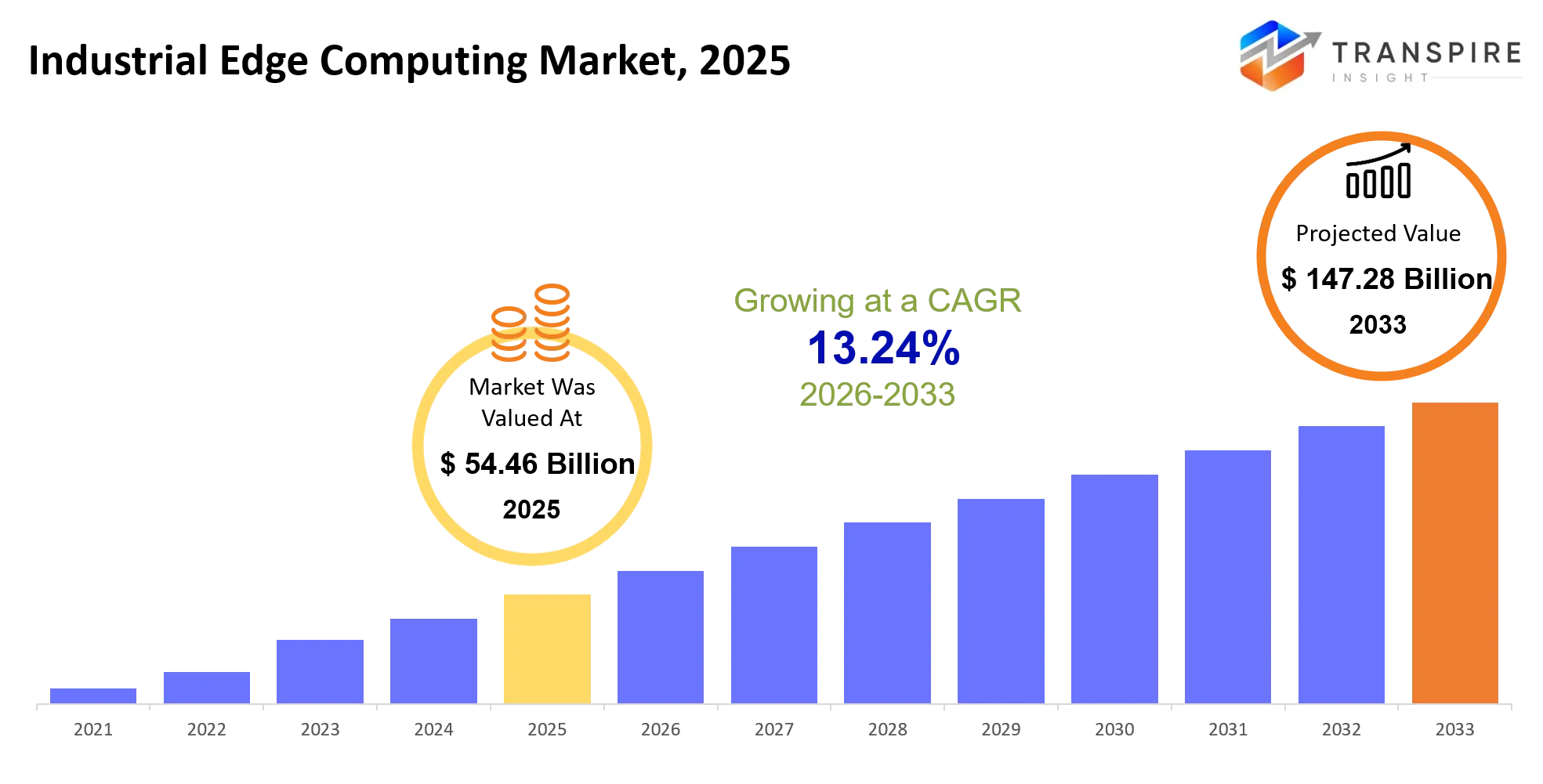
- Market Value (2025): USD 54.46 Billion.
- Expected Market Value (2026): USD 61.67 Billion.
- Estimated Market Value (2033): USD 147.28 Billion.
- Forecast CAGR (2026–2033): 13.24%.
- Leading Region in 2025: North America
- Second-largest Region: Asia Pacific
- Fastest Growing Region: Europe
Introduction
The Industrial Edge Computing Market refers to the hardware, software, platforms, and network connections that allow data processing, analytics, and decision-making near the physical assets, machines, sensors, and production process. Compared to cloud architectures, where the processing of critical data is done remotely, industrial edge computing involves data processing in close proximity to the physical assets, which allows for quick response times, increased resilience of operations, and effective data management. Such solutions have already found application in smart manufacturing, automation of industry processes, predictive maintenance, quality control, robotics, energy efficiency, and other fields related to industry automation. Advantages include low latency, efficient use of bandwidth, high level of data security, increased reliability of machines, and better IT/OT integration.
For instance:-
- North America: The leading Industrial Edge Computing Market in North America is enabled by advanced manufacturing, digitization of industries, deployment of private 5G networks, investment in cybersecurity, and usage of real-time analytics and edge AI.
- Europe: Europe stresses on Industrial Edge Computing through industry 4.0 initiatives, industrial interoperability, data governance, cybersecurity, energy efficiency, and localized processing within advanced manufacturing setups.
Key Market Highlights: -
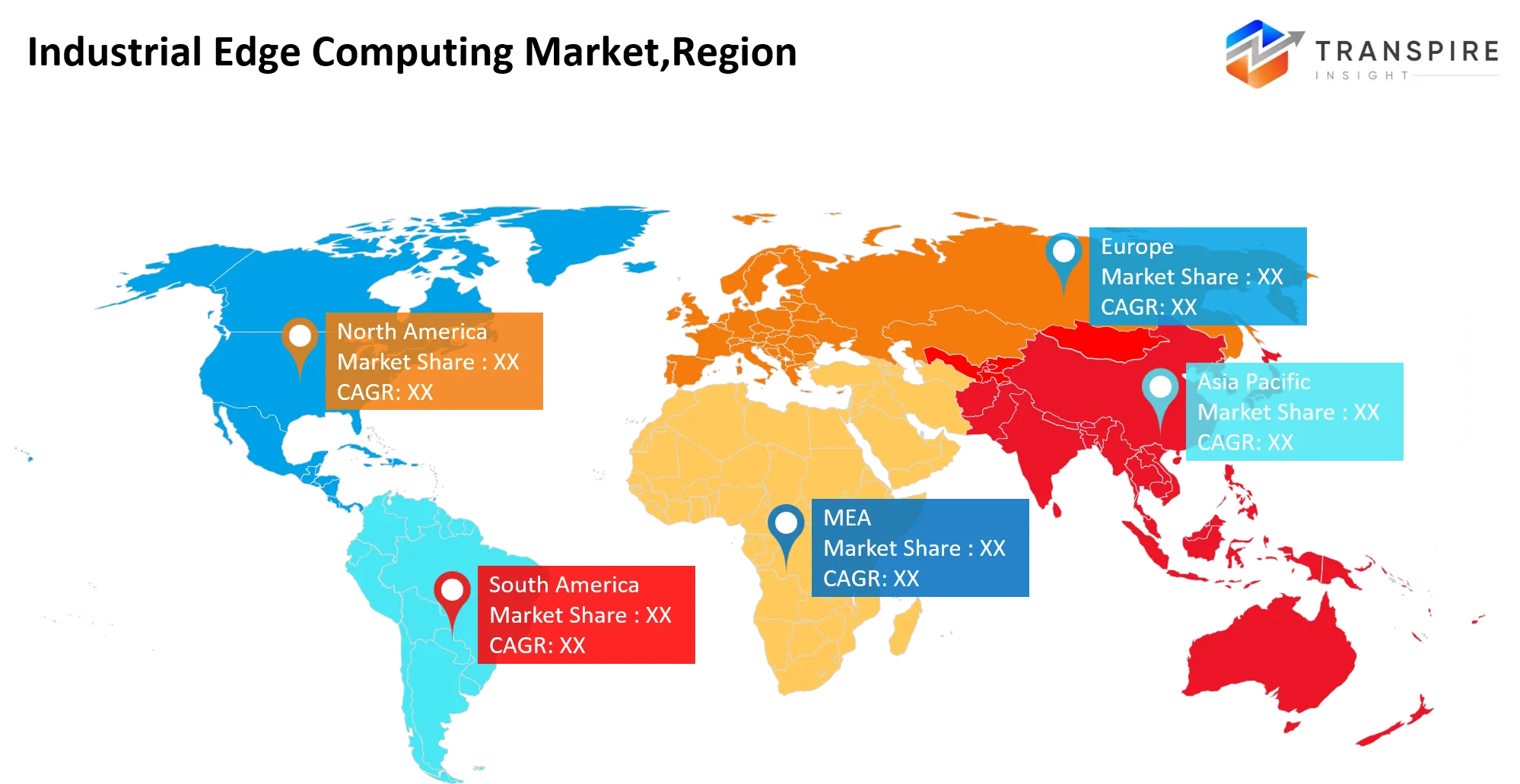
- North America is expected to grow at a rapid CAGR in the Industrial Edge Computing Market by holding around44% of the share during the forecast period.
- Asia Pacific is anticipated to hold roughly27% share of the Industrial Edge Computing Market over the predicted timeframe.
- Europe is anticipated to hold nearly 22%share of the Industrial Edge Computing Market over the predicted timeframe.
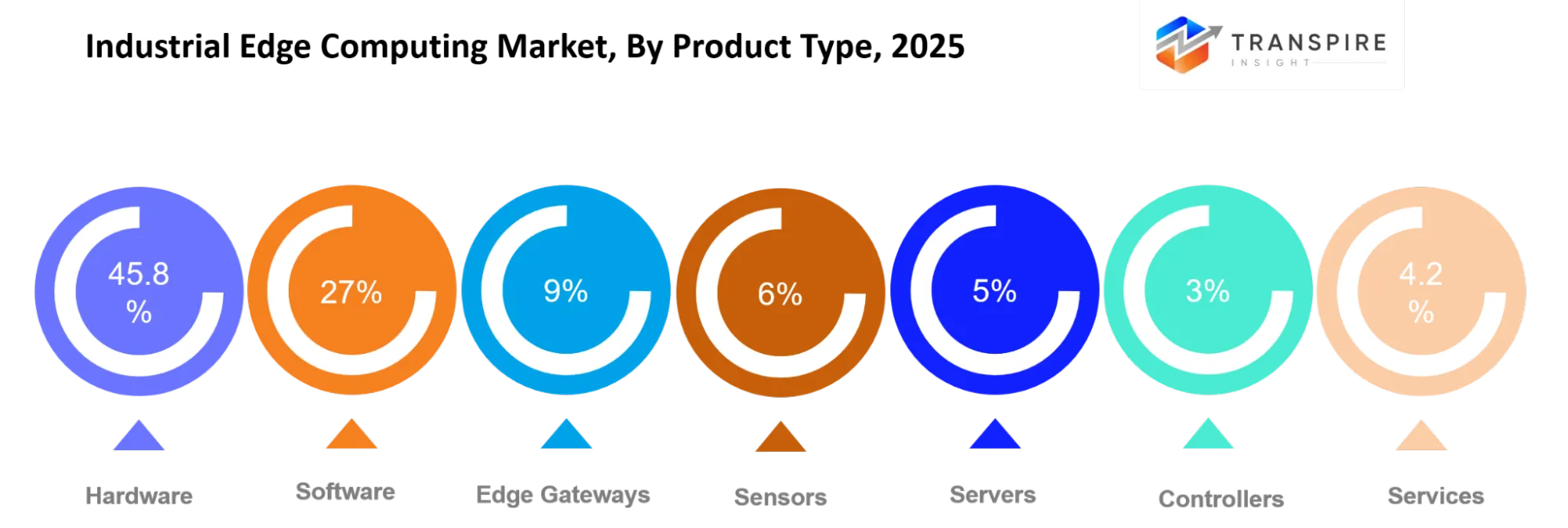
- By Component, the Hardware segment dominated the market and holds nearly 44% share in 2025 and is projected to grow at a substantial CAGR during the forecast period.
- By Deployment, the Cloud deployment segment dominated the market and holds close to 58.19% share in 2025 and is projected to grow at a substantial CAGR during the forecast period.
- By Application, the Predictive Maintenance dominated the market and holds about 38% share in 2025 and is projected to grow at a substantial CAGR during the forecast period.
- Investments in AI computing, semiconductor manufacturing, electronics manufacturing, and industrial digitization are building a robust infrastructure ecosystem in India, which provides conducive conditions for Industrial Edge Computing.
How is Technology Driving Growth in the Industrial Edge Computing Market?
Technology is contributing to the growth of the Industrial Edge Computing Market through faster data processing at the edge, less latency, better bandwidth optimization, and higher response times. Technology such as 5G and advanced connectivity helps in connecting high density industrial devices, private networking, and machine communications. The use of edge AI and machine learning helps in performing tasks such as predictive maintenance, autonomous decisions, computer vision, and real-time quality inspections. Containerization technology is also providing solutions like scalable applications and software-defined systems. In addition to that, local cybersecurity and data processing helps in enhancing data security and avoids any cloud-based data transfer.
|
Report Metrics |
Details |
|
Market size value in 2025 |
USD 54.46 Billion |
|
Market size value in 2026 |
USD 61.67 Billion |
|
Revenue forecast in 2033 |
USD 147.28 Billion |
|
Growth rate |
CAGR of 13.24%from 2026 to 2033 |
|
Base year |
2025 |
|
Historical data |
2021 - 2024 |
|
Forecast period |
2026 - 2033 |
|
Report coverage |
Revenue forecast, competitive landscape, growth factors, and trends |
|
Regional scope |
United States; Canada; Mexico; United Kingdom; Germany; France; Italy; Spain; Denmark; Sweden; Norway; China; Japan; India; Australia; South Korea; Thailand; Brazil; Argentina; South Africa; Saudi Arabia; United Arab Emirates |
|
Key company profiled |
Cisco, Dell Technologies, HPE, Siemens, Schneider Electric, IBM, Intel, NVIDIA, Advantech, Huawei, Rockwell Automation, ABB, Emerson, Bosch Rexroth, Microsoft |
|
Customization scope |
Free report customization (country, regional & segment scope). Avail customized purchase options to meet your exact research needs. |
|
Report Segmentation |
By Component (Hardware, Software, Services, Edge Gateways, Sensors, Servers, Controllers, Others); By Deployment (On-premise, Cloud, Hybrid, Edge-native, Fog, Distributed, Private Edge, Others); By Application (Predictive Maintenance, Quality Control, Asset Monitoring, Process Optimization, Remote Monitoring, Safety & Security, Robotics, Others); By Industry (Manufacturing, Energy & Utilities, Automotive, Oil & Gas, Healthcare, Transportation, Logistics, Others); By Hardware (Edge Servers, Gateways, Industrial PCs, Routers, Sensors, Controllers, Storage, Others); By Connectivity (Ethernet, Wi-Fi, 5G, LPWAN, Bluetooth, Zigbee, Industrial Ethernet, Others); By Enterprise Size (Large Enterprises, SMEs, Mid-sized, Startups, Government, Industrial Groups, OEMs, Others) |
Market Drivers
The drivers of the Industrial Edge Computing Market include the fast adoption of Industrial Internet of Things (IIoT), growing demand for real-time analytics and private 5G networks. Sensors, machines, and devices used in industries produce high amounts of data, which leads to processing of data locally in order to minimize latency and network traffic. Predictive maintenance, machine vision, automation, and quality assurance are other features that can be supported with edge computing. The increased interest in improving operational efficiency and minimizing costs contributes to the popularity of the market due to minimized cloud transfers of unnecessary data and reduced downtime.
For instance:-
- Asia Pacific: Asia Pacific is a growing market for Industrial Edge Computing due to manufacturing growth, 5G network deployments, adoption of IIoT technologies, automation, and use of edge AI.
- Latin America: The adoption of Industrial Edge Computing can be seen in the manufacturing, logistics, energy, and resources industry in Latin America through opportunities enabled by industrial modernization, better connectivity, and operational efficiency requirements.
Restrain
Deployment costs coupled with infrastructure expenses continue to be a significant constraint for the Industrial Edge Computing Market especially for small and medium businesses that require edge-specific servers and gateways. Integration complexities with existing industrial machinery can result in delays and increased difficulties in operation. Moreover, scaling up of the distributed edge systems presents security concerns, whereas scarcity of technical expertise becomes an obstacle in the deployment process.
|
Driver |
Relative Impact on Growth (%) |
Geographic Relevance |
Impact Timeline |
Demand Strength |
Growth Mechanism |
Key Beneficiaries |
Major Constraint |
|
Driver 1: Rising Industrial AI and Smart Manufacturing Adoption |
28% |
North America, Europe, Asia Pacific |
Short-term |
High |
Enables real-time AI inference, automation, and predictive decision-making. |
Edge hardware vendors, AI providers, manufacturers, system integrators |
High integration complexity across legacy industrial systems |
|
Driver 2: Increasing IT/OT Convergence and Real-Time Data Processing |
23% |
Europe, North America, Asia Pacific |
Short-term |
High |
Processes operational data locally, reducing latency and cloud dependency. |
Industrial software vendors, manufacturers, networking providers, end users |
Legacy OT infrastructure limits seamless interoperability |
|
Driver 3: Expansion of 5G, IIoT, and Connected Industrial Infrastructure |
19% |
Asia Pacific, North America, Europe |
Medium-term |
High |
Combines high-speed connectivity with distributed edge processing capabilities. |
Telecom operators, edge platforms, sensor vendors, industrial users |
Uneven industrial 5G infrastructure and deployment costs |
|
Driver 4: Growing Demand for Industrial Cybersecurity and Data Sovereignty |
16% |
Europe, North America |
Medium-term |
High |
Localizes sensitive operational data while strengthening security controls. |
Cybersecurity vendors, edge providers, critical infrastructure operators |
Cybersecurity compliance increases deployment costs and complexity |
|
Driver 5: Expansion of Predictive Maintenance, Quality Inspection, and Digital Twins |
14% |
Europe, Asia Pacific, North America |
Long-term |
Medium |
Converts machine data into localized insights for asset optimization. |
Manufacturers, industrial AI vendors, automation providers, maintenance firms |
Skills shortages and limited high-quality industrial datasets |
Analysis of Prices and Consumer Behaviour
The market share of the industrial edge computing solutions market consists of high-performance edge infrastructure solutions which constitutes 68% of the total market share (as the demand for industrial automation, manufacturing and industrial IoT industries is the reason behind that). The cost of the high-performance and standardized edge computing infrastructure solutions is supposed to be 35% higher than the cost of the other solutions as the development of these products would involve highly powerful processing capabilities and quality certified components and also provides real-time computing performance. Around 45% of the total units sold consist of the industrial edge computing solutions which are in small size. The volume is a result of flexibility of use and durability of edge infrastructure solution and also the fact that the industrial automation and industrial IoT industry represents around 70% of the demand from these industries. It is seen that the purchasing behavior of consumers is that 55% of consumers give the most importance to computing performance, reliability of solutions and standardized processing capabilities. Another 33% of consumers prefer bulk purchases of their solutions due to the reasons of lowering costs of procurement and ensuring supply consistency to their customers.
|
Company |
Est. Revenue Share Range |
Key Offerings |
Strategic Positioning |
Geographic Strength |
Technology Focus |
|
Siemens AG |
7–10% (Estimated) |
Siemens Industrial Edge, Industrial Edge Management, Insights Hub, SIMATIC IPCs |
Platform ecosystem leadership across industrial automation |
Europe, Asia Pacific, North America |
Industrial AI, edge analytics, OT/IT integration |
|
Schneider Electric SE |
6–9% (Estimated) |
EcoStruxure Automation Expert, AVEVA Edge, Edge Controllers, EcoStruxure Plant |
Open automation and integrated edge platform strategy |
Europe, North America, Asia Pacific |
Software-defined automation, edge control, IIoT |
|
Cisco Systems Inc. |
5–8% (Estimated) |
Cisco Edge Intelligence, IOx, industrial switches, industrial routers |
Secure networking-led industrial edge ecosystem expansion |
North America, Europe, Asia Pacific |
Industrial networking, cybersecurity, edge-to-cloud |
|
Dell Technologies Inc. |
4–7% (Estimated) |
Dell NativeEdge, PowerEdge servers, edge endpoints, edge orchestration |
Infrastructure-led distributed edge computing strategy |
North America, Europe, Asia Pacific |
Edge infrastructure, virtualization, AI acceleration |
|
Hewlett Packard Enterprise Co. |
3–6% (Estimated) |
HPE Edgeline, HPE Ezmeral, edge servers, Aruba networking |
Converged edge infrastructure for distributed workloads |
North America, Europe, Asia Pacific |
Edge compute, AI, hybrid cloud |
|
Rockwell Automation Inc. |
3–5% (Estimated) |
FactoryTalk Edge Gateway, FactoryTalk, industrial PCs, Plex |
Factory automation-centric edge software differentiation |
North America, Europe, Asia Pacific |
OT data, IIoT, edge-to-cloud convergence |
|
ABB Ltd. |
3–5% (Estimated) |
ABB Ability Genix Edge AI, EdgeInsight, Edge Industrial Gateway |
Industrial analytics and automation-led edge intelligence |
Europe, Asia Pacific, North America |
Edge AI, industrial analytics, asset intelligence |
|
Advantech Co. Ltd. |
2–4% (Estimated) |
WISE-PaaS, EdgeLink, WebAccess, industrial edge computers |
Industrial computing and edge hardware specialization |
Asia Pacific, Europe, North America |
Edge AI, industrial IoT, rugged computing |
|
Honeywell International Inc. |
2–4% (Estimated) |
Honeywell Forge, Forge AI Engine, industrial edge solutions, OT cybersecurity |
Domain-specific industrial intelligence and autonomy |
North America, Europe, Middle East & Africa |
Industrial AI, asset intelligence, OT security |
|
Emerson Electric Co. |
2–4% (Estimated) |
PACEdge 3.0, PACSystems, industrial PCs, edge solutions |
Process automation and AI-enabled edge specialization |
North America, Europe, Asia Pacific |
Edge AI, IIoT, industrial control |
Who are the Key Players in the Industrial Edge Computing Market and how do they compete?
The competitiveness of the Industrial Edge Computing Market in the international market is determined by companies that deal with technological innovations, industry-related solutions, and distribution network development on a worldwide scale. The competitiveness strategy based on durable infrastructure, cutting-edge computing technologies, smart and connected solutions, and integration with digital platforms and operations results in continuous innovation and increases productivity, efficiency, resource utilization, and operational transparency.
Cisco develops its competitive advantage through the development of industrial networking, edge computing, secure connectivity, and connected industrial technologies. With the help of the development of high-performance edge infrastructure for industrial computing and data processing and automation, Dell Technologies gains an advantage over its competitors. Siemens develops its competitive position through the provision of integrated solutions for industrial edge computing, automation, industrial software, and smart manufacturing.
Top Companies in the Industrial Edge Computing Market
- Cisco
- Dell Technologies
- HPE
- Siemens
- Schneider Electric
- IBM
- Intel
- NVIDIA
- Advantech
- Huawei
- Rockwell Automation
- ABB
- Emerson
- Bosch Rexroth
- Microsoft
|
Investment Factor |
Why It Matters to Investors |
Opportunity |
Investment Implication |
|
Industrial AI and Automation Adoption |
Why it is attractive: AI-driven industrial decisions increasingly require localized processing. |
Edge AI for predictive maintenance, machine vision, robotics, and process optimization. |
Short-term: Invest in AI-enabled edge platforms and industrial software ecosystems. |
|
IT/OT Convergence and Real-Time Processing |
Why it is attractive: Real-time workloads require low-latency computing closer to machines. |
Industrial edge gateways, servers, orchestration software, and OT connectivity solutions. |
Short-to-medium-term: Favor interoperable infrastructure serving brownfield industrial facilities. |
|
Edge Cybersecurity and Data Sovereignty |
Why it is attractive: Local processing strengthens operational control and security requirements. |
OT cybersecurity, secure edge architectures, network segmentation, and localized data management. |
Medium-term: Security-integrated edge solutions can support recurring enterprise demand. |
|
5G and Industrial IoT Expansion |
Why it is attractive: Connected factories require faster distributed computing infrastructure. |
Private 5G, industrial gateways, connected sensors, and edge-to-cloud architectures. |
Medium-term: Target integrated connectivity and edge infrastructure providers. |
|
Edge-Based Digital Twins and Predictive Maintenance |
Why it is attractive: Real-time asset intelligence can reduce downtime and operational inefficiencies. |
Digital twins, condition monitoring, industrial analytics, and asset-performance platforms. |
Medium-to-long-term: Software-led solutions offer scalable industrial deployment opportunities. |
|
Distributed Edge Infrastructure and Managed Services |
Why it is attractive: Distributed factories require centralized lifecycle management capabilities. |
Remote monitoring, edge orchestration, managed services, and containerized industrial applications. |
Long-term: Recurring software and services revenue can improve business scalability. |
Airport Quick Service Restaurant (QSR) Market Segmentation
The Industrial Edge Computing Market share is divided into seven categories: By Component, By Deployment, By Application, By Industry, By Hardware, By Connectivity, By Enterprise Size.
The Hardware segment dominated the market, accounting for nearly 44% in 2025 and is expected to rise at a significant CAGR during the forecast period.
The Industrial Edge Computing Market is by component into hardware, software, services, edge gateways, sensors, servers, controllers, others. Among these, the Hardware segment dominated the market, accounting for nearly 44% in 2025 and expected to increase at a significant CAGR during the forecast period. The prevalence of hardware arises because of the increased need for rugged edge infrastructures, real-time processing, industrial connectivity, and reliable deployment in manufacturing facilities.
The Cloud deployment segment dominated the market, accounting for close to 58.19% in 2025, and is expected to rise at a significant CAGR during the forecast period
The Industrial Edge Computing Market is segmented by deployment into on-premise, cloud, and hybrid, edge-native, fog, distributed, private edge, others. Among these, the Cloud deployment segment dominated the market, accounting for close to 58.19% in 2025 and expected to increase at a significant CAGR during the forecast period. Cloud deployment prevails because of scalability of infrastructure, flexibility in resource management, centralized management system, low capital expenditure, and an increasing demand for industrial edge-to-cloud solutions.
The Predictive Maintenance dominated the market, accounting for about 38% in 2025 and is expected to rise at a significant CAGR during the forecast period.
The Industrial Edge Computing Market by application into predictive maintenance, quality control, asset monitoring, process optimization, remote monitoring, safety & security, robotics, others. Among these, thePredictive Maintenance dominated the market, accounting for about 38% in 2025 and expected to increase at a significant CAGR during the forecast period. Predictive maintenance holds the leading position because of real-time monitoring of machines, minimal downtime, fault detection, optimization of maintenance costs, and better reliability of industrial assets.
Regional Segment Analysis of the Industrial Edge Computing Market
- Europe (Germany, France, U.K., Italy, Spain, Rest of Europe)
- North America (U.S., Canada, Mexico)
- Asia-Pacific (China, Japan, India, Rest of APAC)
- South America (Brazil and the Rest of South America)
- The Middle East and Africa (UAE, South Africa, Rest of MEA)
North America is expected to grow at a rapid CAGR in the Industrial Edge Computing Market, holding around 44% of the share during the forecast period.
It is anticipated that North America will continue its dominance in the Industrial Edge Computing Market because of the developed infrastructure for manufacturing, fast adoption of Industrial IoT, automation of processes, and deployment of edge AI solutions. Significant investments into the development of 5G networks, cybersecurity, integration of cloud and edge, and real-time analytics boost the growth of the market.
Asia Pacific is the high-growth region in the Industrial Edge Computing Market during the period, holding roughly 27% share.
The Asia-Pacific region will be the fastest-growing region in the Industrial Edge Computing Market due to industrialization, manufacturing capabilities, and use of Industrial IoT and smart factories technology. Investments in automation, 5G connectivity, edge AI, and digitization have helped to boost the growth of the market. Countries like China, Japan, South Korea, and India are boosting their industrial digitalization efforts, while the need for real-time analytics, predictive maintenance, and local data processing has also increased.
Europe is the fastest-growing region in the Industrial Edge Computing Market during the period, holding nearly 22% share.
Europe is the fastest-growing region in the Industrial Edge Computing Market owing to Industry 4.0, advanced manufacturing infrastructures, and the increasing demand for real-time processing of industrial data. Increasing investments in industrial automation, edge AI, private 5G, and cybersecurity have helped to promote the adoption of industrial edge computing in the manufacturing environment. Initiatives taken in Europe to promote digitalization and data sovereignty have helped the market grow even more.
Strategies for Market Growth in Non-Leading Regions:
Non-leading regions can gain from the implementation of scalable and effective industrial edge computing technology. By implementing edge infrastructure that involves edge servers, gateways, and processing technology locally, companies can avoid depending on cloud infrastructure centrally and operate effectively. Strategic partnerships with regional industrial manufacturers, automation companies, technology providers, and system integrators can lead to market penetration of industrial edge computing technologies. For increasing the level of knowledge of edge deployment, cybersecurity, data management, interoperability, and integration of IT and OT, training and technical skills development are essential. Besides that, flexible financing, long-term technology contracts, and managed edge services will make it easier to implement and use industrial edge computing technologies. Industrial edge computing technologies will be easily available through collaborative programs developed by governments, manufacturing companies, technology firms, and digital transformation efforts, together with the utilization of digital sales.
Future Market Trends for the Industrial Edge Computing Market: -
Edge Computing and AI Integration: Industries are increasingly making use of AI inference on the edge, allowing for real-time analytics, predictive maintenance, decision making, and less reliance on cloud-based processing.
Private 5G Connectivity: The use of private 5G networks is increasingly enhancing industrial edge computing through providing low latency communication, robotics, automated guided vehicles, and machine to machine connectivity.
Open Connectivity and Cybersecurity: The adoption of OPC UA, MQTT, zero trust cybersecurity, and open edge computing platforms has enhanced multi-vendor connectivity, cybersecurity, scalability, and IT/OT convergence.
Recent Development
In June 16, 2026 – Launch: Siemens announced integration from edge to cloud, where the integration between Industrial Edge and FFT DataBridge with Databricks provides direct access to production data for enterprise AI application.
In April 21, 2026 – Launch: Siemens released the General Availability of the Siemens Industrial AI Suite and WinCC Unified.
Market Segment
This study forecasts revenue at global, regional and country levels from 2020 to 2033. Transpire Insights has segmented the Industrial Edge Computing Market based on the below-mentioned segments:
Industrial Edge Computing Market, By Component
- Hardware
- Software
- Services
- Edge Gateways
- Sensors
- Servers
- Controllers
- Others
Industrial Edge Computing Market, By Deployment
- On-premise
- Cloud
- Hybrid
- Edge-native
- Fog, Distributed
- Private Edge
- Others
Industrial Edge Computing Market, By Application
- Predictive Maintenance
- Quality Control
- Asset Monitoring
- Process Optimization
- Remote Monitoring
- Safety & Security
- Robotics
- Others
Industrial Edge Computing Market, By Industry
- Manufacturing
- Energy & Utilities
- Automotive
- Oil & Gas
- Healthcare
- Transportation
- Logistics
- Others
Industrial Edge Computing Market, By Hardware
- Edge Servers
- Gateways
- Industrial PCs
- Routers
- Sensors
- Controllers
- Storage
- Others
Industrial Edge Computing Market, By Connectivity
- Ethernet
- Wi-Fi
- 5G
- LPWAN
- Bluetooth
- Zigbee
- Industrial Ethernet
- Others
Industrial Edge Computing Market, By Enterprise Size
- Large Enterprises
- SMEs
- Mid-sized
- Startups
- Government
- Industrial Groups
- OEMs
- Others
Industrial Edge Computing Market, By Regional Analysis
North America
- US
- Canada
- Mexico
Europe
- Germany
- UK
- France
- Italy
- Spain
- Russia
- Rest of Europe
Asia Pacific
- China
- Japan
- India
- South Korea
- Australia
- Rest of Asia Pacific
South America
- Brazil
- Argentina
- Rest of South America
Middle East & Africa
- UAE
- Saudi Arabia
- Qatar
- South Africa
- Rest of the Middle East & Africa
Frequently Asked Questions
Find quick answers to common questions.
The Industrial Edge Computing Market is projected to grow at a 13.24% CAGR from 2026 to 2033, driven by industrial digitalization.
North America dominates the Industrial Edge Computing Market, supported by advanced manufacturing, Industrial IoT adoption, automation, cybersecurity investments, and edge AI.
Predictive Maintenance leads the Industrial Edge Computing Market, supported by real-time machine monitoring, fault detection, reduced downtime, and improved asset reliability.
Cloud deployment dominates the Industrial Edge Computing Market, supported by scalable infrastructure, flexible resource management, centralized control, and increasing edge-to-cloud integration.
Edge AI, 5G, machine learning, and containerization enable faster processing, lower latency, optimized bandwidth, predictive maintenance, and improved industrial decision-making.
- Cisco
- Dell Technologies
- HPE
- Siemens
- Schneider Electric
- IBM
- Intel
- NVIDIA
- Advantech
- Huawei
- Rockwell Automation
- ABB
- Emerson
- Bosch Rexroth
- Microsoft
About the Authors

Mayur Shinde
I am Mayur Shinde, a Senior Research Analyst at Transpire Insight, specializing in the Automotive & Transportation and Information & Communication Technology (ICT) Industry. My work focuses on analyzing emerging market trends, technological advancements, competitive landscapes, and industry developments to deliver accurate, data-driven insights. I am passionate about transforming complex market information into clear, actionable content that helps businesses, professionals, and decision-makers stay informed and make confident strategic decisions.

Chakradhar Khansole
Chakradhar serves as the Research Director at Transpire Insight, bringing over 8 years of experience in technology, innovation, and strategic market intelligence. He specializes in transforming complex market data into actionable business insights that enable organizations to make informed, growth-oriented decisions. Recognized for his strategic vision and analytical expertise, Chakradhar leads high-impact research initiatives, delivering comprehensive market assessments, competitive intelligence, and forward-looking industry analysis.
Recently Published Reports
-
Apr 2026
3D Optical Profiler Market
3D Optical Profiler Market Size, Share & Analysis Report By Type (Desktop 3D Optical Profiler, and Portable 3D Optical Profiler), By Technology (Confocal Technology, and White Light Interference), By End-Use Industry (Manufacturing, Research Institutions, Automotive, Aerospace and Defense, Medical Devices, and Other), and Geography (North America, Europe, Asia-Pacific, Middle East and Africa, South and Central America), 2021 - 2031
-
Apr 2026
Depth Sensor Market
Depth Sensor Market Size, Share & Analysis Report By Type (Infrared Depth Sensors, Time-of-Flight (ToF) Sensors, Stereo Vision Sensors, Structured Light Sensors, Ultrasonic Depth Sensors), By Application (Automotive, Robotics, Gaming, Consumer Electronics, Industrial Automation, Healthcare, Security & Surveillance, Others), By End Users (Automotive Manufacturers, Consumer Electronics Companies, Healthcare Providers, Industrial Companies, Security Agencies, Gaming Companies, Robotics Companies, Others), and Geography (North America, Europe, Asia-Pacific, Middle East and Africa, South and Central America), 2021 – 2031
-
Apr 2026
Digital Manufacturing Market
Digital Manufacturing Market Size, Share & Analysis Report By Component (Hardware, Software, and Services), By Technology (Robotics, 3D Printing, Internet of Things (IoT), and Others), By Application (Automotive and Transportation, Aerospace and Defense, Consumer Electronics, Industrial Machinery, and Others), By Process Type (Computer-Based Designing, Computer-Based Simulation, Computer 3D Visualization, Analytics, and Others), and Geography (North America, Europe, Asia-Pacific, Middle East and Africa, South and Central America), 2021 – 2031
-
Apr 2026
Digital Visa Services Market
Digital Visa Services Market Size, Share & Analysis Report By Type (Individual Travelers, Group Travelers), By Application (Tourism, Business Travel, Others), and Geography (North America, Europe, Asia-Pacific, Middle East and Africa, South and Central America), 2021 – 2031