
Digital Wallet Market Summary:
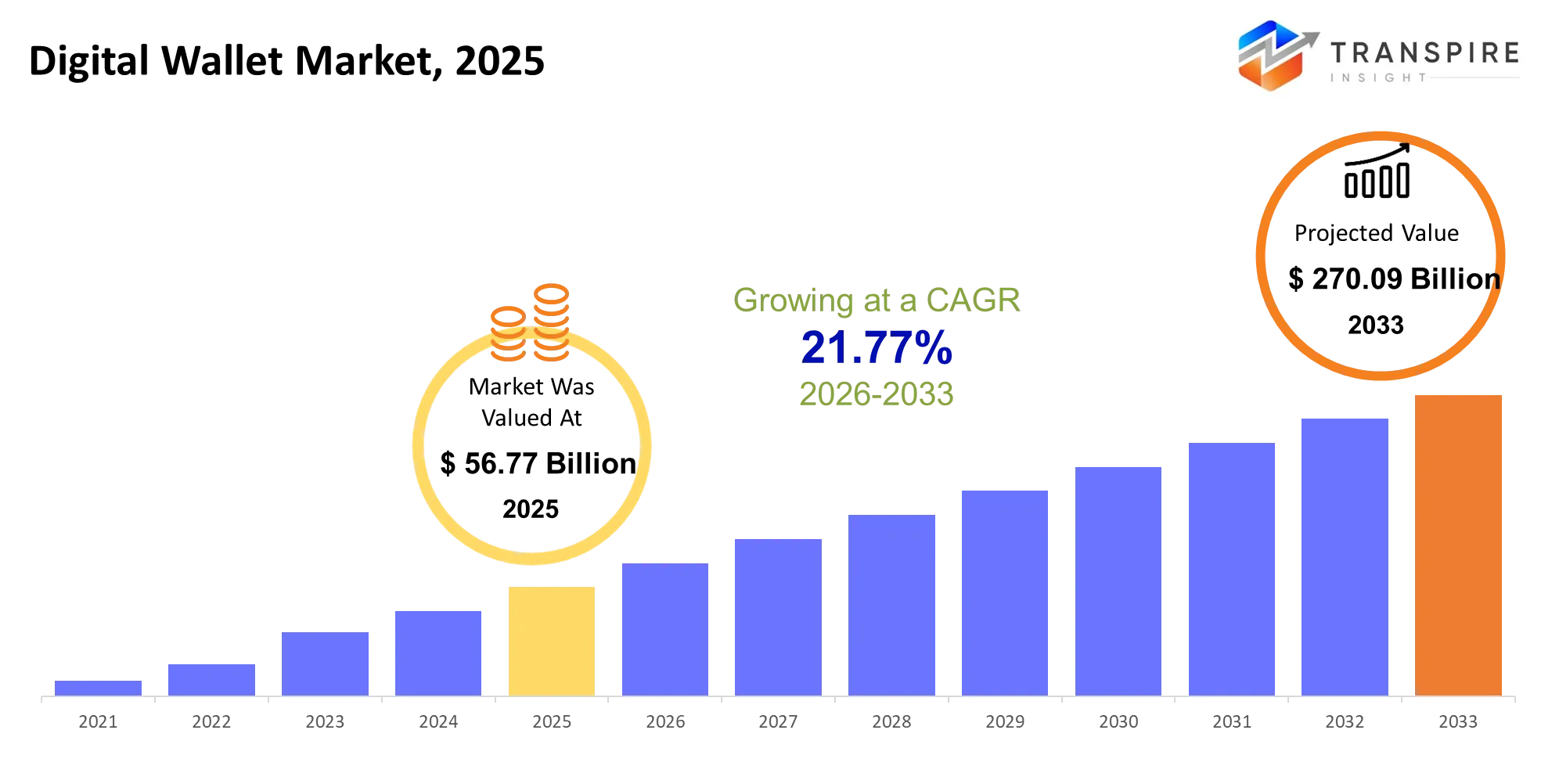
As per Transpire Insight Analysis, the Digital Wallet Market size is estimated at USD 56.77 billion in 2025 and is anticipated to reach USD 270.09 billion by 2033, growing at a CAGR of 21.77% from 2026 to 2033.
The digital wallet market lets consumers and businesses keep payment details, move money, buy things and handle transactions on devices. In the past three to five years, digital wallets have gone beyond just online checkout. They now help with contactless payments, QR code transactions, peer‑to‑peer transfers and services that work inside banking and retail apps. A big change is the shift toward payment ecosystems. In these ecosystems, digital wallets can work on different platforms instead of staying locked to one provider. New rules and new partnerships are also giving people access to mobile payment technology. For the rise of payment systems and smartphone shopping has pushed merchants to give faster digital checkout options. As people want payments on both online and in‑store channels, digital wallet providers are adding more places where the wallet works, making security stronger and adding more financial services. These changes open up chances for digital wallet companies to earn money through merchant services, transaction processing and extra financial products.
Digital Wallet Market Size & Forecast:
- Market Size 2025: USD 56.77 Billion
- Expected Market Value (2033): USD 270.09 Billion
- Forecast CAGR (2026–2033): 21.77%
- Leading Region in 2025: Asia Pacific
- Fastest Growing Region: Middle East & Africa
- Key Company Profiles: PayPal, Apple Pay, Google Pay, Alipay, WeChat Pay, Samsung Wallet, Amazon Pay, Cash App, Venmo, Paytm, PhonePe, Revolut, Ant Group, Block, Inc., GrabPay
Key Market Insights:
The market is evolving from basic tools of digital payments towards platforms incorporating payments, identity, financial services, and connection to merchants.
- The segment of mobile wallets constitutes the majority at 58.0% share of the provided market data, reflecting the relevance of mobile payments to regular transactions.
- The provided market data projects the cryptocurrency wallets' CAGR of 20.1%, providing room for providers offering secure asset storage and transfer solutions.
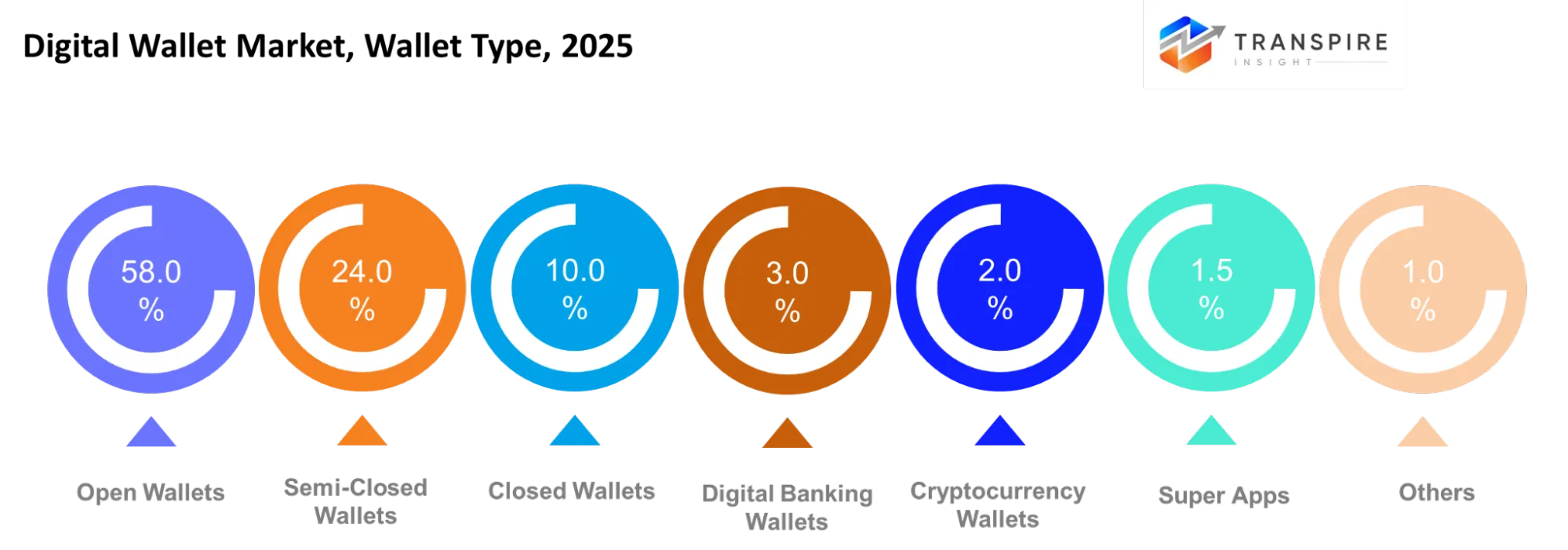
- Open wallets account for 58.0% share of the provided market split, representing the stated relevance of flexible payments and broader transaction acceptance.
- Semi-closed wallets constitute 24.0% of the provided market split, allowing the development of payment ecosystems revolving around participating merchants and partnerships.
- Closed wallets make up 10.0% of the stated market split, accounting for balances specific to certain retailers, their loyalty programs, and regular repeat purchases.
What are the Key Drivers, Restraints, and Opportunities in the Digital Wallet Market?
Drivers
With digital business growing every day, many businesses are looking into integrating wallets with their sites, mobile apps, as well as counter checkouts. Consumers benefit from faster transactions with reduced usage of physical money, while the merchant gains from having an account-to-account transaction history with easy checkout options. With a rise in real-time payment facilities, the popularity is driven by easier account-to-account transfers. The country of India has been making headlines as the government has declared that UPI was the driving force behind 81% of retail digital payment transactions f
Restraining
The information stored in the wallet is of high value. Wallets are susceptible to account takeovers, phishing attempts, identity theft, and payments fraud. Providers need to devote efforts towards user authentication and detection of frauds. They need to encrypt data and regulate themselves, all of which cost money. Inconsistency in accepting standards by different vendors can be a problem.
Opportunities
Interoperability, digital identity and cross-border payments are areas of high potential for growth. There is an opportunity for wallet providers to develop their platforms by linking up their local infrastructure with that of other countries and with international merchants and financial institutions. Linkages between wallets that simplify the payment process will help reduce friction for travelers, online shoppers and migrant workers. The use of tokenization, biometric authentication and AI-based fraud detection can help make payments safer without making the checkout process overly complicated. It is a provider that combines trusted payment processing, transparency and merchant acceptance that will win both merchants and consumers.
|
Driver |
Relative Impact on Growth (%) |
Geographic Relevance |
Impact Timeline |
Demand Strength |
Growth Mechanism (5–10 words) |
Key Beneficiaries (5–10 words) |
Major Constraint (5–10 words) |
|
Rising adoption of cashless and contactless payments |
28% |
Asia Pacific, North America, Europe |
Short-term (≤2 years) |
High |
Speeds up checkout and reduces dependence on cash. |
Wallet operators, merchants, payment processors, consumers. |
Uneven merchant acceptance and persistent cash preferences. |
|
Expansion of e-commerce and mobile commerce |
24% |
Asia Pacific, North America, Europe |
Short-term (≤2 years) |
High |
Enables seamless online checkout and repeat purchases. |
E-commerce platforms, wallet providers, retailers, consumers. |
Cybersecurity risks and checkout integration costs. |
|
Growth of real-time payment infrastructure and QR transactions |
20% |
Asia Pacific, Latin America, Africa |
Medium-term (2–4 years) |
High |
Connects wallets with instant transfers and merchant payments. |
Fintech companies, banks, payment networks, small merchants. |
Interoperability gaps and inconsistent payment infrastructure. |
|
Increasing financial inclusion and mobile money adoption |
16% |
Sub-Saharan Africa, South Asia, Southeast Asia |
Medium-term (2–4 years) |
High |
Extends digital financial access to underserved populations. |
Mobile money operators, fintech firms, unbanked consumers, agents. |
Limited connectivity, digital literacy, and affordable smartphones. |
|
Advancements in wallet security, AI, and embedded finance |
12% |
North America, Europe, Asia Pacific |
Long-term (≥4 years) |
High |
Improves fraud detection, personalization, and integrated payments. |
Technology vendors, banks, wallet platforms, digital merchants. |
Privacy concerns, regulatory complexity, and implementation expenses. |
|
Total |
100% |
— |
— |
— |
— |
— |
— |
What Has the Impact of Artificial Intelligence Been on the Digital Wallet Market?
AI technologies have revolutionised digital wallet providers to enhance transaction safety, streamline payment process monitoring and offer more personalised finance services. Machine learning systems are able to analyse such details as transaction amount, payment locations, device data and payment patterns to detect deviations from the normal activity of a particular user. Upon the detection of suspicious transactions, digital wallet service providers can demand additional authentication from a user or flag a transaction for further analysis. Such features can allow payment companies to react to any fraud attempts in real time and to reduce manual analysis of each transaction. In addition, predictive analytics can help providers to predict transaction volumes, possible customer churn and optimise their operations. At the same time, for merchants, intelligent payment analytics can help to understand checkout problems and discover patterns in transaction failures. The use of AI technologies faces several constraints. Creating models requires proper data, professional skills, regular testing and integration with a current payment system. False positives may annoy users, while biased or incomplete data may lower detection effectiveness. Thus, digital wallet providers need human intervention, data governance and model evaluation to create a balance between fraud prevention and comfortable usage.
Instance
In August 2026, Razorpay introduced Vulcan, an AI-driven payments foundation model that was created in collaboration with NVIDIA and Amazon Web Services (AWS). The technology seeks to increase the chances of successful payments, prevent frauds, and route payments optimally.https://razorpay.com/newsroom/
Key Market Trends:
Digital wallets are transitioning from payment-oriented applications to an integrated platform where money management, identity verification, and cross-border payments are also possible.
- The wallet providers are going beyond isolated payment networks by making partnerships where the user can conduct transactions across multiple platforms and markets.
- NFC payment methods have become more available due to the support of technology providers and payment networks for other wallets besides those of smartphones.
- QR payments are still relevant for small businesses and services as they reduce the need for payment terminals.
- The providers are using more tokenisation, biometric verification, and risk-based authentication to secure transactions while maintaining a convenient checkout experience.
- The wallet applications are incorporating identity verification and credentials along with the payments to increase utility beyond shopping.
- Payment companies are introducing financial services, rewards, credit services, and merchant services to promote reuse and retention of customers.
Digital Wallet MarketSegmentation
By wallet type
the market comprises open wallets, semi-closed wallets, closed wallets, mobile wallets, digital banking wallets, cryptocurrency wallets, super apps, and many others. Mobile wallets have been specified as the leading category in the provided market information, holding a 58.0% market share because of its significance in phone-based payment services. Open wallets have been indicated individually to hold a 58.0% market share, while semi-closed wallets hold 24.0%, closed wallets 10.0%, digital banking wallets 3.0%, cryptocurrency wallets 2.0%, super apps 1.5%, others 1.0%, and specialised others 0.5%. Since the above percentages and segments do not agree with the individual mobile wallets' market share, further verification will be needed for the categories and their respective market percentages. Cryptocurrency wallets have a 20.1% CAGR growth potential.
By payment
The market involves P2P payments, online payments, in-store payments, bill payments, international payments, remittance, QR payments and others. The former are intended for casual retailing, while the latter are for fund transfers between people. Bill payments and remittances move beyond the one-time purchase and fund transfer towards ongoing household expense management and international payments. QR payments could be of interest as a way of adoption for smaller merchants and traders, while future adoption will depend on payment acceptance, transaction cost, stability and linking domestic and international payments.
By technology
Near field communication, QR codes, Bluetooth Low Energy, tokenisation, biometrics, blockchain, cloud computing and others. Near field communication provides support for tap-and-pay payments. QR codes allow merchants and users to exchange payment information using a smartphone camera. Tokenisation allows hiding sensitive payment data behind a tokenised payment key. Biometric authentication may help simplify the identification process, while cloud computing could scale the solution and make applications available at large scale. Blockchain solutions could offer a foundation for digital assets and settlement use cases..
By device
The market includes smartphones, tablets, smartwatches, wearable devices, point-of-sale terminals, desktop computers, IoT devices and others. Smartphones continue to be the primary devices for consumers' wallet experiences as they integrate payment apps, authentication, connectivity and transaction notifications into a single device. Watches and wearables add more convenience for contactless payments, especially in retail and transportation. Desktop wallets stay relevant for online shopping, while POS terminals link wallet payments with merchant checkout systems. The bigger the connected device becomes, the more wallet providers will need to ensure consistent security and experience.
By end user
The market reaches consumers, small businesses, enterprises, government, financial institutions, retail companies, e-commerce companies, and other organisations. Consumers use wallets to shop, transfer money, pay bills, and make everyday payments. Small businesses benefit from more streamlined digital payment acceptance and transaction history, while enterprises might want to include wallet acceptance and payment with their customer account system and/or commerce infrastructure. Governments and financial institutions might want to leverage a digital payment infrastructure for providing government services and account-based payments. E-commerce companies and retail companies have an additional business driver to increase their wallet payment options in order to enable frictionless checkout and support ongoing re-purchases.
By wallet provider
The market may involve banks, fintech firms, technology firms, telecom operators, retailers and e-commerce operators, payment networks and others. Banks can leverage customer relationships and existing finance infrastructure. Fintech competitors may differentiate on targeted payment experiences and rapid product execution. Technology competitors may differentiate by linking wallets to devices and digital services. Telecom operators may leverage customer reach to extend mobile financial services. Retailers and e-commerce operators may differentiate by linking wallets with loyalty and shopping experiences. Payment networks may leverage infrastructure, security capabilities and merchant relationships. Success may depend on value through trust, adoption, interoperability and sustainable transaction economics.
What are the Key Use Cases Driving the Digital Wallet Market?
The everyday payments made by consumers continue to be an important use case for digital wallets, using applications for shopping online, at brick-and-mortar stores, and scanning QR codes at the point of sale. Such transactions enable people to make payments without having to key in their credit card details over and over again or carry any actual cash, with the merchant being able to provide an enhanced checkout experience.Use cases like peer-to-peer money transfers, bill payments, subscription management, and even money transfer across borders have added value to digital wallets and made them go beyond just retail purchasing. They are important in providing convenient options for transferring money to individuals or businesses.Other emerging use-cases of the digital wallet include identification, wearable device payments, and transactions with certain chosen cryptoassets on the blockchain platform. Other possible use-cases will depend upon the extent to which such features can be combined with AI-assisted and connected services.
|
Report Metrics |
Details |
|
Market size value in 2025 |
USD 56.77 Billion |
|
Market size value in 2026 |
USD 68.02 Billion |
|
Revenue forecast in 2033 |
USD 270.09 Billion |
|
Growth rate |
CAGR of 21.77% from 2026 to 2033 |
|
Base year |
2025 |
|
Historical data |
2021 - 2024 |
|
Forecast period |
2026 - 2033 |
|
Report coverage |
Revenue forecast, competitive landscape, growth factors, and trends |
|
Regional scope |
United States; Canada; Mexico; United Kingdom; Germany; France; Italy; Spain; Denmark; Sweden; Norway; China; Japan; India; Australia; South Korea; Thailand; Brazil; Argentina; South Africa; Saudi Arabia; United Arab Emirates |
|
Key company profiled |
PayPal, Apple Pay, Google Pay, Alipay, WeChat Pay, Samsung Wallet, Amazon Pay, Cash App, Venmo, Paytm, PhonePe, Revolut, Ant Group, Block, Inc., GrabPay |
|
Customization scope |
Free report customization (country, regional & segment scope). Avail customized purchase options to meet your exact research needs. |
|
Report Segmentation |
Wallet Type (Open Wallets, Semi-Closed Wallets, Closed Wallets, Mobile Wallets, Digital Banking Wallets, Cryptocurrency Wallets, Super Apps, Others)Payment Type (P2P Payments, Online Payments, In-Store Payments, Bill Payments, International Payments, Remittances, QR Payments, Others)Technology (NFC, QR Code, BLE, Tokenization, Biometrics, Blockchain, Cloud Computing, Others)Device (Smartphone, Tablet, Smartwatch, Wearable Devices, POS Terminals, Desktop, IoT Devices, Others)End User (Consumers, Small Businesses, Large Enterprises, Government, Financial Institutions, Retailers, E-commerce Companies, Others)Wallet Provider (Banks, FinTech Companies, Technology Companies, Telecom Operators, Retailers, E-commerce Platforms, Payment Networks, Others) |
Which Regions are Driving the Digital Wallet Market Growth?
North America
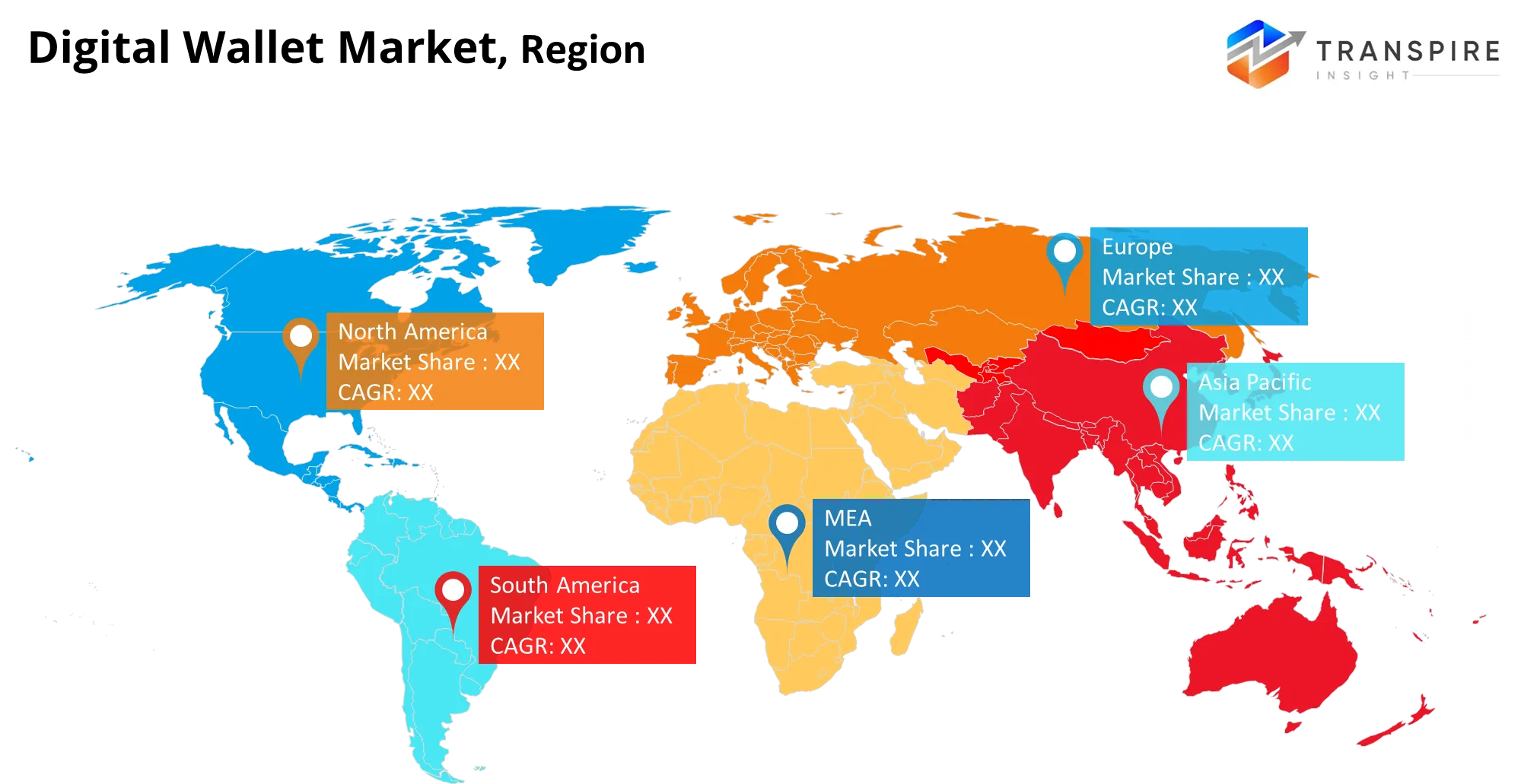
North America represents 19.0% of the regional market provided for this study. The current existence of banks, a well-developed online commerce market, and payment network among merchants has made digital wallets popular for both online shopping and traditional retail purchases. It is a competitive field with companies striving to develop technologies like contactless payments and anti-fraud mechanisms. Possible advancements include increased interoperability, digital security, and digital wallet use in services apart from check out procedures.
In November 2025,Apple released Digital ID through Apple Wallet, allowing qualified individuals in the U.S. to use digital identity details at chosen TSA checkpoints. This is an expansion of wallet uses beyond payments.https://www.apple.com/newsroom/2025/11/apple-introduces-digital-id-a-new-way-to-create-and-present-an-id-in-apple-wallet/
Europe
Europe accounts for 24.0% of the supplied regional market breakdown and is backed up by existing payment networks, cross-border trade, and regulations that impact digital payments. Digital Markets Act of the European Union has facilitated access to NFC functionality by third-party wallet providers on compatible Apple devices, thus providing more scope for competition in mobile payments. Visa announced the launch of wallet services with BBVA, Klarna, and Vipps MobilePay. Growth in the region will depend on building consumer trust, payment security, and consistency across national markets.
In October 2025, BBVA and Visa launched BBVA Pay in Spain, increasing options for contactless mobile payments among qualified consumers on compatible Apple devices. https://corporate.visa.com/en/sites/visa-perspectives/innovation/bbva-launches-bbva-pay-with-visa-in-spain.html
Asia Pacific
Asia Pacific accounts for 49.0% in the provided data. The region boasts high levels of adoption of mobile phone payment solutions, QR merchant acceptance capabilities, and real-time payment solutions, which facilitate the usage of electronic wallets in regular purchases. In East Asia and the Pacific, digital merchant payments were conducted, with China being a significant contributor. There are still openings in linking local wallets to payment systems, extending acceptance among small merchants, and providing more financial services to underbanked consumers.
In November 2025, OCBC Bank added connectivity in eight more digital wallets in Southeast Asia, making cross-border money transfer possible. https://www.ocbc.com/group/media/release/2025/ocbc-adds-eight-major-digital-wallets-across-southeast-asia-to-ocbc-app
Who are the Key Players in the Digital Wallet Marketand how do they Compete?
Technology companies, payment networks, financial institutions, and fintechs participate in the market of digital wallets. The most important players are Apple, Google, PayPal, Samsung, Alipay, WeChat Pay, Amazon, Visa, Mastercard, and regional digital wallets such as PhonePe. Each of these competitors has its own strategy of offering digital wallet products related to target audience, location, relationships with merchants, and payment infrastructures. Apple competes using integration of its digital wallet services with devices and their security. Google offers various wallet services along with Android and payment networks, and expands the list of supported payment experiences and credentials. PayPal is focused on providing solutions for online commerce, merchants, and payment platforms integration. As for Visa and Mastercard, their strategies involve payment networks, tokenisation, security services, and cooperation with other companies in order to allow digital wallet providers to reach merchants. As for regional providers of digital wallets (Alipay, WeChat Pay, and PhonePe), their approach consists in the use of existing ecosystems and transaction experience. Long-term factors of differentiation may include trust, convenience, acceptance, regulatory compliance, and business model.
Digital Wallet Market companies
- PayPal
- Apple Pay
- Google Pay
- Alipay
- WeChat Pay
- Samsung Wallet
- Amazon Pay
- Cash App
- Venmo
- Paytm
- PhonePe
- Revolut
- Ant Group
- Block, Inc.
- GrabPay
|
Company |
Est. Revenue Share Range |
Key Offerings |
Strategic Positioning |
Geographic Strength |
Technology Focus |
|
Ant Group (Alipay) |
Estimated 2.5–4.0% |
Alipay, Alipay+, QR payments, Antom |
China-led ecosystem with cross-border expansion |
Asia Pacific, Europe |
AI payments, QR technology, wallet interoperability |
|
Apple Inc. (Apple Pay) |
Estimated 2.0–3.5% |
Apple Pay, Apple Wallet, contactless payments, in-app payments |
Premium device-integrated payments with security differentiation |
North America, Europe, Asia Pacific |
NFC, tokenization, biometric authentication |
|
Alphabet Inc. (Google Pay and Google Wallet) |
Estimated 1.5–3.0% |
Google Pay, Google Wallet, contactless payments, UPI payments |
Android ecosystem integration and broad payment accessibility |
Asia Pacific, North America, Europe |
NFC, tokenization, biometric verification |
|
Tencent Holdings (WeChat Pay) |
Estimated 1.5–3.0% |
WeChat Pay, QR payments, mini-program payments, merchant services |
Super-app ecosystem integrating payments with daily services |
Asia Pacific, selected international markets |
QR payments, embedded finance, mini-program integration |
|
PayPal Holdings, Inc. |
Estimated 1.0–2.5% |
PayPal wallet, Venmo, Xoom, PayPal checkout |
online checkout leadership and cross-border payments |
North America, Europe, Latin America |
Fraud analytics, risk scoring, payment orchestration |
|
Samsung Electronics (Samsung Wallet) |
Estimated 0.5–1.5% |
Samsung Wallet, Samsung Pay, payment cards, digital credentials |
Device-based wallet differentiation across Samsung devices |
Asia Pacific, North America, Europe |
NFC, secure hardware, biometric authentication |
|
Amazon.com, Inc. (Amazon Pay) |
Estimated 0.5–1.5% |
Amazon Pay, online checkout, stored payment credentials, merchant payments |
Commerce-led wallet integration and checkout convenience |
North America, Europe, Asia Pacific |
One-click checkout, identity verification, payment APIs |
|
PhonePe Private Limited |
Estimated 0.5–1.5% |
PhonePe UPI, PhonePe Wallet, bill payments, merchant QR payments |
India-focused scale through interoperable instant payments |
Asia Pacific, primarily India |
UPI integration, QR payments, fraud detection |
|
One97 Communications Limited (Paytm) |
Estimated 0.3–1.0% |
Paytm Wallet, UPI payments, merchant QR, bill payments |
Merchant-led ecosystem combining consumer and business payments |
Asia Pacific, primarily India |
QR acceptance, real-time payments, merchant technology |
|
MercadoLibre, Inc. (Mercado Pago) |
Estimated 0.5–1.5% |
Mercado Pago wallet, QR payments, prepaid cards, merchant payment solutions |
Integrated commerce and financial services for Latin America |
Latin America |
QR payments, digital identity, embedded finance |
Recent Development News
In January 2026, Google and UIDAI made an announcement about their effort to provide Aadhaar verifiable credentials in Google Wallet in India. This effort will enable users to access their digital identity credentials through a wallet app, which will expand its scope beyond being just a payment app. https://blog.google/intl/en-in/company-news/technology/partnering-with-uidai-to-bring-a-secure-digital-first-identity-with-aadhaar-on-google-wallet/
In July 2025, PayPal launched PayPal World, which is a platform initiative that aims to interconnect major digital wallets and payment systems. The launch partners were Mercado Pago, NPCI International Payments Limited, Tenpay , and Venmo. https://newsroom.paypal-corp.com/2025-07-23-Introducing-PayPal-World-a--platform-connecting-the-worlds-largest-payment-systems-and-digital-wallets,-starting-with-interoperability-to-PayPal-and-Venmo
What Strategic Insights Define the Future of the Digital Wallet Market?
The development of the digital wallet market in the future will depend more on the interconnection of wallets rather than on their payment features. It will be important for the wallets to become usable for different services, merchants, and countries. Collaboration between the wallet companies, payment systems, and banks can help to expand the ecosystem faster than creating a separate one. In addition, digital identity, tokenization, and artificial intelligence-based fraud detection can give the opportunity to earn more trust and improve the payment process. One more underestimated risk can be the cost of ensuring the security and compliance in several markets. In case of a serious data breach or frequent fraud alarms, the company will face the loss of customer trust and higher expenses. Instead of working only on the expansion of wallet features, the provider should focus on security, transparency of data processing, and fraud detection. Strategically speaking, it will be easier to establish long-term relations with customers if the company offers security, cross-border payments, and merchant services.
Wallet Type
- Open Wallets
- Semi-Closed Wallets
- Closed Wallets
- Mobile Wallets
- Digital Banking Wallets
- Cryptocurrency Wallets
- Super Apps
- Others
Payment Type
- P2P Payments
- Online Payments
- In-Store Payments
- Bill Payments
- International Payments
- Remittances
- QR Payments
- Others
Technology
- NFC
- QR Code
- BLE
- Tokenization
- Biometrics
- Blockchain
- Cloud Computing
- Others
Device
- Smartphone
- Tablet
- Smartwatch
- Wearable Devices
- POS Terminals
- Desktop
- IoT Devices
- Others
End User
- Consumers
- Small Businesses
- Large Enterprises
- Government
- Financial Institutions
- Retailers
- E-commerce Companies
- Others
Wallet Provider
- Banks
- FinTech Companies
- Technology Companies
- Telecom Operators
- Retailers
- E-commerce Platforms
- Payment Networks
- Others
By Regional Analysis
North America
- US
- Canada
- Mexico
Europe
- Germany
- UK
- France
- Italy
- Spain
- Russia
- Rest of Europe
Asia Pacific
- China
- Japan
- India
- South Korea
- Australia
- Rest of Asia Pacific
South America
- Brazil
- Argentina
- Rest of South America
Middle East & Africa
- UAE
- Saudi Arabia
- Qatar
- South Africa
- Rest of the Middle East & Africa
Frequently Asked Questions
Find quick answers to common questions.
The digital wallet market size was valued at USD 56.77 Billion in 2025 and is poised to reach USD 270.09 Billion by 2033, expanding at a 21.77%CAGR.
Key segments for the digital wallet market are Wallet Type (Open Wallets, Semi-Closed Wallets, Closed Wallets, Mobile Wallets, Digital Banking Wallets, Cryptocurrency Wallets, Super Apps, Others)Payment Type (P2P Payments, Online Payments, In-Store Payments, Bill Payments, International Payments, Remittances, QR Payments, Others)Technology (NFC, QR Code, BLE, Tokenization, Biometrics, Blockchain, Cloud Computing, Others)Device (Smartphone, Tablet, Smartwatch, Wearable Devices, POS Terminals, Desktop, IoT Devices, Others)End User (Consumers, Small Businesses, Large Enterprises, Government, Financial Institutions, Retailers, E-commerce Companies, Others)Wallet Provider (Banks, FinTech Companies, Technology Companies, Telecom Operators, Retailers, E-commerce Platforms, Payment Networks, Others)
Growth is primarily driven by increasing smartphone penetration, rising e-commerce transactions, growing demand for contactless payments, expanding digital banking services, government initiatives promoting cashless economies, and the adoption of secure, convenient payment technologies.
The market is led by major manufacturers including PayPal, Apple Pay, Google Pay, Alipay, WeChat Pay, Samsung Wallet, Amazon Pay, Cash App, Venmo, Paytm, PhonePe, Revolut, Ant Group, Block, Inc., GrabPay
The Asia Pacific region accounts for 49.0% of the total digital wallet market, owing to extensive smartphone penetration, fast growth in e-commerce, increasing digital payments, favorable government policies, and the rise of platforms such as Alipay, WeChat Pay, Paytm, and PhonePe.
Opportunities in the digital wallet market worldwide include cross-border payments, linking up digital wallets and e-commerce, AI-driven fraud detection mechanisms, contactless payment systems, and underbanked consumers through mobile banking services.
- PayPal
- Apple Pay
- Google Pay
- Alipay
- WeChat Pay
- Samsung Wallet
- Amazon Pay
- Cash App
- Venmo
- Paytm
- PhonePe
- Revolut
- Ant Group
- Block, Inc.
- GrabPay
About the Authors

Avinash Kumar
I’m Avinash Kumar, a Senior Research Analyst at Transpire Insight, with expertise in the Electronics and Semiconductor and Energy & Power industry. My work focuses on analyzing emerging technologies, market trends, industry developments, and innovation across these sectors. I specialize in transforming complex technical and market insights into clear, research-backed content that helps professionals, businesses, and decision-makers stay informed. Through continuous industry research and data-driven analysis, I strive to deliver accurate, reliable, and practical perspectives on the latest advancements shaping the semiconductor and energy landscape.

Chakradhar Khansole
Chakradhar serves as the Research Director at Transpire Insight, bringing over 8 years of experience in technology, innovation, and strategic market intelligence. He specializes in transforming complex market data into actionable business insights that enable organizations to make informed, growth-oriented decisions. Recognized for his strategic vision and analytical expertise, Chakradhar leads high-impact research initiatives, delivering comprehensive market assessments, competitive intelligence, and forward-looking industry analysis.
Recently Published Reports
-
Apr 2026
Fiber Optic Faceplates Market
Fiber Optic Faceplates Market Size, Share & Analysis Report By Type (< 300 mm2, 300-350 mm2, and > 350 mm2, By Application (Night Vision, Holographic Imaging, Medical, and Others), and Geography (North America, Europe, Asia-Pacific, Middle East and Africa, South and Central America), 2021 - 2031
-
Apr 2026
High Temperature Superconductors Market
High Temperature Superconductors Market Size, Share & Analysis Report By Type (1G HTS, and 2G HTS), By Application (Power Cable, Fault Current Limiter, and Transformer), and Geography (North America, Europe, Asia-Pacific, Middle East and Africa, South and Central America), 2021 - 2031
-
Apr 2026
Industrial Plugs and Socket Market
Industrial Plugs and Socket Market Size, Share & Analysis Report By Type (Industrial Plugs, Industrial Sockets), By Current (Up to 32 A, 32 to 125 A, Above 125 A), By Protection (Dustproof and Splash Proof, Waterproof, Explosion Proof), By End User (Heavy Industries, Oil and Gas, Chemicals and Pharmaceuticals, Power Generation, Others), and Geography (North America, Europe, Asia-Pacific, Middle East and Africa, South and Central America), 2021 - 2031
-
Apr 2026
InGaAs Avalanche Photodiodes Market
InGaAs Avalanche Photodiodes Market Size, Share & Analysis Report By Type (1100 - 1700 nm, and 1000 - 1600 nm), By Application (Missile Warning System, Muzzle Flash Detection, Wafer Defect Inspection, Laser Rangefinders, and Others), and Geography (North America, Europe, Asia-Pacific, Middle East and Africa, South and Central America), 2021 - 2031