

Telecom Subscriber Data Management Market Summary:
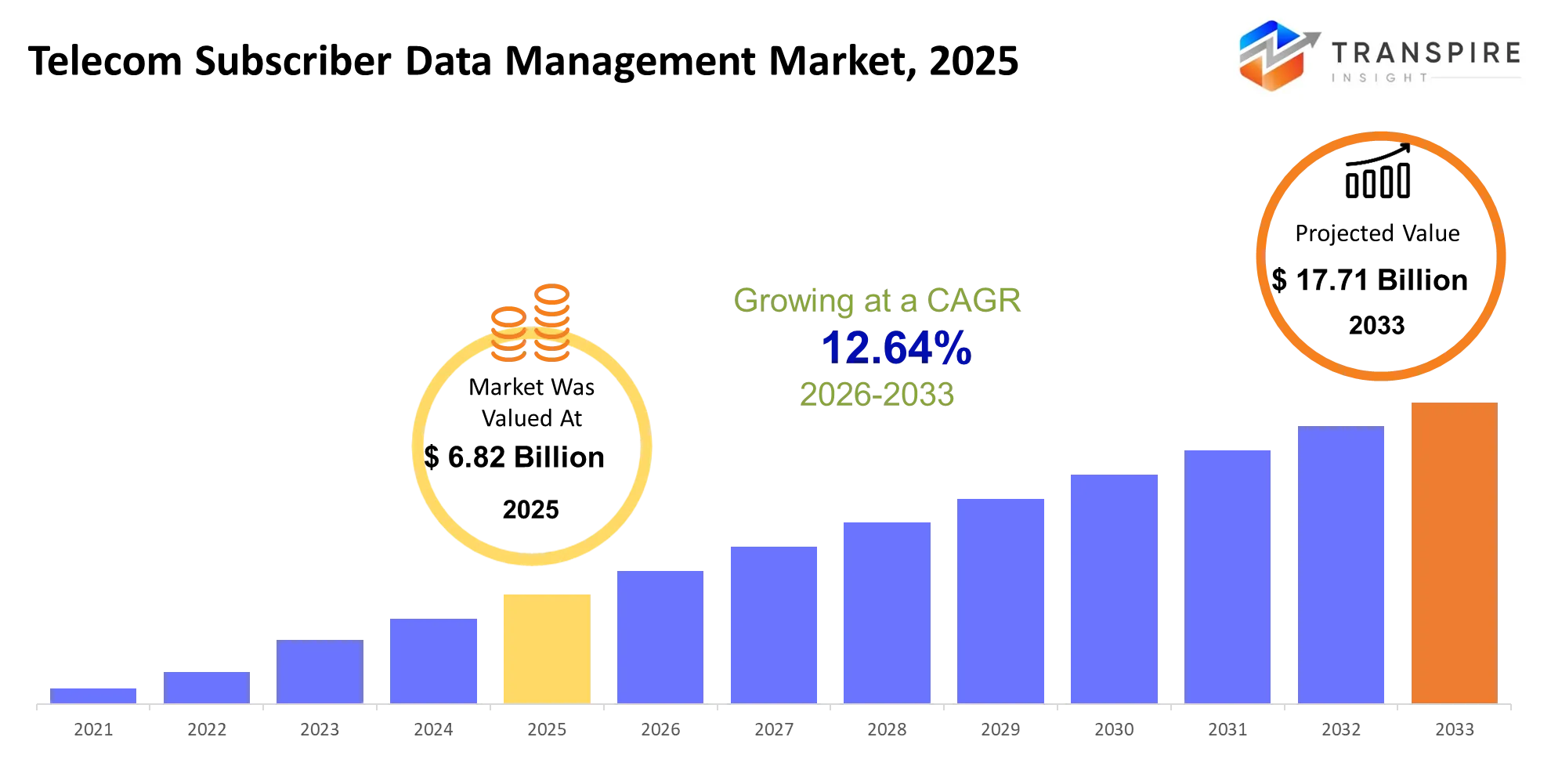
As per Transpire Insight, the Telecom Subscriber Data Management Market size is estimated at USD 6.82 billion in 2025 and is anticipated to reach USD 17.71 billion by 2033, growing at a CAGR of 12.64% from 2026 to 2033.
The telecom subscriber data management market supports telecom companies in keeping track of customer information. It includes storing details about each customer, checking who they are, controlling what they can access and making sure they can use communication services on both landline networks. This area has grown in importance as telecom companies move away from network databases and start using new unified cloud-based systems that handle different types of network connections. Over the past three to five years, the move toward 5G Standalone systems has led to more money being spent on central data storage, automatic setup of services and quick checks to make sure customers are who they say they are. More and more devices are connecting to the internet, which makes managing all of these devices. Networks now have to handle lots of device identities along with customer information. Telecom companies that are updating their networks need systems that can handle both old 4G services and new 5G apps. This change is opening up chances for companies that provide data management tools that can grow, stay safe and work well with systems.
Telecom Subscriber Data Management Market Size & Forecast:
- Market Size 2025: USD 6.82 Billion
- Expected Market Value (2033): USD 17.71 Billion
- Forecast CAGR (2026–2033): 12.64%
- Leading Region in 2025: North America
- Fastest Growing Region: Asia-Pacific
- Key Company Profiles: Nokia, Ericsson, Huawei Technologies, Oracle, Cisco Systems, Amdocs, Mavenir, Enea, Hewlett Packard Enterprise, ZTE, Openwave Mobility, Alepo, Juniper Networks, Comarch, MATRIXX Software
Key Market Insights:
Market is a move towards having integrated subscriber management systems to ease the process of managing the network and launching services quickly.
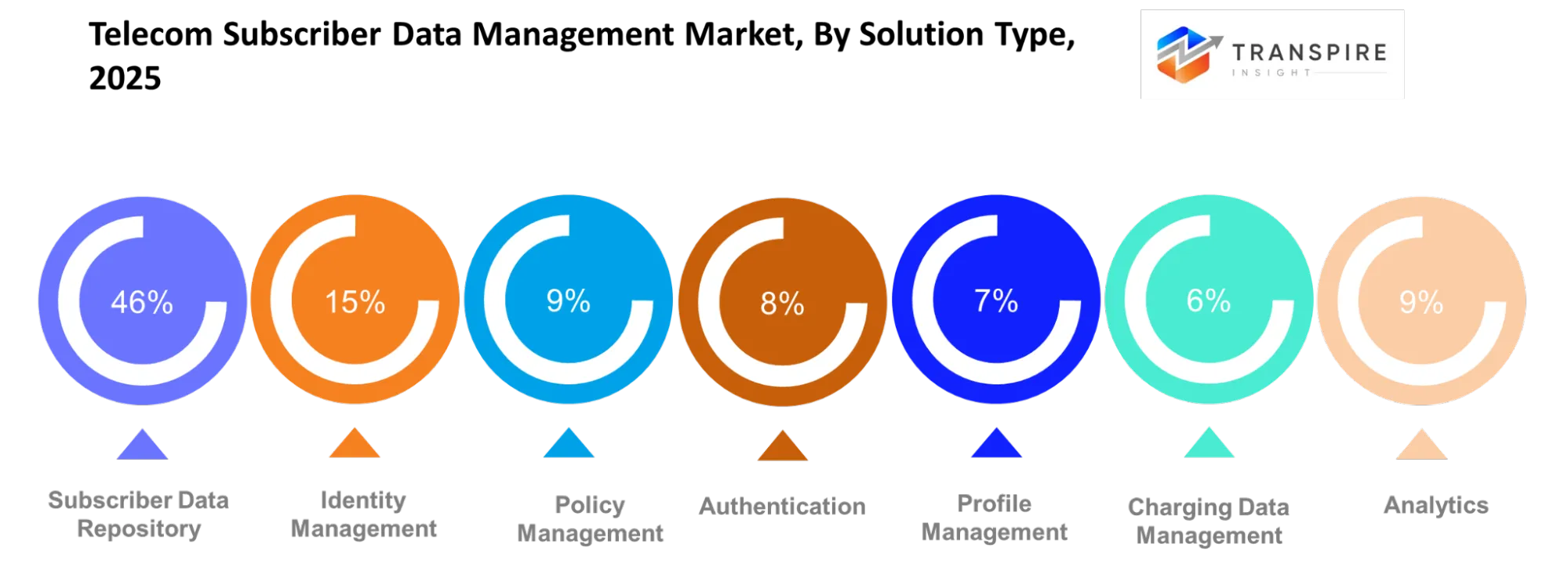
- Subscriber Data Repository constitutes 45.87% market share owing to the growing need for a central repository of subscriber data and uniform management of the same.
- Policy Management makes up 9.00% market share due to adoption of automated network policies and services.
- Authentication holds 8.00% owing to the rising need for subscriber/device validation and secure authentication.
- Profile Management constitutes 7.00% of the market share, which helps in maintaining consistent subscriber data across services of operators.
- Charging Data Management constitutes 6.00% and helps in tracking usage and billing.
- Analytics accounts for a 5.00% share and helps in improved operations and network monitoring.
What are the Key Drivers, Restraints, and Opportunities in the Telecom Subscriber Data Management Market?
Drivers:
The increasing use of 5G standalone technologies, there is motivation for telecom carriers to integrate their disparate subscriber databases. Such systems assist in handling subscriber authentication, subscriber profiles, and subscriber entitlements on multiple generations of network technology. With the addition of IoT capabilities, this task has become more complex since carriers have to manage both device identities and conventional mobile subscribers as well.
Restraints:
The cost of implementing the new technology, the intricacy of the integration process, and the need to ensure smooth service provision may delay the modernisation process. New platforms have to be integrated with legacy databases, billing systems, authentication functions, and existing network infrastructure. Security issues and compliance with data privacy standards also call for continuous investment in security.
Opportunities:
Cloud-native platforms, automated provisioning processes, and unified data repositories may serve as opportunities for vendors to simplify network operations. Telecom companies may also use this chance to increase the range of services offered for private 5G, connected devices, and applications requiring reliable identity management. Asia-Pacific region seems to be an interesting growth area for operators who will modernize their networks and introduce advanced connectivity.
What Has the Impact of Artificial Intelligence Been on the Telecom Subscriber Data Management Market?
The use of artificial intelligence has introduced a predictive element into telecom subscriber data management by enabling operators to detect unusual behavior, make more informed decisions and automate the management of networks. The use of AI in analytics can be used to analyze authentication logs, subscriber sessions, device activity and service usage to detect behavior that needs further investigation. In combination with network security tools, AI can help detect suspicious access attempts and enable quicker responses to threats.Another application of AI is automation. AI-enabled monitoring can assist in detecting performance problems, prioritizing maintenance tasks and reducing the time needed for investigating recurring service problems. Predictive analytics may also help with capacity planning by detecting usage patterns before they become an issue.there are also some constraints to the implementation of AI. Poor quality of data, integration with existing network infrastructure, cybersecurity considerations and computing infrastructure costs may limit the adoption of AI. In addition, inaccurate predictions can result in unnecessary alerts and missed issues. Thus, telecom operators will require quality training data, proper governance and human involvement in the use of AI recommendations for critical operations on the network.
Instance:
In March 2025, Ericsson, Indosat Ooredoo Hutchison, and Google Cloud launched a cloud-native business support system in Indonesia, making use of artificial intelligence to enhance efficiency and tailor telecom services. This serves to demonstrate the capabilities of AI in enhancing the analysis and management of subscriber information.
Key Market Trends:
The market trends are moving away from disparate subscriber databases to more integrated solutions that can handle various network generations and applications.
- The traditional approach to infrastructure is now being augmented by containers and microservices that scale according to network demand.
- They are moving on from early 5G implementations to having a network architecture that can support advanced connectivity and service management systems.
- Providers of network services have resorted to implementing automated user provisioning and configuration for quick deployments and lower labour costs.
- The concepts of private 5G networks, network slicing, and mission-critical applications are prompting service providers to create more tailored services.
- Operators are now considering how AI solutions can aid their efforts in monitoring and predicting network faults.
Telecom Subscriber Data Management Market Segmentation
By Solution Type:
Data Repository of Subscribers leads the solutions segment, taking up 45.87% of market share and being the largest in terms of the provided dataset. It shows the necessity of creating an organised system containing subscribers' information which can be accessed by different network functions. According to the results of research conducted on identity verification and control of access, Identity Management has been identified as the fastest-growing segment in the market with a CAGR of 15.37%. Policy Management takes up 9.00%, Authentication 8.00%, Profile Management 7.00%, Charging Data Management 6.00%, Analytics 5.00%, and Others 4.13%.
By Deployment:
Cloud, On-Premise, Hybrid, Private Cloud, Public Cloud, Multi-Cloud, Edge, and others are the deployment categories. The on-premises infrastructure is still important for operators who need to have direct control of the sensitive subscriber data and network environment. The cloud infrastructure deployment gives the opportunity for scalable infrastructure deployment, and hybrid will allow combining the old infrastructure with the new cloud-native applications. The private cloud provides dedicated resources, while the public and multi-cloud will give other possibilities for workload and infrastructure management. Edge deployment can be helpful for applications needing data processing near network users or devices.
By Network Type:
There are such types of networks in the market like 4G/LTE, 5G NSA, 5G SA, 3G, IoT Networks, Private 5G, Fixed Wireless, and Others. The existing 4G/LTE network needs reliable subscriber profiles and authentication, and 5G NSA allows the operator to migrate to new mobile services. 5G SA is being developed, and it increases the necessity of having cloud-native subscriber management and unified data functions. IoT Networks introduce device identity and connectivity profiles into the management processes. Private 5G makes special demands for enterprise networks.
By Organizations Size:
Large enterprises, SMEs, telecom groups, MVNOs, IoT providers, enterprises, government networks, and others are the organisation types referred to in the report. Large telecom groups will require platforms that can handle large subscriber numbers in different network generations and geographic regions. SMEs and small service providers will be looking for cost-effective implementations, simplicity, and flexibility. MVNOs can leverage subscriber management to facilitate customer onboarding, activation, and engagement with host network operators. IoT providers need to handle large device populations, while government networks may focus on security and control.
By End User:
Mobile network operators, fixed operators, MVNOs, enterprises, IoT service providers, CSPs, government, and others are the primary end-user types. Mobile network operators will require platforms that can store subscriber information for identity management, authentication, and delivery of services on mobile networks. Fixed operators use the platform for customer profile and service entitlement management, while MVNOs will require robust subscriber administration in their operating models. Communication service providers may combine mobile, fixed, and digital services in one environment.
What are the Key Use Cases Driving the Telecom Subscriber Data Management Market?
The use case is Centralised Subscriber Information Management, which is enabled through the Subscriber Data Repository use case, in the market within the given dataset. The telecommunications operators rely on these repositories to manage the identities of their subscribers, their subscription information, authentication, and authorisations within the various network functions. This helps to ensure the integrity of the subscriber information through service activation and migration. Extended applications would be 5G service provisioning, roaming, policies, and authorisation in mobile and fixed network scenarios. They can also assist MVNOs and communication service providers in coordinating their subscribers' services as well as their entitlements. Potential applications would include the management of the identities of connected devices, private 5G connections, enterprise network slicing, and AI-driven operational visibility. Such applications would enable platforms combining access to secure subscriber data and network operations flexibility and automation.
|
Report Metrics |
Details |
|
Market size value in 2025 |
USD 6.82 Billion |
|
Market size value in 2026 |
USD 7.7 Billion |
|
Revenue forecast in 2033 |
USD 17.71 Billion |
|
Growth rate |
CAGR of 12.64% from 2026 to 2033 |
|
Base year |
2025 |
|
Historical data |
2021 - 2024 |
|
Forecast period |
2026 - 2033 |
|
Report coverage |
Revenue forecast, competitive landscape, growth factors, and trends |
|
Regional scope |
United States; Canada; Mexico; United Kingdom; Germany; France; Italy; Spain; Denmark; Sweden; Norway; China; Japan; India; Australia; South Korea; Thailand; Brazil; Argentina; South Africa; Saudi Arabia; United Arab Emirates |
|
Key company profiled |
Nokia, Ericsson, Huawei Technologies, Oracle, Cisco Systems, Amdocs, Mavenir, Enea, Hewlett Packard Enterprise, ZTE, Openwave Mobility, Alepo, Juniper Networks, Comarch, MATRIXX Software |
|
Customization scope |
Free report customization (country, regional & segment scope). Avail customized purchase options to meet your exact research needs. |
|
Report Segmentation |
Solution Type (Subscriber Data Repository, Identity Management, Policy Management, Authentication, Profile Management, Charging Data Management, Analytics, Others); Deployment (Cloud, On-Premise, Hybrid, Private Cloud, Public Cloud, Multi-Cloud, Edge, Others); Network Type (4G/LTE, 5G NSA, 5G SA, 3G, IoT Networks, Private 5G, Fixed Wireless, Others); Organization Size (Large Enterprises, SMEs, Telecom Groups, MVNOs, IoT Providers, Enterprises, Government Networks, Others); End User (Mobile Network Operators, Fixed Operators, MVNOs, Enterprises, IoT Service Providers, CSPs, Government, Others) |
Which Regions are Driving the Telecom Subscriber Data Management Market Growth?
North America:
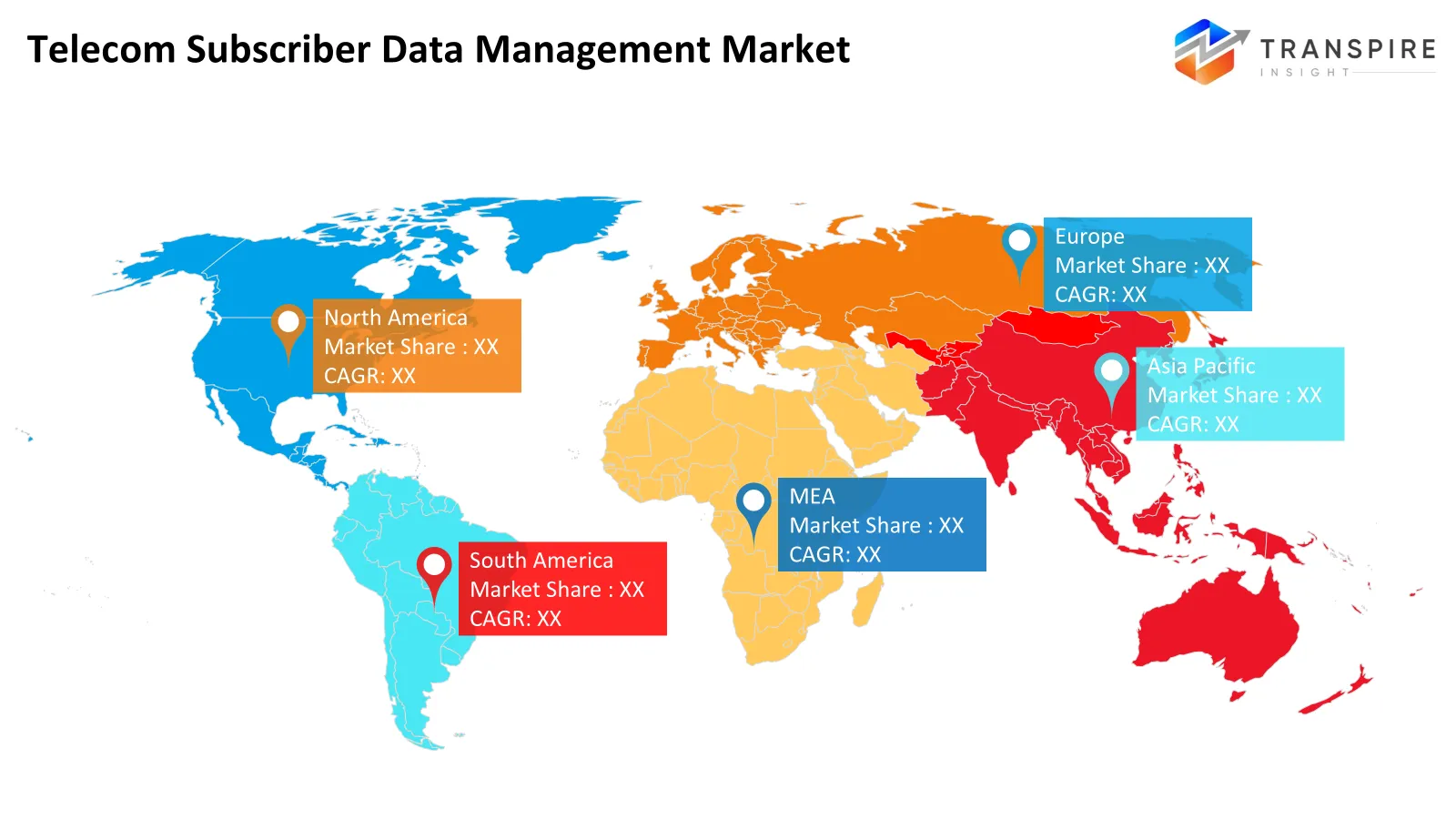
The North America region is the largest player in the telecom subscriber data management market, with a market share of 33.60% as per the provided dataset. It is backed by the presence of a robust telecommunications network infrastructure, network upgrade investments, and the need for secure subscriber management solutions. Telecom operators in this region are working on upgrades of their core networks to increase service dependability and enable advanced connectivity applications.
In March 2026, Ericsson has indicated that VTel Wireless has chosen their 5G Core and RAN solutions to build a cloud-native 5G Standalone network in Vermont, U.S. This is meant to help in providing nationwide 5G voice roaming, enhanced network interworking capability, and better connectivity for rural customers. This shows the increasing focus on investing in modern core network which can offer subscriber authentication, mobility, and connectivity.
https://www.ericsson.com/es/press-releases/6/2026/vtel-wireless
Europe:
Europe holds 24.00% of the market, fueled by the presence of mature mobile operators, interconnection needs, and transformation of the existing networks. In contrast to North America, the regional market dynamics are largely driven by regulatory compliance, privacy issues, and the need to ensure the provision of consistent services in various national markets. It is necessary to ensure that infrastructure transformation does not go against the requirements to protect privacy and integrate with existing infrastructure. These factors contribute to the demand for platforms that will be able to manage subscriber information in various networks.
In June 2025,Nokia has announced that 02 Czech Republic has used their 5G Standalone core software solution to provide flexible mobile services for its users. This would help the company to offer network slicing, enhanced network security, and automation, and thus, provide flexible connectivity services to their subscribers. This reflects Europe’s continuing efforts at modernizing their telecom core network and offering advanced subscriber services.
Asia-Pacific:
The Asia-Pacific region represents 30.00% of the market and is considered the fastest-growing region, with a reported CAGR of 19.40%. Increasing connectivity, network investments, and advanced mobile services are creating new requirements for managing subscriber identities and processing their data. The growth potential of the region is additionally driven by the need to accommodate large numbers of subscribers and connected devices, along with the modernisation of the existing infrastructure. Platforms that are scalable, cloud native, cost-effective, and support mixed-generation networks can become worthy of investment in the region.
In April 2025, Ericsson has announced 5G Core agreement with Bharti Airtel in India, under their first-quarter business activities. This highlights the continued focus on upgrading to modern telecom core network. Such upgrades make subscriber data management, subscriber authentication, and other network operations even more critical.
Who are the Key Players in the Telecom Subscriber Data Management Market and how do they compete?
Telecom subscriber data management is a competitive marketplace where network connectivity, scalability, security, and multi-generation compatibility stand out. Some players in this space are Ericsson, Nokia, Huawei, Oracle, and Amdocs. They compete in varied ways due to differences in their product lines and capabilities, relationship with carriers, and methods of implementation. The strength of Ericsson’s competition revolves around cloud-native core networks and subscriber management. Nokia stands out due to the implementation of centralised solutions and cloud-native core networks. competition lies in integrating enterprise software, operation platforms for telecom, identity management, and modernised networks. Expansion of these vendors will involve cloud-based implementations, migration to 5G Standalone, IoT connections, and working with the operators.
Telecom Subscriber Data Management Market companies
- Nokia
- Ericsson
- Huawei Technologies
- Oracle
- Cisco Systems
- Amdocs
- Mavenir
- Enea
- Hewlett Packard Enterprise
- ZTE
- Openwave Mobility
- Alepo
- Juniper Networks
- Comarch
- MATRIXX Software
Recent Development News
- In February 2026, Amdocs announced its aOS agentic operating system for telecommunications, which was created for the incorporation of AI-enabled workflows into telecom business and operational support systems. This news may bring improvements in automation of processes for service providers. https://www.amdocs.com/press-release/amdocs-introduces-aos-agentic-operating-system-telecommunications
- In October 2025, Ericsson signed a multi-year contract with e& UAE for the upgrade of its 5G core network via cloud-native solutions such as Unified Data Management and User Data Consolidation. The upgrade will enable advanced connectivity and will be ready for future applications like mission-critical IoT. https://www.ericsson.com/en/press-releases/5/2025/ericsson-and-e-enter-multi-year-agreement-to-modernize-5g-core-network
What Strategic Insights Define the Future of the Telecom Subscriber Data Management Market?
The future of the telecom subscriber data management market will depend largely on how well telecom operators integrate centralised subscriber data, cloud-native architecture, and network automation processes. With the growth of 5G Standalone networks and connected device ecosystems, platforms should be able to address increased complexities of the identity requirements without sacrificing reliability and data protection. One of the lesser-known challenges is the challenge of moving legacy subscriber databases in such a way that it will not disrupt services. Inconsistencies in integration, database records, or security measures can lead to increased costs and decreased customer confidence. On the other hand, the advent of private 5G, IoT connectivity, and enterprise network slicing provide opportunities for vendors to come up with specialized subscriber management solutions. Vendors should aim for interoperable architectures, flexible deployment models, and automated provisioning with solid access controls.
Key Segmentations are:
Solution Type
- Subscriber Data Repository
- Identity Management
- Policy Management
- Authentication
- Profile Management
- Charging Data Management
- Analytics
- Others
Deployment
- Cloud
- On-Premise
- Hybrid
- Private Cloud
- Public Cloud
- Multi-Cloud
- Edge
- Others
Network Type
- 4G/LTE
- 5G NSA
- 5G SA
- 3G
- IoT Networks
- Private 5G
- Fixed Wireless
- Others
Organization Size
- Large Enterprises
- SMEs
- Telecom Groups
- MVNOs
- IoT Providers
- Enterprises
- Government Networks
- Others
End User
- Mobile Network Operators
- Fixed Operators
- MVNOs
- Enterprises
- IoT Service Providers
- CSPs
- Government
- Others
By Regional Analysis
North America
- US
- Canada
- Mexico
Europe
- Germany
- UK
- France
- Italy
- Spain
- Russia
- Rest of Europe
Asia Pacific
- China
- Japan
- India
- South Korea
- Australia
- Rest of Asia Pacific
South America
- Brazil
- Argentina
- Rest of South America
Middle East & Africa
- UAE
- Saudi Arabia
- Qatar
- South Africa
- Rest of the Middle East & Africa
Frequently Asked Questions
Find quick answers to common questions.
The telecom subscriber data management market size was valued at USD 6.82 billion in 2025 and is poised to reach USD 17.71 billion by 2033, expanding at a 12.64% CAGR.
Key segments for the telecom subscriber data management market are Solution Type (Subscriber Data Repository, Identity Management, Policy Management, Authentication, Profile Management, Charging Data Management, Analytics, Others); Deployment (Cloud, On-Premise, Hybrid, Private Cloud, Public Cloud, Multi-Cloud, Edge, Others); Network Type (4G/LTE, 5G NSA, 5G SA, 3G, IoT Networks, Private 5G, Fixed Wireless, Others); Organization Size (Large Enterprises, SMEs, Telecom Groups, MVNOs, IoT Providers, Enterprises, Government Networks, Others); End User (Mobile Network Operators, Fixed Operators, MVNOs, Enterprises, IoT Service Providers, CSPs, Government, Others).
Growth is primarily driven by increased volumes of mobile data traffic, need for real-time user authentication, increased adoption of telecom cloud infrastructure, and need for subscriber data management and network security.
The market is led by major manufacturers including Nokia, Ericsson, Huawei Technologies, Oracle, Cisco Systems, Amdocs, Mavenir, Enea, Hewlett Packard Enterprise, ZTE, Openwave Mobility, Alepo, Juniper Networks, Comarch, MATRIXX Software.
North America holds 33.60% share of the telecom subscriber data management market owing to the presence of state-of-the-art telecommunications infrastructure, adoption of 5G, high traffic of data, and substantial investments in cloud-based subscriber management systems.
Opportunities in telecom subscriber data management include the rapid uptake of 5G technology, the increasing demand for cloud-based subscriber data management solutions, the development of network virtualisation, and increased spending on AI-enabled data analytics and subscriber identity management.
- Nokia
- Ericsson
- Huawei Technologies
- Oracle
- Cisco Systems
- Amdocs
- Mavenir
- Enea
- Hewlett Packard Enterprise
- ZTE
- Openwave Mobility
- Alepo
- Juniper Networks
- Comarch
- MATRIXX Software
About the Authors

Mayur Shinde
I am Mayur Shinde, a Senior Research Analyst at Transpire Insight, specializing in the Automotive & Transportation and Information & Communication Technology (ICT) Industry. My work focuses on analyzing emerging market trends, technological advancements, competitive landscapes, and industry developments to deliver accurate, data-driven insights. I am passionate about transforming complex market information into clear, actionable content that helps businesses, professionals, and decision-makers stay informed and make confident strategic decisions.

Chakradhar Khansole
Chakradhar serves as the Research Director at Transpire Insight, bringing over 8 years of experience in technology, innovation, and strategic market intelligence. He specializes in transforming complex market data into actionable business insights that enable organizations to make informed, growth-oriented decisions. Recognized for his strategic vision and analytical expertise, Chakradhar leads high-impact research initiatives, delivering comprehensive market assessments, competitive intelligence, and forward-looking industry analysis.
Recently Published Reports
-
Apr 2026
3D Optical Profiler Market
3D Optical Profiler Market Size, Share & Analysis Report By Type (Desktop 3D Optical Profiler, and Portable 3D Optical Profiler), By Technology (Confocal Technology, and White Light Interference), By End-Use Industry (Manufacturing, Research Institutions, Automotive, Aerospace and Defense, Medical Devices, and Other), and Geography (North America, Europe, Asia-Pacific, Middle East and Africa, South and Central America), 2021 - 2031
-
Apr 2026
Depth Sensor Market
Depth Sensor Market Size, Share & Analysis Report By Type (Infrared Depth Sensors, Time-of-Flight (ToF) Sensors, Stereo Vision Sensors, Structured Light Sensors, Ultrasonic Depth Sensors), By Application (Automotive, Robotics, Gaming, Consumer Electronics, Industrial Automation, Healthcare, Security & Surveillance, Others), By End Users (Automotive Manufacturers, Consumer Electronics Companies, Healthcare Providers, Industrial Companies, Security Agencies, Gaming Companies, Robotics Companies, Others), and Geography (North America, Europe, Asia-Pacific, Middle East and Africa, South and Central America), 2021 – 2031
-
Apr 2026
Digital Manufacturing Market
Digital Manufacturing Market Size, Share & Analysis Report By Component (Hardware, Software, and Services), By Technology (Robotics, 3D Printing, Internet of Things (IoT), and Others), By Application (Automotive and Transportation, Aerospace and Defense, Consumer Electronics, Industrial Machinery, and Others), By Process Type (Computer-Based Designing, Computer-Based Simulation, Computer 3D Visualization, Analytics, and Others), and Geography (North America, Europe, Asia-Pacific, Middle East and Africa, South and Central America), 2021 – 2031
-
Apr 2026
Digital Visa Services Market
Digital Visa Services Market Size, Share & Analysis Report By Type (Individual Travelers, Group Travelers), By Application (Tourism, Business Travel, Others), and Geography (North America, Europe, Asia-Pacific, Middle East and Africa, South and Central America), 2021 – 2031