

Digital Scent Market Summary:
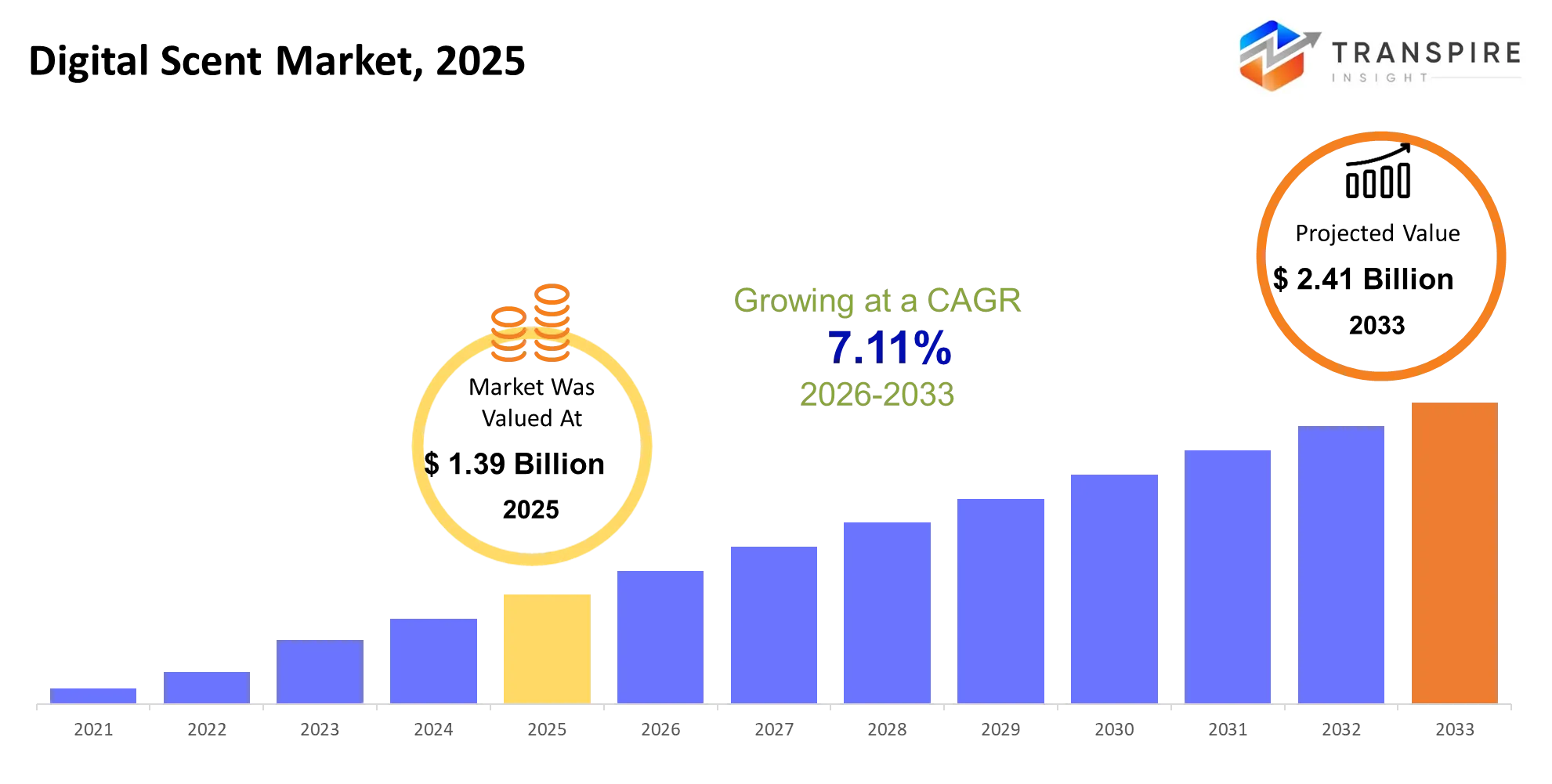
As per Transpire Insight, the Digital Scent Market size is estimated at USD 1.39 billion in 2025 and is anticipated to reach USD 2.41 billion by 2033, growing at a CAGR of 7.11% from 2026 to 2033.
The digital scent market is changing the way businesses find, understand, and copy smells. This is happening in areas like healthcare, food quality, industrial monitoring and digital experiences for consumers. In the past three to five years, the field has moved past old ways of detecting odours. Now it uses noses, smart sensors and artificial intelligence to pick up on complex scent patterns. A major change is how machine learning is being added to sensor hardware. This lets companies turn chemical signals into data that’s easy to use. One big reason for this shift is the need for more reliable quality checks. Also, spotting chemical issues early is important in both manufacturing and healthcare. As companies look for ways to replace hands-on testing, digital scent tools can help automate checks, make processes more consistent, and support decisions based on real data. Better sensor design and smarter pattern recognition are also leading to connected devices. These new gadgets are opening up business uses. That’s pushing tech providers to build solutions that can grow and work well in both industrial and consumer markets.
Digital Scent Market Size & Forecast:
- Market Size 2025: USD 1.39 Billion
- Expected Market Value (2033): USD 2.41 Billion
- Forecast CAGR (2026–2033): 7.11%
- Leading Region in 2025: North America
- Fastest Growing Region: Asia Pacific
- Key Company Profiles: Aryballe, Alpha MOS, Osmo, Aromajoin, OVR Technology, Feelreal, Sensigent, eNose Company, Owlstone Medical, Scentee, DigiScents, Electronic Sensor Technology, Plasmion, Comon Invent, Enviropure
Key Market Insights
The market is moving from simple odour detection to scent intelligence and monitoring systems, as well as digitalisation of fragrance experiences
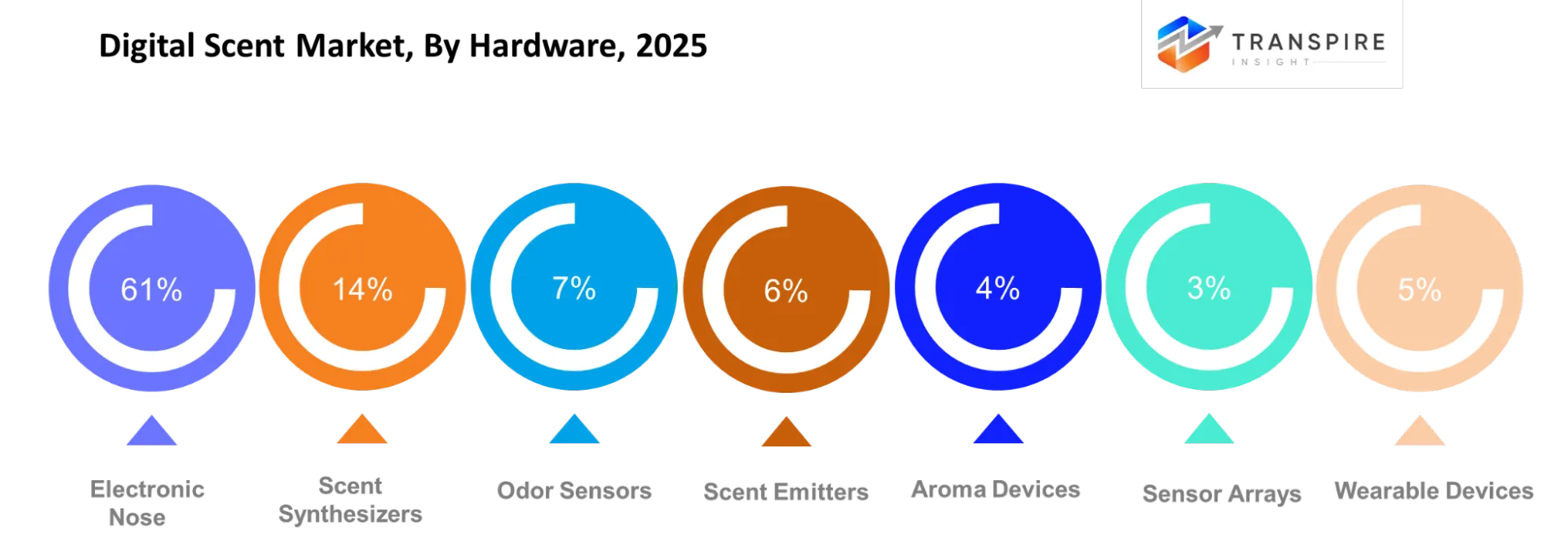
- Electronic noses hold 61.1% of the hardware market segment as the leading technology in chemical pattern recognition, and development in AI-based sensing technologies by companies.
- Scent synthesisers constitute 14.0% of the hardware market segment, being an important element in developing digitally controlled fragrances for tests and interactive experiences.
- Aroma devices constitute 4.5% of the segment, while smartphone-connected aroma tools are assisting companies to develop interactive products.
- Sensor arrays make up 3.0% of the market segment and provide capability to collect multiple chemical signals for scent classification.
- Wearable devices constitute 2.4% of the hardware segment, while wearable and embedded modules will grow at the
What are the Key Drivers, Restraints, and Opportunities in the Digital Scent Market?
Drivers:
Drivers of the market include the demand for quicker and more reliable chemical detection for processing in the food industry, healthcare and manufacturing: traditional testing may mean samples have to be taken and sent for lab analysis. AI-enabled electronic noses can categorise chemical patterns to help make faster inspection decisions. Commercialisation of industrial scent-sensing platforms is another driver as manufacturers look for automated monitoring to enhance process control, eliminate waste and detect anomalies earlier.
Restraints:
High cost of implementation and the lack of standardised sensor performance are major restraints. Electronic noses need to identify the aromas from complex mixes even when the temperature, humidity and environment change. Sensor drift, calibration, limited collection of standard data sets and the need for new equipment may increase the costs of operation. This limits the use in smaller applications and the ones that need high levels of accuracy.
Opportunities:
Healthcare diagnostics, food security and intelligence-based manufacturing have the potential to increase. Volatile organic compounds (VOCs) could be analyzed using AI to help develop non-invasive diagnostic tools; contamination or quality issues during production could be detected by internet-enabled sensors. Scentian Bio has received investment in its pre-Series A phase to support the development of its digital nose in the field of food quality and security monitoring. They are ready to invest in this entry into the healthcare market through digital noses.
|
Driver |
Relative Impact on Growth (%) |
Geographic Relevance |
Impact Timeline |
Demand Strength |
Growth Mechanism (5–10 words) |
Key Beneficiaries (5–10 words) |
Major Constraint (5–10 words) |
|
Integration of Artificial Intelligence and Machine Learning |
25% |
North America, Europe, Asia Pacific |
Medium-term (2–4 years) |
High |
Improves odor recognition, classification, prediction, and analysis accuracy |
AI developers, sensor manufacturers, analytics providers, industrial users |
Limited standardized datasets and inconsistent odor recognition accuracy |
|
Rising Demand for Electronic Noses in Industrial Quality Control |
23% |
North America, Europe, Asia Pacific |
Short-term (≤2 years) |
High |
Enables rapid odor detection and automated quality inspection |
Electronic nose manufacturers, testing laboratories, food and beverage producers |
High equipment costs and application-specific calibration requirements |
|
Expanding Applications in Healthcare and Disease Diagnostics |
20% |
North America, Europe, Asia Pacific |
Long-term (≥4 years) |
High |
Detects disease-associated volatile organic compound patterns noninvasively |
Medical device companies, diagnostic laboratories, healthcare providers, research institutions |
Clinical validation requirements and regulatory approval uncertainties |
|
Growing Adoption of Immersive Digital Experiences and Scent-Enabled Devices |
17% |
North America, Asia Pacific, Europe |
Medium-term (2–4 years) |
Medium |
Adds synchronized scent delivery to immersive digital experiences |
VR hardware makers, gaming companies, scent technology developers, content platforms |
Limited consumer adoption and incompatible device ecosystems |
|
Increasing Investment in Smart Environmental Monitoring and Personalized Scent Technologies |
15% |
Asia Pacific, North America, Europe |
Long-term (≥4 years) |
Medium |
Supports real-time odor monitoring and customized scent delivery |
Environmental monitoring firms, smart device makers, fragrance companies, technology vendors |
Sensor drift, maintenance costs, and uncertain commercialization pathways |
|
Total |
100% |
— |
— |
— |
— |
— |
— |
What Has the Impact of Artificial Intelligence Been on the Digital Scent Market?
Artificial intelligence is further developing the capabilities of digital scent technology by enabling the recognition of chemical signatures that might be difficult for traditional sensors to discern. Electronic noses gather data from several sensors at once, whereas machine learning algorithms use this information to classify odours and detect differences between samples. These technologies have relevance in the fields of food quality inspection, environmental monitoring, industrial safety, and health care research. Automation is one of the advantages of using this technology. AI-based tools can analyse recurring sensor data and perform continuous monitoring without relying on manual interpretation. Predictive analytics might be used to detect abnormal chemical signatures before they evolve into bigger issues in the production process, as long as the models are correctly trained and validated. In manufacturing, these technologies could provide process optimisation and faster quality testing, as well as more consistent inspection documentation.AI is helping researchers develop new medical uses of these technologies by detecting volatile organic compounds in biological samples. With possible uses in the healthcare industry, cosmetics and environmental monitoring, their effectiveness will depend on the quality of training data, sensor calibration, and the environment
Instance:
In March 2025, Ainos and ASE came together for an innovation involving the use of artificial intelligence in scent detection within the semiconductor industry. Ainos, Inc. worked with ASE to leverage its AI Nose technology in transforming the patterns of chemicals in the air into digital data, which would enable manufacturers to monitor their production processes, detect possible contamination, and ensure safety in the workplace.
Key Market Trends:
The market is moving away from odour detection systems that are stand-alone towards sensing platforms that integrate hardware, AI, and digital data analysis. Commercial interest is growing as companies seek to apply technology beyond laboratory research.
- Previous odour detection systems were mainly concerned with the detection of odours, but now modern systems are utilising machine learning for complex chemical pattern recognition and decision-making.
- Research is progressing from traditional diagnostic procedures to electronic nose technologies that can analyse volatile substances in biological samples.
- Companies are looking into digital odour analysis to evaluate the freshness of products and identify inconsistencies in the production process.
- Companies are using smartphone-based aroma devices and digital interfaces to gather information about customer preferences for their products.
- Tech companies are partnering with manufacturers, automation companies, and research institutions to test applications in real-world operating conditions.
- Sensor data quality is an important issue. With the increase of demands in applications, companies are working on calibration,
Digital Scent Market Segmentation
By hardware:
Electronic noses, which form the largest segment with 61.1% contribution, represent the major segment within the offered segmentation data. These systems use sensor arrays to detect odour patterns and are applicable for inspection of foods, environmental monitoring and industrial purposes. The second major hardware product includes scent synthesisers accounting for 14.0%, odour sensors forming 7.5% of the market, scent emitters representing 6.0%, aroma devices representing 4.5%, sensor arrays making up 3.0%, wearable devices contributing 2.4% and other hardware making up 1.5%. The fastest-growing segment has been found to be wearable and embedded modules, with CAGR of 9.2%. This growth will be possible owing to the growing demand for compact devices.
By technology:
The market comprises gas sensors, biosensors, AI-based sensing, micro-electromechanical systems (MEMS), optical sensors, chemical sensors, machine learning and other means. Gas and chemical sensors form the basis for an airborne compound detection method, while biosensors can be used for a more selective form of detection. AI-based sensing and machine learning will be used to analyse the data, while MEMS is a method to make devices smaller and optical sensing offers a different chemical measurement approach. The document does not specify market shares for these categories of technology so there can be no reliable assignment of individual percentages.
By application:
Market to cover medical diagnostics, food quality, the environment, entertainment, virtual and augmented reality, marketing, consumer electronics and others – Medical diagnostics could learn from the non-invasive chemical analysis research, while the food industry could investigate odour-based inspection and quality evaluation. Environmental monitoring and industrial applications could have a market for sensing chemical changes, while entertainment and VR/AR fields could use scent delivery to provide immersive experiences. The market for interactive fragrance discovery and connected aromatic products, as well as marketing and consumer electronics, can also be targeted. Market shares for each application are not mentioned in the material provided.
By end user:
The primary customer bases include: healthcare users who may research scent analysis for diagnostic purposes, food producers who can leverage it for quality assurance, automotive and consumer electronics users that may consider embedded scent technologies, retailers that could deploy digital fragrances to enhance product discovery, defence agencies and environmental groups that could use specialised sensing applications, and others. The choice of systems will come down to precision, cost of operation, regulatory guidelines and each technology's respective appropriateness to the goal at hand.
By form factor:
The market consists of benchtop or fixed systems, portable instruments, handheld instruments, wearables, embedded modules, mobile solutions, IoT-connected units, among others. Fixed formats are key for testing in test and control laboratories, while portable and handheld formats support field inspections away from the lab or test room. Wearables and embedded formats open up application areas where size and proximity to the test subject are critical factors for success. IoT connectivity can then extend these applications further through remote availability and diagnosis in conjunction with centralised and analytical capabilities.
By distribution:
For digital scent products, route-to-market options can include direct sales, distributors, online, OEM relationships, system integrators, speciality stores, and institutional sales. Direct sales can be used for complex systems that benefit from demonstrations and tailored installation, while distributor and OEM relationships can establish more direct routes to industrial end-user customers. System integrators can integrate digital scent sensors with other automation and control equipment, and online channels can work well for smaller devices and user-focused offerings. Speciality stores and institutional sales can target niche applications, all depending on the level of complexity and support needed by customers, and the purchasing habits of the end-user industry.
What are the Key Use Cases Driving the Digital Scent Market?
Electronic noses serve as the primary hardware type in use. With their capacity to identify patterns in chemicals, these sensors become applicable in quality control for food products, environmental monitoring, and controlling production processes due to consistent odour identification. Along with the well-known areas of application, new ones appear, including medical diagnostics and monitoring industrial processes in conjunction with AI. Non-invasive diagnostic methods might be analysed by AI, whereas the quality of food products and chemical anomalies will be identified automatically. Some other applications include scented virtual reality, discovering fragrances, personal monitoring via wearable gadgets, and scent-enabled robotic systems. These areas involve small-size sensors, digital analytics, and aroma delivery under control.
|
Report Metrics |
Details |
|
Market size value in 2025 |
USD 1.39 Billion |
|
Market size value in 2026 |
USD 1.49 Billion |
|
Revenue forecast in 2033 |
USD 2.41 Billion |
|
Growth rate |
CAGR of 7.11% from 2026 to 2033 |
|
Base year |
2025 |
|
Historical data |
2021 - 2024 |
|
Forecast period |
2026 - 2033 |
|
Report coverage |
Revenue forecast, competitive landscape, growth factors, and trends |
|
Regional scope |
United States; Canada; Mexico; United Kingdom; Germany; France; Italy; Spain; Denmark; Sweden; Norway; China; Japan; India; Australia; South Korea; Thailand; Brazil; Argentina; South Africa; Saudi Arabia; United Arab Emirates |
|
Key company profiled |
Aryballe, Alpha MOS, Osmo, Aromajoin, OVR Technology, Feelreal, Sensigent, eNose Company, Owlstone Medical, Scentee, DigiScents, Electronic Sensor Technology, Plasmion, Comon Invent, Enviropure |
|
Customization scope |
Free report customization (country, regional & segment scope). Avail customized purchase options to meet your exact research needs. |
|
Report Segmentation |
Hardware (Electronic Nose, Scent Synthesizers, Odor Sensors, Scent Emitters, Aroma Devices, Sensor Arrays, Wearable Devices, Others)Technology (Gas Sensors, Biosensors, AI-Based Sensing, MEMS, Optical Sensors, Chemical Sensors, Machine Learning, Others)Application (Medical Diagnostics, Food Quality, Environmental Monitoring, Entertainment, VR/AR, Marketing, Consumer Electronics, Others)End User (Healthcare, Food & Beverage, Automotive, Consumer Electronics, Retail, Defense, Environmental Agencies, Others)Form Factor (Fixed/Benchtop, Portable, Handheld, Wearable, Embedded, Mobile, IoT-Connected, Others)Distribution (Direct Sales, Distributors, Online, OEM, System Integrators, Specialty Stores, Institutional Sales, Others) |
Which Regions are Driving the Digital Scent Market Growth?
North America:
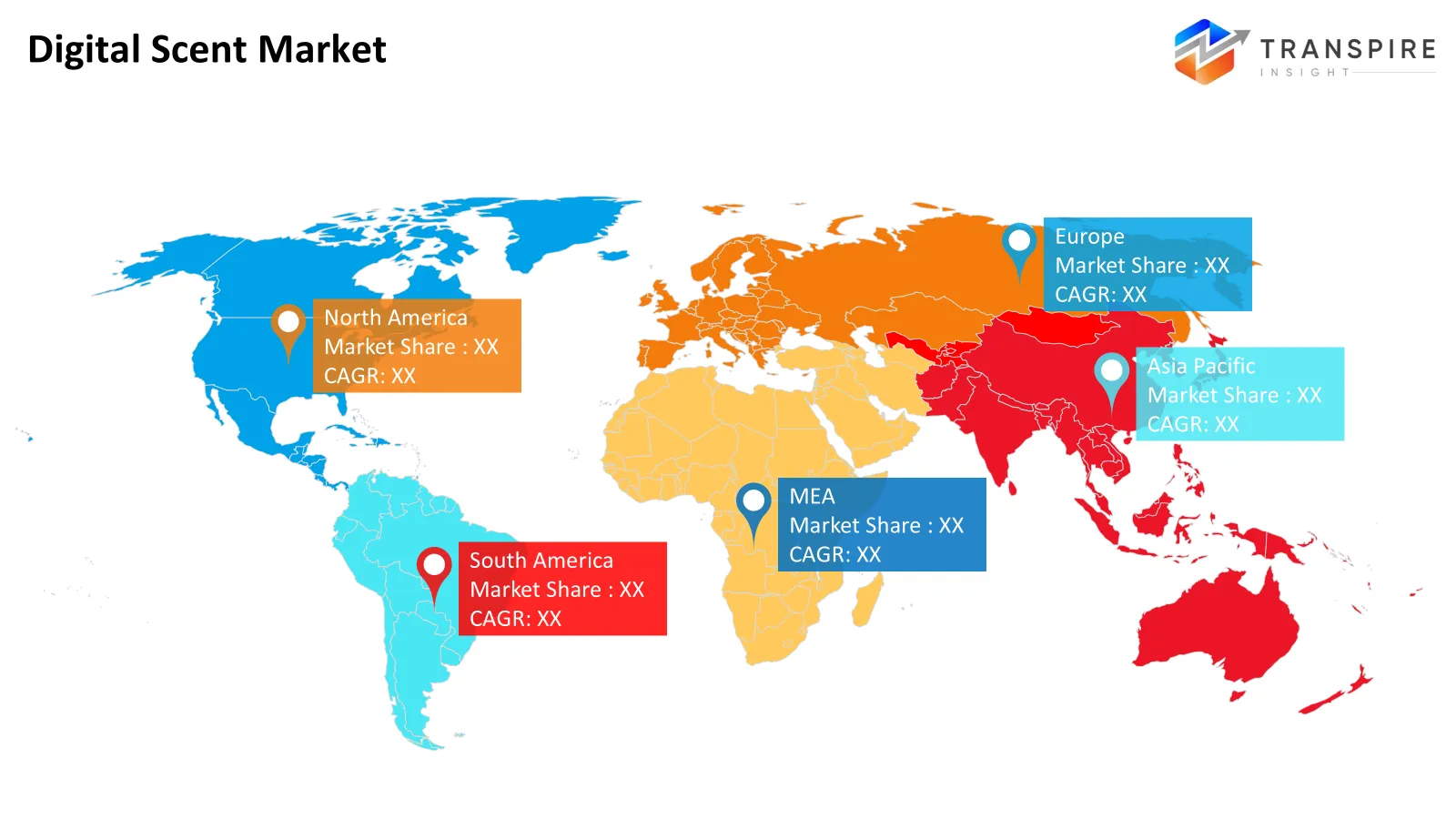
North America is the leading region, accounting for 37.1% of the market for digital scent. The region's status is driven by technology development, research, and interest in AI-enabled sensing in various applications. Cooperation between technology companies, research centres, and industrial consumers may lead to translating innovations from laboratories into marketable products. Investment in automated monitoring and sensing is the basis for further market growth.
In March 2025,Osmo launched AI capabilities in fragrance development. Osmo, the US-based company, revealed the development of an AI-driven fragrance house and disclosed filing patents for its new fragrance molecules. This event reflects the potential of using AI and digital olfaction technology in the development of fragrances.
Europe:
Europe accounts for 28.1% of the worldwide market. Its market characteristics are influenced by industrial engineering skills, scientific research and the demand for advanced quality control technologies. Unlike North America, the European market operates differently due to the tight connection of opportunities with the optimisation of industrial processes, environmental needs and unique fragrance design. The cooperation between manufacturers, research institutes and technology vendors may become an important tool for product development and its practical testing.
In June 2025, Aryballe emphasised the NeOse odour sensing device. The French-based digital olfaction company Aryballe showed the application of its portable NeOse for detecting unpleasant smells in shared spaces like public transport, public places, foods, cosmetic products, and healthcare. This development shows the potential of using odour sensors in industrial quality assurance and commercial purposes.
https://aryballe.com/use-cases/
Asia Pacific:
The Asia Pacific constitutes 26.0% of the market and has been categorised as the fastest-growing one. It has a projected CAGR of 9.0%, and its growth can be attributed to the development in the manufacturing sector, electronic manufacturing, and automation within the industries. The recent commercial development in terms of the distribution and deployment of Industrial Digital Olfaction by Ainos in association with Trusval Technology in Taiwan.
In August 2025,Ainos signed contract with ASE Technology Holding. Ainos, the leading developer of digital olfaction technology, signed a contract with ASE Technology Holding for using 1,400 AI Noses for a period of three years in the semiconductor plants in Taiwan.
https://www.sec.gov/Archives/edgar/data/1014763/000149315225011679/ex99-1.htm
Who are the Key Players in the Digital Scent Market and how do they compete?
In the market for digital scent, competition covers areas of electronic nose devices, AI-based odour detection systems, fragrance creation solutions, and chemical sensors. The unique features offered by businesses in the market include sensor accuracy, data sets, software abilities, ease of integration, and ability to meet particular industry needs. Since the scent market involves scent detection and delivery, competitive positioning depends on the particular type of products. Ainos is working on its AI Nose system, which comprises electronic noses and AI scent analysis for industrial and medical sectors. Its strategy is industrial application and continuous technology services. Osmo concentrates on olfactory AI and fragrance creation solutions and uses funding for growth to fragrance, medical and public safety sectors. Scentian Bio offers unique biosensor solutions for food testing applications based on insect biology. In terms of fragrance creation, Givaudan has launched the Myromi device, which is controlled using smartphones and allows for personal scent creation and customer feedback. Such competitive products offer users personalisation and user engagement features instead of industrial detection only. Further growth would require product validation, partnerships, consistent performance and scalability.
Digital Scent Market Companies
- Aryballe
- Alpha MOS
- Osmo
- Aromajoin
- OVR Technology
- Feelreal
- Sensigent
- eNose Company
- Owlstone Medical
- Scentee
- DigiScents
- Electronic Sensor Technology
- Plasmion
- Comon Invent
- Enviropure
|
Company |
Est. Revenue Share Range |
Key Offerings |
Strategic Positioning |
Geographic Strength |
Technology Focus |
|
Aryballe Technologies |
Estimated 3–7% |
NeOse, NeOse Advance, Core Sensor Module, Digital Olfaction Hub |
Industrial digital olfaction and sensor integration specialist |
Europe, North America, Asia Pacific |
Silicon photonics, VOC sensing, machine learning, cloud analytics |
|
Alpha MOS |
Estimated 4–8% |
HERACLES electronic nose, FOX electronic nose, odor fingerprinting systems, automated sampling |
Analytical instrumentation leader for industrial quality control |
Europe, North America, Asia Pacific |
Fast gas chromatography, chemical fingerprinting, automated odor analysis |
|
Aromajoin Corporation |
Estimated 2–6% |
Aroma Shooter 2, Aroma Shooter 3, AromaCreator, developer SDK |
Digital scent delivery specialist for immersive experiences |
Asia Pacific, North America, Europe |
Programmable scent emission, rapid switching, multichannel aroma blending |
|
OVR Technology |
Estimated 1–4% |
Omara Core, Omara Pro, Scentware, scent cartridges |
Immersive scent technology provider for gaming and VR |
North America, Europe |
Micro-mist delivery, synchronized scent cues, Unity and Unreal integration |
|
Olorama Technology |
Estimated 1–4% |
Professional scent generators, VR scent packs, AromaCore 6, custom scent solutions |
Specialty provider of synchronized scent experiences |
Europe, North America, Asia Pacific |
Cold diffusion, programmable scent release, audiovisual synchronization |
|
AIRSENSE Analytics GmbH |
Estimated 2–5% |
PEN 3 electronic nose, Olfo Sense, chemical detection systems, environmental monitoring |
Specialized sensing provider for analytical applications |
Europe, North America, Asia Pacific |
Sensor arrays, gas detection, odor recognition, continuous monitoring |
|
The eNose Company |
Estimated 1–4% |
Aeonose, electronic nose systems, breath-analysis platforms, odor-pattern analysis |
Electronic nose specialist in breath analysis |
Europe, North America |
Pattern recognition, volatile compound profiling, sensor-based diagnostics |
|
Electronic Sensor Technology |
Estimated 1–3% |
zNose systems, vapor analysis instruments, chemical identification solutions |
Specialized provider of rapid chemical analysis |
North America, Europe, Asia Pacific |
Gas chromatography, surface acoustic wave sensing, vapor fingerprinting |
|
Osmo |
Estimated 1–5% |
Olfactory Intelligence, Osmo Studio, AI-assisted fragrance development, custom fragrance formulation |
AI-led scent intelligence and fragrance innovation challenger |
North America, Europe |
AI molecular prediction, olfactory data mapping, computational fragrance design |
|
Sensigent |
Estimated 1–3% |
ChemPro chemical sensing systems, electronic nose solutions, gas-analysis technologies |
Specialty sensing company for chemical identification |
North America, Europe, Asia Pacific |
Chemical sensor arrays, gas classification, portable detection systems |
Recent Development News
- In December 2025, The Estée Lauder Companies, along with Jo Malone London, launched an AI-based Scent Advisor using Google Cloud AI to help make personalised fragrance recommendations through an online chat service. https://www.elcompanies.com/en/news-and-media/newsroom/press-releases/2025/12-02-2025-121509645
- In February 2026, Osmo received Series B funding to expand its AI-based olfactory technology, which can be used for developing fragrances and various scent applications. https://www.vcaonline.com/news/2026020403/osmo-digital-scent-design-company-announces-70m-in-series-b-funding-and-executive-leadership-team-to-scale-ai-powered-olfaction-technology/
What Strategic Insights Define the Future of the Digital Scent Market?
The future of the worldwide digital scent market will be contingent on the extent to which technology suppliers are able to transform their experimental sensing capabilities into reliable commercial offerings. Electronic noses of the supplied hardware type suggest an existing basis for further innovations. Perhaps the most promising areas of growth will involve the combination of sensors, AI analytics, connectivity, and application-specific software. Another challenge lies in ensuring reliable detection accuracy under different environmental conditions, which is often complicated by such factors as sensor drift, insufficient amounts of training data, calibration issues, and discrepancies between the conditions of lab and real-life tests. Businesses capable of overcoming these problems through testing and validation procedures may gain competitive advantages. There is room for growth in healthcare screening, food quality assurance, and automated industrial inspection. The presence of investments also suggests the continuing interest in creating commercially viable digital olfaction systems. Businesses in the field should focus on validated use cases, partner with end users, and prove the capability of accelerating inspection processes, increasing their reliability or reducing their cost before entering other markets.
Key Segmentations are:
Hardware
- Electronic Nose
- Scent Synthesizers
- Odor Sensors
- Scent Emitters
- Aroma Devices
- Sensor Arrays
- Wearable Devices
- Others
Technology
- Gas Sensors
- Biosensors
- AI-Based Sensing
- MEMS
- Optical Sensors
- Chemical Sensors
- Machine Learning
- Others
Application
- Medical Diagnostics
- Food Quality
- Environmental Monitoring
- Entertainment
- VR/AR
- Marketing
- Consumer Electronics
- Others
End User
- Healthcare
- Food & Beverage
- Automotive
- Consumer Electronics
- Retail
- Defense
- Environmental Agencies
- Others
Form Factor
- Fixed/Benchtop
- Portable
- Handheld
- Wearable
- Embedded
- Mobile
- IoT-Connected
- Others
Distribution
- Direct Sales
- Distributors
- Online
- OEM
- System Integrators
- Specialty Stores
- Institutional Sales
- Others
By Regional Analysis
North America
- US
- Canada
- Mexico
Europe
- Germany
- UK
- France
- Italy
- Spain
- Russia
- Rest of Europe
Asia Pacific
- China
- Japan
- India
- South Korea
- Australia
- Rest of Asia Pacific
South America
- Brazil
- Argentina
- Rest of South America
Middle East & Africa
- UAE
- Saudi Arabia
- Qatar
- South Africa
- Rest of the Middle East & Africa
Frequently Asked Questions
Find quick answers to common questions.
The digital scent market size was valued at USD 1.39 billion in 2025 and is poised to reach USD 2.41 billion by 2033, expanding at a 7.11% CAGR.
Key segments for the digital scent market are Hardware (Electronic Nose, Scent Synthesizers, Odor Sensors, Scent Emitters, Aroma Devices, Sensor Arrays, Wearable Devices, Others)Technology (Gas Sensors, Biosensors, AI-Based Sensing, MEMS, Optical Sensors, Chemical Sensors, Machine Learning, Others)Application (Medical Diagnostics, Food Quality, Environmental Monitoring, Entertainment, VR/AR, Marketing, Consumer Electronics, Others)End User (Healthcare, Food & Beverage, Automotive, Consumer Electronics, Retail, Defense, Environmental Agencies, Others)Form Factor (Fixed/Benchtop, Portable, Handheld, Wearable, Embedded, Mobile, IoT-Connected, Others)Distribution (Direct Sales, Distributors, Online, OEM, System Integrators, Specialty Stores, Institutional Sales, Others).
Growth is primarily driven by increasing adoption of AI-powered odor detection, rising demand for healthcare diagnostics, growing use of digital scent technology in virtual reality and gaming, and expanding applications in food quality monitoring and industrial safety.
The market is led by major manufacturers including Aryballe, Alpha MOS, Osmo, Aromajoin, OVR Technology, Feelreal, Sensigent, eNose Company, Owlstone Medical, Scentee, DigiScents, Electronic Sensor Technology, Plasmion, Comon Invent, Enviropure.
North America holds 37.1% of the market share in the digital scent market, owing to sophisticated sensor technologies, heavy investments in AI and IoT, increasing demand for digital olfaction in healthcare and food quality testing, and the presence of key technology firms.
Opportunities within the digital scent industry include the increased application of scent technology in medical diagnosis, increased immersion in virtual reality and games, increased need for electronic nose technology in the quality inspection of food, and the incorporation of digital scent technology in smart homes and marketing.
- Aryballe
- Alpha MOS
- Osmo
- Aromajoin
- OVR Technology
- Feelreal
- Sensigent
- eNose Company
- Owlstone Medical
- Scentee
- DigiScents
- Electronic Sensor Technology
- Plasmion
- Comon Invent
- Enviropure
About the Authors

Avinash Kumar
I’m Avinash Kumar, a Senior Research Analyst at Transpire Insight, with expertise in the Electronics and Semiconductor and Energy & Power industry. My work focuses on analyzing emerging technologies, market trends, industry developments, and innovation across these sectors. I specialize in transforming complex technical and market insights into clear, research-backed content that helps professionals, businesses, and decision-makers stay informed. Through continuous industry research and data-driven analysis, I strive to deliver accurate, reliable, and practical perspectives on the latest advancements shaping the semiconductor and energy landscape.

Chakradhar Khansole
Chakradhar serves as the Research Director at Transpire Insight, bringing over 8 years of experience in technology, innovation, and strategic market intelligence. He specializes in transforming complex market data into actionable business insights that enable organizations to make informed, growth-oriented decisions. Recognized for his strategic vision and analytical expertise, Chakradhar leads high-impact research initiatives, delivering comprehensive market assessments, competitive intelligence, and forward-looking industry analysis.
Recently Published Reports
-
Apr 2026
Fiber Optic Faceplates Market
Fiber Optic Faceplates Market Size, Share & Analysis Report By Type (< 300 mm2, 300-350 mm2, and > 350 mm2, By Application (Night Vision, Holographic Imaging, Medical, and Others), and Geography (North America, Europe, Asia-Pacific, Middle East and Africa, South and Central America), 2021 - 2031
-
Apr 2026
High Temperature Superconductors Market
High Temperature Superconductors Market Size, Share & Analysis Report By Type (1G HTS, and 2G HTS), By Application (Power Cable, Fault Current Limiter, and Transformer), and Geography (North America, Europe, Asia-Pacific, Middle East and Africa, South and Central America), 2021 - 2031
-
Apr 2026
Industrial Plugs and Socket Market
Industrial Plugs and Socket Market Size, Share & Analysis Report By Type (Industrial Plugs, Industrial Sockets), By Current (Up to 32 A, 32 to 125 A, Above 125 A), By Protection (Dustproof and Splash Proof, Waterproof, Explosion Proof), By End User (Heavy Industries, Oil and Gas, Chemicals and Pharmaceuticals, Power Generation, Others), and Geography (North America, Europe, Asia-Pacific, Middle East and Africa, South and Central America), 2021 - 2031
-
Apr 2026
InGaAs Avalanche Photodiodes Market
InGaAs Avalanche Photodiodes Market Size, Share & Analysis Report By Type (1100 - 1700 nm, and 1000 - 1600 nm), By Application (Missile Warning System, Muzzle Flash Detection, Wafer Defect Inspection, Laser Rangefinders, and Others), and Geography (North America, Europe, Asia-Pacific, Middle East and Africa, South and Central America), 2021 - 2031