
Asia Pacific Gas Sensor Market Summary
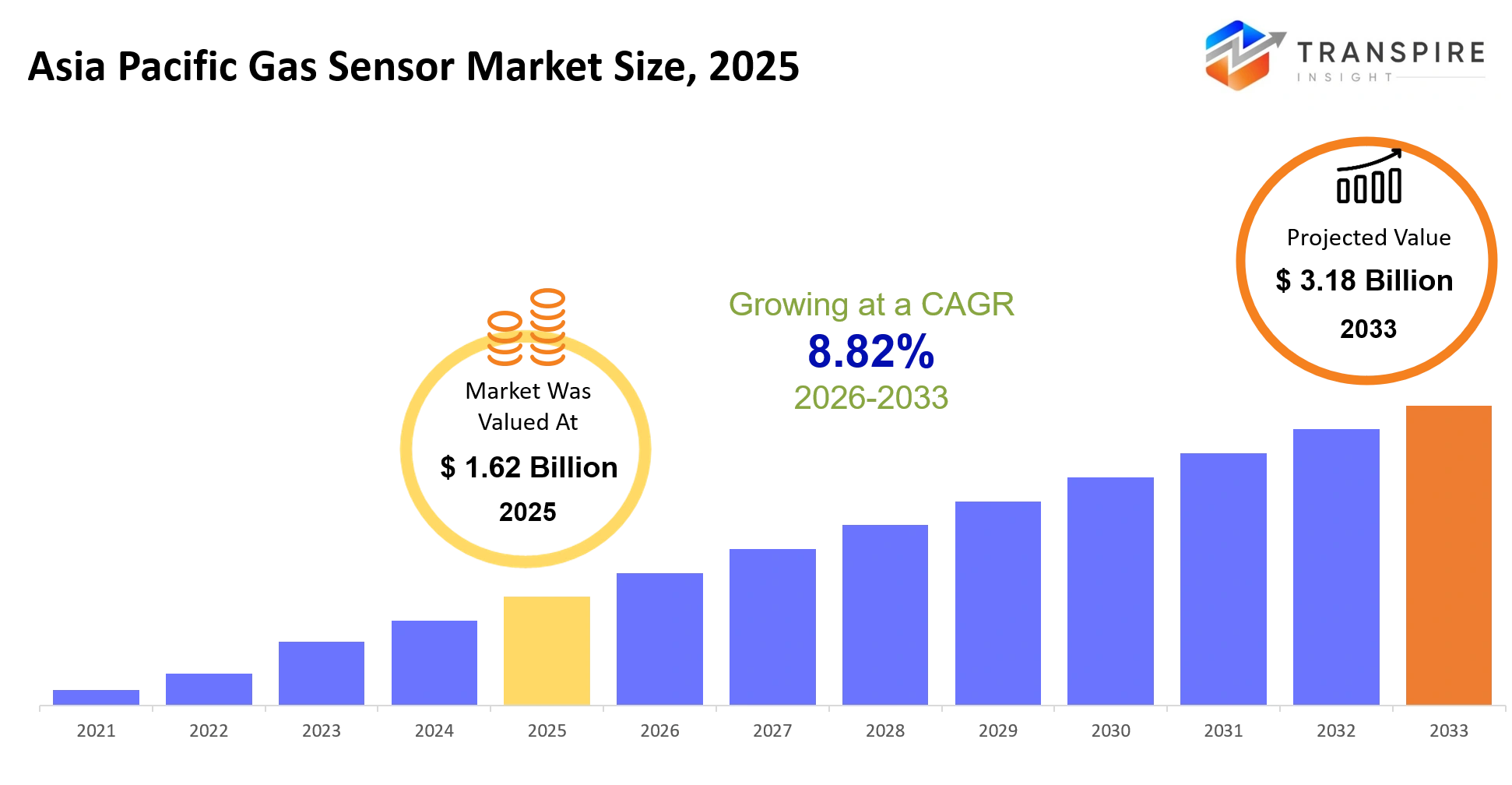
As per Transpire Insight Analysis the Asia Pacific Gas Sensor Market size is estimated at USD 1.62 Billion in 2025 and is anticipated to reach USD 3.18 Billion by 2033, growing at a CAGR of 8.82% from 2026 to 2033.
The Asia Pacific Gas Sensor Market kind of plays a big role in protecting workers, equipment, and production assets by keeping on detecting dangerous gases all the time across manufacturing plants, energy facilities, semiconductor fabrication units, mining operations, and even commercial buildings. When gas monitoring works properly it helps stop accidents, stay within regulatory rules, and minimise those expensive operational disruptions in places where even a small gas leak can turn into major safety trouble and financial risk.
Over the last five years, the market has moved away from standalone detection devices to more connected and smarter sensing solutions that sort of blend into industrial automation systems and predictive maintenance platforms. Tighter workplace safety regulations plus emissions monitoring requirements, pushed forward after governments made industrial compliance stricter following a few high-profile incidents, and some environmental policy efforts, have sped up adoption.
Now, as facilities pour more into digital operations and real-time monitoring, gas sensors are getting embedded across production processes, which creates recurring chances for advanced sensing tech, software integration, calibration services, and long‑term maintenance income.
Asia Pacific Gas Sensor Market Size & Forecast:
- Asia Pacific Gas Sensor Market Size 2025: USD 1.62 Billion
- Expected Market Value 2033: USD 3.18 Billion
- Forecast CAGR: 8.82%
- Leading region in 2025: England
- Fastest Growing region: Scotland
- Key Profile: Honeywell, Figaro Engineering, Bosch Sensortec, Sensirion, SGX Sensortech, ABB, Siemens, Amphenol, City Technology, Membrapor, Nissha FIS, Alphasense, Dräger, Teledyne FLIR, Emerson.
Key Market Insights
- In 2025, East Asia kinda dominated the Asia Pacific Gas Sensor Market , grabbing around 46% of the overall share, and this was mostly backed by investments in semiconductor, electronics, and yes automotive manufacturing too .
- South Asia on the other hand is expected to become the fastest-growing regional market in the period 2025–2032, largely because of industrial expansion, smart factory rollout, plus tighter workplace safety rules, you know the usual pressure to comply.
- If we look at the product side, electrochemical gas sensors took the lead with nearly 38% market share in 2025, they will be used widely for toxic gas monitoring and industrial safety purposes.
- After that, infrared gas sensors stayed in second place , and their reach kept widening across oil and gas, chemical processing, and commercial building monitoring , mostly due to stronger long-term stability.
- For the growth trend, MEMS-based smart gas sensors are forecasted to grow the quickest from 2025 to 2032, supported by compact industrial IoT devices and wearable safety equipment.
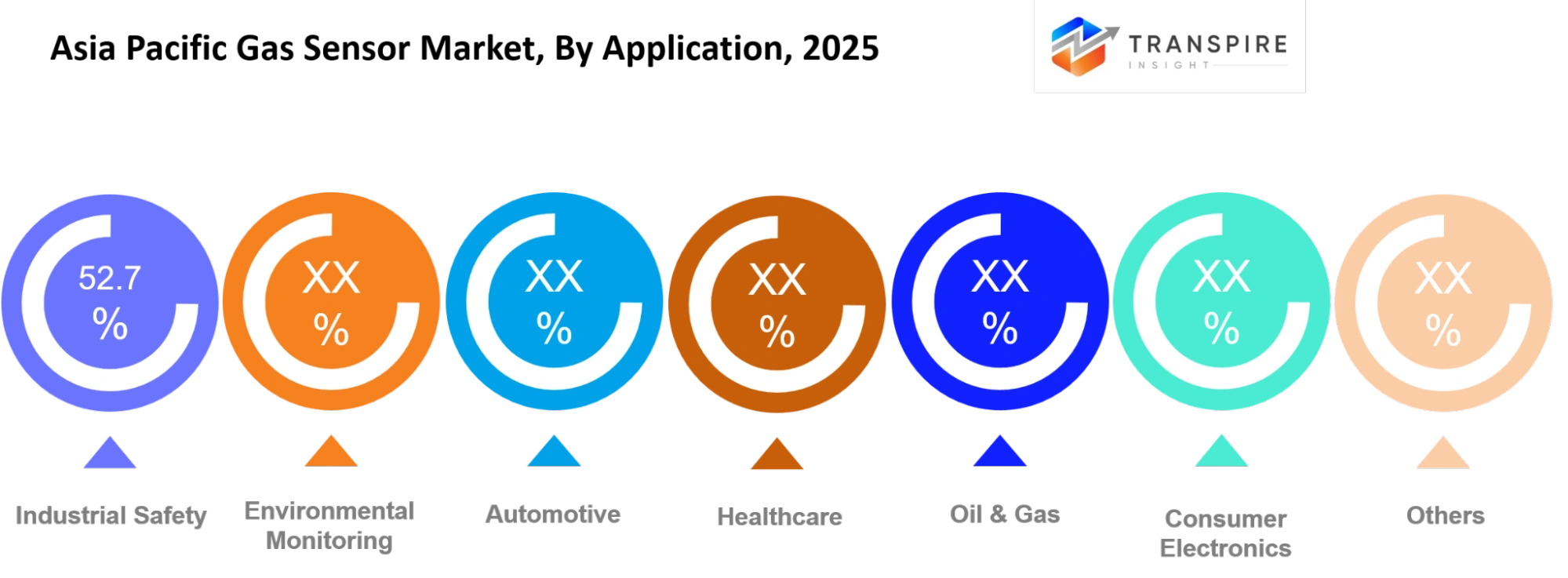
- When it comes to applications, industrial safety and process monitoring held the top position with roughly 44% market share in 2025, which really shows how compliance expectations are getting stricter in hazardous work environments.
- Meanwhile, environmental monitoring is likely to become the fastest-growing application by 2032, driven by tougher emissions tracking needs and urban air quality programs.
- On the end-user side, manufacturing continued to lead with almost 35% market share in 2025, as automated production facilities keep expanding continuous gas detection infrastructure.
- Finally, semiconductor and electronics manufacturing is projected to be the fastest-growing end-user category over 2025–2032, with fabrication plant investments across Asia Pacific giving it the boost.
What are the Key Drivers, Restraints, and Opportunities in the Asia Pacific Gas Sensor Market?
Industrial safety regulations and digital factory transformation are still the strongest drivers behind market expansion, like, they really keep pushing it forward. Governments tightened workplace safety rules while manufacturers rolled out automated production lines after the last round of industrial compliance reforms. In practice, these reforms turned continuous gas monitoring into a normal operating requirement, not just some “upgrade if we feel like it” option. And smart factories don’t stop there—they also need real-time environmental insights so automated control systems can actually do the right thing on time. Altogether this mix has sped up equipment replacement cycles, broadened the software-enabled monitoring services, and helped sensor manufacturers move toward stronger revenue growth.
The biggest, more stubborn obstacle is still supply chain concentration for specialised sensing materials, semiconductor parts, and precision calibration gear. Based on a Transpire Insight review of regional procurement notices and product launch timing, this concentration remains the main execution risk. If you want to expand manufacturing capacity, you need specialised production know-how that just cannot be rebuilt quickly in another facility. Longer component lead times, in turn, keep delaying commercial deployments and they postpone industrial upgrades. Because of that, these limits end up suppressing annual revenue potential, and they also slow new product introductions across several Asia Pacific markets.
The next phase, of growth will come from AI enabled industrial monitoring platforms, sort of tied in with wireless sensing networks, and also edge computing. I mean semiconductor investments across Taiwan South Korea India and Southeast Asia are making the whole setup feel more workable for advanced sensing to get deployed. Multi gas monitoring systems combined with predictive analytics should unlock more value, like recurring software and maintenance revenue that keeps showing up. And the firms that are putting money into cloud connected sensor ecosystems will, likely, keep a stronger long term competitive stance, compared to others.
What Has the Impact of Artificial Intelligence Been on the Asia Pacific Gas Sensor Market?
Artificial intelligence is kinda changing industrial gas monitoring, in the sense that it can keep analyzing sensor feeds all the time, instead of only using threshold based alarms like before. In many manufacturing plants, energy sites, and semiconductor fabrication areas they are now mixing intelligent sensing platforms with industrial automation systems. The goal is to spot odd gas patterns, and also make compliance reporting more or less automatic. As a side effect it cuts down on the whole manual checking workload and it can make response times faster when hazardous events pop up.
On top of that, machine learning models help with predictive maintenance too, because they can notice things like sensor drift, calibration needs, and early equipment degradation long before the readings start getting worse. And then there are digital twins and more advanced analytics, which really helps in tuning maintenance timetables, so there are fewer pointless inspections, while sensor lifespan tends to stretch out. All of this boosts operational uptime, supports regulatory compliance efforts, and brings down maintenance costs by leaning on condition based servicing rather than fixed inspection intervals. AI assisted forecasting also helps sensor manufacturers with inventory planning and production timing, by looking at old procurement behavior along with how industrial investment is shifting over time.
Still, even with all those advantages, a big rollout can hit real world friction. Integration costs are high, and that’s still a major roadblock, especially for older facilities that run legacy automation infrastructure. Plus, AI results depend heavily on large amounts of high quality operational data. When connectivity is patchy, or when industrial settings vary a lot, analytical accuracy may drop, especially across complex multi-site operations where everything is a little different.
Key Market Trends
- Since 2022, manufacturers have been kinda speeding up the shift from standalone detectors toward cloud-connected gas monitoring platforms, with real time industrial analytics kind of baked in.
- From 2023 through 2025 MEMS gas sensor adoption has picked up rapidly, which is helping with compact wearable safety devices and portable industrial monitoring gear.
- Also, environmental compliance rules rolled out across multiple Asia Pacific economies, have pushed emissions monitoring deployments into heavy industrial sites since 2021.
- Wireless gas detection networks are now replacing wired installs across big industrial areas, cutting installation expenses and making day to day operations more flexible by 2025.
- Honeywell, ABB, and Siemens have also expanded industrial IoT integration playbooks, mixing gas sensing with predictive maintenance and factory automation platforms.
- Meanwhile, semiconductor fabrication investments across Taiwan, South Korea, and India have strengthened demand for ultra high-precision gas monitoring technologies, since 2023.
- Multi-gas detection systems are increasingly taking the place of single-gas products, because many industrial operators want wider hazard coverage without stretching the monitoring infrastructure.
- Edge AI analytics have become a real competitive edge since 2024, enabling quicker anomaly detection and reducing reliance on central cloud processing.
- Finally, regional manufacturing localisation efforts have gained momentum after recent supply chain problems, that kind of revealed how much dependence exists on specialised imported sensing components.
Asia Pacific Gas Sensor Market Segmentation
By Sensor Type :
Electrochemical sensors keep a strong standing, because accurate detection of toxic gases still remains essential in manufacturing, mining, healthcare, and even energy facilities. Their high sensitivity , dependable operation and cost effective use all matter a lot, so that wide adoption stays realistic for continuous safety checks at work. Infrared sensors still show major demand for carbon dioxide, plus hydrocarbon detection, mainly because a long service life and steady behavior lower maintenance needs, which people notice quickly. Semiconductor sensors keep getting more traction in consumer electronics and smart building scenarios, due to compact form factor and lower production prices that help large scale deployment.
Catalytic sensors also remain relevant for combustible gas detection across refineries, chemical plants, and industrial processing sites, where preventing an explosion is a top priority. Photoionization detectors keep spreading through environmental monitoring and hazardous material inspection, because volatile organic compounds need fast , precise identification. Continued funding toward sensor miniaturisation, digital connectivity, and better precision will support product development across every sensor type, in a sort of cascade of improvements. And product innovation will further help broader deployment within industrial automation, environmental compliance, and connected monitoring systems, where reliability is kind of the whole point.
By Gas Type :
Carbon monoxide detection takes a big part, because factories, commercial buildings , transport systems, and all kinds of enclosed workplaces really need steady monitoring, to protect personnel and also keep things working safely. Oxygen monitoring is still essential in healthcare facilities, laboratories, mining sites, and other trapped industrial areas, since stable air conditions have to be kept. Carbon dioxide sensing keeps growing in commercial buildings, food processing facilities, plus indoor air quality routines. Methane detection stays a priority for natural gas infrastructure , since stopping leaks helps with continuity and it keeps regulatory compliance on track.
Hydrogen sulfide monitoring keeps showing steady adoption across wastewater treatment plants, oil and gas sites, and chemical processing activities, mainly because exposure can bring real safety hazards. Volatile organic compound detection is moving forward in environmental monitoring, semiconductor production, and pharmaceutical manufacturing, where emission control expectations keep getting stricter. Overall industrial compliance programmes, along with environmental regulations, will push wider deployment across many gas detection uses. Advanced multi gas monitoring systems should also boost operational efficiency while cutting down on equipment complexity.
By Application :
Industrial safety still seems like the main use, because continuous monitoring kinda helps avoid workplace incidents, unexpected production stoppages and also regulatory violations in manufacturing and processing sites, across the whole chain. Environmental monitoring is still getting broader too, as governments push stricter emission measurement rules and more urban air quality plans. Automotive use is moving ahead on several fronts like hydrogen mobility and electric vehicle battery production, plus cabin air quality monitoring tech. In healthcare, facilities keep putting in stronger monitoring setups to back oxygen management, lab safety, and proper medical gas handling, without much delay.
In oil and gas, operations keep relying on advanced detection systems for leak prevention, better worker protection, and dependable operations across both upstream and downstream work. For consumer electronics, makers are increasingly adding small sensing solutions into smart home devices, air purifiers and even wearable products. Industrial automation, along with connected monitoring platforms, will probably drive broader deployment in basically every major application category. And over time, as sensor accuracy improves and wireless communication gets more reliable, the market should keep expanding for the long run.
By End User :
Manufacturing kind of ends up being the biggest end-user group since production facilities really do need steady gas monitoring, not just for “okay” reasons but for worker safety, equipment protection, and to keep things running without interruptions. You can see automated production lines, semiconductor fabrication facilities, and chemical plants keep putting money into smarter monitoring systems, which helps their overall digital manufacturing approach. Oil and gas firms also keep up big spending because those hazardous operating conditions mean gas detection has to be dependable during exploration, transportation, and even refining work. At the same time healthcare sites are still building out monitoring infrastructure for medical gases, lab use, and general patient safety needs.
On another note automotive manufacturers are increasingly rolling out advanced sensing technologies across their plants and also in vehicle safety systems, especially as emission rules keep getting tightened. Government organizations back this shift through environmental monitoring projects, public safety programmes, and workplace compliance efforts. Meanwhile, infrastructure investments across developing economies will likely open up more chances for monitoring system deployment. Growth across transport, utilities, research institutions, and public facilities should, in general, keep supporting the long-term demand in the industry.
By Technology :
Wired sensors keep on showing up in a lot of fixed industrial setups, mostly because dependable connectivity helps everything keep running, especially in those really critical production conditions. You still see established manufacturing facilities, chemical processing plants, and energy infrastructure picking wired systems, since uninterrupted communication is basically the whole point. Meanwhile wireless sensors are moving ahead pretty fast, mainly because installation flexibility helps, plus reduced infrastructure costs, and deployment feels way less heavy overall. On top of that, remote monitoring gives teams quicker reaction when a hazardous event shows up, and it also makes maintenance tasks a bit simpler, you know.
IoT-enabled sensors are arguably the fastest-growing slice of the market because cloud connectivity plus predictive analytics and real-time monitoring gives better operational visibility, and it also supports more thoughtful maintenance planning. Smart factories are increasingly weaving connected sensing platforms into industrial automation systems, so they can run digital operations while also staying aligned with compliance requirements. Artificial intelligence, edge computing, and industrial Internet of Things platforms will keep pushing stronger adoption across various industries too. Looking ahead, future investment is likely to land on intelligent monitoring networks that boost safety, improve efficiency, and protect long-term operational performance.
What are the Key Use Cases Driving the Asia Pacific Gas Sensor Market?
Industrial safety is still the main use case, so manufacturing facilities, chemical processing plants, mining operations, and energy producers make up the biggest procurement volumes, generally. With continuous gas monitoring you can keep workplace compliance in check, avoid annoying operational interruptions, and safeguard critical assets, which is why permanent detection systems have become this standard investment, especially for higher-risk industrial locations.
On the other hand, environmental monitoring, and healthcare are growing pretty fast across the region. Government agencies are putting in place more advanced sensing systems for emissions surveillance, and for urban air quality programmes , while hospitals and laboratories depend on accurate gas monitoring in order to handle medical gases and keep day to day operations safer. Also, semiconductor manufacturers keep moving toward advanced monitoring solutions for cleanroom process control, bit by bit.
Newer applications are starting to cluster around hydrogen production infrastructure and smart buildings that come with connected environmental management systems. Data centres too, are beginning to weave in intelligent gas detection for battery storage, and for fire risk management. These areas are still kind of early, but they should open up fresh commercial opportunities once the digital infrastructure expands, and as safety regulations continue to evolve.
|
Report Metrics |
Details |
|
Market size value in 2025 |
USD 1.62 Billion |
|
Market size value in 2026 |
USD 1.76 Billion |
|
Revenue forecast in 2033 |
USD 3.18 Billion |
|
Growth rate |
CAGR of 8.82% from 2026 to 2033 |
|
Base year |
2025 |
|
Historical data |
2021 - 2024 |
|
Forecast period |
2026 - 2033 |
|
Report coverage |
Revenue forecast, competitive landscape, growth factors, and trends |
|
Regional scope |
Asia Pacific (India, China, Japan, Australia, South Korea, Rest of Asia Pacific) |
|
Key company profiled |
Honeywell, Figaro Engineering, Bosch Sensortec, Sensirion, SGX Sensortech, ABB, Siemens, Amphenol, City Technology, Membrapor, Nissha FIS, Alphasense, Dräger, Teledyne FLIR, Emerson. |
|
Customization scope |
Free report customization (country, regional & segment scope). Avail customized purchase options to meet your exact research needs. |
|
Report Segmentation |
By Sensor Type (Electrochemical Sensors, Infrared Sensors, Semiconductor Sensors, Catalytic Sensors, Photoionization Detectors, Others); By Gas Type (Oxygen, Carbon Monoxide, Carbon Dioxide, Methane, Hydrogen Sulfide, Volatile Organic Compounds (VOC), Others); By Application (Industrial Safety, Environmental Monitoring, Automotive, Healthcare, Oil & Gas, Consumer Electronics, Others); By End User (Manufacturing, Oil & Gas, Healthcare, Automotive, Government, Others); By Technology (Wired Sensors, Wireless Sensors, IoT-Enabled Sensors, Others). |
Which Regions are Driving the Asia Pacific Gas Sensor Market Growth?
East Asia brings in around 46% of regional revenue and it still feels like the biggest market. There are tough industrial safety rules, emissions compliance needs, and ongoing spending on advanced manufacturing, so the conditions are pretty good for the widespread use of gas detection technologies. You can also see a mature setup of semiconductor makers, electronics manufacturers, automation providers, and component suppliers, so product improvement keeps moving and the supply chains stay stable. With continued investment into smart factories, industrial digitalisation, and precision manufacturing, regional leadership should stay solid through the whole forecast period, more or less.
Southeast Asia has a slightly different growth picture, because the buildout is backed by diversified industrial development, not just the high value manufacturing angle. Steady foreign direct investment, more industrial parks, and fairly stable economic growth keep pushing the adoption of safety monitoring systems in multiple industries. There are also government-backed infrastructure programmes, plus industrial zone expansion, which often means procurement stays predictable for monitoring equipment suppliers. Because of this mix, the region becomes a dependable recurring revenue source across manufacturing, logistics, chemicals, and commercial infrastructure too.
South Asia is expected to see the quickest growth from 2026–2033, mainly because investment is getting ramped up in manufacturing capacity, semiconductor output, and general industrial infrastructure. At the same time, refreshed workplace safety standards, plus wider environmental monitoring programmes, have basically made it easier for firms to roll out connected sensing technologies in new industrial facilities. Big factory builds are still moving along, and digital manufacturing initiatives are also coming in strong, so that keeps opening new procurement chances for advanced monitoring systems. If this keeps going, it should make things a lot more inviting for technology providers, system integrators, and investors who are looking for long-term expansion options across those developing industrial markets.
Who are the Key Players in the Asia Pacific Gas Sensor Market and How Do They Compete?
Competition across the Asia Pacific Gas Sensor Market is still somewhat moderately consolidated, like you have big global tech firms showing up alongside specialised sensor manufacturers, not always in the same way. Usually, what really drives the contest is technology innovation, measurement accuracy , digital integration, and even long term service capabilities, but also how long they can support the customers after the sale. Meanwhile established manufacturers keep expanding their product portfolios, and at the same time specialized players push more compact and intelligent sensing approaches, which kinda shifts the feel of the whole segment. The pressure is shifting more toward connected monitoring platforms, predictive diagnostics, and sensor performance that fits specific applications, rather than leaning only on price.
Honeywell differentiates with connected industrial safety platforms that bundle gas detection together with cloud-based monitoring plus predictive maintenance, so industrial operators can support compliance and boost day-to-day efficiency. Dräger leans into certified safety solutions for hazardous areas, backed by advanced portable and fixed detection systems that are used across energy, mining, and manufacturing. ABB, on the other hand, strengthens its position by embedding gas sensing technologies into wider industrial automation platforms, so customers can handle monitoring, control, and operational data in one unified system, not several separate ones.
Figaro Engineering kind of focuses on compact semiconductor gas sensing tech for consumer electronics, environmental monitoring, and also industrial uses where they need small, energy-efficient devices. Bosch Sensortec keep expanding those tiny sensor technologies for connected gadgets and smart buildings, and they use advanced microelectromechanical systems to raise sensitivity while also lowering power consumption. Ongoing investment in research, regional collaborations, and intelligent sensing platforms helps them broaden what they can do, in practical terms, and at the same time strengthens their long term competitive footing across several different industrial fields, not just one.
Company List
- Honeywell
- Figaro Engineering
- Bosch Sensortec
- Sensirion
- SGX Sensortech
- ABB
- Siemens
- Amphenol
- City Technology
- Membrapor
- Nissha FIS
- Alphasense
- Dräger
- Teledyne FLIR
- Emerson
Recent Development News
In March 2026, Honeywell launched the 4-Series NDIR Hydrocarbon Gas Sensor for industrial gas detection. The new optical sensor improves detection of flammable hydrocarbons while offering greater resistance to sensor poisoning, supporting safer operations across oil and gas, mining, petrochemicals, and manufacturing.
Source: https://www.honeywell.com/
In March 2026, Honeywell introduced its new infrared gas sensor using non-dispersive infrared (NDIR) technology for fixed and portable gas detectors. The launch expands the company's industrial sensing portfolio with a durable, low-power solution designed to improve hazardous gas monitoring and reduce maintenance requirements in demanding environments.
Source: https://www.honeywell.com/
What Strategic Insights Define the Future of the Asia Pacific Gas Sensor Market?
Over the next five to seven years, the Asia Pacific Gas Sensor Market will move past just standalone detection hardware, toward more integrated sensing platforms that pair up artificial intelligence, edge computing, and industrial automation . And yeah, this shift is mostly being nudged by digital manufacturing investments, tighter emissions compliance, and the growing role of high value sectors like semiconductors, hydrogen production, and battery manufacturing.
There is also a quieter risk that doesn’t get talked about enough , which is the concentration of specialised sensing materials plus semiconductor components . If there’s a supply disruption, or even export restrictions, production schedules could get thrown off and then technology availability across the region may end up limited.
Still, a pretty important opportunity is starting to take shape around hydrogen infrastructure. As safety standards mature, and commercial deployment expands, dedicated sensing solutions will become more and more necessary, almost like a baseline requirement rather than an extra.
Market participants should probably prioritise partnerships with industrial automation providers, and also with software developers. That way, the hardware offerings can gradually turn into connected monitoring ecosystems that keep producing recurring service revenue, and help lock in long term customer retention.
Asia Pacific Gas Sensor Market Report Segmentation
By Sensor Type
- Electrochemical Sensors
- Infrared Sensors
- Semiconductor Sensors
- Catalytic Sensors
- Photoionization Detectors
By Gas Type
- Oxygen
- Carbon Monoxide
- Carbon Dioxide
- Methane
- Hydrogen Sulfide
- Volatile Organic Compounds (VOC)
By Application
- Industrial Safety
- Environmental Monitoring
- Automotive
- Healthcare
- Oil & Gas
- Consumer Electronics
By End User
- Manufacturing
- Oil & Gas
- Healthcare
- Automotive
- Government
By Technology
- Wired Sensors
- Wireless Sensors
- IoT-Enabled Sensors
Frequently Asked Questions
Find quick answers to common questions.
The expected Asia Pacific Gas Sensor Market size for the market will be USD 3.18 Billion in 2033.
Key segments for the Asia Pacific Gas Sensor Market are By Sensor Type (Electrochemical Sensors, Infrared Sensors, Semiconductor Sensors, Catalytic Sensors, Photoionization Detectors, Others); By Gas Type (Oxygen, Carbon Monoxide, Carbon Dioxide, Methane, Hydrogen Sulfide, Volatile Organic Compounds (VOC), Others); By Application (Industrial Safety, Environmental Monitoring, Automotive, Healthcare, Oil & Gas, Consumer Electronics, Others); By End User (Manufacturing, Oil & Gas, Healthcare, Automotive, Government, Others); By Technology (Wired Sensors, Wireless Sensors, IoT-Enabled Sensors, Others).
Major Asia Pacific Gas Sensor Market players are Honeywell, Figaro Engineering, Bosch Sensortec, Sensirion, SGX Sensortech, ABB, Siemens, Amphenol, City Technology, Membrapor, Nissha FIS, Alphasense, Dräger, Teledyne FLIR, Emerson.
The Asia Pacific Gas Sensor Market size is USD 1.62 Billion in 2025.
The Asia Pacific Gas Sensor Market CAGR is 8.82% from 2026 to 2033.
- Honeywell
- Figaro Engineering
- Bosch Sensortec
- Sensirion
- SGX Sensortech
- ABB
- Siemens
- Amphenol
- City Technology
- Membrapor
- Nissha FIS
- Alphasense
- Dräger
- Teledyne FLIR
- Emerson
About the Authors

Avinash Kumar
I’m Avinash Kumar, a Senior Research Analyst at Transpire Insight, with expertise in the Electronics and Semiconductor and Energy & Power industry. My work focuses on analyzing emerging technologies, market trends, industry developments, and innovation across these sectors. I specialize in transforming complex technical and market insights into clear, research-backed content that helps professionals, businesses, and decision-makers stay informed. Through continuous industry research and data-driven analysis, I strive to deliver accurate, reliable, and practical perspectives on the latest advancements shaping the semiconductor and energy landscape.

Chakradhar Khansole
Chakradhar serves as the Research Director at Transpire Insight, bringing over 8 years of experience in technology, innovation, and strategic market intelligence. He specializes in transforming complex market data into actionable business insights that enable organizations to make informed, growth-oriented decisions. Recognized for his strategic vision and analytical expertise, Chakradhar leads high-impact research initiatives, delivering comprehensive market assessments, competitive intelligence, and forward-looking industry analysis.
Recently Published Reports
-
Apr 2026
Fiber Optic Faceplates Market
Fiber Optic Faceplates Market Size, Share & Analysis Report By Type (< 300 mm2, 300-350 mm2, and > 350 mm2, By Application (Night Vision, Holographic Imaging, Medical, and Others), and Geography (North America, Europe, Asia-Pacific, Middle East and Africa, South and Central America), 2021 - 2031
-
Apr 2026
High Temperature Superconductors Market
High Temperature Superconductors Market Size, Share & Analysis Report By Type (1G HTS, and 2G HTS), By Application (Power Cable, Fault Current Limiter, and Transformer), and Geography (North America, Europe, Asia-Pacific, Middle East and Africa, South and Central America), 2021 - 2031
-
Apr 2026
Industrial Plugs and Socket Market
Industrial Plugs and Socket Market Size, Share & Analysis Report By Type (Industrial Plugs, Industrial Sockets), By Current (Up to 32 A, 32 to 125 A, Above 125 A), By Protection (Dustproof and Splash Proof, Waterproof, Explosion Proof), By End User (Heavy Industries, Oil and Gas, Chemicals and Pharmaceuticals, Power Generation, Others), and Geography (North America, Europe, Asia-Pacific, Middle East and Africa, South and Central America), 2021 - 2031
-
Apr 2026
InGaAs Avalanche Photodiodes Market
InGaAs Avalanche Photodiodes Market Size, Share & Analysis Report By Type (1100 - 1700 nm, and 1000 - 1600 nm), By Application (Missile Warning System, Muzzle Flash Detection, Wafer Defect Inspection, Laser Rangefinders, and Others), and Geography (North America, Europe, Asia-Pacific, Middle East and Africa, South and Central America), 2021 - 2031