

Digital BSS Market Summary:
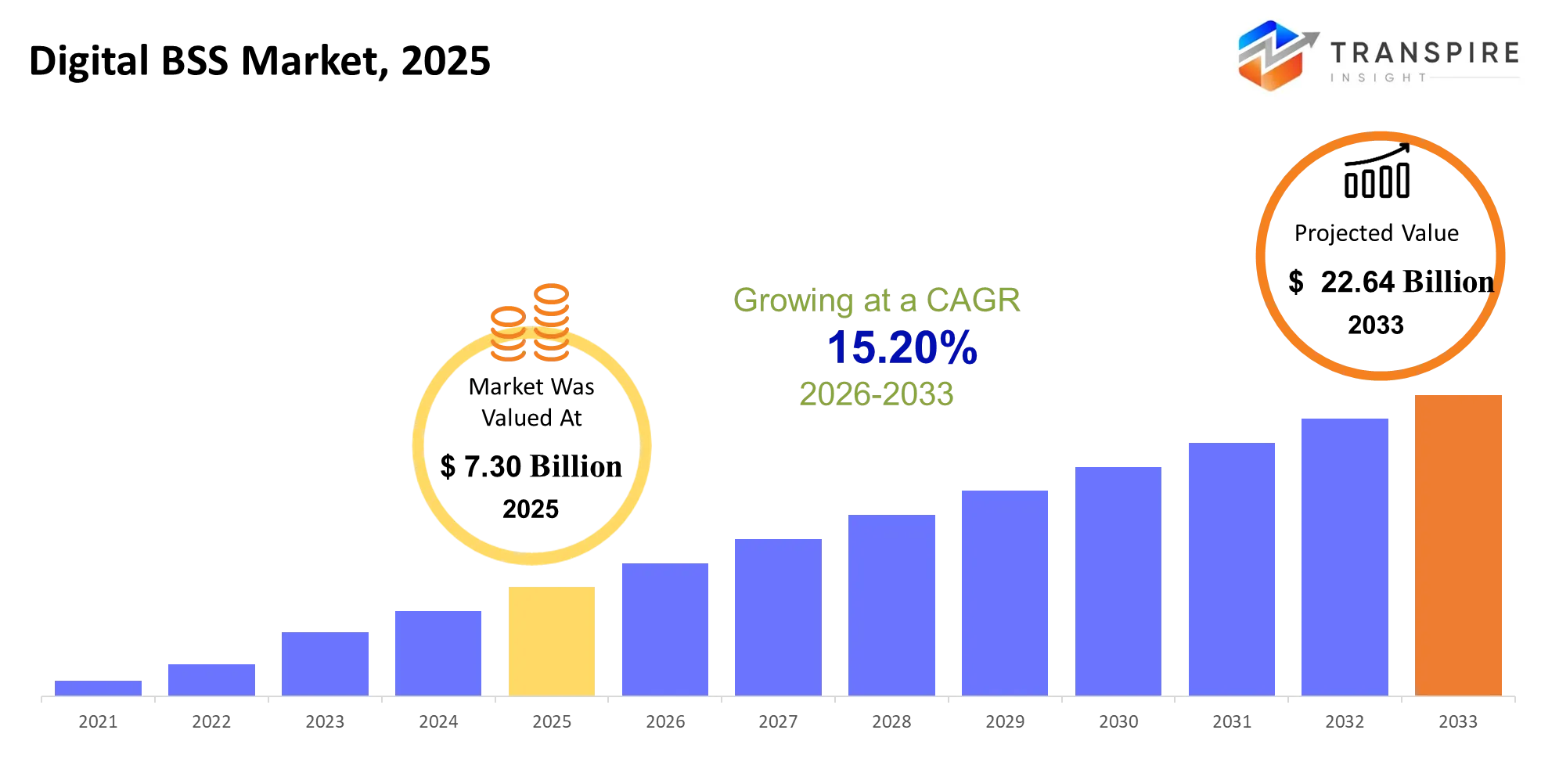
As per the Transpire Insight Analysis, The Digital BSS Market size is estimated at USD 7.30 billion in 2025 and is anticipated to reach USD 22.64 billion by 2033, growing at a CAGR of 15.20% from 2026 to 2033.
The digital business support systems market is critical in supporting carriers in the provisioning and monetization of connectivity, from onboarding and activation to billing, collections, payments, subscriptions, and partner settlements. Over the past three to five years, there has been a shift away from industry-standard legacy platform configurations towards real-time, flexible, API-driven, cloud-enabled architectures to support real-time transactions for flexible digital services. A proliferation of 5G, connected devices, and digital service bundling has overwhelmed legacy billing platforms, which are not able to support complex usage billing and frequent product launches. A major shift that is occurring in the market is the move toward open, modular, cloud-native BSS architectures in which carriers can re-architect their platforms to replace only the functions that require modernisation, helping to reduce risk and cost while prioritising targeted digital business monetisation opportunities. The accelerating adoption of 5G commercial services and IoT connections is driving significant investment in cloud-native architectures to modernise select BSS functions.
Digital BSS Market Size & Forecast:
- Market Size 2025: USD 7.30 Billion
- Expected Market Value (2033): USD 22.64 Billion
- Forecast CAGR (2026-2033): 15.20%
- Leading Region in 2025: North America
- Fastest Growing Region: Asia Pacific
- Key Company Profiles: Amdocs, Ericsson, Nokia, Netcracker, Huawei, Oracle, CSG Systems, Tecnotree, Comarch, Optiva, MATRIXX Software, Salesforce, SAP, IBM, Cerillion.
Key Digital BSS Market Insights:
The digital BSS competition moves away from replacement of systems and towards faster monetisation, automated operations and measurable business outcomes. Cloud-native architecture, AI-driven decision-making and flexible integration with telecom networks are differentiating vendors.
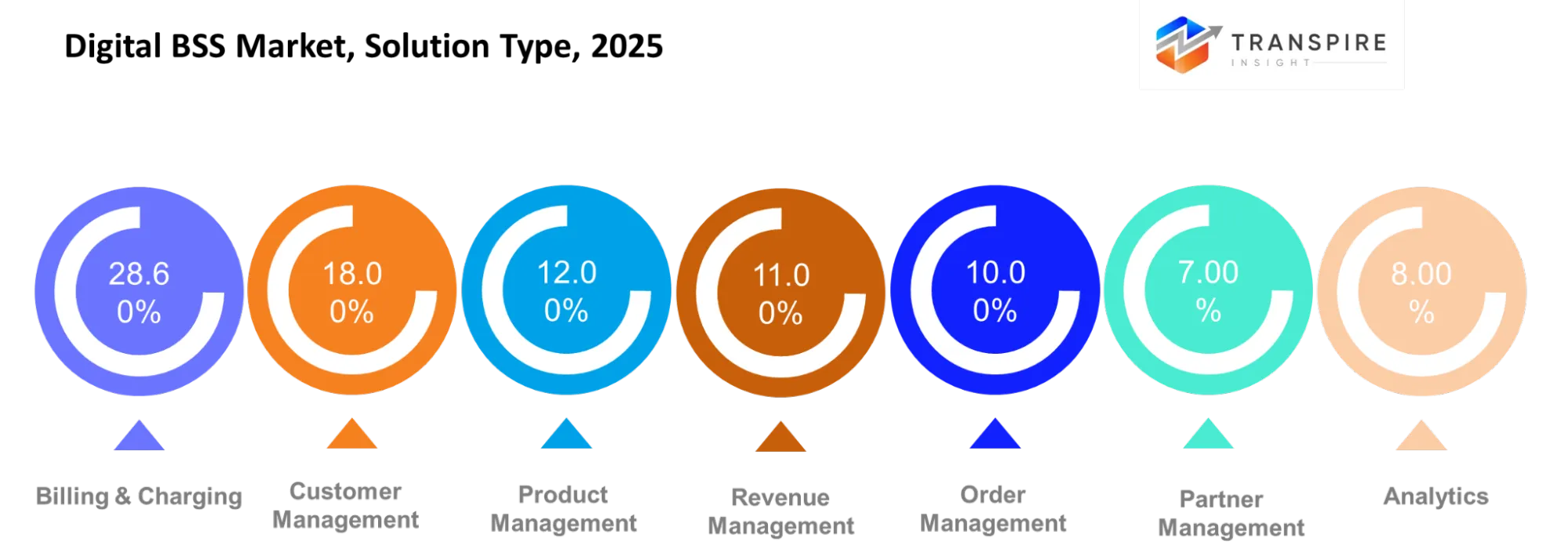
- Billing & Charging is a 28.60% stakeholder, while Amdocs is making progress on GenAI-powered BSS/OSS modernisation for quicker service launches and revenue assurance.
- Customer Management accounts for 18.00%, and Salesforce differentiates itself from traditional telecom billing with its CRM-focused personalisation and cloud integration.
- Product Management is 12.00%; Netcracker is integrating orchestration, assurance, inventory, charging and AI into a single cloud-native platform.
- Revenue Management accounts for 11.00%, and Oracle is building around Cloud Scale Monetisation for high-volume, multi-service charging.
- Order Management accounts for 10.00%, while Cerillion is geared towards agile operators with its modular billing and CRM platforms that reduce deployment time.
- Partner Management accounts for 7.00%, and Huawei focuses on deployments of large-scale integrated BSS, especially in Asia's operator ecosystems.
- Analytics represents 8.00%, with IBM and Comarch emphasising automation, data intelligence and operational efficiency in their telecom software portfolios.
- Digital Commerce's 5.40% stake and CSG Systems' revenue-management and customer-engagement tools for complex cloud billing differentiate.
- 5G & IoT BSS is expanding at 12.60% CAGR; Ericsson and Nokia are introducing intent-based operations, closed-loop automation and agentic AI into 5G monetisation.
What are the Key Drivers, Restraints, and Opportunities in the Digital BSS Market?
Driver:
The strongest growth driver is the need to monetize 5G, IoT, and enterprise connectivity beyond conventional data plans. As operators introduce network slicing, connected-device subscriptions and usage-based enterprise services, older billing platforms struggle to rate transactions accurately across products and partners. This creates investment in real-time charging, automated order management, and unified customer accounts, helping operators launch differentiated offers and capture previously difficult-to-bill revenue. The commercial shift towards monetizing 5G standalone capabilities reinforces this need.
Restraint:
High migration costs and integration complexity remain significant barriers. BSS platforms often connect to decades-old billing databases, customer records, payment gateways and network systems. Replacing these components without interrupting billing or service delivery requires extensive testing, data reconciliation, and specialist expertise. Operators may therefore postpone transformation or modernize in stages, extending implementation timelines and delaying returns on investment.
Opportunity:
Cloud-native, modular BSS and AI-enabled monetization offer a route to future growth. Operators can adopt specific capabilities through APIs instead of replacing entire platforms, reducing transformation risk while improving flexibility. For example, enterprise 5G providers can introduce differentiated service tiers, network-slicing packages and performance-based contracts supported by real-time charging. Asia-Pacific offers opportunities as operators expand 5G and IoT services. Privacy obligations and data-residency requirements also create demand for configurable consent management, audit trails and secure data handling.
Digital BSS Market — Driver Impact Analysis
|
Driver |
Relative Impact on Growth (%) |
Geographic Relevance |
Impact Timeline |
Demand Strength |
Growth Mechanism |
Key Beneficiaries |
Major Constraint |
|
1. 5G monetisation and enterprise service diversification |
28% |
Asia-Pacific, North America, Europe |
Short-term (≤2 years) |
High |
Enables tiered pricing, private 5G, and enterprise service monetisation |
Telecom operators, BSS vendors, enterprise connectivity providers |
Uncertain returns on advanced connectivity investments |
|
2. Cloud-native BSS modernisation and legacy replacement |
24% |
North America, Europe, Asia-Pacific |
Medium-term (2-4 years) |
High |
Replaces rigid legacy platforms with scalable modular architectures |
Amdocs, Ericsson, Nokia, cloud providers, telecom operators |
Migration complexity and legacy system integration costs |
|
3. AI-driven automation and personalised customer management |
19% |
North America, Asia-Pacific, Europe |
Medium-term (2-4 years) |
High |
Automates billing, customer insights, fraud detection, and retention |
BSS software vendors, telecom operators, AI technology providers |
Data quality, privacy risks, and implementation complexity |
|
4. Digital ecosystem expansion and real-time monetization |
16% |
Asia-Pacific, Middle East, North America |
Medium-term (2-4 years) |
High |
Enables partner billing, API monetisation, and digital marketplaces |
BSS vendors, telecom operators, fintech and platform partners |
Limited interoperability and complex revenue-sharing models |
|
5. Regulatory compliance and digital billing transparency |
13% |
Europe, North America, Asia-Pacific |
Short-term (≤2 years) |
Medium |
Modernises billing controls, consent management, and audit reporting |
Telecom operators, compliance vendors, billing software providers |
Diverse national regulations and ongoing compliance costs |
|
Total |
100% |
— |
— |
— |
— |
— |
What Has the Impact of Artificial Intelligence Been on the Digital BSS Market?
AI is elevating Digital BSS from its traditional transaction-processing layer to a decision-making layer. For Billing & Charging, use cases include real-time policy control, dynamic pricing, and automated handling of usage spikes or new IoT activations. For Customer Management, it includes churn prediction, next-best offer recommendations, and guidance of service faults to conversational or agent-based assistants. For Revenue Assurance, it includes anomaly detection, fraud detection, and billing leakage detection on large sets of network and transaction data. For Operations, it includes automation to speed up product-launch cycles, reduced manual configuration, and helping operators to match network capacity with commercial demand. Both companies highlight intent-based, autonomous network operations, as well as proactive policy & billing use cases as major AI use cases in telco BSS.
A major limitation is related to the maturity of implementation. AI models need clean, unified customer, network, and billing data; however, many operators still struggle with multiple disconnects. Integration costs, data-privacy requirements, and automation accuracy gaps may also hinder implementation, especially for cases where billing mistakes have regulatory or customer loyalty consequences.
In June 2026, Ericsson launched its new OSS/BSS Business Value Pathways to help operators achieve autonomous network operation goals through intent-based systems. This deployment addresses implementation maturity constraints by replacing legacy batch data pipelines with a streaming-first architecture, enabling zero-touch product launches and real-time data transformation powered by agentic AI.https://www.ericsson.com/en/press-releases/2026/6/ericsson-ensures-csps-meet-autonomous-networks-operations-goals-with-new-ossbss-business-value-pathways
Key Digital BSS Market Trends:
Digital BSS is moving from back-office transaction processing to intelligent, real-time monetisation. The ability to transform network resources and customer information into profitable, personalised services is becoming more important to operators for competitive advantage.
- While legacy monolithic platforms are being replaced by microservices and open APIs, operators are now able to upgrade functions without impacting billing.
- With cloud and SaaS deployment becoming the standard for new BSS programs, it's likely that the amount of upfront infrastructure spending will be cut, and features will be released sooner.
- Real-time charging is not limited to telecom consumers, but is also growing into IoT, private 5G, and enterprise service models.
- Per-slice pricing, quality-based charging, and automated service assurance are all becoming a necessity for BSS as a result of 5G network slicing.
- Operators are moving to multi-sided business models, which necessitates settlement with content providers, enterprises, IoT partners, and digital-marketplace participants.
- AI is evolving from descriptive analytics to agentic automation throughout billing, provisioning, and customer-care processes.
- Customer-experience platforms are becoming integral to BSS, and personalisation, omnichannel support and self-service are all becoming aspects of monetisation.
- The attack surface is growing with digital payments, eSIMs and connected devices, and fraud management and revenue assurance are emerging as proactive controls.
- BSS is being offered as a service by MVNOs, broadband and digital-service providers, reducing the barriers to entry for niche operators.
Digital BSS Market Segmentation
Solution Type:
Billing & Charging is the largest segment of the overall TAM with 28.60%, representing the basis of all rating of usage, billing, and collecting payments for mobile and broadband as well as digital services. Customer Management accounts for 18.00%, being responsible for subscriber lifecycle management and personalized engagement. Product Management has a 12.00% share and includes definition, composition, and management of products and services offered to customers. Revenue Management, with an 11.00% share, includes product and partner sale tracking. Order Management (10.00%), analytics (8.00%), partner management (7.00%) and digital commerce (5.40%) help operators to coordinate their commercial activities, be profitable and launch services more efficiently.
Deployment:
Deployment models in the Digital BSS Market include Cloud, On-Premise, Hybrid, SaaS, Private Cloud, Public Cloud and Edge. Cloud and SaaS deployments offer scalable infrastructure and faster updates, helping operators reduce hardware dependence and accelerate service launches. Hybrid models support gradual modernisation by connecting new applications with existing billing systems. Private cloud provides greater control over sensitive workloads, while public cloud supports flexible capacity. Edge deployment can reduce latency for selected services. Adoption depends on security, integration complexity, compliance requirements, and total ownership costs.
Communication Type:
The communication segment includes Mobile, Fixed Broadband, IoT, Enterprise Communication, 5G, Voice and Messaging. Mobile and broadband services require accurate usage rating, subscription management, and reliable billing across customer plans. IoT introduces large volumes of device connections, often with low-value, frequent transactions that require automated charging. The 5G & IoT BSS segment is projected to grow at a 15.80% CAGR, supported by enterprise connectivity, connected-device services and differentiated service packages. Operators consequently need flexible pricing engines, real-time charging and automated provisioning to monetise increasingly complex communication services.
Operator Type:
Telecom Operators, MVNOs, Cable Operators, Broadband Providers, Digital Service Providers, Satellite Operators and IoT Providers. Telecom operators require integrated billing and customer management, while MVNOs prioritise cost-efficient platforms and rapid tariff launches. Cable and broadband providers need converged service billing, whereas satellite and IoT providers require flexible charging for geographically dispersed connections and connected devices. Digital service providers benefit from subscription management and partner integration. These differences are encouraging modular BSS architectures that improve operational flexibility, accelerate commercialisation, and support diversified revenue streams.
Enterprise Size:
Large Enterprises, SMEs, Mid-Sized Operators, Startups, Government Operators, Regional Operators and Operators. Large and organizations need scalable platforms, advanced analytics, and integration across multiple markets, while smaller operators prioritize affordability, faster deployment, and reduced maintenance. Government operators may place greater emphasis on security, auditability and procurement compliance. Subscription-based cloud solutions can reduce upfront infrastructure costs, enabling smaller organizations to modernize incrementally. Future adoption will depend on interoperability, customization requirements, cybersecurity controls and the ability to support expanding service portfolios.
Application:
Digital BSS applications include Customer Experience, Revenue Assurance, Digital Commerce, Subscription Management, Service Activation, Self-Service and Partner Management. Customer experience tools support personalised interactions, while revenue assurance helps identify billing discrepancies and prevent commercial leakage. Digital commerce and subscription management enable operators to launch bundled services and manage recurring payments. Automated service activation reduces manual provisioning, and self-service portals help customers manage accounts independently. Partner management supports settlement across multi-provider ecosystems. Adoption increasingly depends on the ability to integrate these functions, improve operational efficiency, and generate measurable returns from new digital services.
What are the Key Use Cases Driving the Digital BSS Market?
The primary use case is integrated billing and charging, aligned with the segment’s 28.60% share. Telecom operators use these platforms to rate usage, manage recurring subscriptions, consolidate invoices, and process payments across mobile and fixed broadband services. This integration improves billing accuracy and supports flexible commercial plans.
Expanding applications include customer lifecycle management, revenue assurance, digital commerce and automated service activation. Operators use analytics to identify billing discrepancies, personalise offers and coordinate subscriptions across connectivity and digital services. Partner Management also supports revenue sharing between telecom providers and external service partners.
Emerging use cases include monetising 5G network slicing, IoT connectivity and enterprise service-level agreements. As operators introduce differentiated performance tiers, real-time charging and usage-based contracts become essential for converting advanced network capabilities into measurable commercial returns.
|
Report Metrics |
Details |
|
Market size value in 2025 |
USD 7.30 Billion |
|
Market size value in 2026 |
USD 8.41 Billion |
|
Revenue forecast in 2033 |
USD 22.64 Billion |
|
Growth rate |
CAGR of 15.20% from 2026 to 2033 |
|
Base year |
2025 |
|
Historical data |
2021 - 2024 |
|
Forecast period |
2026 - 2033 |
|
Report coverage |
Revenue forecast, competitive landscape, growth factors, and trends |
|
Regional scope |
United States; Canada; Mexico; United Kingdom; Germany; France; Italy; Spain; Denmark; Sweden; Norway; China; Japan; India; Australia; South Korea; Thailand; Brazil; Argentina; South Africa; Saudi Arabia; United Arab Emirates |
|
Key companies profiled |
Amdocs, Ericsson, Nokia, Netcracker, Huawei, Oracle, CSG Systems, Tecnotree, Comarch, Optiva, MATRIXX Software, Salesforce, SAP, IBM, Cerillion. |
|
Customization scope |
Free report customization (country, regional & segment scope). Available customised purchase options to meet your exact research needs. |
|
Report Segmentation |
Solution Type (Billing & Charging, Customer Management, Product Management, Revenue Management, Order Management, Partner Management, Analytics, Digital Commerce); Deployment (Cloud, On-Premise, Hybrid, SaaS, Private Cloud, Public Cloud, Edge); Communication Type (Mobile, Fixed Broadband, IoT, Enterprise Communication, 5G, Voice, Messaging); Operator Type (Telecom Operators, MVNOs, Cable Operators, Broadband Providers, Digital Service Providers, Satellite Operators, IoT Providers); Enterprise Size (Large Enterprises, SMEs, Mid-Sized Operators, Startups, Government Operators, Regional Operators, Operators); Application (Customer Experience, Revenue Assurance, Digital Commerce, Subscription Management, Service Activation, Self-Service, Partner Management) |
Which Regions are Driving the Digital BSS Market Growth?
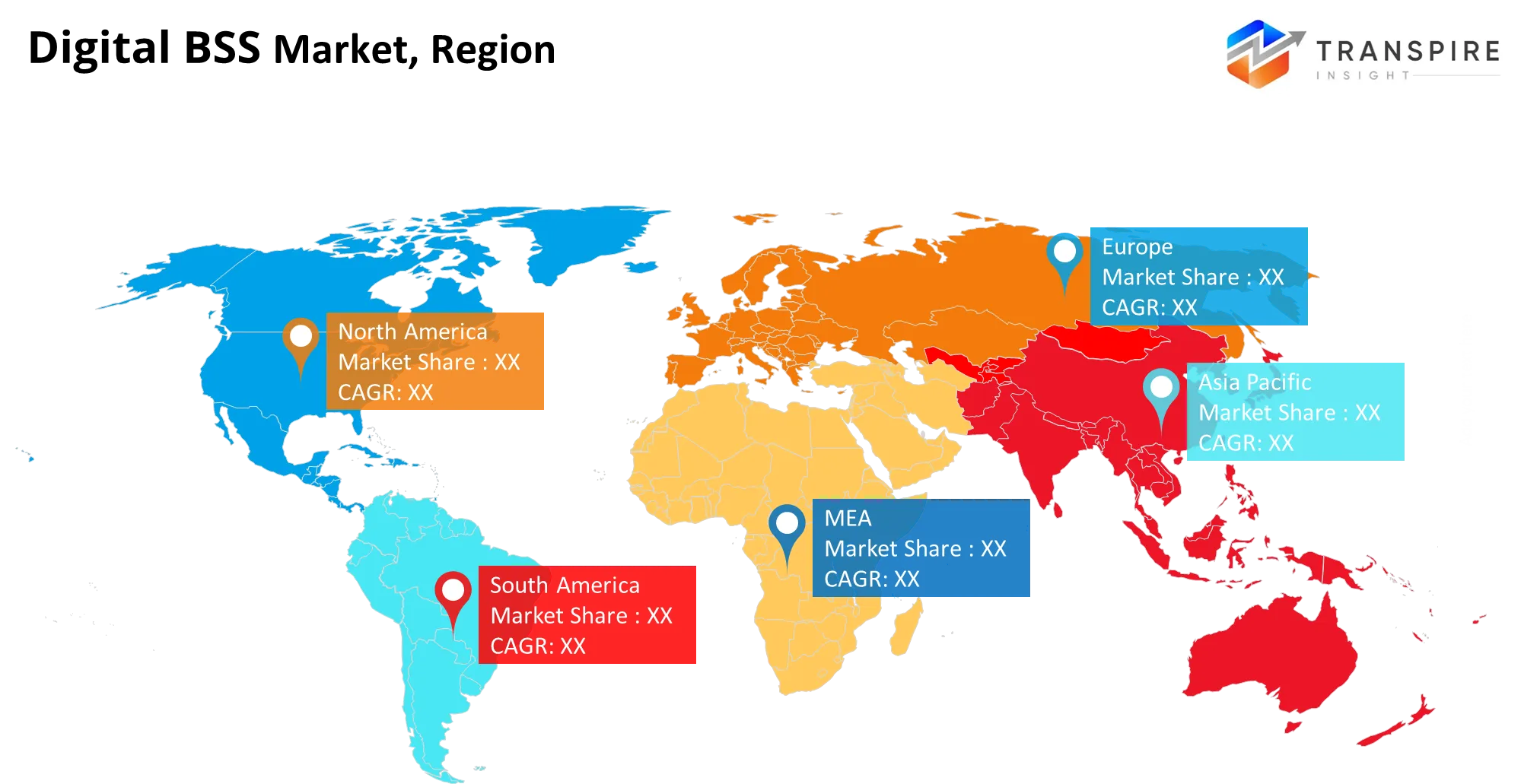
North America has the largest market share at 35.40%. Tier-1 operators that are heavily investing in 5G monetisation, AI-enabled billing, and enterprise private networks contribute to the dominance of North America in BSS modernisation. North America is ahead in terms of cloud infrastructure, API-led architecture adoption, and vendor ecosystems including Amdocs, Oracle, CSG and IBM. The regulatory emphasis on billing transparency and data privacy pushes operators toward modern, auditable BSS deployments, increasing the demand for these solutions and platforms for complex pricing with less operational risk.
In January 2026, Amdocs acquired MATRIXX for approximately $200 million. This transaction directly solidifies Amdocs' market leadership by absorbing MATRIXX's real-time convergent charging software, enabling Tier-1 operators to significantly accelerate 5G standalone network slicing monetization and complex enterprise billing architectures.https://www.fierce-network.com/broadband/analysts-amdocsmatrixx-big-consolidation-5g-sa-growth
Europe accounts for 28.00% of the market share, supported by network modernisation, operational efficiency, and the need to facilitate customer data management in different territories. Unlike North America, where enterprise monetisation and platform innovation are driving the adoption, European operators have more compelling motivations to incorporate privacy, data governance, and auditability elements into BSS structures. GDPR and related compliance standards call for better data security and accountability standards. Existing operators and prolonged transformation initiatives drive a relatively mature user base.
In February 2026, Deutsche Telekom, Orange, Telefónica, TIM, and Vodafone entered a partnership to successfully launch the live demonstration of the European Edge Continuum.https://www.vodafone.com/news/newsroom/technology/pan-european-federated-edge-continuum
Asia-Pacific accounts for 25.00% of the market share, with a CAGR of 12.60%, driven by the growing 5G networks, the dominance of mobile-first digital commerce, and the need for connected devices. The region's established telecommunications industry demands an adaptable, robust charging platform that can efficiently handle different usage scenarios and facilitate quick deployment of new services. Latin America for 6.00% with a CAGR of 8.80%, where digital services growth and legacy system upgrades generate new revenue streams, and Middle East and Africa for 5.60% with a CAGR of 8.80%, stimulated by network infrastructure investments, connectivity expansion, and new digital ecosystems.
In March 2026, Vodafone Idea expanded its strategic partnership with Ericsson. Under this agreement, the telecommunications operator will deploy Ericsson’s cloud-native Convergent Charging System to modernise its postpaid services and scale operations across India.https://www.ericsson.com/en/press-releases/2/2026/vi-expands-ericsson-tie-up-for-network-charging-in-india
Who are the Key Players in the Digital BSS Market, and how do they compete?
Competition in digital BSS is shifting from scale-centric, large-system integration plays to modular, cloud-native and AI-enabled platforms. The vendors will compete with respect to speed to market, real-time charging, deep-platform integration, and automation of commercial operations. The market has moderate market share concentration, with Amdocs, Ericsson, Nokia, Huawei and Netcracker having a large combined share of revenue.
Amdocs leverages an innovation-led play with Generative AI for BSS/OSS modernisation and differentiates from the competition with end-to-end customer-experience and revenue-management capabilities, and ongoing large-operator transformation contracts. Ericsson and Nokia target ecosystem convergences with BSS, 5G automation and assurance, using network-software convergence as differentiation. Netcracker emphasises an integrated digital-transformation platform unified through orchestration, charging, engagement and artificial intelligence. Huawei's strategy emphasises scale and integrated-deployment power across entire Asia. Oracle, SAP, IBM and Salesforce rely on enterprise-cloud, data and CRM ecosystems to serve operators looking for composable architectures. CSG, Optiva, MATRIXX, Tecnotree, Comarch and Cerillion leverage niche and modular strategies to serve fast and agile operators, MVNOs, and specialized billing and monetization needs.
Key Players are:
- Amdocs
- Ericsson
- Nokia
- Netcracker
- Huawei
- Oracle
- CSG Systems
- Tecnotree
- Comarch
- Optiva
- MATRIXX Software
- Salesforce
- SAP
- IBM
- Cerillion
Digital BSS Market — Enhanced Competitive Benchmarking
|
Company |
Est. Revenue Share Range |
Key Offerings |
Strategic Positioning |
Geographic Strength |
Technology Focus |
|
Amdocs |
Estimated 10-15% |
Customer Experience Suite, CatalogONE, Amdocs Charging, Freestyle Billing |
Broad telecom BSS leadership with end-to-end transformation |
North America, Europe, Asia Pacific |
Agentic AI, cloud-native BSS, real-time monetization |
|
Ericsson |
Estimated 7-12% |
Digital Monetization Platform, Ericsson Billing, Charging, Catalog Manager |
Integrated monetization aligned with telecom network evolution |
Europe, Asia Pacific, Middle East & Africa |
Convergent charging, 5G monetization, modular architecture |
|
Netcracker Technology |
Estimated 6-10% |
Netcracker Cloud BSS, Revenue Management Cloud, Marketing and Commerce Cloud, Digital Platform |
Cloud-native transformation and integrated BSS/OSS delivery |
North America, Europe, Asia Pacific |
Microservices, GenAI, SaaS, open APIs |
|
Nokia |
Estimated 4-8% |
Digital operations and BSS capabilities, charging, customer and service management solutions |
Telecom ecosystem integration and service lifecycle modernization |
Europe, Asia Pacific, North America |
Cloud platforms, automation, 5G service monetization |
|
Huawei |
Estimated 4-8% |
Convergent billing, digital customer management, charging and product management solutions |
Integrated telecom transformation for operator-scale deployments |
Asia Pacific, Middle East & Africa, Latin America |
Cloud-based BSS, real-time charging, AI-enabled operations |
|
Oracle |
Estimated 3-7% |
Oracle Communications Billing and Revenue Management, cloud monetization, customer management |
Enterprise-grade revenue management and complex billing specialization |
North America, Europe, Asia Pacific |
Cloud infrastructure, convergent billing, policy-driven monetization |
|
CSG |
Estimated 3-6% |
CSG Ascendon, revenue management, subscription billing, customer experience solutions |
Subscription monetization and customer lifecycle specialization |
North America, Europe, Asia Pacific |
SaaS billing, digital commerce, customer engagement automation |
|
Tecnotree |
Estimated 2-5% |
Tecnotree Moments, Digital BSS, monetisation, partner and marketplace solutions |
Agile digital BSS for emerging and growth-oriented operators |
Asia Pacific, Middle East & Africa, Africa |
AI-enabled digital services, cloud BSS, digital marketplaces |
|
Comarch |
Estimated 2-4% |
Telecom BSS, billing and charging, customer management, product catalogues |
Flexible modular platforms and cost-conscious operator transformation |
Europe, Middle East & Africa, Asia Pacific |
Modular BSS, automation, analytics, cloud deployment |
|
Optiva |
Estimated 1-3% |
Optiva Charging, Optiva BSS Platform, monetisation and billing solutions |
Specialised charging and cloud-based BSS modernisation |
North America, Asia Pacific, Middle East & Africa |
Cloud-native charging, real-time monetisation, microservices |
Recent Development News
- In September 2026, Covalense Digital launched the Csmart Agentic BSS Overlay, an AI-powered orchestration layer that integrates with existing business support systems without requiring a complete system replacement. The launch helps telecom operators automate workflows, improve business intelligence, and reduce the cost and risk of legacy BSS modernisation.https://covalensedigital.com/resources/press-releases/csmart-agentic-bss-overlay-legacy-bss-transformation
- In June 2026, Aria Systems and ServiceNow launched an agentic Business Support System (BSS) solution for communication service providers, combining AI-driven billing and monetisation with CRM and workflow automation capabilities. The launch aims to unify fragmented commercial processes, improve operational efficiency, and help telecom operators monetise digital services through more automated business operations.https://www.ariasystems.com/resources/aria-systems-and-servicenow-launch-world-first-agentic-bss-for-telecoms
- In September 2026, Covalense Digital announced the general availability of Csmart MVNx GA 6.0, a multi-tenant BSS platform combining customer management, billing, integration, self-care, and mobile engagement. The release lets mobile virtual network operators and service providers launch new brands and services through configurable workflows, enabling faster commercialisation and more scalable digital operations.https://covalensedigital.com/resources/press-releases/csmart-mvnx-upgrade-multi-tenant-bss-mvnos-mvnes
What Strategic Insights Define the Future of the Digital BSS Market?
The Digital Business Support Systems (BSS) Market is headed towards AI-native, composable solutions, where operators can assemble billing, CRM, analytics and revenue assurance via APIs rather than wholesale replacement of legacy solutions. A key migration risk is the potential for data fragmentation; advanced pricing and autonomous customer decisions may suffer if customer, network and billing data are siloed. A new opportunity is emerging in monetising 5G network slicing, IoT subscriptions and multi-party digital ecosystems via real-time, partner-aware charging; these features could help operators realise new revenues while enabling greater commercial agility. Among future architectures, the focus should be on open cloud platforms, embedded AI governance and ready-to-go modules for mid-tier operators and MVNOs. For operators, adoption of an incremental approach to modernisation, starting with revenue-critical billing and assurance before extending automation to the whole BSS stack, can de-risk migration, maximise the ROI on previous investments and build an elastic platform for future digital services.
Key Segmentations are:
Solution Type
- Billing & Charging
- Customer Management
- Product Management
- Revenue Management
- Order Management
- Partner Management
- Analytics
- Digital Commerce
Deployment
- Cloud
- On-Premise
- Hybrid
- SaaS
- Private Cloud
- Public Cloud
- Edge
Communication Type
- Mobile
- Fixed Broadband
- IoT
- Enterprise Communication
- 5G
- Voice
- Messaging
Operator Type
- Telecom Operators
- MVNOs
- Cable Operators
- Broadband Providers
- Digital Service Providers
- Satellite Operators
- IoT Providers
Enterprise Size
- Large Enterprises
- SMEs
- Mid-Sized Operators
- Startups
- Government Operators
- Regional Operators
- Operators
Application
- Customer Experience
- Revenue Assurance
- Digital Commerce
- Subscription Management
- Service Activation
- Self-Service
- Partner Management
By Regional Analysis
North America
- US
- Canada
- Mexico
Europe
- Germany
- UK
- France
- Italy
- Spain
- Russia
- Rest of Europe
Asia Pacific
- China
- Japan
- India
- South Korea
- Australia
- Rest of Asia Pacific
South America
- Brazil
- Argentina
- Rest of South America
Middle East & Africa
- UAE
- Saudi Arabia
- Qatar
- South Africa
- Rest of the Middle East & Africa
Frequently Asked Questions
Find quick answers to common questions.
The digital BSS market size was valued at USD 7.30 billion in 2025 and is poised to reach USD 22.64 billion by 2033, expanding at a 15.20% CAGR.
Key segments for the digital BSS market are Solution Type (Billing & Charging, Customer Management, Product Management, Revenue Management, Order Management, Partner Management, Analytics, Digital Commerce); Deployment (Cloud, On-Premise, Hybrid, SaaS, Private Cloud, Public Cloud, Edge); Communication Type (Mobile, Fixed Broadband, IoT, Enterprise Communication, 5G, Voice, Messaging); Operator Type (Telecom Operators, MVNOs, Cable Operators, Broadband Providers, Digital Service Providers, Satellite Operators, IoT Providers); Enterprise Size (Large Enterprises, SMEs, Mid-Sized Operators, Startups, Government Operators, Regional Operators, Operators); Application (Customer Experience, Revenue Assurance, Digital Commerce, Subscription Management, Service Activation, Self-Service, Partner Management).
Growth is primarily driven by 5G and IoT monetisation, cloud-based BSS modernisation, AI-powered revenue assurance, personalised customer experiences, automated billing, and demand for flexible digital service management.
The digital BSS market is led by major manufacturers, including Amdocs, Ericsson, Nokia, Netcracker, Huawei, Oracle, CSG Systems, Tecnotree, Comarch, Optiva, MATRIXX Software, Salesforce, SAP, IBM, and Cerillion.
North America holds 35.40% of the market, supported by advanced telecom infrastructure, 5G deployment, cloud adoption, digital service innovation, and strong investment in network monetisation and customer experience platforms.
Key opportunities include AI-driven revenue assurance, cloud-native BSS migration, 5G and IoT monetization, network-slicing billing, and subscription-based digital services.
- Amdocs
- Ericsson
- Nokia
- Netcracker
- Huawei
- Oracle
- CSG Systems
- Tecnotree
- Comarch
- Optiva
- MATRIXX Software
- Salesforce
- SAP
- IBM
- Cerillion
About the Authors

Avinash Kumar
I’m Avinash Kumar, a Senior Research Analyst at Transpire Insight, with expertise in the Electronics and Semiconductor and Energy & Power industry. My work focuses on analyzing emerging technologies, market trends, industry developments, and innovation across these sectors. I specialize in transforming complex technical and market insights into clear, research-backed content that helps professionals, businesses, and decision-makers stay informed. Through continuous industry research and data-driven analysis, I strive to deliver accurate, reliable, and practical perspectives on the latest advancements shaping the semiconductor and energy landscape.

Chakradhar Khansole
Chakradhar serves as the Research Director at Transpire Insight, bringing over 8 years of experience in technology, innovation, and strategic market intelligence. He specializes in transforming complex market data into actionable business insights that enable organizations to make informed, growth-oriented decisions. Recognized for his strategic vision and analytical expertise, Chakradhar leads high-impact research initiatives, delivering comprehensive market assessments, competitive intelligence, and forward-looking industry analysis.
Recently Published Reports
-
Apr 2026
Fiber Optic Faceplates Market
Fiber Optic Faceplates Market Size, Share & Analysis Report By Type (< 300 mm2, 300-350 mm2, and > 350 mm2, By Application (Night Vision, Holographic Imaging, Medical, and Others), and Geography (North America, Europe, Asia-Pacific, Middle East and Africa, South and Central America), 2021 - 2031
-
Apr 2026
High Temperature Superconductors Market
High Temperature Superconductors Market Size, Share & Analysis Report By Type (1G HTS, and 2G HTS), By Application (Power Cable, Fault Current Limiter, and Transformer), and Geography (North America, Europe, Asia-Pacific, Middle East and Africa, South and Central America), 2021 - 2031
-
Apr 2026
Industrial Plugs and Socket Market
Industrial Plugs and Socket Market Size, Share & Analysis Report By Type (Industrial Plugs, Industrial Sockets), By Current (Up to 32 A, 32 to 125 A, Above 125 A), By Protection (Dustproof and Splash Proof, Waterproof, Explosion Proof), By End User (Heavy Industries, Oil and Gas, Chemicals and Pharmaceuticals, Power Generation, Others), and Geography (North America, Europe, Asia-Pacific, Middle East and Africa, South and Central America), 2021 - 2031
-
Apr 2026
InGaAs Avalanche Photodiodes Market
InGaAs Avalanche Photodiodes Market Size, Share & Analysis Report By Type (1100 - 1700 nm, and 1000 - 1600 nm), By Application (Missile Warning System, Muzzle Flash Detection, Wafer Defect Inspection, Laser Rangefinders, and Others), and Geography (North America, Europe, Asia-Pacific, Middle East and Africa, South and Central America), 2021 - 2031