

Enterprise Imaging Solutions Market Summary:
According to Transpire Insight, a detailed research report on the market reflects that the enterprise imaging platform segment dominates the Global Enterprise Imaging Solutions Market, supported by increasing demand for centralized medical image management, interoperability, and integrated clinical workflows. GE HealthCare leads the market with approximately USD 20.6 billion in annual revenue and a significant global presence in medical imaging and healthcare technology, making it a leading contributor to global market development, innovation, advanced enterprise imaging solutions, expanding technological capabilities, and growth dynamics.
Market Snapshot
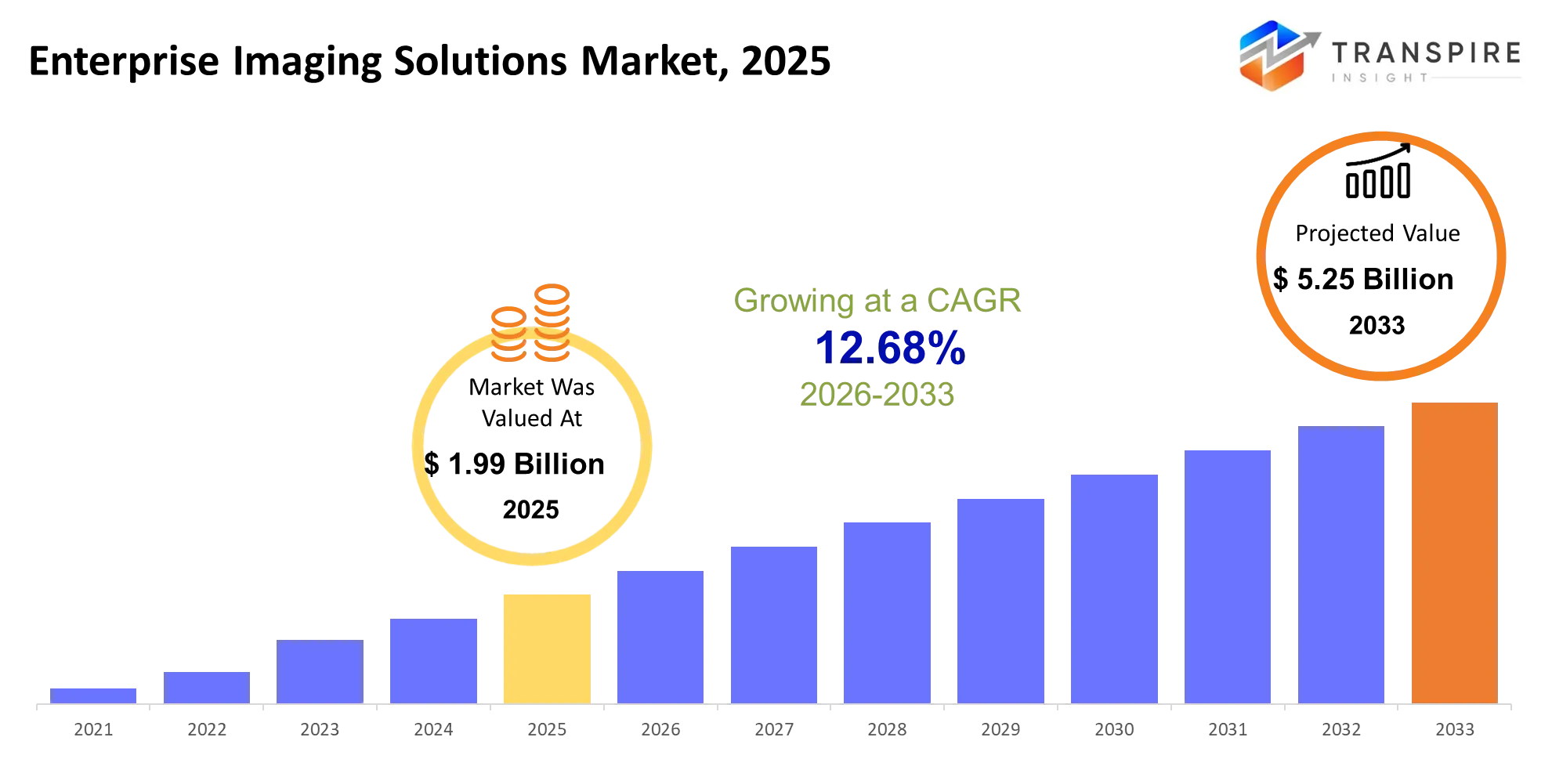
- Market Value (2025): USD 1.99 Billion.
- Expected Market Value (2026): USD 2.28 Billion.
- Estimated Market Value (2033): USD 5.25 Billion.
- Forecast CAGR (2026–2033): 12.68%.
- Leading Region in 2025: North America
- Second-largest Region: Europe
- Fastest Growing Region: Asia Pacific
Introduction
Enterprise imaging solutions is a market that consists of software, hardware, and IT solutions that enable healthcare providers to acquire, store, retrieve, and share images and multimedia content for clinical purposes. By integrating fragmented departmental image repositories into one system, enterprise imaging solutions allow clinicians to have one patient history timeline connected to the electronic health record system. The primary components of these systems are vendor neutral archive, picture archiving and communication system, universal viewer, and image exchange solution, which are available in subscription-based scalable cloud solutions. The adoption of these solutions has been expanding from radiology and cardiology departments to pathology, oncology, orthopedics, and point-of-care ultrasound while the integration of artificial intelligence and enhanced data security ensure more rapid diagnosis, collaboration, minimized duplication of tests, and regulatory compliance.
For instance:-
- North America: North America has the highest level of investment activity due to cloud-native PACS migration, FDA-approved AI implementation, interoperability legislation, and consolidations like that of GE HealthCare and Intelerad.
- Europe: Europe provides consistent opportunities owing to the regulatory environment promoting data sharing and vendor-neutral archives and universal viewers as well as cloud migration thanks to established vendors such as Sectra, Agfa, Siemens Healthineers, and Philips.
Key Market Highlights: -
- North America is expected to grow at a rapid CAGR in the Enterprise Imaging Solutions Market by holding around 44% of the share during the forecast period.
- Europe is anticipated to hold roughly 29% share of the Enterprise Imaging Solutions Market over the predicted timeframe.
- Asia Pacific is anticipated to hold nearly 15% share of the Enterprise Imaging Solutions Market over the predicted timeframe.
- By Deployment, the Public Cloud dominated the market and holds nearly 60% share in 2025 and is projected to grow at a substantial CAGR during the forecast period.
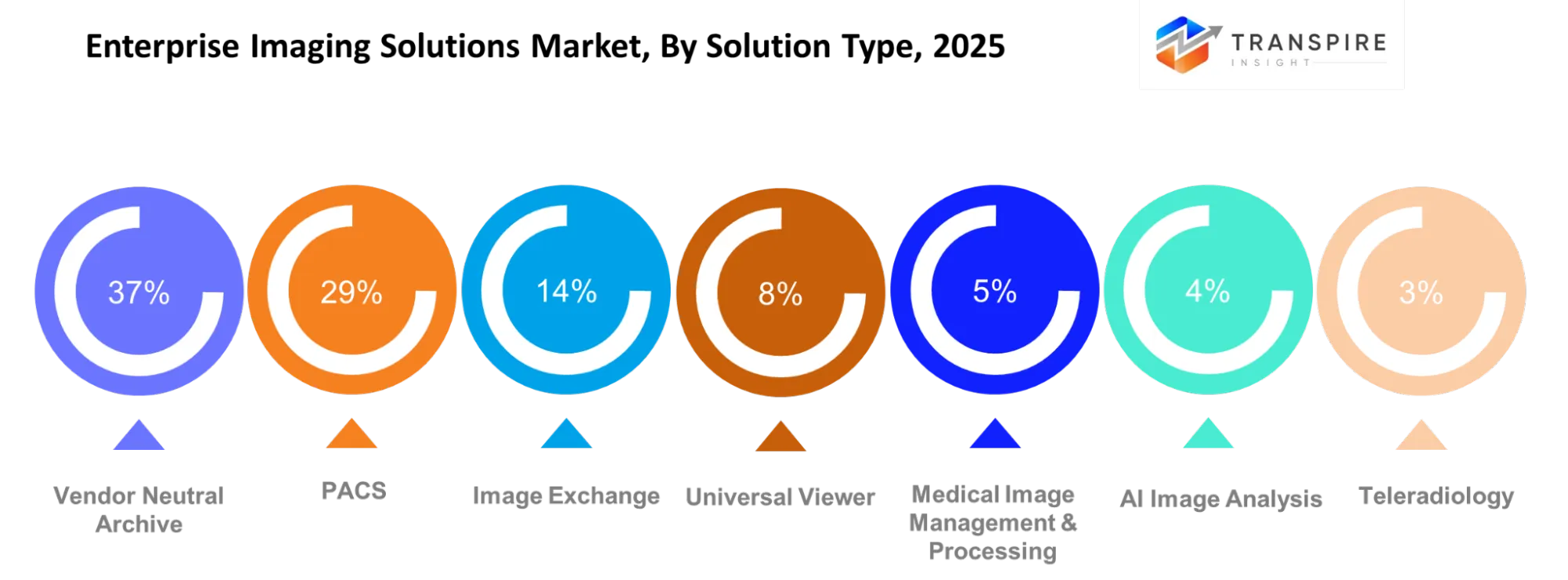
- By Solution Type, the PACS (Picture Archiving and Communication System) dominated the market and holds close to 58% share in 2025 and is projected to grow at a substantial CAGR during the forecast period.
- By Modality, the Multinational Corporations dominated the market and holds about 63% share in 2025 and is projected to grow at a substantial CAGR during the forecast period.
- "ABDM mandates": The Ayushman Bharat Digital Mission encourages interoperability via ABHA IDs and open standards such as FHIR; however, this system depends upon voluntary participation. The initiative does not mandate hospitals to transition from standalone PACS to VNAs and hence, this fact must be deleted from the essay.
How is Technology Driving Growth in the Enterprise Imaging Solutions Market?
Technology is fueling the enterprise imaging solutions market through the replacement of fragmented departmental systems by integrated, cloud-enabled systems. AI drives the diagnosis and reduces reporting time, and cloud and hybrid technologies provide scalable DICOM storage via subscriptions. VNA integrates imaging of radiology, cardiology, pathology, and surgery departments into one central repository, and universal viewers along with image exchange network facilitates cross-enterprise sharing. The cybersecurity, encryption, and audit logs provide security of patients' information and help in compliance with HIPAA and GDPR standards, and hence, provides the much-needed interoperability for healthcare providers.
|
Report Metrics |
Details |
|
Market size value in 2025 |
USD 1.99 Billion |
|
Market size value in 2026 |
USD 2.28 Billion |
|
Revenue forecast in 2033 |
USD 5.25 Billion |
|
Growth rate |
CAGR of 12.68% from 2026 to 2033 |
|
Base year |
2025 |
|
Historical data |
2021 - 2024 |
|
Forecast period |
2026 - 2033 |
|
Report coverage |
Revenue forecast, competitive landscape, growth factors, and trends |
|
Regional scope |
United States; Canada; Mexico; United Kingdom; Germany; France; Italy; Spain; Denmark; Sweden; Norway; China; Japan; India; Australia; South Korea; Thailand; Brazil; Argentina; South Africa; Saudi Arabia; United Arab Emirates |
|
Key company profiled |
GE HealthCare, Siemens Healthineers, Philips, Fujifilm, Agfa-Gevaert, Sectra, IBM, Oracle, Hyland, Intelerad, Merge Healthcare, Canon Medical, Change Healthcare, Visage Imaging, Mach7 Technologies |
|
Customization scope |
Free report customization (country, regional & segment scope). Avail customized purchase options to meet your exact research needs. |
|
Report Segmentation |
By Deployment (Cloud-based, On-premise, Hybrid, Private Cloud, Public Cloud, Multi-cloud, Edge, Others); By Solution Type (Vendor Neutral Archive, PACS, Image Exchange, Universal Viewer, Medical Image Management & Processing, AI Image Analysis, Teleradiology, Others); By Modality (Radiology, Cardiology, Pathology, Ophthalmology, Point-of-care Ultrasound, Dermatology, Oncology, Others); By End User (Hospitals, Diagnostic Imaging Centers, Ambulatory Surgical Centers, Academic Medical Centers, Specialty Clinics, Research Institutes, Government, Others); By Service (Implementation, Consulting, Integration, Support, Maintenance, Managed Services, Training, Others); By Content Type (DICOM Images, Non-DICOM Images, Video, Documents, Clinical Media, Pathology Slides, Patient Records, Others); By Technology (Cloud, AI, Analytics, DICOMweb, Interoperability, Cybersecurity, Automation, Others) |
Market Drivers
The market dynamics of enterprise imaging solutions revolve around increasing volumes of diagnostic procedures due to the increasing numbers of elderly patients and the existence of chronic diseases. In addition, the use of artificial intelligence in enterprise imaging enables automation of work processes and diagnostic decision-making, and cloud storage and vendor-neutral archiving allow extending traditional PACS with new functions of data storage, sharing, and disaster recovery. The increase in the need for interoperability and EHRs integration leads to the increased demand for integrated enterprise imaging platforms that ensure secure image exchange. Finally, digital health efforts of governments, along with mergers among vendors, drive the development of enterprise imaging worldwide.
For instance:-
- Asia-Pacific: Asia-Pacific is a region of rapid growth in relation to the ongoing health care industry digital transformation, although with limitations on budgets and broadband in remote and lower-tier facilities.
- Latin America: Latin America is a promising emerging market where increasing digitization of hospitals makes cloud-based imaging platforms highly attractive.
Restrain
There are some restraints that are affecting the market for enterprise imaging solutions, and the leading among them is high total cost of ownership along with complexities associated with data migration from traditional PACS to vendor-neutral archives, making it tough for small hospitals and clinics with limited resources. Challenges in integrating the systems with their existing fragmented health IT structure are adding to the difficulties. Moreover, ensuring the security of patients’ data in terms of sensitive imaging information through HIPAA and GDPR compliance is another constraint, and lack of experts in the field of healthcare informatics is also a concern.
|
Driver |
Relative Impact on Growth (%) |
Geographic Relevance |
Impact Timeline |
Demand Strength |
Growth Mechanism |
Key Beneficiaries |
Major Constraint |
|
1. Healthcare digitization and centralized imaging infrastructure |
27% |
North America, Europe, Asia Pacific |
Medium-term (2–4 years) |
High |
Consolidates departmental PACS and imaging archives into enterprise-wide repositories, expanding platform deployments. |
Enterprise imaging vendors, hospitals, diagnostic networks, IT integrators |
Legacy system migration costs and operational disruption |
|
2. Rising demand for interoperability and longitudinal imaging access |
23% |
North America, Europe |
Medium-term (2–4 years) |
High |
DICOM, HL7, FHIR and VNAs enable cross-platform image exchange and unified clinical workflows. |
VNA vendors, healthcare networks, EHR providers, clinicians |
Proprietary interfaces and inconsistent data standards |
|
3. Cloud-based imaging adoption and scalable storage requirements |
20% |
North America, Asia Pacific |
Medium-term (2–4 years) |
High |
Cloud and hybrid platforms expand storage capacity, remote access, disaster recovery and subscription-based deployments. |
Cloud providers, SaaS vendors, hospitals, imaging centers |
Data sovereignty, cybersecurity risks and bandwidth expenses |
|
4. Integration of AI-enabled imaging and workflow automation |
17% |
North America, Europe, Asia Pacific |
Short-term (≤2 years) |
High |
AI orchestration automates image triage, prioritization and workflow routing, increasing platform value. |
AI developers, imaging software vendors, radiology departments, healthcare providers |
Clinical validation, integration complexity and regulatory compliance |
|
5. Expansion of multimodality imaging and distributed care delivery |
13% |
Asia Pacific, North America |
Long-term (≥4 years) |
Medium |
Growing imaging volumes and outpatient services increase demand for scalable image sharing and management. |
Imaging centers, hospitals, teleradiology providers, platform vendors |
Capital constraints and shortages of trained imaging professionals |
|
Total |
100% |
Global |
— |
— |
— |
— |
— |
Analysis of Prices and Consumer Behaviour
In the Enterprise Imaging Solutions Market, the major category is enterprise imaging platforms (accounting for 63.54% of the entire market share; mainly due to the demand for such from hospitals, diagnostic imaging centers, and integrated healthcare delivery networks). It is anticipated that the cost of enterprise imaging solutions that include AI-powered workflows, cloud deployments, and interoperable vendor-neutral archives will be greater compared to that of the basic imaging solutions as those require more complex technologies and security infrastructure, as well as good integration with other healthcare IT solutions. Cloud or hybrid infrastructures are expected to be used in approximately 45% of the enterprise imaging solutions. The drivers of the adoption include scalability, remote access to images, and decreased infrastructure demands. Radiology and diagnostic imaging industries comprise about 70% of the enterprise imaging solutions demand. In the purchasing decisions of the healthcare organizations, 55% of the purchasers place their emphasis on interoperability, cybersecurity, and workflow integration. Moreover, 33% of the healthcare organizations prefer vendor lock-ins or enterprise solutions in order to save money on procurement and maintenance and ensure the same infrastructure at all healthcare facilities.
|
Company |
Est. Revenue Share Range |
Key Offerings |
Strategic Positioning |
Geographic Strength |
Technology Focus |
|
1. GE HealthCare |
Estimated 8–13% |
Enterprise imaging; Centricity PACS; Edison imaging applications; Intelerad imaging portfolio |
Broad installed-base strategy with integrated enterprise imaging and cloud expansion |
North America, Europe, Asia Pacific |
AI-enabled imaging workflows; enterprise integration |
|
2. Philips |
Estimated 7–12% |
Philips Enterprise Imaging; Vue PACS; IntelliSpace Cardiovascular; vendor-neutral image management |
Enterprise platform strategy spanning radiology, cardiology, and clinical imaging |
North America, Europe, Asia Pacific |
Vendor-neutral architecture; cloud-ready imaging |
|
3. Siemens Healthineers |
Estimated 6–10% |
Syngo Carbon; syngo.plaza; syngo.via; enterprise imaging and reporting solutions |
Modality-linked enterprise ecosystem with integrated diagnostic workflows |
Europe, North America, Asia Pacific |
Advanced visualization; multimodality workflow integration |
|
4. Fujifilm |
Estimated 5–9% |
Synapse PACS; Synapse VNA; Synapse 3D; Synapse Cardiovascular |
Broad imaging portfolio combining modality expertise and enterprise software |
Asia Pacific, North America, Europe |
Advanced visualization; cloud-enabled image management |
|
5. Sectra |
Estimated 4–8% |
Sectra PACS; Sectra VNA; Sectra Enterprise Imaging; Sectra One Cloud |
Specialized enterprise imaging platform emphasizing reliability and long-term partnerships |
Europe, North America, Asia Pacific |
SaaS imaging; secure, interoperable architecture |
|
6. Agfa HealthCare |
Estimated 3–6% |
Enterprise Imaging; Enterprise Imaging XERO Viewer; IMPAX; imaging workflow solutions |
Vendor-neutral enterprise consolidation and diagnostic workflow specialization |
Europe, North America, Asia Pacific |
Cross-department imaging; workflow orchestration |
|
7. Intelerad |
Estimated 3–6% |
Intelerad Enterprise Imaging; IntelePACS; InteleViewer; cloud imaging and image exchange |
Cloud-first imaging and distributed radiology workflow specialization |
North America, Europe |
Cloud-native PACS; remote reading workflows |
|
8. Carestream Health |
Estimated 2–5% |
CARESTREAM Vue PACS; Vue Cloud; Vue RIS; enterprise imaging solutions |
Integrated imaging workflow and cost-conscious deployment strategy |
North America, Europe, Asia Pacific |
Scalable PACS; cloud and hybrid deployment |
|
9. Hyland Healthcare |
Estimated 2–4% |
Acquired healthcare imaging portfolio; NilRead; Acuo VNA; enterprise content and image management |
Enterprise content and vendor-neutral archive integration strategy |
North America, Europe |
VNA; enterprise content interoperability |
|
10. INFINITT Healthcare |
Estimated 1–3% |
INFINITT PACS; INFINITT Enterprise Imaging; cardiology and specialty imaging solutions |
Specialty-focused imaging platform with competitive regional expansion |
Asia Pacific, North America |
Web-based PACS; specialty imaging integration |
Who are the Key Players in the Enterprise Imaging Solutions Market and how do they compete?
The competitiveness of the Enterprise Imaging Solutions Market in the international market can only be achieved by companies specializing in technological innovations, specific industry solutions, and the creation of a global distribution network. Involving in competitive struggle without pricing the company relies on the quality of imaging platforms, advanced technology, intelligent solutions, and integration with digital health platforms and clinical information systems. This kind of competition contributes not only to continuous product development but also to increased efficiency of healthcare organizations.
The development of enterprise imaging platforms, AI-enabled imaging solutions, and imaging workflow allows GE HealthCare to establish its position in the market. The company Siemens Healthineers is differentiated through the creation of high-performance medical imaging and enterprise informatics solutions for radiology, cardiology, and other clinical imaging applications. The position in the market is established by Philips through the development of integrated solutions in enterprise imaging, clinical informatics, imaging management, and connected healthcare technologies.
Top Companies in the Enterprise Imaging Solutions Market
- GE HealthCare
- Siemens Healthineers
- Philips
- Fujifilm
- Agfa-Gevaert
- Sectra
- IBM
- Oracle
- Hyland
- Intelerad
- Merge Healthcare
- Canon Medical
- Change Healthcare
- Visage Imaging
- Mach7 Technologies
|
Investment Factor |
Why It Matters to Investors |
Opportunity |
Investment Implication |
|
1. Recurring Revenue and Cloud Migration |
Subscription contracts and managed services can support predictable revenue streams. |
Cloud PACS, SaaS imaging, hosted VNA, managed imaging services. |
Prioritize scalable platforms with strong customer retention and manageable infrastructure costs. |
|
2. AI-Enabled Imaging and Workflow Automation |
AI integration creates opportunities for differentiated software and workflow services. |
AI orchestration, automated triage, intelligent routing, diagnostic application integration. |
Evaluate validated solutions with clinical integration, measurable workflow benefits, and regulatory readiness. |
|
3. Enterprise Imaging Consolidation and Interoperability |
Hospitals need unified access across imaging departments and legacy systems. |
Enterprise imaging platforms, VNA modernization, DICOM and FHIR integration services. |
Target providers solving complex migration and interoperability challenges with lower switching friction. |
|
4. Expansion into Specialty and Distributed Imaging |
Multimodality imaging creates demand beyond traditional radiology departments. |
Cardiology, digital pathology, ophthalmology, outpatient imaging, teleradiology. |
Assess specialty-specific platforms and scalable solutions for decentralized healthcare networks. |
|
5. Geographic Expansion and Healthcare Digitization |
Uneven healthcare IT maturity creates differentiated regional growth opportunities. |
Asia Pacific expansion, emerging-market deployments, regional cloud and integration services. |
Pursue local partnerships, regulatory alignment, and flexible deployment models suited to regional infrastructure. |
|
6. Cybersecurity, Compliance, and Operational Resilience |
Sensitive imaging data increases demand for secure, reliable infrastructure. |
Secure cloud hosting, disaster recovery, access controls, compliance-focused managed services. |
Favor defensible security capabilities while accounting for compliance costs and liability exposure. |
Enterprise Imaging Solutions Market Segmentation
The Enterprise Imaging Solutions Market share is divided into seven categories: By Deployment, By Solution Type, By Modality, By End User, By Service, By Content Type, By Technology
The Public Cloud dominated the market, accounting for nearly 60% in 2025 and is expected to rise at a significant CAGR during the forecast period.
The Enterprise Imaging Solutions Market is by deployment into cloud-based, on-premise, hybrid, private cloud, public cloud, multi-cloud, edge, others. Among these, the Public Cloud dominated the market, accounting for nearly 60% in 2025 and expected to increase at a significant CAGR during the forecast period. Public Cloud is leading because of scalability, less initial investment, faster deployment, easier sharing of images between multiple sites and disaster recovery.
The PACS (Picture Archiving and Communication System) dominated the market, accounting for close to 58% in 2025, and is expected to rise at a significant CAGR during the forecast period
The Enterprise Imaging Solutions Market is segmented by solution type into vendor neutral archive, pacs, image exchange, universal viewer, medical image management & processing, ai image analysis, teleradiology, others. Among these, the PACS (Picture Archiving and Communication System) dominated the market, accounting for close to 58% in 2025 and expected to increase at a significant CAGR during the forecast period. PACS is leading because of its traditional use in radiology workflow, wide acceptance by hospitals, easy integration with EHRs and increased volume of images.
The Radiology dominated the market, accounting for about 63% in 2025 and is expected to rise at a significant CAGR during the forecast period.
The Enterprise Imaging Solutions Market by modality into radiology, cardiology, pathology, ophthalmology, point-of-care ultrasound, dermatology, oncology, others. Among these, theMultinational Corporations dominated the market, accounting for about 63% in 2025 and expected to increase at a significant CAGR during the forecast period. Radiology is leading because of large number of diagnostic imaging cases, adoption of PACS, increase in chronic diseases screening and image interpretation through AI.
Regional Segment Analysis of the Enterprise Imaging Solutions Market
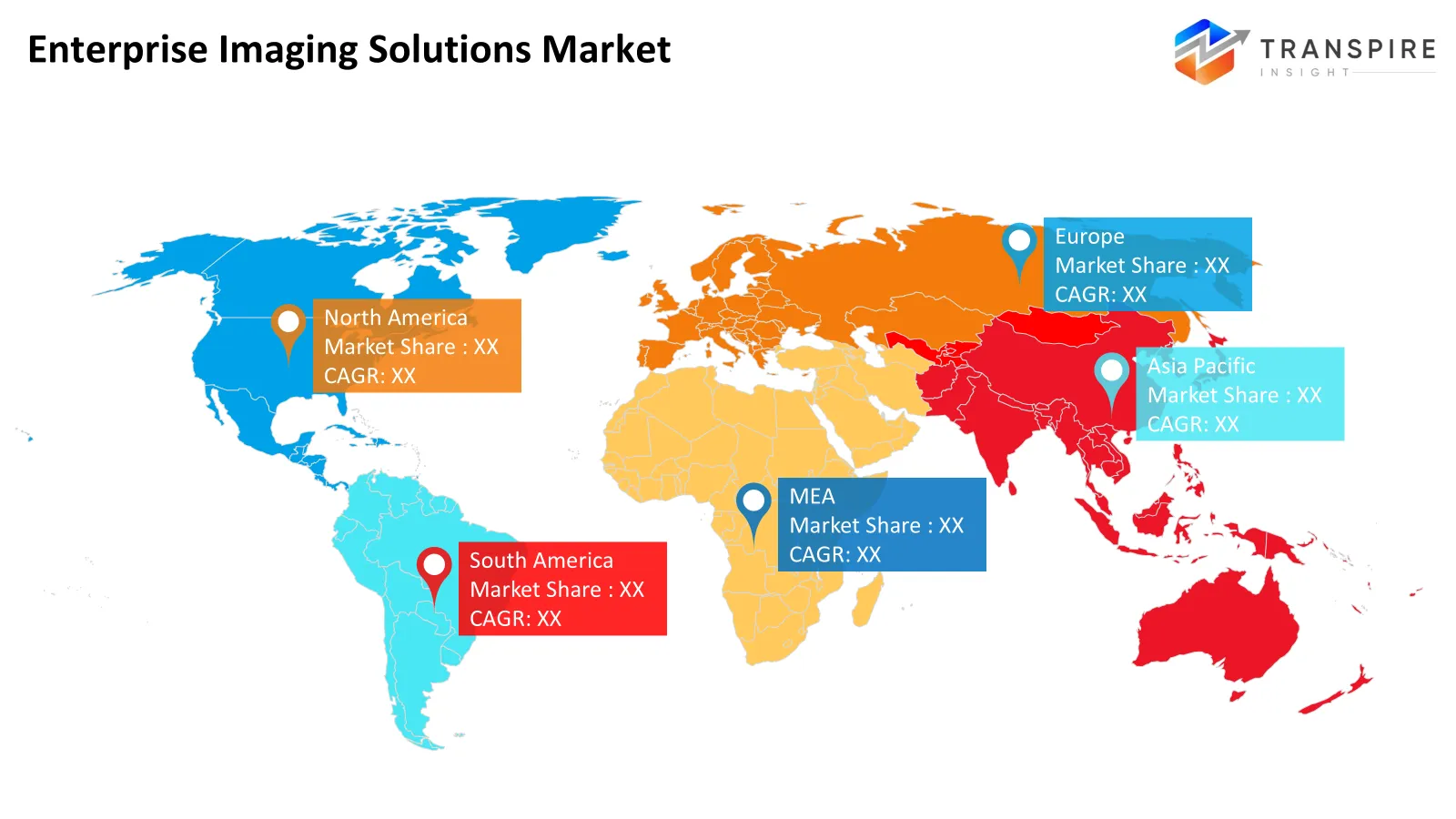
- Europe (Germany, France, U.K., Italy, Spain, Rest of Europe)
- North America (U.S., Canada, Mexico)
- Asia-Pacific (China, Japan, India, Rest of APAC)
- South America (Brazil and the Rest of South America)
- The Middle East and Africa (UAE, South Africa, Rest of MEA)
North America is expected to grow at a rapid CAGR in the Enterprise Imaging Solutions Market, holding around 44% of the share during the forecast period.
The North American region dominates the market for enterprise imaging solutions due to the highly developed healthcare infrastructure, adoption of PACS, vendor-neutral archiving solutions, and cloud platforms, and the effective electronic health record integration. The high volume of diagnostic imaging procedures, FDA-approved AI solutions, and generous reimbursement drive the growth of the regional market even faster. Regulations related to the focus on interoperability and data security, significant investments in healthcare IT solutions, and major regional players such as GE HealthCare, Hyland, and Intelerad also boost the regional market growth.
Europe is the high-growth region in the Enterprise Imaging Solutions Market during the period, holding roughly 29% share.
Europe is a rapidly developing region in terms of enterprise imaging solutions. There are national digital health strategies, strict data sharing and data protection regulations based on the GDPR, and the European Health Data Space development that stimulate the growth of the regional market for enterprise imaging solutions. The aging population and the concentration of imaging in vendor-neutral archives and cloud platforms in public healthcare systems contribute to the regional growth, along with such established regional players as Sectra, Agfa, Siemens Healthineers, and Philips.
Asia Pacific is the fastest-growing region in the Enterprise Imaging Solutions Market during the period, holding nearly 15% share.
The Asia Pacific region is currently leading in terms of growth in the market for enterprise imaging solutions due to the development of healthcare facilities, increasing volumes of diagnostics, and government initiatives like the Ayushman Bharat Digital Mission in India. Investment in cloud-based technologies, upgrading of PACS, artificial intelligence, increasing age, and chronic diseases are some of the factors driving the demand for these services.
Strategies for Market Growth in Non-Leading Regions:
Implementation of enterprise imaging technologies for efficient development of non-leading areas will be useful for small to medium healthcare providers and diagnostic imaging centers. Local deployment of cloud-based imaging systems, vendor neutral archiving, and enterprise imaging infrastructure, as well as the creation of regional imaging technology and service centers, will allow reducing reliance on foreign suppliers and minimizing the total cost of implementation and operation of enterprise imaging. Partnership with regional hospitals, diagnostic imaging centers, healthcare IT companies, and medical technology distributors will facilitate market penetration of enterprise imaging solution providers. Training and improvement of technical skills will be needed in order to increase awareness regarding enterprise imaging implementation, interoperability, cybersecurity, workflow integration, and medical images management. Moreover, flexible financing, subscription, long-term service agreements, and managed imaging will make enterprise imaging solutions cheaper and will encourage their adoption by healthcare organizations. Collaboration with government healthcare digitization programs, regional healthcare infrastructure projects, and digital sales channels will promote enterprise imaging solutions and will contribute to sustainable worldwide market growth in developing countries.
Future Market Trends for the Enterprise Imaging Solutions Market: -
- Adoption of cloud-native and hybrid: Cloud-native and hybrid adoption is growing, whereby the vendors move from on premise hardware to secure and scalable platforms and subscription-based managed services that reduce maintenance cost and minimize upfront capital investment.
- AI adoption: AI adoption is changing processes through automation of the repetitive screening process, handling of high priority cases, and image interpretation time reduction, enabled by the regulator approved algorithms incorporated into the enterprise imaging systems.
- VNA adoption and cyber resiliency: VNA adoption is increasing by expanding from the siloed radiology-focused PACS into multi-departmental imaging archives including cardiology and pathology and reinforced cyber resilience for patient imaging.
Recent Development
- In 2026 (January-March): Agfa HealthCare conducted several large enterprise imaging go-live deployments within integrated delivery networks, academic institutions, and federal health organizations, confirming the trend towards consolidation within enterprise imaging solutions.
- In February 11, 2026: According to StartUs Insights, imaging companies have decided to emphasize reconstruction, protocoling, and workflow automation rather than standalone detection algorithms in their AI-enabled products.
- In September 7, 2026: According to SNS Insider, there is fast growth in the services segment, mainly due to complicated data migration processes from one healthcare network to another.
- In September 11, 2026: According to SNS Insider, the market for enterprise imaging solutions will be worth USD 6.69 billion by 2035 with the CAGR of 11.18%.
Market Segment
This study forecasts revenue at global, regional and country levels from 2020 to 2033. Transpire Insight has segmented the Enterprise Imaging Solutions Market based on the below-mentioned segments:
Enterprise Imaging Solutions Market, By Deployment
- Cloud-based
- On-premise
- Hybrid
- Private Cloud
- Public Cloud
- Multi-cloud
- Edge
- Others
Enterprise Imaging Solutions Market, By Solution Type
- Vendor Neutral Archive
- PACS
- Image Exchange
- Universal Viewer
- Medical Image Management & Processing
- AI Image Analysis
- Teleradiology
- Others
Enterprise Imaging Solutions Market, By Modality
- Radiology
- Cardiology
- Pathology
- Ophthalmology
- Point-of-care Ultrasound
- Dermatology
- Oncology
- Others
Enterprise Imaging Solutions Market, By End User
- Hospitals
- Diagnostic Imaging Centers
- Ambulatory Surgical Centers
- Academic Medical Centers
- Specialty Clinics
- Research Institutes
- Government
- Others
Enterprise Imaging Solutions Market, By Service
- Implementation
- Consulting
- Integration
- Support
- Maintenance
- Managed Services
- Training
- Others
Enterprise Imaging Solutions Market, By Content Type
- DICOM Images
- Non-DICOM Images
- Video
- Documents
- Clinical Media
- Pathology Slides
- Patient Records
- Others
Enterprise Imaging Solutions Market, By Technology
- Cloud
- AI
- Analytics
- DICOMweb
- Interoperability
- Cybersecurity
- Automation
- Others
Enterprise Imaging Solutions Market, By Regional Analysis
North America
- US
- Canada
- Mexico
Europe
- Germany
- UK
- France
- Italy
- Spain
- Russia
- Rest of Europe
Asia Pacific
- China
- Japan
- India
- South Korea
- Australia
- Rest of Asia Pacific
South America
- Brazil
- Argentina
- Rest of South America
Middle East & Africa
- UAE
- Saudi Arabia
- Qatar
- South Africa
- Rest of the Middle East & Africa
Frequently Asked Questions
Find quick answers to common questions.
The market is valued at USD 1.99 billion in 2025 and is projected to reach USD 5.25 billion by 2033.
Growth is driven by rising diagnostic volumes, healthcare digitization, cloud adoption, interoperability demand, and AI-enabled workflow automation in modern hospitals.
North America leads with about 44% share, driven by advanced healthcare infrastructure and cloud adoption, while Asia Pacific grows fastest.
Public cloud holds nearly 60% share, while PACS leads solution types at nearly 58%, reflecting scalability and adoption.
High total cost of ownership, complex legacy PACS migration, interoperability gaps, cybersecurity compliance, and skilled informatics shortages remain key restraints.
- GE HealthCare
- Siemens Healthineers
- Philips
- Fujifilm
- Agfa-Gevaert
- Sectra
- IBM
- Oracle
- Hyland
- Intelerad
- Merge Healthcare
- Canon Medical
- Change Healthcare
- Visage Imaging
- Mach7 Technologies
About the Authors

Mayur Shinde
I am Mayur Shinde, a Senior Research Analyst at Transpire Insight, specializing in the Automotive & Transportation and Information & Communication Technology (ICT) Industry. My work focuses on analyzing emerging market trends, technological advancements, competitive landscapes, and industry developments to deliver accurate, data-driven insights. I am passionate about transforming complex market information into clear, actionable content that helps businesses, professionals, and decision-makers stay informed and make confident strategic decisions.

Chakradhar Khansole
Chakradhar serves as the Research Director at Transpire Insight, bringing over 8 years of experience in technology, innovation, and strategic market intelligence. He specializes in transforming complex market data into actionable business insights that enable organizations to make informed, growth-oriented decisions. Recognized for his strategic vision and analytical expertise, Chakradhar leads high-impact research initiatives, delivering comprehensive market assessments, competitive intelligence, and forward-looking industry analysis.
Recently Published Reports
-
Apr 2026
3D Optical Profiler Market
3D Optical Profiler Market Size, Share & Analysis Report By Type (Desktop 3D Optical Profiler, and Portable 3D Optical Profiler), By Technology (Confocal Technology, and White Light Interference), By End-Use Industry (Manufacturing, Research Institutions, Automotive, Aerospace and Defense, Medical Devices, and Other), and Geography (North America, Europe, Asia-Pacific, Middle East and Africa, South and Central America), 2021 - 2031
-
Apr 2026
Depth Sensor Market
Depth Sensor Market Size, Share & Analysis Report By Type (Infrared Depth Sensors, Time-of-Flight (ToF) Sensors, Stereo Vision Sensors, Structured Light Sensors, Ultrasonic Depth Sensors), By Application (Automotive, Robotics, Gaming, Consumer Electronics, Industrial Automation, Healthcare, Security & Surveillance, Others), By End Users (Automotive Manufacturers, Consumer Electronics Companies, Healthcare Providers, Industrial Companies, Security Agencies, Gaming Companies, Robotics Companies, Others), and Geography (North America, Europe, Asia-Pacific, Middle East and Africa, South and Central America), 2021 – 2031
-
Apr 2026
Digital Manufacturing Market
Digital Manufacturing Market Size, Share & Analysis Report By Component (Hardware, Software, and Services), By Technology (Robotics, 3D Printing, Internet of Things (IoT), and Others), By Application (Automotive and Transportation, Aerospace and Defense, Consumer Electronics, Industrial Machinery, and Others), By Process Type (Computer-Based Designing, Computer-Based Simulation, Computer 3D Visualization, Analytics, and Others), and Geography (North America, Europe, Asia-Pacific, Middle East and Africa, South and Central America), 2021 – 2031
-
Apr 2026
Digital Visa Services Market
Digital Visa Services Market Size, Share & Analysis Report By Type (Individual Travelers, Group Travelers), By Application (Tourism, Business Travel, Others), and Geography (North America, Europe, Asia-Pacific, Middle East and Africa, South and Central America), 2021 – 2031