

Digital Watch Market Summary:
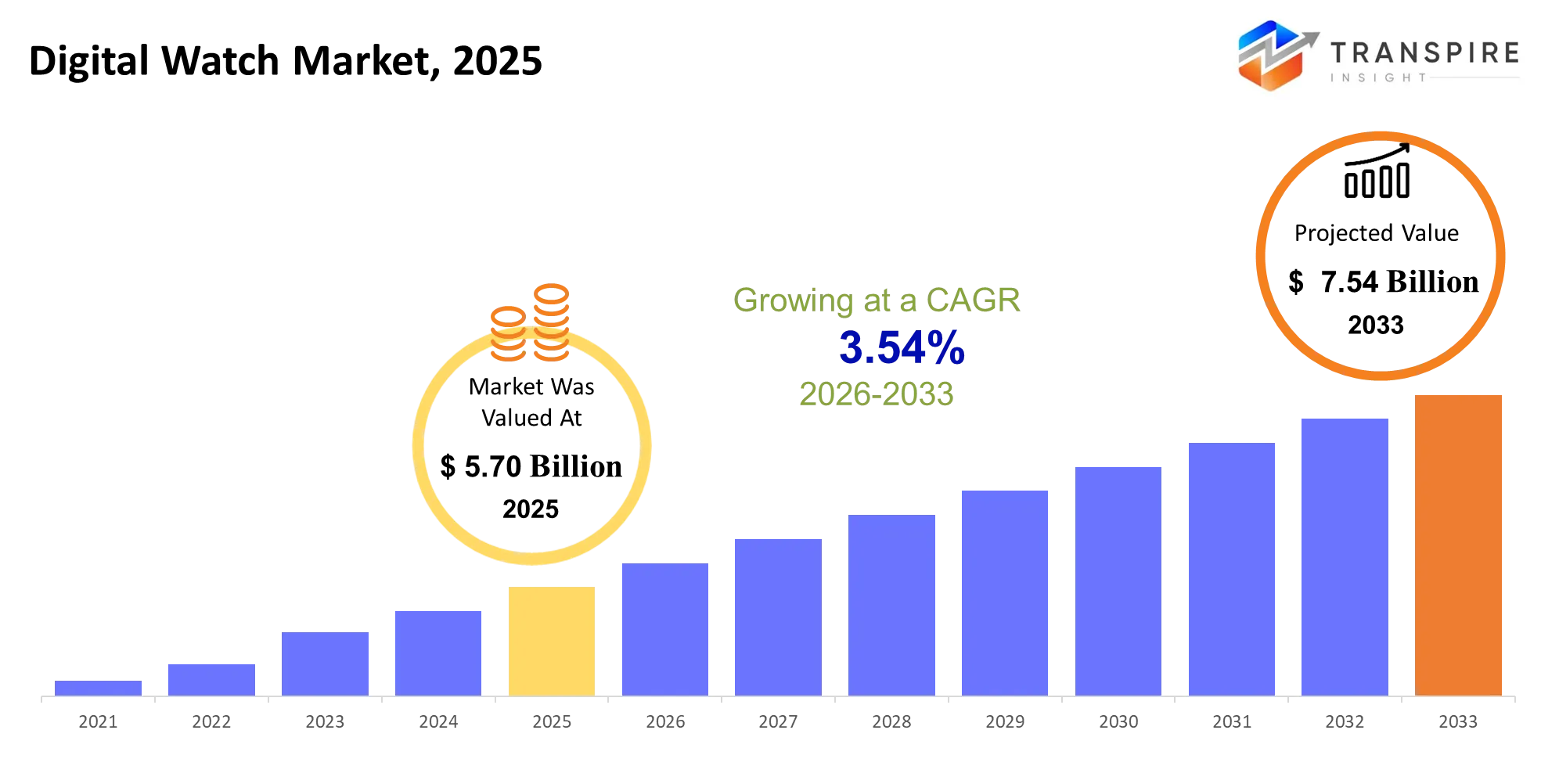
As per the Transpire Insight Analysis, The Digital Watch Market size is estimated at USD 5.70 billion in 2025 and is anticipated to reach USD 7.54 billion by 2033, growing at a CAGR of 3.54% from 2026 to 2033.
Digital Watch Market Consumers can track their everyday physical activity, notifications, health information, and more on their wrist without being glued to their smartphone with the digital watch market. The digital watch market has been evolving over the last 3-5 years, with it no longer being used as a step tracker, but as an extension of the smartphone, increasingly embracing health sensors, mobile payment, GPS, and custom digital services. One notable disruption in market structure has been health monitoring becoming more ubiquitous in common smartwatch platforms, making the device relevant to more than just working-out consumers. Several macro drivers of everyday usage, such as hybrid working, preventative wellness, and contactless payment adoption, have nudged users to upgrade their features; increased sensor integration and long-term software support have made feature-rich watches more appealing. However, continued growth hinges on ensuring health info reliability and privacy, improving battery life, and providing features that make financial and technological sense.
Digital Watch Market Size & Forecast:
- Market Size 2025: USD 5.70 Billion
- Expected Market Value (2033): USD 7.54 Billion
- Forecast CAGR (2026-2033): 3.54%
- Leading Region in 2025: Asia Pacific
- Fastest Growing Region: Middle East and Africa
- Key Company Profiles: Apple, Samsung, Huawei, Xiaomi, Garmin, Fitbit, Amazfit, Polar Electro, Suunto, Fossil Group, Casio, Google, OnePlus, Mobvoi, Withings.
Key Digital Watch Market Insights:
The market is shifting from hardware competition to a more personalized experience with wearables based on consistent health data, battery life, and seamless integration. The ability to match the capabilities and pricing of devices to consumer needs is becoming a key component of commercial success more than ever before, which means the need to add features indiscriminately is becoming a key weakness.
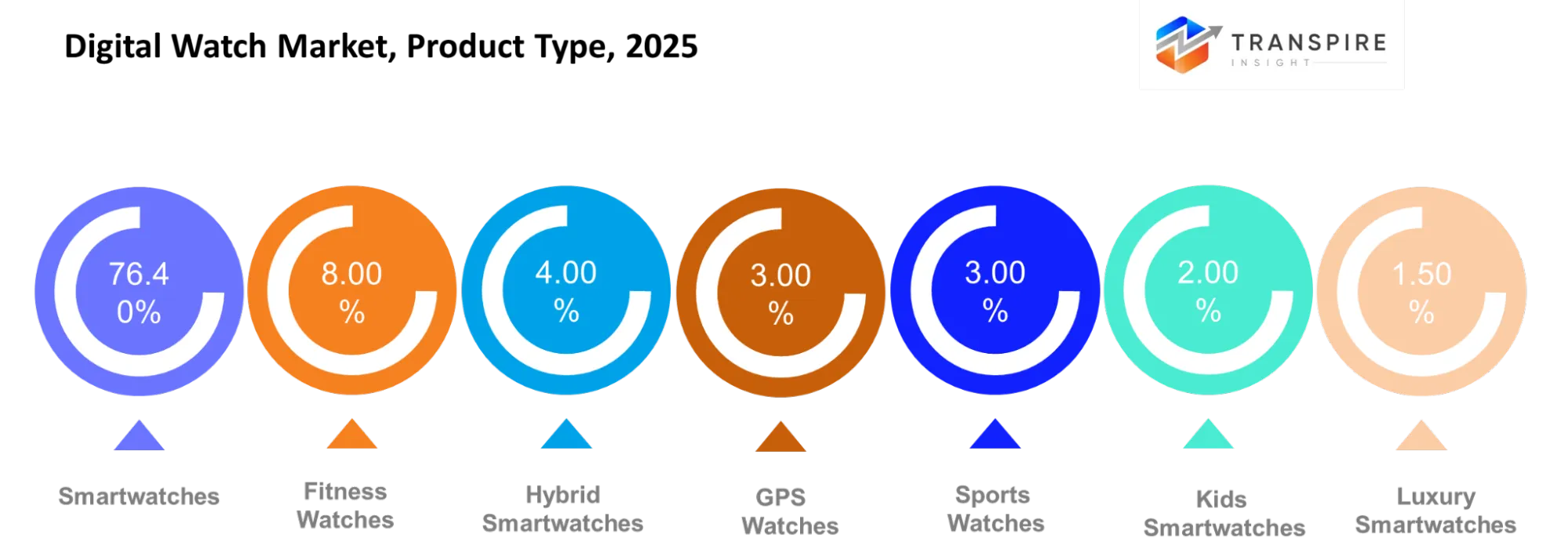
- The 76.40% product-type share for smartwatches is indicative of demand for preventive monitoring, with health and fitness smartwatches showing the highest growth rate at 10.80% CAGR.
- In Q1 2026, 25% of shipments were edge-AI capable, up 70% YoY, as users demand real-time information without relying on the cloud.
- About 90% of Edge-AI smartwatch shipments went to Apple, which employs on-wrist intelligence to further cement the ecosystem lock-in and premium loyalty.
- Blood-pressure monitoring increased by 12%, and sleep-apnea detection tripled to 18%, indicating a new trend toward clinically relevant screening.
- Samsung is pushing Galaxy AI health insights and research on non-invasive glucose monitoring, with a focus on chronic-disease management instead of fitness.
- Huawei is partnering with hospitals and leveraging AI health interpretation to take its HarmonyOS watches one step closer to diabetes risk assessment and daily health guidance.
- Fitness watches hold an 8.00% share, and hybrid smartwatches at 4.00% are attractive to users who want a traditional watch with discreet notifications.
- GPS and sports watches are tied at 3.00%, with runners, cyclists and outdoor users favouring route accuracy, durability and training analytics.
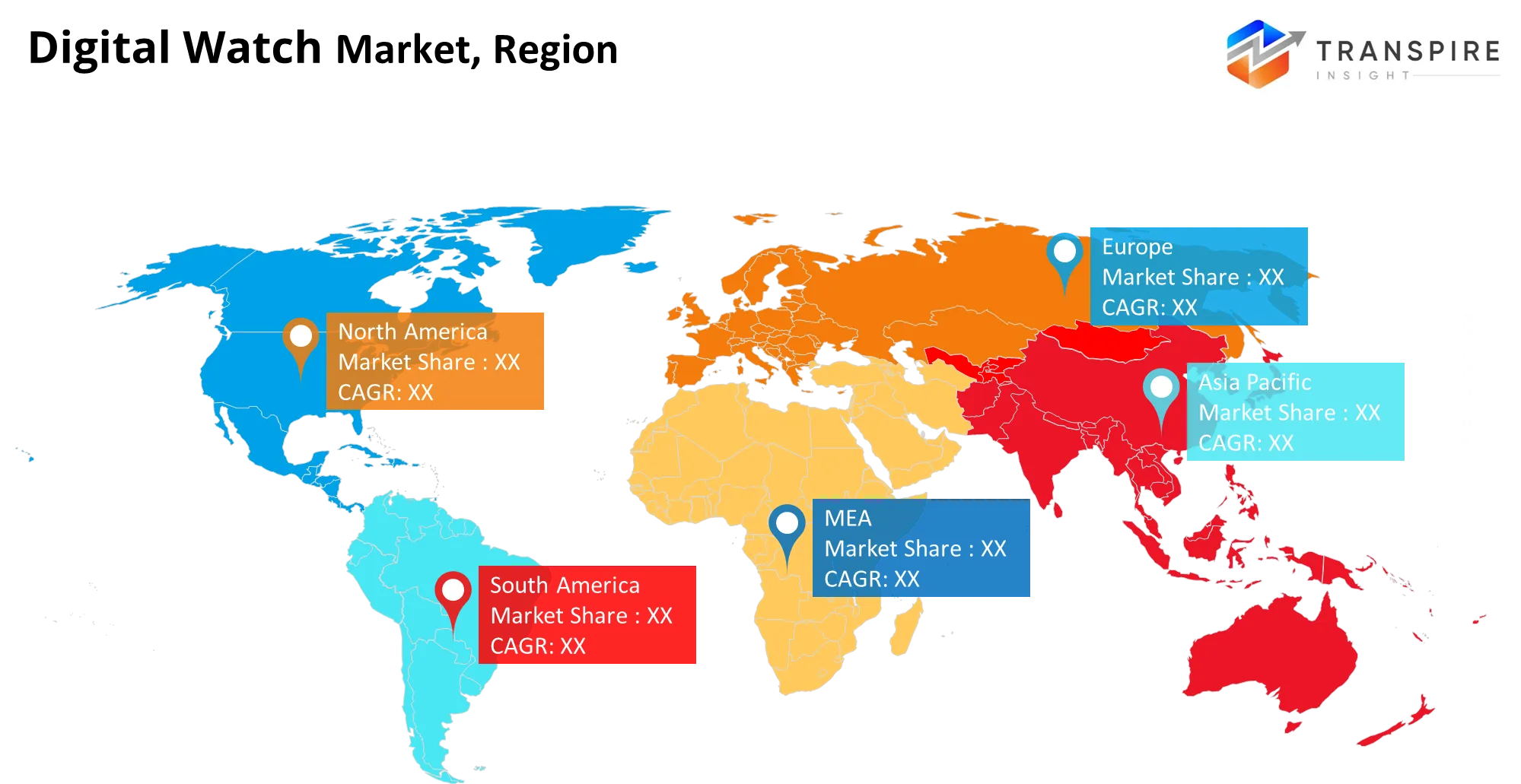
- Kids smartwatches, luxury smartwatches, and health monitoring watches are the niche markets, with Asia Pacific dominating the market with a 45.60% share, followed by North America at 25.00%, Europe at 21.00%, Latin America at 5.00%, and the Middle East & Africa at 3.40%, which is expected to grow fastest at 9.40% CAGR.
What are the Key Drivers, Restraints, and Opportunities in the Digital Watch Market?
Driver:
Health-focused functionality is moving digital watches beyond basic timekeeping. Improved optical sensors, sleep analysis, recovery metrics, and personalised workout recommendations give consumers practical reasons to use devices throughout the day. This shift is supported by the growing availability of on-device artificial intelligence and cellular connectivity. Counterpoint Research reported that smartwatch shipments increased 4% after declining in 2024, reflecting renewed interest in upgraded hardware and health features. These improvements encourage premium purchases and ecosystem-based customer retention.
Restraint:
Replacement cycles remain a structural challenge because many users see limited value in upgrading watches that already handle notifications, step tracking, and basic health measurements. Battery limitations, subscription costs, compatibility issues, and concerns about biometric-data privacy can further weaken conversion. In addition, inaccurate readings or unclear medical claims may reduce trust and increase compliance costs.
Opportunity:
The strongest opportunity lies in combining personalised wellness with clinically validated monitoring. In January 2026, the US Food and Drug Administration updated its guidance for low-risk general-wellness products, clarifying its regulatory approach while distinguishing wellness claims from medical functions. This creates opportunities for manufacturers to develop useful wellness tools while carefully managing medical claims. Partnerships with healthcare providers, insurers, and telehealth platforms could expand adoption, particularly in ageing populations and underserved markets.
Driver Impact Analysis - Digital Watch Market
|
Driver |
Relative Impact on Growth (%) |
Geographic Relevance |
Impact Timeline |
Demand Strength |
Growth Mechanism |
Key Beneficiaries |
Major Constraint |
|
Rising adoption of smartwatches and connected digital devices |
26% |
North America, China, India |
Short-term (≤2 years) |
High |
Smartphone integration expands everyday smartwatch utility. |
Watch manufacturers, chipset suppliers, app developers, retailers |
Platform incompatibility and longer replacement cycles. |
|
Increasing demand for health, fitness, and wellness monitoring |
24% |
North America, Europe, Asia Pacific |
Medium-term (2-4 years) |
High |
Biometric sensors encourage fitness-focused device purchases. |
Wearable brands, sensor suppliers, fitness platforms, consumers |
Accuracy limitations and health-data privacy concerns. |
|
Advancements in AI, sensors, displays, and battery technology |
20% |
North America, China, South Korea, Japan |
Long-term (≥4 years) |
High |
Smarter sensors and efficient batteries improve functionality. |
Semiconductor firms, display manufacturers, technology vendors |
High R&D costs and technical integration challenges. |
|
Growing affordability and e-commerce penetration in emerging markets |
17% |
India, China, Southeast Asia, Latin America |
Short-term (≤2 years) |
High |
Competitive pricing and online retail broaden customer access. |
Budget watch brands, e-commerce platforms, distributors |
Price sensitivity and intense competition. |
|
Demand for durable, sustainable, and specialised digital watches |
13% |
Europe, North America, Japan |
Medium-term (2-4 years) |
Medium |
Longer-lasting designs attract outdoor and eco-conscious users. |
Sports-watch brands, component suppliers, repair providers |
Higher material costs and limited repairability. |
|
Total |
100% |
— |
— |
— |
— |
— |
— |
What Has the Impact of Artificial Intelligence Been on the Digital Watch Market?
AI is elevating the digital watch from a simple notification tool to an emerging predictive personal health platform. On-device models have the potential to monitor heart-rate variability, sleep stages, temperature, activity, and location in real time, paving the way for fall alerts, arrhythmia alerts, sleep-apnea screening, and coaching, all without requiring constant connectivity to the cloud. This reduces response times and data transmission while improving privacy. Automation is also improving the product experience with autonomous battery management, voice assistants, contextual recommendations, and automatic workout detection. These factors increase transparency and reduce manual interactions. The scope and frequency of drug resistance, illness, overtraining, cardiac-rhythm irregularities, and high-blood-pressure warnings may ultimately prove predictive as well. In 2026, shipments of blood-pressure-enabled watches doubled, while sleep apnea detection tripled.
Insurers, employers, and providers are using these signals to generate risk scores, engagement around wellness, and remote-care workflows. Accuracy and integration remain the key limitations. The quality of sensors, the wearer's skin tone, watch fit, movement, and individual physiology can result in false positives or missed events. Costs to open up and harmonise validated watch data in clinical systems also remain high.
In October 2026, Google launched a women's health partnership with Flo Health to integrate cycle data with Google Health metrics and Google Health Coach. This collaboration bridges the gap between continuous wearable tracking and personalized gynecological insights.https://www.pymnts.com/healthcare/2026/google-launches-womens-health-partnership-and-new-fitbit/
Key Digital Watch Market Trends:
The market is evolving from basic connected accessories to specialised devices that feature health intelligence, stand-alone connectivity, and extended personal utility. It is not just about features anymore - it's about useful insights, reliability, battery performance, and ecosystem integration.
- Edge AI has gone mainstream, with 25% of all Q1 2026 smartwatch shipments being able to perform on-device inference.
- Health is shifting from wellness to clinically proven screening such as sleep apnea and blood pressure.
- As biometric and sleep data are considered sensitive information, privacy-by-design is increasingly becoming a competitive requirement.
- eSIM and LTE connectivity will help free people from their reliance on smartphones, allowing for standalone calling, navigation, payments, and safety capabilities.
- Beyond selling hardware, subscription-based coaching, recovery insights, and premium health analytics are generating revenue streams.
- Wearable data is increasingly integrated with electronic medical records, and remote-monitoring initiatives are becoming more common.
- As Huawei continues to build its ecosystem, it is gradually making a mark against the existing watchOS and Wear OS duo with its new HarmonyOS.
- Demand for enterprise adoption is increasing in areas such as worker safety, logistics, and field service, which are less reliant on consumer discretionary spending.
- The premiumisation trend is visible with upgrades for ECG, advanced sleep tracking, and AI wellness features.
Digital Watch Market Segmentation
Product Type:
Smartwatches dominate with a 76.40% share given their role as the sole connected-wearable platform; their growth logic is based on app ecosystems, cell canopies, and high-end health sensing. 10.80% CAGR Health & Fitness Smartwatches have the fastest value pool growth by far, as buyers increasingly value preventative monitoring. 8.00% CAGR Fitness watches still have demand from pocket-sensitive activity users. 4.00% CAGR Hybrid smartwatches combine the classic timepiece with discreet smart functions, targeting traditional watch owners. 3.00% CAGR GPS watches serve outdoor sports and outdoor activity seekers. 3.00% CAGR Sports watches serve outdoor sports and active people. 2.00% CAGR Kids smartwatches grow through tracked safety and location. 2.10% CAGR Health monitoring watches grow through clinical and non-clinical health and fitness use. 1.50% CAGR Luxury smartwatches serve ultra-high-income groups.
Operating System:
watchOS and Wear OS anchor the digital watch market, with watchOS holding approximately a 40% share and Wear OS around 30%. Apple benefits from ecosystem integration across its devices, applications, and services, while Google leverages Android compatibility and access to third-party applications. HarmonyOS is emerging as an alternative within Huawei’s ecosystem. Proprietary OS, Android-based, Linux-based, and RTOS platforms serve specialised requirements, including fitness tracking, rugged applications, and energy-efficient operation. Future competition will depend on software reliability, application availability, security updates, and battery optimisation.
Connectivity:
Bluetooth remains the fundamental connection between digital watches and smartphones, while Bluetooth-plus-Wi-Fi configurations support synchronisation, updates, and internet access. NFC enables contactless payments, and GPS supports navigation, location tracking, and outdoor activities. Cellular and LTE connectivity allow compatible watches to handle calls, messages, and selected services independently of smartphones. These capabilities expand adoption among children, older adults, travellers, and field workers. Future development will focus on improving network reliability, emergency communication, and power efficiency while reducing the additional cost of standalone connectivity.
Application:
Fitness tracking and health monitoring remain central to digital watch adoption, supported by activity measurement, sleep analysis, heart-rate tracking, and workout guidance. Communication, navigation, payments, sports tracking, entertainment, and personal safety extend usage into everyday routines. AI-assisted interpretation can transform collected measurements into personalised recommendations, while connected platforms may support remote wellness monitoring. However, accuracy, privacy, and responsible interpretation remain essential. Future growth will depend on making insights actionable and integrating devices with fitness applications, healthcare services, and digital payment ecosystems.
Price Range:
Entry-level and budget watches attract first-time buyers through accessible pricing and essential tracking functions. Mid-range products balance connectivity, battery performance, and health features, while premium and luxury devices differentiate through materials, advanced sensors, design, and ecosystem integration. Ultra-premium and professional models target specialised users requiring sophisticated analytics, durability, or advanced navigation. These price tiers allow manufacturers to address distinct purchasing priorities. Future opportunities will centre on delivering reliable core functionality at lower prices while justifying premium margins through measurable performance benefits and longer software support.
Distribution Channel:
Online retail enables consumers to compare specifications, prices, reviews, and compatibility before purchasing, while direct-to-consumer platforms provide manufacturers with greater control over product presentation. Speciality stores and electronics retailers support demonstrations, fitting, and technical guidance. Brand stores strengthen ecosystem engagement, while supermarkets and department stores improve accessibility. Telecom operators can bundle cellular watches with compatible service plans, reducing adoption barriers. Future channel strategies will increasingly combine digital discovery with physical demonstrations, personalised recommendations, convenient returns, and after-sales support to improve conversion and strengthen customer retention.
What are the Key Use Cases Driving the Digital Watch Market?
The core use case is continuous health and fitness management, aligned with the 76.40% smartwatch segment and the 10.80% CAGR of health and fitness smartwatches. Users rely on watches for heart rate, sleep, SpO2, stress, workout, and recovery tracking, turning daily behaviour into actionable health feedback.indexbox+1
Expanding applications include standalone communication, contactless payments, navigation, and personal safety. Cellular, LTE, NFC, and GPS-enabled models serve commuters, travellers, children, older adults, and outdoor users who need assistance without carrying a phone.
Emerging use cases focus on remote patient monitoring, workplace safety, and insurance-linked wellness. Clinicians, employers, and insurers can use validated watch data for chronic-care oversight, fall detection, field-worker protection, and preventive-health programmes, shifting the market from consumer gadgets toward service-enabled health infrastructure.
|
Report Metrics |
Details |
|
Market size value in 2025 |
USD 5.70 Billion |
|
Market size value in 2026 |
USD 5.91 Billion |
|
Revenue forecast in 2033 |
USD 7.54 Billion |
|
Growth rate |
CAGR of 3.54% from 2026 to 2033 |
|
Base year |
2025 |
|
Historical data |
2021 - 2024 |
|
Forecast period |
2026 - 2033 |
|
Report coverage |
Revenue forecast, competitive landscape, growth factors, and trends |
|
Regional scope |
United States; Canada; Mexico; United Kingdom; Germany; France; Italy; Spain; Denmark; Sweden; Norway; China; Japan; India; Australia; South Korea; Thailand; Brazil; Argentina; South Africa; Saudi Arabia; United Arab Emirates |
|
Key companies profiled |
Apple, Samsung, Huawei, Xiaomi, Garmin, Fitbit, Amazfit, Polar Electro, Suunto, Fossil Group, Casio, Google, OnePlus, Mobvoi, Withings. |
|
Customization scope |
Free report customization (country, regional & segment scope). Available customized purchase options to meet your exact research needs. |
|
Report Segmentation |
Product Type (Smartwatches, Fitness Watches, Hybrid Smartwatches, GPS Watches, Sports Watches, Kids Smartwatches, Luxury Smartwatches, Health Monitoring Watches); Operating System (Wear OS, watchOS, HarmonyOS, Proprietary OS, Android-Based, Linux-Based, RTOS); Connectivity (Bluetooth, Wi-Fi, Cellular, NFC, GPS, LTE, Bluetooth + Wi-Fi); Application (Fitness Tracking, Health Monitoring, Communication, Navigation, Payments, Sports Tracking, Entertainment, Personal Safety); Price Range (Budget, Mid-Range, Premium, Luxury, Ultra-Premium, Professional, Entry-Level); Distribution Channel (Online Retail, Specialty Stores, Electronics Stores, Brand Stores, Supermarkets, Telecom Operators, Department Stores) |
Which Regions are Driving the Digital Watch Market Growth?
Asia Pacific is at the forefront of the digital watch industry, with a share of 45.60%. This is primarily due to the presence of an abundant manufacturing base, an established supply chain, and a large consumer base. China is a prominent player in the digital watch market through domestic manufacturing of connected devices. India and Southeast Asia form a lucrative market due to the expansion in digital retail. Manufacturing incentives and electronics investments have helped expand production potential, while effective marketing strategies such as low prices and smartphone integration help digital watches effectively target consumers across the various income groups.
In October 2026, Mibro launched the AeroPace running smartwatch, featuring AI-powered Mibro Coach for personalised training plans through its companion app. The launch aims to make structured running guidance more accessible to beginners, supporting Asia Pacific’s shift toward affordable, feature-rich wearables tailored to mobile-first consumers.https://www.globenewswire.com/news-release/2026/10/14/3380554/0/en/mibro-launches-aeropace-a-running-smartwatch-designed-for-beginner-runners.html
North America has a market share of 25.00%. Europe, Latin America, and the Middle East/Africa have a market share of 21.00%, 5.00%, and 3.40%, respectively. While Asia Pacific is large in manufacturing, North America's advantage lies in mature premium-device ecosystems, digital payment infrastructure, and consumer demand for bundling health features. Europe benefits from consumer interest in sports, retail channels, and increased attention to data privacy, including GDPR requirements. These developed markets benefit from replacement demand and high-end offerings, which might limit device growth to some extent as devices have longer life spans.
In September 2026, Ultrahuman secured $70 million in growth financing for its smart ring and consumer health wearable platform. This funding enables the company to scale its production capabilities and expand its integrated health tracking footprint to capture growing demand for premium biometric data ecosystems.https://newmarketpitch.com/blogs/news/wearable-funding-news
Middle East and Africa's 3.40% market share is expected to grow at a 9.40% CAGR, highlighting its potential beyond its current small market share. Urbanisation, better connectivity, retail and access to e-commerce, and growing inclination towards fitness devices are unlocking further potential for its adoption. Gulf countries provide scope for high-end devices, whereas some markets in Africa might lean towards affordable devices with their added battery benefits. Manufacturers can have a wider market share with customised pricing, distribution, language support, and after-sales services besides high-end devices.
In October 2026, WHOOP launched its health and performance tracking app with full Arabic language support across the Gulf Cooperation Council (GCC). This strategic expansion empowers native Arabic speakers to monitor personalised physiological metrics like sleep, stress, and recovery, thereby accelerating user adoption in high-end Gulf markets under their ongoing health-technology partnership with Mubadala Investment Company.https://gulfbusiness.com/en/2026/wellbeing/from-sleep-to-performance-whoop-brings-its-health-insights-to-arabic-speakers/
Who are the Key Players in the Digital Watch Market, and how do they compete?
Competition revolves around ecosystem integration, health features, battery life, design, and price. Apple and Samsung focus on locking users into premium features and smartphone ecosystems; Huawei and Xiaomi leverage comprehensive product ranges and value pricing. Garmin, Polar Electro, and Suunto emphasise sporting performance, navigation, and rugged outdoor durability. These myriad strategies carve up the ecosystem into connected lifestyle devices and performance-oriented watches. Apple capitalises on watchOS and integrated services; Samsung combines Galaxy device presence with Wear OS; Google boosts its Wear OS platform with Fitbit health services; Huawei and Xiaomi use a connected-device ecosystem and diverse pricing; OnePlus targets Android users who want performance in a reasonable range; Mobvoi capitalises on Wear OS and ecosystem lock-in; and growth here depends on relevant apps, channels, and regional presence. Garmin emphasises advanced training metrics; Polar Electro relies on exercise science; Suunto goes after outdoor explorers; Amazfit offers affordable prices and long battery life; Fitbit emphasises accessible wellness tracking; Withings specialises in connected health watches; Casio plays on rugged designs; and the Fossil Group banks on design appeal. Their role in the contest now largely depends on reliability, software, and a clearly differentiated value to users.
Key Players are:
Garmin
Fitbit
Amazfit
Polar Electro
Suunto
Fossil Group
Casio
OnePlus
Mobvoi
Withings
Digital Watch Market — Enhanced Competitive Benchmarking
|
Company |
Est. Revenue Share Range |
Key Offerings |
Strategic Positioning |
Geographic Strength |
Technology Focus |
|
Apple Inc. |
Estimated 25-36% |
Apple Watch Series, SE, Ultra |
Premium ecosystem leadership and health-led differentiation |
North America, Europe, Asia Pacific |
Advanced health sensors, watchOS, cellular connectivity |
|
Huawei Technologies |
Estimated 12-20% |
Watch GT, Watch Ultimate, Watch Fit |
Broad portfolio with strong domestic scale and value |
Asia Pacific, Europe, Middle East |
HarmonyOS, health monitoring, efficient multi-day batteries |
|
Xiaomi Corporation |
Estimated 5-10% |
Redmi Watch, Xiaomi Watch, Smart Band |
Cost leadership and high-volume consumer distribution |
Asia Pacific, Europe, Latin America |
Affordable sensors, smartphone integration, battery optimization |
|
Samsung Electronics |
Estimated 5-10% |
Galaxy Watch, Galaxy Watch Ultra |
Android ecosystem integration and premium feature competition |
Asia Pacific, North America, Europe |
Wear OS, BioActive sensors, Galaxy AI integration |
|
Garmin Ltd. |
Estimated 4-9% |
Forerunner, fēnix, Venu, Instinct |
Performance specialization and premium sports differentiation |
North America, Europe, Asia Pacific |
GPS, training analytics, multisport and health sensors |
|
Imoo (BBK-affiliated brand) |
Estimated 2-5% |
Z-series children's watches, kids' connected watches |
Children's safety specialization and family connectivity |
Asia Pacific, selected international markets |
GPS tracking, video calling, parental controls |
|
Zepp Health (Amazfit) |
Estimated 2-5% |
Amazfit Balance, T-Rex, GTR, Active |
Feature-rich alternatives at competitive price points |
Asia Pacific, Europe, North America |
Zepp OS, biometric tracking, AI-assisted fitness |
|
Google (Fitbit) |
Estimated 2-5% |
Pixel Watch, Fitbit Versa, Charge |
Health-platform integration and Android smartwatch expansion |
North America, Europe, Asia Pacific |
Fitbit health analytics, Wear OS, activity monitoring |
|
Casio Computer Co. |
Estimated 1-4% |
G-SHOCK, Pro Trek, classic digital watches |
Durable digital timekeeping and outdoor niche leadership |
Asia Pacific, North America, Europe |
Shock resistance, solar power, sensors, time synchronization |
|
Polar Electro |
Estimated 0.5-2% |
Vantage, Pacer, Grit X |
Specialist sports training and physiological measurement |
Europe, North America, Asia Pacific |
Heart-rate analytics, training load, recovery monitoring |
Recent Development News
- In July 2026, SHARP Corporation launched the Karada Mate Watch by integrating HEALBE’s FLOW® technology for automatic calorie intake and hydration estimation. The launch expands digital watch applications in personalised health monitoring and strengthens the role of biometric analytics in connected wearable devices.https://www.globenewswire.com/news-release/2026/07/03/3321884/0/en/healbe-s-technology-powers-sharp-s-first-health-focused-smartwatch.html
- In January 2026, Motorola partnered with Polar to introduce the moto watch with Polar-powered sleep, training, wellness, activity, and recovery tracking capabilities. The collaboration combines smartwatch connectivity with established sports-science expertise, supporting demand for digital watches offering more advanced fitness insights.https://www.polar.com/en/media-room/polar-expands-powered-by-polar-through-partnership-with-motorola
- In February 2026, X3 Holdings announced a strategic agreement with an AI healthcare technology company to support the commercialisation and operational deployment of an AI-powered healthcare smartwatch. The agreement expands the company's presence in digital healthcare and highlights opportunities for AI-enabled wearables focused on continuous monitoring and personalised health management.https://www.nasdaq.com/press-release/x3-holdings-expands-ai-healthcare-through-strategic-smartwatch-partnership-2026-02-24
What Strategic Insights Define the Future of the Digital Watch Market?
The market is shifting towards software-led differentiation, where trustworthy health insights and continuous engagement will be more valuable than new hardware features. Manufacturers providing wellness insights alongside conveniences like ease of use could foster loyalty and prices that capture value, which is critical to market success. Existing risks include sensor inaccuracy, privacy, and subscription fatigue that could undermine trust and loyalty, especially as the device collects even more detailed behavioural data. Novel opportunities include affordable, AI-enabled wearables and partnerships that can monitor wellness remotely, with on-device processing preferable as long as no-compromise battery life and accuracy are achievable. Manufacturers should focus on validated features, transparency, long-term support, and cross-device platform capabilities. Regional considerations should include the manufacturing concentrations of Asia Pacific, the ecosystem strength of North America, and the price sensitivity of emerging markets. All this must add tangible value to the user, rather than just have a long list of features.
Key Segmentations are:
Product Type
- Smartwatches
- Fitness Watches
- Hybrid Smartwatches
- GPS Watches
- Sports Watches
- Kids Smartwatches
- Luxury Smartwatches
- Health Monitoring Watches
Operating System
- Wear OS
- watchOS
- HarmonyOS
- Proprietary OS
- Android-Based
- Linux-Based
- RTOS
Connectivity
- Bluetooth
- Wi-Fi
- Cellular
- NFC
- GPS
- LTE
- Bluetooth + Wi-Fi
Application
- Fitness Tracking
- Health Monitoring
- Communication
- Navigation
- Payments
- Sports Tracking
- Entertainment
- Personal Safety
Price Range
- Budget
- Mid-Range
- Premium
- Luxury
- Ultra-Premium
- Professional
- Entry-Level
Distribution Channel
- Online Retail
- Speciality Stores
- Electronics Stores
- Brand Stores
- Supermarkets
- Telecom Operators
- Department Stores
By Regional Analysis
North America
- US
- Canada
- Mexico
Europe
- Germany
- UK
- France
- Italy
- Spain
- Russia
- Rest of Europe
Asia Pacific
- China
- Japan
- India
- South Korea
- Australia
- Rest of Asia Pacific
South America
- Brazil
- Argentina
- Rest of South America
Middle East & Africa
- UAE
- Saudi Arabia
- Qatar
- South Africa
- Rest of the Middle East & Africa
Frequently Asked Questions
Find quick answers to common questions.
The digital watch market size was valued at USD 5.70 billion in 2025 and is poised to reach USD 7.54 billion by 2033, expanding at a 3.54% CAGR.
Key segments for the digital watch market are Product Type (Smartwatches, Fitness Watches, Hybrid Smartwatches, GPS Watches, Sports Watches, Kids Smartwatches, Luxury Smartwatches, Health Monitoring Watches); Operating System (Wear OS, watchOS, HarmonyOS, Proprietary OS, Android-Based, Linux-Based, RTOS); Connectivity (Bluetooth, Wi-Fi, Cellular, NFC, GPS, LTE, Bluetooth + Wi-Fi); Application (Fitness Tracking, Health Monitoring, Communication, Navigation, Payments, Sports Tracking, Entertainment, Personal Safety); Price Range (Budget, Mid-Range, Premium, Luxury, Ultra-Premium, Professional, Entry-Level); Distribution Channel (Online Retail, Specialty Stores, Electronics Stores, Brand Stores, Supermarkets, Telecom Operators, Department Stores)
Growth is primarily driven by advanced health and fitness tracking, AI-powered wellness insights, improved connectivity, contactless payments, longer battery life, and affordable, feature-rich devices that encourage adoption and replacement purchases.
The digital watch market is led by major manufacturers, including Apple, Samsung, Huawei, Xiaomi, Garmin, Fitbit, Amazfit, Polar Electro, Suunto, Fossil Group, Casio, Google, OnePlus, Mobvoi, and Withings.
Asia Pacific holds a 45.60% market share, supported by large-scale electronics manufacturing, competitive pricing, strong smartphone ecosystems, expanding digital retail, and growing demand for connected health and fitness devices.
Key opportunities include AI-enabled wellness monitoring, affordable smartwatches in emerging markets, remote healthcare partnerships, cellular connectivity, and personalised health services.
Apple
Samsung
Huawei
Xiaomi
Garmin
Fitbit
Amazfit
Polar Electro
Suunto
Fossil Group
Casio
OnePlus
Mobvoi
Withings
About the Authors

Chetan Dhatrak
I’m Chetan Dhatrak, a Senior Research Analyst at Transpire Insight, specializing in the Consumer Goods, Foods and Beverages industry. I focus on analyzing market trends, consumer behavior, competitive landscapes, and industry developments to deliver accurate, data-driven insights. My research at Transpire Insight is built on credible sources and in-depth analysis, helping businesses and readers better understand market dynamics, emerging opportunities, and evolving consumer preferences. I’m committed to creating reliable, well-researched content that supports informed decision-making and reflects the latest developments in the consumer goods and food & beverage sectors.

Chakradhar Khansole
Chakradhar serves as the Research Director at Transpire Insight, bringing over 8 years of experience in technology, innovation, and strategic market intelligence. He specializes in transforming complex market data into actionable business insights that enable organizations to make informed, growth-oriented decisions. Recognized for his strategic vision and analytical expertise, Chakradhar leads high-impact research initiatives, delivering comprehensive market assessments, competitive intelligence, and forward-looking industry analysis.
Recently Published Reports
-
Apr 2026
Bottled Water Market
Bottled Water Market Size, Share & Analysis Report By Product Type (Still Bottled Water, Carbonated Bottled Water, Functional Bottled Water, and Others), By Packaging (PET, Cans, and Others), By Sales Channel (Supermarkets/Hypermarkets, Convenience Stores/Drug Stores, Grocery Stores/Club Stores, Foodservice, and Others) and Geography (North America, Europe, Asia-Pacific, Middle East and Africa, South and Central America), 2021 - 2032
-
Apr 2026
Color Cosmetic Packaging Market
Color Cosmetic Packaging Market Size, Share & Analysis Report By Application (Mascara Packaging, Liquid Packaging, and Liquid Face), By Type (Tubes & Bottles, Pens & Markers, Compacts & Containers, and Droppers & Pumps), and Geography (North America, Europe, Asia-Pacific, Middle East and Africa, South and Central America), 2021 - 2031
-
Apr 2026
External Microphone For Camera Market
External Microphone For Camera Market Size, Share & Analysis Report By Type (Shotgun Microphone, Lavalier Microphone, and Others), By Application (Digital Camera, Professional Video Camera, and Others), and Geography (North America, Europe, Asia-Pacific, Middle East and Africa, South and Central America), 2021 - 2031
-
Apr 2026
Foot Orthotic Insoles Market
Foot Orthotic Insoles Market Size, Share & Analysis Report By Type (Pre-fabricated, and Custom-made), By Material (Thermoplastic, Composite Carbon Fiber, and Others), By Distribution Channel (Drug Stores, Hospitals & Clinics, and Others), and Geography (North America, Europe, Asia-Pacific, Middle East and Africa, South and Central America), 2021 - 2031