
Japan Smartphone Sensors Market Summary:
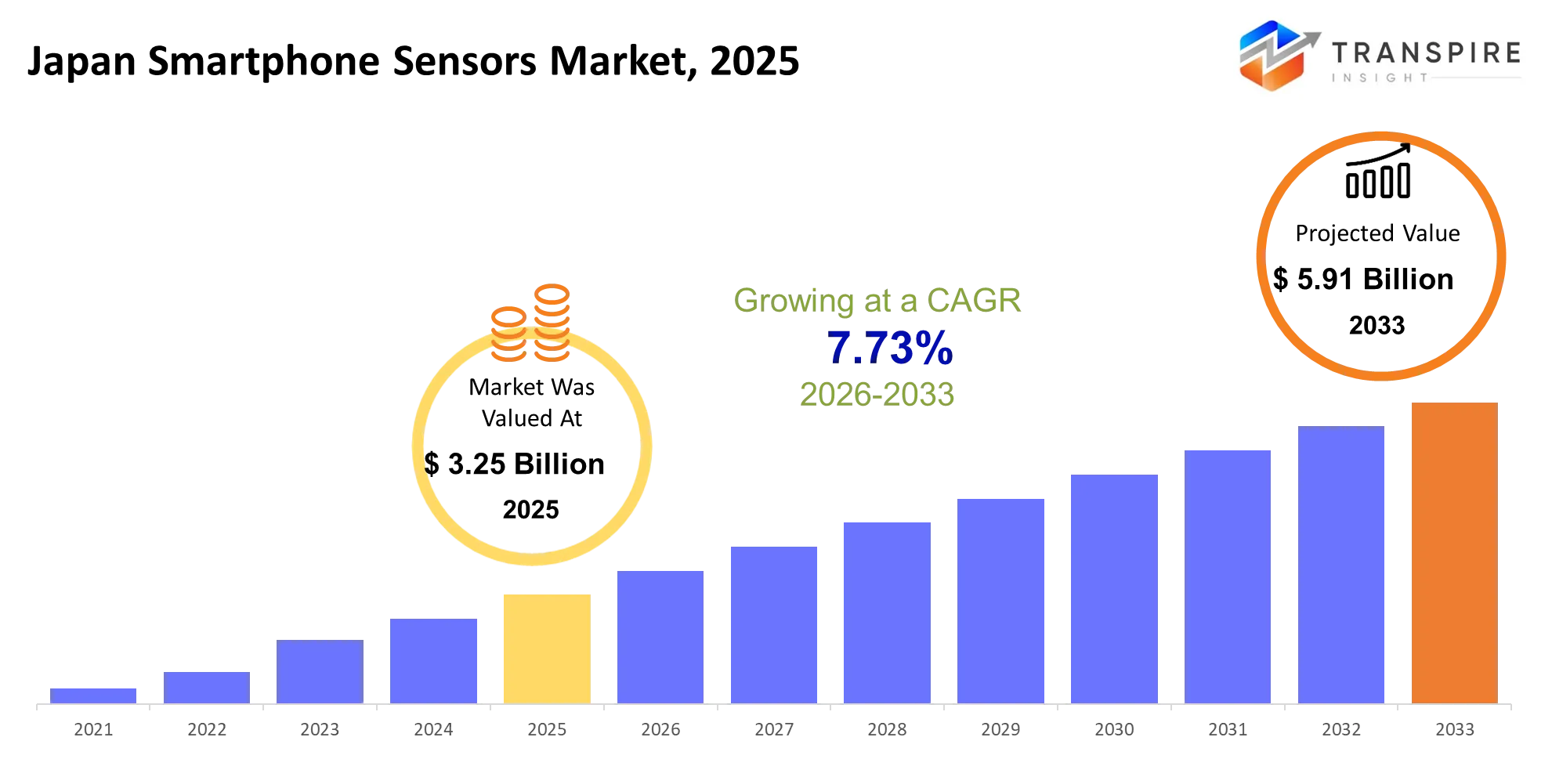
According to Transpire Insight, a detailed research report on the Japan Smartphone Sensors Market reflects that the market was valued at approximately USD 3.25 billion in 2025, is expected to reach USD 3.51 billion in 2026, and is projected to reach approximately USD 5.91 billion by 2033, expanding at a CAGR of 7.73% during 2026–2033, reflecting strong market development, technological innovation, advanced smartphone sensor integration, expanding manufacturing capabilities, and evolving growth dynamics in Japan.
Market Snapshot
- Market Value (2025): USD 3.25 Billion.
- Expected Market Value (2026): USD 3.51 Billion.
- Estimated Market Value (2033): USD 5.91 Billion.
- Forecast CAGR (2026–2033): 7.73%
Introduction
The Japan Smartphone Sensors Market is a niche part of the electronics and semiconductor industry, which involves the design, production, distribution, and application of advanced sensing devices in smartphones. They allow devices to sense motion, light, distance, pressure, orientation and biometric characteristics, allowing photography, security, navigation, gaming, health tracking and augmented reality applications. Japan is a major player in the smartphone sensor ecosystem with expertise in CMOS image sensors, MEMS technologies, optical components, and precision semiconductor manufacturing. Japanese technology firms are leading the miniaturization of sensors, stacked architecture, depth sensing and sensor fusion that enhance smartphone functionality and enable compact designs. Complex component supply chains, continued research and development, and rising demand for intelligent mobile experiences are also driving the market.
Key Market Highlights: -
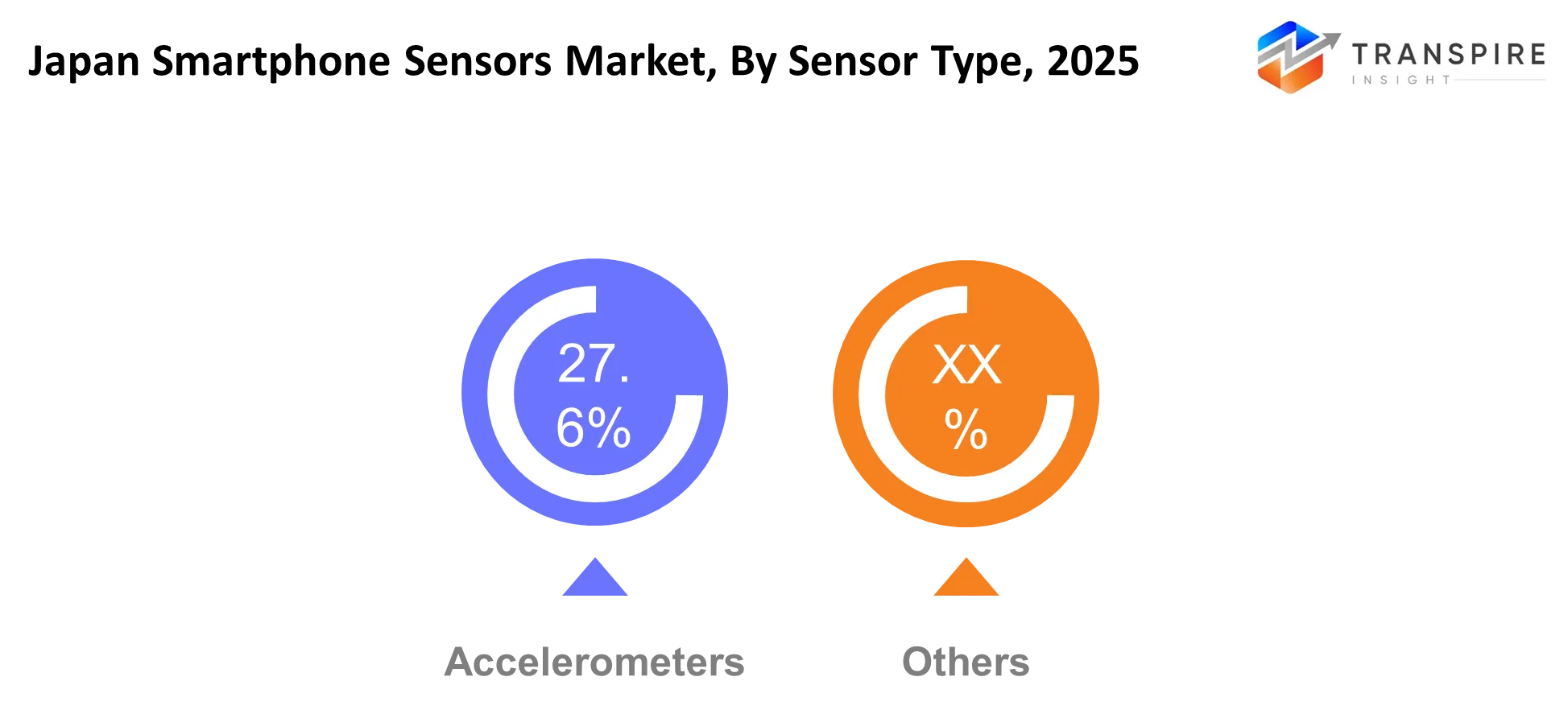
- By Sensor Type, the Accelerometer dominated the market and holds approximately 48% share in 2025 and is projected to grow at a substantial CAGR during the forecast period.
- By Technology, the MEMS dominated the market and holds approximately 54.36% share in 2025 and is projected to grow at a substantial CAGR during the forecast period.
- By Application, the Camera Stabilization Manufacturers segment dominated the market and holds approximately 39% share in 2025 and is projected to grow at a substantial CAGR during the forecast period.
- The Japan smartphone sensors market is driven by advanced CMOS image sensor manufacturing, investments in semiconductors, MEMS innovation, and increasing adoption of AI-enabled sensing technologies across next generation mobile devices.
How is Technology Driving Growth in the Japan Smartphone Sensors Market?
Advanced imaging, AI-enabled sensing, miniaturized MEMS components, and advanced 3D perception technologies are propelling the technology in the Japan Smartphone Sensors Market. Stacked CMOS image sensors boost smartphone photography, low-light performance and computational imaging, while edge AI allows for faster on-device interpretation of sensor data. Advanced 3D sensing and Time-of-Flight technologies enable facial recognition, augmented reality, autofocus and depth mapping. Advances in semiconductor manufacturing and sensor miniaturization allow more functionality in a smaller device. Meanwhile, 5G connectivity supports sensor-based real-time applications, and cooperation between component manufacturers in Japan and smartphone brands worldwide to accelerate commercialization and technology integration.
Market Drivers
The Japan Smartphone Sensors Market is driven by the demand for premium smartphones with advanced imaging biometric security and intelligent sensing capabilities. With the proliferation of 5G connectivity, advanced mobile applications are now possible that require high responsiveness from sensors. AI integration allows for real-time processing and personalized device operation. 3D sensing, augmented reality and computational photography are also driving demand for high-performance image, proximity, motion and depth sensors. Domestic innovation and manufacturing capabilities are bolstered by Japan’s robust semiconductor ecosystem and know-how in CMOS image sensor technology. Continued investment in miniaturization, energy efficiency and next-generation smartphone components is also aiding product differentiation and fast-tracking the development of advanced mobile sensing solutions.
Restrain
The Japan Smartphone Sensors Market is restrained by the high R&D and manufacturing costs involved in advanced CMOS, MEMS, and 3D sensing technologies. “A mature smartphone market and longer replacement cycles can limit the growth in demand for sensors. Component pricing is coming under more pressure, and power-consumption constraints and complex hardware integration add to the challenges facing manufacturers. In addition, disruptions to the semiconductor supply chain, geopolitical uncertainties and shortages of specialized engineering talent may affect the ability to scale production, innovate and bring next-generation smartphone sensor solutions to market in a timely manner.
Analysis of Prices and Consumer Behaviour
The CMOS Image Sensors constitute approx. 68% of the total Japan Smartphone Sensors Market due to the surge in demand from smartphone photography, computational imaging and premium mobile devices. High-performance, advanced image sensors are expected to cost 35% more than standard sensor products as these components integrate stacked architectures, advanced pixel technologies, precision manufacturing and enhanced imaging capabilities. Compact, highly integrated sensor modules account for roughly 45% of demand for smartphone sensor units. Sales volume is driven by the wide variety of applications in imaging, biometric security, motion detection & environmental sensing. The demand for these technologies is about 70 percent for smartphone imaging and advanced mobile applications. Sensor performance, miniaturization, power efficiency and consistency of manufacture are the key factors for 55% of manufacturers in their purchasing decisions. Another 33% of buyers choose bulk deals or long-term supply contracts to cut procurement costs & secure a stable supply of advanced smartphone sensor components.
Top Companies in the Japan Smartphone Sensors Market
- Sony Semiconductor Solutions
- Bosch Sensortec
- STMicroelectronics
- TDK
- Murata
- Samsung Electronics
- Apple
- Qualcomm
- NXP Semiconductors
- Texas Instruments
- Infineon
- Omron
- ROHM
- Asahi Kasei Microdevices
- Alps Alpine
Japan Smartphone Sensors Market Segmentation
The Japan Smartphone Sensors Market share is divided into six categories: By Sensor Type, By Technology, By Application, By Smartphone Type, By End User
The Accelerometer dominated the market, accounting for nearly 48% in 2025 and is expected to rise at a significant CAGR during the forecast period.
The Japan Smartphone Sensors Market is segmented by sensor type into accelerometer, gyroscope, magnetometer, proximity sensor, ambient light sensor, barometer, fingerprint sensor, temperature sensor. Among these, the Accelerometer segment dominated the market, accounting for nearly 48% in 2025 and expected to increase at a significant CAGR during the forecast period. The Accelerometer dominated the Japan Smartphone Sensors Market, accounting for nearly 48% in 2025. The growth is supported by the wide integration of accelerometers in the motion tracking, navigation, gaming, fitness monitoring and device orientation applications.
The MEMS dominated the market, accounting for nearly 54.36% in 2025, and is expected to rise at a significant CAGR during the forecast period.
The Japan Smartphone Sensors Market is segmented by technology into mems, cmos, optical, capacitive, piezoelectric, magnetic, inertial, biometric. Among these, the MEMS dominated the market, accounting for nearly 54.36% in 2025 and expected to increase at a significant CAGR during the forecast period. MEMS technology is driven by compact design, low power consumption, precision sensing and wide integration in smartphones which improve performance, functionality and miniaturisation.
The Camera Stabilization dominated the market, accounting for nearly 39% in 2025 and is expected to rise at a significant CAGR during the forecast period.
The Japan Smartphone Sensors Market is segmentedby application into motion detection, navigation, biometrics, camera stabilization, display control, health monitoring, gaming, environmental sensing. Among these, the Camera Stabilization dominated the market, accounting for nearly 39% in 2025 and expected to increase at a significant CAGR during the forecast period. Driven by growing demand for shake-free mobile photography, enhanced video quality and advanced smartphone imaging capabilities across premium devices.
Future Market Trends for the Japan Smartphone Sensors Market: -
- AI-Powered Image Sensing: Smartphone manufacturers are increasingly leveraging computational imaging and AI capabilities on top of advanced CMOS sensors, resulting in better image quality, autofocus, low-light performance, and real-time scene recognition.
- Advanced 3D and Depth Sensing: The increasing popularity of biometric authentication, augmented reality, and spatial computing will likely spur demand for advanced ToF, depth, and proximity sensing technologies.
- Sensor Miniaturization and Integration: Further Semiconductor Innovation is leading to the development of smaller, lower power, multi-functional sensor modules, allowing manufacturers to offer enhanced smartphone functionalities while maintaining compact designs and more efficient energy usage.
Recent Development
- In August 2026: Sony Semiconductor Solutions and TSMC finalized a Kumamoto joint venture to accelerate volume production of next-generation smartphone image sensors and automotive components.
- In Sept 2026: Japan’s METI approved subsidies to support Sony Semiconductor Manufacturing’s expansion of its Kumamoto facility, adding to its domestic production capacity for advanced smartphone image sensors.
- In May 2026: Sony launches Xperia 1 VIII in Japan with multi-camera system and improved telephoto sensor technology to boost smartphone imaging performance.
Market Segmentation
This study forecasts revenue at Japan, regional and country levels from 2020 to 2033. Transpire Insight has segmented the Japan Smartphone Sensors Market based on the below-mentioned segments:
Japan Smartphone Sensors Market, By Sensor Type
- Accelerometer
- Gyroscope
- Magnetometer
- Proximity Sensor
- Ambient Light Sensor
- Barometer
- Fingerprint Sensor
- Temperature Sensor
Japan Smartphone Sensors Market, By Technology
- MEMS
- CMOS
- Optical
- Capacitive
- Piezoelectric
- Magnetic
- Inertial
- Biometric
Japan Smartphone Sensors Market, By Application
- Motion Detection
- Navigation
- Biometrics
- Camera Stabilization
- Display Control
- Health Monitoring
- Gaming
- Environmental Sensing
Japan Smartphone Sensors Market, By Smartphone Type
- Entry-Level
- Mid-Range
- Premium
- Foldable
- Gaming
- 5G Smartphones
- Rugged Smartphones
- Flagship
Japan Smartphone Sensors Market, By Connectivity
- 4G
- 5G
- Wi-Fi
- Bluetooth
- NFC
- GPS
- GNSS
- UWB
Japan Smartphone Sensors Market, By End User
- Consumer Electronics
- Smartphone OEMs
- Mobile Operators
- App Developers
- Healthcare
- Gaming
- Automotive
- IoT
Frequently Asked Questions
Find quick answers to common questions.
Rising demand for premium smartphones, AI-enabled features, advanced imaging, 5G connectivity, and sophisticated sensing capabilities is driving market growth.
Accelerometers dominate due to extensive integration in motion detection, navigation, gaming, fitness monitoring, orientation tracking, and smartphone functionality applications.
MEMS technology enables compact, low-power, precise sensing solutions, supporting miniaturization, enhanced performance, efficient integration, and multifunctional smartphone applications.
AI enhances sensor data processing, computational photography, autofocus, scene recognition, biometric security, and personalized smartphone experiences through intelligent sensing capabilities.
Key trends include AI-powered imaging, advanced 3D sensing, sensor miniaturization, edge processing, energy efficiency, and multifunctional sensor integration.
- Sony Semiconductor Solutions
- Bosch Sensortec
- STMicroelectronics
- TDK
- Murata
- Samsung Electronics
- Apple
- Qualcomm
- NXP Semiconductors
- Texas Instruments
- Infineon
- Omron
- ROHM
- Asahi Kasei Microdevices
- Alps Alpine
About the Authors

Mayur Shinde
I am Mayur Shinde, a Senior Research Analyst at Transpire Insight, specializing in the Automotive & Transportation and Information & Communication Technology (ICT) Industry. My work focuses on analyzing emerging market trends, technological advancements, competitive landscapes, and industry developments to deliver accurate, data-driven insights. I am passionate about transforming complex market information into clear, actionable content that helps businesses, professionals, and decision-makers stay informed and make confident strategic decisions.

Chakradhar Khansole
Chakradhar serves as the Research Director at Transpire Insight, bringing over 8 years of experience in technology, innovation, and strategic market intelligence. He specializes in transforming complex market data into actionable business insights that enable organizations to make informed, growth-oriented decisions. Recognized for his strategic vision and analytical expertise, Chakradhar leads high-impact research initiatives, delivering comprehensive market assessments, competitive intelligence, and forward-looking industry analysis.
Recently Published Reports
-
Apr 2026
3D Optical Profiler Market
3D Optical Profiler Market Size, Share & Analysis Report By Type (Desktop 3D Optical Profiler, and Portable 3D Optical Profiler), By Technology (Confocal Technology, and White Light Interference), By End-Use Industry (Manufacturing, Research Institutions, Automotive, Aerospace and Defense, Medical Devices, and Other), and Geography (North America, Europe, Asia-Pacific, Middle East and Africa, South and Central America), 2021 - 2031
-
Apr 2026
Depth Sensor Market
Depth Sensor Market Size, Share & Analysis Report By Type (Infrared Depth Sensors, Time-of-Flight (ToF) Sensors, Stereo Vision Sensors, Structured Light Sensors, Ultrasonic Depth Sensors), By Application (Automotive, Robotics, Gaming, Consumer Electronics, Industrial Automation, Healthcare, Security & Surveillance, Others), By End Users (Automotive Manufacturers, Consumer Electronics Companies, Healthcare Providers, Industrial Companies, Security Agencies, Gaming Companies, Robotics Companies, Others), and Geography (North America, Europe, Asia-Pacific, Middle East and Africa, South and Central America), 2021 – 2031
-
Apr 2026
Digital Manufacturing Market
Digital Manufacturing Market Size, Share & Analysis Report By Component (Hardware, Software, and Services), By Technology (Robotics, 3D Printing, Internet of Things (IoT), and Others), By Application (Automotive and Transportation, Aerospace and Defense, Consumer Electronics, Industrial Machinery, and Others), By Process Type (Computer-Based Designing, Computer-Based Simulation, Computer 3D Visualization, Analytics, and Others), and Geography (North America, Europe, Asia-Pacific, Middle East and Africa, South and Central America), 2021 – 2031
-
Apr 2026
Digital Visa Services Market
Digital Visa Services Market Size, Share & Analysis Report By Type (Individual Travelers, Group Travelers), By Application (Tourism, Business Travel, Others), and Geography (North America, Europe, Asia-Pacific, Middle East and Africa, South and Central America), 2021 – 2031