
Biometrics Technology Market Summary:
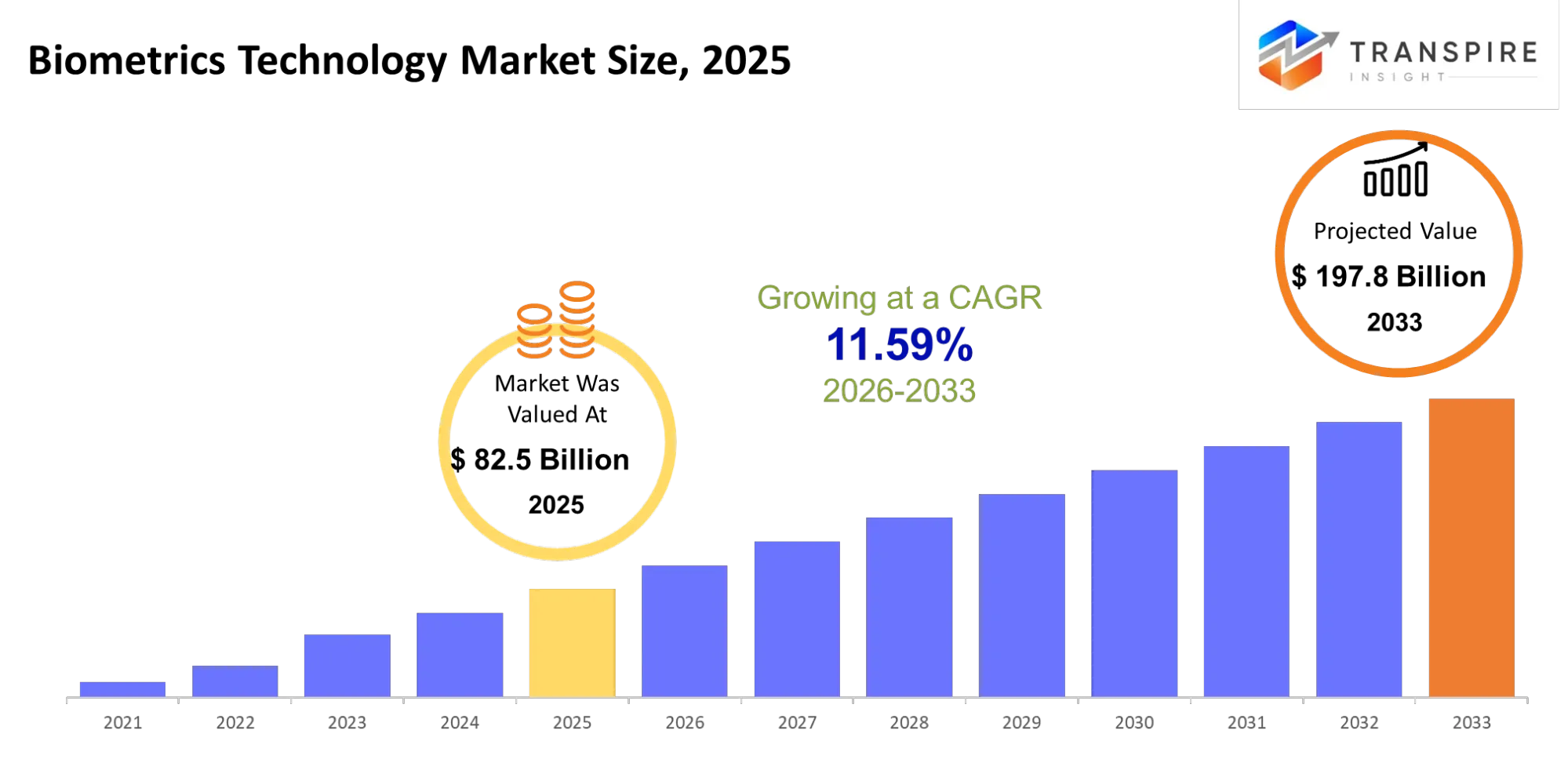
As per Transpire Insight Analysis, the Biometrics Technology Market size is estimated at USD 82.5 billion in 2025 and is anticipated to reach USD 197.8 billion by 2033, growing at a CAGR of 11.59% from 2026 to 2033.
The biometric technology industry is supporting organisations in verifying the identities of individuals. These groups use biometrics technology market tools to control who enters places like banks, government offices, hospitals and even digital apps. In the past three to five years, I have noticed that we are moving away from just using fingerprints. Now people use facial recognition, iris scans, voice checks and even how they act. This new way of doing things uses intelligence and cloud platforms to work better. This shift is changing how companies handle logins because it makes identity checks faster and more automatic. One big reason for this change is that more people are using services every single day. Because of this, there is a need for secure ways to check identities without making everyone type in long passwords or go through manual checks. The biometrics technology market is growing because companies want security. They also want to save time and handle identity checks at once without making mistakes. Since these tools are being used in both the world and online, there are many more opportunities to sell biometrics technology market hardware, software and AI services.
Biometrics Technology Market Size & Forecast:
- Market Size 2025: USD 82.5 Billion
- Expected Market Value (2033): USD 197.8 Billion
- Forecast CAGR (2026–2033): 11.59%
- Leading Region in 2025: North America
- Fastest Growing Region: Asia Pacific
- Key Company Profiles: IDEMIA, Thales, NEC Corporation, HID Global, Suprema, Cognitec Systems, Aware Inc., FacePhi, Daon, Fujitsu, Apple, Microsoft, Samsung Electronics, BioEnable, ZKTeco
Key Market Insights:
The biometrics technology market is progressing towards AI-enabled authentication and connected identity solutions. The well-established technologies are holding their ground in the market, while the behavioural biometrics market segment is experiencing growth as well.
- Fingerprint recognition is leading the market with a market share of 36% due to its usage in identity verification, access control, and authentication.
- Facial recognition has a market share of 19%. This technology is used in applications such as border security, surveillance, digital identity and contactless authentication.
- The iris recognition accounts for 17% of the biometrics market. It is used in applications where organisations need precise and reliable identity verification.
- The voice recognition market segment is estimated to have a 10% share. Businesses are becoming increasingly interested in voice-based authentication for their digital services.
- Artificial intelligence is getting more significant in the field of biometrics because it enables companies to improve recognition accuracy and automate the verification process.
- Cloud-connected biometric solutions are becoming popular as an authentication infrastructure for multi-location operations.
What are the Key Drivers, Restraints, and Opportunities in the Biometrics Technology Market?
Drivers
The market growth of biometrics technology around the world is due to the rise in the automated process of verifying identities in various industries such as government services, banking, health care, border control, and other online operations. In addition to enhancing security, the trend has reduced the time taken to verify identities as well. This has inspired various organisations to invest in biometric technology.
Restraints
The high cost of integration and compatibility issues are significant obstacles that hinder the application of biometric technology. Organisations may need to link the biometric technology system to their existing IT network, and this will make implementation difficult and costly. The issue of privacy and security, data protection and environmental recognition accuracy will influence the decision to deploy biometrics.
Opportunities
There are opportunities being presented by way of AI, cloud technology, and edge computing in the business space of biometric solutions. With AI, there could be better accuracy as well as automation of the process of identity verification, while cloud technologies can help in scaling the deployment of solutions at various locations. Behavioural biometrics is yet another opportunity.
What Has the Impact of Artificial Intelligence Been on the Biometrics Technology Market?
The use of artificial intelligence is revolutionising the biometrics technology market through faster, automated and adaptive identity recognition processes for various security environments. The use of artificial intelligence can allow the identification of biometric attributes, which include facial attributes, fingerprints, voice and behavioural traits, for automation of the identity verification and authentication process. Artificial intelligence will also increase efficiency in operations through the automation of the identity verification process. Machine learning algorithms will help in detecting patterns in biometric data, real time authentication and detection of abnormal behaviour. This will be helpful for industries in the banking sector, government sector, border security, workforce management and digital access sectors. The challenges of implementation arise due to the fact that biometric solutions through artificial intelligence require investment, system integration, high-quality data and optimisation of the model. The accuracy also depends on operating conditions
Instance
In January 2026, Incode introduced its Deepsight AI Defence technology that can identify deepfake video threats when verifying the biometric identity of an individual using facial recognition technology.
Key Market Trends:
There are new trends in the biometrics technology market that involve a transition from traditional identification solutions to connected, intelligent, and continuous authentication processes.
- Fingerprint recognition and face recognition technologies are transitioning from standard access control solutions to digital identity, banking, border security, and other mass authentication uses.
- Biometric technologies are gradually incorporating AI technologies to make automation of the identity verification process and quicken the decision-making process possible.
- Behavioural biometrics is becoming increasingly popular since organisations require continuous authentication that will identify any suspicious activity of the user without focusing solely on one-time verification at login.
- Cloud based solution is becoming a trend in biometric technology since companies need a solution that will allow scaling a biometric platform without the need to build extensive local infrastructure.
- Edge AI technology is becoming popular since processing of biometric data closer to its use point provides faster authentication and reduces reliance on the central processing of biometric data.
Biometrics Technology Market Segmentation
By Technology
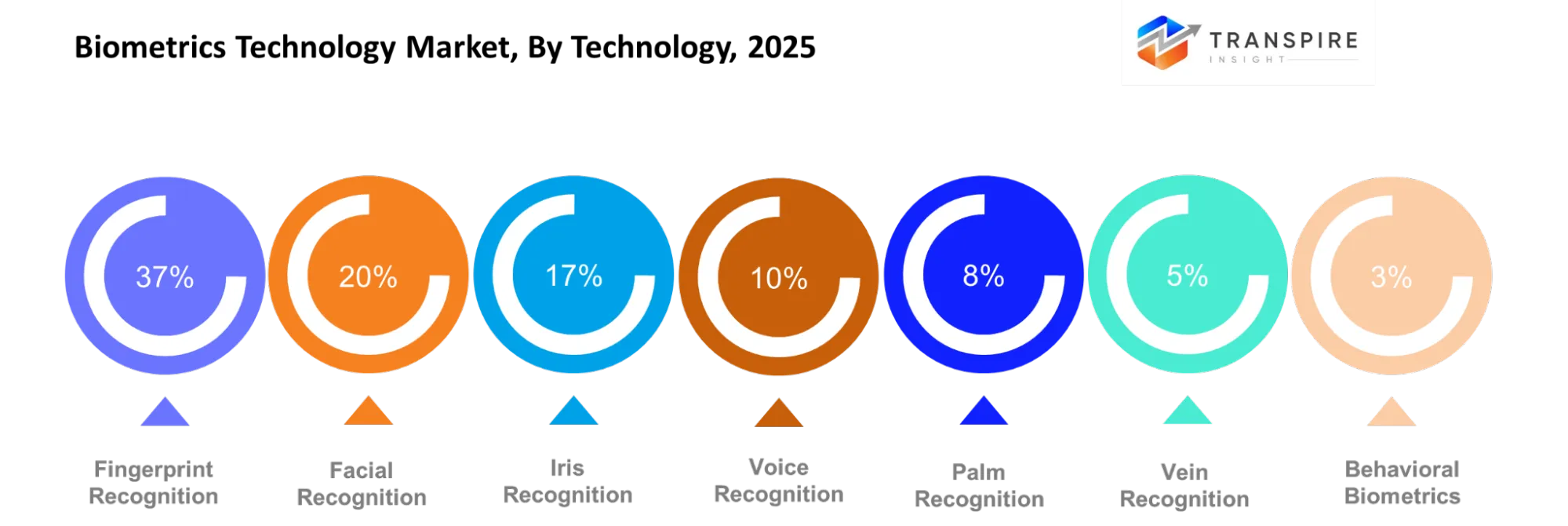
Fingerprint recognition has a dominant market share of 36%, based on its wide adoption in identity and access management processes. Facial recognition has a 19% market share and has been continuously growing in digital identity and security-related applications, while iris recognition has a 17% market share and has continued to be significant in areas requiring high accuracy. Voice recognition has a 10% market share, followed by palm recognition and vein recognition with 8% and 5%, respectively. Behavioural biometric technology has a market share of only 3% but is the fastest-growing one with a CAGR of 19.8%.
By Components
Hardware is essential since devices such as biometric readers, scanners, cameras, and others are the basic building blocks for identification systems. Software deals with biometric matching, identification, and authentication functions, while services include implementation and maintenance, as well as integration. Artificial intelligence platforms are getting more relevant for automated recognition and behaviour analysis, while cloud solutions are useful for organisations that use biometrics across many sites.
By end users
Government agencies can be categorised as another significant industry due to the usage of biometric technology to facilitate identity schemes, border security measures, and access controls. The BFSI sector is making use of biometrics to enhance customer and payment authentication processes, whereas the healthcare segment uses biometric technology for workforce and patient identification. The consumer electronics industry and retail are making use of biometric authentication technology for seamless digital experiences. At the same time, the defence sector and enterprise businesses keep applying biometrics for secure access and identity management.
By application
Identity verification is one of the essential applications of biometric technology because there is a necessity to identify individuals through certain methods. Access control helps to ensure secure entry to various facilities and systems, while border security relies on biometric identification technology to facilitate travel screening processes. Authentication of payments is becoming increasingly popular along with digital transactions, and workforce management also uses biometric identification technology to verify personnel.
By Deployment
Cloud-based solutions are becoming increasingly significant since companies have the ability to deploy biometric applications without developing any elaborate physical infrastructure. The On-Premise solution continues to work well for businesses that need total control over their biometric infrastructure, whereas hybrid deployments use both cloud and on-premises solutions together. Edge AI has emerged as a significant method for efficient biometric processing close to the point of authentication.
What are the Key Use Cases Driving the Biometrics Technology Market?
Use of fingerprints in biometric authentication still holds its importance in the international biometric technology market in such applications as access control, identification, time and attendance systems, and secure digital authentication systems. It is the robust presence of this market application that results from the use of biometric fingerprint authentication in organisations looking for accurate and convenient identification procedures. Facial, iris and voice recognition technologies are currently being used for such applications as border security, payment authentication, health care authentication, consumer electronics and digital identity. These biometric technologies help businesses minimise manual verification and speed up the process of authentication in physical and online environments. Some of the emerging applications include behavioural biometrics and AI-based biometric authentication.
|
Report Metrics |
Details |
|
Market size value in 2025 |
USD 82.5 Billion |
|
Market size value in 2026 |
USD 91.4 Billion |
|
Revenue forecast in 2033 |
USD 197.8 Billion |
|
Growth rate |
CAGR of 11.59% from 2026 to 2033 |
|
Base year |
2025 |
|
Historical data |
2021 - 2024 |
|
Forecast period |
2026 - 2033 |
|
Report coverage |
Revenue forecast, competitive landscape, growth factors, and trends |
|
Regional scope |
United States; Canada; Mexico; United Kingdom; Germany; France; Italy; Spain; Denmark; Sweden; Norway; China; Japan; India; Australia; South Korea; Thailand; Brazil; Argentina; South Africa; Saudi Arabia; United Arab Emirates |
|
Key company profiled |
IDEMIA, Thales, NEC Corporation, HID Global, Suprema, Cognitec Systems, Aware Inc., FacePhi, Daon, Fujitsu, Apple, Microsoft, Samsung Electronics, BioEnable, ZKTeco |
|
Customization scope |
Free report customization (country, regional & segment scope). Avail customized purchase options to meet your exact research needs. |
|
Report Segmentation |
By Technology (Fingerprint Recognition, Facial Recognition, Iris Recognition, Voice Recognition, Palm Recognition, Vein Recognition, Behavioral Biometrics, Others); By Component (Hardware, Software, Services, AI Platforms, Cloud Solutions, Others); By End User (Government, BFSI, Healthcare, Consumer Electronics, Retail, Defense, Enterprises, Others); By Application (Identity Verification, Access Control, Border Security, Payment Authentication, Workforce Management, Healthcare Authentication, Others); By Deployment (Cloud-based, On-premise, Hybrid, Edge AI, Others) |
Which Regions are Driving the Biometrics Technology Market Growth?
North America
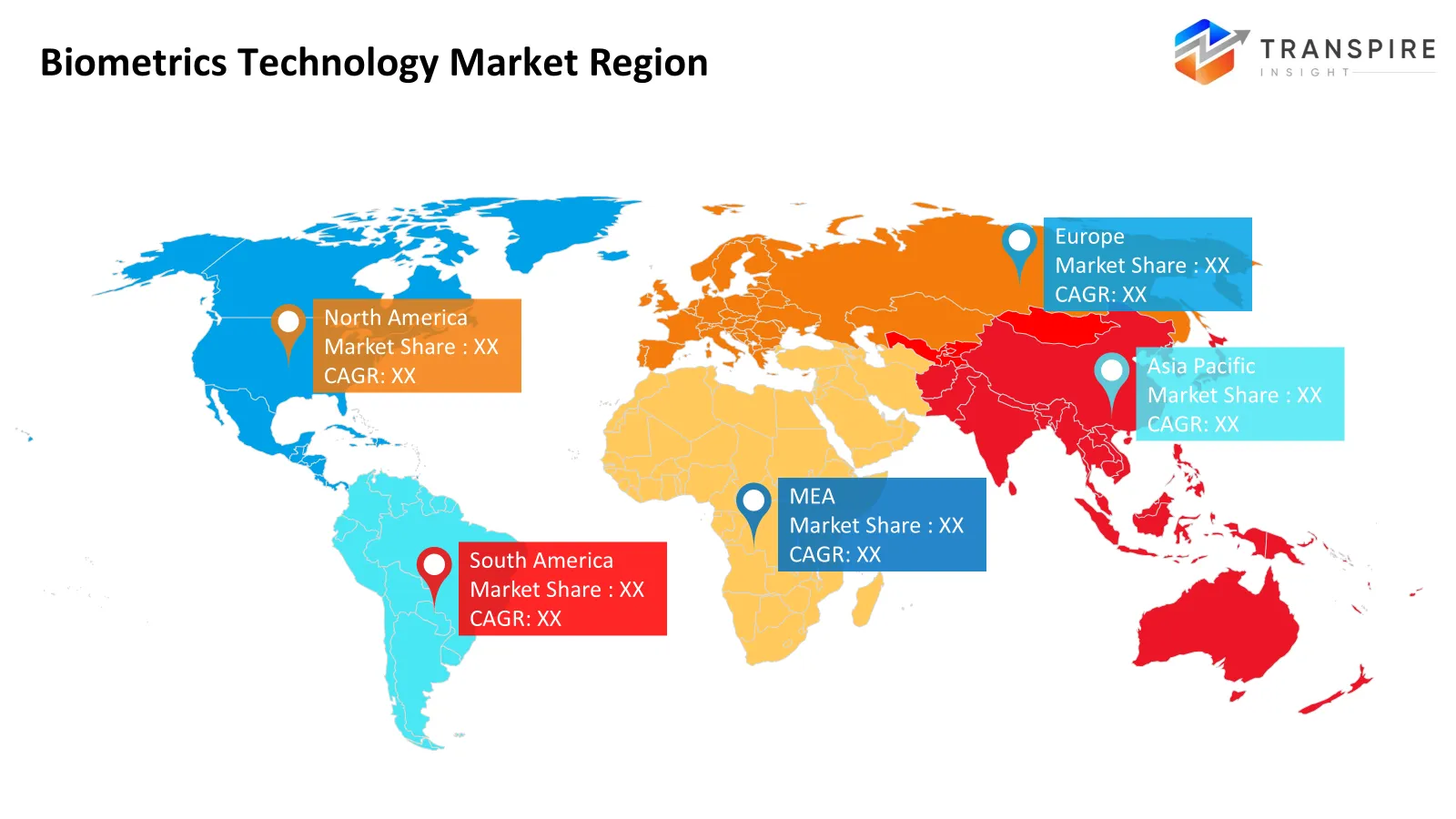
North America leads the way as the most dominant region in terms of the biometric solutions market, with a share of 40% in the market. This dominance is attributable to the advanced digital infrastructure and the use of biometric authentication technologies within the region. The government, financial institutions, organisations, and the technology industry play an instrumental role in shaping regional demand for biometric technology applications.
- In July 2026, HID enhanced its biometric product line in North America with the launch of the HID Amico face recognition readers, thereby increasing the availability of biometric access control solutions for SMBs.
https://www.hidglobal.com/products/amico?utm_source
Europe
Europe has a 24% share of the biometrics technology market worldwide and enjoys a consistent position owing to its strong technological infrastructure, along with a concentration on secure digital identification. Deployment of biometric solutions in government services, banking, health care, and enterprise security is contributing to regional demand. Regulations related to identity management and data security are impacting the use of biometric technologies.
- In August 2025, IDEMIA and Sopra Steria rolled out the go-live of the sBMS of the EU, allowing for central comparison of fingerprints and faces for European border and migration management.
Asia Pacific
The Asia Pacific region has a 29% market share and is also the highest-growing regional market at a CAGR of 21.3%. Digitalisation, the expansion of government identity programs, growing smartphone penetration, and digital financial service adoption are some of the factors that are fueling the use of biometrics in this region. The growing investments in AI-based authentication systems will offer new growth avenues for biometric solutions providers.
- In August 2025, NEXT Biometrics got its first significant production order from an Indian OEM for the company’s FAP 30 fingerprint sensors that have been manufactured to meet high security requirements for governments
Who are the Key Players in the Biometrics Technology Marketand how do they compete?
Market competitiveness among companies is high and is characterised by competition on factors like accuracy of recognition, implementation of artificial intelligence, product development and application expansion. Market competition is driven by demands from government, BFSI, healthcare, consumer electronics, defence, and enterprise sectors, where providers compete based on technology and integration capabilities. There are several strategies that providers use in order to enhance their market position. Innovation is one of them, and it is achieved by using a combination of recognition and AI technologies. Specialised solutions for applications like border security, access control, digital identity and workforce management are also provided by some companies. Another strategy of some companies involves partnership and integration of biometric solutions with cloud platforms, enabling these solutions to be applied in distributed organisations. Market differentiation increasingly relies on scalability, integration capabilities, security and multi-authentication capabilities. Providers are developing not only hardware but software, AI platforms and cloud solutions to meet customers' identity management needs.
Biometrics Technology Market companies
- IDEMIA
- Thales
- NEC Corporation
- HID Global
- Suprema
- Cognitec Systems
- Aware Inc.
- FacePhi
- Daon
- Fujitsu
- Apple
- Microsoft
- Samsung Electronics
- BioEnable
- ZKTeco
Recent Development News
In September 2025, the Neurotechnology company unveiled upgrades to its MegaMatcher biometric multimodal platform, which includes enhanced fingerprint acquisition, facial recognition, and video analysis. The upgrades increase the platform’s capabilities regarding the use of biometrics in advanced identification systems.
https://www.neurotechnology.com/press.html?utm_source
In March 2026, NEC Corporation announced that its face recognition technology secured the best score in the latest Face Recognition Technology Evaluation by NIST for 1 identification. This success reinforces NEC’s dominance in accurate face recognition technology.
https://www.nec.com/en/press/202603/global_20260309_02.html?utm_source
What Strategic Insights Define the Future of the Biometrics Technology Market?
Future trends for the biometrics technology industry indicate the transition of this type of authentication to becoming intelligent, connected, and continuous. There might be a tendency towards the convergence of biometrics, artificial intelligence, cloud-based platforms, edge computing, and digital identities in the future of the industry. The first hidden trend for the industry could be the increased difficulty of securing biometric data due to the irreversibility of compromise of this type of data compared to passwords. Furthermore, higher cost of integration, privacy regulations, and accuracy variance in different operating environments might become an obstacle for biometric adoption in organisations with insufficient technological infrastructure.
The most obvious new opportunity for the industry could be behavioural biometrics and AI-enabled continuous authentication that could allow organisations to monitor users' behaviour and detect unusual patterns. In this case, companies would be able to move their efforts from the field of access control to such sectors as financial services, healthcare, digital payments, workforce management, and border security.
Market Segmentation
By Technology
- Fingerprint Recognition
- Facial Recognition
- Iris Recognition
- Voice Recognition
- Palm Recognition
- Vein Recognition
- Behavioral Biometrics
By Component
- Hardware
- Software
- Services
- AI Platforms
- Cloud Solutions
By End User
- Government
- BFSI,
- Healthcare
- Consumer Electronic
- Retail
- Defense
- Enterprises
By Application
- Identity Verification
- Access Control
- Border Security
- Payment Authentication
- Workforce Management
- Healthcare Authentication
By Deployment
- Cloud-based
- On-premise
- Hybrid
- Edge AI
By Regional Analysis
North America
- United States
- Canada
- Mexico
Europe
- Germany
- United Kingdom
- France
- Spain
- Italy
- Rest of Europe
Asia Pacific
- Japan
- China
- Australia & New Zealand
- South Korea
- India
- Rest of Asia Pacific
South America
- Brazil
- Argentina
- Rest of South America
Middle East & Africa
- Saudi Arabia
- United Arab Emirates
- South Africa
- Rest of the Middle East & Africa
Frequently Asked Questions
Find quick answers to common questions.
The biometrics technology market size was valued at USD 82.5 billion in 2025 and is poised to reach USD 197.8 billion by 2033, expanding at a 11.59% CAGR.
Key segments for the biometrics technology market are By Technology (Fingerprint Recognition, Facial Recognition, Iris Recognition, Voice Recognition, Palm Recognition, Vein Recognition, Behavioral Biometrics, Others); By Component (Hardware, Software, Services, AI Platforms, Cloud Solutions, Others); By End User (Government, BFSI, Healthcare, Consumer Electronics, Retail, Defense, Enterprises, Others); By Application (Identity Verification, Access Control, Border Security, Payment Authentication, Workforce Management, Healthcare Authentication, Others); By Deployment (Cloud-based, On-premise, Hybrid, Edge AI, Others).
Growth is primarily driven by increasing demand for identity verification, increased use of biometric authentication in smartphones and banking applications, more government spending on identification card systems, and the need to avoid identity fraud and cybercrimes.
The market is led by major manufacturers including IDEMIA, Thales, NEC Corporation, HID Global, Suprema, Cognitec Systems, Aware Inc., FacePhi, Daon, Fujitsu, Apple, Microsoft, Samsung Electronics, BioEnable, ZKTeco.
North America accounts for 40% of the world market of biometric technology owing to widespread use of biometric security, strong technology infrastructure, huge investments in AI and identity management systems, and increasing need for authentication in governments, banks, hospitals, and airports.
The business opportunities in the biometric technology market are artificial intelligence-enabled biometric authentication, biometric payment systems, digital identity, border security, and biometric use cases for banking, healthcare, and smart devices.
- IDEMIA
- Thales
- NEC Corporation
- HID Global
- Suprema
- Cognitec Systems
- Aware Inc.
- FacePhi
- Daon
- Fujitsu
- Apple
- Microsoft
- Samsung Electronics
- BioEnable
- ZKTeco
About the Authors

Avinash Kumar
I’m Avinash Kumar, a Senior Research Analyst at Transpire Insight, with expertise in the Electronics and Semiconductor and Energy & Power industry. My work focuses on analyzing emerging technologies, market trends, industry developments, and innovation across these sectors. I specialize in transforming complex technical and market insights into clear, research-backed content that helps professionals, businesses, and decision-makers stay informed. Through continuous industry research and data-driven analysis, I strive to deliver accurate, reliable, and practical perspectives on the latest advancements shaping the semiconductor and energy landscape.

Chakradhar Khansole
Chakradhar serves as the Research Director at Transpire Insight, bringing over 8 years of experience in technology, innovation, and strategic market intelligence. He specializes in transforming complex market data into actionable business insights that enable organizations to make informed, growth-oriented decisions. Recognized for his strategic vision and analytical expertise, Chakradhar leads high-impact research initiatives, delivering comprehensive market assessments, competitive intelligence, and forward-looking industry analysis.
Recently Published Reports
-
Apr 2026
Fiber Optic Faceplates Market
Fiber Optic Faceplates Market Size, Share & Analysis Report By Type (< 300 mm2, 300-350 mm2, and > 350 mm2, By Application (Night Vision, Holographic Imaging, Medical, and Others), and Geography (North America, Europe, Asia-Pacific, Middle East and Africa, South and Central America), 2021 - 2031
-
Apr 2026
High Temperature Superconductors Market
High Temperature Superconductors Market Size, Share & Analysis Report By Type (1G HTS, and 2G HTS), By Application (Power Cable, Fault Current Limiter, and Transformer), and Geography (North America, Europe, Asia-Pacific, Middle East and Africa, South and Central America), 2021 - 2031
-
Apr 2026
Industrial Plugs and Socket Market
Industrial Plugs and Socket Market Size, Share & Analysis Report By Type (Industrial Plugs, Industrial Sockets), By Current (Up to 32 A, 32 to 125 A, Above 125 A), By Protection (Dustproof and Splash Proof, Waterproof, Explosion Proof), By End User (Heavy Industries, Oil and Gas, Chemicals and Pharmaceuticals, Power Generation, Others), and Geography (North America, Europe, Asia-Pacific, Middle East and Africa, South and Central America), 2021 - 2031
-
Apr 2026
InGaAs Avalanche Photodiodes Market
InGaAs Avalanche Photodiodes Market Size, Share & Analysis Report By Type (1100 - 1700 nm, and 1000 - 1600 nm), By Application (Missile Warning System, Muzzle Flash Detection, Wafer Defect Inspection, Laser Rangefinders, and Others), and Geography (North America, Europe, Asia-Pacific, Middle East and Africa, South and Central America), 2021 - 2031